HaysMed, part of The University of Kansas Health System, has expanded services to their cardiac program recently.
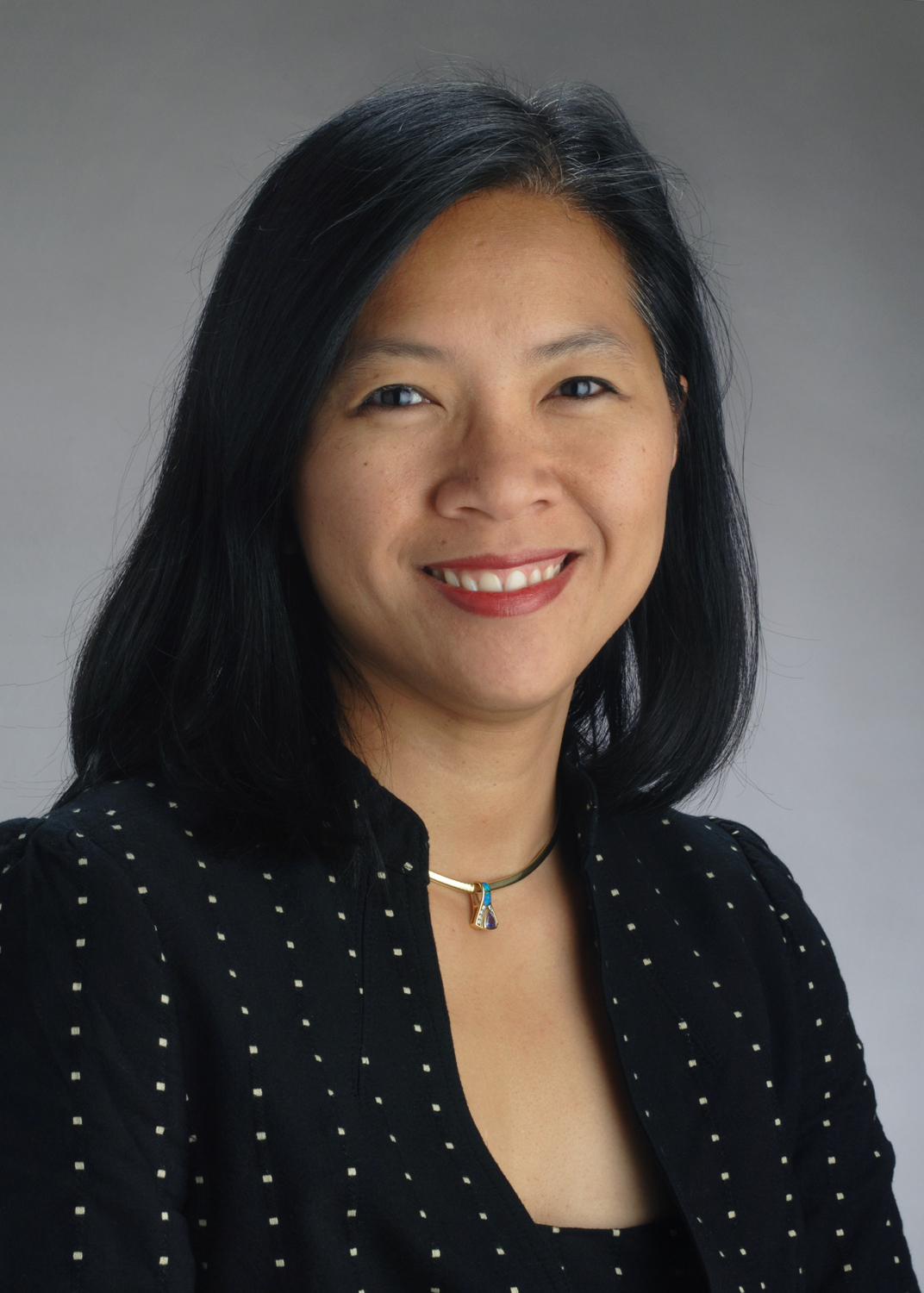
Drs. Rhea Pimentel and Madhu Reddy have been seeing patients for several months at the Debakey Heart Institute. Both physicians are electrophysiologists, cardiologists who specialize in the electrical functions of the heart.
“Our affiliation with The University of Kansas Health System has made it possible to bring these much needed services available locally,” said Bryce Young, chief operating officer at HaysMed. “We were able to make arrangements for these physicians to come to Hays on a regular basis to see patients in our heart clinic. The addition of the two electrophysiologists will help strengthen the cardiac services available at HaysMed.”
Dr. Pimentel completed medical school at Northwestern University. She did here residency at the University Hospital of Cleveland at Case Western Reserve University and a fellowship at Washington University School of Medicine.
Dr. Madhu Reddy
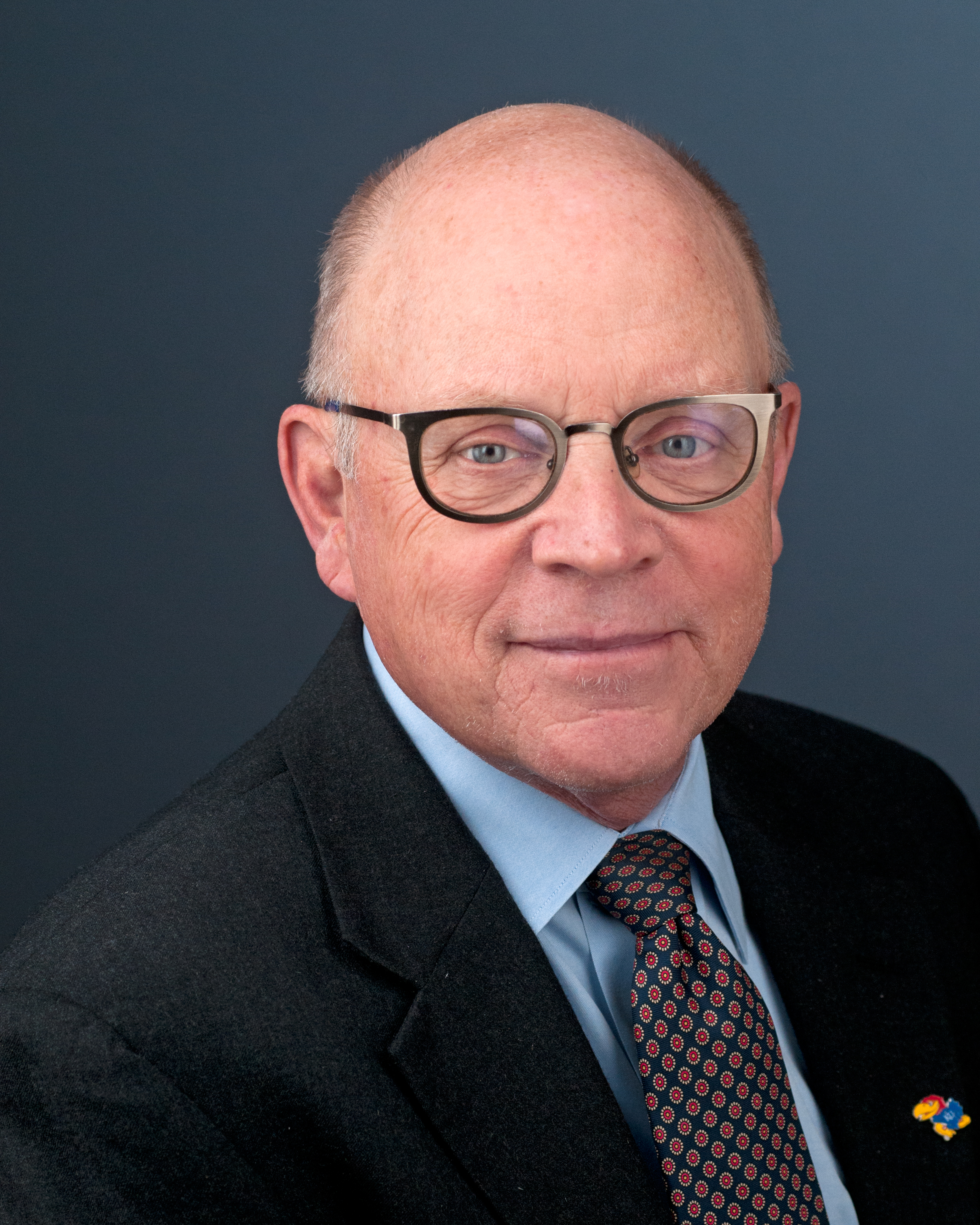
Dr. Reddy completed medical school at the Armed Forces medical College and did a residency and fellowship at Creighton University and a fellowship at The University of Kansas Medical Center.
While cardiologists typically evaluate and treat patients with heart-related symptoms, including a fast or slow heartbeat, chest pain, dizziness and other symptoms, electrophysiologists deal with the diagnosis and management of irregular heart rhythm. In most cases, when a cardiologist suspects a patient has an arrhythmia, they refer that patient to an electrophysiologist for further care.
Arrhythmia is a condition in which the heart beats with an irregular or abnormal rhythm, whether that is too fast, too slow or erratically. When the heart is unable to beat properly, it can affect blood flow, which can cause damage to or even shut down the brain, lungs and other organs. Some arrhythmias are harmless, but others can be life-threatening.
One of the most common arrhythmias that electrophysiologists treat is atrial fibrillation, also known as AFib. AFib occurs when the heart’s upper chambers—the atria—contract irregularly. AFib is the most common type of heart arrhythmia in the U.S., and it is a leading cause of blood clots that can result in a deadly stroke.
The number of people with arrhythmias is increasing and as the population ages, that number will continue to go up.
“We are excited to be able to help patients in this region with their electrophysiology needs so they can have the convenience of receiving this type of care closer to home,” said Dr. Jeffery Curtis, cardiologist and administrative director of the DeBakey Heart Clinic.
“We’re fortunate that being part of the system has given us the opportunity to have access to additional cardiologists to focus on our patients with heart rhythm problems. Any time we can partner and offer additional services for our patients it is a win-win situation. It is definitely a benefit of being part of The University of Kansas Health System.”
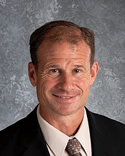
The USD 388 Board of Education Wednesday announced the selection of Corey Burton, as the new superintendent.
Burton will take the reins on July 1 after the retirement of Robert Young at the end of the 2018-19 school year.
Burton is currently serving as the Ellis JH/SH principal and has done so for 13 years.
Previously, Burton served as principal at Hillsboro Middle School and as district curriculum coordinator for USD 410 for three years and, prior to that position, he also served in Hillsboro High School as a business/computer teacher for from 1994-2003.
Q & A
Why did you want to be superintendent at Ellis?
My family and I truly enjoy living in the Ellis community and being a part of the Ellis school system. I knew that one day I wanted to be a school superintendent, and I am very happy that I will get that opportunity while staying in the community we love.
Are there any goals you have as the new superintendent?
I believe that we have a great teaching staff and excellent school system. My hope is to continue this tradition by working with staff, students, parents and the community to ensure we continue to meet our students’ needs.
What do you think the Ellis school district is doing well right now?
Providing our students (PK-12) a high quality caring learning environment.
What do you see as some of the challenges the district is facing and how would you address those challenges?
As with any western Kansas school district, I see maintaining a quality staff as a challenge. We will need to work together to ensure our staff has competitive wages and a positive work environment. We will need to be proactive in recruiting high quality staff members.
What are some of things you will take from working at the Jr./Sr. high into working in the superintendent position?
Serving in the role of Jr./Sr. high school principal for 13 years, I feel I have a pretty good understanding on how our district runs and functions. I think this will make my transition into my new role much easier.
Do you think you have good relations with teachers, how would you improve those relationships?
I do feel that I already have a good working relationship with most of the staff. I look forward to visiting with each of them to learn more about what I can do in my new role to help them in their position.
You seem to have a very positive relationship with community members, how have you built that and how do intend to maintain that?
I believe that the community knows that I care about kids and that I am committed to my job. I don’t see this changing as I move into my new role.
Our county Farm Bureau board members support Kansas Farm Bureau’s effort to ensure farmers and ranchers have access to affordable health care. We ask Kansas legislators to vote yes on Senate Bill 32. This will allow KFB to offer its members a market-based solution for health coverage while supporting local hospitals and providers.
The cost of health care benefits is a major expense for Kansas farm families. Area producers are also battling a decline in net farm income of more than 50 percent over the past five years. KFB estimates it can offer its members a robust and competitive benefit that’s 30 percent less expensive than current market options. KFB’s health benefit will offer local farmers and ranchers a cost-effective option to receive care they need in our community.
SB 32 will provide options for area farmers and ranchers who don’t qualify for subsidies under the Affordable Care Act and can’t afford spending up to $40,000 to insure their family.
KFB’s health benefit will offer farmers and ranchers a cost-effective option to receive care they need in the communities where they live.
We strongly ask the Kansas Legislature to allow KFB to offer this coverage to its members.
Ellis County Farm Bureau President Matt Grabbe
Trego County Farm Bureau President Gerald Riedle
Rooks County Farm Bureau President Anna Luna
Russell County Farm Bureau President Gerald Machin
Gove County Farm Bureau President Kassie Remington
Rush County Farm Bureau President Maureen George
Barton County Farm Bureau President Jerry Morgenstern
Ness County Farm Bureau President Lauri Petersilie
OBERLIN — The Decatur County Sheriff’s Office has announced an arrest after a series of burglaries across several counties in Kansas and Nebraska.
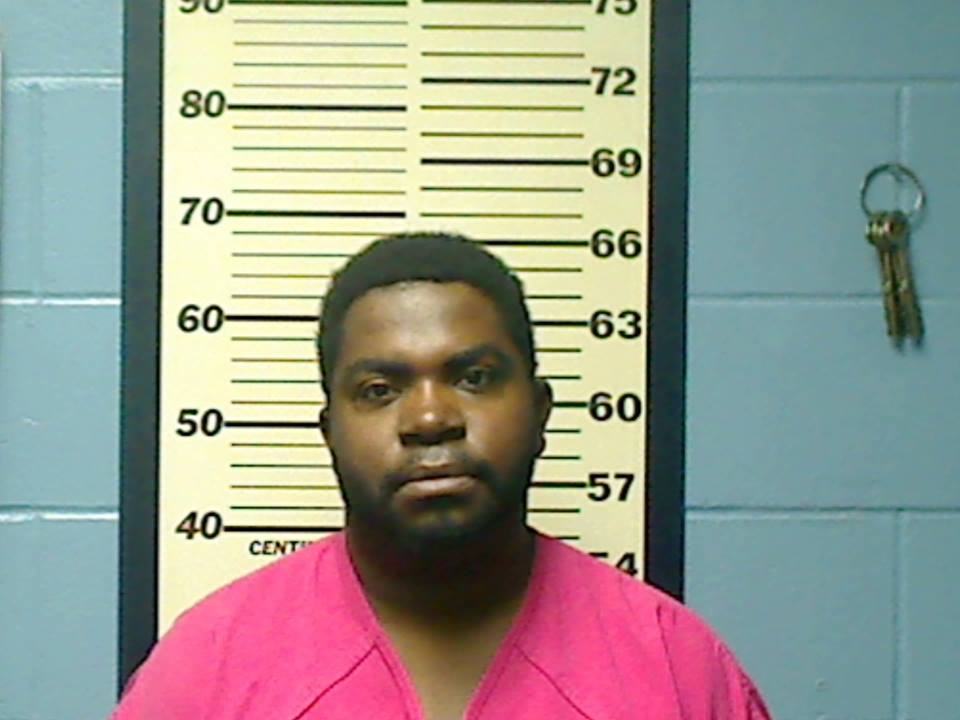
The department reported Thursday that Nathan Sunblade was taken into custody Wednesday by the Norton Police Department on a Decatur County warrant.
He was arrested on suspicion of six counts of felony burglary and two counts of theft. He remains held at the Decatur County jail on a $50,000 bond.
“I would like to thank the Norton Police Department and the Norton County Sheriff’s Office for their assistance with this investigation,” the department said in a release on social media. “We anticipate several other arrests in these cases.”
The Kansas Legislature opened its 2019 session on January 14. It will most likely close up shop sometime in May. Governor Laura Kelly came into office with a well-defined agenda, and lots of optimistic Democrats foresaw school funding increases and Medicaid expansion moving through the legislative process.
Burdett Loomis, Professor, Political Science, College of Liberal Arts and Science, University of Kansas
Conversely, conservative Republican leaders in both chambers, their numbers buttressed by the same electorate that decisively chose Kelly over Republican Kris Kobach, have made aggressive opening moves to return the so-called “windfall” from 2017 federal tax changes back to a select number of Kansas families and corporations who may pay increased state taxes.
Meanwhile, Kansas tax revenues have fallen substantially ($49 million) below estimates for January. No one knows if that is a hiccup or the start of a trend, but it does signal a possible problem for either increased spending or reduced taxes.
And that’s just it. Legislative sessions are not sprints, they are four-month marathons, often culminating in omnibus budget packages and other deals that address a multitude of issues under severe time constraints. This comes as no surprise. Still, every legislative session is different, and sometimes, as in 2019, it will take some time just to understand where power lies and when it can be used.
Crucial here, for both Republicans and Democrats, is to determine what is the three-party breakdown of conservative Republicans, moderate Republicans, and Democrats. Although numbers will shift from issue to issue, some rough breakdown will allow Governor Kelly and legislative leaders to assess what kinds of bills can pass through the Legislature and win her signature.
The Senate’s initial salvo, passing a $191-million “windfall” tax reduction, demonstrated that the GOP-dominated Senate likely has no automatic veto-override majority of 27 votes; nor will the House. That established, the legislative process can continue, although we should not expect much in the way of short-term results. As time passes, we will get the February and March revenue reports and then, in early April, a new set of revenue estimates. Only then, perhaps, will the actual outlines of major policy decisions become clear, despite the “deadline” of April 15 for both sides to respond to the Supreme Court’s school finance decision.
All this does not mean that the Legislature will not be busy, and potentially productive, over the next couple of months. A host of younger legislators, mostly House Democrats, are eager to make their mark, with their proposals on discrimination, on spousal abuse, and other issues; likewise, legalizing medical marijuana is on the agenda, and sports betting may be.
As lawmakers address these issues, with committee hearings and, eventually, floor votes and some attempted veto overrides, legislative leaders will form a better sense of what this year’s version of the Legislature will finally look like.
Ultimately, the dual realities of a Democratic governor’s veto pen and the more conservative nature of both House and Senate will define what policies merge from the Legislature. Most likely, we will see end-game legislating and close votes that will determine what Kansas does on taxation, Medicaid expansion, and adding funds for school finance.
Recently, GOP senators, per the Kansas News Service, have challenged Laura Kelly’s political strength and her toughness. Let’s be clear, her political strength comes from her ability to veto legislation and hold her troops together to prevent overrides. Her toughness? Ha. This is a legislator who has served in the minority for 14 years and has learned all the ropes. Beyond that, she decisively defeated Mr. Macho Machine Gun in the governor’s race. She’s tough, it she’ll need all the support and all the toughness she can muster to prevail as the legislative calendar turns to May.
Burdett Loomis is an emeritus professor of political science at the University of Kansas.
From 10:30 a.m. to 2 p.m. Thursday, Feb. 28, there will be a community-wide baked potato bar at the Trego County Hospital’s Hamilton Room. Freewill donations will be accepted, with all proceeds benefiting the fire department.
The event is sponsored by Trego County-Lemke Memorial Hospital. For more information, visit click HERE or call (785) 743-2182.
With a $95,000 grant from the Dane G. Hansen Foundation, Logan, the Department of Social Work at Fort Hays State University is expanding its Bachelor of Social Work cohort program to Colby Community College and, through Colby’s outreach program, to Norton.
The grant will help fund three years of operations at Colby, beginning in the fall 2019 semester.
The Fort Hays State cohort program began as a creative way to begin correcting shortages of Licensed Bachelor’s Social Workers (LBSWs) in rural Southwest Kansas.
In the program, the Department of Social Work partners with local community colleges to enable students to complete Bachelor of Social Work degrees after earning an associate’s degree through the local college. The local community college then provides a location for FHSU to teach the core social work classes on site.
“This provides an option for western Kansans to earn an FHSU Bachelor of Social Work degree, fully accredited by the Council of Social Work Education, in their local communities,” said Dr. Tim Davis, chair of FHSU’s Department of Social Work.
The department currently has cohorts at Garden City Community College, Dodge City Community College and Seward County Community College, Liberal.
Classes, evening and online, are completed over a three-year period. Students take courses from both core faculty members at FHSU and local professional social workers serving as adjuncts. A full-time cohort coordinator is hired to provide for student recruitment, advisement, and to coordinate the ongoing needs of an offsite location, said Davis.
Students in a cohort start and go through the three-year cycle together. FHSU commits to provide all three years of cohort education on site so that students who start can also finish in the same location.
“We are seeking legislative funding for another location,” said Davis. “If this is granted, we will have funding for additional cohorts, taking the BSW program online and launching a Master of Social Work program focused on training Clinical Social Workers to meet the need for well-trained mental health practitioners in our service area.”
Davis said the clinical nature of the master’s program is especially important because there is no clinical MSW program in Western Kansas.
“Only around 4.5 percent of clinical social workers in the state are in Western Kansas,” he said, “and there is an increasing need for mental health practitioners and not enough out here to meet that need.” He cited as particular factors the growing national opioid crisis and the increasing suicide rates in rural areas
Three other sites are also being considered for cohorts, one in north-central Kansas, another in the south-central part of the state and one in the northeast.
The BSW cohort model has been operated successfully in Southwest Kansas since 2006. They were designed to be delivered in the local community so that non-traditional students and students who were established and committed to their home communities would be able to complete their degrees and maintain their community roots.
“The first three Garden City cohorts graduated 30 BSW students, the majority of whom have remained in Finney County to practice,” said Davis. “These students now make up over half of the LBSWs in the county.”
The Dodge City cohort currently has 13 students who will graduate in 2019 and, said Davis, this graduating class will more than double the number of LBSWs currently in Ford County.
The Liberal cohort, with eight students, was requested by local child welfare agencies who could not fill open professional positions. If all eight finish, said Davis, this class will more than double the number of LBSWs in Seward County.
There are added expenses associated with providing a program in a location distant from the university. The SWKS programs were made possible in part by a fund created by the Kansas Legislature called AccessUs. This fund provides for student scholarships and administrative costs but is restricted for use in Southwest Kansas.
“The need for social workers is also apparent in Northwest Kansas, but it is difficult to operate a cohort program without external support,” said Davis.
The Hansen Foundation grant will be used in a manner similar to the AccessUS funds, said Davis. Students will receive scholarships of $100 per credit hour for the 60 hours of upper division courses taken from FHSU, and funds will also support some expenses such as travel and field trips.
Davis said that Northwest Kansas students have the option of getting a BSW degree at FHSU in Hays, but students who come to Hays often do not return to their home communities.
“In the entire Hansen Foundation service area, there are 166 LBSWs,” said Davis. “The majority of these are concentrated in Ellis and Saline counties.” Of all 1,741 LBSWs in the state, only about 11 percent live in Western Kansas.
The Hansen Foundation’s service area is the 26 counties stretching from Cheyenne down to Wallace County, east through the top three tiers of counties and then into the eight-county block from Jewell and Republic down through Ellsworth and Saline.
“Many rural counties in Northwest Kansas do not have a single practicing LBSW, and 17 counties in the Hansen service area have three or fewer practicing licensed social workers,” said Davis.
The need, he said, extends to the field of addiction counseling. LBSWs who graduate from FHSU can be licensed as addictions counselors (LACs) without taking any additional classes. The Hansen service area has only 57 LACs, and only 16 of those practice outside Ellis and Saline counties.
The lack exists elsewhere also, he said. East of I-135, a 21-county triangle from Rice County to Atchison and Doniphan and north to the Nebraska line is similarly underserved. Jewell County, for instance, has only 1 LBSW and no LACs. Doniphan has two LBSWs and zero LACs. Lincoln County has neither an LBSW or an LAC. Eight of the 21 have zero of one or the other.
“The need is there,” said Davis. “We are exploring every avenue we can imagine to meet that need.”
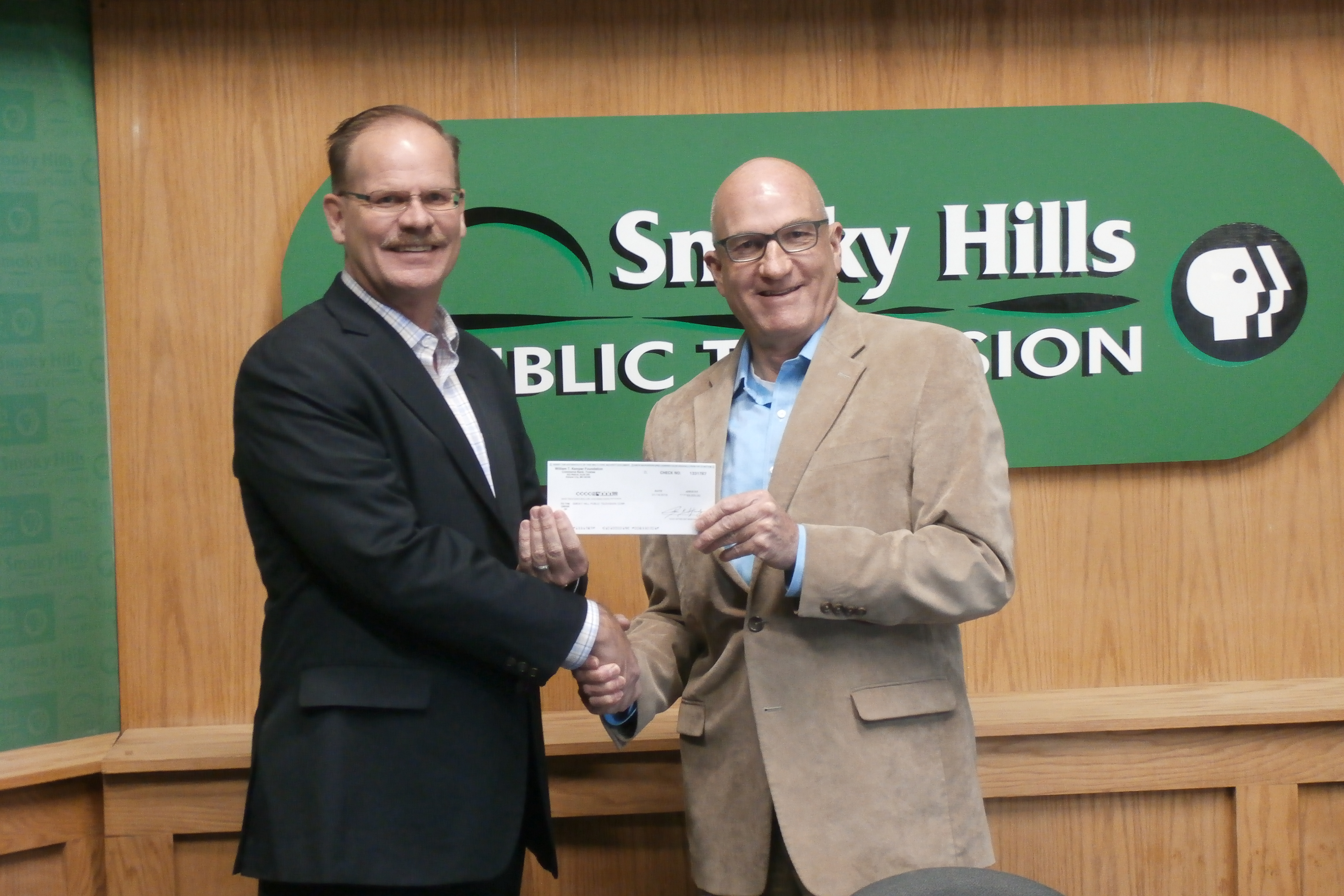
From left to right): Deron O’Connor, president of the Hays Commerce Bank, presenting a $10,000 check to Larry Calvery, SHPTV’s general manager.BUNKER HILL — The William T. Kemper Foundation – Commerce Bank, Trustee, and the Commerce Bancshares Foundation has awarded SHPTV a total of $10,000 in grants to support Smoky Hills Public Television’s video server replacement project.
“We cannot thank the William T. Kemper Foundation and Commerce Bancshares Foundation enough for their show of support for Smoky Hills Public Television,” said Larry Calvery, SHPTV’s general manager. “With a new server, we can continue to bring local productions to our viewers, close-to-home programming that is important to them. The funds from the William T. Kemper Foundation and Commerce Bancshares Foundation help us to continue our mission of providing quality programming and educational resources to all of western Kansas.”
The William T. Kemper Foundation, established in 1989, honors Mr. Kemper’s lifelong interest in improving the human condition and quality of life. The Kemper Foundation focuses its giving on education, health and human services, the arts and civic improvements.
Western Kansas Human Resource Management Association will hold its monthly meeting from noon to 1 p.m. March 13 at the Robbins Center (Eagle Communication Hall), One Tiger Place.
Registration is from 11:15 to 11:30 a.m., with a short business meeting starting at 11:30 a.m.
The program for the March meeting will be “Legal and Regulatory Updates” presented by Michael Smoots, Qualified Plan Advisors. The program will be submitted for SHRM continuing education credits. WKHRMA members can RSVP at wkhrma.shrm.org.
The deadline to RSVP is noon on March 8. WKHRMA is an affiliate chapter of SHRM (Society for Human Resource Management), a local professional organization for persons engaged in personal or human resource management. For more information on WKHRMA, visit wkhrma.shrm.org.
Thursday Mostly sunny, with a high near 54. Breezy, with a north northwest wind 7 to 12 mph increasing to 15 to 20 mph in the afternoon.
Thursday Night A 20 percent chance of snow after 1am. Increasing clouds, with a low around 20. North wind 9 to 15 mph becoming east northeast after midnight.
Friday A 50 percent chance of snow, mainly between 7am and 1pm. Cloudy, with a high near 26. East wind 8 to 10 mph. New snow accumulation of less than one inch possible.
Friday NightA 20 percent chance of snow before 7pm. Mostly cloudy, with a low around 15. East wind around 8 mph.
Saturday Mostly cloudy, with a high near 31.
Saturday NightA slight chance of snow between 7pm and 1am. Mostly cloudy, with a low around 18. Chance of precipitation is 20%.
Farmers, come and join us for a “Weed Control Update for Field Crops” program featuring K-State Research & Extension Weed Control specialists Dallas Peterson and Vipan Kumar on Tuesday, February 19 in Hays at the K-State Agriculture Research Center, 1232 240th Ave.
Topics of discussion will be weed research in western Kansas, herbicide resistant weed management, and weed control updates for field crops. As always, there will be time for your questions and answers.
Continuing education units for Certified Crop Advisors & Commercial Applicators are available.
Registration begins at 8:30 a.m. with the program kicking off at 9 a.m. and concluding at 12 noon with a complimentary lunch.
RSVP is requested for the meal count by Friday, February 15. Call the Cottonwood Extension Office in Hays at 785-628-9430 or email Theresa [email protected].
TOPEKA – Governor Laura Kelly joined Kansas Secretary of Transportation Julie Lorenz to announce the Kansas Department of Transportation’s (KDOT) plans to invest $160 million in revenue that is included in the Governor’s FY 2020 budget for transportation.
The $160 million comes from reducing the amount of money transferred out of the State Highway Fund. Since 2011, approximately $2 billion has been transferred out of the State Highway Fund, causing costly project delays, reduced highway preservation work, a decline in the health of our highway system and an inability to plan for future projects.
“With this $160 million in revenue, we will strengthen our highway system, take steps towards completing T-WORKS, and provide resources to communities across the state,” said Governor Laura Kelly. “These are important steps forward, but to be clear, we still have a long way to go in order to get our transportation system where it should be.”
With the $160 million in FY 2020, KDOT will:
Increase the highway preservation investment from $350 – $400 million
Move forward with four delayed T-WORKS projects:
o US-54 in Seward County (Expansion project; let for construction Fall 2019)
o US-169 in Anderson County (Modernization project; let for construction Fall 2019) o US-281 in Russell County (Modernization project; let for construction Spring 2020)
o US-50 in Lyon County (Expansion Project; let for construction Spring 2020)
Reinstate the Kansas Local Bridge Improvement Program
Implement a new cost-share program for state/local partnerships
Enhance its safety program
Increase City Connecting Link maintenance payments
Increase funding for modal programs (e.g., transit, aviation, rail and bike/pedestrian)
These investments begin to implement the recommendations from the Joint Legislative Transportation Vision Task Force that met last year.
“We look forward to working with communities and our partners across the state to deliver these investments,” said Secretary Julie Lorenz. “We know that funding reductions have impacted the health of our system. I’m so pleased to work with Governor Kelly to take this important step forward to achieving the goals the task force laid out and improving our state’s transportation system.”
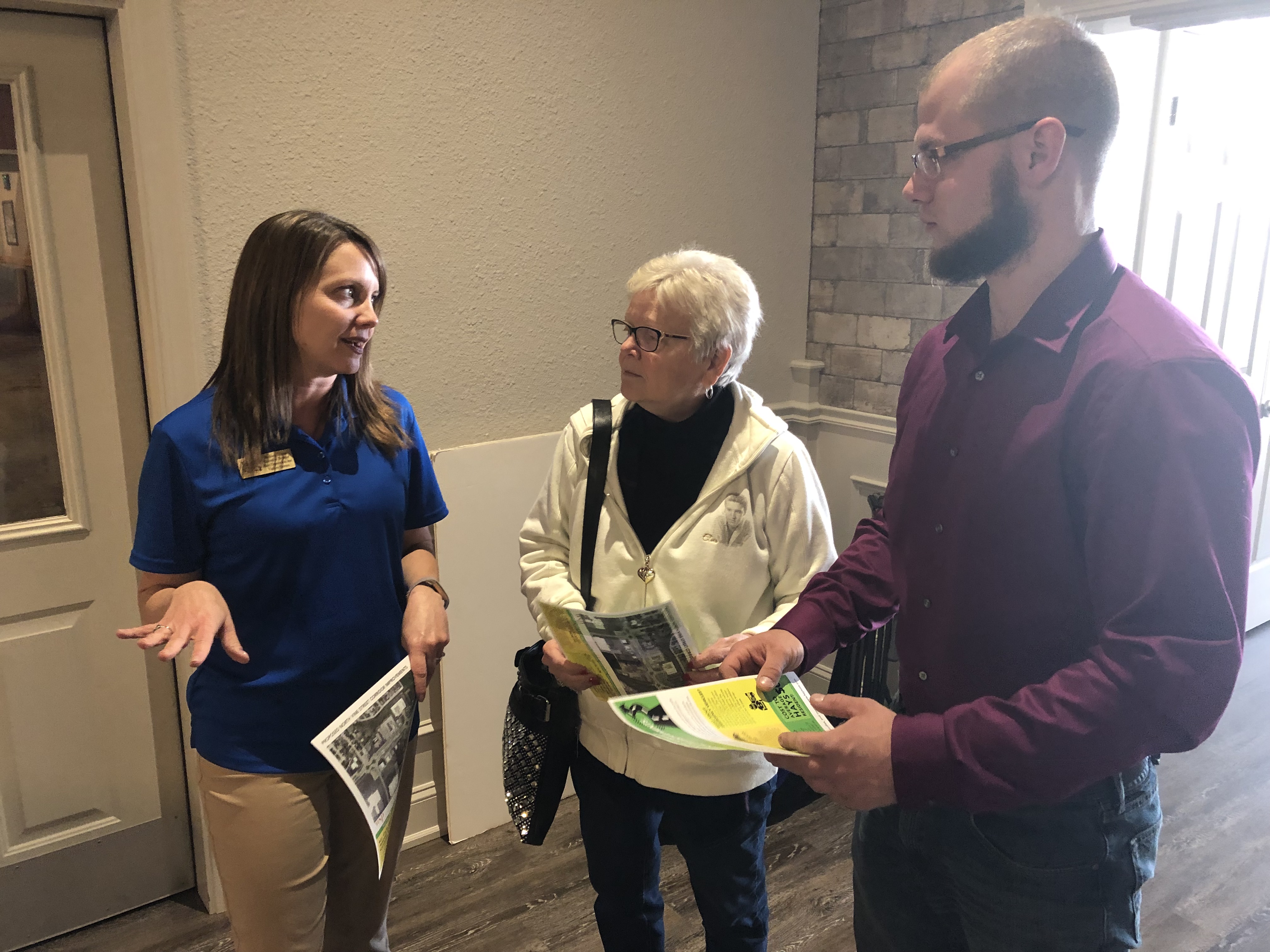
The city of Hays hosted an information session Tuesday night about the proposed North Vine Street Corridor Improvement Project.
By BECKY KISER Hays Post
Within the first 15 minutes, 80 people gathered Tuesday night for the city of Hays’ open house to see the design concept for four proposed traffic roundabouts on north Vine Street.
They were greeted — and counted — by Melissa Dixon, executive director of the Hays Convention and Visitors Bureau.
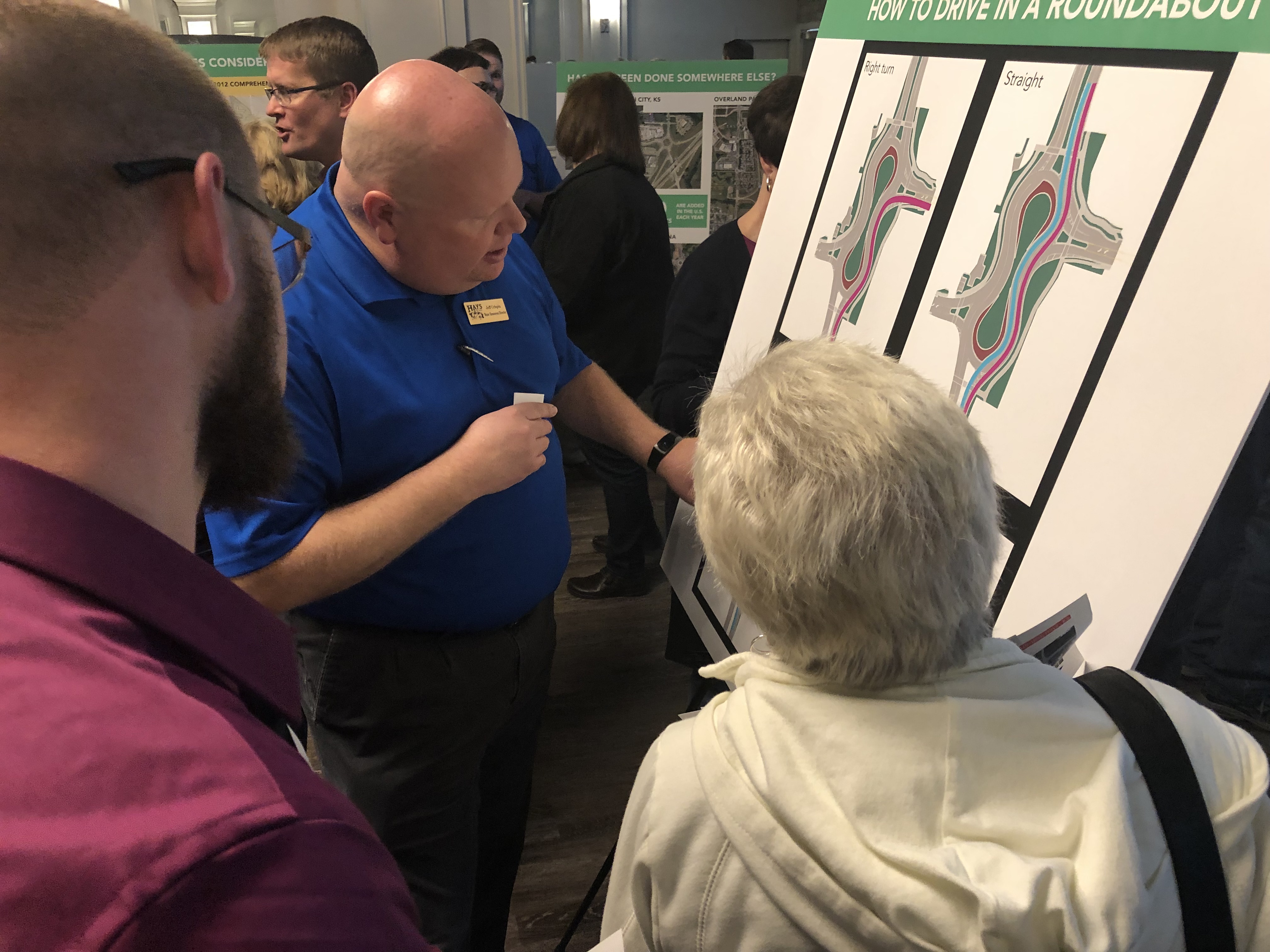
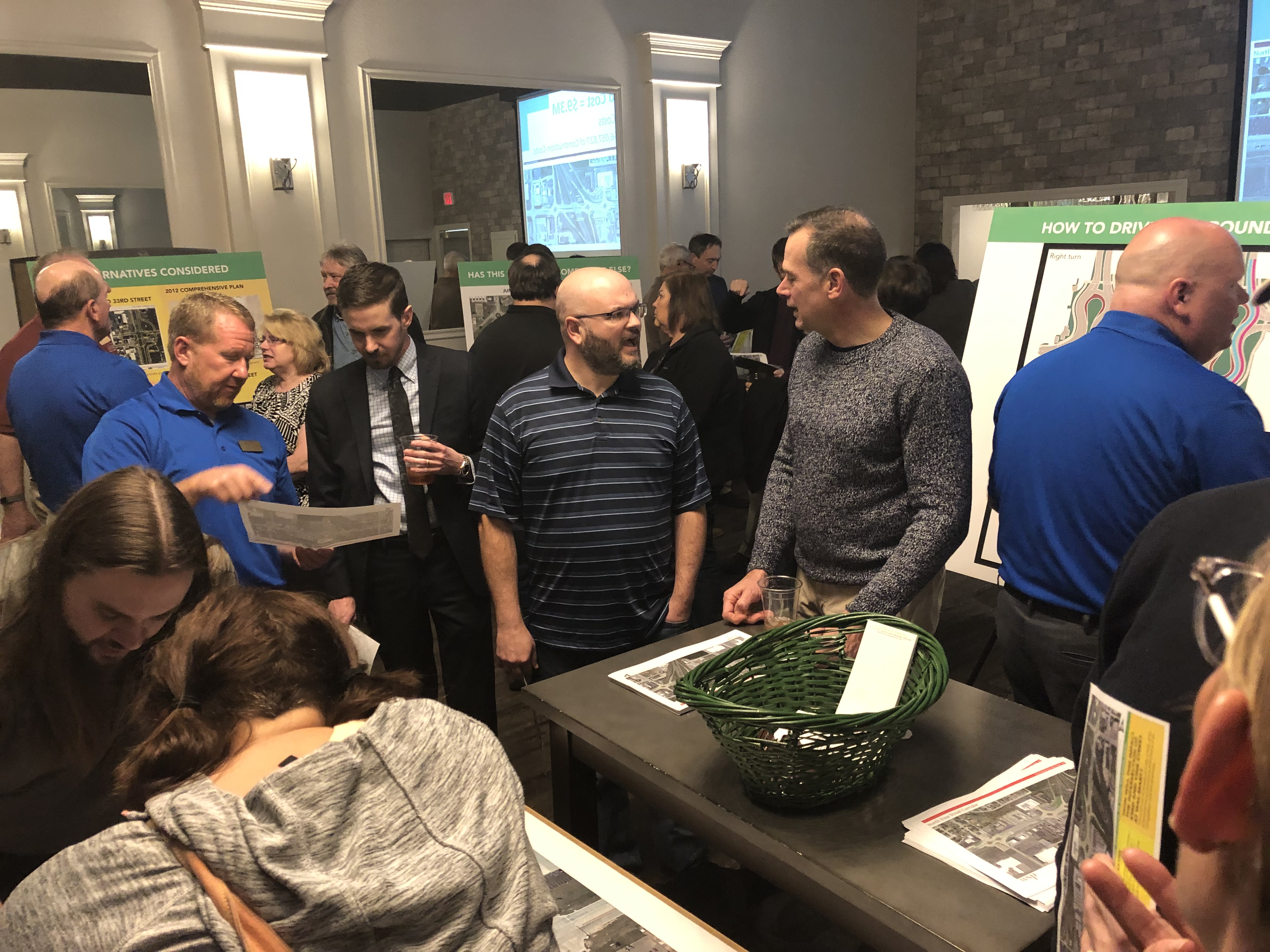
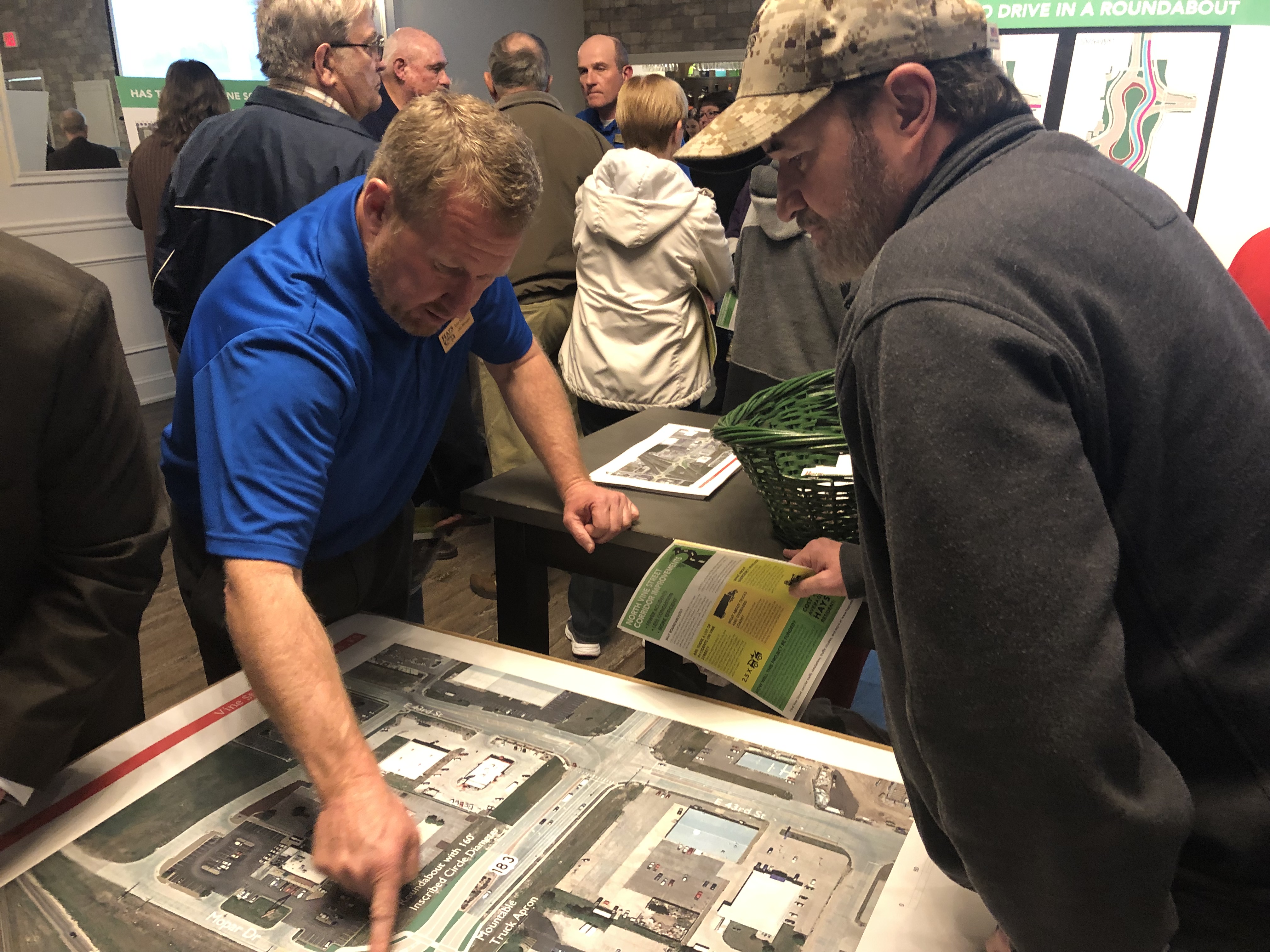
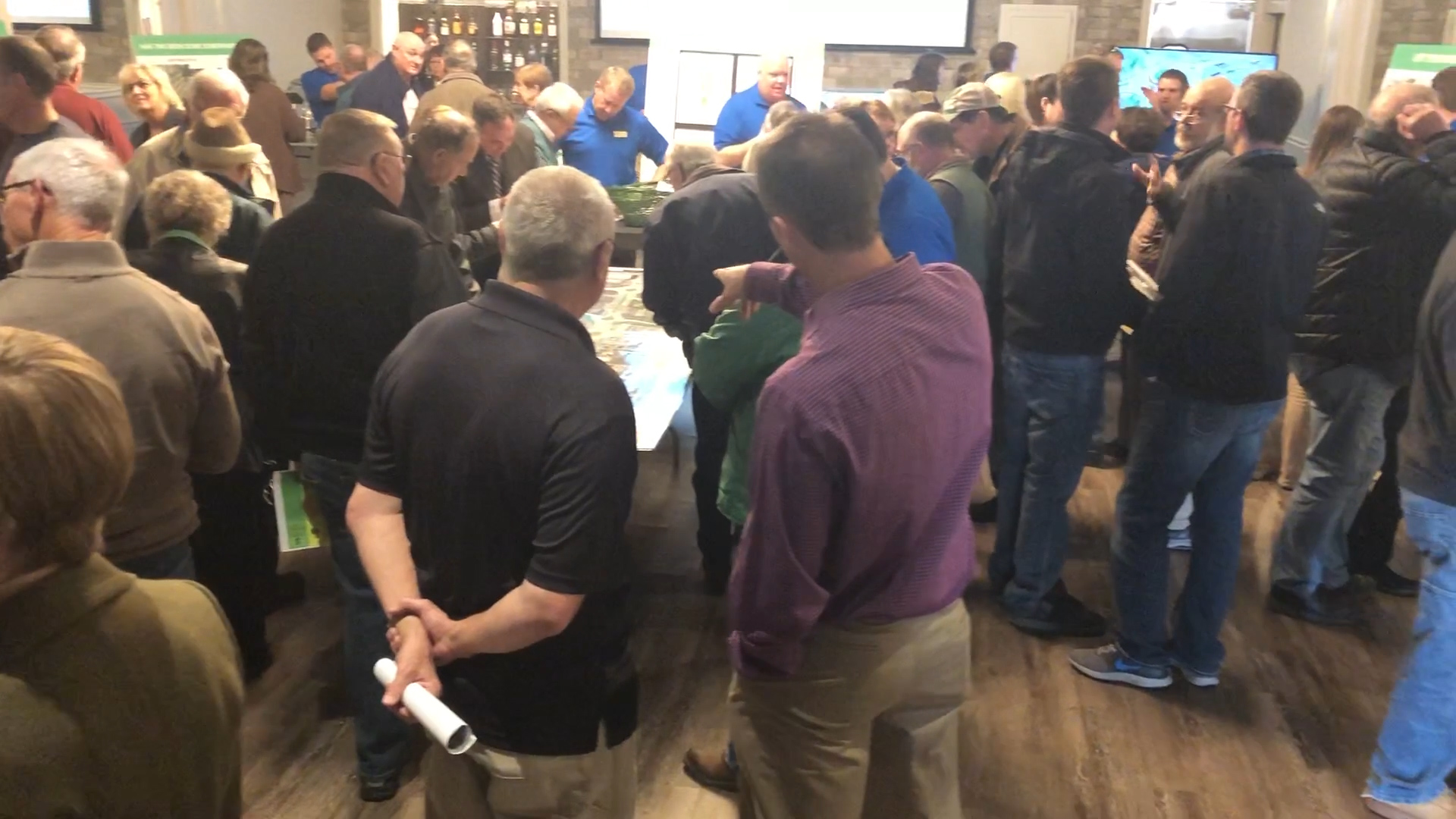
More than 200 people attended the two-hour event at The Venue in Thirsty’s Bar & Grill, where city staff, wearing bright blue polo shirts, were on hand along with project engineers from WSP and the Kansas Department of Transportation to answer questions from the public.
“I was hoping for a good turnout,” said James Meier, city commissioner, “but this is better than I expected.” Meier, who favors the roundabouts, said he hoped the information “alleviates some fears” residents might have.
Mayor Henry Schwaller said he talked to more people opposed to the project than in favor of it.
“This gives everyone a chance to see what the project will probably look like and how it works. This is a design. It’s not been approved,” he said.
Schwaller has said previously he is a “roundabout skeptic.”
He agreed the situation at 32nd and 33rd streets creates the most dangerous intersection in the city and “something has to be done.” Schwaller also sees a problem at 37th Street, where the former Ambassador Hotel was located.
“We can’t put a stoplight there. The Kansas Department of Transportation won’t allow us that,” he said.
The rest of the proposed project is too big to work, Schwaller said, “particularly for visitors coming from out of town. Getting through that gauntlet can be pretty daunting.”
Still, Schwaller concedes the city commission will “go for what the majority wants.”
RELATED: Hays Post conducted two polls, one on HaysPost.com and the other on Facebook, asking the public for their opinion of the proposed north Vine Street improvements.
The city is still waiting for final design on the project. Preliminary design is expected to be completed in March with a final design in November, according to John Braun, the city’s project manager. Bid opening would begin in April 2020 with construction planned to start in June 2020. The work is scheduled to be finished in November 2021.
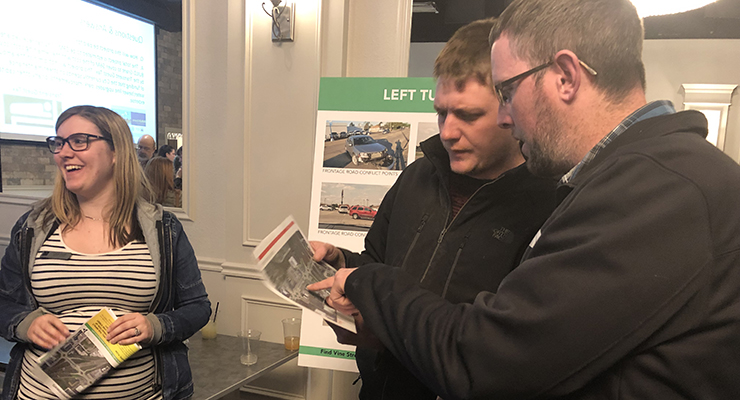
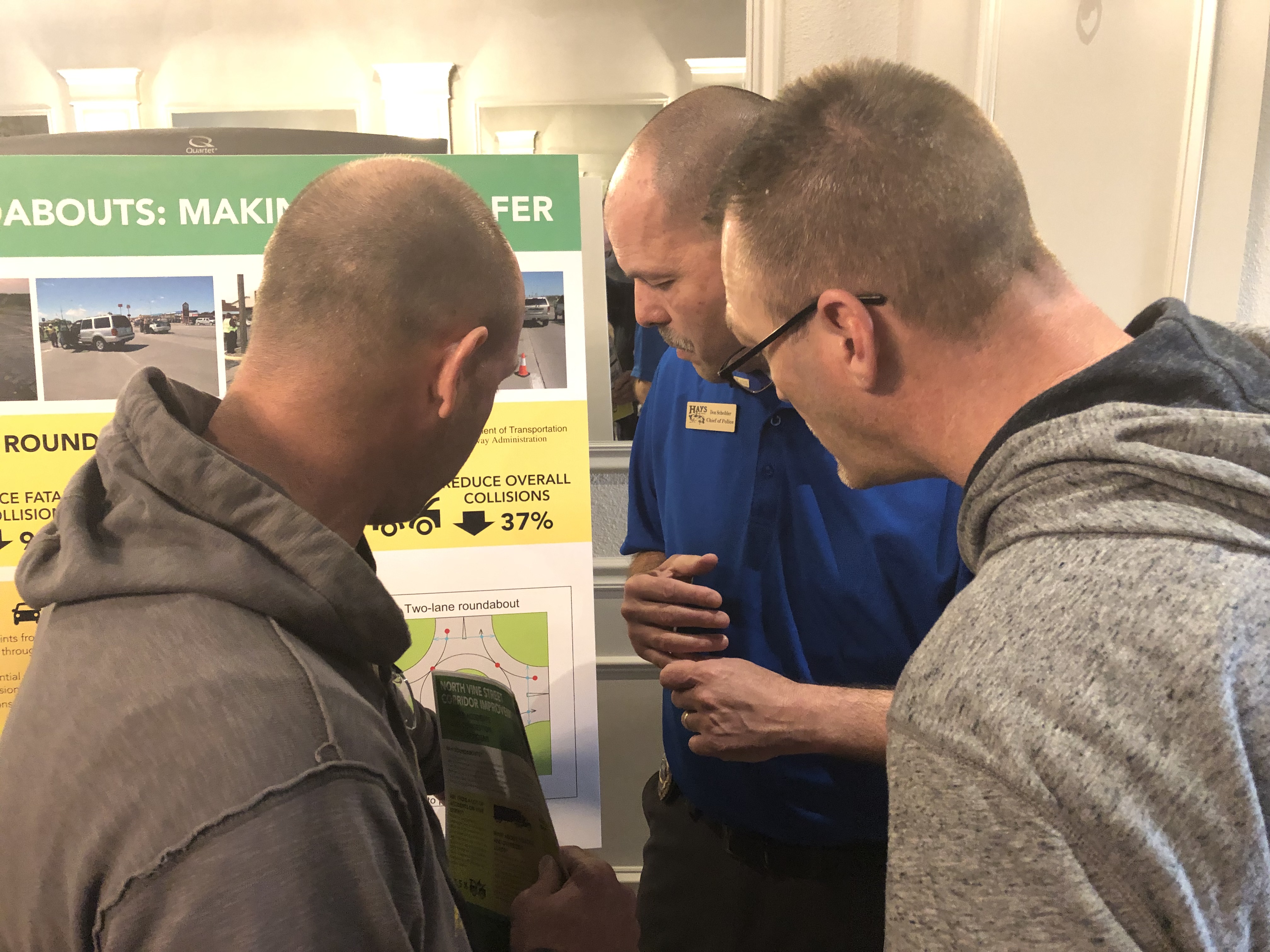
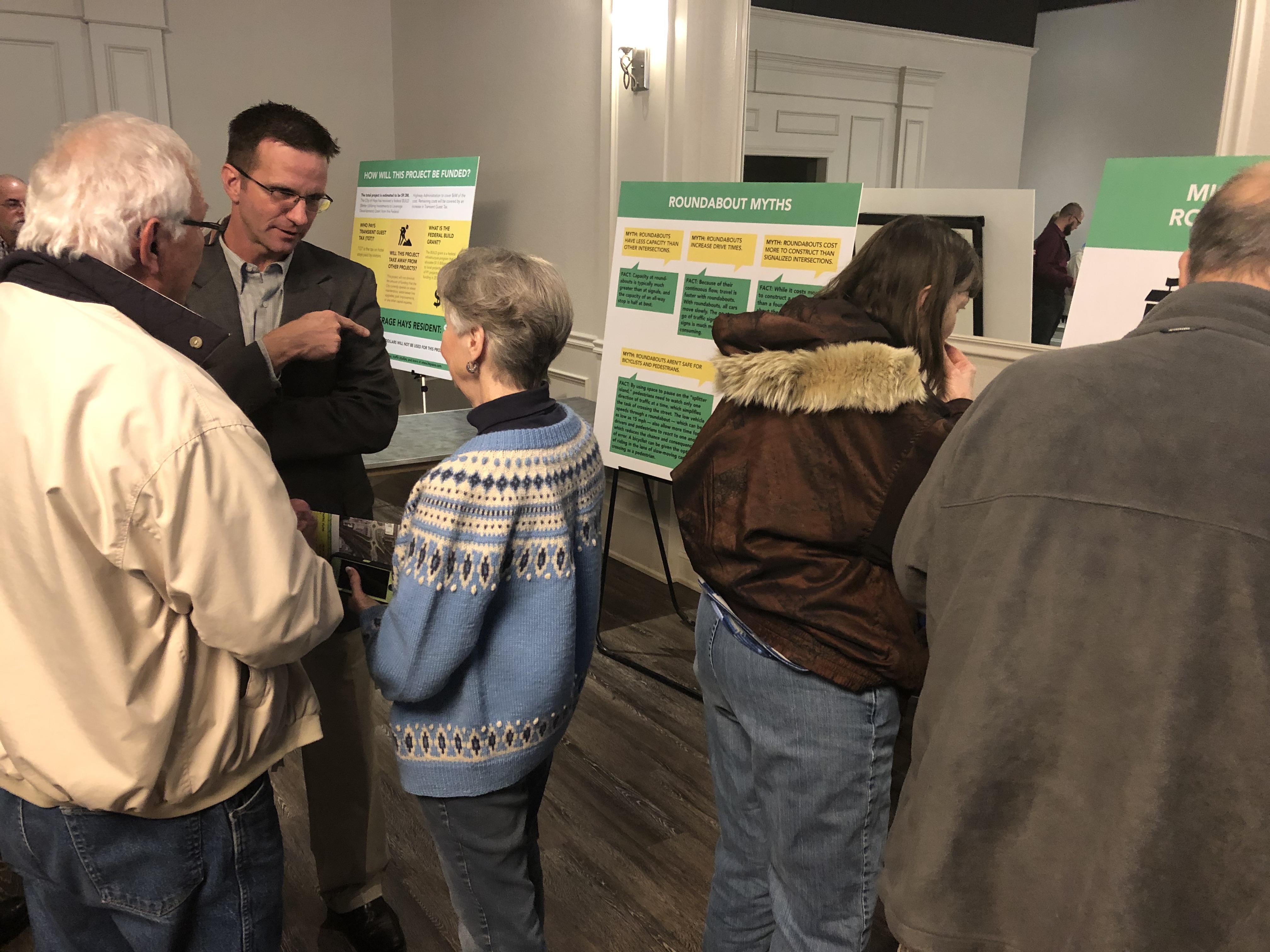
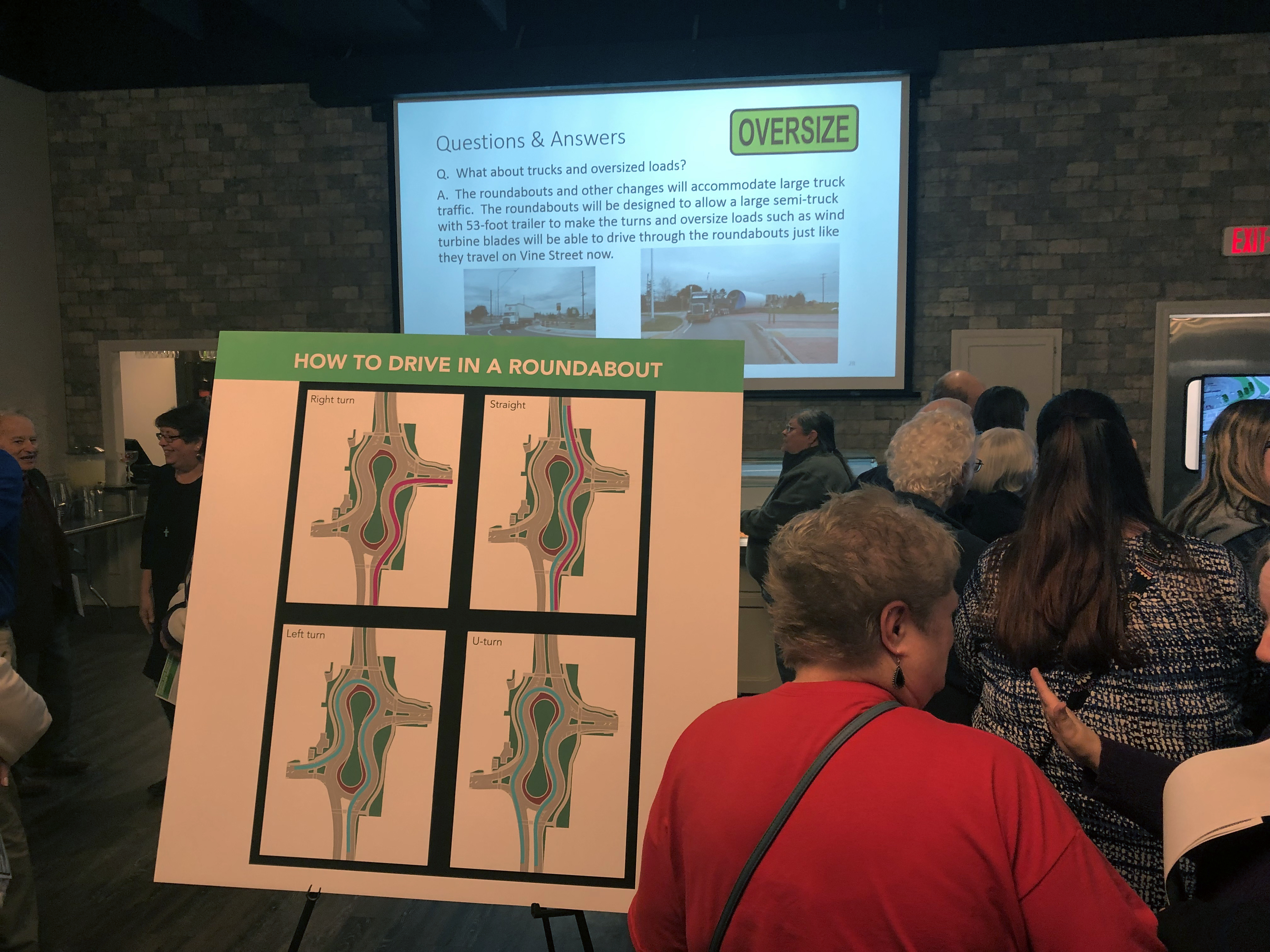
The conversation was non-stop in the meeting room. Posters depicting often-asked questions and the answers were set up on easels around the room perimeter. One poster showed four previous design plans to improve safety which were all rejected.
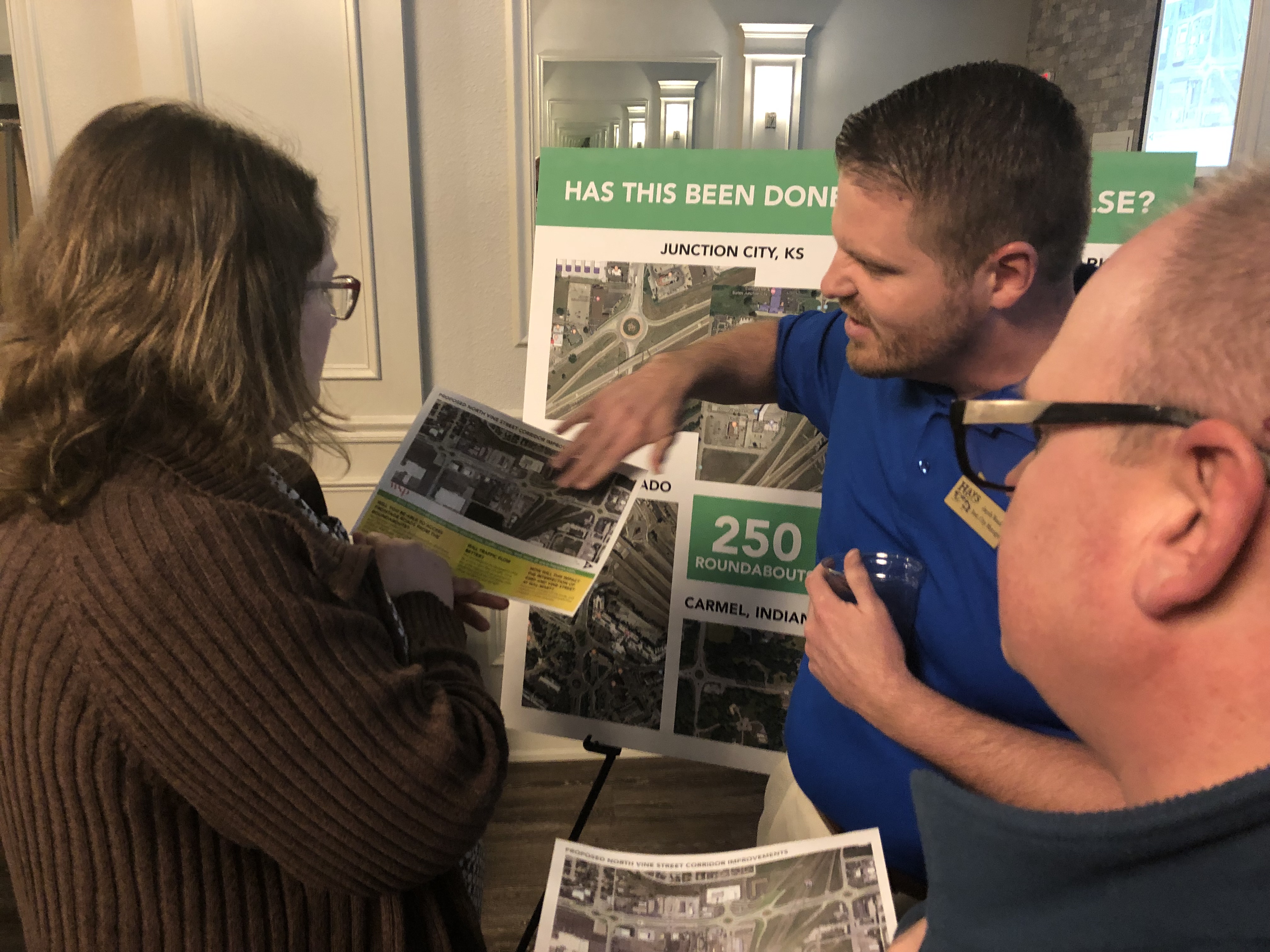
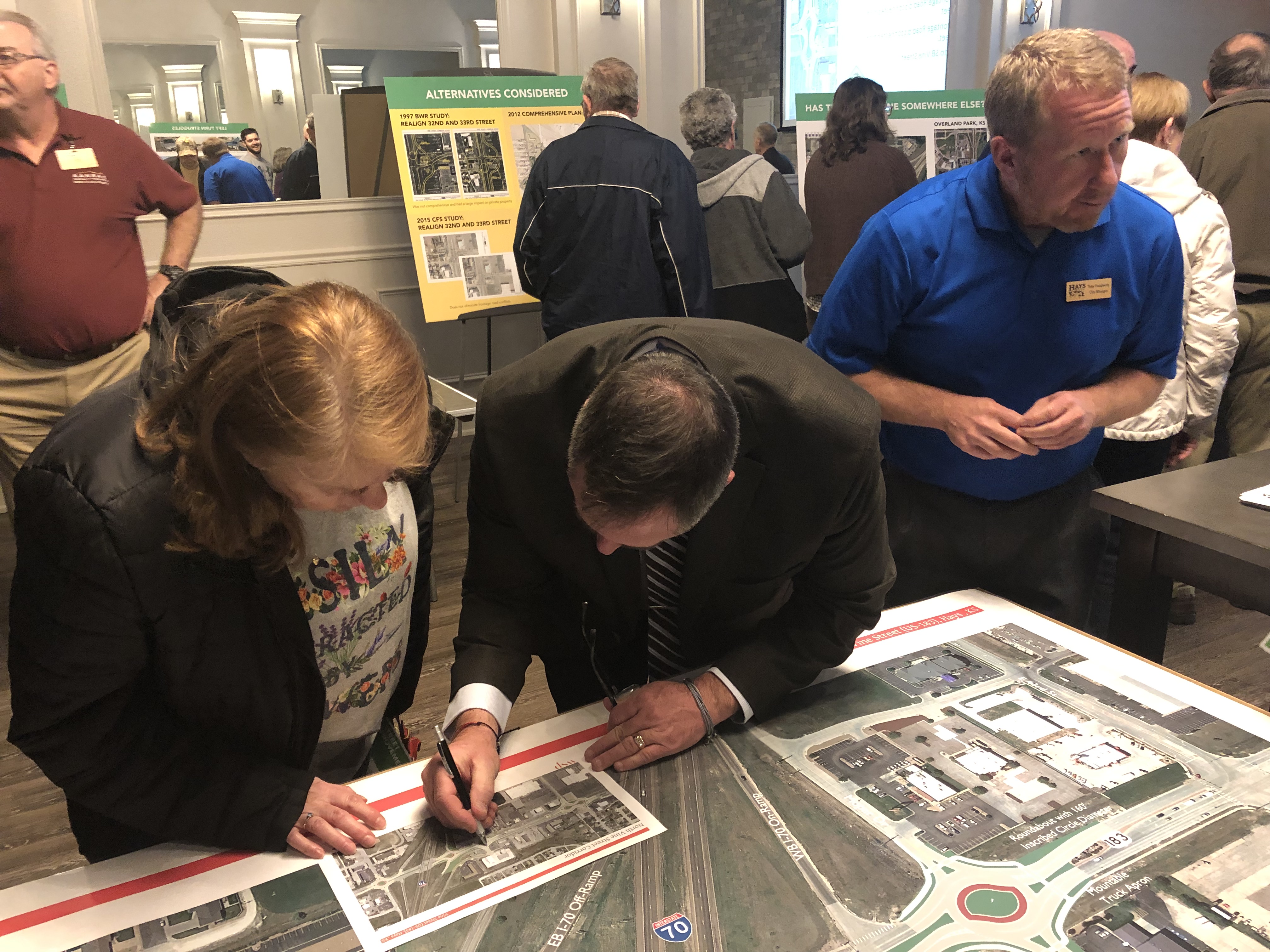
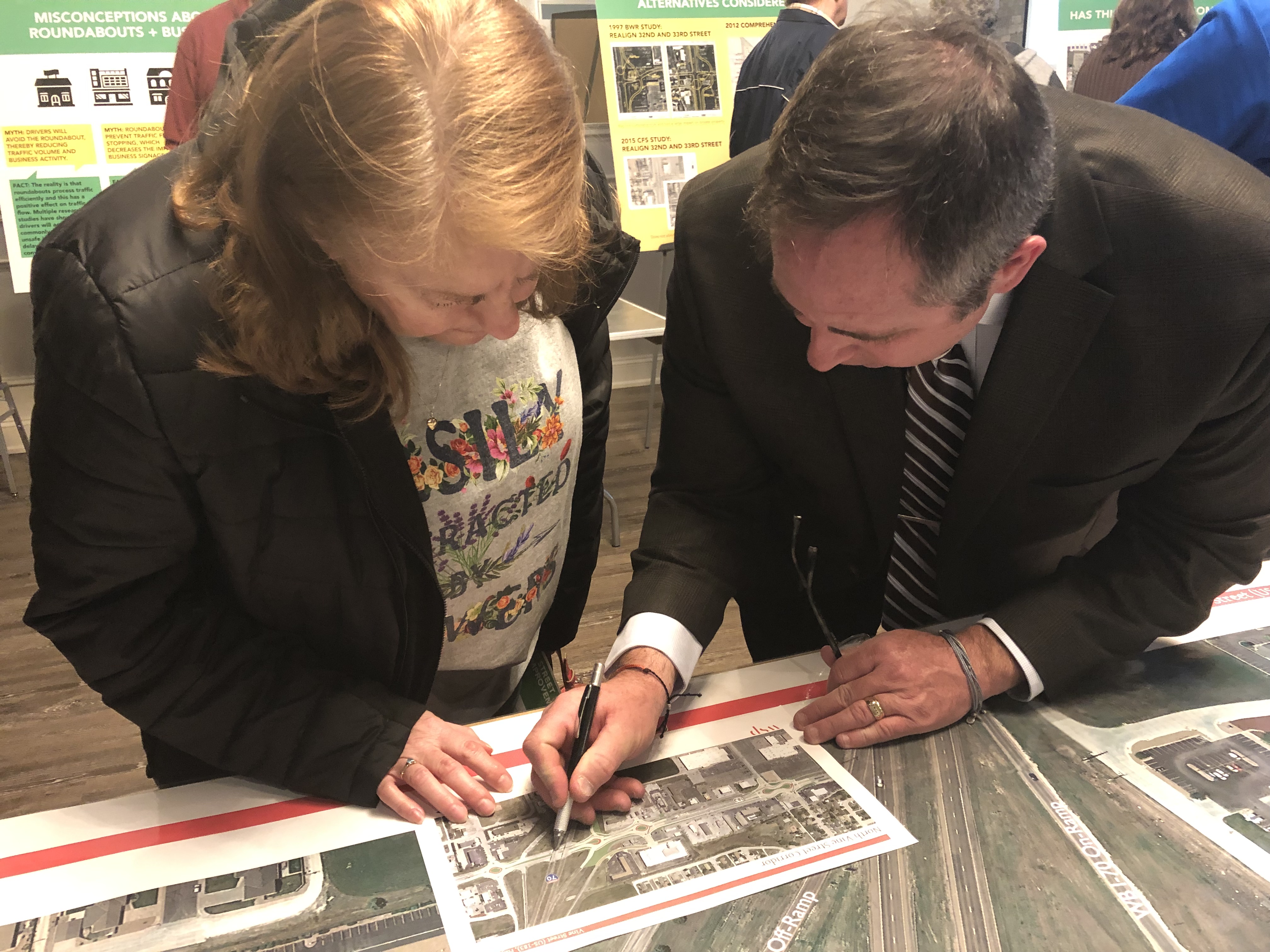
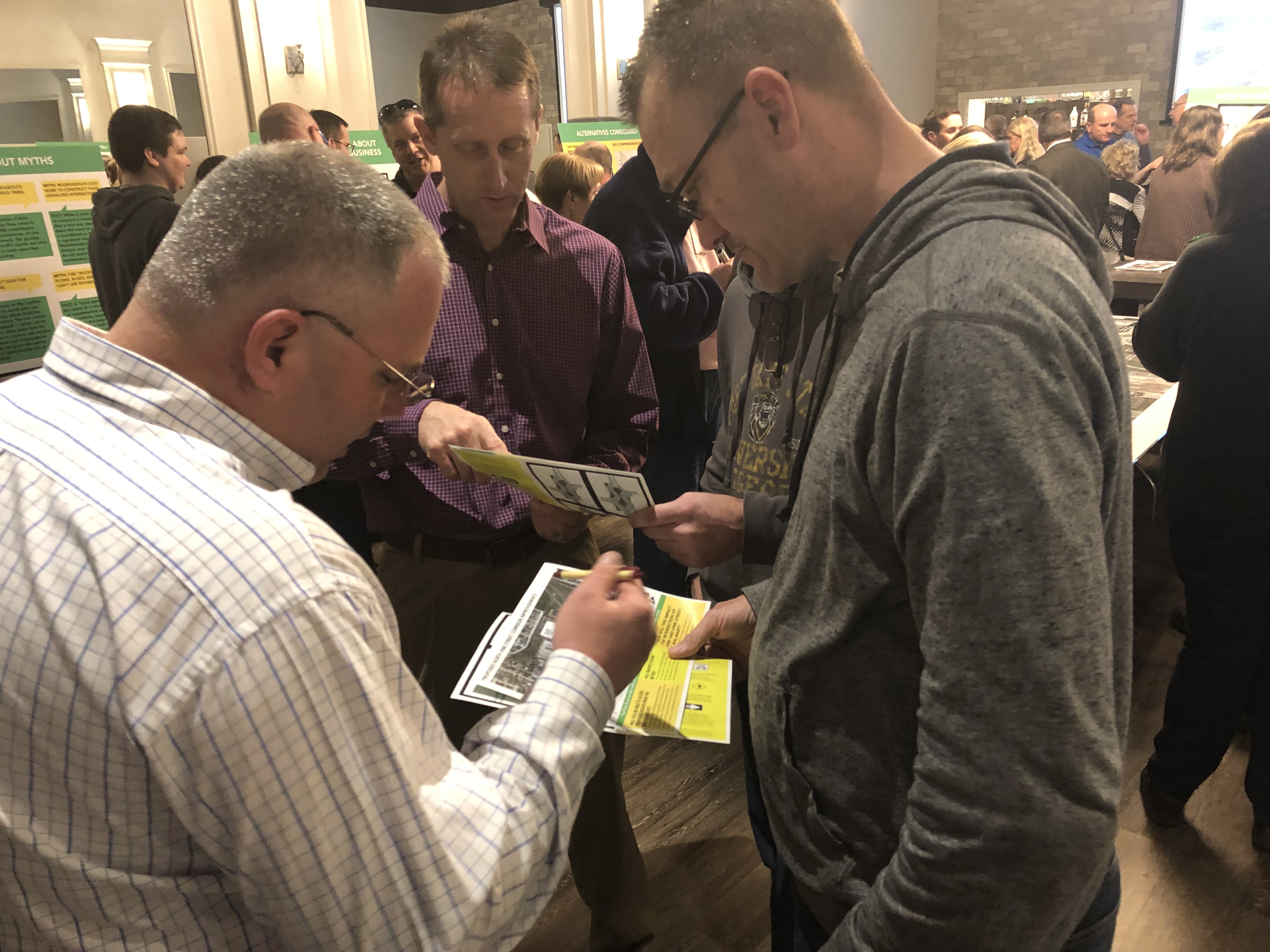
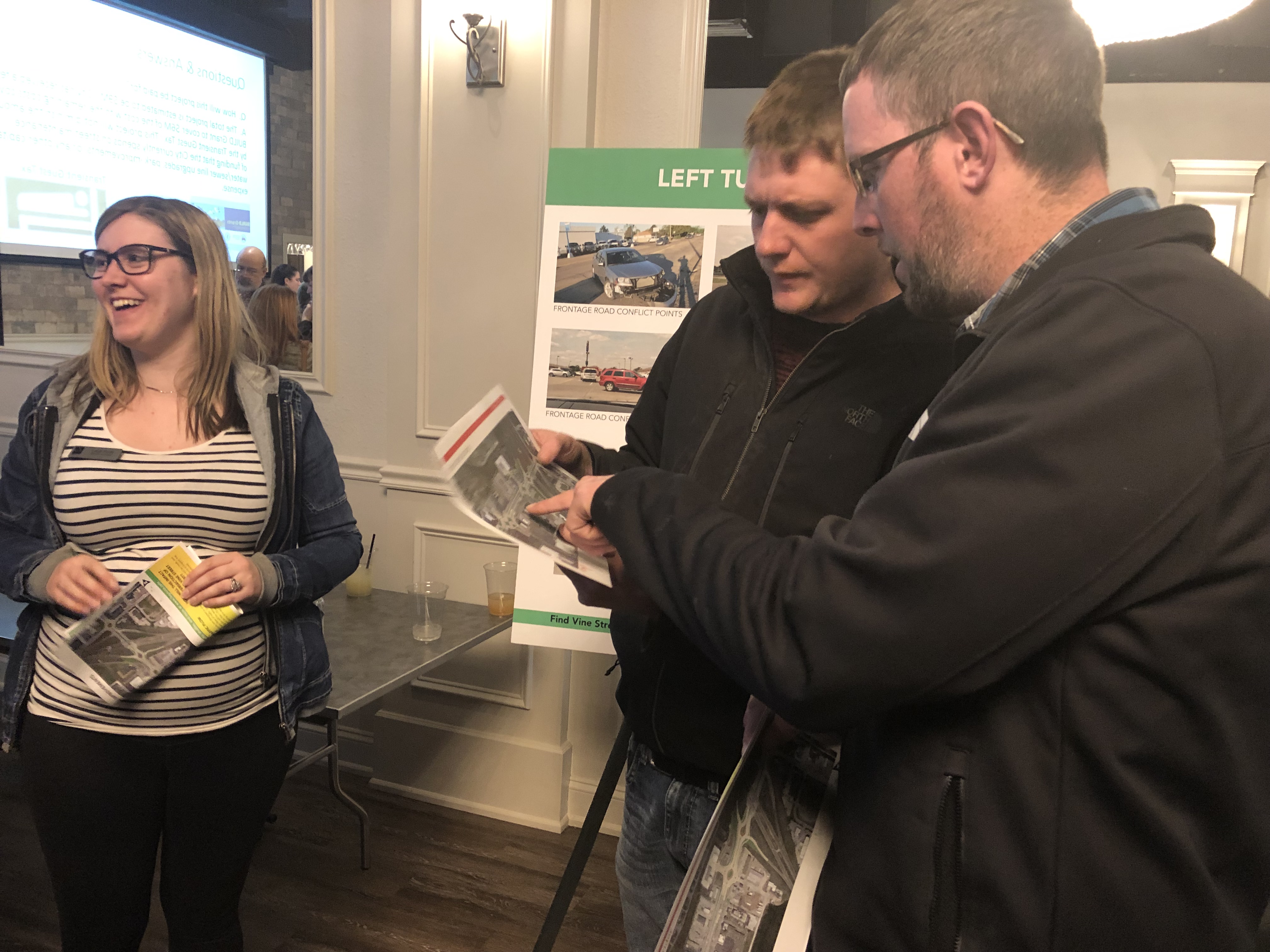
An oversized map of the Vine Street traffic corridor design between 32nd and 41st streets was laid out on a table in the middle of the room. People crowded around it the entire evening, pointing to specific areas with their questions. Staff and engineers used dry erase markers on the map to illustrate their points.
(Click to enlarge)
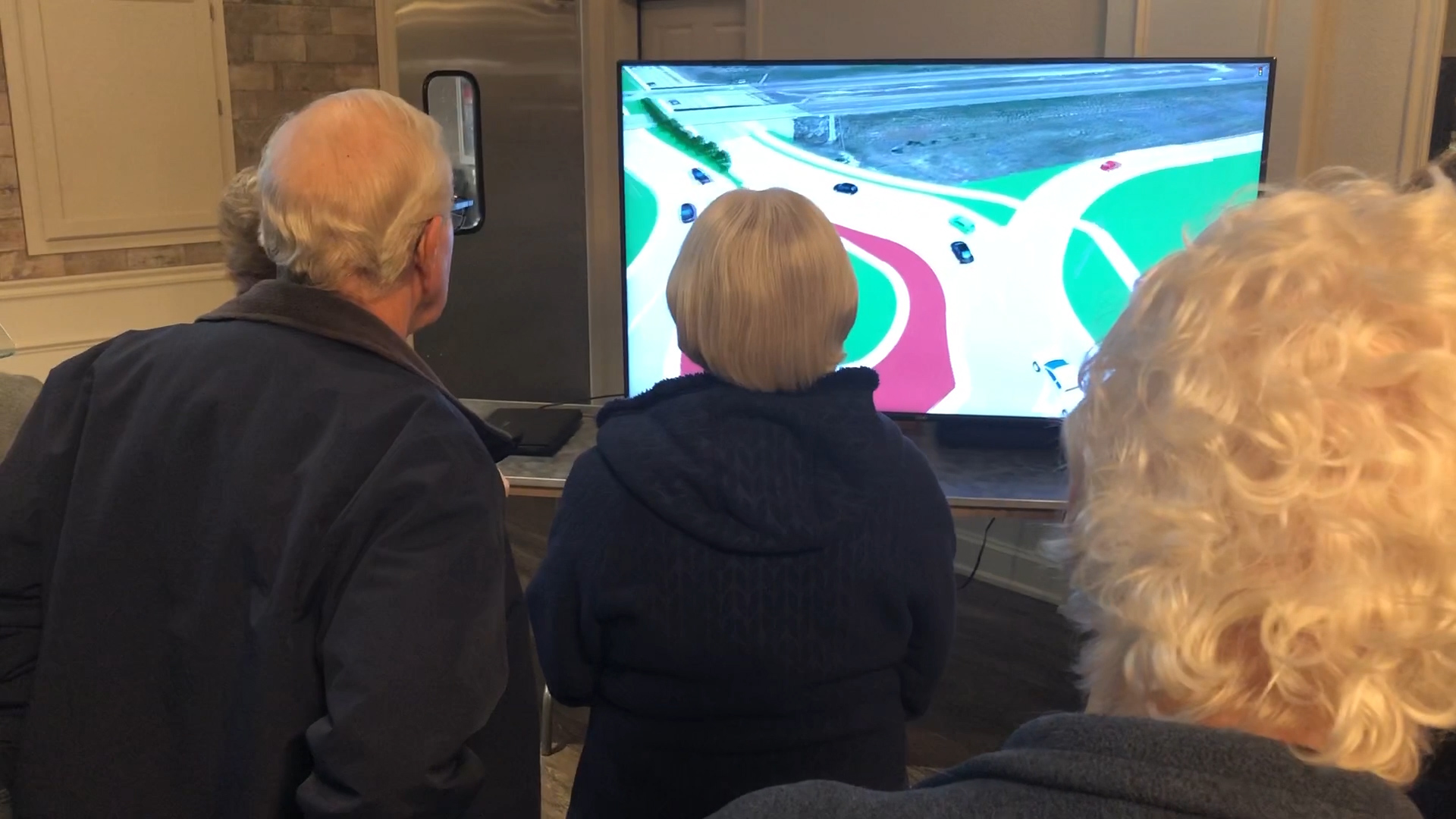
A large-screen TV continuously played the simulated corridor traffic flow through the roundabouts at 32nd/33rd, 37th, 41st and the westbound Interstate 70 exit ramp.
The simulation, created by Jay Aber, senior traffic engineer at WSP Engineers, Lenexa, uses a four-year study of Hays traffic in the corridor.
Another video screen scrolled through questions and answers with graphics showing examples of the changes.
Marcie Pray lives in Victoria and works in downtown Hays. She’s driven through traffic roundabouts in bigger cities.
“I think it’s becoming an accepted thing although it’s very intimidating to us drivers who are little older,” Pray said with a laugh. “You gotta know which lane you’re getting into and how to get around to where you’re trying to get at.”
She described the open house as “overwhelming but informative.”
A simulation of traffic flowing through proposed Hays roundabouts.
“But I think the best was the video. That was tremendous. First of all, I didn’t realize it was actually Hays video, and that really shone the light. And seeing the traffic flow was really helpful,” Pray said.
Aber answered several questions about how semis would get through a roundabout.
“U.S. 183 is a really important freight corridor. The highway is Vine Street itself. Obviously you have a lot of regular trucking. You also have a lot of oversize loads, including wind turbine towers and blades.
“One of the early requirements for this project was that two semi-trucks could drive side by side through the entire corridor,” said Aber.
“It’s also designed for the wind turbine blades specifically because they’re roughly the length of of two and half semi-trucks together. The wheels track really far outside of any kind of typical truck.
“So we also designed it so that a wind turbine blade on a 180-foot long truck can drive through the corridor without needing to stop traffic or to stop and use any special rear-wheel turning.”
Even though the proposed $9.3 million project would be funded by a $6 million federal grant and a dedicated 20-year 2 percent increase in the transient guest tax, 77-year-old Tom McClelland believes it’s “a waste of money.”
“I wish I was 35, 40 years younger. I’d buy a piece of property close and buy wrecker trucks because I think there’s gonna be a lot of them (wrecks),” the retired McClelland said. “All the people that are for this are telling me that’s not gonna happen, that there’ll be minor crashes. No T-bone wrecks but I can see a lot of side-swiping.”
Hays Police Chief Don Scheibler
Hays Police Chief Don Scheibler talked about roundabout safety to the crowd, using statistics from the U.S. Department of Transportation.
According to the Federal Highway Administration, roundabouts reduce fatality collisions by 90 percent and injury collisions by 75 percent. Overall collisions in a traffic roundabout are reduced by 37 percent.
The roundabouts would reduce the current number of vehicle conflict points from 32 to 8. Scheibler prefers to call them “contact points.”
“The current configuration really encourages aggressive driving through this area on Vine,” Scheibler said. “To make it through all the traffic lights, you have to speed.”
Scheibler also pointed out the driving speed in a roundabout is reduced. “Somebody may be going 40 miles an hour right now on Vine. That’ll be slowed down to about 25 miles an hour.”
The four-year traffic study of the Vine Street corridor from 32nd to 41st showed there were 124 vehicle accidents; 119 of those occurred in intersections.
With the elimination of traffic signals by the roundabouts at 32nd/33rd and the I-70 ramps, the potential of head-on and T-bone collisions typical in signaled intersections, are also eliminated. Vehicle crashes are more likely to be side-swipes at much lower speeds, Scheibler explained.
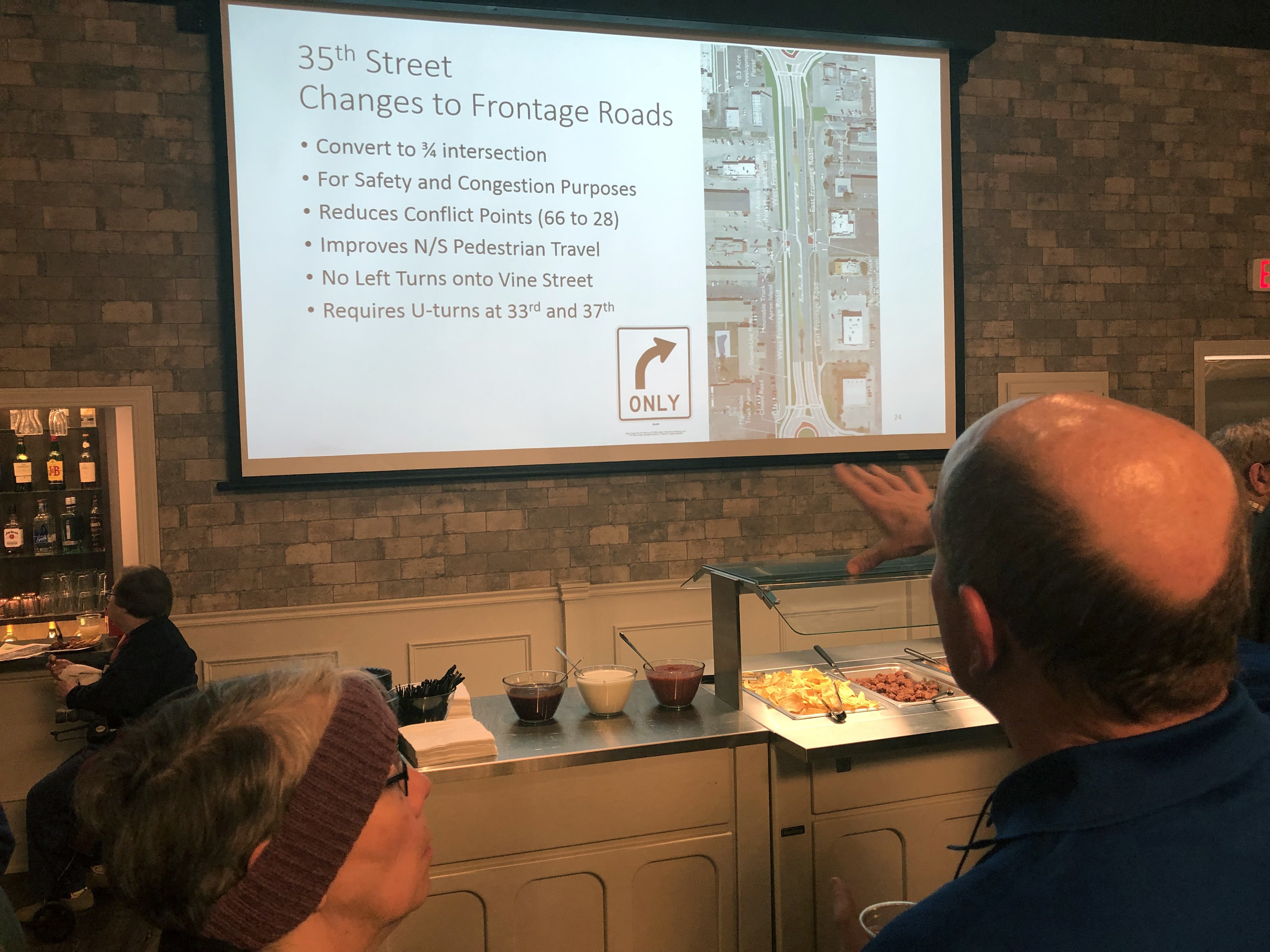
The project design is also safer for pedestrians, reducing conflict points from 24 to 8.
Existing frontage roads would be disconnected from 32nd and 37th. Frontage roads will only have access to Vine at 35th, which will be changed to a 3/4 intersection. That would allow right and left turns from Vine but only right turns onto Vine.
Attendees were given handouts and copies of the poster boards to take home for further study.
Pray is somewhat sure the roundabouts would be a positive addition to Hays. “I think it is. It’s just going to take a learning curve to accept it.”
The traffic simulation video and copies of the poster handouts are available on the city’s website www.haysusa.com.
Hays Mayor Henry Schwaller
Asst. City Manager Jacob Wood
Water Resources Dir. Jeff Crispin
CVB Exec. Dir. Melissa Dixon
City Commissioner Ron Mellick
City Manager Toby Dougherty, Ellis Co. Commissioner Dustin Roths, City Commissioner James Meier, Mayor Henry Schwaller
Police Chief Don Scheibler
City of Hays Project Dir. John Braun
The city of Hays hosted an information session Tuesday night about the proposed North Vine Street Corridor Improvement Project.