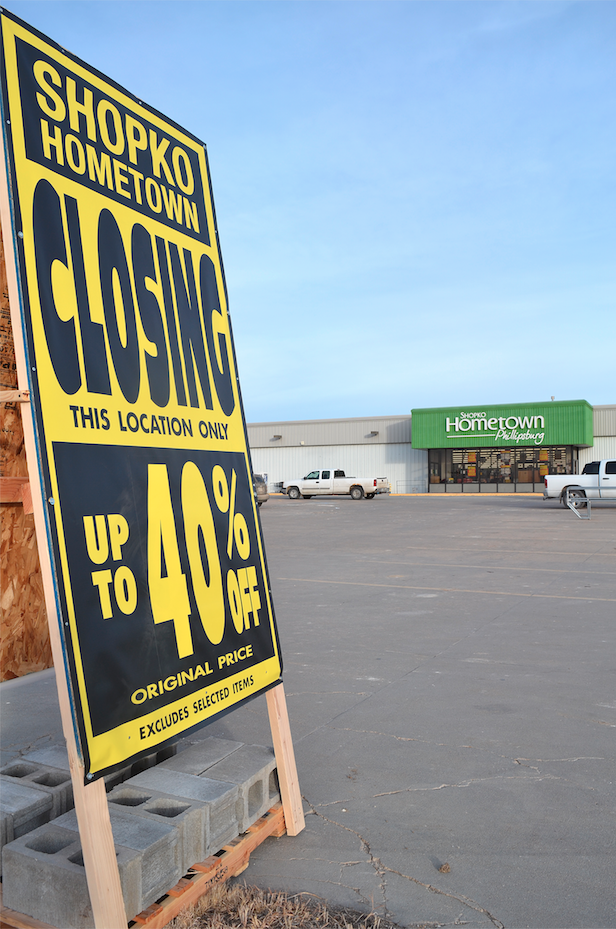
The Phillipsburg Shopko is slated to be shuttered by Feb. 28. Photo by Kirby Ross
Norton Telegram
NORTON — Retail company Shopko has announced Wednesday evening it is closing over 100 more locations, including the Norton store.
“It has become clear that it is in our best interest to operate with a significantly smaller store footprint,” a press release from the company stated.
“The Norton Telegram will publish further details regarding the store closure,” according to the Telegram. “In the interim, please keep the store employees and their families in your thoughts and prayers.”
Phillipsburg, Russell and Scott City stores also are scheduled to be closed by month’s end.
Horses that emerge from a tangle of roots, bright bugs made of fused glass and dancers frozen in time by a single shutter click all will come together in a single show that opens Friday at the Hays Arts Center.
The main gallery is featuring “Intermittent Musings,” a career retrospect of glass and mixed media art from Stan Detrixhe. The Founders gallery will host “Unwrapping Life,” mixed media carving and ceramics by Terri Horner. Also featured will be “In Motion, Dance photography by Michael Strong.”
The opening reception for all three exhibits will be from 7 to 9 p.m. Friday at the Hays Arts Council.
Stan Detrixhe
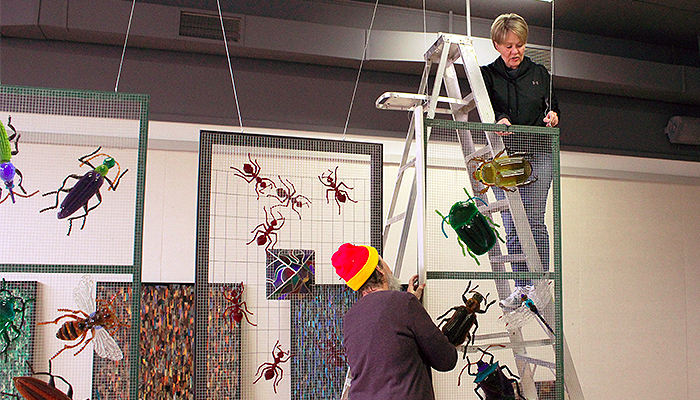
Stan Detrixhe installing an art piece for an exhibit at the Hays Arts Center.
Detrixhe, 66, works in a variety of media including fused glass, reverse painted glass, oil and collage.
Detrixhe is a a Hays native, but studied at San Diego State before moving back to Kansas. He started working with in glass in 1983 when he working as a designer for High Plains Stained Glass. The company designed and repaired stained glass windows. Although there is not as much demand for it today, Detrixhe still offers commercial stained glass work as well.
One of the larger pieces of glass work in the exhibit includes several wire panes featuring bugs.
Detrixhe said he chose the subject because he saw them as a challenge.
“What is an extreme example of what you could do with fusing and still have it hold up?” he said. “So I thought of all the little legs on the insects coming off as being very, very delicate, and then the middles of the insects are very, very strong. I was trying to determine if those two things were compatible.”
Advances have been made in fused glass, but when Detrixhe started there were issues with compatibility in different colors of fused glass. One color of glass can solidify before another, which will cause the glass to crack.
A fused glass insect by Stan Detrixhe.
All the insects in this piece of artwork were modeled after actual insects. Detrixhe researched the anatomy and features of the insects as he was creating the pieces.
Another challenge for Detrixhe is painting reversed glass. As the name implies, all of the painting has to be done in reverse on the back of the piece of glass. He said he likes the effect that is achieved in the final product. As light hits the front of the finished pieces, it makes the color seem even brighter than the original paint.
Detrixhe has several large collage pieces in this exhibit. Some are abstract and others look more like a traditional paintings.
He created abstract brown, blue and green collage pieces by chance. He started snipping pieces out of magazines and gluing them on a background, and it just kept getting bigger until it was several feet tall. A second piece followed. The third green piece in the series he created from digitized images.
He said even if he is going to create a finished piece in another medium, such as oil or glass, he likes to use collage to create a first impression of what the finished piece will look like.
Two oil paintings will make a reappearance in this exhibit from a former Hays downtown bar. The bar used to be in the basement of what is now Coldwell Banker Executive Realty, 1001 Main. The paintings were donated to the HAC when the bar closed.
Terri Horner
Terri Horner of Great Bend with two of her art pieces that will be on exhibit at the Hays Arts Center.
Horner, 61, Great Bend, is a cosmetologist by trade, but went back to school and earned her bachelor’s degree in art from Fort Hays State University in 2009.
Although Horner’s formal education came later in life, she has always loved art and drawing. Today she is a sculpture. Her favorite media is wood, and she often uses cedar.
“Wood and stone are particularly nice because you uncover what is in there,” she said. “What I see I can bring to light for someone else to see that they might not otherwise find in there.”
Horner gave several examples. A piece that was chosen for the 2018 Smoky Hill Art Exhibition at the HAC depicts horses carved from the roots of a hydrangea bush. The roots were a gift from a friend’s garden. Horner said she turned the root around and around and upside down, but all she could see were the heads of horses in the tangled wood.
A horse sculpture by Terri Horner.
A thin sculpture of a women was inspired by a knot that Horner imagined as the women’s hair. In yet another piece depicting Eve, the nape of the woman’s neck, her hair and the curvature of her face were all determined by the grain that was naturally in the wood.
“The fact that I like three-dimensional work and it’s more comfortable to me, I think is because I have worked on a 3-D pallet my entire life working on hair,” she said, “because that is an art in and of itself.”‘
Another piece was inspired by her in-laws, Ralph and Edna Horner. The wood sculpture features a faded, ghostly image of the couple when they were young. A cast of their hands is in an opening in the wood below. On the back of the piece is inscribed a excerpt from a love letter Ralph wrote to Edna when he was stationed in Africa during World War II. He worked as mechanic in the Army Air Corps. They wrote to each other every day.
“I really wanted to honor them in a sense, because No. 1 they were awesome people,” Horner said. “They were just the kindest, sweetest people ever. They were also so in love. Dad died in ’93, and they were every bit in love at that moment as the day they met. They were such an inspiration and an example.”
The hydrangea roots from which Terri Horner carved her horse sculpture.
Several of the pieces in “Unwrapping Life” also depict animals, such as a lion, monkey, giraffe and elephant in wood and polar bears in Italian ice alabaster.
“I have just always been an animal lover or that’s just what’s there,” she said.
Horner is branching off in new directions. She is working on an independent study at Barton Community College in ceramics. Although it was not ready for this show, she hopes to be able to show that work soon.
Michael Strong
Mike Strong started shooting photos in the 1967 when he took a photojournalism class in college. That was the only photo class he took, but he had found his passion.
He couldn’t find a job as a photographer right out of college. He kept finding jobs for reporters, so he became a photographer who wrote. Today he is primarily a dance and performance photographer. Strong formerly lived in Kansas City, but is now living in Hays.
Photo b Michael Strong
His exhibition “In Motion: Dance Photography by Michael Strong,” shows examples from years of perfecting the art of photographing the movement and emotion of dance.
“It never, never stops for me,” he said of the dance photography. “This is always perfection. I am always perfecting. There is nothing else as interesting or exciting for me because there are always changes in moves.”
Strong said he didn’t really understand dance photography nor was he any good at it until he took tap lessons. He started to see new aspects in his photography and better understand the timing that goes into dance after he started to dance.
“I didn’t know what it was, but I knew my pictures were different from the normal newspaper people who came in, who clearly didn’t see what they were looking at,” he said. “To see something, you have to know something. To know something, you have to do something.”
American Youth Ballet (AYB) dress rehearsal #1 in Polsky Theater Wed 5 p.m. May 10, 2018 for performances May 12 and 13. Photo by Mike Strong.
When Strong is going to photograph a performance, he starts attending rehearsals as soon as possible. He makes notes about the timing of the movements.
When he shoots, he does not use continuous shooting. Every image is captured with a single click of the shutter. He said this has forced him to choose his shots more carefully and perfect his timing. Several photos in the exhibit will include consecutive frames of a single subject to show how this techniques shapes Strong’s photography.
Strong also shoots with an ultra-wide angel lens. This allows him to be very close to his subjects, but still capture a broader image.
“For me, this is about perfecting and never quite getting there,” Strong said of his photography, “but always staying on an edge. I have a tell I have for myself. If I find myself thinking it is too easy, I stop because it means that I am not paying attention. I start doing a quick little inventory of where I am at in the dance. I do a quick little inventory of all the setting on my camera. That puts me back in the mood. You have to be on edge in some way, shape or form.”
Photo by Mike Strong
He never shoots a posed shot. They are all images made in the moment.
“I call these my transitive [shots] like a transitive verb. You know you need an object that comes after it,” he said. “These are transitive in the sense they are coming from somewhere and going to somewhere rather than just jumping up and boom there you are.”
Although Strong started shooting ballroom dancing, today he photographs the American Youth Ballet, University of Kansas dance and University of Missouri Kansas City dance as well as other events and companies.
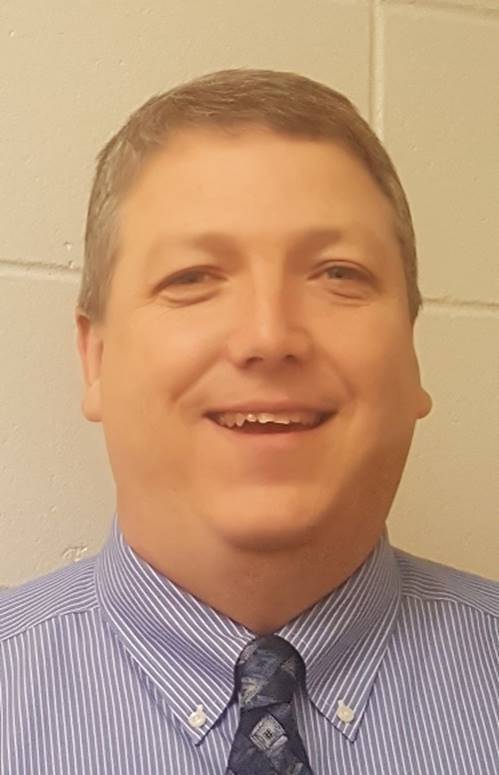
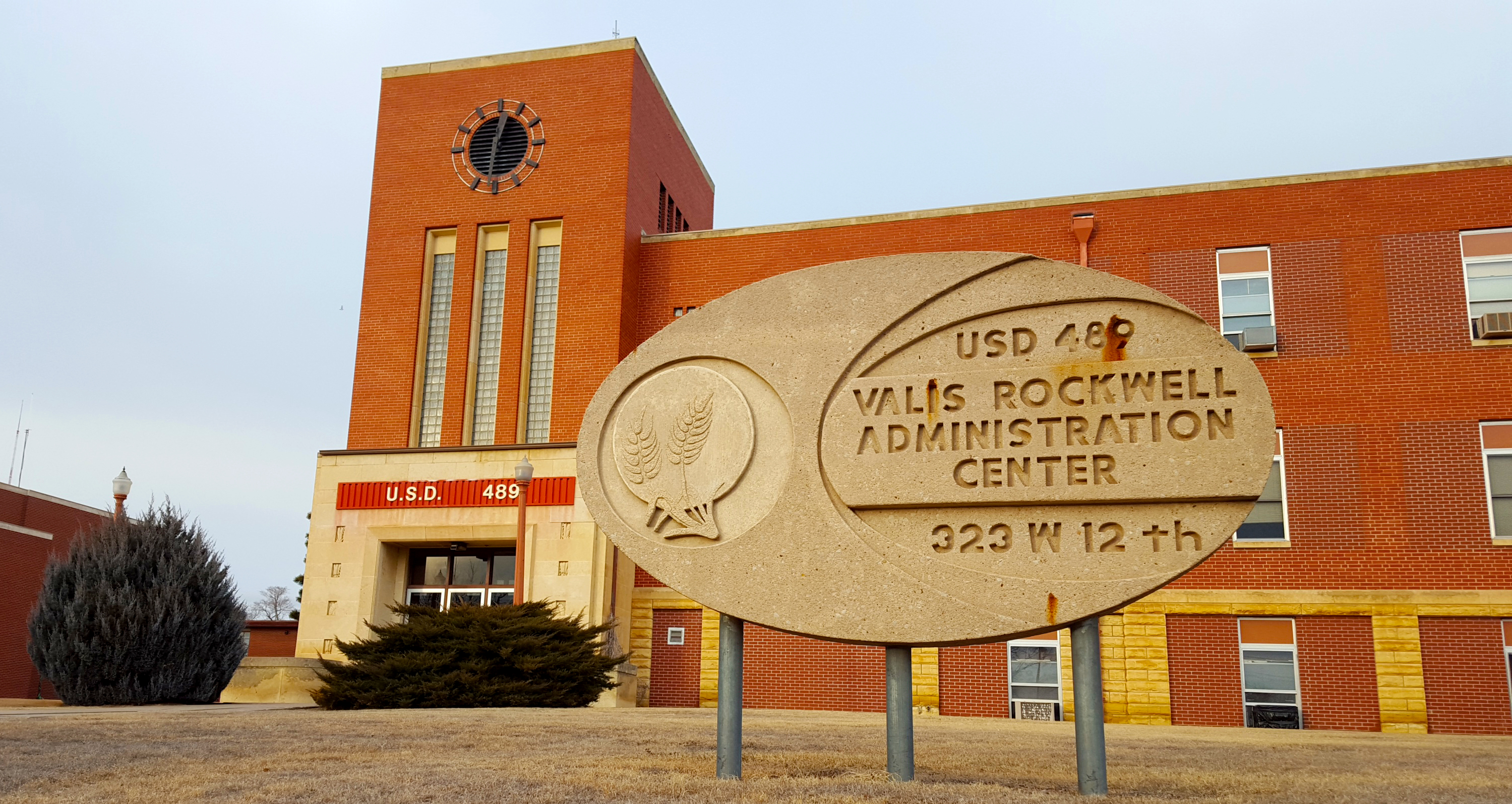
Ron Wilson will interview for the position of Superintendent with the USD 489 Board of Education Thursday night.
Wilson is the fourth of four candidates that the USD 489 Hays Board of Education will be interviewing. Wednesday the school board interviewed Michael Gower, Phillipsburg and Logan superintendent. Last week the school board interviewed Keith Hall, USD 489 interim director of finance,and Jamie Wetig, Ashland superintendent.
The board is set to vote on the new superintendent at its meeting Monday night.
Candidates were selected for interviews based on their fit with desired characteristics that were developed with input from focus groups that were utilized throughout the search process.
Wilson is currently serving as the superintendent of schools in Herington USD 487.Wilson is in his second year in the position.Previously, Wilson served as the Abilene Middle School Principal for 18 years in USD 435.
Schedule February 7, 2019
10 a.m. Arrive at Rockwell Administration Center
10:05 a.m. – 10:20 a.m. Meet with Superintendent Thissen
Receive schedule and information for the day
10:30 – 11 a..m Drive to Lincoln, O’Loughlin, and Early Childhood Connections
11 – 11:45 a.m. Hays High School – facility tour and meet and greet
noon – 1:15 p.m. Lunch with building and district administrators
1:30– 2:15 p.m. Hays Middle School – facility tour and meet and greet
2:30 – 3:15 p.m. Roosevelt Elementary School – facility tour and meet and greet
3:30 – 4:30 p.m. Community and parent meet and greet – Toepfer Board Room
4:30 – 5:30 p.m. Free time for the candidate (the district will provide transportation to and from the motel for the candidate and/or guest.
5:30 p.m. Dinner with board, candidate and guest, central administrative team
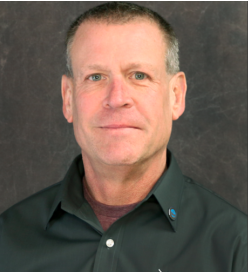
Eagle Communications announced today that Executive Vice President and Chief Operating Officer Kurt K. David has been promoted to President and Chief Operating Officer, effective immediately.
David has served as Chief Financial Officer at Eagle Communications since 2006 and has worked as part of the financial services and communications industry in Kansas for over 25 years.
Gary Shorman will continue as Chairman and CEO of Eagle Communications and President of the Schmidt Foundation.
“Kurt’s new leadership role represents the ‘forward ever’ growth of our company, in employee ownership, financial, advocacy, and community leadership,” Shorman said. “We believe that advancing good people is one of the hallmarks of our success”
David earned an undergraduate degree in finance and management from Kansas State University and a master’s of business administration from the University of Kansas. He also has a master’s of agribusiness from Kansas State University.
He has held officer and leadership positions with the Ellis County Coalition for Economic Development, Heart of America Development Corporation, Rotary and the Ellis County Historical Society. David is also Past Chair of the Kansas Cable and Telecommunications Association. He is an avid triathlete competing locally, regionally and at the World Championship level. David and his wife, Kathy, have two children — Hayden, Olathe, and Jennifer, New Orleans.
Kohlrus
In addition to David’s promotion, the Eagle Board has promoted Travis Kohlrus to Vice President of Eagle Broadband Division, which provides TV, internet and phone, as well as technology and marketing solutions in over 60 communities across Kansas, Nebraska and Colorado.
“Under Kohlrus’s leadership, our Broadband Division has seen exciting growth,” Shorman said. “This promotion is appropriate as Travis represents us in community and state issues facing our company. The change also signifies the importance of leadership growth as we look to continue to build our company for the next 20 years.”
A native of Ellis, Kohlrus joined Eagle Communications in 2003. He was elected to the Eagle Communications Board in April 2017. Kohlrus and his wife, Susie, have two children — Tanner, 14, and MaKenzie, 11.
Recipients announced at ‘Destination Statehouse’ event
TOPEKA —This year, Arrivalist and Kansas Department of Wildlife Parks and Tourism handed out ArrivaLIST most-visited places awards to top visited destinations in Kansas. Arrivalist is a visitation-intelligence company that empowers marketers with a suite of measurements to evaluate the lifetime value of a visitor. In 2014, KDWPT was the first state agency to partner with Arrivalist to track visitors entering Kansas after visiting KDWPT’s websites online or seeing one of their digital ads. Attractions with the most tourist visits tracked through Arrivalist in 2018 were awarded at a lunch ceremony on February 6, 2019 during the Destination Statehouse event.
Historically, out-of-state visitor information relied on self-reporting, and marketers were only getting a fraction of data they needed to accurately understand visitation behavior. Arrivalist uses concrete data to report actual foot-traffic captured in real time. The company unveiled ArrivaLIST, Kansas’ most-visited sites, to provide consumers, travelers and businesses with accurate, unbiased travel advice. Arrivalist only captures unique visitors at each attraction once per trip, allowing the company to offer clients the most precise visitation behavior.
The ArrivaLIST winners include a variety of categories. Following are the top winners in each category:
Attractions winner: Massachusetts Street, Lawrence
Zoos, Parks and Natural Attractions winner: Sedgwick County Zoo, Wichita
Farms and Ranch Experiences winner: Ringneck Ranch, Tipton
Breweries, Distilleries and Wineries winner: Gella’s Diner and Lb. Brewing Company, Hays
Large & Luxury Hotels winner: Great Wolf Lodge, Kansas City, Kansas
The Center for Entrepreneurship at Fort Hays State University will host the Faulkner Challenge on March 30 at the W.R. and Yvonne Robbins College of Business and Entrepreneurship. Fort Hays State students and residents of a 26-county area of northwest Kansas are eligible to compete for $10,000 in prizes.
The event begins at 9 a.m. Saturday, March 30, in McCartney Hall, home of the Robbins College, on the Fort Hays State campus. Admission is free for participants and the public.
“It will be an exciting event on our campus to showcase the creativity and entrepreneurial spirit of our students and the Kansans of this region,” said Dr. David Snow, director of Entrepreneurship for FHSU.
“This is meant not only to be a fun event for all involved, but a contribution to economic development in northwest Kansas and a boost for those early-stage entrepreneurs.”
The Faulkner Challenge is made possible by the generosity of alumnus, Kevin Faulkner. It is a business plan competition for new, independent proposed ventures in the conceptual, seed or startup stages.
Entries will be accepted until the March 20 deadline.
The eight best business plans will be selected as finalists to present on the Fort Hays State campus. Finalists will deliver 10 minute presentations to a panel of judges and the top three business projects will split the $10,000 in prize money into awards of $6,000, $3,000, and $1,000, to first, second, and third places, respectively.
The eligibility area comprises the 26 northwest Kansas counties stretching from Cheyenne down to Wallace County, east through the top three tiers of counties and then into the eight-county block from Jewell and Republic down through Ellsworth and Saline.
Plan presentations begin at 9 a.m. and run through 12:15 p.m. Luncheon will go from 12:15 p.m. to 12:45 p.m. The judges feedback session will run from 12:45 p.m. to 1:15 p.m. Awards presentations begin at 1:15 p.m. and end at 1:30 p.m.
The certified public accounting firm of Adams, Brown, Beran & Ball, Chartered (ABBB) is pleased to announce the promotion of Jami Benyshek, CPA to manager.
Benyshek joined ABBB as an intern in 2012. She joined the team full-time as a staff accountant in 2013 and works primarily in the firm’s Audit and Assurance (A&A) Department.
“Congratulations to Jami on her recent promotion,” said Brian Staats, CPA, CGMA, managing partner of ABBB. “Jami’s dedication to the firm, our clients, and her career has been impressive. We look forward to witnessing her continued success and development in her new role!”
A graduate of Fort Hays State University, Benyshek holds Bachelor of Business Administration degrees in Accounting and Finance. She is a member of the American Institute of Certified Public Accountants (AICPA), the Kansas Society of CPAs (KSCPA), and Hays Area Young Professionals. She currently lives in Hays.
Donna KrugWith freezing drizzle predicted and wind chills in the single digits as I write this column, it sounds a bit crazy to talk about going for a walk, but that is just what I’m going to do.
Walk Kansas is a signature program for K-State Research and Extension that has been around since 2000. Each year this fitness challenge motivates people from all walks of life to get moving. The dates for the 2019 campaign are March 17th through May 11th.
To participate in Walk KS you will need to start by recruiting a team of six people. Many times teams consist of family members, friends or co-workers. Come up with a fun name, register your team, and report the minutes that team members exercise each week, beginning March 17th. All of the registration details can be accomplished on line. There is a fee of $8 per team member or $17 per person if all team members wish to order a t-shirt. Payment by check or cash will need to be made at either the Hays or Great Bend offices. Brenda and Theresa, our office professionals in the Great Bend and Hays offices can answer specific questions you may have as you register your teams.
On-line registration will open for residents of the Cottonwood Extension District the week of February 18th. We would like to complete team registration by Monday, March 11th if possible.
Several interesting activities that support this fitness challenge are planned for the next few months. Mark your calendar for Thursday, February 21st, and join me at noon at the Great Bend Activity Center for the program “Let’s Live a Little: Physical Activity for Fun and Fitness.” March programs focus on “Healthy Choices When Eating Out.” I helped update a K-State Research and Extension publication by the same title and am excited to share the information with everyone. Join me Wednesday, March 6th at noon at the Great Bend Activity Center, or Friday, March 22nd at 1:00 p.m. at the Great Bend Senior Center. My visit to Hays to present “Healthy Choices When Eating Out” is Thursday, March 14th, at 5:30 p.m. at the Extension office meeting room at 601 Main in Hays.
A wrap up celebration for the Walk KS program is scheduled for Wednesday, May 15th, at noon at the Great Bend Activity Center. A free healthy luncheon will be provided for any Walk KS team member. The public may pre-register by May 3rd for lunch by paying $5.
So get your walking shoes ready and your team pulled together and join the 2019 Walk KS program in your community!
Donna Krug is the Family & Consumer Science Agent and District Director for the Cottonwood Extension District – Great Bend office. You may reach her at: (620)793-1910 or [email protected]
The certified public accounting firm of Adams, Brown, Beran & Ball, Chartered (ABBB) is pleased to announce that Matthew Frank has earned his license as a Certified Public Accountant (CPA) in Kansas.
Frank currently serves as a staff accountant. In this role, he works in the firm’s Hays and Ness City offices, preparing tax returns, completing compilations, and working on audits. Frank specializes in working with clients in the agriculture industry.
“Congratulations to Matt for reaching this important career milestone,” said Brian Staats, CPA, CGMA, managing partner of ABBB. “We are confident Matt will use his CPA license to continue delivering value to our clients.”
Frank joined the ABBB team full-time in 2018 after working as an intern and student worker with the firm. He graduated summa cum laude with his Bachelor of Business Administration from Fort Hays State University in 2017. Originally from Ness City, Frank resides in Hays. – SUBMITTED –
A teardrop partial roundabout has been added to the eastbound I-70 off ramp for the North Vine Street corridor traffic improvements. (Click to enlarge)
By BECKY KISER Hays Post
A fourth major traffic element has been added to the plan for improvements to the Hays North Vine Street corridor between 32nd and 41st Streets.
The project has been in development the past 12 months by the city’s consultant, WSP Engineers of Lenexa, the Kansas Department of Transportation (KDOT) and city staff.
“Our engineers [WSP] hired another engineering firm to do an independent review of the whole plan just to make sure we got another set of eyes on it,” said Jacob Wood, assistant city manager.
The nationwide firm Kittelson & Associates specializes in transportation projects.
“One of the things that they recommended was that we put in what we’re calling the ‘teardrop’ on the south side of I-70.
“It’s not a full roundabout but what it will allow is traffic going eastbound to pull off of the interstate, go through the tear drop, and go directly north,” Wood explained.
“The old plan would have had them going south, and coming around the roundabout and then going north. This will make it a bit easier to come off the interstate and go north, if they want to do that.”
Traffic studies and modeling determined the teardrop would alleviate some of the congestion at the 37th Street roundabout.
“We looked at doing [a teardrop] on the north side of I-70 but there’s really not enough room to do it between the interstate and the intersection. So [westbound traffic] will still have to pull off the interstate and go north through the roundabout to then head south on Vine.”
Plans are to build two-lane traffic roundabouts at 32nd/33rd, 37th, and 41st Streets, plus the teardrop at the eastbound I-70 exit ramp.
Adding the teardrop increases the total project cost from an estimated $7.6 million to approximately $9 million.
In early December the city was awarded a $6 million federal grant from the Department of Transportation for the Better Utilizing Investments to Leverage Development (BUILD) Grant program for the North Vine Street Corridor Project construction.
The remainder of the project cost will be paid through a two percent increase in the Transient Guest Tax (TGT). It went into effect Oct. 1 and is projected to raise $6.2 million over 20 years.
On January 9 city staff attended a meeting in Topeka with representatives from the Federal Highway Administration (FHWA) and KDOT to discuss how the project is to be administered. KDOT will act as the pass-through agency in letting the bids and managing the project.
“We’ve had conference calls with them, both KDOT and Federal Highways, and will continue to do that as part of the process as it goes forward.
“Anytime you do a project of this magnitude on a state highway at the intersection of an interstate, you’re going to have those players involved anyway. But they’ll probably be a little bit more involved this go around [due to] the federal money.
Wood says the concept plan is now “pretty well refined.”
The city has been meeting with business owners along Vine Street throughout the corridor.
“We’ve been having conversations and, actually, some of those have resulted in changes to the plan. Those guys that work on Vine have the operator-level kind of knowledge that maybe city staff and engineers don’t see.
“For the most part, the meetings have been positive.”
The city will host a public meeting and open house Tue., Feb. 12, 5:30-7:30 p.m., at The Venue at Thirsty’s Brew Pub & Grill, 2704 Vine. Information will be presented about Vine Street corridor improvements, including the proposed roundabout solutions. Detailed models of proposed changes will be on display to show the capabilities of roundabouts and how they improve safety for vehicles and pedestrians.
“We’ll see if there’s any feedback that may require adjusting or tweaking the plan, and we’ll still be able to do that. But we’ll really start kicking on the design pretty heavy after next week.”
Utilizing the federal funds required a slight shift in the work timeline.
Design will continue until October or November. Once the design plan is finalized and approved, bids will be let with a construction start expected in the summer of 2020.
“It’s a long road and there are a lot of regulatory requirements, which we would have to deal with regardless of whether we got the federal dollars,” Wood added.
Wind turbines are thought of as environment-friendly sources of energy, but for bats, they are a death trap.
Amanda Adams, instructor of biology at Fort Hays State University, talked to a capacity crowd Monday night about the plight of the bats during a FHSU Science Cafe presentation titled “Bats: The Rock Stars of the Night.”
Adams said bats are being killed by the millions by wind turbines.
Curious creatures, the bats are drawn to the turbines, where they are either struck or killed by a low pressure field that surrounds the turbines.
“When you go out and you are driving and you think ‘How majestic,’ in my head I think ‘It is a death count,’ ” Adams said. “It’s really awful.”
Amanda Adams, instructor of biology at FHSU talks about the diversity of bats at a Science Cafe lecture on Monday.
Researchers are trying to develop deterrents that will keep bats away from the turbines. They have investigated using sound to dissuade the creatures from approaching the turbines, but that has not been effective.
A type of fungus found in caves is also killing some species of bats by the millions. White-nose syndrome first appeared in U.S. caves in 2006. It has proven to be 99 percent fatal to bats in the caves were the fungus has been found.
Although researches have found chemicals that could kill the fungus, conversationists are concerned about the effect spraying would have on soil quality, Adams said.
Although bats are often confused with rodents, they are in a completely different mammalian group. They also live very different lives. Rodents have short lives and reproduce quickly. However, bats may only have one young per year, and can live anywhere from six to 20 years. The oldest bat on record lived to be 45.
Because bats’ reproduction is slower than rodents, killing a bat has a much greater impact on the bat population. They are also slower to rebound from environmental disasters, such as the white-nose disease.
A quarter of all mammal species are bats with 1,300 species. They live on all continents except Antartica. Sixteen species of bats are found in Kansas — eight in Ellis County.
“That is the reason why I am in love with them. The incredible diversity of bats that are out there makes it really fun to study them and learn about them, because they are always doing something weird and breaking rules and you can never make a generalization about bats,” Adams said.
Bats in that diversity have some incredible adaptations. California’s spotted bats can hear the footsteps of a cricket on the ground. Common vampire bats have specialized heat sensors in their nose that allow them to locate blood-rich areas in the skin of their prey.
A species of bats that lives in the tropics make their own tents out of banana leaves and then they “cuddle” together like a hand full of cotton balls.
A Central American species has suction cups on its wrists. This helps the bats stick inside leaves at night when they rest.
The largest bat in the world is the flying fox and has a wing span of 6 feet. The smallest bat is called the bumblebee bat, which weighs less than a penny and could fit on the tip of your thumb. Both of these bats overlap range in the Philippines.
All the bats that live in North America are insect eaters. Depending on species, bats prey on insects both from the ground and catch flying insects, such as moths, in mid-air.
Adams talks to a capacity crowd at the Science Cafe Monday night at The Venue in Hays.
Some bats are carnivores. They eat frogs, fish, birds, reptiles and rodents. Some species that eat frogs have an special adaptation to let them know they have preyed upon a poisonous frog before they eat it.
Sanguivores or vampire bats have all kinds of incredible adaptations to consume blood, Adams said.
Common vampire bats can run along the ground. They land on the ground and climb up their prey, such as a cow or goat. They make a very small incision in the animal’s skin. An anti-coagulant in their saliva helps keep the animal’s blood flowing while they “daintly and gently” lap up about a tablespoon of blood with a curled tongue, Adams explained.
The bat’s metabolism is so specialized they can’t skip a single night of feeding or they will die.
Bats are essential to the environments in which they live. Bats save U.S. farmers $23 billion annually in pesticide costs and reduce crop damage. Many bats eat their weight in insects each night.
They are helping regrow the Latin American rainforests. Up to 95 percent of “pioneer plants” in cleared land come from seeds dispersed by bats.
If you like tequila, you can thank bats for that too. Bats pollinate more than 500 species of plants, including the agave plant from which tequila is made.
Conservations are urging agave growers to become more bat friendly. Typically, agave is harvested for tequila before it blooms. This cuts off a food source for the bats and results in inbreeding of the agave plants.
Some growers are allowing at least some of their agave plants to flower to help the bats and promote biodiversity in their crops. When you are at the liquor store, look for bat-friendly stickers on tequila bottles.
Adams’ recent research has centered around echolocation. She has conducted research in which she has tried to determine how bats echolocate in groups. This line of research has indicated that bats use jamming avoidance. When they are in groups, they mutually suppress their signals in essence making fewer sounds to avoid conflict with other bats.
Bats will also shift their call on the sound spectrum to differentiate their signals from the bats around them.
The sounds bats use for echolocation is at a much higher frequency than can be heard by humans. However, in addition, to using sound to find objects and prey in low light, bats also use lower frequency sound, some of which humans may be able to hear, as social calls.
If you find a bat, don’t touch it. If you must move it, use gloves or a towel. Adams said she will not rescue you from the bats, but she will come rescue a bat from you. Call 979-393-2062.
The next Science Cafe will be at 7 p.m. March 18 at The Venue at Thirsty’s, 2704 Vine St., Hays. Cat Sartin, FHSU instructor of biological sciences, will present “The Bare Bones About Dinosaur Growth.” The lecture is free and open to the public.