Board member Sophia Young has been recognized by the Kansas Association of School Boards for earning her Level Two Certificate for board member training.
Board members must earn 75 points or more to qualify for level two certification. Points are awarded on an annual basis for attendance at regional and state conferences.
Only 146 KASB members received level two certification from KASB this year.
Ron Wilson is director of the Huck Boyd National Institute for Rural Development at Kansas State University.
By RON WILSON Huck Boyd National Institute for Rural Development
“We’re number 1!” That cry goes up in sports arenas across the country. Today, around Kansas Day, the state of Kansas can point to many Kansas firsts. These are accomplishments in addition to sports where our state was number one in historic developments.
Marci Penner is executive director of the Kansas Sampler Foundation, author, and passionate advocate for rural Kansas. Her organization’s website, www.kansassampler.org, plus Kansapedia and other online sources list numerous cases where Kansas was number 1.
For example, the first U.S. patent for a helicopter was issued to Kansans William Purvis and Charles Wilson of Goodland. They invented the helicopter in 1909. A replica of their original helicopter can be viewed at the High Plains Museum in Goodland.
In addition to helicopters, other Kansans made their mark in aviation. The booming airplane production in Wichita led to that city being called the “air capital of the world.”
In the 1920s, Clyde Cessna of Kingman, Lloyd Stearman of Wellsford, and Walter Beech worked on one of those pioneering airplane companies in Wichita. Walter Beech and his wife Olive Ann from Waverly started their own business, Beech Aircraft Company, in 1932. When Walter became ill, Olive Ann Beech took over the company. Olive Ann was the first woman to receive the National Aeronautic Association’s Wright Brothers Memorial Trophy.
Of all women in aviation, Amelia Earhart was the most famous. Earhart, from Atchison, was the first woman to fly across the Atlantic Ocean. She was preceded by the first man to fly solo non-stop across the Atlantic. His name was Charles Lindbergh. When Lindbergh was barnstorming as a young pilot, he lived near Bird City.
On a more down to earth note, the world’s first bulldozer was invented by J. Earl McLeod and Jim Cummings in Morrowville.
There are many, many other Kansas firsts. Several involve women in politics. Susanna Salter of Argonia was the first woman elected mayor in the U.S. in 1887. She was a member of the Prohibition Party, which reminds me that Kansas was the first state to pass a law to prohibit all alcoholic beverages (that one didn’t work out so well.)
In 1949, banker Georgia Neese Clark of Richland was appointed by President Harry Truman as the first woman Treasurer of the United States. That meant her signature was printed on millions of dollars’ worth of U.S. currency.
In 1978, Nancy Landon Kassebaum was elected to the U.S. Senate, becoming the first woman elected to a full term in the Senate without being preceded by a husband. She would later retire to the family ranch near Burdick.
Kansas women and minorities made their mark in other fields also. Hattie McDaniel of Wichita was the first African-American woman and, for that matter, the first African-American of any gender, to win an Academy Award for her role in “Gone with the Wind.” Another woman founded the first black women’s academy in New England. She came to Kansas and is buried at the rural community of Elk Falls, population 107 people. Now, that’s rural.
In sports, Lynette Woodard of Wichita was the first woman to play for the Harlem Globetrotters. In politics, Charles Curtis of Topeka was the first Native American to become U.S. vice president.
Some firsts are less prominent. The nation’s first chain restaurant was the Harvey House restaurants which served Kansas railroad travelers. A Harvey House Museum is in Florence. Decades later, the country’s first national hamburger chain was founded when White Castle opened in Wichita.
The world’s first synthetic diamond was made by Dr. Willard Hersey on the McPherson College Campus in 1926. Also in McPherson was an amateur athletic basketball team sponsored by the local oil refinery. In 1936, the first year that basketball was an Olympic sport, the Globe Refiners from Kansas became the first basketball team to win a gold medal in the Olympics.
“We’re number 1!” These are some of the Kansas firsts which we find in our history. We salute Marci Penner and others who are making a difference by finding and sharing these Kansas accomplishments. I appreciate the way that they have helped put Kansas first.
TOPEKA —Kansas Insurance Commissioner Vicki Schmidt, Acting Bank Commissioner Tim Kemp, and Shannon Santschi of the Office of the Kansas Securities Commissioner announced the opening of the 2019 Kansas Financial Scholars Essay Scholarship Contest Monday. The contest will run from January 17 through April 1, 2019.
“Kansas High School seniors will soon make decisions about post-secondary education that will impact their future for years to come,” said Insurance Commissioner Vicki Schmidt. “I’m pleased to support this program because it not only provides a scholarship to help offset the rising cost of post-secondary education, but it also provides a solid financial education that prepares students to make better financial choices for their future.”
Acting State Bank Commissioner Tim Kemp added, “Financial literacy is integral to the future success of Kansas which includes our Kansas youth. The Office of the State Bank Commissioner is proud to contribute scholarship funds to promote increased financial knowledge and support further educational opportunities. I encourage all Kansas educators to promote this opportunity and Kansas seniors to participate.”
New this year: The top scholarship award has increased to $3,000. Subsequent awards are as follows: second place — $2,000, third, fourth and fifth places —$1,000 each.
Students who choose to participate in the competition will be asked to write a two-part composition. Part one requires students write an essay about an experience that has influenced their views on money management. In Part two, students will interview someone who is active in the field they aspire to, and provide analysis on how they will apply what they’ve learned from the essay and interview to their life as they prepare for the future.
“Since we initiated this contest five years ago, the goal has always been to promote financial education in our high schools and invest in young Kansans’ vision for the future,” said Shannon Santschi, director of Investor Education for the Securities Commissioner’s Office. “To date, nearly 400 students have participated in an approved financial literacy programming and submitted essays to our contest. Additionally, $30,000 in scholarships has been awarded to high school seniors who have committed to attending schools of higher learning here in Kansas.”
To be eligible, students must be in their senior year and attending a Kansas public, private or home school. They must plan to attend a Kansas technical school, trade school, college or university after high school graduation. Eligibility is also dependent on students participating in one of six approved financial education courses; among them: EverFi/Kansas Financial Scholars Program, The Stock Market Game and Foundations in Personal Finance.
Teachers, parents or students may inquire with the director of Investor Education at [email protected] or 785-296-4756 to sign up today for one of the complimentary prerequisite programs.
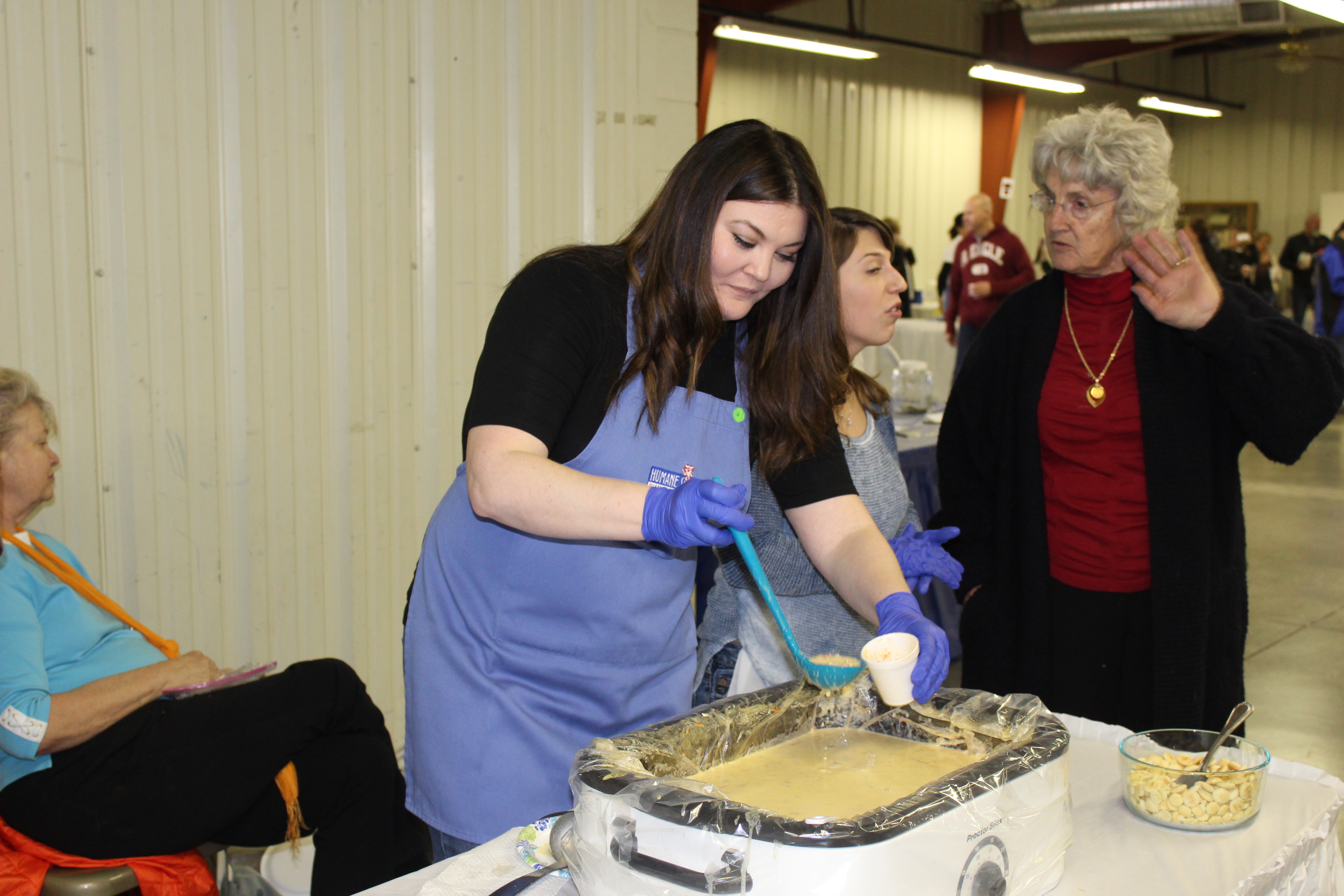
The Humane Society of the High Plains is expanding its space for the annual Soup ‘R Bowl, which will be 11 a.m. to 1 p.m. Jan. 27 at the Ellis County Fairgrounds.
In years past, the event had been only in the Unrein Building, but this year the Humane Society has added the Schenk Building.
Alicia Tripler, Humane Society board president, said the board hopes the added space will help participants move between the soup stations more easily. Several vendors will also share with participants how their products and services relate to pets and pet owners.
Tickets are $7 in advance and $8 at the door. Tickets can be purchased in advance at Cerv’s; Petsense, 2508 Vine St.; Barkley Suites, 2202 Vine; Big Creek Veterinary Service, 2807 U.S. 183 Bypass; Fur is Flying, 700 E. Eighth; Hays Veterinary Hospital, 700 E. Eighth; Hillside Veterinary Clinic, 5250 Vine; and the Humane Society of the High Plains, 2050 E. Highway 40.
The event will have 14 soup stations this year. Some of the soup entries this year include taco soup, cheeseburger soup, vegetable dumpling soup, loaded baked potato, Italian soup, cheesy broccoli, vegetable dumpling, and one of last year’s favorites — Traeger brisket chili.
In some past years, chefs have run out of the most popular soups before the end of the event, but Tripler said this year all of the chefs have pledged to make enough soup to serve all attendees. This is equal to at least 10 gallons of soup per chef. Past events have served as many as 800 people.
The Humane Society also will offer for sale stamped bricks for the Humane Society Herb Garden, desserts, T-shirts and cookbooks containing recipes for all this year’s soups, plus the winner from last year. The T-shirts will have slogans such as “Adopt” and “Dog Hair Don’t Care” with the Humane Society logo on the back. There will also be a raffle.
The Humane Society hopes to raise at least $5,000. The money raised is dedicated to medical services for animals that come into the shelter. In 2018, the humane society spent $17,000 on animal medical care.
“Many times when the animals come in, they need medical treatment, whether they have an illness or a broken bone or they need their teeth cleaned or removed sometimes,” Tripler said. “We partner with local vets for the services for the Humane Society, but we do have to pay for those medical expenses.
“We appreciate the support from the community,” she added. “We are always pleasantly surprised how many people turn out for the event. We can’t wait to see everyone this year and see how they react to the additional space.”
John Richard Schrock is a professor at Emporia State University.
“You should probably know that one of your ancestors was an American President,” my Mom told me one day. I was in fifth grade, so probably about 11 years old. And I had never heard my relatives talk about an ancestor who was President.
“Which one?” I asked.
“James K. Polk,” she answered, and went on with her housework with no further words.
I could hardly wait to get to school. I was a kid who did my homework. So I always had extra time while the teacher worked with other students. A nod from the teacher and I headed straight back to the reference books. I was already working my way through the encyclopedia page-by-page, reading those things that were most interesting (and most were). But I had not yet arrived at the “P’s’.
And there it was: James K. Polk.
My first question was what his middle initial “K” stood for (remember, I am just in fifth grade). It is “Knox.” My Dad worked on road construction—we moved around a lot—and I had just spent the prior semester going to school in Knox, Indiana. Strange to name a place after a person’s middle name. “Probably some other Knox” I correctly guessed. But what did this president do? I read on.
Oh, dear!
You do not see prominent statues of President Knox in the Capitol or read much about him today. He was the great invader, the man who put our nation’s “Manifest Destiny” into action with vengeance. At that time, the U.S. had no West Coast. Mexico extended up through what is now California. And Britain held all property from there northward to Alaska (at that time Russian).
There were two major parties back then, the Whigs and the Democrats. Polk was an expansionist and the 1844 Democratic platform advocated that the entire region held by Britain, from Oregon north to the southern edge of Alaska, should be claimed for America. That northern limit was at a latitude of 54 degrees 40 minutes North, leading expansionists to shout “Fifty-four forty or fight!”
At the Democratic Convention, Polk was a “dark horse” candidate, only nominated by the ninth ballot. As our 11th President, Polk settled the dispute with Britain by extending the Canadian boundary along the 49th parallel. Britain wanted to avoid war. The treaty was signed in 1846.
Then he started “Polk’s War.” Most Americans, including Congress, were not in favor of this war just to seize land. Polk was a skilled liar, a politician and supremely arrogant.
As a little kid, I could read between the lines where the encyclopedia tried to smooth over the atrocities. Today, the book “Invading Mexico” by Joe Wheelan provides even more details.
What is now New Mexico, Arizona and California belonged to Mexico. Mexico had won them in a war with Spain 25 years earlier. But Mexico was no military power, having lost their war with Texas 10 years earlier.
Polk sent a message to the retired General Santa Anna (the general who lost Texas) in Cuba asking him to now help the U.S. against Mexico. Instead, Santa Anna returned to Mexico, became president, and led their unsuccessful defense of Mexico.
The Polk War took a terrible toll on Mexico civilians due to our massive shelling of villages. American troops eventually occupied Mexico City. Polk’s War ended with the Treaty of Guadalupe Hidalgo on February 2, 1848. Our North and South now debated how slavery would expand into these new territories and the drumbeat to our Civil War quickened. That is why you will find no national monuments to this Mexican War of 1846-48. Polk was a one-term President and died in 1849.
It takes the long hindsight of history to fully evaluate a Presidency. There are certainly other candidates for “worst President in history.” Andrew Jackson, William McKinley, Warren Harding and James Buchanan often make scholars’ “worst list” too. That is a lot of embarrassed descendants.
As a little kid, I remember thinking how it might be wise if we let people run for President only if they had no offspring. Then there would be no need for little kids to hide their ancestry.
John Richard Schrock is a professor at Emporia State University.
Appropriations Committee
The Kansas Legislature had a condensed week this week while we observed Martin Luther King, Jr. Day on Monday, an ice and snow storm blanketed Topeka Tuesday night. Due to the ice and snow, the Kansas Legislature did not reconvene until late Wednesday morning. Due to the delay and the safety of our staff, the Appropriations Committee canceled the meeting for Wednesday morning.
On Thursday, the Appropriations Committee did have hearings from a varied list of agencies. Due to Governor Kelly’s budget proposal on reamortizing the unfunded liability for the Kansas Public Employee Retirement System (KPERS), we had the executive director, Alan Conroy, give a presentation on the status of the KPERS system.
We then had an update from the Kansas Department of Agriculture that presented the current details of the agriculture sector. Their main focus was regarding commodity prices, credit, trade, agriculture economics, and the recently passed farm bill by Congress.
The final information briefing was an overview of the Joint Legislative Transportation Task Force, of which I was a member. The Research Department detailed the subject matter of each meeting we had across the state of Kansas and the future transportation plan.
Kansas Watershed Annual Meeting
On Tuesday, January 22nd, Senator Dan Kerschen, chairman of the Senate Agriculture and Natural Resources committee, and I spoke at the Kansas Watershed Annual meeting. Senator Kerschen gave a detailed explanation about some of the bills that were passed last session regarding agriculture. I discussed the current budgetary status for the state of Kansas. I also gave an overview of Governor Kelly’s budget that was released last Thursday and the direction that I see the House Appropriations committee will take to address the state budget. Thank you to all of the individuals that were there from the Wet Walnut Creek Watershed in Rush County.
Bills Introduced
As with any legislative session, there are numerous bills that have already been introduced by either committee, individual legislators, or interest groups.
In the Appropriations Committee, the only bill introduced, at this time, is Governor Kelly’s bill to address the Kansas Supreme Court decision for K-12 education. It was introduced as a formality; other education bills, I presume, will also be introduced.
Some other legislation that has been introduced vary from eliminating day light savings time in Kansas, restrictions on legislators becoming lobbyists, to election crimes and penalties. As the session continues, I will focus on some of the noteworthy items of legislation that have been introduced.
Contact Information
As always, if you have any concerns, feel free to contact me (785) 296-7672, follow on twitter at #waymaster4house, visit www.troywaymaster.com or email me at [email protected]. Also, if you happen to visit the statehouse, please let my office know.
It is a distinct honor to serve as your representative for the 109th Kansas House District and the state of Kansas. Please do not hesitate to contact me with your thoughts, concerns, and questions. I always appreciate hearing from the residents of the 109th House District and others from the state of Kansas, as well.
Troy Waymaster (R-Bunker Hill) is the 109th Dist. state representative and chairman of the House Appropriations committee. The 109th District includes Osborne, Russell, and Smith counties and portions of Barton, Jewell, Lincoln and Rush counties.
Blue Cross and Blue Shield of Kansas has recognized HaysMed, part of The University of Kansas Health System, as a Blue Distinction Center+ for Cardiac Care as part of the Blue Distinction Specialty Care program. Blue Distinction Centers are nationally designated providers that show expertise in delivering improved patient safety and better health outcomes, based on objective measures that were developed with input from the medical community and leading accreditation and quality organizations.
According to the American Heart Association (AHA), cardiovascular disease is the leading cause of death globally and is expected to claim more than 23.6 million lives annually by 2030. Blue Distinction Centers+ for Cardiac Care seek to empower patients with the knowledge and tools to find quality cardiac care.
To receive a Blue Distinction Center+ designation, HaysMed demonstrated expertise in delivering safe and effective cardiac care, focusing on cardiac valve surgery, coronary artery bypass graft (CABG), and percutaneous coronary interventions (PCI) episodes of care. Additionally, HaysMed also demonstrated better cost-efficiency compared to their peers.
Only those hospitals that first meet nationally established quality measures for Blue Distinction Centers are considered for designation as a Blue Distinction Center+.
“HaysMed has always been committed to providing cardiology services to people in western Kansas.” said Jeff Curtis, Cardiology and Administrative Director of HaysMed Debakey Heart. “Twenty years ago we were the first and are still the only cardiology program in western Kansas to provide cardiology services including heart surgery. This Distinction is recognition for the commitment we have made to making cardiology services available to all patients.”
Hospitals recognized with this designation are assessed using a combination of quality information supplied by hospitals and third party data registries, and cost measures derived from Blue Cross and Blue Shield companies’ medical claims.
Since 2006, the Blue Distinction Specialty Care program has helped patients find quality specialty care in the areas of bariatric surgery, cancer care, cardiac care, cellular immunotherapy, fertility care, gene therapy, knee and hip replacements, maternity care, spine surgery, and transplants, while encouraging health care professionals to improve the care they deliver. Research shows that compared to other providers, those designated as Blue Distinction Centers demonstrate better quality and improved outcomes for patients. On average, Blue Distinction Centers+ are also 20 percent more cost-efficient than non-Blue Distinction Center+ designated providers.
For more information about the program and for a complete listing of the designated providers, visit www.bcbs.com/bluedistinction.
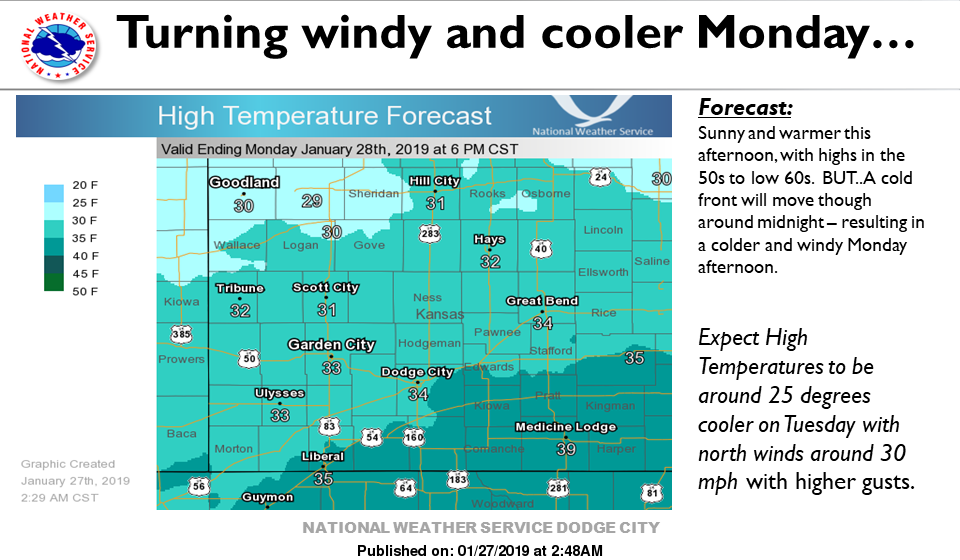
Partly sunny, then gradually becoming sunny, with a high near 58. West southwest wind 6 to 11 mph increasing to 12 to 17 mph in the afternoon.
Tonight
Mostly cloudy, then gradual clearing toward daybreak, with a low around 30. Blustery, with a southwest wind 13 to 21 mph becoming north northwest after midnight.
Monday
Sunny, with a temperature falling to around 28 by 5pm. Very windy, with a north northwest wind 22 to 32 mph, with gusts as high as 45 mph.
Monday Night
Mostly clear, with a low around 18. Wind chill values as low as 5. Blustery, with a west wind 16 to 21 mph decreasing to 6 to 11 mph in the evening.
Tuesday
Sunny, with a high near 38. Northwest wind 11 to 18 mph, with gusts as high as 30 mph.
Jeremy Gill, a recent graduate of Fort Hays State University with master’s in history, will speak about aspects of his master’s thesis, “Cavalry to Campfires: The Politics of Preservation in Frontier Historical Park,” on Monday, Jan. 28, during the Ellis County Historical Society annual meeting. There will be a membership business meeting at 7 p.m. followed by Gill’s presentation at 7:45 p.m.
Doors open at 6:30 p.m. for membership and sponsorship renewals. Membership cards will be available during registration.
Both the meeting and presentation are free and open to the public.
Located at 100 W. Seventh, the Ellis County Historical Society, founded in 1972, collects, preserves, and exhibits items and documents that illustrate the history of Ellis County.
PRATT – Kansas Wildlife, Parks and Tourism Commissioners drew names for Commission Big Game permits at their Jan. 17, 2019 public meeting. The Commission Big Game Permit program allows conservation organizations a chance to draw one of seven big game permits, which can then be sold to raise funds for conservation projects. One-hundred-seventy-six applications were received for the 2019 permits.
Eligible applicants include local chapters of nonprofit organizations based or operating in Kansas that actively promote wildlife conservation and the hunting and fishing heritage. Organizations may receive just one Commission Big Game Permit in a three-year period.
One elk, one antelope or up to seven deer permits are issued each year, depending on applicant preference. The permits are either-species/either-sex and are valid statewide during any season with legal equipment for that season; they do not count against other big game permits the license holder is eligible for.
Once the permit is sold, the cost of the permit, plus 15 percent of the total sale price, is subtracted and kept by the organization, while the remainder is remitted to the Kansas Department of Wildlife, Parks and Tourism with a proposal for a conservation project. When the project is approved, the money is returned to the organization to complete the project.
All organizations drawn this year selected deer permits, so seven Commissioner Big Game Deer Permits are available from the following conservation groups:
National Wild Turkey Federation – Arkansas Valley Limbhangers Chapter, Jared McJunkin, Director of Conservation Operations, 5632 Legends View Dr., Wamego KS 66547, [email protected], 785-456-9735
Friends of NRA – Caldwell #KS-41 Chapter, Brad Dreier, Sr. Field Rep, 5856 S Lowell Blvd, Ste 32-313, Littleton CO 80123, [email protected], 720-232-7601
Pheasants Forever – Solomon Valley Chapter #450, Chris Blackledge, Regional Rep., 503 Ravine Dr., Council Grove KS 66846, [email protected], 620-767-2121
Pheasants Forever – Flint Hills Chapter #739, Chris Blackledge, Regional Rep., 503 Ravine Dr., Council Grove KS 66846, [email protected], 620-767-2121
Quail Forever – Neosho Valley Chapter #3165, Chris Blackledge, Regional Rep., 503 Ravine Dr., Council Grove KS 66846, [email protected], 620-767-2121
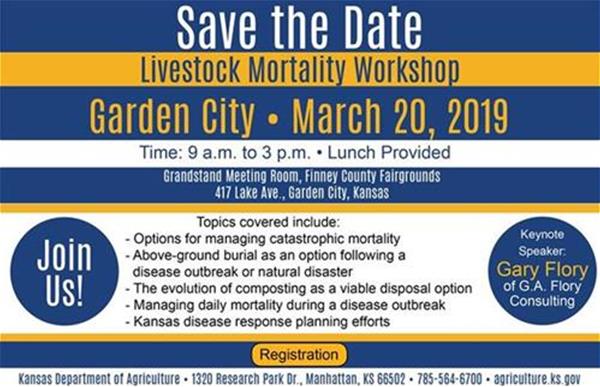
MANHATTAN — The Kansas Department of Agriculture is sponsoring a Livestock Mortality Workshop in Garden City on March 20 for cattle, swine and dairy owners to learn about options for managing large-scale mortality in their herds. The workshop will feature a keynote presentation by Gary Flory of G.A. Flory Consulting, a nationally recognized expert in agricultural and environmental challenges as part of animal disease and natural disaster response.
The Livestock Mortality Workshop will take place in the Grandstand Meeting Room at the Finney County Fairgrounds at 417 Lake Ave. in Garden City on Wednesday, March 20, from 9:00 a.m. to 3:00 p.m. The workshop is free of charge and lunch will be provided, but registration is requested.
In addition to the keynote speaker, participants will receive information related to biosecurity, secure food supply planning and Animal Health Commissioner Justin Smith will also provide an update on Kansas’ disease response planning efforts. Other presentations will cover a variety of topics related to options for managing catastrophic mortality, including above-ground burial, the evolution of composting as a viable disposal option, and managing daily mortality during an outbreak.
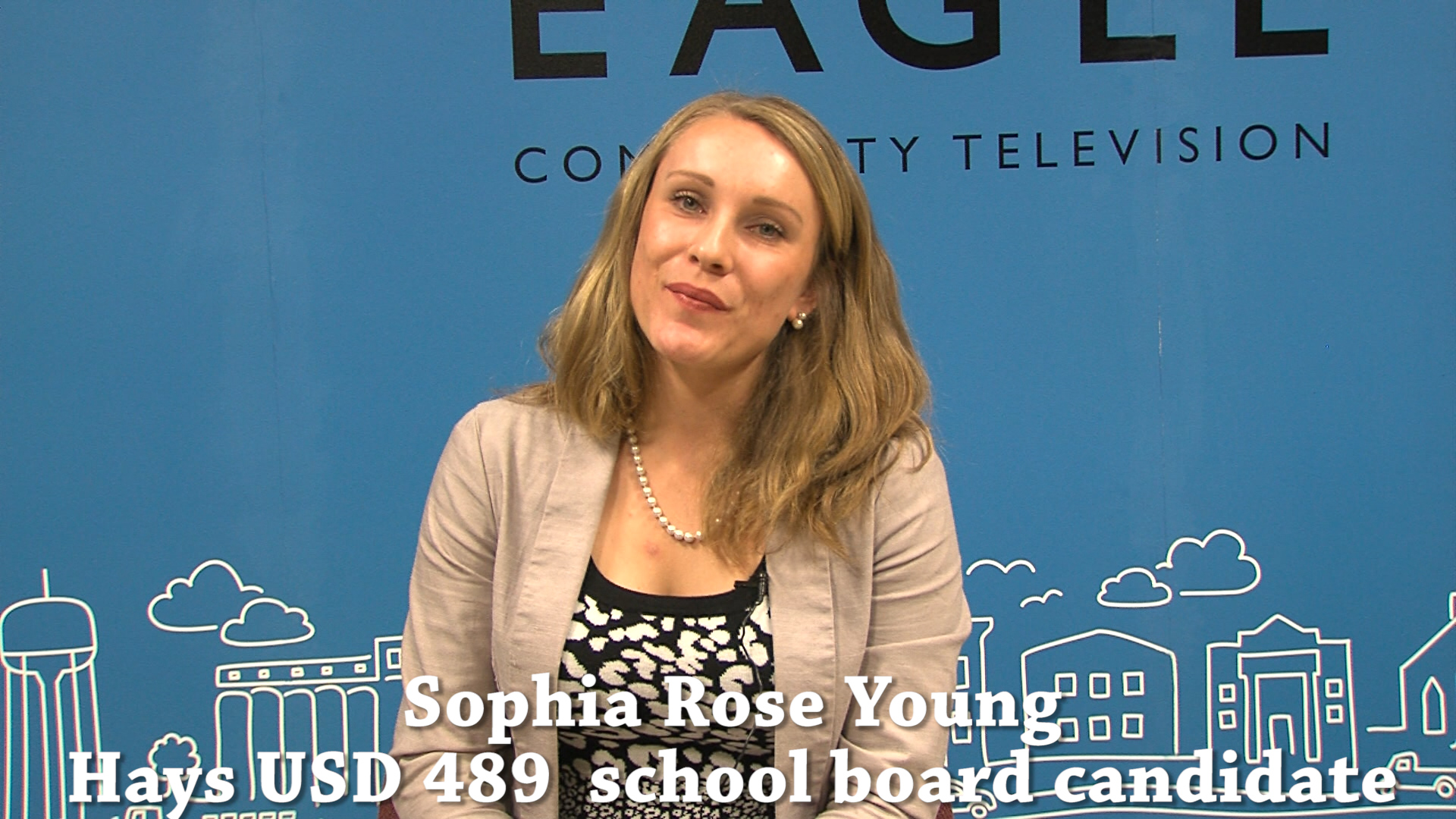
 Board member Sophia Young has been recognized by the Kansas Association of School Boards for earning her Level Two Certificate for board member training.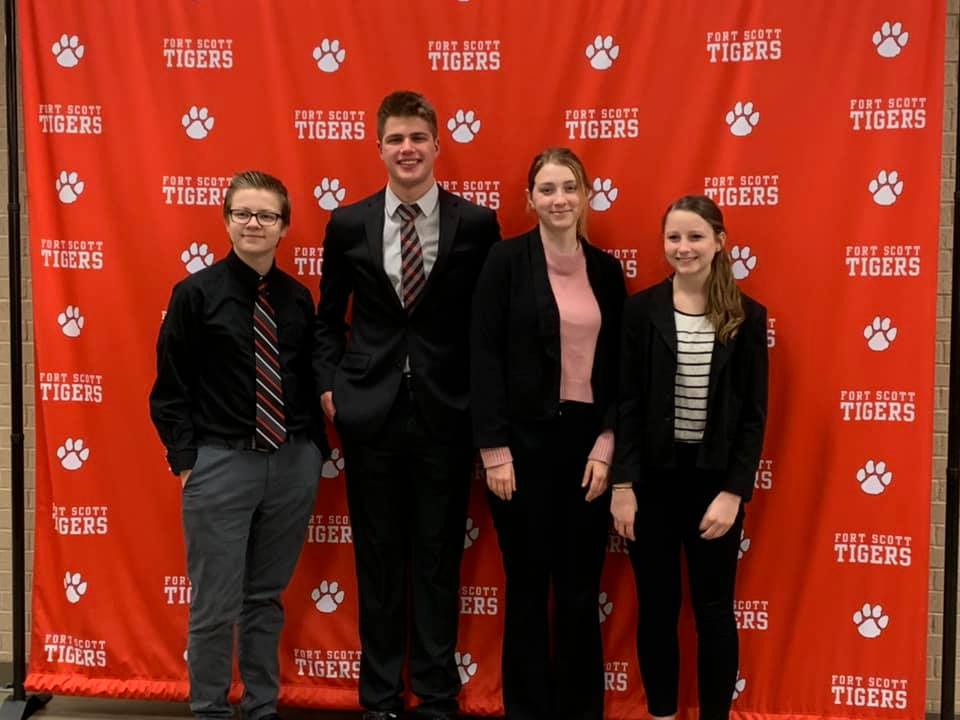
 The TMP four speaker debate team competed at 3-2-1A State at Fort Scott the weekend of Jan. 12 and placed fourth overall.


 By CRISTINA JANNEY





 Today
Today