Every year, students participate in the Scripps National Spelling Bee, one of the nation’s oldest and most iconic competitions.
They progress from the classroom to cafeteria or auditorium, just as millions of other students have done before them.
An average of 11 million students a year, participate in spelling bees.
The TMP-M JH Spelling Bee winner was Delaney Staab with Jensen Brull, Karlyn Rohr, Kadrian Ayarza and Harlie Schmidt following in succession.
Staab took the first-place medal with the word container. From start to finish, the competition took 38 minutes.
The top four participants will compete at the Ellis County Spelling Bee on Jan. 29. Harlie Schmidt, alternate, will attend the Ellis County Spelling Bee if one of the other participants is unable to attend.
Improving spelling, increasing vocabularies and developing correct English usage will aid students the remainder of their lives.
Teachers from USD 248 Great Bend, USD 489 Hays, and USD 350 St John-Hudson are among the more than 3,900 teachers nationwide who achieved the highest professional credentials they can earn – they attained first-time certification from the National Board for Professional Teaching Standards in 2018.
Traci Miller, from USD 248, Kristy Oborny, from USD 489, and Angie Webb, from USD 350, are now national board certified teachers.
Miller teaches second grade at Riley Elementary School in Great Bend and earned her certification in exceptional needs specialist/early childhood through young adulthood.
Oborny teaches fourth grade and is the librarian for O’Loughlin Elementary in Hays and earned her certification in literacy: reading-language arts/early and middle childhood.
Webb is a technology teacher at St John Elementary School and earned her certification in literacy: reading-language arts/early and middle childhood.
National board certification is recognized nationwide as a model for identifying accomplished teaching practice. Teachers were notified in December if they achieved the certification.
“This process of board certification is similar to how a doctor becomes certified in a special area,” said Alvin Peters, director of Emporia State University’s program which assists teachers working toward national certification. “This is voluntary – no state, school district, or program is demanding them to go through this process and each teacher can take from one to three years to complete the process.”
Before certification, teachers must have a bachelor’s degree, a valid state teaching license and three years experience in the classroom. Miller is the lone national board certified teacher in USD 248 Great Bend. USD 489 Hays now has 12 with the addition of Oborny. Webb is the lone national board certified teacher in USD 350.
The national board process is often misunderstood to mean a teacher passed a test or was nominated for the award. Peters adds, “National Board certification is a different kind of honor. Teachers must submit extensive documentation of their instruction, including videos of their students at work in the classroom.”
The accomplishment of national board certification benefits the teachers, the schools they work in, and studies have shown NBCTs improve student learning. The program hosted at ESU, Great Plains Center for National Teacher Certification, has a 78% initial certification rate over the past 13 years. This is nearly twice the national initial certification rate of 40%.
The national board standards were created by teachers. The standards represent a consensus for 25 certificate areas in 16 disciplines, including art, English, mathematics, science, world languages, school education and physical education, from pre-kindergarten through high school and six student development levels from early childhood through adolescence.
Kansas currently has a total of 449 national board certified teachers. To date, more than 122,000 teachers in all 50 states are NBCTs.
The National Board for Professional Teaching Standards was launched in 1987. A decade of research shows board-certified teachers positively impact student learning. The goal is to create standards for high-quality teaching and to professionalize teaching through licensure, following the lead of fields like medicine, engineering, and architecture. More information about ESU’s program can be found at www.emporia.edu/teach/great-plains/.
Alicia BoorSevere winter weather is not only hard on people but can be a life and death struggle for birds.
Though birds also require water and shelter, food is often the resource most lacking during cold weather. Many different bird food mixes are available because various species often prefer different grains. However, there is one seed that has more universal appeal than any other: black oil sunflower. If you are new to the bird-feeding game, make sure there is a high percentage of this seed in your mix. White proso millet is second in popularity and is the favorite of dark-eyed juncos and other sparrows as well as the red-winged blackbird.
As you become more interested in bird feeding, you may want to use more than one feeder to attract specific species of birds. Following is a list of bird species with the grains they prefer.
• Cardinal, evening grosbeak and most finch species – sunflower seeds, all types.
• Rufous-sided towhee – white proso millet.
• Dark-eyed junco – white and red proso millet, canary seed, fine cracked corn.
• Many sparrow species – white and red proso millet.
• Bluejay – peanut kernels and sunflower seeds of all types.
• Chickadee and tufted titmouse – peanut kernels, oil (black) and black-striped sunflower seeds.
• Red-breasted nuthatch – oil (black) and black-striped sunflower seeds.
• Brown thrasher – hulled and black-striped sunflower seeds.
• Red-winged blackbird – white and red proso millet plus German (golden) millet.
• Mourning dove – oil (black) sunflower seeds, white and red proso plus German (golden)millet.
Extended cold periods can also make water unavailable. A heated birdbath can be a tremendous draw for birds during times when all other water is frozen. Energy use is usually less than what most people expect IF the heater has a built-in thermostat.
If you would like more information, Chuck Otte, Agriculture Extension Agent for Geary County has a series of backyard birding guides at https://gearycountyextension.com/NRMW.htm
Alicia Boor is an Agriculture and Natural Resources agent in the Cottonwood District (which includes Barton and Ellis counties) for K-State Research and Extension. You can contact her by e-mail at [email protected] or calling 620-793-1910
It was another busy week on the KAYS Eagle Morning Show. Here’s what you missed last week!
Monday
TMP-Marian STUCO Secretary Leanne Rack and President Ethan Lang
Leanne and Ethan joined the show to talk about their roles in Student Council and the upcoming Catholic Schools Week:
Rack and Lang explain what their jobs are in Student Council
Here’s what STUCO has planned for Catholic Schools Week next week
Tuesday
Ellis County Commission Recap with Jonathan Zweygardt
Jonathan was joined by county administrator Phillip Smith-Hanes and new county commissioner Dustin Roths to review this week’s Ellis County Commission meeting:
Dustin Roths introduces himself to the Eagle Morning Show
Consent to Annexation of Non-Adjoining Land into the City of Hays for Property Located at 183 Bypass and West 33rd Street
Stacy made his monthly visit to the show to talk about upcoming ag programs:
Stacy gives us the dates, times and information of the grain sorghum school on February 6th and the farm land lease meeting on February 12th.
Protect & Serve: Ellis County Fire Chief and Emergency Manager Darin Myers
Darin Myers joined the Eagle Morning Show to talk about fire prevention in the upcoming spring months:
Making an effort around your home to prevent fires
Thursday
USD 489 Report: Hays Middle School Principal Tom Albers
Mr. Albers joined C.D. and Mike to talk about what’s going on at the middle school in the second semester:
Update on the second semester activities at Hays Middle School
The Eagle Morning Show airs LIVE on KAYS (1400 AM/94.3 FM), Eagle Channel 14 & 614, and on the KAYS App or TuneIn from 7-9am on weekday mornings. Here’s what’s coming up next week on the Eagle Morning Show:
Heidi Wamser, Roosevelt kindergarten teacher, stands outside of her class in front of her students’ hand prints and melted snowmen art.
Editor’s note: This month’s Hays Post Teacher of the Month was awarded a special prize. Heidi Wamser, Roosevelt kindergarten teacher, will be the honorary game captain at the Harlem Globetrotters game Feb. 5 at Gross Memorial Coliseum.
By CRISTINA JANNEY Hays Post
When you walk into a classroom full of students who love you and are all excited to be at school, it is an easy place to be, said Heidi Wamser, Roosevelt kindergarten teacher.
Wamser is in her 19th year of teaching kindergarten, all of which have been in Hays USD 489 schools.
She was nominated to be January’s Hays Post Teacher of the Month by parent Brandi VonLintel.
“Throughout every parent’s journey in their child’s education, many of us are lucky to have teachers like Mrs. Wamser,” VonLintel wrote in her nomination. “She taught my child four years ago and still has left an imprint on him to this day.
“Helping in her classroom throughout his year with her, I saw exactly what every child got to experience while in her care. She has the ability to inspire, ignite imagination and truly care about her students — going above and beyond to provide extra activities and special treats throughout the year.”
VonLintel continued, “I cannot thank her enough for helping instill the love of learning in my child, and I know without a doubt that she will continue to do this for all of her classroom children throughout her career.”
Wamser said she loves teaching kindergarten because of the kids.
“The biggest thing is that they still love every minute of being at school,” she said. “They love each other. They love their school. They love their teacher.
“Plus the math gets super harder as you get older, and I am not good at math,” Wamser joked.
Wamser said her favorite part of teaching the littlest students is when they learn something new.
“I think the best is the light in their eyes and the moment they actually figure something out they have been working so hard on,” she said. “You can literally see the light bulb go on by the smile on their face or you can see their shoulders aren’t hung anymore.
“I always try to tell them, ‘Look what you did! Look what you figured out!’ So that they know this was on you. This is not me. It wasn’t me who figured it out. You did. You are 5 or 6 and you read that book or you wrote that story or you did that math problem. I don’t think you see that kind of joy and love in classroom work at the upper grades as much.”
Wamser comes from a family of teachers. Both her father and mother were teachers. Her mother taught for more than 30 years at Munjor and then at Wilson Elementary School.
“I saw the work she put in,” Wamser said. “She was a first-grade teacher and then switched to second grade. Weekends, nights, holidays — she was always at school. I knew that it was going to be a difficult profession, but yet so rewarding in the end.”
Wasmer said she has seen that reward in her career. She has the opportunity to touch the lives of the 23 children in her class seven hours per day for 10 months out of the year.
“Everyone’s profession is important,” she said. “One couldn’t do something without another. But when you think about it, lawyers couldn’t be lawyers without a teacher. Doctors won’t be doctors without a teacher. A teacher has to touch every single person’s life. No matter what their outcome is as a job or profession, they are influenced by a teacher all the time. It is a pretty powerful position to be in.
“People who teach are amazing individuals. It is a lot when you sit down and think about it.”
She takes that position of power seriously. She described kindergarten as the children’s ground floor. She builds on that ground floor through positive reinforcement, teamwork and success.
When a child accomplishes a task, Wamser encourages the child to share the accomplishment with his or her friends.
“For instance if Legos was in groups this week and someone created their snowmobile, we show the entire class. Everyone gives that child a round of applause and we take their picture and we post it — so parents can see and their friends can see. It becomes an important thing, and it drives them in the end to create again. When they have another group like that, they are more apt to work hard to see if they can get to that point again.”
One of Wamser’s great honors in her teaching career was teaching both of her daughters. During school hours, the girls had to address their mother as Mrs. Wamser, but it was still “Mom” at home. The children in her class didn’t figure out until January when her oldest daughter’s birthday rolled around the two were related. The children in her youngest daughter’s class didn’t figure out the relationship until almost spring break when the class started talking about last names.
“Not treating them differently was tricky, because I am Mom, but yet being able to see everything that they were experiencing at a kindergarten level because I was the teacher, that was pretty amazing,” she said.
In January, Wamser focuses lessons on Martin Luther King Jr. and the holiday that celebrates his birthday. She wears a “Teach Peace” T-shirt and the children participate in an activity involving eggs. This activity provoked one of her favorite teaching memories.
Wamser brings in eggs that are brown, white, speckled and sometimes blue. The children talk about how the exteriors of the eggs look very different. She then asks the children what they think the eggs will look like on the inside. Most of think the eggs will look very different on the inside. She cracks the eggs and all of the eggs look the same on the inside.
She has the children look at their skin and hair. They notice that they all look a little different.
One year, Wamser had a boy in her class whose father was from Africa and had dark skin. When the children compared skin, it was if for the first time he realized that his was different.
“At 5 years old, it took 87 days for him to figure out, ‘I’m different on the outside,’ but in kindergarten you can make them believe they are all the same. They are all 5 and 6 years old. They all look the same. They all feel the same. …
“Then all of the other kids were,’So, who cares that you look different on the outside?’ By that time we had opened up all the different eggs, and the kids said, ‘But you are the same on the inside. You’re our friend, and that makes you like everybody else.’ I tear up, because they are so innocent and so lovingly blind to the fact people are different. What point do they change and become nasty to each other? Everyone needs to see that lesson from a 5 and 6 year old’s eyes — to see, ‘No, everybody’s the same.’ ”
She said she walks away from instances like that and thinks, “Thanks for teaching me something today.”
Wamser tries to end each day with a moment of love and reassurance. Each child can opt for a handshake, high five or a hug as they leave her class.
“I feel they walk out with something positive even if it has been a really cruddy day or something happened. So the next day they are still going to know that Mrs. Wamser is still going to love you. She is still going to be right here at the door. Sometimes the most normal part of a child’s life is that seven hours they are at school in the day.”
A unanimous vote to approve a rezoning request in east Hays was preceded by discussion among city commissioners Thursday night about rezoning procedures and notifications to the public.
The request had already been approved by the Hays Area Planning Commission during a public hearing Dec. 17, 2018.
Luke Oborny lives at 1720 Wheatland Ave. His home is near the property at the southeast corner of 22nd and Wheatland that was approved for rezoning from neighborhood to commercial.
Luke Oborny wants Wheatland Avenue to remain a Neighborhood zone.
Oborny said he feels the requirement for notification of property owners within 200 feet of the rezoning request “isn’t very far” and should be increased. “We would like Wheatland Avenue to remain residential.”
Speaking to the city commissioners before they voted, Oborny said he and his wife Kristy were not notified of the public hearing by the planning commission and felt they should have been contacted.
Mayor Henry Schwaller noted the planning commission is a legally separate entity from the Hays city commission.
“We can’t tell them what to do but they could consider a bigger notification area,” Schwaller said.
“They can,” confirmed John Bird, city attorney. “That makes sense to me,” added Schwaller. “[Oborny’s] house is not very far away.”
“The process doesn’t feel right or transparent,” Oborny added. He was also concerned about the variety of commercial operations allowed in the requested C-2 Commercial General District zoning. “What does it leave out?”
According to the city’s Unified Development Code (UDC), C-2 zoning includes 28 allowable businesses, from offices and group day cares to drinking establishments and gas stations.
“This lot would not be appropriate for most of these uses, but some of them, yes. Regardless of our business tonight, would we want to revisit this in a future discussion and change the zoning groups?,” Schwaller asked the commission.
“We’re not supposed to know what’s going to go there but they’re seeking this so they can operate a business.”
Jesse Rohr, public works director, told the commission all property owners within 200 feet of the subject property were notified of the Planning Commission public hearing, as required by state statute.
Property to the north, south and east is zoned residential, including general, single family and duplex, and multi-family.
The property across Wheatland Street to the west is zoned C-2 and is the site of the Kansas Dept. of Children and Families building.
Commissioner Sandy Jacobs said she appreciated the Obornys coming to the meeting with their concerns.
“It seems to me the use that’s being requested is pretty complementary for that area given the fact that North Central Kansas Technical College is across the street and the hospital is across the street,” Jacobs pointed out. Both institutions are on the north side of 22nd Street.
(Click to enlarge)
“Since C-2 zoning is across the street (west to Canterbury) and as you go east to the other end of 22nd to Bruckner’s, it feels right to me for that whole thing,” she said, adding she’s also in favor of any future discussion about zoning.
“A lot of the things in C-2 can be eliminated because of this lot size,” noted Commissioner Ron Mellick.
“The letter of the law was followed,” said Commissioner James Meier, “but Mr. Oborny feels like it wasn’t above board, perhaps.
“… I do think that we need to be very cognizant of being completely above board and giving everybody notice. I understand the 200-foot rule or notification comes from the state statute, but I agree there’s no reason why we can’t give more notice.”
Indian Call candidates for Hays High School have been selected. The king and queen will be announced between the girls and boys basketball games on Feb. 8.
2019 Hays High Indian Call candidates: Front row – Alyssa Underwood, Hannah McGuire, Madyson Flax, Brittany Pflaum, Hannah Harman. Back row – Tradgon McCrae, Cade Swayne, Jack Fort, Johnny Fuller, Jacob Maska.
A new rocket-powered ice cream truck might bring you ice cream from the moon someday if some ambitious entrepreneurs from Wilson Elementary have anything to say about it.
Hays High DECA students are celebrating entrepreneurship this week with an elementary student product build and a speaker.
DECA at Wilson
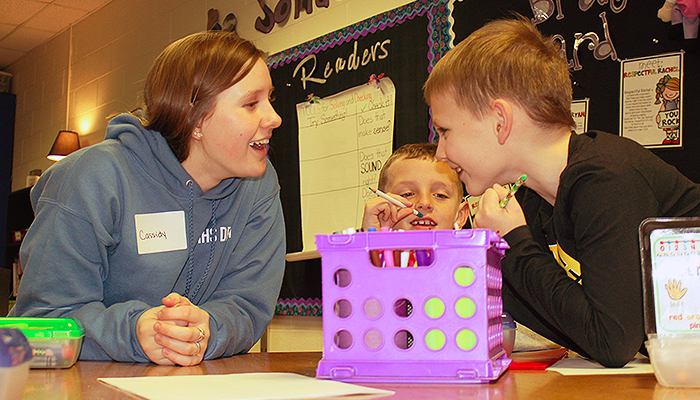
Cassidy Prough, HHS DECA student, discusses the rocket-powered ice cream truck that Wilson students Ben Zeller and Braxton Delzeit have created for their entrepreneurship project.
With the aid of DECA students, the first-grade students drew their creations Wednesday. On Friday, they will build the products out of Legos, present to the class and explain where they would sell their products.
One group of Wilson students created a rocket-powered ice cream truck that would sell alien ice cream.
Another group drew pictures of cherry, strawberry and other food-shaped inflatables for swimming pools.
Another group developed their own Fortnite characters, while two other groups drew images of various designs for jets and airplanes.
“We are trying to promote entrepreneurship around the community,” Madelyn Waddell, junior DECA student, said. “We wanted to use Legos for the kids to express their creativity. We picked the first graders because they are in the middle of learning how to add up money and learning how to use their creativity to put it on paper or build it somehow.”
Although the cost of the students’ projects were supposed to be limited to $5, the students differed greatly on how much they thought their products should sell for.
One group of students who designed jets thought their planes should cost between $100 and $900.
Whereas the students who designed the Fortnite characters thought their in-game purchases should cost “$2,000 billion.”
On Wednesday, the HHS students also read the first graders a book about a person who was struggling to sell lemonade.
Former DECA student returns to HHS for speech
Allyson Werth, a former HHS DECA student and recent FHSU grad, speaks to Hays High students on Wednesday.
Also on Wednesday, HHS students were invited to hear Allyson Werth, a former HHS DECA student and recent FHSU grad, talk about her Farmhouse Crafts business.
Werth started her wooden sign business when she was still in college in 2016. She bought a commercial vinyl cutting machine from her father-in-law.
This allowed her to create custom signs for business windows, wooden signs and door mats. She also offers DIY workshops.
Her signs start at about $35 each. Because all of the signs are custom designs, she requires payment in advance.
Although she has sold to people of all ages and genders, she determined her target market was women between 20 to 50 living in the U.S. She has primarily marketed through word-of-mouth and social media, including Facebook and Instagram. She does giveaways through Facebook posts. She also offers coupons to returning customers.
“More than 50 percent of my customers are return customers, so it is very important that my customers are happy and satisfied with the work that I have given them,” she said.
She said community involvement is important. This helps her grow her customer base through personal interactions. She also gets advice from national social groups of other entrepreneurs and crafters.
In 2018, she launched on Etsy and shipped to 15 states. However, the additional cost and labor involved with handling Etsy orders led her to closing that account at the beginning of this year.
Since graduation, Werth has taken a full-time job in addition to her craft business. She said orders tend not to be stable in her business, which makes it difficult for her to rely on that as a sole source of income.
A home business takes a lot of self-discipline, but Werth said she enjoys being able to set her own hours, learn from her business and take on new challenges.
She also said she received a great deal of satisfaction knowing people enjoy her designs and are pleased with her work.
One of her goals is to start a website for her business this year.
“I always tell people to follow your dreams,” she said. “People are always going to say you are never going to make it in the real world having a business, so that is when you need to weed out that negativity and tell people you are going to make it. It may take awhile. You are not going to be a $100,000 company in a day. It is going to take years and years to build your experience before you get to where you want to be.”
“Many business owners say they are never where they want to be. They are always learning and growing to build their business.”
The theme of this year’s campaign is Passion to Paycheck. The co-chairs of the campaign are Hays High DECA members Brooke Denning, Cassidy Prough and Madelyn Waddell.
DECA prepares emerging leaders and entrepreneurs for careers in marketing, finance, hospitality and management in high schools and colleges around the globe. There are 215,000 members worldwide.
Hays High DECA is active in the community by organizing and conducting the annual Trick or Treat So Others Can Eat Food Drive, supporting and raising funds for Ronald McDonald House Charities of Wichita, and conducting various public relations campaigns as well as various related marketing projects. Hays High DECA members also compete at a state and international level.
A HHS DECA student works with Wilson Elementary first graders Jan Pulido-Ortiz, Noah DeBey, Ella Giebler and Carter Carlisle to create a new product that they could build and sell.Two Hays High DECA students read to first graders Wednesday at Wilson Elementary School.Ella Giebler, first grader, colors her product during a DECA project at Wilson Elementary School.
TOPEKA – The Kansas Department of Health and Environment (KDHE) has rescinded a boil water advisory for the city of Timken, located in Rush County. The advisory was issued because the city could not maintain the minimum required chlorine residual. Failure to maintain required chlorine residual levels may put the system at risk for bacterial contamination.
Public water suppliers in Kansas take all measures necessary to notify customers quickly after a system failure or shutdown. Regardless of whether it’s the supplier or KDHE that announces a boil water advisory, KDHE will issue the rescind order following testing at a certified laboratory.
Laboratory testing samples collected from the City of Timken indicate no evidence of contamination and all other conditions that placed the system at risk of contamination are deemed by KDHE officials to be resolved.
By a very small margin, Barbara (Barb) Wasinger was elected our new state representative, but I recently learned from a colleague who had visited her to discuss ways to increase voter participation of her allegations that certain residents of the 111th District tried to steal the election from her.
Who are these unscrupulous characters who wanted to torpedo this fine Republican’s chances for high office? According to Representative Wasinger, they are the notorious FHSU students. Apparently, Ms. Wasinger feels like the District can take their tuition money, their food money, their rent money, their beer money and the money they spend in the mall and downtown stores. They also pay city and state sales tax on most of these purchases. But when it comes to District representation in state government, their political participation is not welcome, if not illegitimate. These students “live” somewhere else, so let them vote somewhere else, seems to be her attitude, even though they spend well over half of their time and money in Hays.
If you think of what Hays would be without FHSU students, another WaKeeney, and the fact that state legislators control FHSU, determine state funding levels to offset tuition costs and set the tax structure that determines how much taxes college students pay, it seems blatantly unfair and un-American to deny them any say in who their state representative will be. Somewhere I heard, “No taxation without representation.” The City already burdens them with additional sales tax they wouldn’t pay at other Kansas universities. Now Wasinger wants them to pay state sales tax with no representation in the state legislature.
It is no secret. The tide is turning. Women, young people, ethnic minorities and now college students are finally realizing that the Republican Party caters to white, male fat-cats like Donald Trump, most of his cabinet and about 5% of his base. They are desperate at this point and looking for any way to suppress the Democratic vote. FHSU students will not be made second-class citizens just because they move to Hays to attend college or because they lean toward liberal political policies.
Ms. Wasinger will see a voter registration drive on the FHSU campus in 2020 that will show her what real democracy looks like. I invite her to speak at a Times Talk session to explain in detail the election fraud these students perpetrated on her campaign. Perhaps our champion against voter fraud, Kris Kobach, can help her stop the corruption she alleges. Nothing is more important for democracy than a valid and inclusive election.

 Every year, students participate in the Scripps National Spelling Bee, one of the nation’s oldest and most iconic competitions.



 Today
Today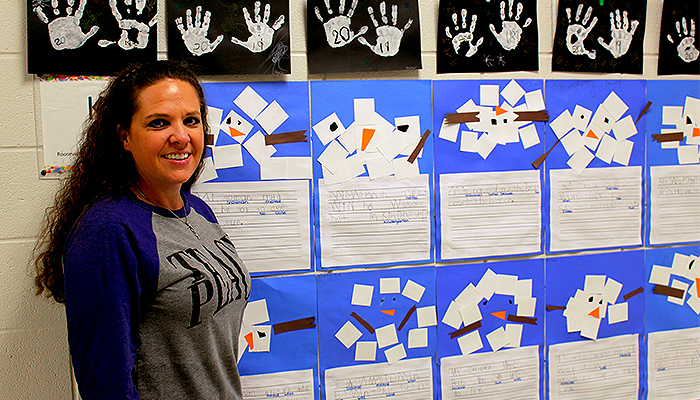








 “We are trying to promote entrepreneurship around the community,” Madelyn Waddell, junior DECA student, said. “We wanted to use Legos for the kids to express their creativity. We picked the first graders because they are in the middle of learning how to add up money and learning how to use their creativity to put it on paper or build it somehow.”