We have a brand new updated website! Click here to check it out!

TMP-M Folk Chorus reunited in song

Thomas More Prep-Marian

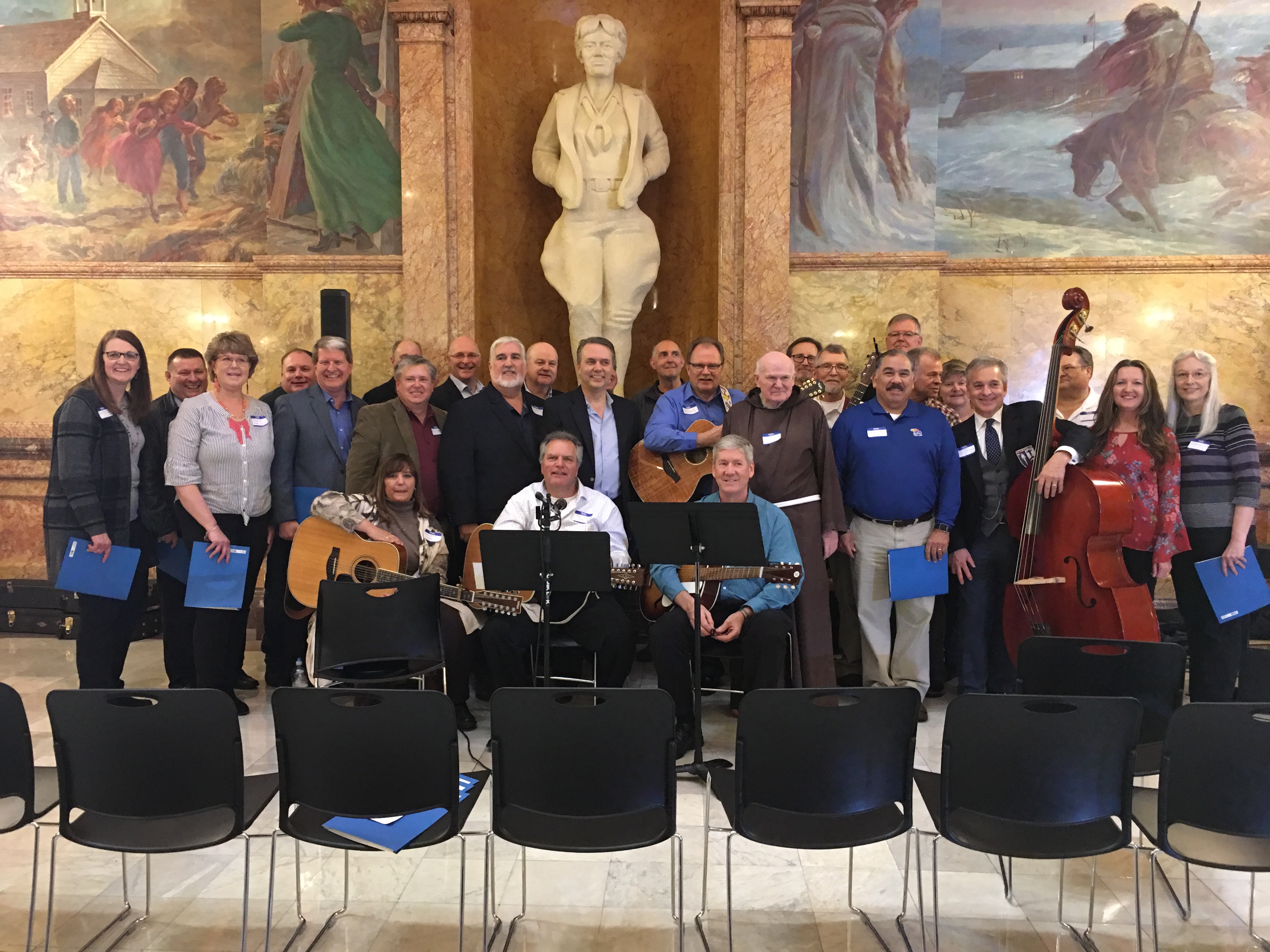
Fr. Mike Scully, O.F.M. Capuchin, wore many hats during his tenure at Thomas More Prep-Marian, teacher, administrator and is probably most remembered, as the leader of the original TMP Folk Chorus.  The Folk Chorus traveled extensively, performing at different venues including many masses throughout the year and even recorded several albums under the leadership of our beloved Fr. Mike.  Dr. Paul ’78 Camarata and Governor Dr. Jeff ’78 Colyer, conceived the idea to honor Fr. Mike Scully with a “Folk Chorus Reunion,” at the Kansas State Capitol Building in Topeka, on Saturday, January 5, 2019.  Wistfully, this was also the final weekend Dr. Colyer would serve the State of Kansas as Governor.

TMP-M photo
Among those in attendance, were 27 members of the 1970 to 1984 Folk Chorus, the era Fr. Mike directed.  In addition, spouses and immediate family of Folk Chorus members were also present, which swelled the overall number to approximately sixty.  Moreover, Chad Meitner, TMP-Marian Principal, Troy ’93 Ruda, TMP-Marian Advancement Director, along with Duane and Mary ’77 (Wilkerson) Lang, Alumni Office Manager, represented the school at this event.  Folk Chorus members attended a practice session in the morning from 10:00 a.m. until noon.  Everyone enjoyed a relaxed lunch of pizza and soda.  The concert commenced at 1:00 p.m. and lasted approximately an hour.  It was held in the Rotunda on the second floor of the State Capitol Building where their voices resonated skyward into the dome.  Following the concert, Governor Colyer took everyone that wished to attend, on a  tour into the private offices of the Governor.  Capitol tours were held on the hour all day long and were available to anyone who wished to go.
Folk Chorus Alumni in attendance were Marie ‘84 (Rajewski) Schmidt, Mike ‘77 Catlett, Tammy ‘84 (Haas) Gipson, Mike ‘83 Ewert, Bob ‘84 Paulbeck, Mike ‘81 Michaud, Cody ‘82 Chavat, Amy ‘84 Staab, Jerry ‘82 Michaud, George ‘72 White, Glenn ‘74 Braun, Tony ‘77 Pianalto, Jeff ‘78 Colyer, Duane ‘80 Weninger, Bob ‘75 Moeder, Ed ‘82 Pianalto, Curt ‘78 Leiker, Al ‘77 Schmidt, Jim ‘70 Buchheister, Bruce ‘76 Lopez, Mike ‘81 Rajewski, Paul ‘76 Winterman, Jeanette ‘78 (Pianalto) Hermes, Paul ‘78 Camarata, Joe ‘78 Bollig, Christine ‘82 (Swenson) Walsh and Linda ‘82 (Leiker) Kepka.
We wish to thank all those who attended and abetted in making this such a prodigious concert.  This event rings true to the “Forever a Monarch,” no matter how far or wide you travel from home, motto.  Please take a look at photographs from the event HERE.

Hoxie farmer takes second in Pioneer sorghum yield content

JOHNSTON, Iowa – Mat Juenemann of Hoxie, Kansas, recently won State Second place in the Irrigated-No Till West category of the 2018 National Sorghum Producers (NSP) Yield and Management Contest. Juenemann won with Pioneer hybrid 85P05, which yielded 161.17 bu/A.

Pioneer growers won 88 percent of the national awards and 77 percent of the state awards presented in 2018.

First-, second- and third-place national honors were awarded in each of nine categories: dryland-no till east, dryland-no till west, dryland-tillage east, dryland-tillage west, food grade, irrigated-no till east, irrigated-no till west, irrigated-tillage east and irrigated-tillage west.

“We are proud of Mat Juenemann’s accomplishment using Pioneer brand sorghum hybrids in the 2018 NSP Yield Contest,” said Liesel Flansburg, Pioneer sorghum marketing manager, Corteva Agriscience(tm), Agriculture Division of DowDuPont. “We continue to focus on sorghum research to develop products with the best yield potential and strong defensive traits, including sugarcane aphid tolerance, in a variety of growing environments and maturities. Combined with strong management practices, the winners have demonstrated how to maximize the yield potential of the sorghum products.”

— Submitted

Exploring Outdoors Kansas: To smoke or not to smoke

Steve Gilliland

I make few if any new year’s resolutions, but this year I’ve decided that 2019 is the year when I will take up smoking. For some time I’ve wanted to learn how, and since making my resolution I’ve been doing lots of research. As with any other subject, the internet teems with “how-to” information on learning to smoke, and as it turns out smoking is actually very healthy….Oh, I can see now that this all sounds bad. What I mean is I’ve decided 2019 is the year when I will learn to smoke meat!

A few years ago I bought a nice little Char Broil charcoal grill at a garage sale. The guy said he used it to smoke, but my first and only attempt at using it as a smoker fell flatter than western Kansas and I was ready to declare that smoking meat was just not for me. Then I disassembled an old air compressor I had and declared I’d build a smoker from the tank, but that never happened. I recently spent time with a young guy who was experienced at smoking meat and he convinced me to just buy a smoker and get the learning curve started.

Smoking is the art of slowly cooking meat and vegetables and adding wood, woodchips or pellets to give them a smoky flavor. Commercial smokers are available in several styles and homemade smokers can be made from old tanks, refrigerators, freezers and almost anything else that can be turned into a fairly airtight structure where the heat and smoke can be controlled to cook the product slowly.

Smokers fall into one of two styles; vertical, where the heat and smoke source is directly below the cooking surface, or offset, in which the heat and smoke source is offset from the cooking surface. Smokers can use wood pellets, propane, electricity, charcoal or wood as their heat source, and wood or pellets to produce the smoke.
At my friends urging, as a beginning smoker to learn on, I bought a vertical electric smoker. It’s simply a small insulated cabinet with a heating element in the bottom, a slide-out tray for wood chips to produce smoke and shelves above for holding meat and other food for smoking. Controls on the top allow for setting and adjusting heat within the smoker cabinet as well as the amount of time for smoking. I researched many brands and styles before purchasing, and here are some things I found.

Buying an electric smoker is sort of like voting; you’ll never find one that has everything you want, like you want it, so you have to decide what features are most important to you and buy with those things in mind. I settled on a Smoke Hollow vertical digital electric smoker. It has a large heating element, an external slide-out tray for adding woodchips, legs to raise it off the ground and controls on top where I can use them without bending over, all features that were important to me. Bear in mind, these are beginning level smokers and not competition quality, but after learning a few do’s and don’ts they will still give you tasty meals.

True to our times, the all-knowing internet teems with websites about smokers and smoking food. All brand names have their own websites too and all offer recipes free for the trying. I plan to make my first trial “smoke” a meatloaf called “Not Your Momma’s Meatloaf” found on the Traeger website. I’ve taken the first step toward becoming “a smoker,” and I’ll let you know how this pans out. In the meantime, all you readers with smokers and recipes you would share get them to me along with any advice for beginners like me and we’ll make a column from them. Continue to Explore Kansas Outdoors.

Steve Gilliland, Inman, can be contacted by email at [email protected].

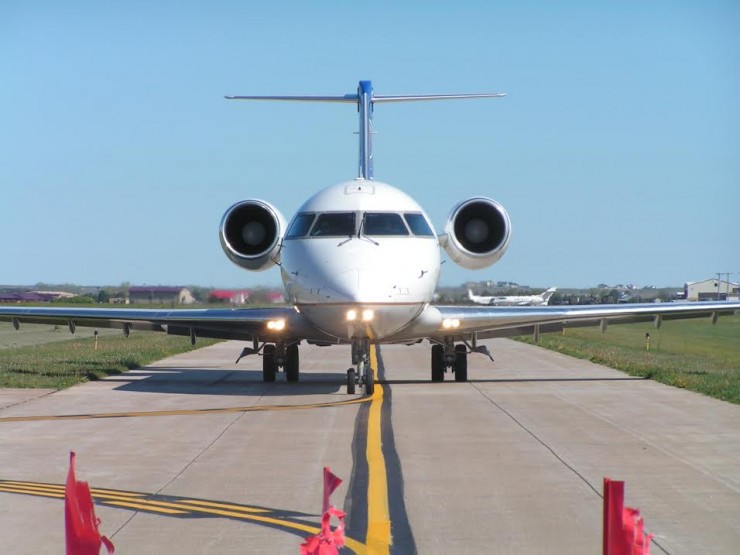
Hays Regional Airport serves record number of passengers

By CRISTINA JANNEY
Hays Post

The Hays Regional Airport will be receiving more funds for improvements from the Federal Aviation Administration, thanks to record boardings in the 2018.

More than 12,000 passengers flew out of the airport last year.

Ovid Seifers, airport manager, said the April addition of SkyWest flights to Chicago’s O’Hare International Airport was the reason for the increase. Flights to Denver were also up slightly.

This included a record month in December, Seifers said. The airport last reached 10,000 boardings in 2011 and 2012.

Since the airport exceeded 10,000 departures in 2018, it is eligible for $1 million in FFA Airport Improvement Funds in 2020. The airport barely missed the 10,000 mark last year, but a loophole will allow the airport to still receive the $1 million in FFA funding in 2019, Seifers said.

Airports that have less than 10,000 travelers receive only $150,000 annually.

The airport has a five-year improvement plan. 2019 improvements include apron and drainage improvements, concrete repair and the purchase of a new snow plow and spreader.

In 2020, the airport plans to replace lighting on the crosswind runway. The runway is currently lit by and an in-ground system that is 20 years old. Because the equipment is buried, it is more susceptible to damage from animals and the elements.

The wiring for the new system will be housed in conduits to protect it and the transformer will be above ground, which will make them easier to maintain. The lights themselves will likely be transitioned to LEDs from incandescent.

Seifers said he thought 2019 will see a slight increase in travelers, although not as significant as in 2018 when the Chicago flights were added.

“I think the City of Hays and its flying community has actively sought better service here,” he said. “They have good service here with SkyWest. The fact that you can go to Denver and O’Hare with one stop to O’Hare in Salina briefly for 30 minutes is great for a community of this size. It doesn’t happen everywhere.”

SkyWest began serving Hays passengers in 2014 with flights to Denver with 50-passenger jets.

The city of Hays in cooperation with SkyWest is offering fares to Chicago and Denver for $89 one way. Flights must be booked by Feb. 26 for flights through May 22. Flights must be booked 14 days in advance. See the airport website for more information.

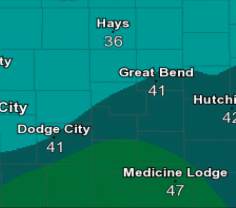
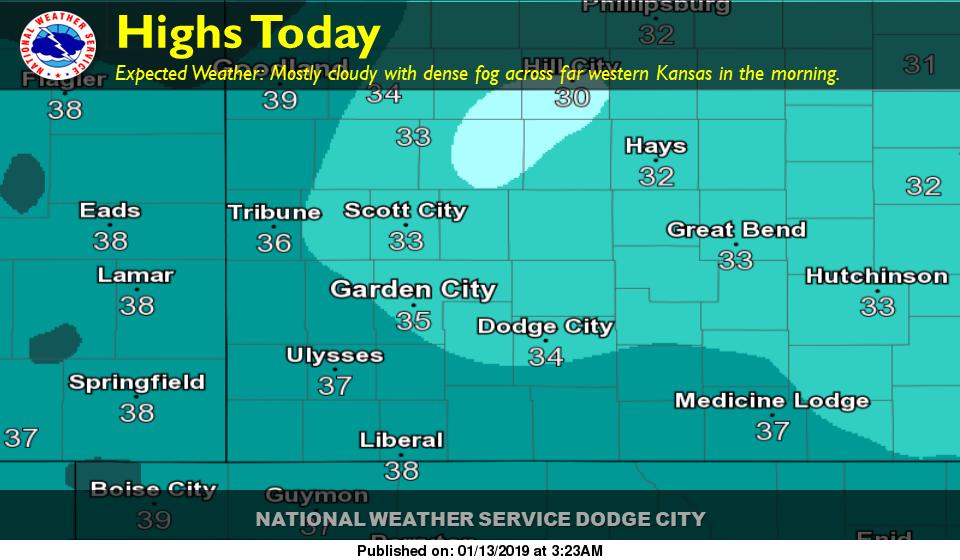
Partly cloudy, cold Monday

Monday Cloudy, then gradually becoming mostly sunny, with a high near 37. Southwest wind 6 to 9 mph.

Monday Night Partly cloudy, with a low around 22. Southwest wind around 7 mph.

Tuesday Sunny, with a high near 42. West southwest wind 5 to 7 mph.

Tuesday Night Mostly clear, with a low around 21. West southwest wind around 6 mph becoming north after midnight.

WednesdayMostly sunny, with a high near 35.

Wednesday NightPartly cloudy, with a low around 22.

ThursdayMostly sunny, with a high near 49.

Thursday NightPartly cloudy, with a low around 24.

Hope Pantry helps 68 families during holidays

USD 489

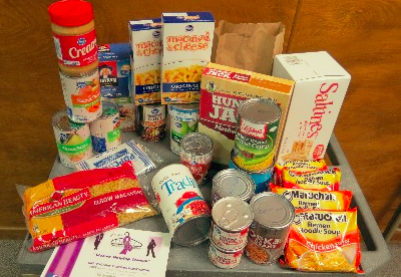
The USD 489 Hope Pantry spread some holiday cheer with families in need for the holiday break.

Sixty-eight families received boxes full of food and hygiene items.

Many of the students and staff from the Learning Center helped package the boxes of supplies for families.

ADK Teacher Sorority, Cornerstone Orthodontics, Arnett Chiropractic, and the Hays First United Methodist Church collected donations to be included in the boxes.

Democrats collect food for Day of Service despite snow

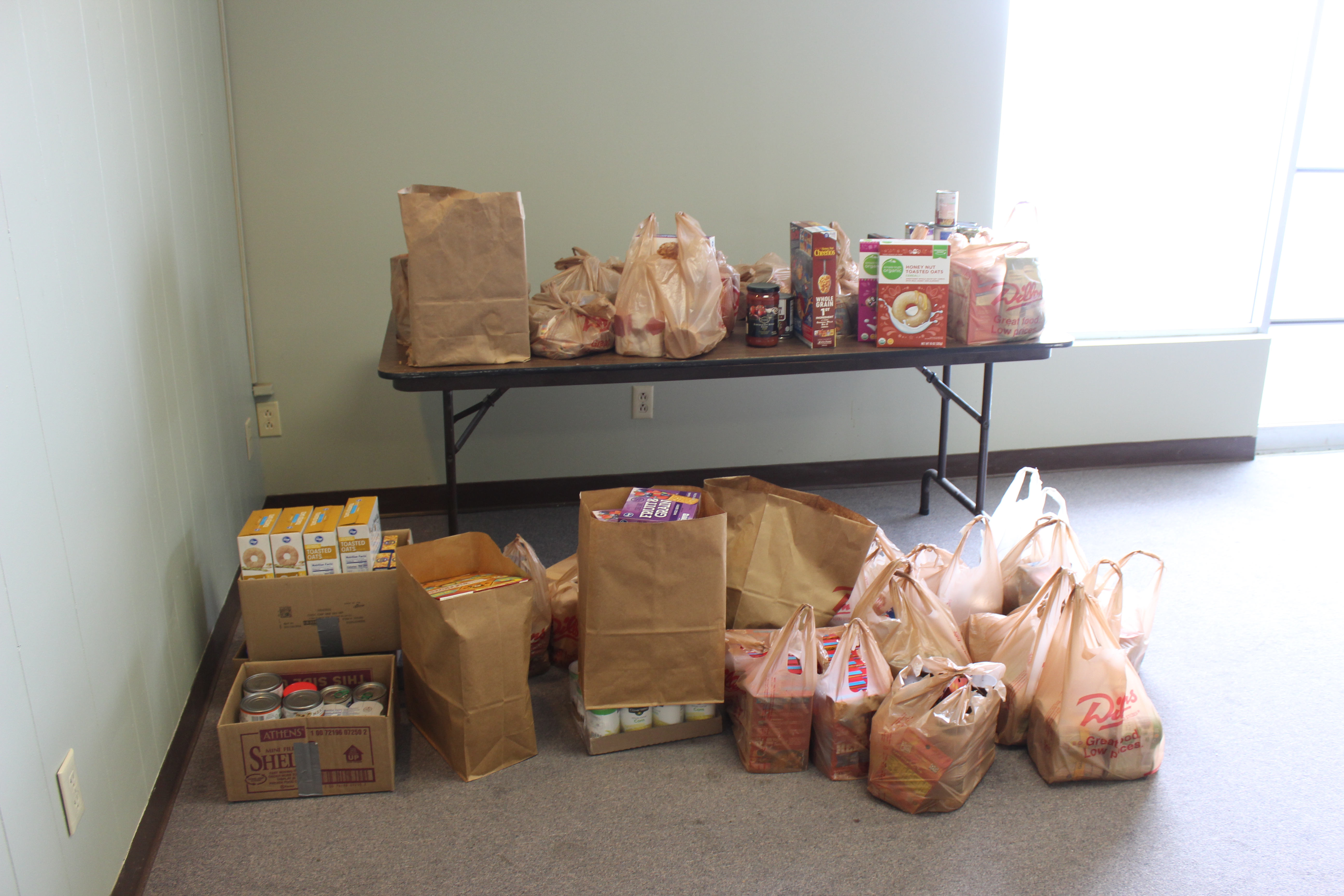
Although Gov-elect Laura Kelly and Lt. Gov-elect Lynn Rogers were unable to fly in for their planned Day of Service on Saturday, local Democrats stilled braved six inches of snow in order to collect food for the needy in Hays.

A cleanup of Aubel Bickle Park was scheduled, but had to be canceled due to the weather.

The Day of Service was set to celebrate Kelly’s inauguration, which will be Monday.

Food collected during the drive will go to First Call for Help and the Community Assistance Center.

Read more 0n the upcoming session:

Gov.-elect Has Her Work Cut Out Fixing State Government In Kansas

Local legislators seek tax relief, budget stability in 2019


Hays school board to consider sale of Washington school

By CRISTINA JANNEY
Hays Post

The Hays USD 489 school board is set to vote on the sale of the former Washington School building at its meeting Monday night.

The district has purchased the Oak Park Medical Complex on 13th Street and is remodeling it for use by Early Childhood Connections, which is currently in the Washington building at 305 Main.

Overland Property Group Land Development has offered $500,000 to purchase the property. The company hopes to use the property to develop affordable housing.

The company also built Stonepost Apartments in Hays.

Matt Gillam, OPG vice president of development, told the school board in December the company would like to renovate the school, which opened in 1926, using federal low income housing tax credits administered by the Kansas Housing Resource Corporation.

If tax credits cannot be secured for the renovation, OPG will likely tear down the building.

OPG has developed other historical properties in the region. The company renovated the former Lee Hardware buildings into lofts in Salina and the Tabor Grand Hotel in Leadville, Colo.

The school district plans to complete the Oak Park Medical Complex renovations by June 30.

Best case scenario, construction would start at Washington school at the end of 2019 and into the first quarter of 2020, Gilliam said.

Computer study

The school district has completed a semester-long study on the use of Chromebooks. The study was requested by members of the school board.

Select classes at O’Loughlin, Hay Middle School and the Learning Center were involved in the study.

The schools used some software in the pilot study that would require additional fees if the Chromebooks were rolled out district-wide.

Teachers found having keyboards was an advantage, especially when the students were answering essay questions.

However, elementary teachers noted issues have occurred with annotating PDFs and having pages for notes, diagramming, graphic organizers and drawing pictures.

Middle school teachers provided some of the following feedback:

• Lack of world-facing camera complicated many learning goals.

• Using Office365 accounts was clunky, and added steps are frequent. Process is derailed due to constant prompting to integrate with Google Drive.

• Concern was expressed over the loss of instructional time due to device limitations.

Middle school students in the study were surveyed about the Chromebooks, and the majority said they preferred using the iPads. However, they liked having a keyboard for typing. They also said the Chromebook’s ability to access and submit files in Canvas was frustrating and time consuming.

The study concluded, “Many hurdles were encountered over the course of the semester. Several can be overcome, but at a large annual cost incurred by the district.”

Concern was also expressed about the number of professional hours to convert just a few classes to the Chromebooks — 323 professional learning hours at an average of $40 per hour.

Fees

The school board will hear a report on summer school and driver’s education fees. Staff is recommending reducing driver’s education fees by $50 and keeping the summer school fees the same.

In other business, the board will:

• Vote on the 2017-18 audit report
• Vote on Hays High School curriculum changes
• Discuss the superintendent evaluation

First Amendment: A growing list of threats to freedom

Gene Policinski

First Amendment threats and defenses have, for much of the past 100 years, largely focused on protecting individual speech — the rights of any one of us to express ourselves without interference or punishment by the government.

Not to be too glib but, oh, those were the days! This glee is due, in no small part, to the degree that individual speech and press rights triumphed in that era. But looking into this new year, that situation — and those victories — may be more nostalgia than norm. There is increasing danger to our core freedoms from what I’ll call “systemic” challenges, which often appear focused on other issues, but which carry a First Amendment impact, if not wallop.

The increasing public and commercial use of drones raise issues of noise, public safety and congestion in the airways — but also questions about what on-board cameras see and record that go far beyond earlier “peeping Tom” worries.

Consider a new network of drones constantly crisscrossing the skies over your hometown, constantly sending video of the passing scene to the insatiable maw of computer storage. Combine that record with facial recognition software, vehicle tracking devices and surveillance cameras that can ID license plates from miles away and it’s but a small step to government discovery of who we meet, where and when, with resulting impact on the right of assembly or association.

We’ve known for some time there’s a running joke, in national security and spy circles in this country and elsewhere, that we’re now doing most of the surveillance work they used to do simply by living our lives on social media. Add the abilities of artificial intelligence to collect, collate and match social media and online data about any one of us and the kind of “anonymous” speech that produced the Federalist Papers is ever more nonexistent.

Put another way, George Orwell’s draconian “Big Brother” presence was predicated on government installing a device in every home — and life — to observe each of us. In 2019, we’re the ones installing the devices. Not just at home, but 24/7 in pockets and purses through smart phones, watches and the like.

In 2018, in two decisions involving GPS and cell phones, the U.S. Supreme Court pushed back on this new technological threat.

Chief Justice John Roberts said that cell phone location information is a “near perfect” tool for government surveillance, analogous to an electronic monitoring ankle bracelet. “The time-stamped data provides an intimate window into a person’s life, revealing not only his particular movements, but through them his ‘familial, political, professional, religious and sexual associations,'” Roberts wrote.

Try being a reporter, under such involuntary transparency in the future, attempting to meet secretly with a source about government corruption or official misconduct or a botched criminal investigation or an undisclosed, invasive national security policy. Good luck.

Let’s round up this Pandora’s box assembly of threats with a look at the 2020 election cycle. Not only will legitimate reports by a free press be mixed in with mis- and disinformation, a new technological threat challenges the adage that “seeing in believing.”

What’s included in “involuntary synthetic imagery” (a mouthful of a title) is the sinister possibility of videos that take real situations and seamlessly “paste” faces of politicians and others onto actual participants. Imagine misleading or embarrassing video that’s nearly impossible for most to distinguish from the real thing. Tragically, such fakery already has invaded our lives thanks to what’s known as “deepfake” porn.

How do we square such “deepfake” videos with First Amendment law, which — with the exceptions when such fake video clearly is being used for extortion or blackmail — would tend to side with free expression and with those who create such works? When would satire cross the line into defamation or intentional infliction of emotional distress — two traditional, but often expensive, time-consuming legal tools available to those who claim injury from such fakery?

And what of news consumers, already besieged by fakery on social media, claims of bias in news reporting by various outlets old and new, photo and video edits that distort, who already have a deep distrust of much of what they see, hear and read?

Despite all this, not the entire look into 2019 is glum. News consumers have more tools to identify misleading items. The fact-checking industry can be paired with “trust” projects and background programs — such as (self-promotion alert!) the Freedom Forum Institute’s “Newstrition” tool.

More of us than ever appear concerned about our First Amendment rights than at any time in the past 25 years. Let’s keep that concern and attention going and growing in the new year.

Gene Policinski is president and chief operating officer of the Freedom Forum Institute. He can be reached at [email protected], or follow him on Twitter at @genefac.

Registration open for summer KAMS camps at FHSU

FHSU University Relations

Fort Hays State University’s Kansas Academy of Mathematics and Science Summer Academy will offer four camps for incoming high school freshmen and sophomores in the month of June.

FHSU faculty and staff will organize each camp, all of which are focused in science, technology, engineering and mathematics. Students will stay in a residence hall on the FHSU campus with staff available all day and night to assist campers. Each camp is four days long with check-in and drop off beginning Sunday evening.

Camps are listed by date.
June 2-6: Engineering Design: 3D Printing and CNC
The use of 3D printing and computer numerical control (CNC) is exploding across the engineering and industrial world and has revolutionized the way we create from 3D-printed houses to guitars cut out of an old slab of wood. In this quick-paced, high-impact camp, students will be immersed in all things 3D and design. Programs like Autodesk Inventor, Sketchup and Aspire will be available for students to produce individual designs that will be exported to 3D printers and CNC routers.
June 9-13: Detective for a Day: CSI and Forensic Science
Students will be able to experience the excitement of forensic science and crime scene investigation in this highly interactive camp. Participants will be able to discover how to scour a crime scene and look for clues. The camp will feature hands-on, mock crime scene exploration coupled with forensic science fundamentals to give individuals a chance to live and learn like a real crime scene analyst.
June 16-20: Faster than the Speed of Sight
In this camp, students will learn how to use a high-speed camera and analyze video of events that are too fast to see with the naked eye. Questions such as “How fast is a baseball dropped from 60 feet traveling when it strikes the ground?” will be answered as students collect video recordings of experiments and measure data in a high-speed learning environment.
June 23-27: Gamers Unite!
Participants will have the opportunity to learn about the tricks and trades of game development. Students will learn how to design, code, test and deploy three-dimensional games using Unity, a popular cross-platform game engine along, with learning the fundamentals of C#, a programming language used in Unity.
Each camp is limited to 30 students and costs $100 for residents of Kansas and $400 for non-residents. The fee includes room and board, supplies and a T-shirt. Priority will be on a first-come, first-served basis with a maximum of two camps per student.
The priority registration deadline is April 1, and the final registration deadline is May 1. Registration must be mailed in with full payment to reserve a spot.

For more information, contact Shelia Clark, KAMS Summer Academy Coordinator, at 785-628-4168 or [email protected]. To download the registration form, visit www.fhsu.edu/kams/summer-camps/index.

About KAMS:
KAMS is an early-entry-to-college program that focuses on advanced mathematics and science. While studying at KAMS, students live on campus in a select residence hall with other KAMS students from across Kansas and around the world. Over the course of two years, students complete over 60 hours of college credit. These college classes are taken alongside traditional college undergraduates and taught by college professors while simultaneously contributing to their high school graduation requirements.

Cloudy, cold Sunday

Today
Patchy fog before 9am. Otherwise, mostly cloudy, with a high near 32. Calm wind becoming south southwest around 6 mph in the afternoon.
Tonight
Mostly cloudy, with a low around 20. Southwest wind around 6 mph.
Monday
Partly sunny, with a high near 38. Southwest wind around 7 mph.
Monday Night
Partly cloudy, with a low around 22. Southwest wind around 6 mph.
Tuesday
Sunny, with a high near 43. West southwest wind around 7 mph.
Tuesday Night
Mostly clear, with a low around 20.
Wednesday
Mostly sunny, with a high near 35.
Wednesday Night
Partly cloudy, with a low around 22.
Thursday
Mostly sunny, with a high near 44.

Rep. Hineman part of ceremony to open new State Capitol lactation room

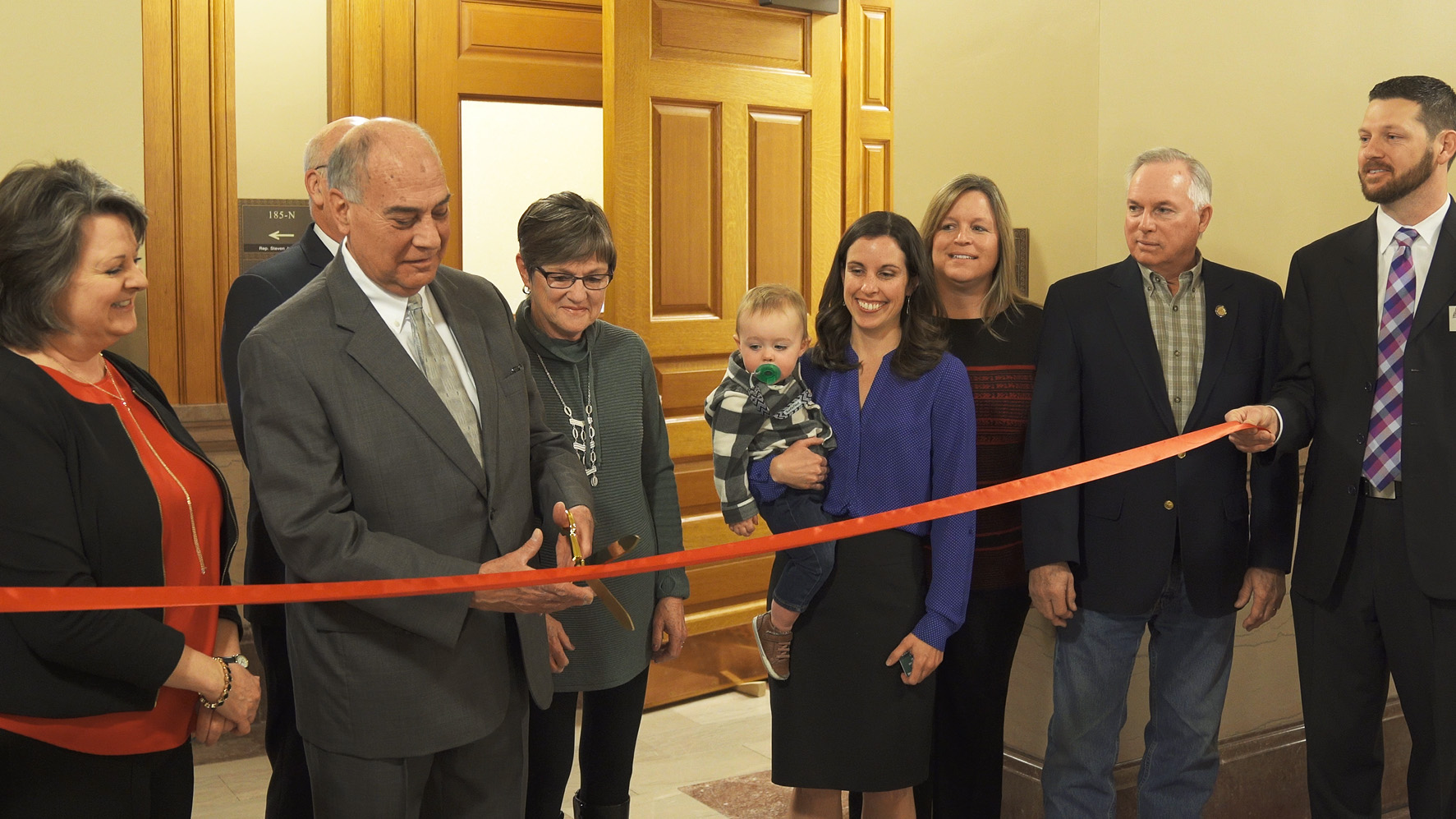
L-R: Brenda Bandy, Rep. Jim Ward, Director of Legislative Administration Tom Day, Gov.-elect Laura Kelly, Rep. Eileen Horn and son, KDHE Deputy Secretary for Public Health Ashley Goss, House Majority Leader Don Hineman, and President of Advocacy, Kansas Action for Children John Wilson.

KDHE

TOPEKA – At a ribbon-cutting ceremony Friday, the Kansas State Capitol joined a growing number of Kansas workplaces that support breastfeeding mothers by opening a new, separate and private lactation room in the Capitol building (Room 186B-N). In addition to the formal lactation room, updates will be made later this year in the family-use restroom on the first floor, to convert it into a suitable space.

“We are extremely proud to add the Capitol Building to the growing list of over 330 award-winning work sites in Kansas and to join the rest of the nation in recognizing the need to normalize and support breastfeeding,” said Brenda Bandy, Executive Director of the Kansas Breastfeeding Coalition (KBC).

“We are pleased to see the Capitol Building leading the way in creating accommodations in public buildings for both breastfeeding employees and the public,” said Gabrielle Hellbusch the State Breastfeeding Coordinator at the Kansas Department of Health and Environment (KDHE).

The Legislative Coordinating Council consists of the President of the Senate, the Speaker of the House, the Speaker Pro Tem of the House, and the majority and minority leaders of each chamber. The Council is responsible for coordinating the delivery of legislative services.

“I am very excited to see a lactation room available at the Capitol that can be used by both the public and staff,” said 10th District Representative Eileen Horn. “As a nursing mother frequently in the Capitol in 2017, I immediately saw the need for improvements to the spaces provided. I am grateful to my colleague Representative Jim Ward, KDHE, state and local Breastfeeding Coalitions, the Legislative Coordinating Council and Tom Day Director of Legislative Administration who invested time to help make this a reality.”

Adequate support for breastfeeding employees has been associated with cost savings related to reduced health care expenses, turnover rates and absenteeism, as well as increased employee loyalty. The Business Case for Breastfeeding is a program that assists employers in developing or enhancing support services for their breastfeeding employees, which can be found at https://kansasbusinesscase.com.

New lactation room, Kansas Capitol Room 186B-N

Staff and visitors to the capitol who wish to use the rooms are encouraged to ask volunteers at the Visitor’s Center for help and information in locating the rooms.

The ribbon-cutting ceremony was attended by Brenda Bandy, Governor-Elect Laura Kelly, House Majority Leader Don Hineman of Dighton, Representative Horn, Representative Ward, KDHE Deputy Secretary for Public Health Ashley Goss, and John Wilson, Vice President of Advocacy for the Kansas Action for Children and Tom Day, Director of Legislative Administration.


Copyright Eagle Radio | FCC Public Files | EEO Public File