USDOT
USDOT
WASHINGTON – U.S. Transportation Secretary Elaine L. Chao Tuesday announced $1.5 billion in discretionary grant funding to 91 projects in 49 states and the District of Columbia. The grants are made through the Better Utilizing Investments to Leverage Development (BUILD) Transportation Grants program and support road, rail, transit, and port infrastructure projects across the country.
“BUILD transportation grants are major investments in road, rail, transit, and port projects that serve as a down payment on this administration’s commitment to America’s infrastructure,” said U.S. Transportation Secretary Elaine L. Chao.
Demand for BUILD grants far exceeded available funds, and the locally-driven nature of the applications was clear in their volume and geographic diversity. 851 eligible applications from all 50 states, as well as U.S. territories, and the District of Columbia were sent in response to the BUILD Notice of Funding Opportunity (NOFO), nearly double the applications received in 2017. Overall, applicants in 2018 requested more than $10.9 billion in funding.
Project applications were evaluated by a team of 222 career staff in the Department and selected based on established criteria. The criteria included safety, economic competitiveness, quality of life, environmental protection, and state of good repair. Further criteria included innovation, such as projects supporting Connected or Autonomous Vehicles infrastructure, broadband service to underserved communities, as well as projects that demonstrate partnerships between the public and private sectors, and non-Federal revenue for transportation infrastructure investments. The Department prioritized rural projects that aligned with the criteria and addressed rural infrastructure needs. The grant announcements made today will contribute to the construction or refurbishment of over 200 bridges nationwide, from North Carolina to the refurbishment of the Brooklyn Bridge.
The BUILD Transportation Grants re-balance a ten-year, historical underinvestment in rural communities. Rural applications more than doubled from the previous year’s TIGER applications. Underinvestment in rural infrastructure has led to a decline in the routes that connect communities in rural America. In this round, in which 59 percent of the applications were for rural projects, 62 projects were awarded to rural grant applications.
Several selected projects will contribute to America’s energy independence. The Permian Basin projects and the Port Arthur Multimodal Rail Expansion and Berth Expansion Project will both contribute to the efficient transportation of domestic energy products. Border security infrastructure is also supported through BUILD Transportation grants, with projects such as the Calexico East Port of Entry Bridge Expansion in California making bridge improvements to accommodate freight traffic and improving other transportation facilities at the border crossing.
The Consolidated Appropriations Act of 2018 appropriated $1.5 billion for BUILD Transportation grants. For this round of BUILD Transportation grants, the maximum grant award is $25 million for a single project, and no more than $150 million can be awarded to a single state. There is a $5 million minimum award for projects located in urban areas, and a $1 million minimum for rural projects.
More information about BUILD grants, including fact sheets on awarded projects, can be found here.
A list of grant award recipients is below:
Lower Yukon River Regional Port and Road Renovation Project, Alaska, $23,168,722 – The project will repair and upgrade approximately 3.5 miles of high-use service roads as well as construct a permanent barge/landing craft ramp and dock/wharf with up to two berths capable of handling 500-ton barges.
Nenana Bridge Project, Alaska, $9,174,000 – This project will construct two permanent fixed bridges across the Nenana River and the Nenana Slough. The project will complete a larger project to provide year-round connection between 10th Avenue and Totchaket Road.
State Highway 157 Widening Project, Alabama, $14,000,000 – The project will widen from two lanes to four lanes an approximately 3.5-mile section of State Highway 157 between US-31 and State Highway 69. The project will also construct a mixed-use walking and biking trail along a portion of the project between Eva Road and Childhaven Road. Concurrent with the highway widening, the project sponsor will improve the co-located broadband fiber infrastructure.
Project SMAART Phase II, Alabama, $14,222,671 – The project will construct an overpass bridge at the intersection of State Route 20 and Bibb Garrett Road. The project includes ramps from SR-20, the addition of a roundabout at the ramp termini, a new access road along SR-20 from the bridge, improved roadway lighting, and accommodations for safe pedestrian access.
Hot Springs Bypass Extension, Arkansas, $20,000,000 – The project will construct an extension of the Hot Springs East-West Arterial Bypass from the interchange of U.S. Highway 70 to the intersection of Highways 5 and 7. The bypass will consist of two 12-foot travel lanes and 8-foot shoulders.
I-49 Missouri-Arkansas Connector, Arkansas, $25,000,000 – The project will complete an approximately 4.8-mile, four-lane interstate facility in southwest Missouri that will bypass US-71 and connect to Interstate 49 in Arkansas.
Verde Connect – State Route 260 to Middle Verde Road, Arizona, $25,000,000 – The project will construct an approximately 1.7-mile, two-lane roadway and bridge across the Verde River to connect the northern portion of the Yavapai-Apache Nation and the Town of Camp Verde to the regionally-significant State Route 260 corridor. The roadway will provide wide paved shoulders to accommodate bicycle traffic.
Better Market Street Phase I, California, $15,000,000 – The project will construct roadway improvements on Market Street between 6th and 8th Streets in downtown San Francisco. Improvements include roadway resurfacing, streetcar track replacement, replacement and upgrade of traffic signals, and a new F-line streetcar turnaround loop at McAllister and Charles J Brenham Streets. The BUILD project is part of a broader reconstruction of 2.2 miles of Market Street that will include non-BUILD funded improvements such as new water and sewer lines, broadband conduit installation, ADA-accessible curb ramps and streetcar access ramps, and landscaping and streetscape improvements.
North County Corridor Project, California, $20,000,000 – The project will construct a 3-mile segment of the State Route 108 North County Corridor. The segment will be a six lane, controlled access expressway that will move SR-108 to the south of the town of Riverbank as the first phase of an 18-mile expressway that will bypass the communities of Modesto, Riverbank, and Oakdale.
Calexico East Port of Entry Bridge Expansion, California, $20,000,000 – The project will widen the Calexico East Port of Entry bridge along the US-Mexico border to accommodate two additional northbound commercial truck lanes and two additional northbound passenger vehicle lanes. The project also includes improvements to the bicycle and pedestrian facilities at the border crossing.
State Route 46 Widening Segment 4B, California, $17,500,000 – The project will widen an approximately 5.3-mile segment of Route 46 from two to four lanes in each direction. The project also includes the addition of an 18-meter median, upgrading seven intersections, bringing the road into compliance with the Americans with Disabilities Act (ADA), adding approximately one mile of bicycle lanes and sidewalks, and building one new bridge.
South Midland Avenue Reconstruction & Rural Broadband Project, Colorado, $7,007,562 – This project will reconstruct South Midland Avenue. Improvements include the expansion of driving lanes, the addition of curbs and gutters, improvements to three intersections and the consolidation of driveway accesses. Additionally, this project will construct a single-lane roundabout at 4-Mile Road, a 6-foot-wide detached sidewalk, install rockfall mitigation technologies, make drainage improvements, install broadband infrastructure and relocate existing overhead utilities.
Colorado’s V2X Technology Safety and Mobility Improvement Project, Colorado, $20,000,000 – This project will create a commercial-scale connected vehicle environment using vehicle-to-everything (V2X) technology. The approximately 537-mile network will provide real-time communication with connected vehicles and install over 200 miles of new fiber optic lines to rural communities. This network will send safety and mobility-critical messages directly to drivers through infrastructure-to-vehicle (I2V) communication as well as notify CDOT of crashes or hazards on the road through vehicle-to-infrastructure (V2I) communication.
North Interstate 25 Phase 2, Colorado, $20,000,000 – The project will make several roadway improvements to Interstate 25, including reconstructing and expanding three interchanges, reconstructing and widening 12 bridges, adding a third lane to serve as an express lane between SH56 and SH402, straightening a reverse curve in the roadway north and through the SH56 interchange, and widening roadway shoulders to bring the project segment up to corridor standards.
Stamford Transportation Center Escalator and Elevator Improvement, Connecticut, $9,160,000 – The project will upgrade approximately five elevators and 17 escalators to enhance the Stamford Transportation Center’s internal circulation system.
Metrorail Station Platform Reconstruction Project, District of Columbia, $20,000,000 – The project will reconstruct platforms and other station elements at seven outdoor Metrorail stations. The scope of the project includes demolishing and rebuilding passenger platforms, correcting height variances to align with railcar floors, and improving and enhancing transit facilities. The project is the first phase of a larger effort to make similar improvements at twenty outdoor Metrorail stations.
Delaware Memorial Bridges Ship Collision Protection System, Delaware, $22,249,850 – The project will install eight 80-ft diameter sheet pile cells at the bases of the Delaware Memorial Bridges, which connect the states of Delaware and New Jersey, to better protect the structural integrity of the bridges in the event of a ship collision.
Urban Core Riverfront Revitalization and Bay Street Innovation Corridor, Florida, $25,000,000 – The City of Jacksonville will demolish the Hart Bridge Expressway and construct a ramp from the Hart Bridge to Bay Street/Gator Bowl Boulevard. A Complete Street will be constructed with traffic calming measures and bicycle/pedestrian paths. The project also installs broadband conduits. The Jacksonville Transportation Authority will deploy approximately 15 autonomous vehicles, dynamic connected traffic signals, smart lighting, pedestrian sensors, smart parking, and flood warning sensors.
South Dade Transitway Park-and-Ride Improvements, Florida, $9,500,000 – The project will expand and improve two existing park-and-ride facilities along the South Dade Transitway Corridor – a Bus Rapid Transit (BRT) line – at SW 152nd Street and SW 168th Street. The project includes additional sidewalks, improved pedestrian access, bicycle parking facilities, a kiss-and-ride, additional parking for individuals with disabilities, and electric vehicle parking with charging stations.
SR 316/US 29 at SR 11 Grade Separation Project, Georgia, $24,821,050 – The project will grade separate the existing intersection of SR 316/US 29 and SR 11, with SR 316 spanning over SR 11 on a new bridge structure, designed as a tight diamond interchange with full access and able to accommodate future widening on SR 316. The work on SR 11 will extend for approximately 0.4 miles. On SR 316, the work will span for approximately 1.1 miles.
Iowa 64 (Platt Street Corridor) Maquoketa Transformation Project, Iowa, $3,818,957 – The project will make several roadway improvements including new and resurfaced street pavement; replacement curbs, gutters, pedestrian curb ramps, and sidewalks for compliance with the Americans with Disabilities Act (ADA); repair and replacement of the storm sewer, sanitary sewer, and water main; installation of a new broadband fiber-optic network; and traffic signal upgrades.
Des Moines Transload Facility, Iowa, $11,200,000 – The project will develop a facility that allows for the direct movement of goods via railcar in order to provide a shipping alternative to businesses within a 150-mile radius of Des Moines. The facility will be located adjacent to the East Martin Luther King Jr. Parkway and in close proximity to Interstate 235, providing connectivity to the Interstate system.
Siouxland Regional Transit Operations and Bus Storage Facility, Iowa, $7,000,000 – The project will design and construct a new joint use facility to house the Siouxland Regional Transit System and the Siouxland Interstate Metropolitan Planning Council. The facility will include bus maintenance areas, indoor bus storage, a bus wash, and driver training areas.
Cherrylane Bridge, Idaho, $15,704,700 – The project will replace the existing one-lane, fracture-critical Cherrylane Bridge with an updated structure that meets current design standards as well as the needs of the community. The new two-lane bridge will have shoulder bikeways on each side for cyclists and pedestrians, add turn lanes, and relocate the bridge approach’s intersection with US 12.
Springfield Rail Improvements – Usable Segment IV, Illinois, $22,000,000 – The project is part of a larger effort to relocate the existing Amtrak/Union Pacific railroad corridor to a new expanded corridor adjacent to the existing Norfolk Southern tracks. Usable Segment IV replaces the existing single track bridge with two new double track bridges over both 5th and 6th Streets to accommodate the expanded corridor. It also includes grading and track work from north of 6th Street to Stanford Avenue.
North Central Indiana Expansion Project – I-65 Added Travel Lanes, Indiana, $20,000,000 – The project will increase the capacity of I-65 between SR 32 (Exit 140) and SR 47 (Exit 146) by reconstructing the existing lanes, adding an additional travel lane in each direction, and adding inside and outside road shoulders. The project will also widen six mainline bridges along this corridor and upgrade the pavement on the ramps at the SR 47 interchange.
South Central Indiana Expansion Project – I-65, Indiana, $20,000,000 – The project will increase the capacity of I-65 between SR 58 (Exit 64) and SR 46 (Exit 68) by reconstructing the existing lanes, adding an additional travel lane in each direction, and adding shoulders. The project will also replace the superstructures of the Carr Hill Road bridge and CR 200 South bridge over I-65.
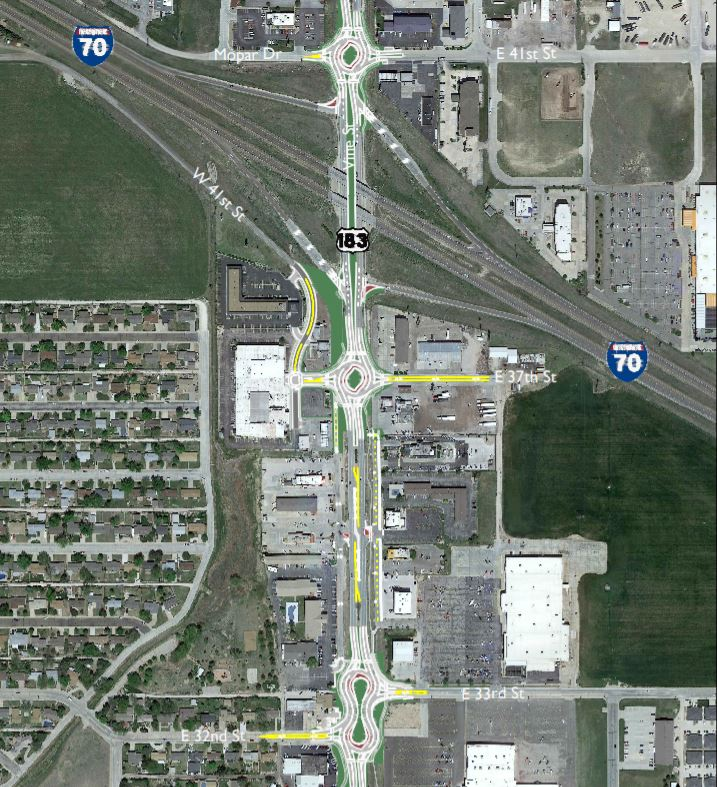
Vine Street Corridor Project, (Hays) Kansas, $6,057,827 – The project will reconstruct a half-mile segment of Vine Street (US 183) near Interstate 70. The project includes three new two-lane roundabouts, access-controlled intersections at the on/off ramps at I-70, bicycle lanes, and upgraded pedestrian crossings.
(See related local story.)
Interstate 70 and Turner Diagonal Interchange Improvements, Kansas, $13,843,600 – The project will replace the existing interchange at Interstate 70 and Turner Diagonal with a more efficient diverging diamond interchange.
US 641 Widening, Kentucky, $23,000,000 – The project will widen an approximately 5.7-mile section of US 641 South from a two-lane divided highway to a four-lane divided highway between the Kentucky/Tennessee state line at Hazel north to the Middle Fork of the Clarks River.
KY 331/Industrial Drive and Rinaldo Road Widening and Reconstruction Project, Kentucky, $11,520,000 – The project will widen and improve approximately 2.6 miles of KY 331/Industrial Drive and Rinaldo Road from 2nd Street into the Owensboro Riverport Intermodal Terminal, and will reconstruct the CSX at-grade railroad crossing.
Pulaski County Interchange Improvement to KY 461, Kentucky, $25,000,000 – This project will replace the KY 80/KY 461 intersection with a grade-separated half-cloverleaf interchange, and the at-grade intersection of Valley Oak Drive – Coin Road/KY with a grade separated tight diamond interchange. The project will also widen approximately 3 miles of KY 461 from two lanes to four lanes.
Port Fourchon to Airport Connector: Bridging a Gap to Critical Rural Infrastructure, Louisiana, $16,422,000 – The project will construct a new 3-lane vertical lift span bridge over Bayou Lafourche and a new 2-lane 2,000-ft connector road extending from LA 1 to LA 3235.
Interstate 12 Widening & Rehabilitation Project, Louisiana, $25,000,000 – This project proposes to widen and rehabilitate approximately 3.8 miles of Interstate 12. Specifically, it will add new travel lanes and auxiliary lanes at various bottleneck sites, widen the Tchefuncte River Bridge to three travel lanes and one auxiliary lane in each direction, and construct a sound barrier.
Closing the Gap in New England: Western Massachusetts Freight Rail Upgrade, Massachusetts, $10,800,000 – The project will upgrade a section of the New England Central Railroad across Massachusetts to meet the 286,000 lbs. national standard. Project components include the installation of approximately 31 miles of continuous welded rail, replacement of ties and ballast, track surfacing, and strengthening approximately 20 bridges.
North Terminal Extension Project, Massachusetts, $15,406,403, The project will construct approximately 800 feet of additional bulkhead, backfill of the constructed bulkhead with clean material from maintenance harbor dredging, and extend three rail spurs to increase multimodal options.
I-95 at Belvidere Road Interchange, Maryland, $20,000,000 – The project will construct a new interchange between I-95 and Belvidere Road, including relocating Belvidere Road and constructing a new bridge over I-95.
Seagirt Marine Terminal Berth 3 Modernization P3 Project, Maryland, $6,554,575 – The project will add a second berth capable of serving 50-foot draft Ultra Large Container Vessels and make necessary supporting landside improvements. Project elements include an expanded access channel and turning basin, repairing existing wharf substructure, superstructure and paving, installing concrete runways in the container yard and hardware to support large ship-to-shore cranes.
Waterville Downtown Transit Corridor, Gateways, and Revitalization, Maine, $7,371,200, The project will convert two downtown streets from single-direction traffic to two-way traffic, improve to five intersections, and reconstruct sidewalks and major public spaces to promote accessibility and walkability throughout the downtown.
Maine Western Gateways Project, Maine, $11,027,500 – The project will reconstruct three roadways for a total of approximately five miles of new road. The project includes repair, resurfacing, drainage improvements, and strengthening sub-surfaces.
Traffic Safety and Mobility Improvements – Phase I, Maine, $8,241,100, This project will replace or enhance approximately 101 traffic signals statewide. Some of the signal systems will have adaptive signal technology, dedicated short-range communications (DSRC), infrared camera detection, fiber interconnect wiring, emergency pre-emption, back-plates with reflective striping, communication to the traffic management center, accessible pedestrian signals (APS), and Americans with Disability Act (ADA) improvements.
Carbide Dock Port Rail Rehabilitation and Truck Route Reconstruction, Michigan, $20,700,000 – The project will rehabilitate the Carbide Dock Port and reconstruct a portion of the connecting truck route on Easterday Avenue from Interstate 75 to Barbeau Street. The project also includes intersection improvements and water/sewer replacement.
US-31 Relocation from Napier Road to I-94, Michigan, $20,000,000 – The project will extend US-31 approximately 2.3 miles to I-94, including the construction of interchange ramps and overpasses. The project will complete an approximately 30-mile limited access freeway route on US-31 from the I-80/90 toll road in Indiana to I-94 in Berrien County, Michigan.
Twin Ports Interchange Reconstruction, Minnesota, $20,000,000 – The project will replace eight bridges with an at-grade and divided interstate roadway at the I-35/I-535/US 53 interchange and replace the remaining weight-restricted ramp bridges to the interchange; reconstruct six concrete box girder bridges on US 53; and reconstruct four weight-restricted bridges at the I-535/Garfield Avenue interchange.
South Main Corridor Improvement Project, Missouri, $10,488,088 – the project will reconfigure approximately 1.5 miles of the South Main Corridor from Highway 71 to South Avenue into a complete street, including reconfiguring intersections and adding designated turn lanes; realigning, reducing, and combining access points and curb cuts; constructing pedestrian amenities; installing and updating traffic signals; replacing water and storm infrastructure, and enhancing streetscape elements.
Rail Spur – Sedalia Industrial Park – Existing and New Industrials with Intermodal Capacity, Missouri, $10,098,105 – This project constructs a rail spur within the Sedalia Rail Industrial Park, including 11,900 feet of new truck and a new wye connection to an existing siding. The Sedalia Rail Industrial Park includes a new mini-steel mill currently under construction, and the spur will help provide access to the mill.
New Buck O’Neil (US 169) Crossing, Missouri, $25,000,000 – The project will replace the Buck O’Neil Bridge which carries US 169 over the Missouri River in Kansas City. This project includes a wider bridge span, separated facilities for pedestrians and bicyclists, connector ramps including a direct connection between US 169 and Interstate 35, and approaching roadway.
SEMO Port Loop Track Terminal Project, Missouri, $19,800,000 – The project will construct a new rail-barge terminal that consists of a loop track for the accommodation of unit trains, a rail-to-barge conveyor system for rapid unloading and product transfer, and a river barge load out terminal.
Holly Springs Road – Road Reconstruction and Bridge Replacement, Mississippi, $13,000,000 – The project will improve approximately 2.6 miles of Holly Springs Road, including elevating the roadway, replacing five bridges, and realigning the roadway.
SR 19 Road and Bridge Improvements, Mississippi, $25,000,000 – The project will construct improvements on approximately 9 miles of SR 19 from SR 492 to Philadelphia, including adding two additional travel lanes for approximately 4.5 miles of this segment, and replacing five structurally deficient bridges on the remaining portion of the segment. The project is the final segment of improvements to a 22.5-mile corridor.
Kalispell Bypass: Foys Lake Section, Montana, $12,750,000 – The project will widen an approximately 2-mile section of the US Highway 93 Bypass from 2 lanes to 4 lanes, and replace an existing roundabout at Foys Lake Road with an interchange, including a shared-use connection to the interchange.
Missouri River Crossing – Toston Structures, Montana, $10,000,000 – The project will reconstruct approximately 3.5 miles of US 287 near Toston, improve several intersections, and replace two structurally bridges.
Hickory Reconnected Through Transportation Infrastructure Investment, North Carolina, $17,092,608, The project will develop an approximately 1.7-mile bicycle and pedestrian trail and a bridge over US 321, and construct a 1.2-mile complete streetscape loop in downtown Hickory that will add designated space for bicycles and pedestrians and concurrently incorporate underground fiber cable systems.
GREATTER-NC Rural Bridge Improvement Project, North Carolina, $23,000,000 – The project will replace approximately 77 bridges in 17 rural counties. The project sponsor will also add broadband for transportation applications to appropriate bridges during construction.
Raleigh Union Station Phase II: RUS Bus, North Carolina, $20,000,000 – The project will construct a new bus facility and structured parking to create a multimodal transit center in downtown Raleigh. The project includes an off-street bus transfer facility, pedestrian bridge, BRT platform and other BRT infrastructure, on-street pedestrian improvements and wayfinding, traffic signal prioritization, and new rolling stock.
Jack Rabbit Road Reconstruction – Phase II, North Dakota, $15,000,000 – This tribal project will reconstruct approximately nine miles of Jack Rabbit Road from roughly BIA Road 15/BIA Road 8 to BIA Road 10/ND Highway 5 on the Turtle Mountain Band of Chippewa Indians Reservation. The project is the second of four phases to reconstruct the 14.25-mile Jack Rabbit Road corridor.
US 75 Highway Mobility Improvement Project, Nebraska, $20,000,000 – The project will reconstruct approximately 7 miles of US-75/US-34 from Murray to Plattsmouth, widening the 2-lane roadway to a 4-lane divided expressway. The project also incorporates roadway, bridge and drainage improvements and replacements.
Market Street Marine Terminal Main Wharf Rehabilitation, New Hampshire, $7,504,854 – The project will rehabilitate approximately 17,500 square feet of the Main Wharf at the Market Street Marine Terminal by replacing the deteriorating wharf access bridge and decking the area between the shoreline and the back of the Main Wharf.
Downtown Toms River Loop Road Project, New Jersey, $5,660,000 – the project will create a loop between the Garden State Parkway and waterfront business district by elevating and reconstructing Herflicker Boulevard as a one-way complete street, converting Water Street to a one-way complete street, and making roadway improvements and upgrades on connecting roadways.
North Central Regional Transit District Maintenance Facility, Vehicle Wash Bay, and Fueling Station, New Mexico, $1,291,910 – The project will construct a maintenance facility, standalone vehicle wash bay, and fueling station for the North Central Regional Transit.
Las Vegas Medical District Automated Circular and Connected Pedestrian Safety Project, Nevada, $5,319,838 – This project will provide autonomous and connected vehicle service, pedestrian safety devices, and smart transit shelters to the Las Vegas Medical District. Additional ITS improvements include pedestrian detection software at intersections, GOVegas app improvements which will extend green light time for pedestrians and Wi-Fi improvements throughout the project area.
Brooklyn Bridge Approach Arches and Towers Rehabilitation, New York, $25,000,000 – The project will restore and rehabilitate the masonry arches and their foundations on the Manhattan and Brooklyn approaches to the Brooklyn Bridge.
Youngstown SMART2 Network, Ohio, $10,853,192 – The project will provide autonomous transit shuttles, transit waiting environments, pedestrian and bicycle facilities, green infrastructure such as permeable surfaces and LED lighting, streetscaping, and wayfinding to connect anchor institutions such as Youngstown State University, Mercy Health, Youngstown Business Incubator, and Eastern Gateway Community College.
Appalachian NGL Hub Rail Transloading Facility, Ohio, $20,000,000 – The project will construct a pipeline-to-rail transloading facility at an energy terminal including truck racks with unloading bays, ladder tracks connecting to the recently constructed loop track, and rail loading arms.
Geagua County Safety Improvement Project, Ohio, $9,651,000 – the project will construct safety improvements to address conflicts between motorized vehicles and non-motorized buggies, including increasing shoulder widths to create non-motorized buggy lanes; implementing advanced detection system to alert motorists of oncoming buggies; installing conflict warning systems with flashing beacons; post school zone signs, and adding pedestrian warning signs/ beacons on roadways.
Oklahoma City Northwest Expressway Multimodal BRT, Oklahoma, $14,375,250 – The project will construct an approximately 8-mile BRT line connecting northwest Oklahoma City, regional medical and commercial centers, and downtown via the Northwest Expressway and Classen Boulevard.
LINK Tulsa (Leveraging Intelligent Networks & Key-Corridors) Project, Oklahoma, $6,500,000 – This project will install fiber optic/broadband cables connecting approximately 42 traffic signals and 60 bus rapid transit (BRT) stations to the Tulsa Traffic Management Center (TMC) as well as outfit approximately 42 intersections with transit signal priority (TSP). The project includes the installation of approximately 15 CCTV cameras at critical intersections for use by the TMC and transit dynamic messaging signs at approximately 36 BRT stops. The project will also make ADA-compliant improvements to area crosswalks.
Port of Muskogee Rail Access, Oklahoma, $5,789,210 – The project will construct rail and road access improvements at the Port of Muskogee including track upgrades, expansion, and realignment to meet current Class I railroad safety standards; State Highway 16 highway-rail grade crossing modernization; and approximately 9,700 feet of additional track to expand the capacity of the existing marshalling yard.
Coos Bay Rail Line Bridge Rehabilitation, Oregon, $20,000,000 – This project will construct improvements or replacements of approximately 15 bridges along the Coos Bay Rail Line to enhance capacity, meet Bridge Safety Standard requirements, and extend the useful life on the structures.
Columbia River Barge Terminal Rail Access, Oregon, $19,414,875 – The project will establish rail-to-barge transloading capability within the Port’s barge terminals on the Columbia River. Improvements include a mainline switch, approximately construction of 11,140 feet of rail line, three rail switches, a Terminal 1 crane and improvements, upgrades to Ullman Bridge, and construction of Marine Drive Bridges and corresponding road realignment, resurfacing, and earthwork.
Gateway 228 Capacity and Safety Improvements Project, Pennsylvania, $20,000,000 – The project will realign and widen to 4 lanes the approximately 1.5-mile Balls Bend and the approximately 0.75-mile Haines School-Commonwealth sections of Route 228, including adding turn lanes, medians, connecting access roads, and pedestrian/bicycle facilities. This project is part of a larger to widen approximately 26 miles of Route 228 in Butler County.
30th Street Station Transformation, Pennsylvania, $15,000,000 – The project will expand the capacity of the 30th Street Station and improve connections between the SEPTA and Amtrak stations at 30th Street. The project will provide new and expanded stairs, escalators, elevators, and fare payment configuration. It will re-design the entrance, and will transform station aesthetics to modernize the station and improve circulation between transit modes.
Simple, Smarter Roads for the Newport Innovation Corridor, Rhode Island, $20,000,000 – This project will construct improvements to the off-ramp and supporting roadways of the Pell Bridge (also known as the Newport Bridge). These improvements will include reconstruction of the Pell Bridge off-ramp, a 1.5-mile extension of the JT Connell Highway to reconnect Downtown Newport to the North End, a roundabout, full road reconstruction of JT Connell Highway from West Main Road to Admiral Kalbfus, and consolidation and removal of existing highway infrastructure.
Upstate Express Corridor Capacity Expansion Project, South Carolina, $25,000,000 – The project will make freight rail infrastructure improvements in South Carolina. It will expand the Inland Port Greer (IPG), extend the IPG lead track, and lengthen the Carlisle Siding to approximately 15,100 feet. The IPG expansion includes acquiring additional equipment for the handling, loading, and unloading of containers and the paving of up to 40 acres.
Gateway Boulevard (CR 106) Improvement Project – Phase II, South Dakota, $8,702,731 – The project will widen and reconstruct approximately 1.3 miles of 271st Street (Lincoln County Road 106) from the Heritage Parkway intersection to the Interstate 29 interchange as a 4-lane divided roadway with pedestrian and bicycle accommodations, sewer upgrades, street lighting, and adaptive traffic signals.
US 83 Reconstruction Project, South Dakota, $20,000,000 – The project will reconstruct and improve the functionality of approximately 23 miles of US 83 between White River and Murdo. The project will also replace three bridges, reconfigure and realign the corridor to improve sight distances and vertical clearances, construct a climbing lane, and widen shoulders. The project also includes an ADA-compliant pedestrian connection to a shared use path serving a Tribal housing community.
I-65 Interchange at Buckner Road, Tennessee, $25,000,000 – The project will construct a new diverging diamond interchange on I-65 between Saturn Parkway (SR 396) and I-840, as well as construct an extension of Buckner Road from Bunker Lane to Lewisburg Pike (US 431) to connect to the new interchange.
Building Brazos Transit District: Bus Replacement Project, Texas, $14,050,000 – the project will replace more than 30 buses including approximately 12 Brazos Transit District diesel buses, approximately 3 Texas A&M University diesel buses with battery-electric buses, and approximately 17 Texas A&M University diesel buses.
Alliance Texas/Haslet Accessibility Improvement Project, Texas, $20,000,000 – The project is comprised of three components: (1) construction of Haslet Parkway as a new 4-lane divided thoroughfare from I-35W to FM 156 and Avondale-Haslet Road; (2) extension of Intermodal Parkway as a 4-lane divided thoroughfare form its current terminus south to the new Haslet Parkway facility; and (3) widening of Avondale-Haslet Road to a 4-lane divided thoroughfare from FM 156 to the Haslet city limits.
Berth 6 Expansion: Multimodal On-Dock Rail Project, Texas, $20,000,000 – This project extends the Port Arthur Berth 5 wharf approximately 1,000 feet to create Berth 6 as a crane-capable pile-supported wharf, including a tied-back bulkhead and a cargo-handling laydown area. The project also modifies and expands the existing rail system to provide a direct connection between the existing rail spur and the dock tracks at Berth 5 and Berth 6.
Winkler County Improvement Project, Texas, $25,000,000 – This project reconstructs the existing at-grade roadway geometry to a grade-separated interchange with SH 302 over SH 115.
Glasscock County and Reagan County Improvement Project, Texas, $25,000,000 – The project comprises a portfolio of improvements along SH 137 including widening to add new turn lanes and reconstructing the existing at-grade roadway geometry on SH 158 and SH 137 to a grade-separated overpass and interchange. The design of these improvements will accommodate future installation of fiber.
Brush Wellman Road, Utah, $7,994,000 – The project will reconstruct approximately 14 miles of Brush Wellman Road, and includes new asphalt overlay, culverts, guardrail, delineators, signage, paint striping, and a chip seal.
Virginia Inland Port Terminal Optimization and Grade Separation, Virginia, $15,500,197, The project will optimize the flow of traffic inside the inland port’s gate through the addition of three long loading tracks, lengthening of existing loading tracks, and acquisition of two hybrid straddle carriers. Outside the gate, the project will construct a new highway-rail grade separation.
Vermont Regional Freight Rail Corridor Upgrade Project, Vermont, $20,000,000 – This project will rehabilitate or replace approximately 31 railroad bridges over approximately 53 miles of track on the Vermont Railway’s Western Corridor to support the 286,000-lbs. national carload standard.
Geiger Boulevard Infrastructure Improvements Project, Washington, $14,300,000 – This project includes a range of infrastructure improvements to the existing Geiger Boulevard, including interchange ramp terminal roundabouts, illumination, widening to accommodate center turn lanes, installation of a shared use pathway, and extended shoulders.
Washington State Rural Rail Rehabilitation, Washington, $5,666,982 – the project will make improvements to three branch lines of the Palouse River and Coulee City Shortline Rail System to support 286,000 lbs. rail cars, including replacing or rehabilitating approximately 10 bridges, replacing about 4.6 miles of rail and rehabilitating nearly 16.3 miles of track structure.
State Trunk Highway 29 – County Highway VV Multimodal Interchange Project, Wisconsin, $19,757,899 – This project will replace the existing at-grade State Trunk Highway (STH) 29 and County Highway VV intersection with a full-access interchange approximately 1,600 feet west of the existing intersection including sidewalks, striped on-street bicycle lanes, and roundabouts at the ramp terminals and nearby intersections, and eliminate the STH 29 and County Highway U at-grade intersection.
Corridor H – Kerens to Parsons – Segment 5, West Virginia, $20,000,000 – This project will construct approximately 10 miles of a 4-lane expressway as part of the Appalachian Development Highway System. The project includes paving, constructing traffic control devices and markings, and new guardrails.
US 522 Berkeley Springs Bypass, West Virginia, $20,000,000 – This project will construct a bypass around Berkeley Springs and includes the construction of the Fairview Connector. The bypass is approximately 4 miles long and will be a 4-lane divided highway with controlled access and a grass median.
I-80 Winter Freight Improvement Project, Wyoming, $20,000,000 – The project will construct approximately 5.5 miles of passing lanes and 2 truck parking areas, dedicated short-range communication (DSRC) roadside radios, on Interstate 80 between Walcott Junction and Quealy Dome Road in southeastern Wyoming.