We have a brand new updated website! Click here to check it out!

Hays USD 489 school board candidates discuss health insurance during debate

By CRISTINA JANNEY

Hays Post

Candidates for the Hays USD 489 school board discussed how the school district spends its money, specifically on health insurance and transportation, during a debate at FHSU Tuesday.

Nine candidates are running for school board for four open positions. This includes incumbents Paul Adams and Luke Oborny and newcomers Lori Hertel, Cole Engel, Tammy Wellbrock, Alex Herman, Allen Park, Jessica Moffitt and Craig Pallister.

The forum panelists were asked about the district’s health insurance policy and if they thought a $3,500 deductible is too much.

The teachers and the school board are at impasse for the second year in a row. Both sides have said teacher pay and health insurance are the stumbling blocks to reaching an agreement. The two groups are scheduled to meet with a federal mediator Thursday night. Teachers have said they are unhappy about the district’s leaving state’s Blue Cross Blue Shield program for Aetna.

The board has also proposed putting a dollar cap on how much it will pay toward family plans. At present, the district pays a percentage.

Engel said he does not know much about the current program.

“I know a compensation package, not only salary but health insurance, is a big deal for the employees in the district. I think that certainly needs to be analyzed and a decision needs to be made as to whether moving away from the state plan or the plan we currently have if that was a good decision or not,” he said.

Herman said he has spoken to teachers who said they were upset about the switch to Aetna insurance.

“The school board has a duty to make sure the money for the school board is properly spent,” he said. “At the same time, the school board also has a duty to make sure that our students are properly educated. They’re going to be properly educated when we keep the best teachers—when the teachers are properly compensated and when we have a health insurance plan for the teachers that makes them want to stay in the district.”

Hertel said she would like to improve the overall compensation package that is offered to teachers, which includes insurance.

“I think they would be happier,” she said. “I think they would respond better to the school board if that was the case.”

Oborny said.,”The state plan was not good for us at that point. We were going to take a $1.5 million increase, and at that point we really needed to find another option because the budget just wouldn’t support it at all.”

He said Aetna looked comparable. He said he supports a committee to look at other health insurance options.

“As long as the cost doesn’t dramatically increase, I don’t care who we go with,” he said.

Pallister said he is hearing from teachers that Aetna is not a better plan.

“It allowed the district to spend money it was spending on insurance in different ways,” he said.

He continued, “More and more our district needs to look into getting insurance for all our employees. Right now we have a lot of paraeducators, a lot of secretaries that don’t qualify for a fiscal reason. Health insurance is a need of families so we can get the best personnel working for this district.”

Park said “I think the cap is a concern. In one year, there could be a 13 percent increase, and that is just another stress for teachers not to know where that money is going to come from.”

Wellbrock said she would like to see the resurrection of the insurance committee.

“I think [health insurance] is certainly something the next board will need to look further into,” she said. “I believe the board thought it was doing what it thought was best at the time. Many of the people expressed to me, there are generating issues. It isn’t always just about the out-of-pocket expenses, but the quality of service issues that are becoming realized. That is certainly a concern.”

Adams said considering the increase the district was facing with Blue Cross Blue Shield, the board made the best decision fiscally at the time. There were some savings initially that were returned to the teachers.

He said the district is now finding some flaws with that system. Now the the district can shop around and bring the insurance committee in on that process. The cap sets a amount the district would pay and help the district with budgeting.

Moffitt, a health educator, said “With health insurance, price is a key determinant of what you are getting. I believe there may have been some excitement in the programs that Aetna offered for the ability for discounts to be [capitalized] on for certain individuals by participating in certain health incentives  that made the plan look like it was really awesome, but the reality of  the situation is that it is a huge financial impact on the teachers and thus on our community members.”

Current board members were asked why the school district needs 13 Suburbans.

Adams said having the Suburbans has to do with the quality of education the school district offers its students.

“It’s the Quiz Bowl or sending kids out to Colby to participate in the science lab night or it’s the football team going somewhere or the soccer team,” Adams said. “There are co-curriculars that we all just said we all value in our students. To achieve that, it does mean that we have to get kids there.

“If you start looking at the number of activities and the number of things our students are going to, those are going out, and they’re in use, and they are in use effectively.”

Oborny said, “A lot of it is economics. It is cheaper, and I think Dr. Adams alluded to this, it is cheaper than to run a bus. Sometimes you have just a few students. It’s a lot cheaper to have a suburban and run them round than the cost of a bus.”

Suburbans can also be driven by teachers and volunteers who don’t have CDLs, he said.

“I believe what my district is telling me, and my director is telling me that there is a need for them,” he said.

Moffitt said she saw the opportunity the suburbans gave to students to participate in a career pathways event at HaysMed. She added maintenance is minimal compared to buses.

“The impact it has on helping our community prosper and grow and help business individuals develop their businesses and expand, personally I can say it was a wonderful experience. For that I am appreciative of the Suburbans,” she said.

Engel said he did not know how many Suburbans the district needs, because he has not looked into the travel budget. He said he believes students need the opportunity to travel. He added he thought the question was more a management question rather than a governance question.

Herman also said he did not know if the district needs 13 Suburbans. He said he agreed in some cases using suburbans made more sense compared to using buses. He said how many vehicles the district needs would need to continue to be looked at by the board.

Hertel said she believes the district needs to be fiscally responsible.

“I don’t know if we need 13 Suburbans or not, but we do need our students to be participating in activities,” she said. “I think if that allows them to, it is a good fiscal decision on the part of the school district.”

Pallister said, “From my past days with the middle school, yes, there were days that we didn’t need all 13 Suburbans throughout the district, but there were a lot of days that we did. It is hard to tell a group of first-graders they can’t attend something, when another group of high school students are attending something else. A lot of our students need the transportation daily to get form one school or one training area, so it is very important that we run the Suburbans.”

He said he was told that operating three suburbans was the equivalent of operating one bus. Suburbans are also used for staff and teacher training.

Park said the transportation department must work within its budget.

“As a parent it is very important to me that we have a fleet that is safe and reliable and they don’t get down to Dodge City and there are issues,” he said.

Wellbrock said, “The board’s role is obviously fiscal oversight of this budget that maintains USD 489. I think a question of this nature flirts a little bit with the aspect of micromanagement …”
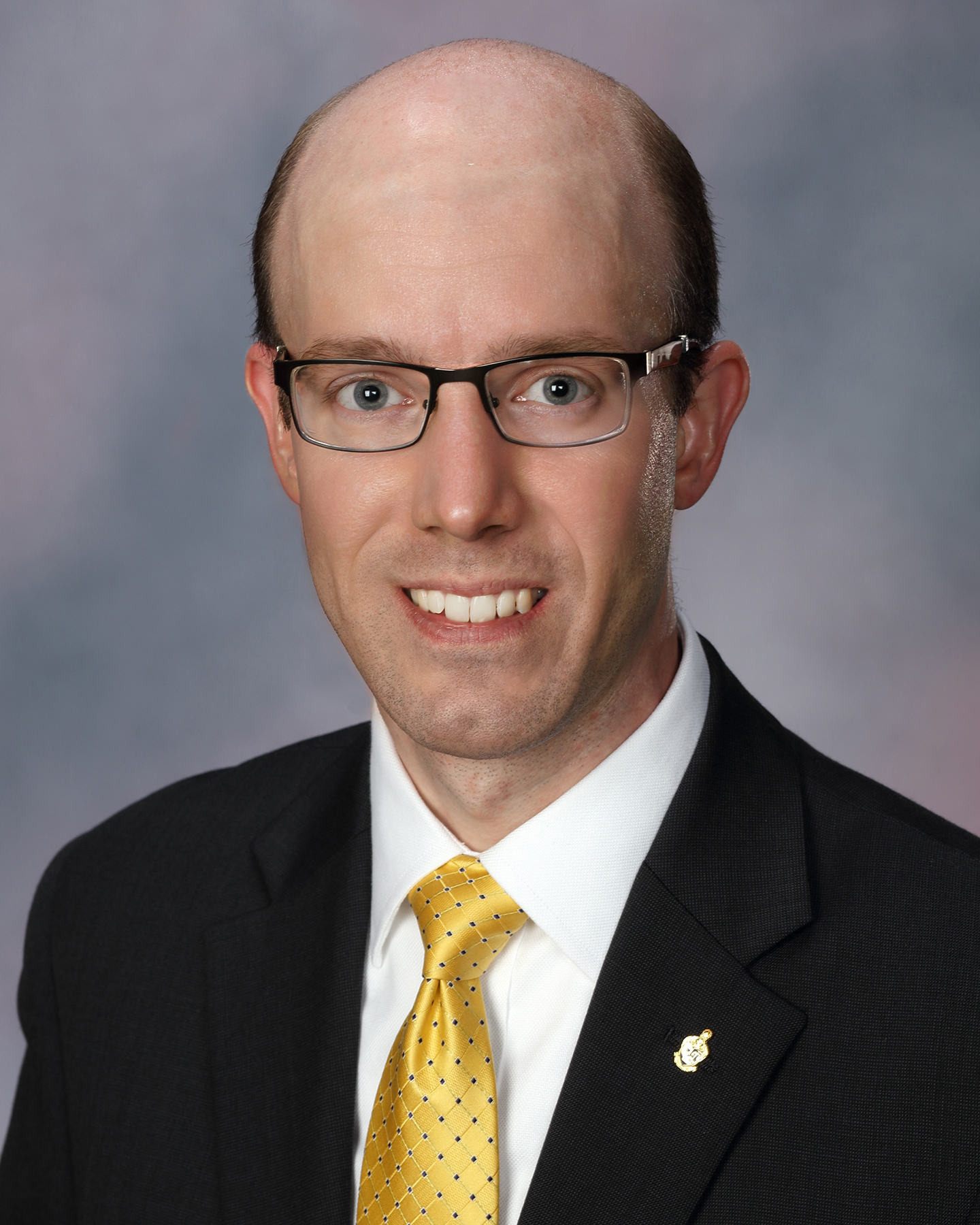
Hays USD 489 school board candidate: Cole Engel

Cole Engel

Age:  36

Education:  BBA, Computer Information Systems; BBA, Accounting; MBA, Accounting; PhD, Advanced Accounting; Certified Public Accountant, State of Kansas

Do you have a student currently attending USD 489 schools?  No

Qualifications? I am a lifelong resident of Hays, a 2002 graduate of Hays High School, and currently an assistant professor of accounting at Fort Hays State University.

Do you support USD 489 trying for another bond issue? What do you think that bond should include? If you don’t support a bond issue, how do you think the school district should address its infrastructure needs?

With two failed bond questions, the hot issue in USD 489 is facilities. I agree there are facilities needs in the district. What remains unresolved is how to prioritize and pay for the necessary improvements.

I think I am the only candidate for the Board of Education who has publicly stated that I did not support either of the previous two bond issues. I believe the district has a responsibility to first clearly define the true needs and then clearly communicate them to the voters and taxpayers. Had the district clearly defined true needs and proposed a reasonable bond issue, the public would have supported it. Obviously the district failed in this regard, twice.

I also think K-12 education is a public good and the entire state benefits from an educated citizenry, not just the USD 489 tax base. I worry that if we step-up and pay for this ourselves, then the state legislature will be ‘off the hook’ and will not have to meet their constitutional requirement to adequately fund public education in Kansas.

The state has an obligation to fund education, and I think it is risky to assume those costs locally. State lawmakers must commit to fully-funding schools. I am not fundamentally opposed to a bond issue, but I am certainly opposed to one that is too big and includes too many ‘wants’ rather than clearly defined ‘needs’ of the students in the district.

What would you do to secure the financial health of the school district?

Without current involvement in the decision-making process at USD 489 and without a full analysis of the financial situation, it is inappropriate for me to render an opinion regarding specific steps to secure the financial health of the school district. Although some may view this response as an effort to dodge the question, as a Certified Public Accountant I am held to high professional standards. It would be professionally inappropriate for me to make public statements regarding the financial health of an organization without a full analysis of the underlying facts.

The Hays school board is at impasse with its teachers for the second year in a row. What would you do to improve relations with teachers?

In short, the two sides need to focus on the issues, not the people. In a perfect world, there would not be two sides. Rather, there would be an issue and proposed solutions to the issue. Together, those tasked with governance and oversight and those tasked with execution of the mission would work to agree on a reasonable compromise. I know we do not live in a perfect world, but that should not stop us from trying.

Do you support the district’s current one-to-one technology policy? If not, what would you propose?

I am not a proponent of technology for technology sake. I think technology in education is very important and necessary, but it should be treated as a supplement to, not a substitute for, high quality curriculum. Too often we get hung-up on the new flashy technology tool and fail to focus on the educational goals or purpose of that tool. We should not be using the tool because it is new and flashy. Rather, we should be using it only if it meets an educational objective.

How would you support the district in its work to improve student performance?

I see facilities, compensation, and technology as the three biggest challenges affecting student performance. Collectively, funding will be the ultimate challenge. I am not running for a seat on the Board of Education to bring sweeping changes or to shake anything up. I am running to provide levelheadedness to decision-making and to improve the culture and overall attitude of the board. A new governor with an increased funding commitment, a new superintendent with hopefully fresh ideas, and potentially several new board members with a commitment to working together to improve working conditions and ultimately the success of our students seems like a formula for much future success in USD 489.

Is there anything else you would like to add about you or your campaign?

There is nothing more important to a community than its public school system. Quality public schools provide the necessary foundation for everything else. I am not sure I am the best candidate for the Board of Education, but I believe I am a qualified candidate. I am a product of USD 489, graduating from Hays High School in 2002. I believe I was part of the system when it was at its prime. USD 489 provided me the educational foundation necessary for my personal and professional success. It is essential that individuals step up and ensure those same opportunities are afforded to those who follow us.

SEE RELATED STORY: USD 489 election: Engel says bond should be smaller, include only needs

🎥 Additional waterline will serve growth in northern Hays

By BECKY KISER
Hays Post

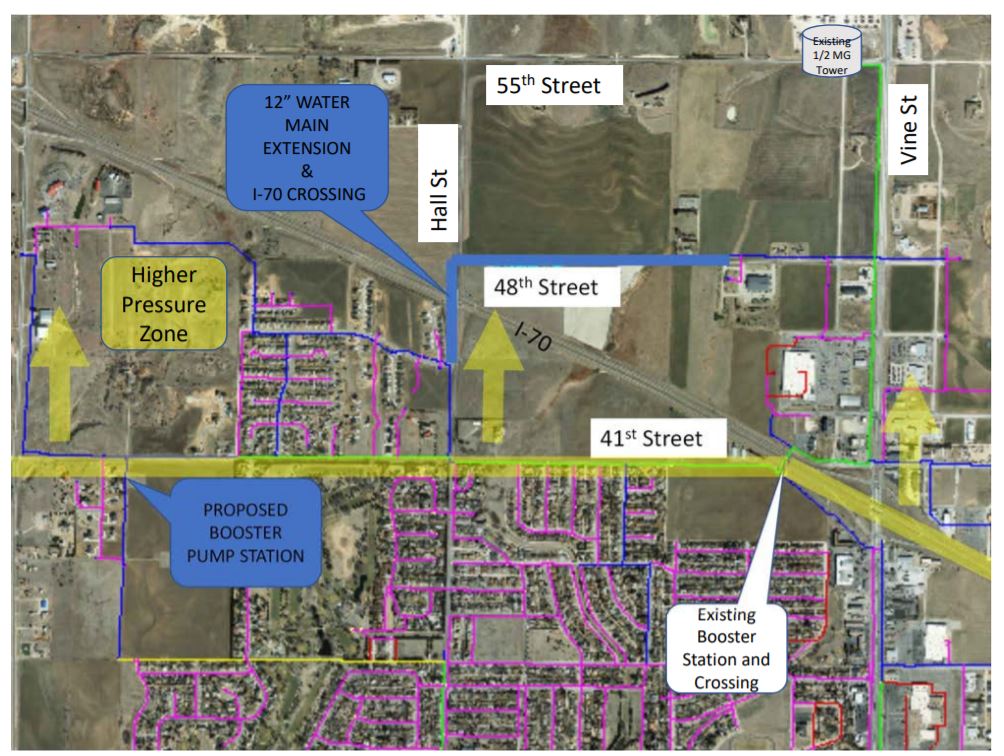
There’s been significant growth north of Interstate 70 in Hays since the 500,000-gallon water tower was constructed and city water was extended to the area in 1993.

A single 16-inch water main crossing under the interstate is the only water service to the many businesses in the north pressure zone and needs to have redundancy.

The project has been in the design phase for the past six months.

“Right now, we have one waterline crossing under I-70 and that was fine while there wasn’t a whole lot up there,” says Toby Dougherty, city manager. “Now that we have a mass balance of businesses up there, if we were to have a significant break underneath the interstate with that one line, we are limited to the supply from the water tower. That’s not a long period of time on days when we’re using a lot of water up there.

“For fire protection, for viability of those businesses, it’s time to put in a second redundant water line crossing.”

As the project began, Dougherty said the city looked at how to provide the most benefit for long-term development, as well as water pressure and flow.

A study by Bartlett & West Engineers in 2018 recommended crossing I-70 at Hall Street, connecting a new 12-inch water main from 45th and Hall to an existing dead-end line along 48th Street at the west property line of Carrico Implement.

The plan also calls for the installation of a new booster pump station on city-owned property along West 41st Street just east of Post Road near a city water well.

Water pressure in the northwest part of Hays, which have been problematic, will be increased.

“That part of town is the furthest away from our towers and our pumping station,” Dougherty noted, “and it’s also at a very high elevation compared to the pumping station.

“We really don’t want to put another water tower up in that area right now. That’s a pretty costly endeavor.”

John Braun, city project manager, will review a recommended low bid of $769,678 with the city commission tonight from Midlands Contracting Inc. of Kearney, Neb., to construct a booster station and an additional waterline under I-70.

Other Oct. 17 agenda items include:

  • Recommendation from city staff for renewal of the current health insurance plan for employees from Blue Cross Blue Shield, which is a 2 percent decrease from last year.
  • Recommendation of  requested annexation of property located at 700 West 48th Street, the former Mid-Kansas Auto. The property is contiguous to the city limits, and water and sewer services will soon be
    available to the property.
  • An update on fundraising and plans for the Hays Accessible Recreation Complex

The meeting begins at 6:30 p.m. in Hays City Hall, 1507 Main.

NW Kansas woman hospitalized after rear-end semi crash

THOMAS COUNTY — One person was injured in an accident just after 3 p.m. Wednesday in Thomas County.

The Kansas Highway Patrol reported a 2018 Kia Sportage driven by Sabrina R. Smith, 28, Selden, was northbound on U.S. 83 three miles north of the U.S. 24 Junction. The driver had a medical condition and rear-ended a 2010 Kenworth semi that had slowed to make a turn.

EMS transported Smith to Citizen’s Medical Center. The semi driver Shawn M. Terwilliger, 42, Stratton, Nebraska, was not injured. Both drivers were properly restrained at the time of the accident, according to the KHP.

Fall control of bindweed

Stacy Campbell is Agriculture & Natural Resources Extension Agent for the Cottonwood Extension District.

Field bindweed is a deep-rooted perennial weed that severely reduces crop yields and land value. This noxious weed is estimated to infest just under 2 million acres and is found in every county in Kansas.

Bindweed is notoriously difficult to control, especially with a single herbicide application. During the fall, but prior to a hard killing freeze, can be an excellent time to treat field bindweed — especially in a year when good fall moisture has been received.

This perennial weed is moving carbohydrate deep into its root system during this period, which can assist the movement of herbicide into the root system.
 
The most effective control program includes preventive measures over several years in conjunction with persistent and timely herbicide applications. The use of narrow row spacings and vigorous, competitive crops such as winter wheat or forage sorghum may aid control.

No-till has been very beneficial for managing bindweed by providing routine herbicide treatments through time and not breaking up the root system and dragging root segments around the fields. No-tillage maintains much of the bindweed seed soil bank at a depth too deep to germinate. It is common to see a resurgence of bindweed after tilling fields that have been in long-term no-till.

Dicamba, Tordon, 2,4-D ester, Facet L (also generics) and glyphosate products alone or in various combinations are registered for suppression or control of field bindweed in fallow and/or in certain crops, pastures, and rangeland. Apply each herbicide or herbicide mixture according to directions, warnings, and precautions on the product label(s). Single herbicide applications rarely eliminate established bindweed stands.

Applications of 2,4-D ester and glyphosate products are most effective when spring-applied to vigorously growing field bindweed in mid to full bloom. However, dicamba and Tordon applications are most effective when applied in the fall. Herbicide treatments are least effective when applied when bindweed plants are stressed.

Facet L, at 22 to 32 fl oz/acre, a new quinclorac product that replaced Paramount at 5.3 to 8 oz, or QuinStar quinclorac products, can be applied to bindweed in fallow prior to planting winter wheat or grain sorghum with no waiting restrictions. All other crops have a 10-month pre-plant interval. Quinclorac products can be used post-emergence in sorghum to control field bindweed during the growing season. In past K-State tests, fall applications of Paramount, now replaced by Quinclorac (Facet L, QuinStar) have been very effective as shown below in the table.
Additional noncropland treatments for bindweed control include Krenite S, Plateau, and Journey.

Considerable research has been done on herbicide products and timing for bindweed control. Although the research is not recent, the products used for bindweed control and the timing options for those products haven’t changed much since this work was done. As a result, the research results in the table below remain very useful today.

Fall-applied treatments for control of field bindweed: Randall Currie, Southwest Research-Extension Center 1992-1997.

Stacy Campbell is an Agriculture and Natural Resources agent in the Cottonwood District. You can contact him by e-mail at [email protected] or calling 785-628-9430. 


SPONSORED: Eagle seeking administrative & marketing assistant

Are you detail oriented and enjoy supporting your fellow coworkers? Would you like to have a vested interest in your company where you will see your efforts benefit the company and the community? If so, we are looking for you at Eagle Communications!

Eagle Communications is 100% employee-owned and we are hiring for a full-time Administrative Assistant. This person would be instrumental in the corporate office’s day to day operations. The position is located in Hays, KS.

Responsibilities:
– Providing support to management and employees.
– Planning and coordinating company meetings and events.
– Supporting community outreach efforts.
– Designing promotional materials and company branding
– Maintaining internal communications through emails, newsletters and social media.
– Scheduling.
– General office upkeep including ordering supplies, mailing and shipping.
– Answering phones and receiving the public.
– Data processing, recordkeeping, and filing.
– Developing and maintaining documents and forms.

Qualifications/Experience:
– Two years related experience preferred.
– Familiar with Microsoft Office programs and Adobe Acrobat.
– Graphic design experience preferred.
– Event planning experience preferred
– Proper phone etiquette.
– Ability to speak and write clearly and accurately.
– Demonstrated proficiency in typing and grammar.
– Multi-tasking capabilities.
– Interpersonal skills and create a positive experience for others.
– Desire to be proactive and creative.

Salary:
Compensation is commensurate with experience, along with a competitive benefits package including health insurance, 401(k), paid vacation, and employee stock ownership plan.

Other information:
Applications will be accepted until the position is filled. The selected candidate will be required to pass a criminal history background check and motor vehicle check. Eagle Communications is an Employee-Owned company and an EEO employer.

Click HERE to apply.

Former National Geographic editor delivers reality check on changing environment

Dennis Dimick

Dimick says humans have become dominant force on the planet

MANHATTAN – Former National Geographic environment editor Dennis Dimick offered a dose of reality to the debate on the world’s changing climate Monday, but noted that humans have the ability to provide solutions to complex challenges.

“The basic equation that stands today is that we have benefitted greatly by the use of ancient carbon fossil fuels, like coal and oil and natural gas,” said Dimick, who draws heavily from 35 years experience working and traveling the world for the national magazine, the last 10 of which were as the executive environment editor.

“Our use of those resources has allowed us to do many things to build the modern world, but we’ve begun to see some by-products and effects that are changing the chemistry of the atmosphere. What’s happening is that we are seeing changes on the planet speeding up. Ice is melting, seas are rising and we are seeing more extreme storms.”

Dimick was the sixth speaker in Kansas State University’s noted Henry C. Gardiner Global Food Systems lecture series, which encourages science-based discussion on issues important to growing food around the world. The series is funded by Gardiner Angus Ranch of Ashland, Kansas and hosted by K-State’s College of Agriculture.

The full lecture, titled ‘Living in the Human Age,’ can be viewed online.

Scientists often refer to the acceleration of environmental processes as the anthropocene epoch, or as Dimick says, “a period of time when humans have become the dominant force on the planet.”

“Did it start 10,000 years ago when we first started transforming our landscapes and domesticating them for growing food?” Dimick asked. “Or was it in the 1700s when we learned how to dig up ancient fossil carbon energy (coal) and light it on fire, changing the chemistry of the atmosphere? Or did it start in the last century when we first learned how to blow up bombs?

“It’s a new way to contemplate our relationship with Earth. We do know that the mark of our presence will endure in the geologic record long after we are gone.”

Dimick helped to bring many environmental issues to global prominence during his time at National Geographic. He helped lead or contribute to projects that covered global warming, genetic diversity of crops, population growth, melting glaciers, diminishing water resources, food safety and security, and more.

Through words and pictures, Dimick said National Geographic aimed to connect people back to the land on which they live, “and to the people who grow that food and keep us all from starvation.”

“We wanted to make agriculture not just big and abstract and mega-scale, but we wanted to make it personal. We wanted people to meet the people that grow food for themselves and for us, whether it’s in Mali or Peru.”

Within that framework, Dimick’s team often encountered sobering realities, such as satellite pictures that show that the Arctic cap at the North Pole has shrunk in half from 1979 to 2012.

“Scientists are trying to figure out why the jet stream is becoming wobbly and more unstable,” Dimick said. “They think there’s a connection to the loss of ice in the Arctic and the unusual behavior of the jet stream that is causing things like the storm that hit eastern Nebraska in late March. We’re seeing more extreme weather events across the country; for example, last year in (the state of) Washington we had 70 inches of rain, which was 20 percent greater than we had ever had before.”

Dimick said much of North American agriculture has been affected by warming temperatures and uncertain weather patterns. He showed a chart that indicates an alarming trend of decreased production of wheat, potatoes, rice and corn – including signs that the trend will continue through 2040.

“As one who has kind of been studying this issue for a very long time, there’s a paradox,” he said. “We hear of the need to double world food production to be able to grow more food for a rising population, but the trends are showing us that we’re going in the wrong direction.”

Dimick cited a report published four years ago that offered some of the steps humans can take to help slow negative environmental changes, including managing refrigerants, reducing food waste, saving tropical forests, family planning, building solar farms, and more.

Mark Gardiner, president of Gardiner Angus Ranch and son of Henry C. Gardiner, closed Monday’s lecture with the challenge that drives the series. “When we think about society and policy, we have complicated questions, and we have a delicate balance. It’s our job to figure it out.”

“We’ve got to be part of the world,” Gardiner said, “and we can do that.”

Gove Co. court finds LEMA water-conservation tool constitutional

MANHATTAN — A district court in western Kansas has ruled that the chief engineer of the Kansas Department of Agriculture Division of Water Resources acted properly in approving a water management tool proposed by the Northwest Kansas Groundwater Management District No. 4 (GMD 4) to aid in local conservation efforts to extend the life of the Ogallala Aquifer. On October 15, 2019, the Gove County District Court upheld the adoption of a Local Enhanced Management Area (LEMA) in much of the district.

The case, Friesen v. Barfield, was filed under the Kansas Judicial Review Act after two public hearings were held by Chief Engineer David Barfield who then approved adoption of the LEMA. The case was brought by multiple petitioners who are required under the LEMA plan to reduce the amount of groundwater withdrawn over the next five years. Petitioners challenged whether the reductions in water use can be made without those cuts being based on priority (date the water right was approved) and generally challenged the lawfulness of any cuts or use of a LEMA.

In 2012, Groundwater Management Districts were granted the authority to recommend the adoption of a LEMA in order to implement local water conservation goals through the adoption of control measures recommended in their plan when conditions demonstrate a threat to groundwater levels, rate of withdrawal, or water quality. The LEMA process involves meeting specific statutory requirements and holding public hearings before approval by the chief engineer. A LEMA management plan typically requires reductions in water use to achieve the water conservation goal, aimed at extending the life of the local aquifer.

In the case of Friesen v. Barfield, plaintiffs challenged both the specifics of this management plan and the constitutionality of the LEMA statue in general. The court ruling this week found that the “GMD 4 District Wide LEMA should be upheld. The LEMA Plan restrictions do not appear to be unconstitutional on their face or as applied. There is substantial evidence backing the agency’s decision and therefore it is not arbitrary or capricious.”

The first LEMA in Kansas, known as the Sheridan 6 LEMA, was approved in 2012 in the Sheridan County area. It was extended in 2017 for the years 2018-2022 after data from the Sheridan 6 LEMA strongly indicated that the water use goals in the area were met, and that significant indicators showed the conservation efforts had slowed the decline of the water table in the region. “The LEMA has been a very successful tool for our district and we plan to utilize them to extend the life of the aquifer,” said Shannon Kenyon, GMD 4 district manager.

For more information about LEMAs in Kansas, including more detail about the GMD 4 LEMA, visit agriculture.ks.gov/LEMA or call KDA-DWR at 785-564-6640.

PREVIEW: Fall Radio Auction Oct. 17 & 18

The Eagle Radio Auction kicks off Thursday morning at 8 a.m. on radio stations 101.9 KKQY and 94.3 FM and 1400 AM KAYS.

There are thousands of items to bid on and buy, including a Bad Boy Mower from Farm Implement and Supply.

Retail Price $4099

Bad Boy Magnum – MZ zero turn mower from Farm Implement and Supply. If you’re looking for efficiencies of a zero turn mower at a price that does not compromise on quality construction and quality of cut – turn to the MZ Magnum. Features 42 inch cutting deck. 19 horsepower Kohler engine. Foot assist manual lift with Dial –style height adjustment. Solid steel deck. And Hydrostatic Trans Axle. Bad Boy the strongest, most powerful mower – with the cleanest cut – on the planet.


Lifetime Dental Invisalign Program

Retail Price $5500

The Invisalign program from Lifetime Dental Care offers comfort, convenience and confidence while straightening your teeth using trays that are virtually invisible. The Invisalign program Includes office consultation, trays, photos, x-rays, aligners, whitening program and more. Invisalign works great for both adults and teens. Your new smile is waiting. Get started today! lifetimedentalcare.com. THIS OFFER NOT VALID WITH ANY OTHER SPECIAL OFFER. Lifetime Dental Care – 2701 Sternberg Drive – Hays – 785-625-7969.


Maytag Electric Dryer from Fitzgerald Furniture

Retail Price $1119

Bid on this very nice 7.4 cubic foot electric dryer from Fitzgerald Furniture in Ness City. The color is metallic slate. Hoses for steam connection are included; the electric cord is not provided. The dryer was the refresh option with steam and power dry. Pictures are included on the auction website. Does include pedestal.

Kansas woman hospitalized after rear-end semi crash

THOMAS COUNTY —One person was injured in an accident just after 3p.m. Wednesday in Thomas County.

The Kansas Highway Patrol reported a 2018 Kia Sportage driven by Sabrina R. Smith, 28, Selden, was northbound on U.S. 83 three miles north of the U.S. 24 Junction. The driver had a medical condition and rear-ended a 2010 Kenworth semi that had slowed to make a turn.

EMS transported Smith to Citizen’s Medical Center. The semi driver Shawn M. Terwilliger, 42, Stratton, Nebraska, was not injured. Both drivers were properly restrained at the time of the accident, according to the KHP.

Kansas man hospitalized after semi overturns

CHEYENNE COUNTY —One person was injured in an accident just after 11a.m. Wednesday in Cheyenne County.

The Kansas Highway Patrol reported a 2004 Kenworth semi driven by Manuel Hernandez, 55, Garden City, was northbound on Kansas 27 when the passenger side tire dropped off the roadway on the right side. The driver overcorrected and the vehicle rolled over.

EMS transported Hernandez to the hospital in St. Francis. He was properly restrained at the time of the accident, according to the KHP.

NW Kansans among winners in Ranchland Trust photo contest

“Herding History” by Nichole Conard

Winners have been announced for the eighth annual Ranchland Trust of Kansas (RTK) photography contest, which concluded Oct. 14.

Each summer, RTK invites amateur and professional photographers of all ages to submit photos that showcase the mission of RTK and Kansas’ ranching heritage. The mission of RTK is: “To preserve Kansas’ ranching heritage and open spaces for future generations through the conservation of working landscapes.”

Nichole Conard of Wichita was the grand prize winner in this year’s contest. Her photo titled “Herding History,” was taken during the 150th Chisholm Trail Drive south of Mayfield in Sumner County. She spent the day following the herd and this was her favorite image.

“Thank you so much for choosing my photo as grand prize. This is the first contest I’ve ever entered, so it is an honor knowing the hard competition I was against,” said Conard.

Marisa Rose Betts, Russell

Amy Robben of Fall River won the Fan Favorite category by receiving 570 votes on RTK’s Facebook page. Her winning photo, titled “Summer Red Angus”, was taken in the Flint Hills.

Robben said, “I live on a 10,000 acre cattle ranch in the Flint Hills. There are about 100 Red Angus heifers out on this pasture. This picture displays the beauty of summer in Kansas and the beauty of the livestock industry.”

A record number of photographs were submitted to the contest this year. The panel of judges narrowed the selection down to a top 30 for the Fan Favorite category voting on Facebook. All other category winners were chosen by the panel of professional photographers, along with RTK and Wolfe’s Camera representatives. The Facebook album was able to reach over 30,000 Facebook users and nearly 6,000 votes were cast for the Fan Favorite category. Thank you to all who viewed and voted for these beautiful Kansas photos.

Additional winners in each category were: Landscape – Sheryll Marks, Wellington; Livestock – Tony Ifland, Cedar; People – Mike Scheufler, Augusta; KLA Member – Marisa Rose Betts, Russell; Youth – Lily Judd, Pomona; and Honorable Mentions – Stacey Rhoades, Newton; Callahan McIver, Council Grove; and Crystal Socha, Augusta. Socha’s honorable mention photograph was the first photo taken with a drone to be entered in the contest. All winning entries can be viewed on RTK’s Facebook page.

Tony Ifland, Cedar

Prizes, sponsored by Wolfe’s Camera of Topeka, are awarded to the top 10 winning photographers. The photographs will be used, with permission of the photographers, to promote Kansas’ ranching heritage and open spaces.

RTK will have photo stationery cards for sale throughout the year featuring the 10 winning photos. Printed on premium cardstock, the folded cards are blank inside and come in packs of 10 with white envelopes. The card packages can be purchased for $20 by contacting Samantha Weishaar at 785-273-5115 or [email protected].

Crystal Socha, Augusta
Copyright Eagle Radio | FCC Public Files | EEO Public File