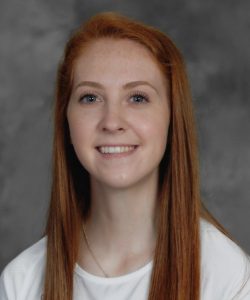
Racheal HamelThomas More Prep-Marian announced Wednesday that Racheal Hamel has accepted the position of head high school girls soccer coach. She begins her role as the team prepares for the 2018-19 Season.
Hamel is a current student at Fort Hays State University. Previously, Hamel played central mid-field for the Bethel Threshers. Her soccer career started at the age of 5.
“I fell in love with the game,” she said.
Her love for the game grew and ultimately led her to soccer camp counseling.
“Camp is where I figured out I enjoyed coaching and leading. I want to teach the ladies that God comes first and weave His teachings into my daily routines,” Hamel said.
“We are excited to welcome Racheal Hamel to our coaching staff and have her lead our girls soccer program. Racheal has a vested interest in the girls soccer program at TMP-Marian as a former player and will do everything in her power to ensure the success of the program. Racheal will bring excitement and passion to the program, as well as, provide a positive role model for our student athletes,” said Troy Schulte, activities director.
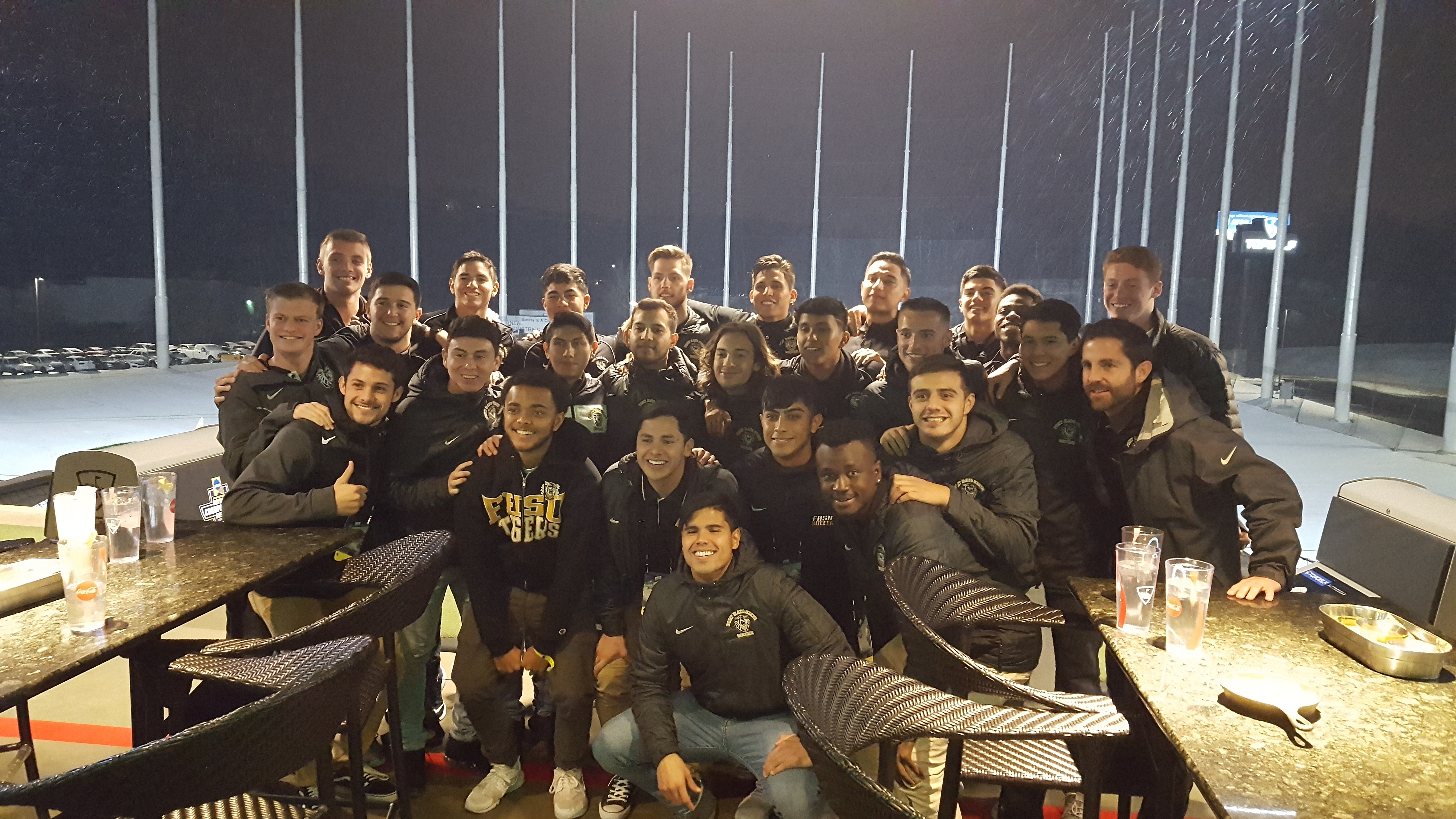
The Fort Hays State University men’s soccer team felt right at home Tuesday night, enjoying the festivities under snow showers during the NCAA Division II Championships Festival Opening Ceremonies in Pittsburgh, Pa. Photo by Ryan Prickett
By DIANE GASPER-O’BRIEN FHSU University Relations and Marketing
Followers of Fort Hays State University fall athletics won’t have to wait until next year to watch Tiger football.
Tiger fútbol – i.e. soccer – is still alive in 2018.
The FHSU men’s soccer team traveled to Pittsburgh, Pa., earlier this week to compete for a national championship in the program’s eighth year of existence. The Tigers qualified for the NCAA Division II championship week by winning a quarterfinal match on their home field on Nov. 17.
FHSU Athletic Director Curtis Hammeke said Fort Hays State is fortunate this year to be part of the National Championships Festival, unique to NCAA Division II and held every four years for fall, winter and spring sports.
“This is going to be a great experience for our student-athletes, to be a part of the festival year,” Hammeke said. “It really enhances the experience for all of them, because it’s a much bigger production than it would be at one location for each individual sport.”
More than 900 student-athletes will be competing in Pittsburgh for six fall championships – men’s and women’s soccer, men’s and women’s cross country, women’s volleyball and women’s field hockey.
The festival has an Olympic-type setting, featuring an opening and closing ceremony for the student-athletes on Tuesday and a social lounge area where they can congregate, similar to an Athletes Village. The festival also features participation in community engagement during the week.
It also will give the Tigers a chance to tell others about Fort Hays State. FHSU will be one of three schools representing Kansas at the festival. Washburn University’s volleyball team made the top eight, and Pittsburg State qualified its women’s cross country team as well as one runner in the men’s competition.
“Any time you can get to where you are competing at the national level, it brings more exposure,” Hammeke said, “not only to your sport, but to your university as a whole, on a regional and national level and in a positive light.”
The 2-0 victory over Ohio Valley University on a cold, windy day not only lifted the program to new heights, but it also gave Brett Parker – the only head coach in program history – his 100th victory at FHSU.
The Tigers would like to make that 102 by the end of the weekend. The semifinal winners will advance to the national title game at 11 a.m. Central Time Saturday.
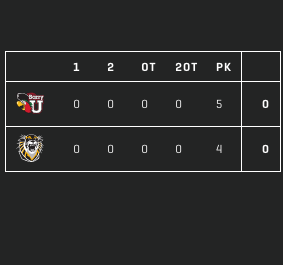
But first things first. FHSU is scheduled to take on Barry (Fla.) University in the first of two semifinal matches at 10 a.m. Thursday.
The match can be seen live online at https://www.ncaa.com/liveschedule/2018/11/29. It will be live-streamed in the Memorial Union’s Cody Commons as well as in Victor E. Lounge in Gross Memorial Coliseum.
With its 17-2-1 record, highlighted by a 14-match winning streak, Fort Hays State received the No. 1 seed for the final four.
Fort Hays State, ranked 11th in the nation, might have a bit of an advantage over its opponent, No. 4 seed and 20th-ranked Barry, whose home is in warm and sunny Miami.
FHSU practiced in cold temperatures recently and left town Monday, a day after Hays’ first winter blizzard of the season. Snow showers are forecast for the Pittsburgh area today and Thursday, with game-time temperatures in the mid-30s.
“We practiced in 30 degrees today with about an inch of snow on the ground,” FHSU Coach Brett Parker said via telephone Tuesday. “I don’t know if it will make a difference. But at least we know what to expect. We definitely are not afraid of cold weather. We’ll take any advantage we can get at this stage.”
The other half of the bracket also features a warm-weather team in No. 2 seed Cal Poly Pomona (17-6-0), which will face what would have to be a local favorite in No. 3 seed West Chester University (15-2-5).
West Chester, located in western Pennsylvania, is only about a four-and-a-half hour drive from Highmark Stadium.
However, Cal Poly Pomona has an edge in experience on the entire field; this marks the third trip to the final four in four years for the Broncos, who finished as national runners-up in 2015. CPP will enter Thursday’s match on a four-game winning streak after defeating three nationally ranked teams on its way to Pennsylvania.
Although Fort Hays State’s program is less than a decade old, Parker said reaching the national semifinals has been a long time coming.
FHSU made it to the quarterfinals four of the past five seasons. The first three years, the Tigers suffered close, heartbreaking losses each time – either by one goal or on penalty kicks following two overtime periods.
Then came this year.
“That (quarterfinal) game is always so difficult with the level of opponent you face and what’s at stake,” Parker said. “We finally got the monkey off our back.”
The Tigers had to overcome some adversity to even get to the quarterfinals this year.
Despite earning the top seed in the Central Region and earning the chance to host the regional and national quarterfinals, things didn’t look good early in the second half in the regional championship game.
FHSU was playing Northeastern State University, a team the Tigers had beaten twice before this season.
“It’s hard beating a team three times in a season, and it got harder each time we faced them,” Parker said.
None was more difficult than the regional title game. The Tigers trailed the RiverHawks 1-0 in the second half when FHSU’s star player went down with an ankle injury.
When junior forward Santiago Agudelo – the top scorer in all of NCAA II with 26 goals – left the field, Parker said, he didn’t have time to wonder how his team would react.
“Soccer is such a team game, and everybody realized they had to pick up some of the slack,” Parker said. “Of course, we would love to have Santiago, one of the best players in the country at his position, but we haven’t missed a beat.”
Fort Hays State went on to score three goals in the final nine minutes to beat Northeastern State, 3-1. The RiverHawks finished the season 15-3-1 with all three of its losses being to the Tigers.
“I think that really helped our confidence in the quarterfinal game, after still playing well in the regional game even without Santiago,” Parker said.
Agudelo, who injured tendons in his left ankle, is in a cast and won’t play this week. But he is still a big part of the team; his role has just changed.
“He’s a big reason why we are even here,” Parker said. “We wish he was playing, but it’s great having him with us on the sidelines, too.”
When looking back at the season, the 2018 Tigers will have plenty to celebrate: their 8-0 conference record earned FHSU a second straight MIAA championship.
Parker was honored as MIAA Coach of the Year for a second consecutive year. Agudelo was named Player of the Year for both the MIAA and the Central Region. Earlier today, Agudelo also garnered National Player-of-the-Year honors, as well as first-team All-America recognition by D2CCA. Two senior teammates, defender Luis Torres and goalkeeper Fernando Pina, also earned All-America honors.
The 17 victories to date surpassed the previous program-best by three. FHSU will finish the season ranked no lower than fourth in the nation.
But all the reminiscing will have to wait.
Right now, the Tigers are focused on Thursday morning’s game, and then hopefully can begin preparing for another match on Saturday.
“If we are going to fly all the way across the country, we might as well play two games,” Parker said. “We’re planning on being here, playing on Saturday.”
The Hays USD 489 school board voted Monday night to hire the Kansas Association of School Boards to assist in a search for a new superintendent.
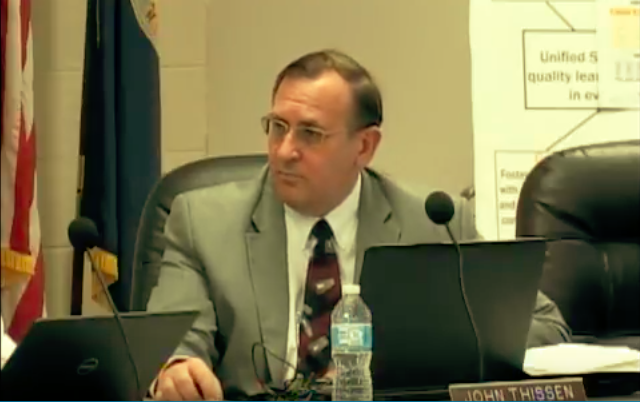
Superintendent John Thissen gave his letter of resignation to the board on Oct. 19. He will finish out his current contract, which runs through June 30.
The district had bids from three entities to aid in the search: Kansas Association of School Boards, $5,850; McPherson and Jacobson, $4,850, which also included other fees for a total of about $13,350; and Ray and Associates, $24,250. Ray and Associates specializes in multi-state searches.
Board members Mandy Fox and Greg Schwartz voted against moving forward with KASB. Schwartz said he was impressed with the schools McPherson and Jacobson had recently worked with, many of which were similar in size to Hays.
The board has worked with KASB on previous searches.
Board member Luke Oborny said he appreciated KASB work in the past.
“I don’t believe KASB steered us wrong in the past, except he decided to leave too soon,” Oborny said.
The board will likely meet with KASB representatives in December to start working on the search.
ELLIS — At Monday’s meeting of the Ellis City Council, Public Works Director Alan Scheuerman reported on the department’s current fleet of vehicles.
He said the average age of the pickups used daily by staff is over 18 years old, noting one vehicle already has incurred over $3,500 in repair costs this year.
The council allocated $24,000 in 2018 to replace a pickup, and an additional $16,000 in 2019. The council’s preference was for Scheuerman to try to replace two pickups in 2019 with the combined $40,000 available.
——————————–
Complete minutes of Monday’s meeting:
ELLIS CITY COUNCIL
REGULAR MEETING
Minutes
November 19, 2018
CALL TO ORDER
Mayor David McDaniel called the meeting to order at 7:30 p.m. Present were Council members Bret Andries, Holly Aschenbrenner, Jolene Niernberger, Dena Patee, and Bob Redger. Also present were Public Works Director Alan Scheuerman, City Clerk Amy Burton, Police Chief Taft Yates, Fire Chief Dustin Vine, and City Attorney Olavee Raub. Council member Susan Eaton was absent.
PLEDGE OF ALLEGIANCE
AMENDMENTS TO AGENDA
None
PUBLIC PRESENT
Martin LaBarge, Verda Flinn, Barbara Perkins, Nickole Byers, Glen Keller, Steve Ferland, Gary Luea, and Guy Riedel.
CONSENT AGENDA
Council member Holly Aschenbrenner moved to approve the consent agenda containing the Minutes from the Regular Meeting on November 5, 2018 and Bills Ordinance #2057. Council member Jolene Niernberger seconded the motion. The Council approved the consent agenda 5-0.
PUBLIC COMMENTS
None
PRESENTATIONS OF AWARDS, PROCLAMATIONS, REQUESTS & PETITIONS (HEARINGS)
None
SPECIAL ORDER
Fire: Report
Fire Chief Dustin Vine provided his monthly report.
UNFINISHED BUSINESS
Fire: Repair/Maintenance
Chief Vine presented bids to replace the roof at the Old Fire Station. Although both bids were similar in price and work performed, High Plains Roofing offered a 20-year warranty, while Roofmasters Roofing & Sheet Metal Co. offered a 15-year warranty. After further discussion, Council member Bret Andries moved to accept the bid from High Plains Roofing in the amount of $14,828, with funds to come from the Capital Improvement Fund and existing insurance proceeds. Council member Jolene Niernberger seconded the motion. The motion carried 5-0.
NEW BUSINESS
Fire: Acquisition
Chief Vine continued by presenting three bids for the purchase of thermal cameras for the Fire Department. Council member Dena Patee moved to accept the low bid from Emergency Fire Equipment for the purchase of two FLIR K2 thermal cameras in the amount of $1,349 each, with funds to come from the Fire Department budget. Council member Holly Aschenbrenner seconded the motion. The motion carried 5-0.
General Government: Licenses/Permits
Council member Bob Redger moved to approve the Application for License to Sell Cereal Malt Beverages for Casey’s General Stores. Council member Dena Patee seconded the motion. The motion carried 5-0.
General Government: Special Event
City Clerk Amy Burton inquired if Council was interested in holding a City Christmas Party for staff, elected officials, and their guests. Council member Jolene Niernberger moved and Council member Bob Redger seconded a motion to hold a City Christmas Party. The motion carried 5-0.
Personnel: Benefits
Ms. Burton continued by asking if Council wanted to continue the practice of giving City employees a Christmas bonus. Council member Bret Andries moved and Council member Jolene Niernberger seconded a motion to approve a Christmas bonus for each full-time and part-time employee in the net amount of $200. The motion carried 5-0.
Public Works: Acquisition
Public Works Director Alan Scheuerman reported on the Department’s current fleet of vehicles. The average age of the pickups used daily by staff is over 18 years old. One vehicle in particular has already incurred over $3,500 in repair costs this year. Council allocated $24,000 in 2018 to replace a pickup, and an additional $16,000 in 2019. Council would like for Mr. Scheuerman to try to replace two pickups in 2019 with the combined $40,000 available. Council would also like for Mr. Scheuerman to purchase a pickup specific to the department needing it, and not switch vehicles around among staff. Mr. Scheuerman stated the four vehicles needing replaced the soonest are the 1988 Chevy, the 1990 Ford, the 2001 Dodge Ram, and the 2004 Ford F250. When pressed for the two worst vehicles, Mr. Scheuerman stated the 1988 Chevy and the 1990 Ford.
REPORTS FROM CITY OFFICIALS
Public Works
Mr. Scheuerman presented the Comparative Water Report for the period September 10th to October 10th.
Water: Training
Council member Bob Redger moved and Council member Jolene Niernberger seconded a motion to approve Water Operator John Leiker to attend backflow prevention training in Hays. The motion carried 5-0.
Sewer: Repair/Maintenance
Mr. Scheuerman further discussed the City’s increasing issue with sewer inflow and infiltration. The sewer plant is treating 150,000 gallons a day more than it is producing. Council questioned why Mr. Scheuerman didn’t have Mayer Service camera more linear feet of sewer line when they were in town for the annual sewer cleaning. The City budgeted $11,000 in 2018 to investigate the infiltration problem.
Police
Police Chief Taft Yates presented his Department report. The two new warning sirens have been installed and the County hopes to have them on-line by the end of the year.
City Clerk
City Clerk Amy Burton informed Council of the Northwest Kansas Planning & Development Commission’s Annual Meeting on November 28th. The October Tourism Committee meeting minutes were reviewed. The Kansas Department of Commerce is considering a special round of CDBG grant funding for swimming pools for small cities. The public hearing will be on December 10th.
Attorney
City Attorney Olavee Raub reported the second contract for the Water Exploration Project has been accepted as revised. Once signed, the City can close on the land contracts. Council member Jolene Niernberger asked Ms. Raub to investigate if the City already has an ordinance in place for infrastructure for tele-communications towers. The League has reported an ordinance needs to be in place by January.
Mayor Update and Announcements
Mayor David McDaniel congratulated Jolene Niernberger, Steve Ferland, and Martin LaBarge on their election to Council. The new council members will be sworn in on January 14th.
Council member Bret Andries questioned the need to hire an engineer to draw up specifications for the Campground Expansion Project. An engineer is needed to apply for grant funds from the Dane G. Hansen Foundation and the grant from the Kansas Department of Wildlife, Parks and Tourism. The Campground Committee has been asked to solicit bids from engineers to review at a future Council meeting.
ADJOURNMENT
Council member Bob Redger moved and Council member Bret Andries seconded a motion to adjourn the meeting. The meeting adjourned at 8:50 p.m.
Steve Gilliland
Archery fall turkey season here in Kansas has been open since October1 and fall turkey gun season will open December 10. I see fall turkey season as the most under-utilized hunting season in Kansas; I shouldn’t preach, I haven’t hunted fall turkeys myself for years. But every time I think about fall turkey season, I think of this story from years ago.
Ordinarily being inducted into any sort of members-only club or organization is an honor; something to be proud of, something to be pleased about, a reason to hold ones head high. One weekend several years ago, however, I was unintentionally and involuntarily given membership in an organization I’m ashamed to be a part of… Let me explain.
It was dusk and a chilly wind blew from the west. I had finally aligned my priorities, and number one was labeled “bag a fall turkey.” Our hunting blind was tucked under some craggy low hanging trees in front of an old silo. An alfalfa field lay in front of me, and the river with its fringe of trees and scrub brush, lay behind. I couldn’t see much to my left, but the west wind had been bringing with it the clucks and cackles of wild turkeys for nearly an hour. Fall turkey hunting is as different from spring turkey hunting as east is from west. The turkeys are grouped in large flocks for the winter, often a hundred or more around here, and hunting them becomes a game of cat and mouse, (ideally the turkeys play the part of the mouse.) Maybe I hunt overly paranoid and ultra-suspicious turkeys, but when the dust settles, I often end up looking more like the mouse myself.
Anyway, there I sat, straining to see the birds I could hear. Slowly black specks appeared in the alfalfa until the field was black, like a pepper shaker had spilled onto a green tablecloth. In two distinct groups they ever-so-slowly filed across the field, strutting, flapping and twittering like school kids after recess. As the first group crossed in front of me they were too far away for a shot, and when they finally disappeared into the trees to my right, I thought my evening’s hunt was over. However, the sounds of turkeys still wafted on the wind and a second large group materialized through the branches to my left, this bunch much closer than the last. I slowly and quietly eased the 12 gauge barrel through the open slit in front of the blind, released the safety and waited, already tasting fresh wild turkey breast.
My best shot was through an opening in the trees about as wide as the blind, and one large hen in front of the flock soon stood there. As she cocked her head and looked my way, I put the front sight of the barrel on the base of her neck, and squeezed off the shot. Even as the sound of the blast still hung in the air, wild turkeys flew everywhere; I mean all the turkeys, every last one of them including the hen I’d shot at!.. I sat in the silence of the dark blind, somehow trying to deny the fact that I had just blown an easy shot. I walked around in the alfalfa as if I expected the earth to suddenly spew forth a dead turkey it had hidden from me as a cruel joke. I gazed in the direction of the fleeing birds as if I planned to see a dead turkey appear without warning somewhere in the distance. I had been told by other hunters that sooner or later every turkey hunter misses an easy shot, and I had just joined that club. I was now a card carrying member of TWITS (That Was Incredibly Terrible Shooting.)
Walking to my pickup, I had to chuckle and wonder what was going through that turkeys mind (since it was not pellets from my shotgun shell.) I knew I could count on a compassionate and understanding response from my wife at home, and, sure enough, she replied “How in the world did that happen?” Continue to Explore Kansas Outdoors.
Steve Gilliland, Inman, can be contacted by email at [email protected].
HaysMed, part of The University of Kansas Health System, was awarded an “A” rating in patient safety from the Leapfrog Group, a Washington D.C-based organization aiming to improve health care quality and safety for consumers and purchasers.
The “A” is for its efforts in protecting patients from harm and meeting the highest safety standards in the U.S. The Safety Grade assigns an A, B, C, D or F grade to hospitals across the country based on their performance in preventing medical errors, infections and other harms among patients in their care.
“Only about one-third of 2600 general acute-care hospitals nationwide get an “A” grade from the Leapfrog organization,” said Melanie Urban, Director of Patient Quality. “Our “A” rating is indicative of the strong culture and focus on patient safety by all of the employees who put patients first every day at HaysMed.” Grades are assigned twice a year by The Leapfrog Group.
According to Leapfrog this is the only national rating of how well hospitals protect patients from preventable harm and death, such as medical errors, infections, and injuries. Receiving an “A” Safety Grade means a hospital is among the best in the country for preventing these problems and putting their patients first, 24 hours a day.”
Developed under the guidance of an expert panel, the Leapfrog Hospital Safety Grade uses 28 measures of publicly available hospital safety data to assign grades to approximately 2600 hospitals twice per year. It is peer reviewed, fully transparent and free to the public.
The 28 performance measures include handwashing practices, blood infections and patient falls. Leapfrog uses the measures to come up with a single letter grade ranging from A to F, meant to show how effective a hospital is in keeping patients safe from preventable harm and medical errors.
Reflection is good for the soul. It allows you to see where you’ve been and hopefully chart a better course on where you’re going. During the Thanksgiving holiday I took the time to contemplate my early life in the small community where I grew up.
Located in northwestern Kansas, Seguin was a small farm/ranch community of approximately 50 hearty souls. It was located in Sheridan County, three miles south of Highway 24 and the Union Pacific railroad used to run through our small village.
Seguin was a community where families were raised and principles – good and sometimes bad – were instilled. Looking back, those fortunate enough to grow up there like I did in the ‘50s and ‘60s were surrounded by people with core values that helped guide us throughout our lives.
At the top of this list of virtues my community provided was spiritual in nature. A spiritual quality like, seek ye first this kingdom of God and his righteousness and all things shall be given unto you.
We all grew up with Monsignor Mulvihill and the Sisters of St. Joseph, went to mass six days a week and learned to abide by the golden rule.
Next, was the courtesy level of our town. This was measured by the ordinary civilities a total stranger could expect. Residents of Seguin and the outlying community always welcomed family and friends back for special events – many centered around our church and its congregation.
Transient laborers, especially during wheat, milo and corn harvest, were also treated well because of their valuable contributions during these critical periods.
Rootedness or a sense of commitment on the part of a town’s people was another cornerstone in our little community. Dependent on the fertile, sandy loam soil of the High Plains, Seguin’s families lived by the unspoken agreement that this was a place to stay, put down roots and build a family, a farm, a business and a future.
This quality is closely related to a sense of place, which now grows more rare with each passing day.
Diversity – not necessarily in the form of many nationalities – but rather in the form of creative disagreement was another building block in our community. This meant our little town enjoyed a certain confidence that all its inhabitants didn’t have to echo one another in order to make progress.
On the contrary, a community, like a country, can profit by its differences. Believe me, nearly everyone I ever knew in Seguin spoke up, voiced their opinions and let their ideas be heard.
Loyalty was the fifth attribute our community was blessed with. Loyalty is often confused with conformity, though the two are really opposites.
It is precisely loyalty to the community, to posterity and to principle that moves a citizen not to conform. A dissenter may never be so loyal as when refusing to go along quietly.
Loyalty is a virtue, but not a simple one. Certainly, it is not as simple as those who use it as a club to enforce their will on an individual or a community.
Generosity was the sixth attribute and not just with material support but a generosity of spirit akin to humility. This broader, deeper attribute sets aside not only personal interests for the sake of community, but personal grudges, slights and obsessions.
One might call this trait charity, but charity in our society has acquired an unfortunate connotation of being optional – not obligatory. Some believe charity is what you do with what you have left over. Those who believe they owe a debt to their community and embrace the opportunity to repay it practice charity, the real thing.
Pride in our little burg was also readily apparent. Self respect may be a better word for this civic virtue. It has to do with much more than clean streets, green lawns and painted buildings. It also explains good schools, honest law enforcement and other amenities that make for a proud, self respecting community.
Openness was the final attribute in our small northwestern Kansas community. Without openness all these other virtues would only be a façade. Our community was an open book. Everyone knew everyone else and everything that was going on. Candor, candidness, frankness, sincerity and plain dealing were the only way of doing business and conducting each day of your life.
Everyone who lived in Seguin was a member of the community and part of our town. Didn’t matter who you were, where you lived, how old you were or whatever else. Our community was a place of human and humane values.
Sometimes in the rush of every day life we forget to live by such values. Know your neighbors, coworkers and the members of your community. And, yes, it’s all right to argue and disagree with them about what is best for the community.
What is important is to care about your community. Think of its best interests and don’t let your mind be diverted by lesser concerns or scattered holdings.
Just like the little community I grew up in and the family and neighbors who helped shape who I am today, each of us live in communities that have values and fine traditions to uphold. Be part of yours.
John Schlageck is a leading commentator on agriculture and rural Kansas. Born and raised on a diversified farm in northwestern Kansas, his writing reflects a lifetime of experience, knowledge and passion.
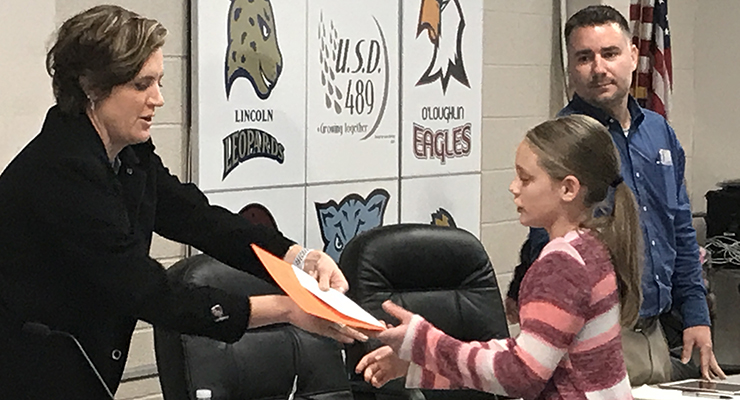
Olivia Goetz, fifth-grader at Roosevelt Elementary School, receives her Best of the Best Award Monday night from Board President Mandy Fox.
The Hays USD 489 honored Olivia Goetz, fifth-grader at Roosevelt Elementary School, with the Best of the Best Award Monday night.
She was nominated by her teacher Michaela Gower.
“Olivia is a student who pushes herself to be the best version of herself each and every day. Olivia comes to class prepared and has a willingness and hunger to learn,” Gower said in her nomination.
“Olivia exemplifies a growth mindset, which is something we have focused on throughout the beginning of the school year. This is exhibited specifically in her writing, where she has been working on a personal narrative piece describing her time at the Kansas State Fair. Olivia knows the importance of pushing herself each day to take the story to new heights.
“As Olivia progresses into middle school, I have no doubt she will continue to experience academic success with the work ethic and growth mindset that she brings to school with her each day,” Gower said. “I’m honored to have the opportunity to be a part of Olivia’s journey as a student at Roosevelt.”
Matt Brooks
Matt Brooks
Abby Gillan, HHS teacher, nominated Matt Brooks, social science teacher at Hays High School, as the staff Best of the Best.
Brooks and Gillan were unable to be at the school board meeting Monday night.
Gillan wrote the following in her nomination letter:
“In a district and school our size, it gets difficult to notice the acts of people around us that are subtle and consistent.Matt Brooks, besides his BOOMING voice that penetrates walls, can be characterized as both subtle and consistent.
“Matt is consistently doing the little/subtle things for his students to give them an extraordinary learning experience.As our district focuses on ‘relationships’ I think there is no better example of how to build positive and meaningful relationships than Matt and his students.
“He consistently greets his kids at the doorway, asks them about their activities, hobbies and families.He takes the time to see kids. To see through a kid sleeping during his lecture to find that kid works late to help support his family, sees through the seemingly unprepared kid who doesn’t ever bring his computer to class to find out that kid cannot pay his fees, and the withdrawn girl who is battling depression.
“He does it every single day, and he does it consistently.So much so, that if you don’t look for it, you may miss it.It challenges all of us to be consistent not only in our instructional efforts, but in building meaningful rapport with all students every single day.”
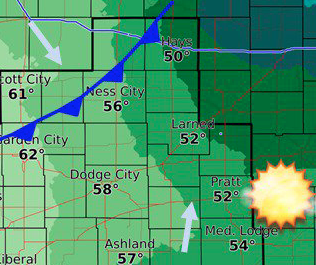
Today Mostly sunny, with a high near 50. South wind 6 to 9 mph becoming west in the afternoon.
Tonight Partly cloudy, with a low around 27. West wind around 6 mph.
Thursday Mostly sunny, with a high near 48. Calm wind becoming east northeast around 6 mph in the afternoon.
Thursday Night Areas of fog after 3am. Otherwise, mostly cloudy, with a low around 29. East northeast wind 3 to 6 mph.
FridayA slight chance of drizzle before noon, then a chance of rain after noon. Areas of fog before noon. Otherwise, mostly cloudy, with a high near 41. East southeast wind 6 to 10 mph. Chance of precipitation is 40%.
Friday NightA chance of rain before 2am, then a chance of rain and snow. Cloudy, with a low around 33. Chance of precipitation is 40%.
Baker Hughes reported 1,079 active drilling rigs across the U.S. last week, a drop of three oil rigs. North Dakota and Texas were both down three, Louisiana was up four and New Mexico increased by three rigs. Oklahoma was down two rigs for the week. Canada reported 204 active rigs, up seven for the week. Independent Oil & Gas Service reported 15 active rigs in eastern Kansas, which is unchanged, and 33 west of Wichita, which is down one.
Operators filed 30 permits last week for drilling at new locations across Kansas, nine east of Wichita and 21 in Western Kansas, including two in Stafford County.
Independent Oil & Gas Service reported 45 new well completions last week, 1,396 so far this year. There were 11 in eastern Kansas and 34 west of Wichita. Three completed wells were reported in Barton County, two in Ellis County, and one each in Russell and Stafford counties.
The government said U.S. crude production continued to rise from record levels, last week topping 11.7 million barrels per day, an increase of four thousand barrels per day over the week before. The U.S. Energy Information Administration reported inventories increased by 4.9 million barrels, and are now about six percent above the five-year average for this time of year.
North Dakota reported another crude-production record in September, 1.36 million barrels per day according to preliminary numbers from the state. But officials say those numbers could go down over the next three months or so, because of low oil prices, and the state’s disappointing gas-capture efforts. The state has decided not to change the scheduled increases in gas capture goals, and instead offer flexibility to operators in their efforts to meet them.
A judge in Oklahoma denied a motion to dismiss an earthquake lawsuit against producers in Oklahoma, but refused to give the suit class-action status. The Journal-Record reports said some clients will have to refile if they want to proceed with their damage claims. Plaintiffs attorney Scott Poynter said he was pleased that the judge denied motions to dismiss the case, but said the potential plaintiffs in the class should file individual petitions soon if they want to protect their rights under statutes of limitations laws.
U.S. liquefied natural gas exports are booming, and some new export facilities are in the works. Cheniere Energy officially opened its $15 billion facility in Corpus Christi, Texas earlier this month. The company won’t say when the first cargoes will set sail, but Reuters reports an LNG vessel currently docked at the plant was expected to take its first cargo soon. Corpus Christi is the third big LNG export terminal to enter service in the lower 48 states.
In Texas producers are worried about infrastructure and personnel. More than a dozen top U.S. energy companies have pledged $100 million toward easing stresses on health care, education and civic infrastructure from the shale oil and gas boom in West Texas and New Mexico. Pioneer Natural Resources is spearheading an effort called the Permian Strategic Partnership. Company CEOs warn that if worker shortages, road problems, healthcare and housing aren’t address soon, Permian development could be stifled.
Some pipeline relief is in the works in North Dakota, but it will be over a year before it bears fruit. Phillips 66 and Bridger Pipeline announced plans for a new pipeline to send Bakken and Rockies crude oil to Texas. The firms announced a joint open season for the proposed Liberty Pipeline, which, if approved, could move some 350,000 barrels per day by the year 2020.
The Oklahoma Supreme Court sided with the state’s oil and gas industry in a dispute over what kinds of water can be transported through temporary lines the county permits in ditches along roadways. The high court said Kingfisher County may not issue rules against moving only drinking water, and not produced wastewater, through those ditches. The court agreed with the industry’s assertion that state law gives state regulators the exclusive authority to regulate oil and gas activities.
Alberta gives carbon-tax breaks to oil and gas drillers, and a tongue-lashing to the national government in Ottawa. Premier Rachel Notley announced her government in Alberta will add oil and gas drilling to a list of trade-exposed industries exempt from the province’s carbon tax. The move is expected to provide $750,000 to $1.5 million per year in relief to the drilling industry. Notley later criticized a fiscal report for underplaying Western Canada’s oil price crisis, blamed on insufficient pipeline capacity to take away a glut of crude trapped in Alberta.
The boom continues in New Mexico, where the State Land Office announced a record for its monthly oil and gas lease sale, generating This month’s sale represents the highest single-month yield in the agency’s history more than $43 million for public schools and other trust land beneficiaries. The previous record of just over $30 million was set in July of last year.
Regulators in Alaska say the state held another record-breaking lease auction for oil and gas rights. The Alaska Division of Oil and Gas received 159 bids totaling $28.1 million for properties on the North Slope, the foothills, and the Beaufort Sea.