We have a brand new updated website! Click here to check it out!

First Amendment: Making social media ‘better’ — with caution

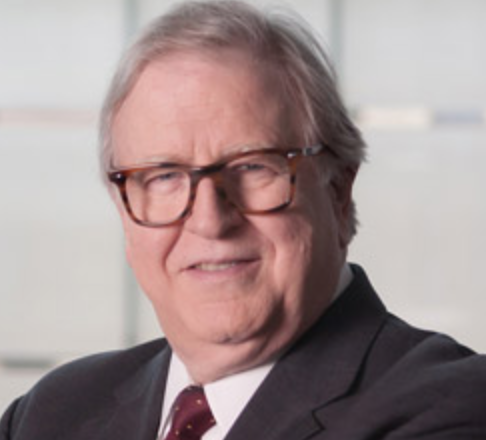
Gene Policinski

We’d all like a “better” internet in terms of privacy, politeness, taste and safety. And who would oppose eliminating false or misleading information from social media sites, or preventing online bullying and such?

Last week, some of the world’s most significant, influential and powerful figures around such issues — in the words of The Wall Street Journal, “the giants of the web” — gathered at the 2018 Web Summit in Lisbon, Portugal and in Brussels at an international conference on data privacy and policy.

At the Lisbon meeting, an audience reportedly cheered for a proposed international institute to propose regulations worldwide on social media. United Nations Secretary-General António Guterres warned in a speech that “the weaponization of artificial intelligence is a serious danger” and Microsoft President Brad Smith called for “a digital Geneva Convention” to end state cyberattacks against civilians.

Web inventor Tim Berners-Lee called for private companies, governments and internet users to unite around what he called a “contract for the Web,” a nine-point plan with goals to protect personal privacy, create online methods to counteract harassment and hate speech and for universal access to the web.

In Brussels, Apple CEO Tim Cook advocated for the U.S. to adopt the European Union’s strict data privacy law, enacted in May, allowing consumers to review, edit and delete personal information on the web. Cook warned that technological advances are leading to a “data industrial complex” and that “our own information, from the everyday to the deeply personal, is being weaponized against us with military efficiency.”

So much for the once-hoped for era of “peace, love and harmony” that the World Wide Web was supposed to usher in on behalf of all humanity.

Still, we’ve been here before — and need to keep in mind we’ve overreacted to the threats, real and imagined, posed by new technology before dialing down regulations and codes to a reasonable compromise on free expression, privacy and safety.

Early concerns about privacy noted that the new-fangled telephone could ring into a home at any hour of the day, while proper guests of the day would knock on the door and announce themselves.

Content on radio was relatively unregulated, with government attention directed more to the actual problems with frequencies and interference — until the Communications Act of 1934 gave the Federal Communications Commission power not only to govern the technology but what was said over the airwaves via the so-called “Fairness Doctrine.” Intended to ensure that all voices were heard on public airwaves, the doctrine was abandoned in the 1980s as no longer needed in a world of virtually unlimited cable and satellite channels, but also with the realization that it actually diminished discussion on matters of public interest.

In movies, the “Hays Code” was adopted by Hollywood filmmakers in the early 1930s to head off moves to have Congress set strict standards for what movies could show across a wide range of topics and issues — from comments about the law and drug use to sex and violence. One silly example of the code’s restrictions: Childbirth was considered a “taboo” subject. In the acclaimed film “Gone with the Wind,” as a character was giving birth, actors in the scene could only be shown as shadows on a wall.

The code was on the books for decades but was weakened in the 1940s and 1950s — particularly in 1952 when the U.S. Supreme Court, considering a case involving the movie “The Miracle,” extended First Amendment protections to films.

Likewise in television, the “Television Code” was adopted by the National Association of Broadcasters under threat of a government council to set rules. From 1952 to 1983, the code ruled on everything from how actors dressed to references to religion, sex, family life and more. Famously, the code resulted in married couples shown on TV only using double beds and in 1952, when the star of “I Love Lucy,” Lucille Ball, became pregnant, that word was not permitted — the show was allowed to say only that she was “with child” or “expecting.”

When the sound of a flushing toilet was heard in 1971 in an episode of the groundbreaking sitcom, “All in the Family,” it reflected a growing demand by the public for realism rather than the unrealistic depictions of everyday life that the code had encouraged.

Note that all of those overreactive attempts to regulate came early in the development of those mediums of expression.

The web is barely out of its teenage years, in effect, and social media megaliths such as Facebook and Twitter are even younger. The web’s revolutionizing impact extends from newly accessible public records to instant global communication. And our reliance on social media as a means of reporting news, recording our lives and relaying our views is unlike anything seen in generations, if anything before.

But if history is a guide — and it is — we need to temper calls to “protect” ourselves from that which we do not like or find dangerous, lest we replace such with censored, sanitized and government-regulated messages or content intended to pacify rather than provoke and inform.

There may well be a need to rein in the wild web, to set privacy boundaries and fight real misuse. But we must be certain that the control over what we see, hear, say and access remains as close to our own fingertips as possible — and not handed over to some “National Nanny” claiming to act on our behalf, lest we be confined to a future of shadows on the wall, double beds and a view of life where no one ever uses a toilet.

Gene Policinski is president and chief operating officer of the Freedom Forum Institute. He can be reached at [email protected], or follow him on Twitter at @genefac.

Schwaller Center to offer care for uninsured

By CRISTINA JANNEY
Hays Post

High Plains Mental Health announced last week that it will expand services at the Schwaller Crisis Center to people who are uninsured.

The four-bed center, which is located in Hays, serves as a mental health crisis center for High Plains’ 20-county catchment area.

In the past, the center has provided care to Medicaid and private-pay clients. An increase in state funding allowed High Plains to expand its care to individuals who are homeless and experiencing a mental health crisis. State funding had been cut by almost a third in the last six to eight years, Walter Hill, High Plains executive director, said. Some of that funding has been restored.

The center provides 24/7 care as a voluntary alternative to hospitalization.

A sitting area at High Plains Mental Health’s Schwaller Center. The center provides 24/7 crisis care in a home-like setting.

Although crisis centers similar Schwaller are opening in metro areas such as Kansas City and Wichita, the Schwaller Center opened in 2002. The center opened after the in-patient hospital unit in Hays closed in the same year.

The center is a half-way point between outpatient treatment and hospitalization.

“There’s a gap between coming in once or twice a week or every couple of weeks versus going to a state hospital where it is locked and people stay overnight and see a psychiatrist,” Hill said.

Since the center opened, it has diverted 6,000 admissions away from Larned State Hospital and allowed people to find support locally. The center has also been used as transition between the hospital and home.

The center provides many of the same services as a hospital, such as access to a psychiatrist and therapy. However, it offers care in a home-like setting. The center has four private bedrooms, a community kitchen and dining room, as well as laundry facilities. The average stay at the center is three to five days.

Individuals receive support to cope with stressful circumstances, strengthen coping skills, improve sleep and manage daily life skills. They make meals with the staff or with the other individuals staying at the center. The staff may help individuals with life skills, such as managing money, and the staff can help connect the individuals with community resources to use when they leave the center.

Some clients are paired with case workers who help them access resources to look for a job, find a place to live or apply for health care.

Hill said individuals who stay at the center do a lot of work on goals on managing their symptoms. They create kits with reminders of how they can better cope with symptoms and stressors.

“It has reminders about those things so they can pull those reminders out about how do I deal with a situation when I am feeling so depressed or so anxious. How do I calm myself down? So it is really teaching self-help skills. It is probably the most important activity,” he said.

Dealing with your time and handling loneliness can be a significant problem for people who suffer from mental illness, and staff help clients with strategies to cope with those issues. Having the center in the community also means clients are closer to friends and family who can come visit during the individual’s stay.

“People still feel like they have a lifeline to pull themselves back into being on their own,” Hill said. “Sometimes going into the hospital increases their feelings of hopelessness and helplessness because they are so far away in a much different environment in a locked environment. This is not a locked environment like it would be at a state hospital.”

The clients receive medication reviews and work with the staff to create plans for transitioning back to independent living.

Sometimes people’s ability to cope gets worn down and having a place where those stresses are reduced is needed, Hill said.

“One of the key issues is [this is] a safe place where we can help them learn to deal with issues in their lives that are kind of coming in on them,” he said.

“Usually mental health issues at that level of severity are a combination of getting things rebalanced and then learning to deal with those things in life once things are stabilized in your nervous system so you are less depressed and you are thinking more clearly and are less anxious,” Hill continued.

High Plains covers 19,000 square miles and a population of about 100,000 people. Sometimes there is a waiting list for the center and people have to go to the hospital instead of using the center. However, Hill said there are no plans to expand the program. At this point, space and funding would be barriers, he said.

The Schwaller Center was named for Julia Schwaller, who was one of the founding members of the High Plains board.

For more information about High Plains and its services, call 1-800-432-0333. If you are having a mental health emergency, call 911.

Sunny, mild Thursday

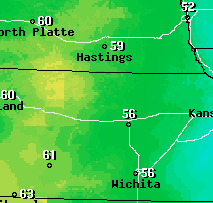
Today Sunny, with a high near 61. West southwest wind 5 to 10 mph becoming north in the afternoon.

Tonight Clear, with a low around 29. North northwest wind 5 to 7 mph becoming west after midnight.

Friday Sunny, with a high near 57. Light west southwest wind becoming south southwest 9 to 14 mph in the morning. Winds could gust as high as 24 mph.

Friday Night Partly cloudy, with a low around 32. Breezy, with a southwest wind 5 to 10 mph becoming north 15 to 20 mph after midnight.

Saturday Mostly cloudy, with a high near 34. Breezy, with a north northeast wind 17 to 21 mph.
Saturday Night A 30 percent chance of snow, mainly before midnight. Cloudy, with a low around 21.

Sunday Mostly sunny, with a high near 37.

National League of Cities announces support of STEM education

Submitted

Today, the National League of Cities announced $100 million in local partnerships to expand America’s innovation economy.

Hays was one of the cities included in the program.

Hays is connecting bilingual services to STEM career support and expanding the program from 25 to 500 participants.

Fort Hays State University’s Science and Mathematics Education Institute and United School District 489’s Migrant Education Program in partnership with the city of Hays and a host of civic partners commit to advancing the STEM and maker-centered learning of the city’s migrant families.

They hope to connect bilingual services with STEM career pathway opportunities and expanding to the general population in 2019 growing from 25 to 500 participants.

These investments come at a critical time when there is a growing need for resources to create startups and train the next generation of science and engineering talent in communities across America. Eighty percent of venture capital goes to just five metropolitan areas, and computer science is not offered in 75 percent of American high schools.

Cities must lead on the nation’s most pressing issues in the absence of federal leadership. Over the past year, NLC, with support from Schmidt Futures, has worked with city leaders, universities, the business community and the social sector to design innovative partnerships that harness the power of science, technology and entrepreneurship to build stronger, more equitable local economies.

Today, over 50 cities, ranging from rural townships and college towns, to major metros, as well as over 200 local partners, are announcing new and specific partnerships that will be supporting young businesses, leveraging technology and ensuring STEM education and workforce training for all. These new partnerships will:

  • Support new and expanded STEM initiatives that connect over 700,000 kids and workers to careers in technology. For example: Tampa, in partnership with 13 university, civic and private sector partners, will provide 600,000 regional K-12 students entrepreneurship training.
  • Partner cities with startups to improve government services in 15 municipalities. For example: Fourteen cities are partnering with City Innovate to establish or expand their local Startup in Residence programs. These programs connect startups with government agencies to co-develop technology solutions to pressing civic challenges.
  • Foster and resource local entrepreneurs in five cities. For example: Akron and the Greater Akron Chamber of Commerce are identifying and supporting 25 local companies that have business models that can grow into regional employment generators.
  • Create and improve eight innovation districts — urban neighborhoods that bring together researchers, workers and entrepreneurs — to ensure these areas benefit all. For example: Providence, with eight higher education institutions and two hospital systems, is creating a new
  • public-private-university partnership, the Urban Innovation Partnership, to collectively govern and develop two Innovation Districts within Providence.
  • Serve as living laboratories to translate university research to address critical social issues such as opioid overdoses, autonomous public transportation, cleaner electrical grids and climate change. For example: Tempe and Arizona State University are testing waste water for opioids to redeploy public services to neighborhoods in the most need.
  • Establish and fund significant, new public-private-civic partnerships that target timely local opportunities. For example: Hartford with Hartford’s insurance industry, led by Travelers, The Hartford, Cigna and LIMRA, and the non-profit StartupBootcamp, have joined together to make the city of Hartford the country’s premier destination for insurance technology startups.

Full list of cities making announcements today

Akron, Ohio

Ames, Iowa

Austin, Texas

Baltimore, Md.

Boulder, Colo.

Buffalo, N.Y.

Charleston, S.C.

Charlotte, N.C.

Chattanooga, Tenn.

College Park, Md.

Corpus Christi, Texas

Denver, Colo.

Erie, Pa.

Fort Collins, Colo.

Fremont, Calif.

Glendale, Calif.

Grand Rapids, MI

Greenville, S.C.

Groton, Conn.

Groton City, Conn.

Hartford, Conn.

Hays, Kan.

Henderson, N.Y.

Kansas City (Kan. & Mo.)

Las Vegas, Nev.

Long Beach, Calif.

Mobile, Ala.

Norfolk, Va.

New Haven, Conn.

New London, Conn.

Oklahoma City, Okla.

Peoria, Ill.

Pittsburgh, Pa.

Portland, Ore.

Providence, R.I.

Roanoke, Va.

Sacramento, Calif.

San Antonio, Texas

San Diego, Calif.

Syracuse, N.Y.

Tampa, Fla.

Tempe, Ariz.

Waco, Texas

Walnut Creek, Calif.

Washington, D.C.

West Palm Beach, Fla.

West Sacramento, Calif.

Other Commitment Makers to Local Activity

Citizen Schools

Johnson C Smith University

Marketplace.city

Portland State University

The U.S. Patent and Trademark Office

Trinity University

Goodland teacher honored with ‘Be The Vision’ at water conference

OFFICE OF GOV.

Weston McCary (Courtesy NWKTC)

MANHATTAN – Approximately 600 attendees with diverse water interests were encouraged at the Governor’s Conference on the Future of Water in Kansas to keep pushing forward with implementation efforts for accomplishing regional priorities within the Long-Term Vision for the Future of Water Supply in Kansas to ensure our state’s water future.

“The state of Kansas remains focused on its goal of a sustainable water future,” said Lt. Governor Tracey Mann. “During this past year serving as Lt. Governor I have met thousands of Kansans that are working each day to make a living and make Kansas a better place and it’s easy to see how having a ready supply of good quality water means a community or industry can develop and grow. It’s important for everyone to know water is not a Republican or Democrat issue, it is a Kansas issue.”

Attendees heard updates on water resource statuses and continued implementation of the Vision as well as areas of concern throughout the state. Progress continues to be made through local, state and federal efforts to implement conservation practices to improve water quality and decrease reservoir sedimentation, but much work still remains. To date 185 failing streambanks have been stabilized but nearly 700 still need to be addressed in priority watersheds. Reservoirs within Kansas continue to lose storage due to sedimentation. There are now 10 Water Technology Farms across the state demonstrating how producers can maintain their bottom line while reducing water use. More progress needs to be made to reduce water use as groundwater levels continue to fall in the Ogallala Aquifer.

Sustainable food production was the message attendees heard from Tim Hardman, Director of Food and Markets, World Wildlife Fund US, as he shared changing consumer attitudes towards how food is produced. This concept is explored as many businesses look to do business in Kansas and sustainable water is part of that conversation. “How and where we produce food in the next 40 years is the biggest challenge of the 21st century.  In the next 40 years we have to produce as much food as we have in the last 8,000. In order to live within the planetary boundaries, we have to figure out how to do more with less.”

Meeting growing water supply needs is a common problem facing communities across the nation, and a critical component of the Vision in Kansas. Tom Kula, Executive Director of the North Texas Municipal Water District addressed this issue head-on while describing the construction of the first major reservoir in Texas in 30 years to serve growing communities. Challenges included mitigation of more than 17,000 acres and permitting requirements at all levels. “Your reservoirs are an absolute necessity in our part of the county. We can find ways of building reservoirs which is smart development and taking care of the environment at the same time. It is important to stay encouraged and build key relationships at the local state and federal levels. As with anything difficult it’s important to develop win-win solutions.”

“One important feature of our Conference is to provide a perspective from outside our state from folks who are addressing similar water issues in other parts of the country and around the world,” said Kansas Water Office Director Tracy Streeter.  “We were very pleased to have Hardman and Kula join us.”

The morning also featured the “Water Legacy Award” which was presented to David Pope, who has worked to define and implement the modern water resource management principles used in Kansas today. Starting with his role as manager of Southwest Kansas Groundwater Management District No. 3 for two years, five years as Assistant Chief Engineer of the Division of Water Resources (DWR) and 24 years as Chief Engineer of DWR, Pope spearheaded many groundbreaking initiatives.

This year’s ‘Be the Vision’ award recipients were also honored for taking extraordinary measures to conserve, reuse or adopt better practices to help ensure the future of our state’s water resources.

This year’s recipients were Bryan Taylor, Project Manager in the Civil Works Branch Programs and Project Management Division, who was assigned to the John Redmond Reservoir Dredging project and became an integral part of the process and eventual success; Chuck Samples, with KVOE radio for his continual media coverage of water in Kansas and the John Redmond Dredging project; USDA-NRCS and State Conservationist Karen Woodrich for their partnership with the Milford Lake Watershed RCPP as well as their critical role in the recent drought through the EQIP Drought Initiative Program; and Weston McCary, director of the Precision Ag program at Northwest Kansas Technical College in Goodland which is a comprehensive program teaching students about high-tech practices, equipment, and software being utilized in production agriculture today. Using a combination of classroom, shop, and field environments, students acquire the skills necessary to succeed in today’s competitive precision agriculture industry and incorporating the practices on the Water Technology Farm.  Secretary of Agriculture Jackie McClaskey and Lieutenant Governor Tracey Mann were on hand to help with the award presentation.

The rest of the day continued with four panels highlighting different water topics, Conservation and Sustainability; Why Does Navigation Matter to Kansas; Water Technology Farms and Aquifer Impacts and Infrastructure for the Future.

Tomorrow will build on Vision implementation and water management and policy discussions from the previous day with technical presentations, posters and talks. Graduate and undergraduate students will present their research.

The conference also features the Kansas Water Office Photo Contest. More than 120 photos were submitted to be voted on as the ‘people’s choice’ at the conference. The winner will be featured on the 2019 brochure, website and other locations throughout the coming year.

The Governor’s Conference on the Future of Water in Kansas is hosted by the KWO, K-State/Kansas Water Resource Institute. Major sponsors for the event include Black & Veatch, Burns & McDonnell and Great Lakes Dredge & Dock.

Midwest Energy gives USD 489 grant for migrant program

USD 489

The USD 489 Migrant Education Program received a $315 grant from Midwest Energy.

The grant was written by Starla Gano, who serves as the district’s migrant services coordinator.

The Kansas Migrant Education Program is designed to address the unique needs of migrant children and their families and offers support for high-quality and comprehensive educational programs to reduce the educational disruption and other problems that result from repeated moves. It seeks to ensure migrant children are provided appropriate educational and supportive services to address their special needs.

This grant will help children receive full and appropriate opportunities to meet the same challenging state academic content and student academic achievement standards that all children are expected to meet.

The grant will allow for the purchase of Science Technology Reading Engineering Arts & Math (STREAM) learning experiences with learning labs.

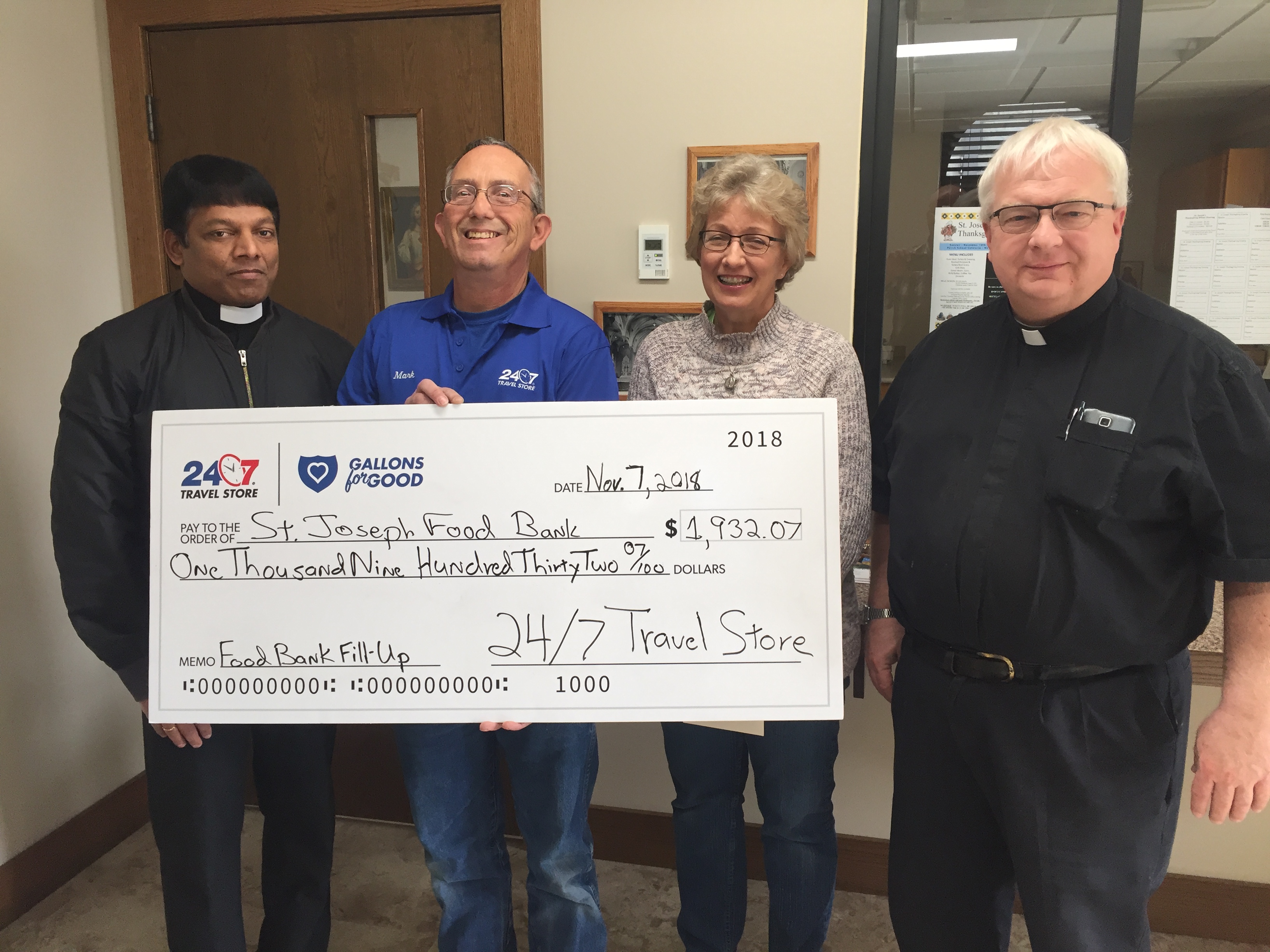
24/7 Travel Store raises $1,900 for St. Joseph Food Bank

Fr. Toney Kulandaijesu, Mark Herl, Rene Michaud, Fr. Fred Gatschet during the 24/7 Travel Store check presentation to the St. Joseph Food Pantry in Hays.

Submitted

For 10 days in October, locally owned travel center 24/7 Travel Stores donated 5¢ for every gallon of gasoline sold at its stores to their local food banks.

The 24/7 Travel Stores donated $1,932.07 to the St. Joseph Food Bank in Hays. The funds raised during the event can be used however the food banks wish, including operating costs and perishable groceries.

24/7 Travel Stores has 10 locations across nine cities, spanning the state of Kansas: Goodland, Colby, WaKeeney, Hays, Russell, Salina, McPherson, Abilene and Maple Hill.

The amount raised across all locations totaled $23,917.24. President of the company, Mark Augustine, is excited to see the impact these funds will have.

“Food Bank Fill-Up was a huge success far exceeding the amount we set out to raise, Augustine said. “24-7 Travel Stores wants to thank each food bank, their volunteers and our local communities for getting involved and supporting this event.”

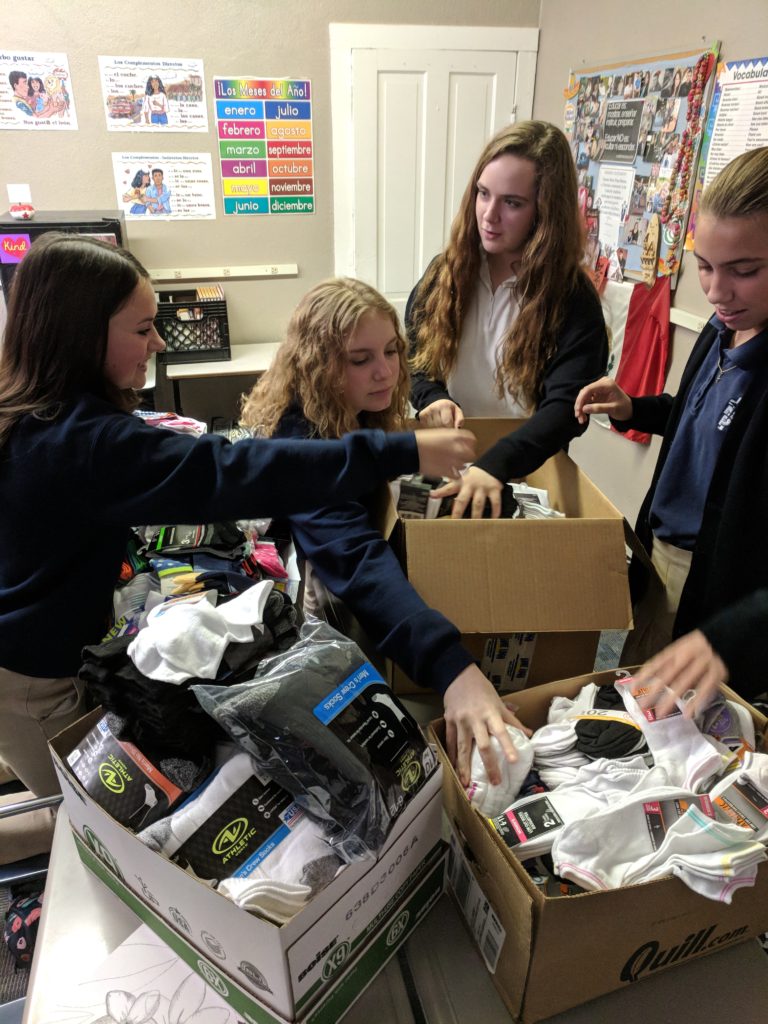
TMP Key Clubs conducts Socktober Drive

TMP

Each night in the United States, an estimated 600,000 people live on the streets.

This October, the goal was to get 2 million people to show that even a small act of love, such as donating a pair of socks, can make a big difference in the lives of our neighbors who are homeless or need assistance.

The Thomas More Prep-Marian Key Club collected 663 pairs of socks in October.

The socks will be donated to the Mary Elizabeth Maternity Home and First Call for Help in Hays.

TMP STUCO supported the project and matched money donations to purchase socks.

Kolacny joins Hays Public Library as communications coordinator

The Hays Public Library has hired Callie Kolacny as communications and projects coordinator.

Kolacny comes to the library after serving five years as the marketing director for Smoky Hills Public Television. Prior to that, she spent 14 years as news director for Eagle Radio in Hays.

An Ellis native, Kolacny has lived in Hays for 19 years. She began her duties at the library on Nov. 12.

KDA–DWR announces water use report paper filing fee

KDA

MANHATTAN — Water right owners in Kansas soon will be expecting a familiar letter in the mail, requiring them to submit a complete and accurate water use report to the Kansas Department of Agriculture, Division of Water Resources. This year’s mailing will look different, because starting with the 2018 water use reporting period KDA–DWR is implementing a $20 per water right paper filing fee on each water use report (except for domestic use) when that report is submitted in paper form. This $20 fee can be avoided by reporting water use online, which is recommended by KDA–DWR.

This is the fifth year that online water use reporting has been available, and many water right owners have already taken advantage of that option. Online reporting allows water right holders to enter official annual water use reports online and receive immediate feedback to help ensure that the report is accurate. It also provides access to other features such as previous reports submitted online. KDA has supported the cost of the transition to online reporting as it will help the agency achieve long-term cost savings. Instead of implementing online “convenience fees,” KDA has taken an entirely different approach and instead will charge a paper filing fee for water use reports beginning with this 2018 water use reporting period.

Complete your online water use report at www.kswaterusereport.org from January 2–March 1. If you need help completing your report, visit or call any of the KDA–DWR field offices or watch the online video tutorials available soon. You can find contact information and a link to the videos at agriculture.ks.gov/wateruse or call the water use team at 785-564-6638. If you choose not to take advantage of the online water use report option, you can send in your report by mail along with the paper filing fee.

Water use data is essential for management of the state’s resources. Each owner of a water right or permit to appropriate water is required by law to submit a complete and accurate water use report every year. This process ensures that the people of Kansas — and officials responsible for managing or monitoring water resources — have access to complete information about how water is used. The information collected is used by many agencies including the Kansas Water Office, U.S. Geological Survey, Kansas Geological Survey, groundwater management districts, Kansas Department of Revenue, county appraisers and others.

Tigers Motorcycle Club seeks to get students geared up about bikes

B.J. Rupp, Doerflers’ Harley-Davidson sales associate, talks to Tigers Motorcycle Club members about bikes during a recent visit to the store.

By CRISTINA JANNEY
Hays Post

Some Fort Hays State University faculty are hoping to pass on their love of the open road to students in the newly formed Tigers Motorcycle Club.

Sponsor for the group, Dennis King, FHSU assistant vice president of student affairs, has been riding for years and has a large collection of bikes.

He said the joy of riding is all about the experience of the ride.

“You see, smell and feel things that you just don’t when you are in a vehicle,” he said. “You are much more aware of your surroundings. When you do ride, you are much more in touch with the road — when you are taking a curve, going around a turn.

B.J. Rupp, Doerflers’ Harley-Davidson sales associate, talks to a Tigers Motorcycle Club member about bikes during a recent visit to the store.

“You can be going 60 miles an hour on a windy day, and the wind is behind you and it is like you’re standing still. You can be going 60 miles an hour and it is just an awesome surreal feeling. … It’s just the thrill of the ride.”

King has a Suzuki, Yamaha, a few Hondas and a Harley, but his favorite bike is a 2005 Triumph America.

“It was one of those that I snuck down to Wichita and bought, and then called home and said, ‘Hey, I bought this bike.’ Depending on the reaction, I was going to come home or not come home,” he said.

Turning a wrench, King said has been his midlife crisis. Ten years ago he couldn’t do anything with a motor. King and a friend work on bikes for a hobby, and that is how he has built up his collection.

“Each bike is unique. Each brand is unique, and each one is a thrill to ride,” he said.

The club already has 18 members in its first semester, but they hope to grow.

The goal of the club, King said, is safe rides and educating young people about maintenance and safety. King hopes to grow the club to the point where they can have regular rides and attend area bike events together.

A FHSU faculty member talks to Tessa Stump, junior in animal science and agribusiness, about a bike during a recent club tour of Doerflers’ Harley-Davidson.

The group recently took a tour of Doerflers’ Harley-Davidson in Hays.

Club President Austin Krejdl, senior in agribusiness, only has a moped right now, but he is saving up for a motorcycle.

“I really like being on two-wheels,” he said. “I like being out on the open road. It is relaxing too after a long day to go on a ride.”

Tessa Stump, junior in animal science and agribusiness, also has dreamed of having her own bike ever since she rode her dad’s Screaming Eagle Harley.

She grew up around horses in Funk, Nebraska, and compared riding a bike to riding a horse.

“I love the fact that I can be on the open road and just enjoy it,” she said, “so it is kind of more peaceful for me.”

Even though Stump doesn’t have her own bike yet, she said she has enjoyed the club.

“It gives me one day out of my week to go out and do something I actually enjoy,” she said.

The club is open to FHSU students, faculty and staff. You can sign up for the club by logging onto to your TigerLink account and searching for Tigers Motorcycle Club.


Sunny, cold Wednesday

Today Sunny, with a high near 47. South wind 3 to 7 mph.

Tonight Mostly clear, with a low around 26. South southwest wind around 7 mph.

Thursday Sunny, with a high near 57. West southwest wind 6 to 9 mph becoming north northwest in the afternoon.

Thursday Night Clear, with a low around 29. Northwest wind 3 to 7 mph.

Friday Sunny, with a high near 58. Light and variable wind becoming south 5 to 10 mph in the morning.

Friday NightPartly cloudy, with a low around 31.

Saturday A slight chance of rain before 1pm, then a slight chance of rain and snow between 1pm and 3pm, then a slight chance of snow after 3pm. Mostly cloudy, with a high near 37. Chance of precipitation is 20%.

Copyright Eagle Radio | FCC Public Files | EEO Public File