We have a brand new updated website! Click here to check it out!

🎥 Navy vet Morley: Remembering the ‘invisible veterans’

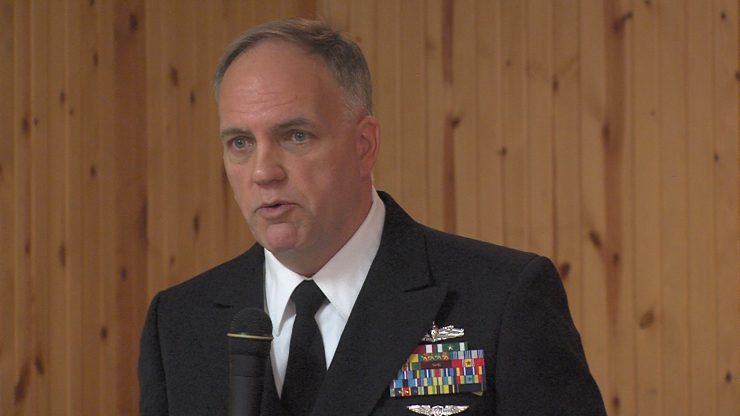
Mike Morley

By BECKY KISER
Hays Post

“I’m just one of roughly 400 members, men and women who compose VFW Post 9076 here in Hays. Our post is a great group. We have several heroes among us. In fact, some of them are here in the first few rows. But I want to make clear that I do not consider myself one of them.”

That was how retired Hays Lt. Commander Mike Morley, who served in the U.S. Navy for 23 years, introduced himself to the crowd gathered Saturday for the annual Hays VFW Veterans Day observation.

As the program’s featured speaker, Morley, who is communications coordinator for Midwest Energy, focused on what he called “my heroes, invisible veterans.”

He started with a reflection back to the devastation of World War I in which 20 million people were killed on all sides.

“Twenty-one million were wounded. And that’s significant because it was the first war where more men came home injured, surviving their combat wounds, than dying from them,” Morley noted.

There were horrific physical injuries. But other injuries were not so obvious.

“For example, shell shock. That’s a polite term for what we call today PTSD (Post Traumatic Stress Disorder). Or nerve and brain damage from widespread use of chemical weapons.

Flag-raising ceremony Saturday at the Hays VFW

“H. G. Wells famously wrote that World War I will be ‘the war that will end war’ because a rerun would be just to horrific to contemplate. Of course, we know things didn’t turn out that way.”

Morley recalled the wars since then, several other smaller actions and places today where troops are fighting in small numbers.

“In the 100 years since the end of World War I, November 11th, 1918, tens of millions of men and women have worn the uniform of their country and all of them to a greater or lesser degree, have been changed forever by that experience.”

Life is just a little bit different for those invisible men and women who made it home, just like those in World War I, he said, whether they served in combat or not.

Morley talked about his friend Brian. “He doesn’t have any ships or places named after him, but his sacrifice is every bit as real as those who do.”

The two met 26 years ago as young sailors. Brian was from Texas; Morley was from Topeka, Kansas.

“We had three things in common: a love of heavy metal music, a love of Japanese beer and a curiosity about amateur boxing.”

One evening after work the two put on sparring gloves. “It wasn’t pretty,” Morley said with a wry grin.

Morley was knocked down in about 40 seconds. Brian had neglected to mention he was a Texas high school Golden Gloves boxer. Rather than rub it in, Brian taught Morley how to improve his boxing skills.

They kept in touch over the years by email and Facebook.

While Morley stayed on active duty, Brian went inactive and into the Navy Reserve, moving to Manhattan, Kansas, and taking a job at Fort Riley to raise his family.

Brian volunteered for his first combat deployment to Afghanistan in 2008. While on patrol with a Marine squad, a teenage boy approached them with a smile, said hello in English, and then detonated the explosive vest he was wearing.

The bomber was killed instantly. The blast scattered the Americans who suffered various injuries, including lost limbs and eyes. Brian was sent into a wall, knocked unconscious and shattered three vertebrae in his back.

After a long convalescence stateside, Brian received the Purple Heart and re-enlisted in the Navy Reserves.

“I was stunned when he volunteered for a second tour,” Morley recalled.

This time, Brian’s base was hit several times by Taliban rocket attacks. During a nighttime attack, Brian fell from his bunk, hitting his head hard on a metal table. He was knocked unconscious and re-injured his back.

His tour was again cut short and he was sent home to recover.

Brian’s wife reported something was different after that event; his normally happy-go-lucky personality had changed. “He became short-tempered, suspicious. His mood swings at work became more pronounced and he couldn’t deal with stress very well,” she said.

Brian ended up losing his job at Fort Riley.

His medical care was also different the second time. Instead of the long inpatient stay at National Naval Medical Center in Bethesda, Maryland, he received after his first injury, Morley said, “Brian was given cursory outpatient treatments at the VA [hospital] in Topeka.”

Brian was on 26 prescription medications in 2010, according to his wife. He was taking anti-psychotics, anxiety drugs, sleeping pills, stimulants and pain pills, all at the same time.

The VA twice scheduled and canceled the back surgery Brian needed for permanent pain relief. There was a surgeon shortage and more severely injured veterans took priority.

“So Brian was simply given more and stronger pills, and the chemical mix made him more and more unpredictable.”

In July 2011, when Brian’s mood swings were at their highest, his wife and children moved out.

“For seven months, Brian rarely left the house, only for food, doctor’s appointments and to pick up prescriptions. His Facebook posts had gone from fun and edgy to being an incoherent mix of statements and paranoid rants.”

On Feb. 11, 2012, Brian received a mail-order prescription for 90 pain pills, double the dosage of an earlier prescription.

That evening he took 10 of the new pills along with the cocktail mix of his regular meds.

When Brian didn’t show up for his son’s track meet the next afternoon, his son went by the house and found him on the basement couch.

The chief petty officer was just 39 years old.

“Ironically, Brian was not among the 22 veterans who would take their own lives that day, or the next day, or every day since,” Morley said.

Brian left no note. His death was declared “respiratory arrest by accidental overdose.”

“He died as he lived his last few years, as an invisible veteran,” said Morley of his longtime friend.

Brian’s story is not unique.

“This country, its VA system, and dozens of non-profit groups have bent over backwards to ease the transition for severely [physically] disabled combat vets. These guys are true heroes,” Morley declared, “and they really deserve to be cared for as such.

“But for the thousands and thousands of invisible veterans whose injuries are less obvious or poorly documented, they fall through the cracks trying to navigate a system that wasn’t designed for them, and this is not new.”

There are Vietnam War Agent Orange vets with cancer, veterans with Gulf War Syndrome, and more recently, veterans suffering from traumatic brain injuries from non-fatal blasts or severe PTSD from events they’ve experienced but can’t unsee.

“They suffer in silence for years on end, hoping and praying that a slow-moving bureaucracy will someday validate or at least acknowledge that they are now different from before they served.

“So H.G. Wells was dead wrong when he predicted an end to war a hundred years ago,” Morley declared.

“Today, we’re in a war against faceless, nameless terrorists with no end in sight, which means we are continuing to make these invisible veterans.

“As we pause today to remember the veterans we’ve lost, let us also remember those we still have with us, especially the invisible ones. Let us vow to never again minimize their service or minimize their symptoms. Instead, let’s embrace them and their families with dignity, compassion, and most of all, understanding,” he concluded.

Morley’s speech was met with a standing ovation by the audience, filled with veterans, family and friends.

Exploring Outdoors Kansas: Katfish the (Canine) Gator

Steve Gilliland

Picture this; you’re a law enforcement officer in Kansas City, MO and you show up one morning at a home to evict the tenant, along with his belongings, only to find his “belongings” include a 7 foot alligator.

On Wednesday morning law enforcement officers arrived at the home of Sean Casey in southeast Kansas City, Missouri to evict him from the home he was renting, giving him just a short time to gather his possessions. They soon found his possessions included 3 python snakes, several domesticated dogs and cats, a rabbit named “Dinner” and a 7 foot alligator affectionately called “Katfish” found lounging in a hot tub at the home. The officers had to enlist the help of animal control officers and Dana Savorelli who operates Monkey Island, a local exotic wildlife rescue group. It took 4 men and Savorelli to remove the gator, and after a lengthy rodeo, Katfish was finally extracted from the hot tub and exiled to Monkey Island.

Casey got Katfish when he was only 15 to 18 inches long and now 4 years later he is 7 feet long and weights 200 ponds. Casey insists “Gators are not big and ferocious like people think. Katfish doesn’t seem to know he’s an alligator and thinks he’s a dog. He likes to come out and play and sit on my lap. Sometimes he gets kinda’ smelly but he wags his tail when I come home.” Casey said “I tell people I have an alligator that can’t swim and is afraid of the dark and thunderstorms.” Casey says he fed Katfish chicken nuggets, steak, deer and fish.

I personally think Casey is being really naïve. I have to think ole’ Katfish made secret nightly soirees out into the hood for snacks. I’ll bet if you only knew, that neighborhood is devoid of most anything else on 4 legs but Katfish, and is possibly missing a few occupants on 2 legs as well. Parts of Kansas City have a whitetail deer problem and that would be a novel “natural” solution.

Since Kansas deer have never seen the likes of a gator before, ole’ Katfish could probably waltz right up to grazing whitetails, wish them a good evening and invite them for dinner… his dinner that is. It looks like the house where he lived with Casey is very near a pond and not far from the Little Blue River, so after dinner a short waddle to either body of water would allow him to dispose of any remains and no one would be the wiser (at least for awhile.) Katfish must have had a special “Don’t Eat Us” contract with the rest of the pets and the rabbit named Dinner and with Casey too for that matter. After all, if Casey were to disappear, who would pay the electric bill to keep his hot tub warm? Casey told reporters he had made Katfish a ramp to get himself in and out of the hot tub and the house, so after his late night banquet he could just drag his fat and sassy carcass back up the ramp, plop back into his comfy warm hot tube sanctuary and life would be good; he’d be livin’ the dream!

Alligators are illegal to possess in Kansas City, so Katfish will remain for now at Monkey Island. Casey says he will fight to get Katfish back, but animal control says “That’s not going to happen.” When asked about Katfish’s new living situation, Savorelli told reporters his sanctuary was now full because he’s had to “rescue” 2 more alligators in the last couple months. Explaining that rescued alligators need separate pens, he said “You can’t just put these guys together, they’d be fighting like dinosaurs.” Wait, I thought Casey said “Gators are not big and ferocious like people think.” …I say isn’t there a Tony Lama
factory somewhere close??? Continue to Explore Kansas Outdoors.

Steve Gilliland, Inman, can be contacted by email at [email protected].

Kirwin Irrigation District No. 1 receives federal grant for project

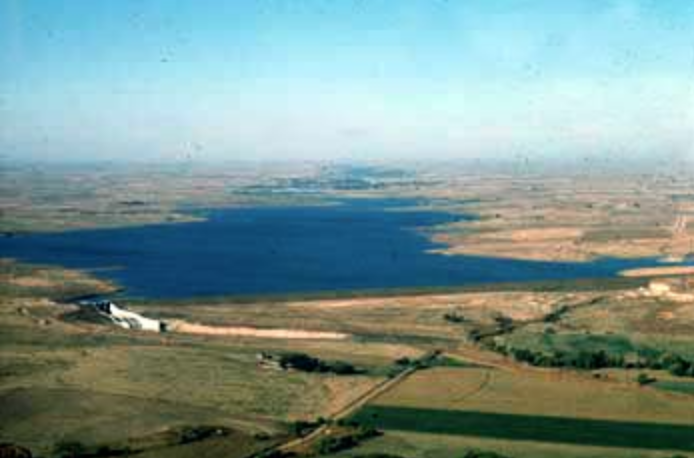
WASHINGTON – Bureau of Reclamation Commissioner Brenda Burman announced today that Reclamation has selected two projects in Kansas to receive $97,000 for small-scale water efficiency projects. The funding from Reclamation will assist the selected applicants with converting open ditch laterals into buried pipeline systems.

Kirwin Irrigation District No. 1, located in northwestern Kansas, will receive $34,000 for its conversion of Lateral 6.8 to buried pipeline. They will convert 3,696 feet of an open ditch lateral to polyvinyl chloride pipe, reducing seepage and evaporation. This project meets goals identified in the district’s Water Conservation Plan and District Operating Plan, and is part of Reclamation’s Pick-Sloan Solomon Division Kirwin Unit.

Webster Irrigation District No. 4, located in Gaylord, Kansas, will receive $63,000 for its conversion of the Osborne Lateral 14.9 into a 1.5-mile buried pipe system. The project will eliminate evaporation, seepage, and operational losses. This project aligns with the Webster Irrigation District’s Water Conservation Plan and the district’s Operating Plan.

Funding is provided to projects on a 50-percent cost-share. A complete list of the selected projects is available at: https://www.usbr.gov/watersmart/swep/.

Small-Scale Water Efficiency Projects are part of Reclamation’s WaterSMART Program. The program aims to improve water conservation and reliability, helping water resource managers make sound decisions about water use. Learn more at https://www.usbr.gov/watersmart/swep/.

Visit https://www.usbr.gov/watersmart for additional information about the WaterSMART program.

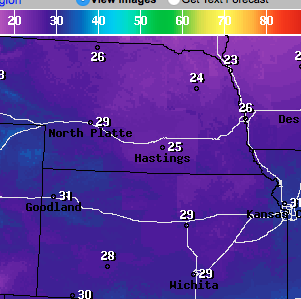
Cold, windy Monday

Today Cloudy through mid morning, then gradual clearing, with a high near 30. Blustery, with a north wind 11 to 20 mph.

Tonight Clear, with a low around 13. North wind 6 to 11 mph becoming light and variable.

Tuesday Sunny, with a high near 41. West southwest wind around 6 mph.

Tuesday Night Clear, with a low around 21. West southwest wind around 6 mph.

WednesdaySunny, with a high near 51. South southwest wind 5 to 8 mph.

Wednesday NightClear, with a low around 27.

ThursdaySunny, with a high near 57.

Tigers receive No. 5 Seed in Super Region 3; face Indianapolis in First Round of playoffs

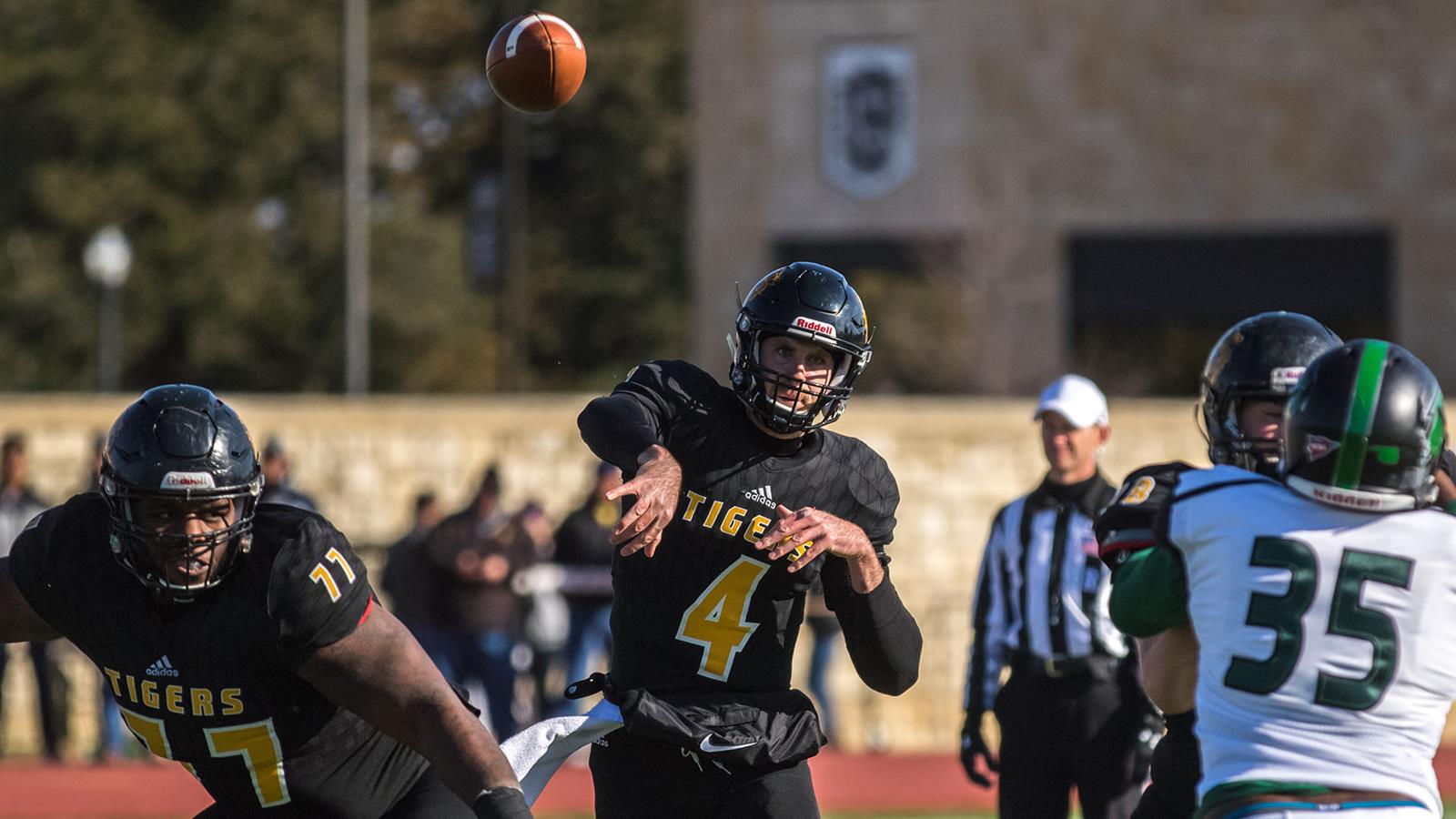
INDIANAPOLIS – Fort Hays State received the No. 5 seed in Super Region 3 for the NCAA Division II Football Playoffs. The Tigers will go on the road in the first round to play Great Lakes Valley Conference champion and No. 4 seed University of Indianapolis. The Tigers are 9-2 overall, while the Greyhounds are 9-1.

NCAA Football Playoff Bracket

The Tigers enter the playoffs on a five-game win streak after claiming their second-straight MIAA Championship on Saturday with a win over Northeastern State. The Greyhounds are on a nine-game win streak after falling in their season opener to the super region’s No. 3 seed Grand Valley State. Indianapolis went undefeated in GLVC play at 7-0, and 2-1 in non-conference play.

The game will take place Saturday (Nov. 17) at Key Stadium on the campus of the University of Indianapolis. Game time will be available soon when set by the University of Indianapolis.

This is the first time in program history that Fort Hays State is appearing in the NCAA Division II Playoffs two consecutive years.

Fort Hays State and Indianapolis were the top two seeds in Super Region 3 last year, both going undefeated in the regular season. However, both fell in their first contest of the playoffs last year. A No. 2 seeded Indianapolis squad fell to No. 7 seed Harding in the opening round, while the No. 1 seeded Tigers lost at home to No. 4 seed Ferris State in the second round.

This year, undefeated Ouachita Baptist receives the No. 1 seed in the region. Ferris State also went undefeated during the regular season and held the No. 1 ranking in all three releases of the super region rankings. However, due to the use of an ineligible player early in the season, the NCAA dropped the Bulldogs slightly in the rankings to No. 2 due to the nullification penalty assessed for the violation.

Rounding out the rest of the teams competing in the Super Region 3 bracket are Northwest Missouri State at the No. 6 seed and Harding at the No. 7 seed. Both teams are in the same seed positions as they were last year. Harding was the Super Region 3 champion last year, knocking off the No. 2, No. 3, and No. 4 seeds to reach the national semifinals.

The winner of the Fort Hays State vs. Indianapolis game will move on to face Ouachita Baptist the following week in Arkadelphia, Arkansas.

All first round games occur on Saturday, November 17. On the opposite side of the Super Region 3 bracket, No. 2 seed Ferris State hosts No. 7 seed Harding, while No. 3 seed Grand Valley State hosts No. 6 seed Northwest Missouri State.

🎥 New and promoted employees introduced to city commission

By BECKY KISER
Hays Post

Several Hays city employees were introduced to city commissioners Thursday night by their supervisors.

Jesse Rohr, public works director, brought three men who were recently promoted: Jake Erickson, Equipment Operator; and Mike Pfannenstiel and Orion Orth who have both been promoted to Maintenance Worker II.

Don Scheibler, police chief, introduced new officers Nicholas Kleiber and Lane Hoffman.

Refuse/recycling routes change for Veteran’s Day observance

CITY OF HAYS

Due to the observance of Veteran’s Day, Monday, November 12, 2018, refuse/recycling route collection schedules will be altered as follows:

Monday, November 12 and Tuesday, November 13 will be collected on Tuesday, November 13.

City of Hays customers that may have any questions regarding this notice should contact the Solid Waste Division of the Public Works Department at 785-628-7350.

It is anticipated that heavy volumes of refuse/recyclable will be encountered around the holidays. Please be sure to set your polycart and recycling out by 7 a.m. on the collection day and keep in mind that the trucks have no set time schedule.

Russell’s Plaid on the Plains promotes shopping local

RUSSELL – Plaid on the Plains, celebrated annually in the Russell area the weekend after Thanksgiving, promotes shopping with locally owned businesses during the holiday season. Russell residents and visitors will enjoy a full weekend of fun and fellowship, shopping and sharing. 

Plaid on the Plains kicks off with Plaid Friday, the small business alternative to Black Friday, on Nov. 23. The American Express initiative, Small Business Saturday follows the next day. The three-day event wraps up with Sunday Funday.


Plaid Friday was first celebrated in 2009 in Oakland, Calif., a city known for strong “shop local” campaigns. The Plaid Friday movement has grown across the nation, and even more so in the Russell area. Starting in 2010, Encore Antiques & Collectables hosted Plaid Friday events and in 2014 Encore Antiques encouraged local businesses to become involved. The Russell County Convention & Visitors Bureau stepped in to support the local Plaid Friday efforts by providing a limited number of plaid shopping bags filled with goodies and local information.

Small Business Saturday was first observed in the United States in 2010, and encourages holiday shoppers to patronize brick and mortar businesses that are small and local. The first event was sponsored and promoted by American Express via a nationwide radio and television advertising campaign. Encore first celebrated Small Business Saturday in 2011 and was named a Small Business Saturday Neighborhood Champion in 2017.

Rounding out the holiday weekend, Sunday Funday includes a variety of events around town, allowing families to enjoy time together and pick up a few more bargains.

Encore Antiques & Collectables serves as the headquarters for Plaid on the Plains. Shoppers are encouraged to start their Plaid on the Plains adventures at Encore where they can pick up their plaid shopping bag and the 2018 Shop Sheet. The Shop Sheet provides an overview of each participating business as well as a schedule of events for Sunday Funday. The Russell County Convention & Visitors Bureau and KRSL Russell Radio have assisted with out-reach and Office Products, Incorporated – Russell (OPI) has provided print and copy services.

“At Encore, we encourage folks to wear plaid when they’re out and about as a visible reminder to think local first,” said Sheryl Krug, co-owner of Encore Antiques & Collectables and local Plaid on the Plains coordinator. “On Plaid Friday at Encore, we offer discounts to all shoppers, but reward those shoppers wearing plaid with a gift.” Other Russell retailers will be offering a variety of discounts and promotions.

For additional information, contact Encore Antiques & Collectables at 785-445-8480 or stop by 590 S. Fossil in Russell.

— Submitted

KRUG: Diabetes is a family affair

Donna Krug

In observance of National Diabetes Month and World Diabetes Day on November 14th, the National Institute of Health urges people to set goals to make plans to prevent diabetes and diabetes related complications. This year the focus is on promoting health after gestational diabetes. Gestational diabetes is a type of diabetes that develops during pregnancy. Mothers who have had gestational diabetes need to know that they and their children have an increased lifelong risk for developing type 2 diabetes.

Most of the time, gestational diabetes goes away after the baby is born. Even if the diabetes goes away, you have a greater chance of getting diabetes – and your child from that pregnancy is at future risk for obesity and type 2 diabetes. In fact, half of all women who had gestational diabetes go on to develop type 2 diabetes.

If you have had gestational diabetes it is important to get tested for type 2 diabetes within 12 weeks after your baby is born. If the test is normal, get tested every 3 years. Talk to your doctor if you plan to become pregnant again in the future.

Keep up healthy habits for a lifetime to prevent or delay type 2 diabetes. Even if you know what to do to improve your health, figuring out how to do it and fitting it into your daily routine can be the challenging part. The first step is to think about what is important to you and your health. Next, determine what changes you are willing and able to make. Third, you will decide what steps will help you reach your health goals.

You have most likely heard me talk about an “Action Plan” in the past. This is the perfect time to revisit that concept. The most important part of an action plan is to choose something you want to do. Next it needs to be something reasonable, such as something you can expect to be able to accomplish in a week or two. A true action plan is behavior specific. Losing weight is not a behavior; not eating after dinner is.

An action plan answers these questions: What? How much? When? How often? The final piece of a successful action plan is to assess the confidence level that you will fulfill the contract. On a scale of 1 to 10 where 1 represents little confidence and 10 represents total confidence, your plan should rank at least a 7. Once you have incorporated that action or goal into your daily life you are ready to choose something else to work on. I wrote a fact sheet a few years ago titled, “Action Plan for Healthy Living” which focuses on 15 lifestyle changes. If you have questions about developing an action plan related to a change you want to make, feel free to give me a call.

One final thought about National Diabetes Month – consider offering healthier choices at upcoming holiday celebrations that are centered around food. Almost any recipe can be modified by cutting down or changing the type of fat or sweetener used. Be respectful of your holiday guests’ dietary restrictions. Always have fresh vegetable and fruit plates available.

Donna Krug is the Family & Consumer Science Agent and District Director in the Cottonwood Extension District. You may reach her at: (620)793-1910 or [email protected]

SCHROCK: Science illuminates the world

John Richard Schrock is a professor at Emporia State University.

“Science knows no country because knowledge belongs to no country and is the torch which illuminates the world.” These are the words of the great French chemist Louis Pasteur.

Recently, I spoke at a National Agricultural Conference here in Yangling, China. Other speakers here were from the United Kingdom, India, Turkey, two from the U.S.D.A (one from Manhattan, KS) and an assortment of smaller countries that had interests in the continually expanding knowledge about our soils, better crop production, reducing pesticides, identifying new insects, etc. There were also local Chinese researchers who spoke. They shared recent Chinese advances that in turn would be taken back and shared worldwide.

But the day before, I added the above quote by Pasteur as my last “slide.” Why? I am disturbed by recent rhetoric and proposals that condemn students and professors who study and teach across national borders. Some want researchers, who travel to teach and spread our latest scientific knowledge at conferences and in classrooms, to stay home.

Parties in Washington D.C. have discussed sending huge numbers of certain foreign students home. University programs that recruit professors to teach overseas are being portrayed as just attempts at espionage. This scapegoating, coming from the highest levels in America, suggests we should hunker down and hold all of our knowledge to our chest. –That the U.S. is always the inventor, the leader. –And that the rest of the world only rises because they steal from us.

But every table of chemical elements that hangs in the labs of Europe, Africa, China, Russia and the United States–is the same. While helium was suspected as a new element from its absorption in light spectra, the first time it was actually captured and identified was in oil well gasses by the Chemistry Department at the University of Kansas. But K.U. cannot and did not patent helium. This is knowledge that makes up the body of science. It is taught worldwide. It belongs to all.

Certainly there is research conducted by private enterprises and a country’s military, sometimes in cooperation with their universities. Such projects of course have obligations to filter their personnel and protect their inventions. But such projects are very limited. But these political discussions and actions are broad brush, casting doubt on whole international exchange programs and whole groups of students and teachers.

University World News reported that “In May, the Trump administration announced that the validity of visas issued to Chinese graduate students studying in the fields of science, technology, engineering and mathematics would be shortened to only one year.”

There are now unjustified wholesale attacks on Confucius Institutes and exchange systems such as the “Thousand Talents” program. For ten years, I have seen the Chinese “Thousand Talent” program recruit experts from around the world to teach in China for five years. I personally know several, one American in forestry and another who is Chinese and brought his 10 years of expertise in modern agricultural practices. These scholars also come from Europe and Australia and elsewhere. In many ways, it is just a longer term version of our Fulbright awards. Are our Fulbright scholars spies?

Of the nearly 7,000 Thousand Talent scholars sponsored over this last decade, there are currently about 2,600 currently working in China. In some fields, those that return to the U.S. will be bringing back some state-of-the-art academic knowledge because, contrary to popular knowledge, China is now leading the world in various fields of science, particularly in physics.

This politicization of science is not new. This condemning of whole groups of teachers and students is scapegoating. The egregious show trials of Senator Joe McCarthy of the early 1950s cost us dearly in science talent. It was wrong then. And it is wrong now.

This was understood by no less than the Frenchman Louis Pasteur and the German Robert Koch who revolutionized medicine with their new germ theory in the 1870s. France and Germany were not friendly countries. Yet both scientists respected and fed off of each other’s work for the mutual benefit of all humanity. It was unthinkable to either of them to hide their work and results so as to only cure their countrymen.

Indeed, Pasteur said precisely that. “One does not ask of one who suffers: what is your country and what is your religion? One merely says: you suffer, that is enough for me….” Amen.

John Richard Schrock is a professor at Emporia State University.

Cloudy, cold Sunday, chance of snow

Veterans Day
Snow likely, mainly after 3pm. Cloudy, with a high near 34. North northeast wind 11 to 15 mph. Chance of precipitation is 60%. Total daytime snow accumulation of less than one inch possible.

Tonight
A 50 percent chance of snow before midnight. Cloudy, with a low around 24. North wind 10 to 13 mph. New snow accumulation of 1 to 2 inches possible.

Monday
Cloudy through mid morning, then gradual clearing, with a high near 30. North wind 11 to 16 mph.

Monday Night
Clear, with a low around 14. North wind 5 to 9 mph becoming west after midnight.

Tuesday
Sunny, with a high near 40. West wind 5 to 7 mph.

Tuesday Night
Mostly clear, with a low around 23.

Wednesday
Sunny, with a high near 53.

Wednesday Night
Clear, with a low around 29.

Thursday
Sunny, with a high near 55.

🎥 Veterans honored at Hays Senior Center

Veterans who are members of the Hays Senior Center and the Hays VFW Honor Guard were honored Friday.

By BECKY KISER
Hays Post

Don Bickle and Harold Kraus

The Hays Senior Center honored its members who are veterans with a patriotic program and lunch Friday.

Men who served in World War II, the Korean War, and the Vietnam War were escorted to their seats of honor at the front of the room as their service branch and years of service were read. They were members of the Army, Navy, Marines and Air Force.

Also honored were three visiting veterans, Don Bickle, Harold Kraus, and Leo Knoll.

Navy veteran Bickle served in 1945 in WWI and again in the Korean War in 1950. Kraus was also in the Navy, serving from 1951-1960 in the Korean War and what’s known as the “Cold War.”

“I flew over some beautiful places during the Cold War, and later took my wife to see those countries as a tourist,” Kraus said during lunch with his wife Virginia beside him.

Knoll served in the Army from 1963 to 1966.

All the honorees were given a small U.S. flag and bright red fabric poppy to wear as the group posed for pictures.

The event was an early observation of Veterans Day, originally called Armistice Day.

In 1918, World War I ended on the 11th hour of the 11th day of the 11th month with a signed armistice declaring the “war to end all wars” was finally over. The next year, the U.S. declared Nov. 11th Armistice Day in memory of the men and women involved in WWI.

Many soldiers were buried in Flanders Field, site of a bloody WWI battle in Belgium. Poppies thrived in the battle-scarred soil strewn with rubble, which provided lime deposits and made the soil rich. The site became a stark contrast of white crosses and vibrant red poppies.

Nancy Augustine

“Today, the poppy represents all the people who died in the service of their country,” explained Nancy Augustine, monthly activity coordinator for the center.

The Hays VFW Post 9076 Honor Guard posted the colors and patriotic music was song by the Victoria trio “Trilogy,” comprised of brothers Jerry and Leroy Schmidtberger and a brother-in-law, Rick Rupp.

Several tables were filled with pictures and memories of servicemen from Hays and Ellis County.

Food server Angela Moxter, who also helped escort the honorees, provided pictures of her father, Robert H. Meyer, a Pearl Harbor survivor. Meyer served in the Navy from 1939 to 1945.

Meyer is first seen in a large, black and white group picture of sailors in Pearl Harbor, Hawaii. The photo was taken Nov. 30, 1941, one week before the Dec. 7 bombing that spurred the United States to enter World War II.

A second, color picture shows Meyer in his Pearl Harbor survivor cap attending a military remembrance ceremony.

Meyer died two years ago.

Copyright Eagle Radio | FCC Public Files | EEO Public File