Alicia BoorBeginning Jan. 1, several packing plants will only purchase fed cattle from BQA (or Beef Quality Assurance) certified feedlots.
It is clear that consumers feel confident in the Beef Quality Assurance program and have driven this change. While further education though BQA always helps the beef industry, we do not want some of our producers to be caught off guard.
Online certification is always an option, however, some producers still prefer and in-person meeting. The Kansas Beef Council has planned and is offering a 2 night in-person training (and via online through zoom). This will give us the opportunity to reach multiple locations in a short amount of time to ensure producers that need BQA certification by the end of the year will have it.
The current dates that the KBC and KLA have set up are: November 5th: 7pm at the Meridian Center in Newton (In-Person), Zoom meeting at the same time in Emporia (Hosted by KLA staff) November 7th: 7pm at the High School in Washington (In-Person), Zoom meeting at the same time offered in Oberlin (Hosted by KLA staff)
If there is interest, I would be happy to host a Zoom meeting on November 7th at the Great Bend Extension Office at 7 pm. There would be no charge for this, but I do need RSVPs to see if there is enough interest for the remote location to be held.
Call 620-793-1910 or e-mail me at [email protected] to register by Monday November 5th for this meeting.
Alicia Boor is an Agriculture and Natural Resources agent in the Cottonwood District (which includes Barton and Ellis counties) for K-State Research and Extension. You can contact her by e-mail at [email protected] or calling 620-793-1910
Not all educators who touch students’ lives work in classrooms.
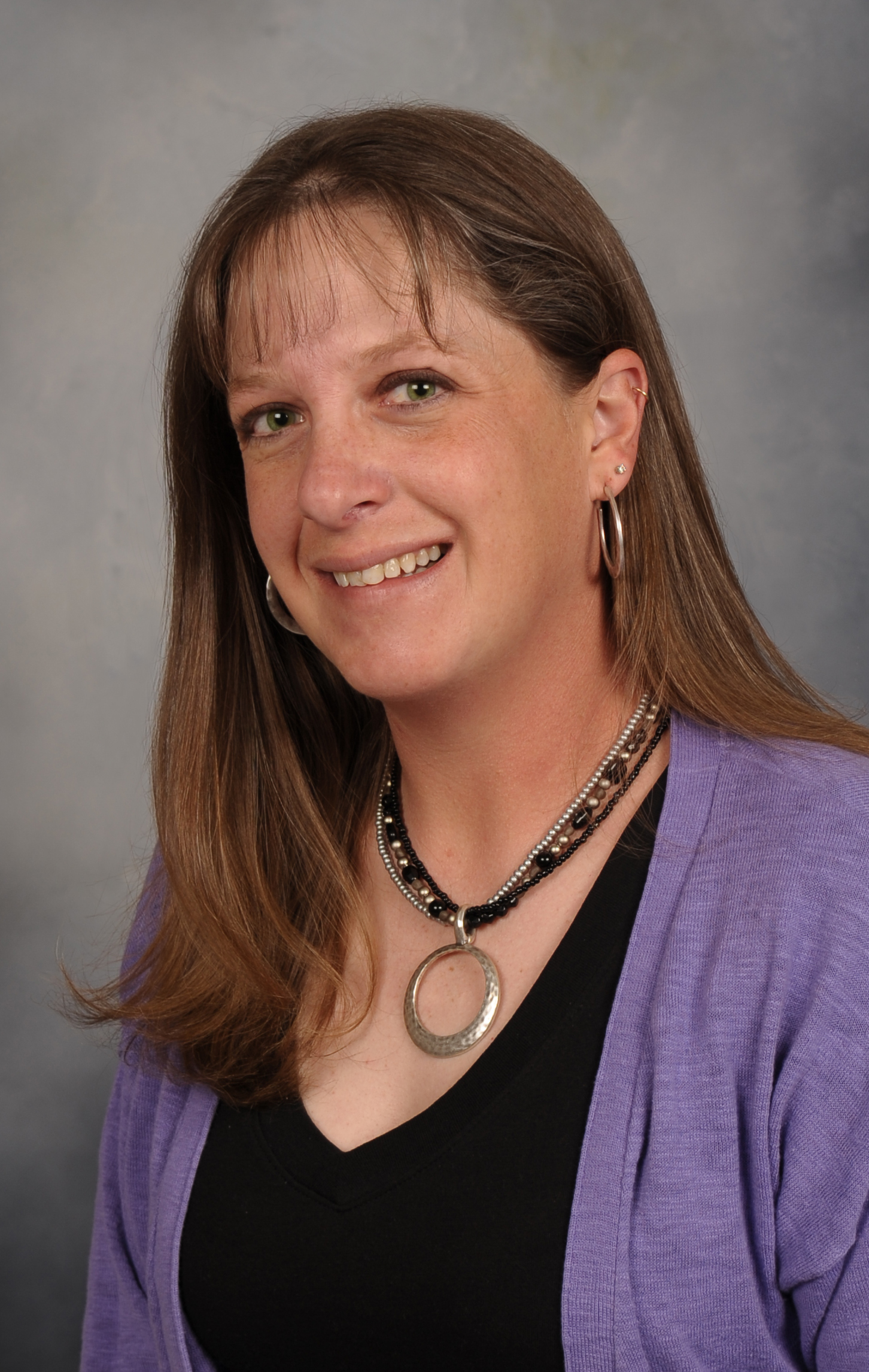
This month’s Hays Teacher of the Month is a Hays High School counselor, Suellyn Stenger. Stenger, who has a master’s degree in music education, is a long time-educator, spending more than 20 years as a music teacher and band director.
Although she loved music, it was a series of student tragedies that led her to her present calling.
When Stenger was in her first teaching job as a music teacher in a small school district in McLouth, Kansas, a student committed suicide. She had no training as a counselor at that time, but students trusted her and came to her to talk about their feelings.
“That was my first real experience that I needed to gain more experience with helping students,” she said.
When she was a band director in McPherson, she received a phone call that one of her students where she previously taught in Garnett, Kansas, was killed in a drunk driving accident. She returned to the school to try to help students process the tragedy.
Additionally while teaching in McPherson, Stenger had a student who died of a rare form of cancer.
She said when dealing with students who are dealing with tragedy, the best thing to do is listen.
“With the first student who died from suicide, there is a lot of guilt with the students’ classmates,” Stenger said. “Again, I had no training at that time, so I just listened a lot.”
“When I was in McPherson and I got called back to Garnett again and just listened a lot to the students, showed a lot of empathy,” she said.
When her student was dying of cancer, she helped her students in McPherson make cards and T-shirts to support the student who was ill. She said she thought it helped the students feel as if they were making a difference for the students who were passing.
“I had just seen the student in Wichita and I knew he was getting close to death,” she said. “The next day the students were coming into the band rooms very excited and saying the student was coming home. They thought the student was coming home because he was getting better. I knew he was coming home to pass away at home.”
She went to the counselors and told them the students thought this young man was coming home because he was getting better, but in reality he was coming home to die.
“The counselor said go back to the band room, have his sister come see me and you tell the band what is going on,” Stenger said. “And I think that was the final decision for me that I really wanted to go into counseling because I went back and told the students he was passing away.
“Student death I think is the most difficult situation for a teacher or counselor or anyone who works within the school systems to deal,” Stenger said, “but showing empathy, listening, giving them a chance to grieve, supporting them on all levels whether it be at the visitation, at the funeral itself and for the time following [is important].”
Stenger said handling these tragedies is very difficult personally but she feels she needs to model resiliency for her students.
“Yes, it is a tragic event, and we can grieve together,” she said, “but we can continue on together as well.”
Stenger went on the earn an additional master’s degree in counseling from Fort Hays State University.
She established the pre-Kindergarten through eighth-grade counseling program at Victoria before joining the Hays High counseling staff 11 years ago.
Stenger, a flutist, said she was inspired to become a teacher by her ninth-grade band teacher, Ken Ticknor, at Landon Junior High in Topeka.
“He had a way of making everyone in the band feel special,” she said. “The thing that I found most important in teaching and counseling and working with children in any capacity is building a positive relationship with students and I never wavered in my desire to be a band director all through high school and college. I just knew that was what I wanted to be.”
“I think being positive is one of the most powerful tools a person can have. Coming in everyday full of energy. He also continued to play outside [of school.] I know he performed when the circus came to town. He was just a fantastic musician.”
Stenger still keeps in touch with her former teacher through Facebook.
“He just found a way of recognizing everyone in the room even though we had a large band at the time,” she said.
Today, Stenger most often first gets to know students through academics. She helps them with their course schedules and their independent plans of study. Counselors help students create plans of support for those who struggle academically or who may need social and emotional support.
“It is wonderful that we have the opportunity to keep the same students on our case load from freshman through their senior year so we can watch them through grow during high school,” she said.
Working with students on academics can lead to students being able to share more of their emotional needs, Stenger said.
“I definitely see there is a need for more support,” she said of the emotional piece of her job. “Forty percent of our student population are kids who are on free or reduced [cost] lunches.”
Stenger said she thought the district works hard to build relationships with students because that keeps them invested in their education.
“When I talk to students, I talk about how everyone who walks through the doors of Hays High School has issues, has things that they deal with and we talk about. Are we going to rise above the challenges or are we going to succumb to them? It is amazing how some students have extreme challenges outside of school yet show great resiliency when they are here at school.”
Stenger gave the example of a young student who faced tremendous challenges throughout her life. She chose this student to share in a video why she came to school each day.
“Despite that she had a lot of challenges, she showed up, and she did her very best,” Stenger said. “There were times she wanted to give up, but she transferred to our Learning Center and very recently graduated and earned her diploma. She is going to be a very successful young adult.
“There are many stories like that where students struggle, but they rise above the challenges.”
Stenger said working with students is very rewarding.
“I love my job,” she said. “I can’t imagine doing anything else.”
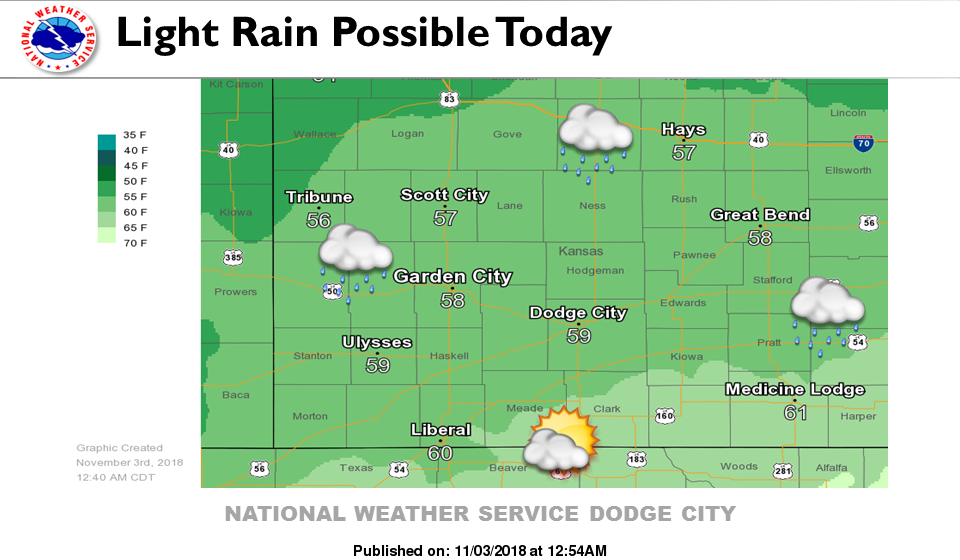
Today
A 30 percent chance of showers, mainly before noon. Partly sunny, with a high near 54. Windy, with a southwest wind 7 to 12 mph becoming north northwest 20 to 25 mph in the morning.
Tonight
Partly cloudy, with a low around 35. Northwest wind around 15 mph.
Sunday
Sunny, with a high near 53. Northwest wind 9 to 11 mph becoming west southwest in the afternoon.
Sunday Night
Mostly cloudy, with a low around 41. South southeast wind 8 to 13 mph, with gusts as high as 24 mph.
Monday
Mostly cloudy, with a high near 58. South wind 7 to 17 mph becoming northwest in the afternoon. Winds could gust as high as 28 mph.
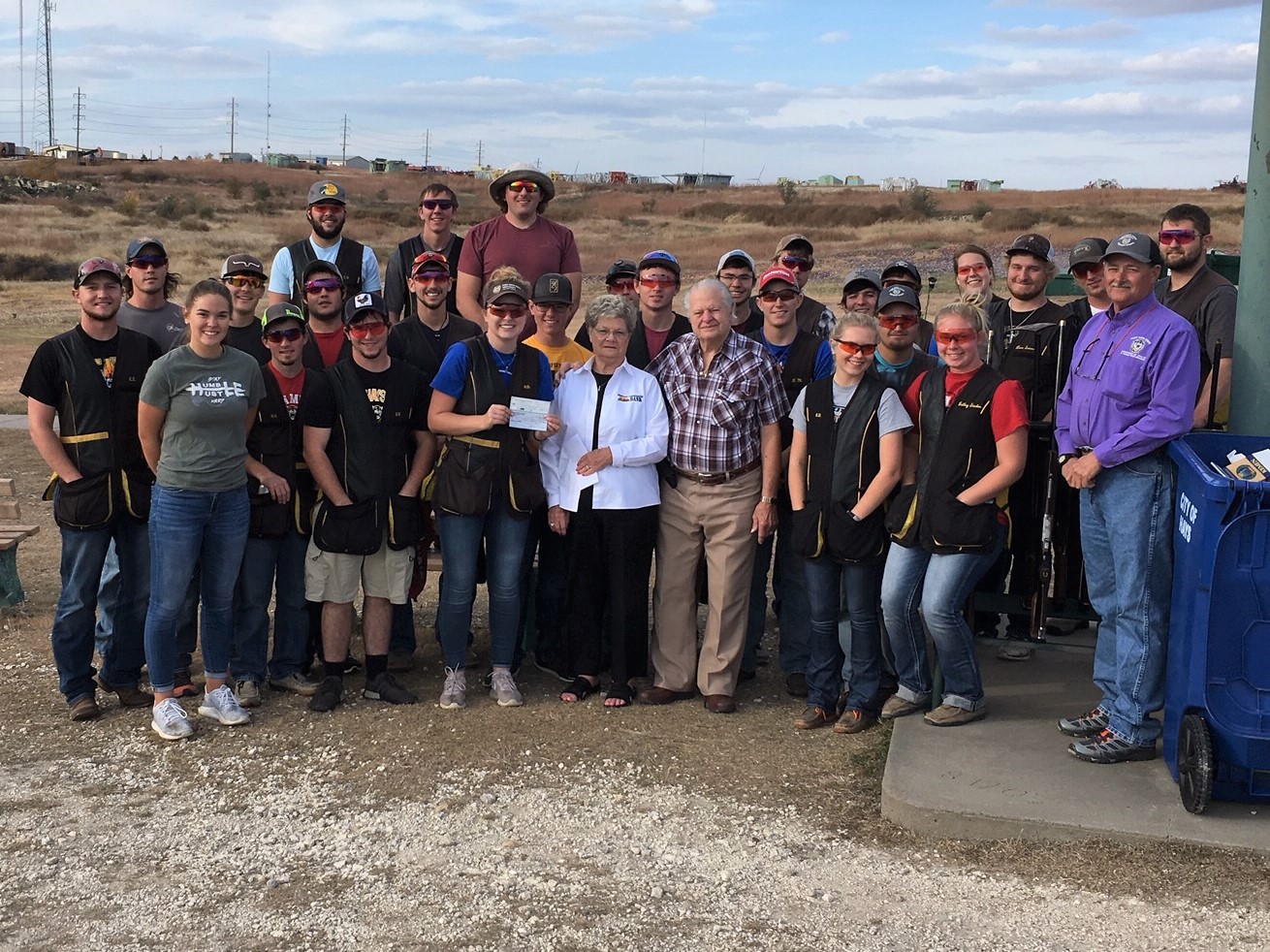
Wilmer and Lorena Kellogg, Hays, are big supporters of the FHSU Shotgun team.
FHSU University Relations
Wilmer and Lorena Kellogg, Hays, and the Elizabeth Colt Legacy Foundation presented the Fort Hays State University Shotgun Team with a total of $2,500 recently in a ceremony at the Hays Sportsmen’s Club, 5810 230th Ave.
“The Kelloggs have been huge supporters of the FHSU Shotgun Team for many years and have been instrumental in spreading the word about our team,” said Dr. Duane Shepherd, associate professor of health and human performance at FHSU and the team’s sponsor.
The Kelloggs presented the club with a personal check for $1,000 and another for $1,500 from the Elizabeth Colt Legacy Foundation.
“As members of the Colt Collectors organization and Elizabeth Colt Legacy Foundation, they have promoted the Shotgun Team and helped secure donations, published articles, and made generous donations to the team,” said Shepherd.
The 12th edition of Kansas Speaks, the annual poll addressing issues of importance to Kansans, is out and once again finds that a majority of Kansans think the state is a “very good” or “excellent” place to live.
The 2018 survey, conducted by Fort Hays State University’s Docking Institute of Public Affairs, interviewed 494 Kansans by phone (land-line and cell). The survey has a 4.4-percent margin of error. The poll asked questions in four areas: quality of life in Kansas, taxes and the economy, government and politicians, and public policy issues.
On the direct question of quality of life in Kansas, 55 percent of respondents rated Kansas as “very good” or “excellent”; 4 percent said “poor” or “very poor.”
One area of particular interest this year is the governor’s race. Respondents were asked, “Who do you plan on voting for governor in 2018?” Responses were consistent with national polls. More than a third of respondents reported that they would vote for Laura Kelly (40 percent) or for Kris Kobach (36 percent). Ten percent reported that they would vote for independent Greg Orman. Asked for positive or negative ratings on Kobach and Kelly, 55 percent rated Kelly positively and 37 percent rated Kobach positively.
Fifteen percent of respondents said the state economy was “very good” or “excellent” while 11 percent said it was “poor” or “very poor.” On the economy’s performance in the last year, 38 percent said it had improved, 45 percent said it stayed the same, and 17 percent said it worsened.
Positive feelings outweighed negative on the right track-wrong track question, with 58 percent saying Kansas is on the “right track” and 42 percent saying “wrong track.”
A sampling of other questions of interest to Kansans:
• 52 percent of respondents “strongly support” or “somewhat support” legalizing recreational marijuana for individuals 21 and older to allow taxation by the state, with 39 percent “somewhat” or “strongly” opposed.
• 30 percent were satisfied with the state’s actions in 2017 to increase state revenue through income tax increases, while 41 percent were unsatisfied. People with higher education showed higher levels of satisfaction.
• Respondents were asked to rate President Donald Trump on seven different areas. He received a high rating on the economy and national security but a low rating on “sharing my values,” “trustworthiness,” and “international diplomacy.”
• 51 percent were at least “somewhat uncomfortable” with the reported relationships between President Trump and the Russian government or Vladimir Putin. Republicans and men were more likely to feel comfortable.
• 45 percent supported Brett Kavanaugh’s nomination for the Supreme Court, 33 percent opposed, and 22 percent were neutral. The support level was higher among Republicans and men.
• 28 percent supported repealing the Affordable Care Act even if it is not replaced, 35 percent supported the repeal only if replaced, and another 37 percent opposed repealing. Democrats and women were more likely to oppose repeal.
The First United Methodist Church will have its annual Peddlers’ Fair from 9 am. to 1:30 p.m. Saturday at the church at Seventh and Ash streets.
Admission is free.
Lunch will be served from 11 a.m. to 1 p.m. The suggested donation is $8 for adults and $3 for children 10 and younger. The meal will include chili or vegetable soup, pie, relishes and a beverage.
Lunch tickets are available at the door or call 785-625-3408.
The event will include a hospitality area, Peddlers’ Pack, silent auction and quilt drawing. The Peddlers’ Pack includes pre-owned items.
Shops include pastry, fall, christmas, jewelry (pre-owned and homemade), nuts and cutlery, frozen, casseroles and bierocks, and the nimble thimble, which includes handmade items.
A desire to continue serving the Hays community and Ellis County is the driving force behind Barb Wasinger’s campaign for the 111th Kansas House District seat.
Wasinger, R-Hays, has been a member the Care Council, the Parish Council, volunteered for 10 years at Holy Family Elementary, served on the Hays City Commission for two terms and is currently serving her second term on the Ellis County Commission.
“I’ve been active in the community for a long time,” Wasinger said. “I love Ellis County, I love Kansas. It’s not my native home, but it is home, and I have raised four children here. From the start, it’s always been important for me to give back to the community, and the political life is just an extension of that service I started a long time ago.”
Wasinger believes her years working in city and local government can transfer to the state level.
“Being a city commissioner gave me great insight into how a city works, into urban government, and moving to the county (commission) … gave me a better view of rural needs and the importance of what’s going on in our rural communities,” Wasinger said.
Wasinger has served as the rural representative on the Kansas Association of Counties board for the past year.
“The joy of being able to do both has given me a good handle on both areas but also gives me a fresh look at what the state government would need,” Wasinger said.
Transportation
Wasinger said finding a way to stop taking money from the Kansas Department of Transportation and the Kansas Public Employee Retirement System would be two of her priorities if she were elected.
“I want to stop taking money from KDOT and not funding KPERS properly and, while it’s clearly going to take a long time, I’d like to start the process of repaying KPERS and stop the draining of KDOT,” Wasinger said.
She said a recent stop in Hays by the Transportation Vision Task Force laid out issues facing the roads in Kansas, especially in Ellis County.
“You heard testimony after testimony of roads that are too narrow for vehicles that are driving on them now,” Wasinger said.
Wasinger also pointed to the proposed bypass on 230th Avenue northwest of Hays as a project that needs funding to be completed.
“Ellis County needs that bypass. We have a grant from KDOT, but it was tied to the building of the truck stop which stalled, so we can’t even use that grant and can’t even start planning for that bypass around (Highway) 183 without regulation change,” Wasinger said.
She said it’s also key the government funds KDOT to help update the state’s infrastructure because there are places that have not seen needed improvements in decades.
KPERS
Wasinger said she has also talked with several state employees who are concerned about their retirement and if there will be any money left in the KPERS system.
With the current state of the budget in Kansas and the anticipated increases needed for funding public schools, KDOT, the Kansas Department of Corrections and others, Wasinger said she would be in favor of keeping taxes level and then begin looking for places that can become more efficient.
“I know that more oversight has to be done on just about anything,” Wasinger said. “We have to figure out how to make everything more efficient.”
She said one way to improve government efficiency is to approach government with a business background.
“Understanding the realities of what government can’t do that a business can do,” Wasinger said. “I think that if you look at things with a business eye, you can adapt a lot of practices that make sense.”
School funding
When it comes to school funding, Wasinger said the claims she is against funding schools adequately or paying teaches is not true.
“It’s not just money being thrown at kids that make the education system better,” Wasinger said. “A lot of funding has gone to schools, but it’s not necessarily going to students and teachers, teachers’ salaries.”
She said after the recent increase in school funding, the Shawnee Mission School District raised the administrators’ salaries by 13 percent. The Russell school district built a sport complex. She said these are examples of money spent on schools that are not going to benefit test scores and outcomes and teachers’ salaries.
“You can’t keep doing the same thing and expect a different result,” Wasinger said.
She said there is a lack of accountability in school education funding. She said while some schools are spending funds on the students, other districts are not.
“Teachers need the money, and we need to be concentrating on our students,” Wasinger said.
Health care
While there is a renewed call for Medicaid expansion, Wasinger said any expansion has to be delayed until the problems with KanCare are solved. The sate of Kansas manages Medicaid through a privatized system called KanCare.
“One thing I’ve heard door-to-door is how many people have trouble with the system the way it is now, and we have to get that fixed before we start adding people to a broken system,” Wasinger said.
She is also concerned about the possibility that the federal government will begin to roll back the amount of money they are giving the states to fund the expansion.
“Patients need to come first. They need to be able to choose their own doctors. They need to be able to choose their own insurance, and there needs to be a work requirement tied to any kind of expansion,” Wasinger said.
Eber Phelps said he wants to continue to improve the collaboration he saw in the 2017-18 Kansas legislative session.
Democratic candidate for the 111th District House seat, Phelps, 67 of Hays, is in his 18th year in the Kansas House. He also spent time as a Hays city commissioner and retired a year ago from Glassman Corp.
He was elected to 16-consecutive years in the Legislature, but lost an election 2012 before successfully earning re-election in 2016.
“In those four years that I was out of the Legislature, I was pretty concerned about what was happening with funding for K-12 education and the cuts to higher ed and other programs and also not really implementing the comprehensive transportation plan,” Phelps said.
When he saw the Legislature passing unbalanced budgets to the governor, he said he knew important programs were going to have more cuts and he needed to run again.
Budget and taxes
He cited maintaining a balanced budget as the No. 1 priority if he is re-elected to the Kansas House.
He said he thought in order to do that the state should not embark on deep tax cuts at this time.
He said the state is still in recovery from the failed Brownback tax experiment that took too much from the state’s traditional three-legged stool — property tax, sales tax and income tax.
“Our decision in 2017 to roll back the governor’s tax plan allowed us to get on some good financial footing, but we still have work to do,” Phelps said. “We still have not restored the cuts to higher education.”
In 1997, Phelps co-sponsored a bill that would decrease sales tax on food. He said he supports Democratic candidate for governor Laura Kelly’s plan to do that if she is elected.
“I have always been in favor of addressing property tax, but, at the moment, we have the opportunity to do something with the tax that really affects every one of us — no matter what age you are or what part of the state you live in — and that is to address our really exorbitant sales tax that we have on food.”
Phelps also said the state needs to pay down debt and build back a reserve.
Education
Phelps feels a passion for education. He served on the House Education Committee for 14 years.
“I have very strong feeling about the importance of education for the growth of our state,” he said. “I know Gov. Brownback was well-intentioned with his tax plan, but industries or businesses that are moving to our state, they are not looking at what the income tax rates are. They are wanting to know if they are going to get an educated workforce.
“The emphasis that we put on K-12 and higher education, that is what is going to be what makes our state grow.”
Teacher pay in Kansas was as low as 42nd in the nation. It is up to 40th in the nation; however, Phelps said the state needs to do better.
“We have fallen below so many other states, it is a fact we have people dropping out of teacher education programs because they are looking at what they are going to make and saying, ‘I don’t know if I can survive on that.’ On the other hand, some of them go through, get their teaching credentials and teach a couple of years in Kansas, and then they are being recruited by other states.”
Health care
Phelps has also been a long-time champion for Medicaid expansion. He voted for a bill to expand Medicaid in 2017, but that was vetoed by Brownback.
“If you really care about rural Kansas, this is a key thing that needs to be adopted,” he said.
The Fort Scott hospital recently announced it will be closing. There are 26 other critical access hospitals in the state that are in financial peril.
“From an economic development stand point, those were some very solid jobs that just got lost in that community,” Phelps said.
He added, “Medicaid expansion could really be a benefit and a real boost to not only those hospitals but the communities that they serve. I think that is one of the first things the Legislature needs to take up and that is to pass that Medicaid expansion bill.”
Water
Phelps said he continues to consider the R9 Ranch project important to Hays. He was on the Hays City Commission when the city of Hays purchased the water rights. He said throughout his time in the Legislature he has tried to inform area legislators of the importance of the project to the regional water supply.
As the 2018 elections approach, Greg Orman continues to do the citizens of Kansas a disservice with his dead-in-the water independent campaign. His floundering effort, with its treasurer resigning and endorsing Democrat Laura Kelly, is denying Kansas voters a clear referendum-like choice on whether to reject or embrace Sam Brownback’s policies.
Burdett Loomis, Professor, Political Science, College of Liberal Arts and Science, University of Kansas
To review, Brownback barely defeated House Minority Leader Paul Davis in 2014. Opinions differ as to why, but I see the wave of GOP outside money that washed over Kansas in support of endangered Senator Pat Roberts as nationalizing the entire election and helping Brownback eke out a victory. Indeed, approval for Brownback’s tax policies was already underwater in 2014, and it sank lower after the election.
In 2016, Brownback was not on the ballot, but many right-wing Republicans, who had supported his extensive, high-income-oriented tax cuts, proved vulnerable. A host of moderate Republicans and Democrats won enough seats to override Brownback’s 2017 veto of higher income taxes and then, in 2018, these legislators responded to the Kansas Supreme Court by passing a $500 million increase in school funding.
Score one (2014) for Brownback and one (2016) for his opponents. Nevertheless, neither election represented an actual referendum on Brownback and his policies, given his absence from the 2016 ballot and the Roberts factor in 2014. Moreover, with Brownback gone from the state and the introduction of independent Orman, the 2018 election will also constitute an imperfect referendum.
Regardless, Brownback’s legacy powerfully affects this contest for governor.
Most remarkable in 2018 is Kris Kobach’s complete embrace, and then some, of Brownback’s tax-cutting experiment, albeit with a few twists. He simultaneously argues that he will fund classroom education (by his definition) and rebuild our infrastructure, all through economic growth. That’s Brownback reincarnated.
As a social conservative, Kobach has moved father right than Brownback in advocating against non-existent voter fraud and beating the anti-immigrant drum as loud as he can.
In sum, Kobach has doubled-down on Brownback’s far-right record.
If this election posed a simple yes-no vote on Brownback’s legacy or Kobach’s policy positions, Kobach would likely lose. Instead, the 2018 governor’s race comes down to its candidates. Putting aside the minor independent candidate and the Libertarian, a straight-up contest between Republican Kobach and Democrat Laura Kelly would probably, even in red-state Kansas, elect the moderate Democrat, given Kobach’s apparent ceiling of 43 or 44 percent.
While not as flashy as Kobach (no machine gun trucks), Kelly may well be exactly the person to continue the progress of the last two legislative sessions, to say nothing of prudently addressing education, health care (expanding Medicaid), and infrastructure. A 14-year state senator, Kelly would bring a range of legislative experience not seen since the productive Bennett-Carlin-Hayden years, 1974-1990.
Enter the man behind door #3, independent Greg Orman, who turns the entire idea of a Brownback referendum on its head. If Orman, with his steady nine-percent support in the polls, siphons off enough votes, mostly from Kelly, the state could easily elect a minority-supported governor who has negative approval ratings and who supports the failed economic policies of Sam Brownback. That would be a travesty.
To paraphrase Sinclair Lewis, “It can happen here.” But it need not. As Orman supporters go to the polls, they should think twice, or three times, before wasting a vote that would allow the widely discredited views of Kobach and Brownback to prevail.
Burdett Loomis is an emeritus professor of political science at the University of Kansas.
SEDGWICK COUNTY —A man arrested in Northwest Kansas in May for shooting of a Menards employee in Wichita is scheduled for sentencing Friday, according to the Sedgwick County District attorney’s office.
Security camera images of Williamson prior to the shooting at Menards -photo courtesy Wichita Police
Dominic Williamson, 19, was arrested in connection with shooting a store loss prevention officer at Menards in the 3600 Block of North Maize Road in Wichita.
The store loss prevention officer observed Williamson and a woman exit the business carrying a home surveillance system they had not paid for. The employee contacted the suspects outside the business and the man brandished a handgun and fired one shot striking the employee in the abdomen and fled the scene in a Black Mercedes Wagon with a Montana license plates.
The following day officers investigated a traffic complaint of an erratic driver of a gray Nissan car on Interstate 70 at the U.S. 183 Bypass.
Deputies attempted a traffic stop at which time the driver, who was later identified as 18-year-old Dominic Joseph Williamson, fled.
Officers deployed stop sticks, deflating three tires, but Williamson continued to flee westbound on Interstate 70.
The pursuit finally ended in Trego County just east of Collyer when Williamson lost control of the vehicle after a tactical vehicle intervention.
Williamson
The suspect’s vehicle entered the north ditch and rolled several times before coming to rest on its top.
Williamson was arrested without further incident.
He was evaluated by medical staff and later booked into the Ellis County Detention Facility.
Williamson was charged with possession of a stolen vehicle, fleeing and eluding, possession with intent to distribute methamphetamine, possession of marijuana and numerous traffic violations in addition to the charges in Sedgwick County.
The 17-year-old female suspect in the shooting was taken into custody in Derby after a high-speed police chase.
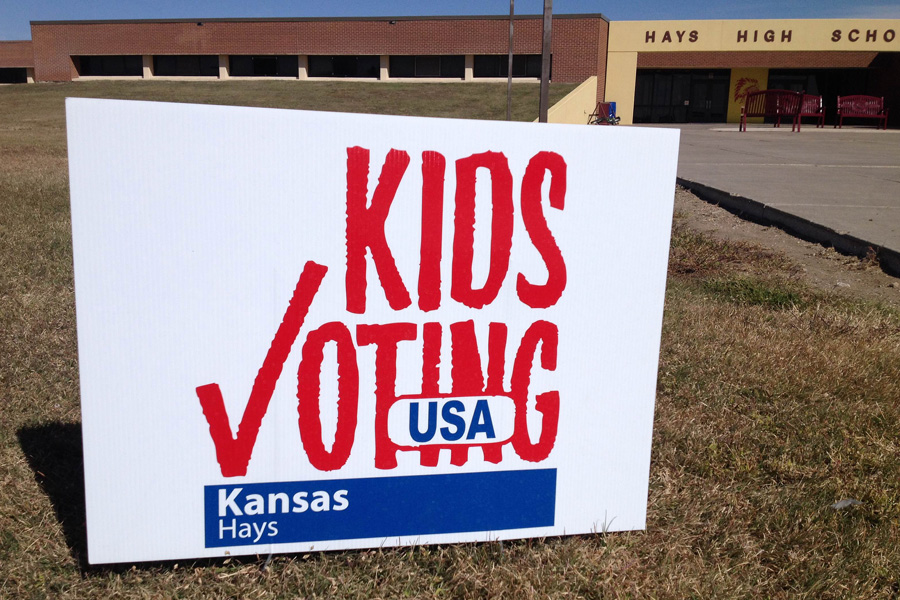
Kids Voting once will again be set up Tuesday, Nov. 6., at the seven polling sites in Hays.
Students K-12 can go with their parents to the voting polls and vote through the Kids Voting Program.
All students that vote will receive an “I voted” sticker and a coupon for a free meal from McDonald’s.
Kids Voting polls will be open from 7 to 8 a.m. and 3 to 7 p.m. Votes will be tallied by Hays High School government students, and results will be published.


 Today
Today