We have a brand new updated website! Click here to check it out!

Marshall: Breast Cancer Awareness Month facts, advice

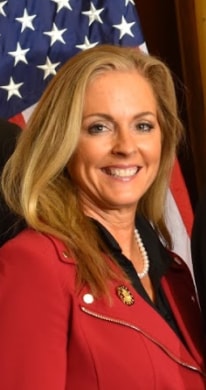
Laina Marshall
You probably don’t need a reminder that October is Breast Cancer Awareness Month; after all, pink ribbons are as abundant as hayrides this month. But it never hurts to refresh your understanding of the disease and share with your loved ones.

In the U.S., breast cancer is the most commonly diagnosed cancer amongst women in the U.S. (aside from skin cancer). An estimated 266,120 women (and 2,550 men) are expected to be diagnosed with invasive breast cancer in 2018, and nearly 41,000 women (480 men) will die of the disease. In Kansas alone, an estimated 2,290 women will be diagnosed this year with the disease. Fortunately, death rates are declining, and improvements in early detection and treatment are key. 

If you’re a woman in your 20s or 30s, talk to your health care professional about Clinical Breast Exams (CBEs); if you have a family history of cancer, be sure to discuss other screening options. Screening saves lives by finding breast cancer earlier, when treatment may be more successful. Beginning at age 40, women should get a CBE and a mammogram annually. Your health care professional may recommend that you begin screening earlier, get screened more frequently or get magnetic resonance imaging (MRI) with your mammogram if you have a family history of the disease.

Although more expensive and not always covered by insurance, 3D mammograms have been found to be slightly better at detecting cancer and may reduce false positives (a result that suggests cancer is present when it really is not). Talk to your health care professional to see if your screening facility offers this technology and if this method is recommended for you.

Pay attention to your body. Talk with a health care professional if you experience a lump, hard knot or thickening in the breast; a lump under your arm; a change in the size or shape of a breast; nipple pain, tenderness or discharge, including bleeding; itchiness, scales, soreness or rash on a nipple; an inward or inverted nipple; a change in skin color and texture (dimpling, puckering or redness); or a breast that feels warm or swollen.

You can take steps to reduce your risk of breast cancer. If you drink alcohol, limit it to no more than one drink a day if you’re a woman or two drinks a day if you’re a man, exercise at least 30 minutes at least five days a week, maintain a healthy weight and don’t smoke. Breastfeeding may also reduce a woman’s risk of breast cancer. Take action now and make these healthy lifestyle choices to stop cancer before it starts. Learn more at www.preventcancer.org/breast.

Laina Marshaqll is the spouse of Representative Dr. Roger Marshall and a member of the Prevent Cancer Foundation’s Congressional Families Cancer Prevention Program. Statistics provided by the American Cancer Society and the Centers for Disease Control and Prevention.
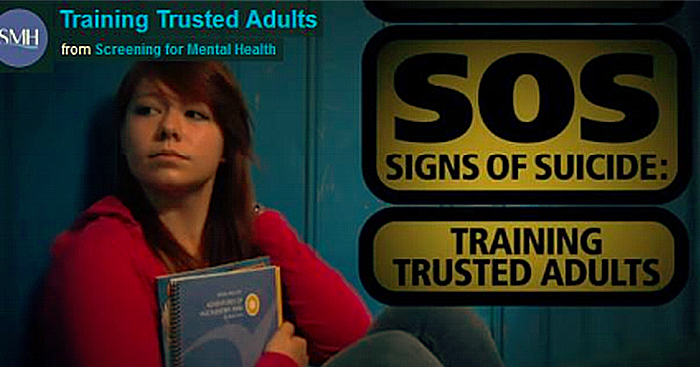
Pilot program at Hays Middle School seeks to prevent suicides

The Signs of Suicide prevention program seeks to decrease the occurrence of suicide and suicide attempts among youth.

By CRISTINA JANNEY
Hays Post

A new program at Hays Middle School seeks to prevent suicide and self-harm among its students.

Already this year, HMS has reported multiple students with either suicide attempts or serious self-harm incidents, Julie Zollinger, school psychologist, said.

The school is rolling out a pilot of the Signs of Suicide prevention program this month. Zollinger gave a presentation on the pilot to USD 489 school board members at their meeting Monday.

SOS is the only program that research has shown increases students knowledge about suicide risk and depression, and decreased suicide attempts.

A report in 2016 indicated SOS reduced self-reported suicide attempts by 64 percent.

Over the last 10 years, the program has been implemented in more than 1,000 schools.

Screenshots from the video students will see as part of the SOS suicide prevention program at HMS.

The strongest indicators for suicide are depression, substance abuse and previous attempts of suicide, Zollinger said. For youth ages 11 to 19, suicide is the second-leading cause of death. In Kansas, suicide is the third-leading cause of death for middle school youth.

Depression has been linked to poor school performance, substance abuse, running away, feelings of hopelessness and worthlessness in addition to suicide.

“The SOS program was created to address the issues of youth depression and suicide simultaneously and age appropriately,” Zollinger said.

She added more than 90 percent of youth who die by suicide have a diagnosable mental health issue, most often depression. Yet 80 percent of youth with a mental disorder are never identified.

The SOS program has the following goals:

• Highlight the relationship between mental health and suicide

• Teach that suicide is, most often, a fatal response to a treatable disorder – depression

• Encourage individuals to seek help from adults

• Encourages students to seek help when they are concerned about themselves or a friend

In addition, the program seeks to reduce stigma, encourage students to seek help for themselves and others, engage parents and teacher to promote education and prevention, increase access to mental health services and strengthen community partnerships.

The students will learn to ACT.

Acknowledge: that you are seeing signs of depression or suicide in yourself or a friend and that it is serious.

Care: Let your friend know how much you care about them and that you are concerned that they need help.

Tell: a trusted adult that you are worried about yourself or a friend.

HMS has already started to roll out the program to a pilot of 25 students. The staff has seen training videos, consent letters have gone out to parents and parent training is set to start later this week.

Parents can watch a video on SOS, receive a newsletter and receive access to an SOS online portal.

Students will also watch a video and receive a newsletter. To complete the session, they must fill out a depression screening and hand in a response card indicating if they are concerned about themselves or a friend. The students also get wallet cards and ACT sticker for their lockers.

SOS research has indicated 12 percent to 15 percent of students report they need a follow-up after they complete the SOS training. That rate is higher if there has been a recent trauma in the community.

Counselors and the school psychologist will be on hand to help students who self-refer or refer a friend. Parents will be contacted, and the students referred to community mental health services if necessary.

Materials for the program were paid for through a gift from the USD 489 Foundation for Educational Excellence. The startup pack for the middle school cost about $500, but Zollinger said further materials would be less expensive and some resources like the newsletters could be produced in-house.

Zollinger said she hopes the SOS program could be rolled out to the entire middle school. The school is only limited, at this point, by the number of mental health providers available following the implementation, she said.

Board member Luke Oborny said the numbers and the evidence on suicide were staggeringly scary.

“It is not a matter if there is a need,” he said. “I am glad you are helping to try to fill that void.”

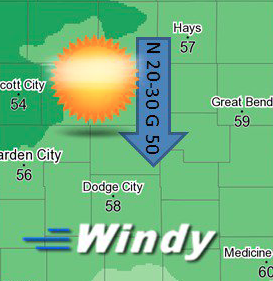
Sunny, windy Tuesday

Today Partly sunny, with a high near 58. Breezy, with a north wind 17 to 24 mph.

Tonight A 50 percent chance of rain, mainly after 3am. Mostly cloudy, with a low around 42. North wind 7 to 14 mph.

Wednesday A 40 percent chance of rain, mainly before 11am. Cloudy, then gradually becoming mostly sunny, with a high near 56. Northwest wind around 8 mph.

Wednesday NightMostly clear, with a low around 33. Light and variable wind becoming west around 6 mph after midnight.

ThursdayMostly sunny, with a high near 60. West southwest wind 6 to 9 mph.

Thursday NightPartly cloudy, with a low around 37.

FridayMostly sunny, with a high near 56.

Friday NightPartly cloudy, with a low around 38.

News From the Oil Patch, Oct. 29

By JOHN P. TRETBAR

Several Kansas drilling contractors returned to active status last week with 14 rigs moving from the “pending” to the “active”column. Independent Oil & Gas Service reports a 30% increase in the number of drilling rigs moving in, rigging up, drilling or relocating: 10 in eastern Kansas, up one, and 29 west of Wichita, up eight since the last report. Operators are about to spud on one lease in Barton County and one in Russell County. Nationally, Baker Hughes reported 1,068 active rigs, up one rig. Texas and Louisiana each dropped by three rigs while the counts in North Dakota and Alaska were up two. Canada reports 200 active rigs, up nine for the week.

Independent Oil & Gas Service reported 35 new well completions for the week, 14 in eastern Kansas and 21 west of Wichita. Two wells completed in Barton County and one in Stafford County are producing pay dirt. There were two dry holes completed in Ellis County. Operators have completed 1,253 wells so far this year, which is 172 more than last year at this time. By the end of October during the boom year of 2014, Kansas operators completed 4,881 wells.

Operators filed 24 permits for drilling at new locations across the state over the last week, 1,479 so far this year. Fourteen of the new permits last week were in Western Kansas, with one each in Ellis, Russell and Stafford Counties. Eleven permits were filed in the eastern half of the state last week.

Gasoline prices are dropping locally and across the U.S. On Monday, we found self-serve regular as cheap as $2.59 in Hays and in Great Bend. Triple A reports a statewide average of $2.616 across Kansas, which is about 20 cents less than the national average. At $2.818, the national average is down nearly six cents in the last month.

At CHS in McPherson, the going price for Kansas Common crude gained a quarter on Friday to end the week at $57.75/bbl, down $1.50 from the week before.

In just over a year, shippers around the world will be faced with new rules mandating cleaner marine fuels, a shift that could hit Russian companies particularly hard. Bloomberg reports that European and American refiners are well positioned to make the change to low-sulfur output. But Russian companies have reportedly done little to prepare. Analysts say they’ll be forced to sell their sulfur-rich fuel oil at an increasing discount. In 2020, the first year of the new rules, Russia stands to lose about $3.5 billion, more than one third of their fuel export revenue last year.

The U.S. Energy Information Administration reports modest growth in U.S. inventories last week, up 6.3 million barrels to 422.8 million, or about two percent above the five year average for this time of year.

U.S. crude production dipped slightly last week to 10.873 million barrels per day. Our four week average is slightly above 11 million barrels per day.

Kansas City Southern moved more than 13,000 carloads of fuel by rail from the U.S. to Mexico in the third quarter of this year, up from just over 5,000 train cars a year ago. The spike in oil-by-rail shipments continues across the US, with 11,955 rail cars hauling petroleum products last week, according to the Association of American Railroads. That’s up slightly (+172) from last week and a 17% increase over last year. The weekly average so far this year is up 15.5%. In Canada, the weekly average so far this year is nearly 19% higher than a year ago.

The Trump administration approved a company’s plan to drill for oil in the Arctic Ocean north of Alaska, which would mark the first oil production from federal waters in the Arctic. Hilcorp Energy hopes to build an artificial gravel island for its 9-acre drilling pad, near similar oil-and-gas producing islands situated in nearby state waters. The company says the play holds as much as 150 million barrels of oil and could produce up to 70,000 barrels per day.

The government will try again next spring with oil lease sales within endangered bird habitats in Montana and North Dakota, after a judge struck down the limits placed on public comments during the first go-round. The Bureau of Land Management says the sale planned for December will be moved back to next March, to allow for open public review periods.

The Texas businessman who called himself the “Frack Master” agreed to settle with the government for nearly $24 million and serve 12 years in federal prison. Christopher Faulkner entered guilty pleas to charges of securities fraud, money laundering and tax evasion in an $80 million scheme involving hundreds of investors nationwide. According to the complaint, Faulkner bought and then sold to investors working and royalty interest in oil and gas prospects in Kansas, Texas, Oklahoma, and North Dakota. Federal prosecutors say he deceived investors about expenses and production to finance a lavish personal lifestyle.

The petroleum industry is pouring tens of millions of dollars into a campaign to defeat a Washington state initiative which would impose a carbon fee on emissions from the state’s major polluters. BP America joins two other major refiners, Phillips 66 and Andeavor, offering seven-figure donations. The total is now $25.87 million, a state record.

The Intercontinental Exchange, or ICE, has launched its West Texas Intermediate pricing guide. The Houston Chronicle reports the move could make Houston the new hub for U.S. oil pricing, as it is based on volumes produced from the Permian Basin and delivered to Houston’s refining and export hub. The Permian pumps nearly one-third of U.S. production.

Russian media reports of promised production increases in Saudi Arabia sent crude prices tumbling Tuesday, a nearly five percent cascade by noon. The Nymex benchmark futures contract dropped $3.03 to $66.33/bbl, the lowest price for WTI since August. London Brent was down $3.29 to $76.54.

The Saudi Energy Minister reportedly said his country would increase crude production to 11 million barrels a day, up from 10.7 million barrels a day now. That would surpass current U.S. output of 10.89 million barrels per day. New production figures due from Washington on Wednesday. Russia currently leads the world with production of 11.36 million barrels per day.

Mistaken pay raise could force some USD 489 employees to repay wages

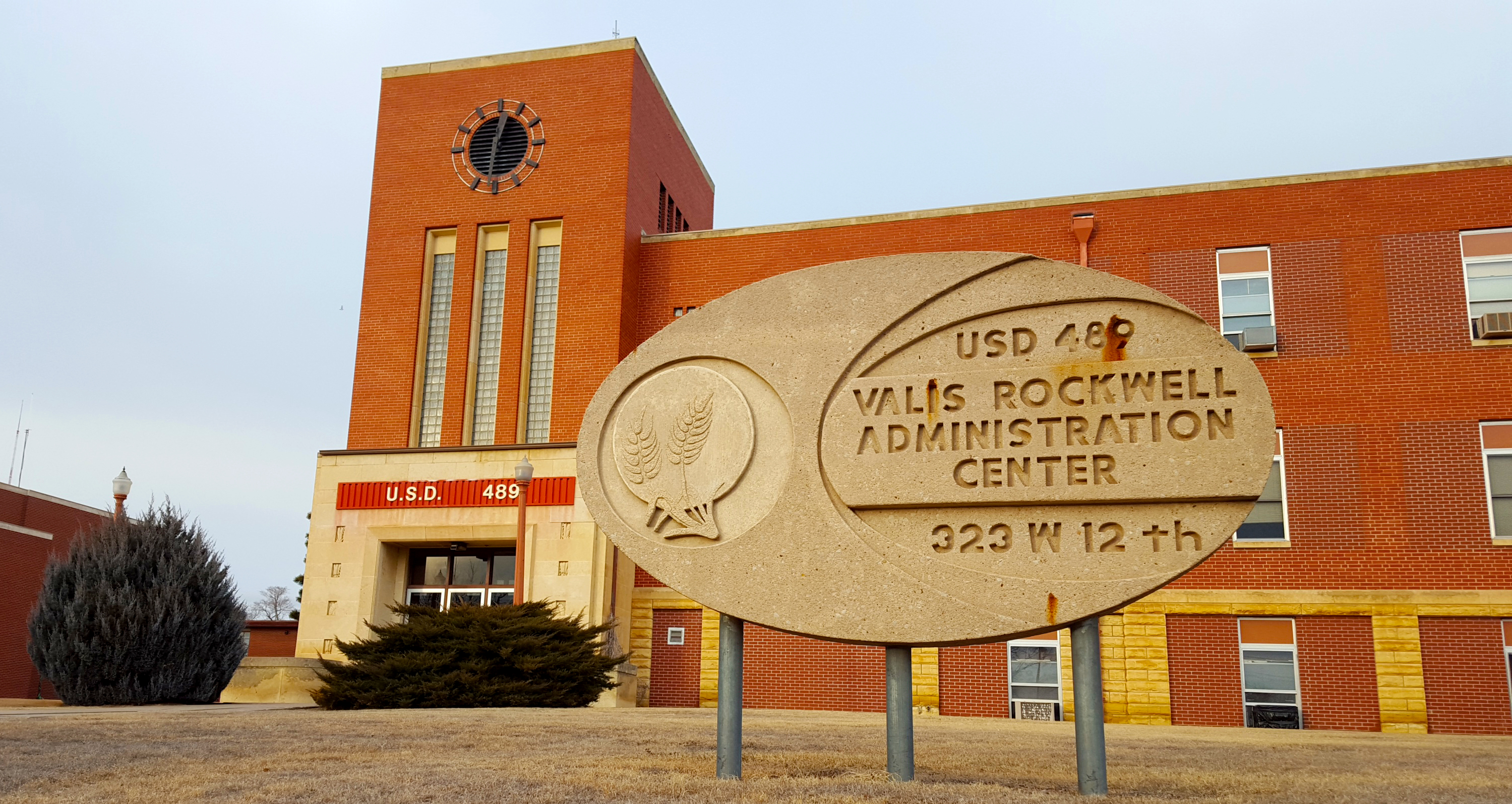
Update: The special board meeting to deal with the pay issue has been scheduled for noon Thursday in the Toepfer Board Room at the Rockwell Administration Center.

By CRISTINA JANNEY
Hays Post

Certain USD 489 staff members received a pay increase that was not approved by the USD 489 school board and could have to pay some of that money back.

Classified staff and administrators received a pay increase in July of 4.6 percent.

“That never should have happened,” Superintendent John Thissen said. “That 4.6 percent should have never happened.”

This did not include custodians or paraprofessionals.

Custodians were in their final year of negotiations with its union, SEIU, and the board has already approved a contract that included a 4.6 percent raise for 28 people under that contract. The board also approved a $2 per hour increase for paraprofessionals beginning this school year in attempts to recruit and retain more staff in these special education positions.

The board has offered teachers a 3.6 percent pay increase, but those contract negotiations have reached impasse. The teachers say they want the 4.6 percent raise the rest of the staff has received.

Thissen said administration and classified staff raises are usually approved by the board after contract negotiations are concluded with the teachers. Administration and classified staff are usually given the same raise as teachers.

The school board now must decide if it wishes to officially give the administrators and classified staff the 4.6 percent raise, the 3.6 percent raise it is offering teachers or some other pay increase that has not yet been identified.

If the board approves a raise less than the 4.6 percent the classified staff and administrators are currently receiving, those staff members would essentially have to pay back the difference. This would take the form of wage reductions until the excess pay was accounted for.

The director of finance position for the district is currently open, but Thissen said the pay mistake occurred before Tracy Kaiser, former finance director, left her post. Thissen took responsibility for the pay error, saying the mistake originated in his office.

Norton Co. Sheriff’s Office warns of scam telephone calls

Norton County Sheriff’s Office

The Norton County Sheriff’s Office has been made aware by several concerned citizens about receiving telephone scam calls about their Social Security numbers, the office said in a social media posting Monday. They report someone saying they worked for the Social Security office and were asking for their Social Security numbers. The sheriff’s office wants to remind everyone.

1) Social Security and IRS will never contact you by telephone to request personal information.

2) Never provide personal information to someone you do not know.

3) If you do receive a phone call from someone stating to be with a government agency, please hang up and call that agency back. This will allow you to verify that the government agency was actually trying to contact you. It is most likely that they were not.

4) If you think that the phone call you received may have been a scam, please contact us at the Sheriff’s Office and we may be able to assist you.

Kansas man dies after pickup overturns on I-70

SHERMAN COUNTY — One person died in an accident just after 4a.m. Monday in Sherman County.

The Kansas Highway Patrol reported a 1988 Chevy pickup driven by Brian Bender,  59, Salina,  was eastbound on Interstate 70 twelve miles west of Goodland.

The pickup left the roadway and entered the median. It hit a paved turn around and a delineator post before re-entering the roadway. The pickup then traveled across eastbound and westbound lanes into the south ditch, overturned and came to rest on its top

Bender was pronounced dead at the scene and transported to Koons-Russell Funeral Home. He was properly restrained at the time of the accident, according to the KHP.

Hays, Sherman Co. among winners of Kansas tourism awards

Awards presented at annual Kansas tourism industry meeting

TOPEKA — Kansas tourism professionals presented several awards at the 2018 Kansas Tourism Conference awards banquet held Oct. 24 at the Geary County Convention Center in Junction City. The Kansas Department of Wildlife, Parks and Tourism presented the following awards:

  • Governor’s Tourism Award – Friends of the Kaw

Established in 1983 to recognize outstanding contributions by individuals or organizations to the Tourism Industry, the Governor’s Award encourages others to strive for excellence. The award demonstrates cooperation, sustainability, quality and accountability. The Kansas River is a recreational treasure and has been a well-kept secret among a few paddlers and anglers, but it is fast becoming a valued recreational resource for thousands of visitors each year. KDWPT has worked with Friends of the Kaw and local communities along the Kansas River to develop more than 20 public access points for public recreation as well as wayfinding signs and increased awareness of the recreational opportunities on the Kansas River.  In 2012, the Kansas River was the second river designated as a National Water Trail.

  • Kansas Tourism Partnership Award – The Nature Conservancy

For nearly 30 years, The Nature Conservancy (TNC) has been working in Kansas to conserve the lands and waters on which all life depends. They’ve permanently protected 139,470 across the state, including five preserves that are open to the public. In 2016, TNC bought a 330-acre tract of land in Logan County that encompasses 250 acres of Niobrara chalk formations. The property adjoins the Smoky Valley Ranch which is owned by TNC. In 2018, the Kansas Legislature formally designated the chalk formations as Little Jerusalem Badlands State Park. KDWPT and TNC are collaborating to design access to the park and build trails to protect the fragile formations and unique ecology of the area. The award recognizes the importance of collaboration in the successful development of tourism in Kansas.

  • Kansas’ Finest Awards – Rebecca (Beccy) Tanner, Wichita, author and Kansas professor at Wichita State University; Patty & Jerry Reece, Shawnee Mission, Tallgrass Prairie and Wabaunsee County Champions; Doc R.C. Trotter, Dodge City, doctor and Dodge City Roundup President, and Joe Minick, Enterprise, machinist and co-creator of the Abilene & Smokey Valley Railroad. The Kansas’ Finest award recognizes and honors advocates who promote the state’s attributes and maintain an abiding love for the sunflower state, exhibiting passion, perseverance, and pride in promoting destinations with statewide significance and national or international relevance.

“These awards highlight the vital role of dedicated individuals and organizations in growing the tourism industry in Kansas. Through their partnership, Kansas tourism will continue to be a significant part of the state’s economy.  A recent economic impact survey indicates tourism has grown to an $11 billion industry in Kansas, one of the fastest growing industries in Kansas.” said Linda Craghead, KDWPT Interim Secretary.

The Travel Industry Association of Kansas (TIAK) also recognized its membership’s top marketing talent. TIAK Marketing Awards focus on overall marketing initiatives and recognize state-level winners only.

  • People’s Choice: Totos Around Town was honored for its artwork from Kansas Artists on Toto statues located throughout Wamego. Each Toto was “adopted” by a local business, organization or individuals.
  • Visitors Guide (designed in-house): Sherman County Convention & Visitors Bureau won in the small budget category for its Sherman County Visitor Guide, providing fun facts and a look behind the scenes. Merriam Visitors Bureau dazzled received bragging rights in the medium budget category with its eye-catching Merriam Visitor Guide, and the large budget winner was Visit Topeka for its attention-grabbing Topeka Visitor Guide.
  • Visitors Guide (outsourced): Kansas Sampler Foundation was awarded the small budget win for its Big Kansas Road Trip Guide, which incorporated a scavenger hunt. Emporia Convention & Visitors Bureau received the medium budget trophy for their Emporia Visitor Guide with its magazine-style layout, and Visit Manhattan won in the large budget for their rearranged and photo-driven Manhattan Visitor Guide.
  • Online Marketing: Wamego Area Chamber of Commerce was recognized in the small budget category for its “Wamego Becomes Boomtown USA” website. Kansas City, Kansas Convention & Visitors Bureau received recognition in the large budget category for its Facebook Live Series, engaging with stakeholders creatively.
  • Integrated Campaign: Kansas Sampler Foundation was honored in the small budget category for its promotion of the “Big Kansas Road Trip” campaign. Emporia Convention & Visitors Bureau received the medium budget win for their Disc Golf Campaign, and Merriam Visitors Bureau garnered Honorable Mention in the same category for their Tour Merriam Campaign. eXplore Lawrence received large budget honors for its “Block by Block” Campaign, highlighting all of its historical real estate.
  • Print Marketing: Marysville Convention & Tourism won in the small budget category for its newspaper advertisement that included strong photography. The medium budget winner was Emporia Convention & Visitors Bureau for their cleverly-headlined magazine ads, and Visit Manhattan received the large budget win for their Oh Manhattan! print ads.
  • Community Awareness: Wamego Area Chamber of Commerce was honored in the small budget category for its “Totos Around Town” project. Hays Convention & Visitors Bureau won in the medium budget category for its welcome banners on Vine Street, and eXplore Lawrence received the large budget category win for their videos on weekly things-to-do.

“The travel industry plays a significant role in enhancing the Kansas economy. These awards are examples of the superb efforts, from all regions of the state, that go into marketing Kansas as a quality visitor destination.”  said TIAK president Jan Stevens.

Hays students on K-State Polytechnic team advancing to nationals

Members of the Kansas State Polytechnic Flight Team pose with their awards from the National Intercollegiate Flying Association SAFECON Region VI competition. Back row, from left: Jacob Hecker, Charles Weeks, Zach Smith, Robert Weesner, Caleb Strahm, Brent Koenigsman, Satoru Okada and Cole Thornberry; and front row, from left: Logan Klein, Marc Hinnen, team captain Maddie Perry, Grant Weldon, Conrad Giebler, Brandon Vu and Zak Kierstein. |

SALINA — The flight team at Kansas State University Polytechnic Campus will compete on a national level next spring after placing second in its region during an annual collegiate aviation competition.

The Kansas State Polytechnic Flight Team attended the National Intercollegiate Flying Association Safety and Flight Evaluation Conference, also known as NIFA SAFECON, Oct. 14-17, battling other colleges in their region for a chance to advance to the national championship. After participating in a variety of events consisting of tests both on the ground and in the air, the Kansas State Polytechnic Flight Team earned several individual awards and placed second overall, securing a spot at nationals in May 2019.

In preparation for regionals, the flight team had the unique responsibility of both training for the competition and helping organize the contest as this year’s host. Ten universities from seven states visited the campus to compete in two different regionals. Kansas State Polytechnic faced the colleges in NIFA SAFECON’s Region VI: Oklahoma State University, Southeastern Oklahoma State University, St. Louis University-Parks College, University of Central Missouri, University of Nebraska Omaha and University of Oklahoma. Minnesota State University-Mankato, University of Dubuque, University of North Dakota and University of Wisconsin challenged one another in NIFA SAFECON’s Region V.

“It was such an honor to welcome other universities to our campus and connect with so many students that share the same interest in aviation,” said Maddie Perry, Wichita, senior in professional pilot and captain of the flight team. “Having the competition close to home also helped our strategy: Because we weren’t traveling out of state, which costs more per person, we were able to increase the number of flight team members participating and each was able to focus on the event or events they best excelled at. Overall, it was a valuable learning and networking experience and I’m proud of what this team accomplished.”

The competition consisted of nine ground and flight events that ranged from determining different types of aircraft from ambiguous photos to attempting to hit a ground target from the air to landing a plane as close as possible to a specific line painted on the runway. Participants earned points for their efficiency in each event entered, which were accumulated to score single event placings as well as each team’s overall performance. Winners in each category received a medal or plaque and the top three teams in each region were selected to move on to nationals.

Fifteen members competed for Kansas State Polytechnic at NIFA SAFECON and more than half of them scored in the top 10 in various events. Their individual placings are as follows:

Jacob Hecker, sophomore, Hays, eighth in Message Drop; Robert Weesner, sophomore, Leawood, eighth in Aircraft Recognition and eighth in Message Drop; Caleb Strahm, senior, Sabetha, first in Short Field Landing, second in Power-off Landing, fourth in Traditional Navigation, and eighth in Simulated Comprehensive Aircraft Navigation; Logan Klein, junior, Salina, 10th in Ground Trainer and 10th in Message Drop; Marc Hinnen, sophomore, Shawnee, first in Power-off Landing, fourth in Computer Accuracy, fourth in Short Field Landing, fourth in Traditional Navigation, seventh in Ground Trainer, and runner-up for Top Pilot; and Maddie Perry, senior, Wichita, fifth in Power-off Landing, sixth in Ground Trainer, and 10th in Short Field Landing.

Brandon Vu, freshman, Johnston, Iowa, 10th in Message Drop; Zach Smith, senior, Hendersonville, North Carolina, seventh in Navigation; and Satoru Okada, sophomore, Yokohama, Japan, second in Computer Accuracy, seventh in Navigation and eighth in Short Field Landing.

The Kansas State Polytechnic Flight Team also was selected as the safest team in both Region V and VI. Other members of the competition team include Brent Koenigsman, sophomore, Hays; Conrad Giebler, sophomore, and Grant Weldon, sophomore, both from Olathe; Cole Thornberry, junior, Troy; Zak Kierstein, junior, Erie, Colorado; and Charles Weeks, sophomore, Woodstock, Georgia.

Along with competing annually, the flight team uses its student organization as a way to give back to the community and to connect children with aviation. Throughout the year, the team is a part of several campus events like Open House and Candy Canes and Airplanes, and also conducts two aviation camps for kids and one for high school students in the summer.

— Kansas State Polytechnic

Exploring Outdoors Kan.: Paul Bunyan would not have been proud

Steve Gilliland

Although it has absolutely nothing to do with the outdoors, I still feel the need to ask you all to observe a moment of silence just now, as the woman credited with creating the Green Bean Casserole has died. Dorcas Reilly who passed away this week at the age of 92 worked in the home economics department of Campbell’s Soup and helped create many of the recipes listed on the soup cans including the iconic green bean casserole. Now that I have that out of my system and have composed myself, on to this week’s column.

Fall is my favorite time of the year, and I love the savory smell of wood smoke in the autumn air. When I was younger, I heated my home with wood for several years. Today, my checkbook curses me each time I pay the monthly winter gas bill, but my back curses me each time I again think of cutting firewood. Nevertheless, I do miss the rumble of a powerful chainsaw in my hands, the smell of the fresh wood chips as they’re spit from the saw, and of course, the wonderfully soothing feel of wood heat that results from it all. You know the old saying, wood is the fuel that heats you twice; once when you cut it, and again when you burn it.
I like to think that my prowess with a chain saw was unparalleled…once I got the tree on the ground. Up to that point, however, my lumberjack skills weren’t worth a hoot. Maybe because I am directionally challenged, I don’t know, but the trees I cut never went the direction they were supposed to go. The clearest memory from my wood cutting days is of a tree-felling gone horribly wrong, that wasn’t entirely my fault.

Where I grew up, our farmstead sat back a very long lane, and just as it reached the house, the lane made a sharp 90-degree turn and became a large, oblong circular drive. At that 90-degree turn, and directly across the lane from the house was a big wild cherry tree. The tree had been dead for a while, and dad had decided its time was at hand, the problem being that it leaned toward the house and the electric lines.

Like most old barns in that part of the country, our barn was designed primarily for storing hay, and still had the steel track high against the roof on which the old hayforks ran. These forks were used to unload loose hay from the wagons and to carry it up high enough to be dumped into the loft. A large diameter rope run through a set of pulleys and hitched to a horse or tractor, pulled the loaded forks from the wagon up into the barn, and that rope still hung high in the rafters… We had an idea!

I clambered as high into the tree as I could and secured a heavy log chain, and then came the old hay rope salvaged from the barn. One end was tied tightly to the chain, the other end to a clevis on the drawbar of the old Farmall “H.” With dad on the tractor ready to pull the dead behemoth away from the house, I began to cut. The diameter of the tree was more than double the length of my chain saw bar, so it was a slow process. I finished the notch, then moved around the tree and started cutting in from the backside. As I reached the point of no return, I gave dad the high sign, and he tightened the “old” rope. The dead beast began to list in his direction. Life was good! However, the smile on my face evaporated at the gnawing, snapping sounds of rope fibers stretching and breaking. I watched in horror as the old rope unraveled and ripped in half, leaving the outcome of this undertaking in the hands of my chainsaw ability!

Time slipped into slow motion as half a years supply of fire wood snapped upright again, then slowly headed for the house and power lines. We had never worried about the house, which was safe by a mile, but like a fullback protecting a football as he dove for the goal line, the power lines were tucked snugly beneath its branches as the tree crashed across the driveway. Bad enough you say? Not quite, as the calamity had torn something loose somewhere, knocking the entire neighborhood out of power. Certainly bad enough now, you think! No not yet, because it was Saturday, and the power company guys had to come out on their day off, not to mention the fact that the televised Ohio State football game was interrupted. (you K State and KU fans can understand this I’m sure) Saying all the neighborhood football fans were steamed is being kind. As I remember it, they were so hot we could have heated the house that winter with their thoughts, and let the tree stand!

Since I don’t cut firewood anymore, the trusty old chain saw sets alone in the dark, now used only for the occasional pruning job around the deer stand. It’s probably all for the better though, because I am still as directionally confused today as ever, and to top it all off, now I wear bifocals!…Continue to Explore Kansas Outdoors!

Steve Gilliland, Inman, can be contacted by email at [email protected].

Copyright Eagle Radio | FCC Public Files | EEO Public File