Category: Local
Race for Kansas governor: Democrat Laura Kelly
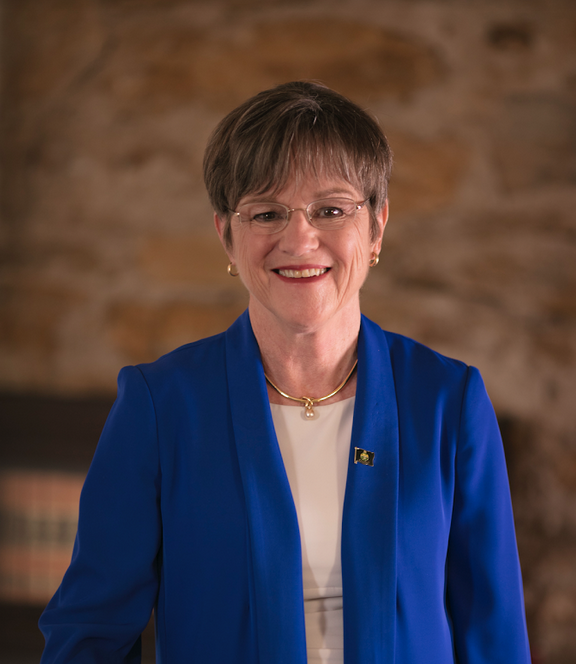

By ROY WENZL
For the Kansas Press Association
She’s heard the predictions that a Democrat can’t get elected Kansas governor these days. Kansans vote mostly Republican, after all, even in her State Senate District 18.
So, Sen. Laura Kelly knows better than most that the race will be a close one. Recent polls show her slightly ahead of her Republican challenger, Secretary of State Kris Kobach.
But Kelly knows Kansans, Republicans and others. She knows what their big worries are, including that “Ïdealogues” might bring back tax cuts that she says “devastated” the state’s schools, roads and other institutions in recent years.
Kelly said she has been able to work across the aisle with Republicans.
“My own senate district is very Republican, by 10 points plus,” she said. “I’ve been able to win that district four times. And it’s because I’ve formed these relationships and maintained them.”
A common thing she’s heard from Republicans in her district during her four terms: ”I voted for you because you showed up.”
And she has been endorsed in the gubernatorial race by two popular Republicans, former Gov. Bill Graves and former U.S. Sen. Nancy Kassebaum.
What she’ll do as governor: Fix what she calls the damage from “the dark years.” Everywhere she goes, voters describe to her what the 2012 “Brownback tax experiment” did to state institutions:
• Class sizes ballooned; teachers left the state.
• The Kansas roster of foster kids jumped from 5,000 to 8,000 because there were no longer enough social workers to reunite them with their families or adopting families.
• Thirty hospitals are on the verge of closing in Kansas because the government refused to deal with Medicaid expansion, a topic she says voters bring up at every stop she’s made.
• Roads are crumbling. “You go into KDOT now (Kansas Department of Transportation) and it looks like a ghost town.”
• “And we’ve had the greatest out-migration ever in the past seven years. It’s because all those cuts made Kansas a much less attractive place.”
• “And there’s one thing I always bring up, on the road – I want to re-instate the state arts commission. I get a standing ovation anytime I bring that up, and it doesn’t matter what part of Kansas I am, Overland Park or Oberlin. We were spending $750,000 on the arts commission — and getting back $28 million, either from the feds or foundations. It was a great investment and reaped rewards all over the state.”
The dark years ended, she said, “because the Republicans and I want the same things: they want to fund their schools. They want Kansas to be a well-respected place that businesses want to move to and to grow.”
Republican voters two years ago elected moderates who combined with Democrats to end some of Gov. Sam Brownback’s tax cuts, and override Brownback’s vetoes. Kris Kobach wants to bring the cuts back, she said.
In the state’s primary in August, “Some of those really wonderful moderate legislators were taken out. We’ll have to see what happens in November, whether they are replaced by an ideologue, or by a Democrat.”
All this and more, she said, is why more than two dozen past and current Republican legislators in the red state of Kansas have endorsed her, including Kassebaum and Graves.
“We need to re-brand … go back to being a sane, open, welcoming state that businesses will look at, that people will look at.”
Voters are telling all three candidates that property appraisals and the sales tax are pricing some voters out of their homes and retirement savings. She agrees with Kobach and Orman that those taxes are too high. “We’ve got to lower the sales tax, particularly on food. Our property taxes are too high. Beyond that, we’ve got to get back to a balanced approach to taxes.”
The Brownback cuts forced the legislature and local municipalities to raise those taxes, she said, to offset what they lost from state-run programs funded with the income tax.
So would a Governor Kelly lower all taxes? Would she raise state taxes to rebuild schools, roads and other programs she said were gutted by Brownback?
“I’m not prepared to do anything about revenues until we really understand the full implications of what we did in overturning the Brownback experiment, and then what the feds did,” she said. “And we’re not going to know that until the middle of 2019.”
She hopes to make state government more open, but said she wants conversations with legislators before she would make any moves. There are many moves to consider, she said. Legislators often prepare bills without putting their names on the bills. Committees, where most of the debate and work takes place, don’t record the votes of committee members, another way to hide a legislator’s maneuvers. Legislators sometimes remove all the wording from a bill, and substitute other wording, a secretive process they themselves call “gut and go.”
Oftentimes, she said, the only way voters find out about state mistakes, big and small, is when a news reporter digs up documents and exposes wrongdoing.
News reporters are not the “enemy of the people,” she said. “Sometimes we need help. Somebody needs to hold us accountable, and the press does a really good job of that.”
Kelly has a master’s degree in therapeutic recreation from Indiana University. Her husband is a physician; they have two daughters.
Her running mate is Lynn Rogers.
– Roy Wenzl is an award-winning journalist who formerly reported for the Wichita Eagle.
Thunder on the Plains helps fund local organizations


Submitted
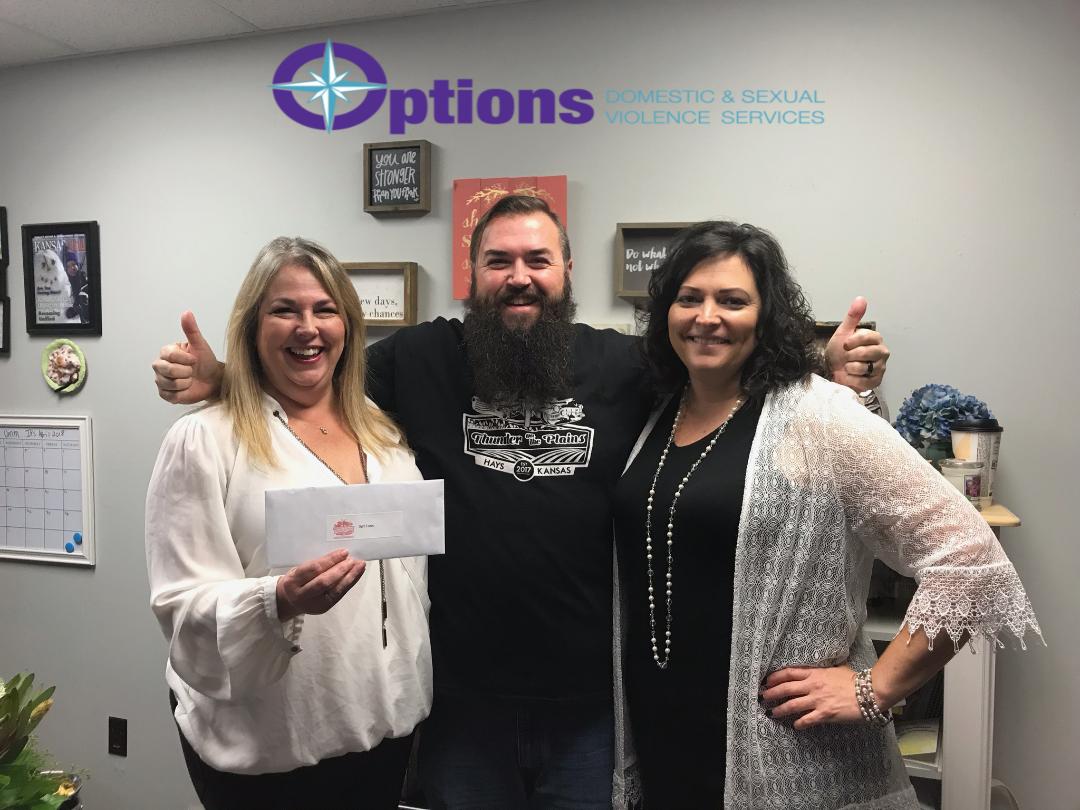
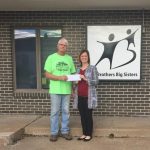
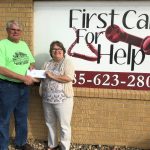
Members of Thunder on the Plains Car, Truck and Cycle show met Monday evening to determine how to disperse the proceeds from their annual car show which was held Sept. 15 at Frontier Park East.
The group hosts the annual event not only as a way for car, truck and bike owners to share their great rides with everyone, but also to raise money to contribute to local agencies who serve those in need.
The success of this event depends mainly on the support of our sponsors – and our sponsors came through for us this year. Because of their generosity we are able to share our success with these 10 local agencies: Big Brothers Big Sisters, DSNWK, First Call for Help, Hays Area Children’s Center, Cancer Council of Ellis County, High Plains Mental Health Center, Humane Society of the High Plains, Kansas Merci Boxcar & Veterans Memorial Park, LINK Inc., and Options. A donation to Kansas Honor Flight was also made.
Thunder on the Plains has set the date for their show next year so mark your calendar. It will be held Sept. 14, 2019, at Frontier Park East. We thank our big-hearted sponsors, and with their continued support. We look forward to this event being bigger and better allowing Thunder on the Plains to increase our contributions to local agencies. Be sure to go to our Facebook page or look up our website, www.thunderontheplainsks.com for upcoming events.
TMP-M Junior High Student Council donates to food pantry

TMP-M
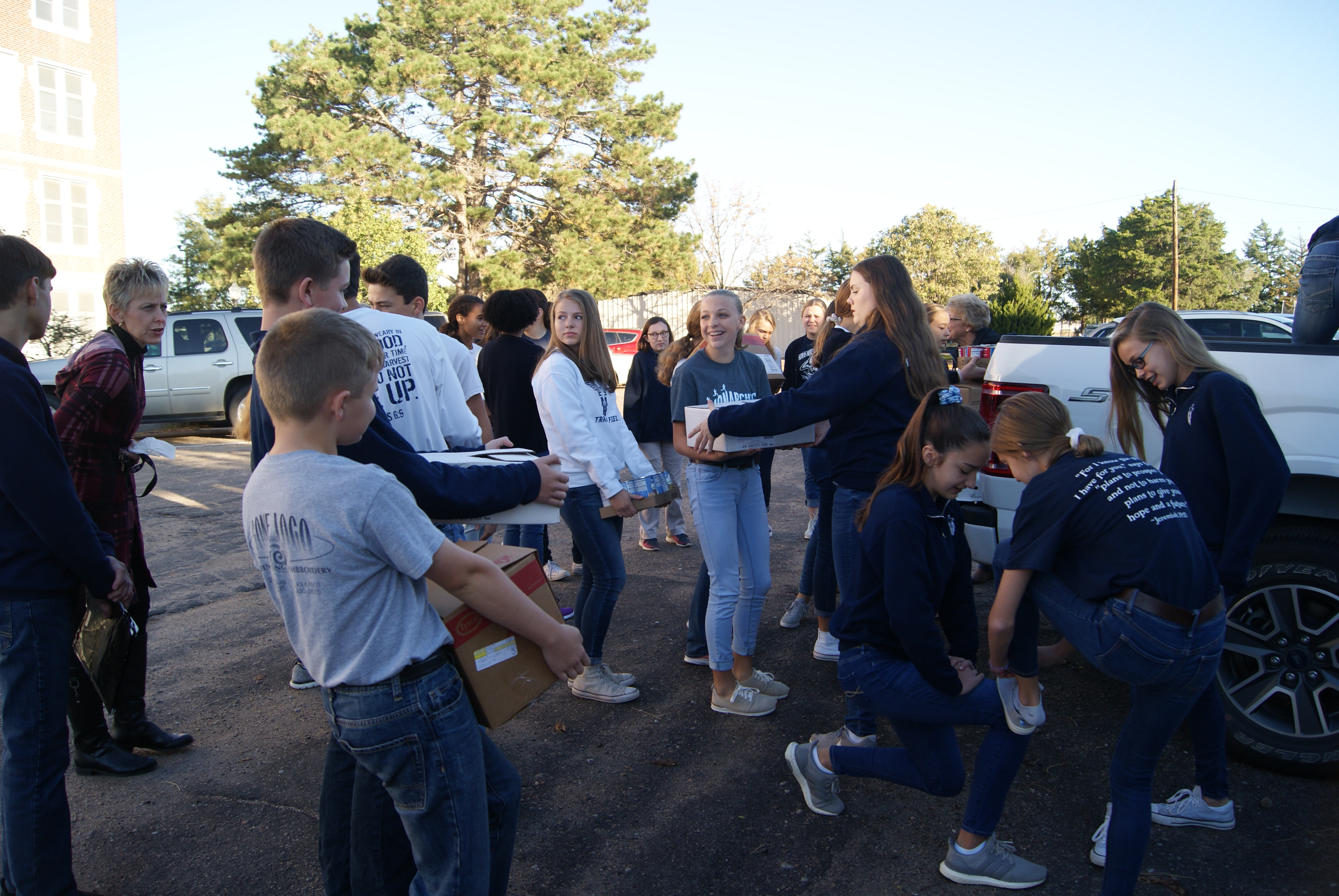
The Thomas More Prep-Marian Junior High Student Council set the goal for donations for the St. Joseph’s Food Pantry at 250 items with the promise to match one item for every two items donated.
Renee Michaud, director of the St. Joseph Food Pantry, attended Mass with the students and spoke to them about the number of people in Hays who are food insecure.
Student council officers Jenna Schlyer and Arin Schibi then presented her with 551 food items the students had collected.

1st Amendment: Protest proposed restrictions on White House protests

To the world, it’s the image of the United States.
To Americans, it’s the “us” in U.S. — and the universally recognized metaphor for the president and the administration behind him.
And for at least 100 years, it’s been the prime spot for demonstrators focused on many of society’s most important issues — war and peace, abortion and gun rights, health care policies and more.
In First Amendment terms, the White House may well be the premier place we go to exercise our rights of free speech, to assemble peaceably and to petition the government for redress of grievances.
The usual space for protests is on the White House’s north side, on a sidewalk along Pennsylvania Avenue, and across the street in the park-like Lafayette Square. While the immediate streets are now closed to vehicles due to terrorist concerns, the sidewalks and green spaces still see daily protests — from a single person adorned with handmade signs to organized rallies that fill the square and beyond.
But the National Park Service has now proposed new regulations and is considering new fees that thousands fear will dissuade most demonstrators from protesting “at the White House.” Park service officials want to limit protesters to a narrow, five-foot strip on the curb side of the 25-foot sidewalk and may establish new charges for security, trash clean-up and such things as “harm to turf.”
The park service argues the changes are needed to help cover higher costs of dealing with what it says is an increasing number of demonstrations. Critics say the moves are a poorly disguised attempt by the Trump administration to thwart visible, anti-Trump protesters — and even dispute the claim of more protests than in previous years.
According to news reports, more than 10,000 people have responded to a public comment period on the new regulations that ended Monday — most in strong opposition.
What would we lose if we moved demonstrations away from the White House?
No less than a century of permitting citizens to send a direct, audible and visible message to the occupant of the Executive Mansion.
In January 1917, a dozen women met in Lafayette Square to start a protest that eventually led to a constitutional amendment granting women the right to vote. The women — called the “Silent Sentinels” — are credited by some historians with creating the first picket line at the White House. Rain or shine, six days a week, they quietly held signs asking, “How Long Must Women Wait For Liberty?” and “Mr. President, What Will You Do for Woman Suffrage?” They stayed on line until June 1919, when Congress sent the 19th Amendment to the states for ratification.
During WWII, crowds were reported to have gathered periodically on the sidewalks at the White House — including a huge gathering Aug. 14, 1945, to hear the news from President Harry S. Truman that the war had ended.
President Lyndon B. Johnson was taunted in the late 1960s by Vietnam War protesters outside the White House, who chanted loud enough to be heard in the White House at all hours: “Hey, hey LBJ — how many kids did you kill today?” During the Nixon administration a few years later, President Richard Nixon could hear car horns beeping — Watergate protestors would ask passing cars to “honk if you think Nixon should be impeached.”
Since Trump took office Jan. 20, 2017, Lafayette Square has been a regular stop for marches and demonstrations, though those in the massive Women’s March a day after the inauguration were prevented from entering the square because of the viewing stands and security fences that remained from the inaugural parade — obstacles that remained into March.
Yes, social media greatly expands the reach of a march anywhere in Washington, D.C. — and online campaigns potentially reach thousands if not millions more. But the unique opportunity for the physical voices of citizens to be heard across the White House grounds remains a unique feature of American democracy — for now.
Yes, there surely are expenses associated with protests and other demonstrations, at the White House and other public areas that might also be affected, but as a nation, we have in the past found ways to absorb such relatively low costs as a price of democracy.
Core freedoms should not be dissected, disassembled or denied via a balance sheet. And there’s hardly anything more un-American than finding back-door ways to mute our right to protest, with vigor and passion and at times with volume, at 1600 Pennsylvania Ave., N.W.
Gene Policinski is president and chief operating officer of the Freedom Forum Institute. He can be reached at [email protected], or follow him on Twitter at @genefac.
Saddle up for the season: FHSU Rodeo 2018-19

By MAKENNA ALLEN
Fort Hays State University
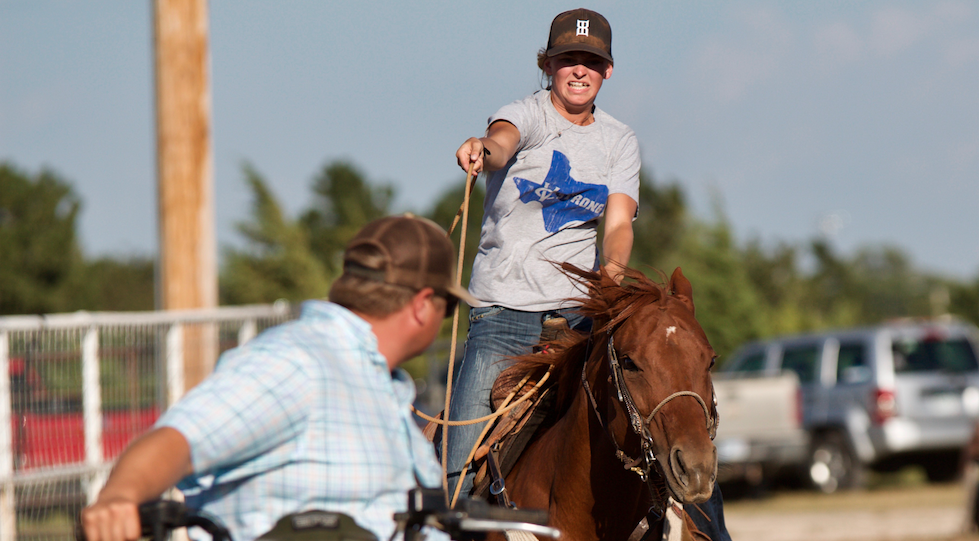
Gates clang and metal clatters as clods of dirt spatter against the rails. The humid fall air is penetrated only by the whinnies of horses tied to trailers. At Fort Hays State University, these sights and sounds can mean but one thing: It’s rodeo season.
Indeed, the rodeo team’s practices are well underway and the student athletes are learning the ropes and routine of daily life as a part of the Fort Hays State University Rodeo Team. New students and returning athletes alike are prepared to jump in, ready to learn from Head Coach Bronc Rumford and Assistant Coach Ross Russell.
“This is my first year,” said Coldwater junior and team roper Tanner Kay. “I’ve always grown up around rodeo, so when I came here I decided to try it out.”
Other new team members, like breakaway roper Larae Boaldin, Garden City junior, are transfer students from other schools where they also rodeoed.
“Through rodeo, being on the team at Garden, I knew Hays had a program and I contacted Bronc,” Boaldin said.
Even returning team members are looking to expand their knowledge when it comes to rodeo and life.
“Spending time with Bronc and Ross, the coaches, has been such an important part in my life, especially learning from Bronc about rodeo and about life in general,” said team roper Zeke Hall, Peyton, Colo., senior.
The coaches also hold a variety of goals for the team.
“We are expecting some qualifiers to the College National Finals, personal improvement each week, and a team GPA of 3.0 to name a few,” Rumford said.
The goal of academic achievement allows the program’s benefits to extend beyond success in the arena. Indeed, managing time in order to fit practice and rodeos into a busy student schedule requires students to develop a sense of balance and the ability to prioritize necessary tasks.
“Balancing schoolwork and rodeo, I struggled at first because you want to spend as much time as you can out here, roping and competing and trying to get better,” Hall said. “It can sometimes take away from schoolwork, so just staying focused and making sure my priorities are in the right place and just taking care of business.”
Boaldin also strives towards success in academics.
“It’s definitely difficult, but I just make sure I’m home at a good time to do my homework but I make sure that I get to practice every day,” Boaldin said.
Outside of these practical skills, being a member of the team holds even more value for students. For them, rodeo is a chance to form new relationships that develop during long hauls to rodeos and during overnight stays in small hotel rooms.
“Really, it’s a way to meet new people and have some fun,” said calf roper and team roper Colton Wagner, Paola junior.
Even as this family atmosphere begins to form, the coaches hope for success within the arena.
“This year we’re really young, so we’re going to try to build them up,” Russell said. “Next year would be a stretch to win a national championship but here in the next three or four years, we’re going to have a chance.”
This fall season provides multiple opportunities to work towards these goals as the team has already competed at Colby Community College, Southeastern State University, and Oklahoma State University.
Rumford highlights the successes so far of Coleman Kirby, Richfield senior, in bull riding and Travis Booth, Castle Rock, Colo., junior, in steer wrestling. Barrel racer Roxanna Clawson, Great Bend junior, finished as one of the top 15 competitors at two rodeos this season.
The team looks to continue this success into their final rodeo of the fall season through the National Intercollegiate Rodeo Association. The rodeo at Northwestern Oklahoma State University is scheduled for Oct. 25 in Alva, Oklahoma.
As the team travels out of state, members seek support from sponsors and donors to help build the program and to help the team find success in the upcoming season.
“That’s everything to our rodeo – sponsors. We get very little money from anybody else. It’s the town that we rely on to be able to have a rodeo,” Russell said.
Rumford stresses how sponsors have made it possible for students to discover and ultimately realize their dreams. For Hall, this is possibly the most important role of the rodeo club in students’ lives.
“It’s taught me that anything is possible. Before I came here, I didn’t really rope or anything,” Hall said. “It’s just taught me that if you have something in mind that you want to do, if you have a goal, if you have a dream, then just put your head down and go do it and believe in yourself.”
Makenna Allen, Littleton, Colo., freshman, is majoring in information networking and telecommunications at Fort Hays State University.
Sunny, mild Monday
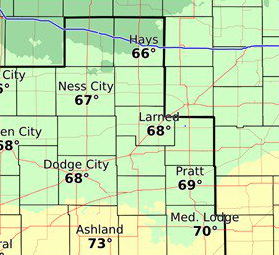
Monday Sunny, with a high near 65. Northwest wind 6 to 11 mph becoming northeast in the afternoon.
Monday Night Mostly clear, with a low around 43. Northeast wind around 8 mph.
TuesdayPartly sunny, with a high near 61. East southeast wind 7 to 11 mph.
Tuesday NightA 20 percent chance of rain after 1am. Mostly cloudy, with a low around 45. Southeast wind around 9 mph.
WednesdayRain, mainly after 1pm. High near 53. Chance of precipitation is 90%. New precipitation amounts between a tenth and quarter of an inch possible.
Wednesday NightRain likely, mainly before 1am. Cloudy, with a low around 43. Chance of precipitation is 60%. New precipitation amounts between a quarter and half of an inch possible.
ThursdayPartly sunny, with a high near 62.
Thursday NightPartly cloudy, with a low around 44.
FridayMostly sunny, with a high near 66.
Criminal Justice Club presents ‘A Dinner to Die For’

 FHSU
FHSU
The Criminal Justice Club at Fort Hays State University is hosting a 1920s gangster-themed murder mystery dinner on Saturday, Oct. 27, at The Venue in Thirsty’s Brew Pub and Grill, 2704 Vine St.
Doors open at 6 p.m. and dinner will be served at 7:30 p.m. with entertainment to follow. A silent auction will be held throughout the evening.
Attendees are welcome to dress up with the theme chosen for the night.
Individual tickets are $50 and couples tickets are two tickets for $85. Ticket prices include admission, two free drink coupons, dinner, dessert and entertainment.
Tickets can be purchased in the Department of Criminal Justice, located in Rarick Hall, Room 233, or at Thirsty’s Brew Pub and Grill.
All proceeds will help the Criminal Justice Club attend the National American Criminal Justice Association meeting and competition in Baltimore.
For more information, or to request tickets contact Tamara Lynn at [email protected].
Ranker: Hays among the ‘smartest’ cities in Kansas

 Online ranker Zippia.com has included Hays on its article “These are the 10 smartest cities in Kansas.”
Zippia used data including high school graduation and dropout rates to compile the list.
Find out where Hays ranked HERE.
New tax break rules for ‘opportunity zone’ investors
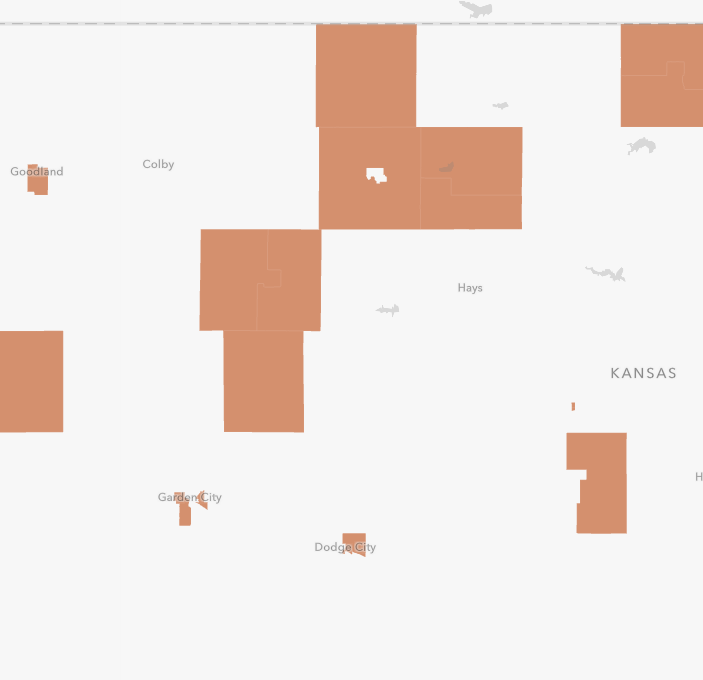
Click HERE for a map of Opportunity Zones, which includes areas of northwest Kansas.
By MARCY GORDON
AP Business Writer
WASHINGTON — The Trump administration is proposing rules for investors in a new program that it says could have a big impact on economically depressed areas around the country. About 8,700 so-called “opportunity zones” have been set up in all 50 states to lure investors and developers with tax breaks.
The rules from the Treasury Department, issued Friday, lay out the period of time that individuals or companies must hold on to their investments in the zones to avoid paying taxes on resulting profits.
Administration officials say the goal of the program, established by the new tax law enacted last December, is to create businesses and jobs in low-income areas and lift residents out of poverty.
Treasury Secretary Steven Mnuchin predicts that $100 billion in private capital will be invested in the new zones.
“This incentive will foster economic revitalization and promote sustainable economic growth,” Mnuchin said in a statement.
But some critics say the new rules and the way the program is set up will benefit real estate developers and Wall Street funds, and will pull investment toward more well-off areas that need it least.
“The real estate industry is completely excited and mobilized about this, and now is getting paid through massive tax cuts,” said Timothy Weaver, a professor at the State University of New York in Albany who has studied similar development programs.
He said the program “doesn’t have much of an effect other than giving tax breaks to people who are going to invest anyway.”
Under the rules, the investments are open to individuals, corporations, partnerships and real estate investment trusts. Any kind of business or real estate development is qualified so long as it isn’t deemed by regulators to contribute to vice — a liquor store or massage parlor, for example. Participants can take their profits from unrelated investments and plow them into an opportunity zone fund, avoiding paying taxes on those gains until the end of 2026. Depending on how many years they hold the investment, they can reduce their eventual tax bill by up to 15 percent.
Investments within the zones held for 10 years or more are entirely free of capital gains taxes.
A new rule sets up a 70-30 split for determining if certain businesses are eligible for the tax break. Provided that at least 70 percent of a business’s “tangible” property sits within a zone, it is considered eligible even if the rest is outside the zone. An example would be individual locations of a restaurant chain, some inside and some outside.
With 30 percent of the properties allowed outside the zones, many of the new jobs could come in already booming areas, Weaver suggested. Conventional economic development programs generally require all of a business’s property to be within the affected area, he said.
Brett Theodos, principal research associate at the Urban Institute, estimates that only about 10 to 15 percent of the zones will attract investment, and that around 10 percent could get 90 percent of the money invested.
The 8,761 census tracts — in every state, the District of Columbia and five U.S. territories — now officially beckoning to investors as opportunity zones encompass some 35 million people. Based on Census data, the zones have an average poverty rate of about 32 percent, compared with the national average of 17 percent.
Governors in the states and territories put forward their choices for areas to become special development zones. Every choice — 100 percent of the areas proposed — was blessed by the Treasury Department after a four-month review.
The choices “indicate only minimal targeting of the program toward disadvantaged communities with lesser access to capital,” Theodos wrote in a research paper. “Low- and moderate-income residents will need to be able to afford to remain in their communities as the areas upgrade and not be displaced, if they are to benefit from the gains opportunity zones bring.”
Census tracts were eligible to become opportunity zones if their residents meet average low-income requirements. Some tracts with higher average incomes were allowed if they’re located next to the low-income tracts. Those better-off areas, with more infrastructure and amenities, could be more attractive to investors.
The mix will work out well, as Maurice Jones, the president of Local Initiatives Support Corp., a community development organization, sees it.
“From our perspective, the governors did a really fine job in picking places that are in distress,” Jones said in an interview.
The program has drawn bipartisan support. Even Democratic lawmakers, who fiercely opposed the tax legislation and unanimously withheld their votes for it, do like the opportunity zones program nestled within it.
Supporters see the estimated $9.4 billion in lost revenue from the program’s tax breaks as a small price — for U.S. taxpayers indirectly — to pay.
___
To read the proposed rules: https://www.irs.gov/pub/irs-drop/reg-115420-18.pdf
Race for Kansas governor: Republican Kris Kobach

By ROY WENZL
For the Kansas Press Association
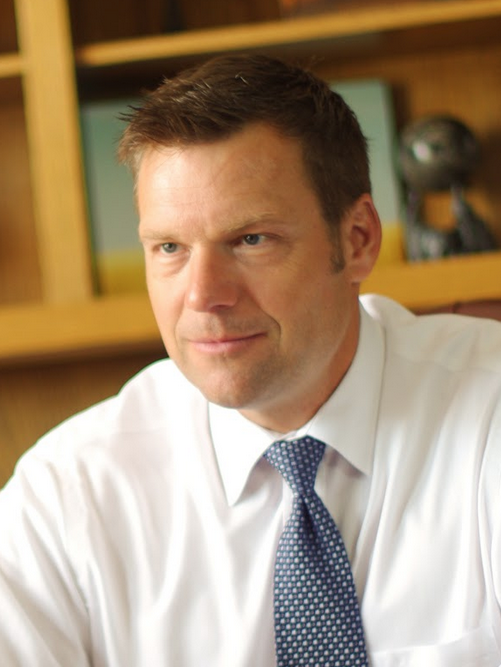
Kris Kobach made a national reputation by writing bills for Kansas and other states that opposed illegal immigration and placed restrictions on voting.
Opponents denounced him, judges ruled against some of his legal writings, (one federal judge fined him $27,000 for contempt of court). Critics have said, including in court, that many of his national and state “voter fraud” assertions are false, and that his suggestion for a Muslim national registry to help national security was a cruel and unconstitutional position.
Yet, this was what made him a friend of Donald Trump and a national name. He stands by what he’s done.
But Kansas gubernatorial candidate Kobach talks mostly taxes these days. When asked why Kansans should vote for him on Nov. 6, he pledged lower taxes, including those not directly controlled by the state. At stake, he said, are jobs, livelihoods – and retirement savings. A Republican, Kobach says his opponents, Democratic Sen. Laura Kelly and Independent candidate Greg Orman, are out of touch with voters.
What he’s heard from voters upsets him.
“Everywhere I go, people tell me how they are hurting,” he said. It’s not only state taxes but local property appraisal increases and utility bills, bills he says are 25 percent higher in Kansas than in surrounding states. “Families, elderly people who worked all their lives, and made plans, tell me they are seeing their retirement savings depleted.”
“If you look at income, property and sales taxes combined, we have the highest combined tax rate of the five-state area,” he said. “Our appraisals have been going through the roof in Kansas, our people have seen stealth tax hikes when they’ve had double-digit appraisals (on property taxes). People are being appraised out of their homes.”
The Legislature doesn’t directly set property taxes raised by municipalities and school boards but does have some say, Kobach said. If elected, he’ll ask the Legislature to impose a statutory cap of 2 percent per year on how much property tax appraisals can rise, even though critics content that may not be legally feasible. Kobach also says he will appoint members to the Kansas Corporation Commission to better-regulate utilities.
“Many of our kids are leaving after graduating from high school or college because the businesses are leaving our state,” said Kobach, a father of five. “We’ve driven many businesses out of the state because our taxes are punitively high.”
Here is what else he’d do:
State taxes. “The problem with the tax plan of 2012 was that Kansas cut taxes but did not cut spending. You can’t do it that way. There is a lot that can be cut… I was able to shrink my office, the Secretary of state’s office, from $7 million in fiscal year 2011 to $4.6 million today.”
Schools: Critics said the 2012 tax plan starved schools. Kobach says there’s not a reason to cut money for schools (or roads) if we cut elsewhere, which he says can be done. He will push for a statutory requirement that 75 cents of every school dollar go to teachers and classrooms, rather than administration. Meanwhile: “We have doubled the amount of dollars we spend on education in the last 20 years but … performance and scores have not improved – they’ve flatlined.”
More open government: If elected, he plans to personally make government more open. ”I have a policy of answering reporters’ questions personally, and not through intermediaries,” he said.
The state’s executive branch is open enough, he said. The Legislature, not so much.
“Kansas is one of the few states where the legislature does not record committee votes. And as people who follow politics know, the way you kill a bill — you kill it in committee. Right now, if you want to see how your representative is voting, you have to sit in the committee room and watch his or her lips move. It is outrageous that we don’t have that transparency. And I’ll push for that in office.”
Labor shortages: Kobach said the labor shortage in Kansas is a serious problem – and he’s willing to solve it with legal labor. He pointed out that legal immigrants from Somalia, Myanmar and Mexico have helped economies in southwest Kansas thrive. “I am only concerned with removing the illegal workforce, not the legal workforce. We should be a welcoming state to those who want to come here legally to work, whether it be in a high-tech industry or in the packing plants in southwest Kansas. We absolutely should welcome those who want to come in legally.”
One other solution: Prison labor. Some people in farming and ranching and in meat product services are looking at taking advantage of that now,” he said. “I’m willing to look at maximizing that supply of labor. That may mean moving certain inmates to facilities further west, to where the demand is highest for that.”
His opponents, Laura Kelly and Greg Orman: “Two Democrats,” he said with a grin. (Orman is on the November ballot as an Independent). They are out of step with most Kansans regarding taxes, gun rights, abortion and small government, he said.
The media: The news media is not “the enemy of the people.” “The vast majority of reporters in Kansas are doing a good job.” But – editorial pages over the last 30 years have “gone so far to the left.”
Kobach, 52, grew up in Topeka and earned degrees at Washburn, Harvard, Yale and the University of Oxford. He has served the last eight years as Kansas Secretary of State.
His running mate is Wink Hartman.
– Roy Wenzl is an award-winning journalist who formerly reported for the Wichita Eagle.
LETTER: Phelps’ campaign increasingly desperate

 Just like Eber Phelps sending out negative attack mailers against me a few weeks ago, his latest personal negative attack mailer is just another desperate attempt by him to divert attention away from the fact that after serving as a state representative for 18 years – an entire generation – he has become a “professional politician” in Topeka. IT IS TRULY TIME FOR A CHANGE!
Let’s put the facts in their proper context. During the 8 years I served on the Hays City Commission and the 6 years I have been serving on the Ellis County Commission my attendance record is 90%. During the times when my absence was unavoidable, I did my best to coordinate in advance with my fellow Commissioners and the County Administrator to ensure business could be conducted.
I will not allow my campaign to lower itself to the level of Mr. Phelps’ campaign. I will continue a positive campaign focused on the issues, and let the voters decide whether they want a fresh new voice in Topeka or the same old voice that has been there for an entire generation – 18 years.
If missing a handful of meetings due to my recovery from open heart surgery, and if taking care of my 91-year-old mother (who lived in Chicago and now lives in Savannah, Georgia) from time to time disqualifies me from holding public office in the eyes of some voters and the local and state Democratic Party then we’ve got a real societal problem in this community.
Barbara Wasinger, R-Hays
Candidate for 111th District
Kansas State Legislature
🎥 Health insurance cost for city of Hays to decrease
 By BECKY KISER
Hays Post
The city of Hays is anticipating a decrease in the 2019 premium for employees’ health insurance.
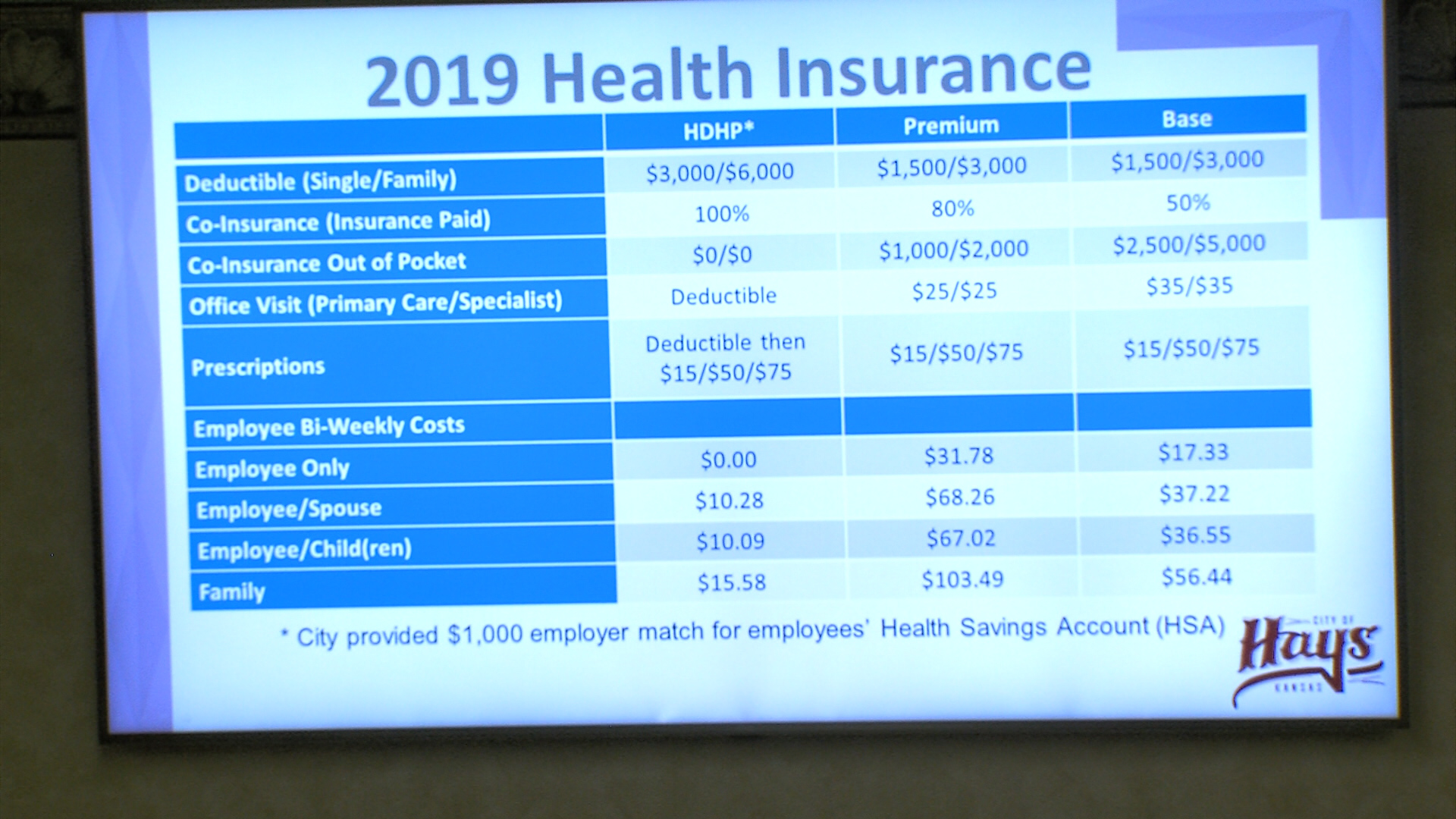
Erin Giebler, human resources director, told city commissioners Thursday night the high deductible plan is the most popular.
The city switched to Blue Cross Blue Shield of Kansas in 2017 which offers three plans. “Really, it was our employees that came back to us saying ‘we want this high deductible plan back,'” Giebler said.
For the first time, employees were required to pay a portion of the premiums in order to keep health costs within the budget.
The city kept the same plan in 2018 and added up to a $700 match for employees’ Health Savings Accounts.
“We got our renewals and it’s working out for us. We’re actually seeing a 2.46% decrease compared to last year. If you take out the costs our employees will be paying, the cost to the city is $161,414,” reported Giebler.
Thanks to the premium decrease, Giebler said staff is recommending an increase to the 2019 Health Savings Account (HSA) contribution to $1,000 each, an estimated additional $120,000.
“I will point out the total cost of the premium plus the HSA contribution being recommended is still lower than the 2018 proposal,” Giebler added.
Commissioners thanked Giebler and the Employee Benefit Committee for their work on the renewal plan.
“We also have to thank our employees for keeping their health benefits in line,” added Commissioner Ron Mellick. “We want to take care of our employees but they’re helping themselves on this. That’s great.”
Mayor James Meier also noted the estimate for the Hays Public Library employee health plan is going down almost 20 percent.
“I think they had a different mixture of ages in their employees this year than they’ve had in the past,” Meier explained, “and that accounted for a lot of that decrease.
The commission will vote on the renewal at the Oct. 25 meeting.