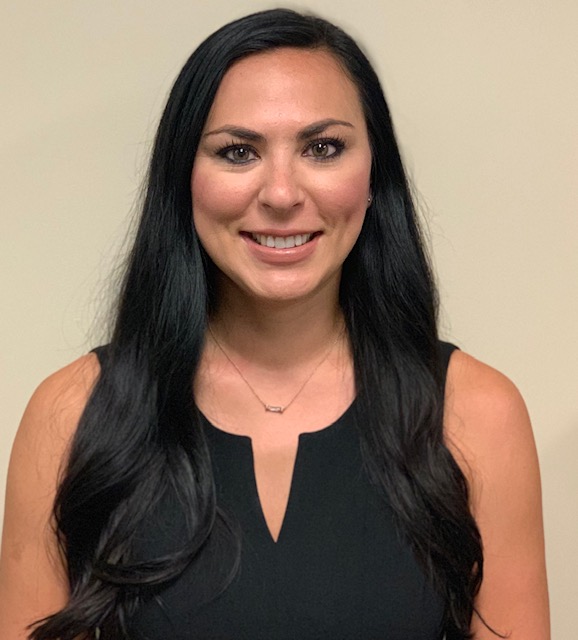
HaysMed, part of The University of Kansas Health System announced this week that Kelsey Accurso, MS, APRN, AGCNS-BC and Sarah Green, RN, MSN, NEA-BC, CPAN were honored at the March of Dimes Nurse of the Year Awards Gala held recently in Kansas City.
Accurso was named Nurse of the Year out of 5 finalists in the area of Quality Management. Green was one of five finalists in the category of Surgical Services.
There were 845 nurses nominated in 22 award categories. One winner for each category was announced at the black tie awards gala at 7 p.m. on Saturday, Nov. 9, at the Marriott Downtown in Kansas City, Mo.
Sarah Green
Hosted by the Greater Kansas Chapter of the March of Dimes, the Nurse of the Year Awards is an annual event that recognizes the vital role of registered nurses and the many contributions they make in the community, while helping raise funds to support the nonprofit’s mission to prevent birth defects, premature birth and infant mortality.
Greensburg, Kansas, built a new, environmentally friendly, high-tech high school after being hit by a massive tornado in 2007. But the town has barely half the population it did before the twister struck. Chris Neal / For the Kansas News Service
It now runs on renewable energy wired into buildings and homes designed with the latest in conservation technology.
Yet the question persists: What difference did it make?
About 850 people live in Greensburg, still about 600 fewer than when the tornado struck.
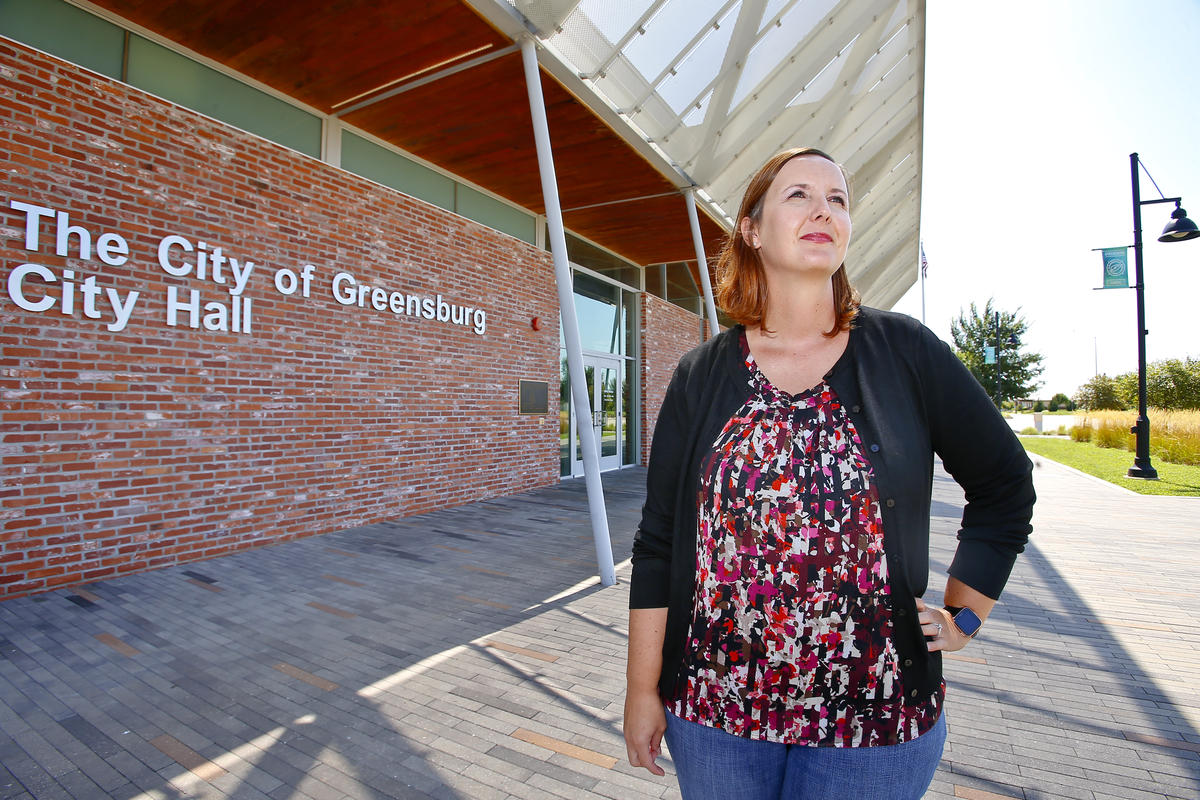
“I don’t think that population is the only measurement of success,” said Stacy Barnes, who is Greensburg’s city administrator and now in charge of sustaining the community’s comeback.
Stacy Barnes moved back to Greensburg after the 2007 tornado. She’s now the city administrator. Credit Chris Neal / For the Kansas News Service
Some defensiveness, even spin, lies in the suggestion that the number of people who live in a town doesn’t measure its success. Despite Greensburg’s shinier, more ecological veneer — like so many diminished towns across rural Kansas — it’s less than it wants to be.
Greensburg’s leaders sold the town’s green comeback as a way to set it apart from other withering rural communities. They hoped such a bold plan could help the community buck trends that had been driving people out of rural Kansas for generations.
They’re still hoping.
The tale of Greensburg’s comeback starts on the night after the tornado struck the town. When local, state and federal officials took cover from yet another storm in the basement of the damaged Kiowa County Courthouse.
“The discussion was, ‘Hey, we’re going to build back. Why don’t we do it green?’” said former Mayor Bob Dixson. “The seed was planted that night.”
A dozen years after the devastation, the scars from May 4, 2007, remain visible. Desiccated trees. Vacant lots in the middle of town. A few crumbling foundations where houses once stood.
Former Greensburg Mayor Bob Dixson. Credit Chris Neal / For the Kansas News Service
Still, the town looks fresh and revitalized compared to neighboring communities.
Its new high school brims with technology. Many of the community’s new energy-efficient buildings look like something you’d expect in a trendy tourist town, not in windswept Greensburg.
Great expectations
Barnes, the current city administrator, lived in Lawrence at the time of the tornado. She returned to help her parents — former mayor Dixson and his wife — sort through the rubble of her childhood home. After several trips, Barnes and her husband decided to move back “to be a part of this community’s future.”
First, she worked as an assistant to the city administrator. Then she got a job helping to plan a new museum to showcase the city’s main tourist attraction — a hand-dug well dubbed “the largest” in the nation.
Barnes is back at City Hall now. And she feels pressure to make the community’s comeback story the success envisioned by those who planned it in the months after the tornado.
Drawing a deep breath, she said, “I feel a tremendous responsibility.”
Greensburg’s top tourist attraction: a museum built around a hand-dug well. Credit Chris Neal / For the Kansas News Service
“Early on,” she said, “there were probably some unrealistic expectations.”
The town’s effort to transform itself captured international attention. Actor and environmental activist Leonardo DiCaprio produced a Discovery Channel television series about it. Reporters arrived from around the world to tell a story of a community’s phoenix-like rebirth.
The town built a 72-acre business park for the green companies that indicated to Dixson that they wanted to be a part of Greensburg’s celebrated transformation.
“We were under the impression that there would be opportunities,” Dixson said. “But it just never panned out.”
Today, the business park sits empty at the edge of town. To some, it’s evidence of the community’s failure to fully capitalize on its green rebirth. Yet Barnes insists the park still represents “opportunity.”
“We continue to work on projects,” she said.
Among other obstacles, even the remade version of Greensburg doesn’t have enough affordable housing.
Greensburg has trouble drawing in residents because it’s short on adequate housing. Credit Chris Neal / For the Kansas News Service
Dennis McKinney, a former state treasurer and one-time legislator from Greensburg, said housing shortages hold back communities across rural Kansas.
“I’ve talked to community leader after community leader from all over Kansas,” he said. “That’s their number one issue.”
Promises and realities
Scott Brown played a key role in Greensburg’s recovery. The building that houses his auction and real estate company on the east edge of town was just outside the path of the tornado. People gathered there to talk about whether they intended to stay and rebuild.
At one of those early meetings, Brown said, 63 people who had owned businesses in town signaled their desire to rebuild.
That may not sound like a big number, Brown said, “but I didn’t even know there (were) 63 businesses in Greensburg before the tornado.”
Early on, developers from Wichita, Kansas City and Denver offered to help rebuild the downtown business district. They walked away, Brown said, when it became clear that they couldn’t charge enough rent to make any money.
“That’s what spurred me into action, I guess,” he said.
Scott Brown helped rally people in Greensburg to rebuild its downtown as a strip mall. Credit Jim McLean / Kansas News Service
Brown figured it would cost about $1 million to build a kind of strip mall in what used to be downtown. He concluded that money needed to come from residents “not interested in getting a financial return.”
Those people invested, Brown said, just to support “a place to get a hamburger (or) get their hair fixed.”
Pitching in
Brown put up the first $50,000 and asked others to give what they could. Some matched his contribution. Others gave $10,000 or $5,000 to fund the Kiowa County United Foundation.
When it opened in 2009, the downtown mall was fully paid for and fully occupied. Over the past decade, Brown said, occupancy has averaged between 80% and 90%.
Brown would like to think that all the community has accomplished over the last 12 years has made it less vulnerable to the economic and cultural forces threatening the survival of rural communities across Kansas and the Plains.
He hopes it isn’t destined to become a “ghost town with the newest buildings.”
“I don’t doubt that we’ll survive, but that’s not what we want to do,” he said. “We want to get a little growth.”
This is the fifth in a series of stories investigating the decline in rural Kansas and efforts to reverse it.
Support for this season of “My Fellow Kansans” was provided by the United Methodist Health Ministry Fund, working to improve the health and wholeness of Kansans since 1986 through funding innovative ideas and sparking conversations in the health community. Learn more at healthfund.org.
Jim McLean is the senior correspondent for the Kansas News Service, a collaboration of KCUR, Kansas Public Radio, KMUW and High Plains Public Radio covering health, education and politics. You can reach him on Twitter @jmcleanks or email [email protected].
In November 2019, Hays Post was rated by NewsGuard, an international organization that employs trained journalists to rate and review thousands of news websites for credibility and transparency.
Hays Post received a green rating for its high journalistic standards.
NewsGuard uses nine journalistic criteria to rate each website. To learn more about NewsGuard’s rating of publications, go to www.newsguardtech.com.
The green or red badge of sites rated by NewsGuard are designed to alert readers about the credibility of a news source and appears on social media feeds and as a browser extension that rates search engine results. The extension can be downloaded HERE.
NewsGuard was launched in 2018. Based on each website’s performance on NewsGuard’s nine journalistic criteria, each site is rated with a red or green rating. News organizations producing high quality journalism and following basic standards of accuracy and accountability get green ratings.
Again this year, our Ellis County Catholic schools, TMP-Marian and Holy Family Elementary are participating in iGiveCatholic (iGC). iGC encourages charitable donations on Giving Tuesday, December 3. Donations to either of our Catholic schools through iGC benefit the St. Thomas More Society, the second-largest fund to the benefit of our annual operating budgets.
Advanced giving to iGC begins on Monday, Nov. 18 and 24/7 Travel Stores has generously donated $50,000 of matching funds restricted to Catholic schools in the Salina Diocese.
Gifts are matched at $.50 per dollar up to $1000 max per gift until matching funds are depleted. For every dollar you contribute, 24/7 Travel Stores will give $.50. These matching funds are available beginning with gifts received on Nov. 18.
Last year, TMP-M and HFE earned among the top in the nation against other organizations participating in iGC. With your help, we can do it again.
Donate offline and your gift will be entered upon receipt. Offline donations are not subject to fees. Deliver your gifts to either school with a memo of iGC and it will be counted as soon as it is received.
Remember, matching funds are available with the first gift on November 18 and likely will not last through Giving Tuesday. Make your gift early to increase it by half.
Direct questions and contributions to Troy Ruda, Advancement Director at [email protected].
Ron Wilson is director of the Huck Boyd National Institute for Rural Development at Kansas State University.
By RON WILSON Huck Boyd National Institute for Rural Development
Let’s go to London, England. It’s a meeting of the International Institute of Municipal Clerks, led by the president of this international organization. This year’s international president comes from a small town in Kansas.
Lana McPherson is president of the International Institute of Municipal Clerks and the long-time city clerk of De Soto, Kansas.
Lana grew up at De Soto, attended Johnson County Community College and Rockhurst University. She worked as a paralegal in several law offices and then for a multi-state insurance company.
She also met and married Ian McPherson, a soldier who had served at Fort Riley and then moved to Olathe to be close to family. They made their home in De Soto.
In 1998, the town council was looking for a new city clerk. Lana accepted the position in June. “I reached out to several experienced city clerks in surrounding communities and they took me under their wing,” Lana said.
McPherson
In November of that year, Lana attended a weeklong training program developed by the International Institute of Municipal Clerks, or IIMC. The training institute is conducted annually by the Hugo Wall Center for Public Affairs at Wichita State.
When Lana got into this class with the other city clerks, she immediately noticed two things. First, she had the shortest tenure in office of any of the clerks, and second, she was the oldest clerk in the class. “By the end of the day they were calling me `clerk mom,’” Lana said. “It is a term that I treasure.”
Lana deeply valued the training and the relationships which developed in the process. She has served as De Soto city clerk ever since. She also pursued the advanced certifications that are available through ongoing education from IIMC.
In 2000, she earned her Certified Municipal Clerk designation. In 2007, she achieved the designation of Master Municipal Clerk, a distinction held by only 37 Kansans and fewer than 2,000 people worldwide.
Having seen the benefits of IIMC, she got involved in the organization and was ultimately asked to run for president of the group. “I prayed at lot about it,” Lana said. It is a four-year commitment to go through the chairs of the executive committee. In 2017, she successfully ran for vice president of IIMC which meant that she became president of the international organization in 2019.
“Our primary goal is to actively pursue and promote the continuing education and professional development of municipal clerks through extensive education and certification programs,” Lana said.
“We also need to let communities know the importance of their clerks being certified, because clerks have important statutory duties which they carry out,” Lana said.
“The city clerk’s office is the hub of the city government’s activity,” she said. “We are the glue that holds the city together. We keep the official records of the city, but it goes beyond that to be a liaison between the city council and the staff and the community.”
Lana has found that city clerks around the world have common challenges. “City clerks are like family,” Lana said. IIMC has 14,765 members around the globe. How impressive that this year’s international president is from the rural community of De Soto, population 5,720 people. Now, that’s rural.
“I love my job. I love what I do,” Lana said. “We have a great staff here. My mayor and city administrator and city attorney are so supportive, they’ve made it possible for me to do this.”
She takes her role in serving the citizens very seriously. Lana plays piano and organ at various churches in town. “People will come up and ask about some city project, or hand me their water bill and ask me to drop it off when I go to work the next day,” she said. “It’s my way of giving back to those people who gave me so much support growing up.”
It’s time to leave England, another place where Lana McPherson is making a difference with her commitment to local government. How great to find that a person from small-town Kansas can make a big impact.
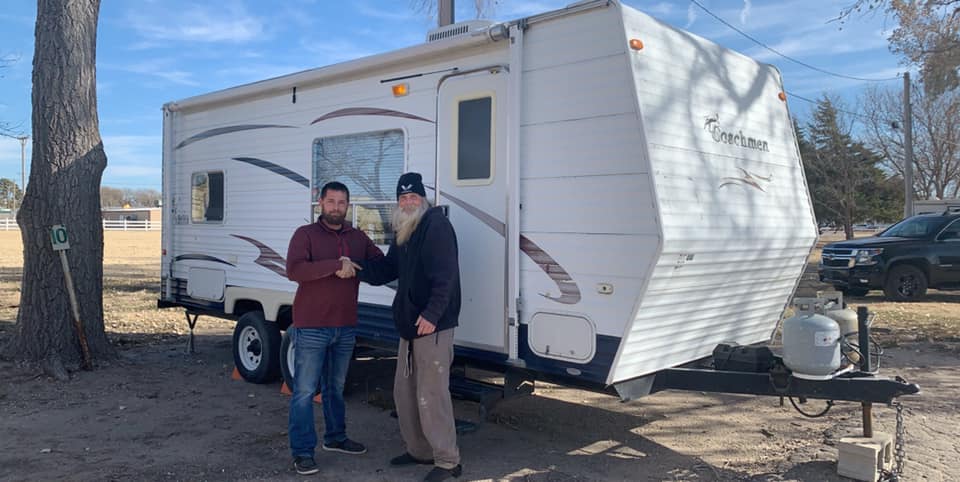
Spencer Mohler, left, of Randall shakes hands with James Arnold, right. Mohler and his wife have donated the use of the camper to James, who was homeless.
Jewell Co. couple donates camper, RV park owner offers a place to live
By CRISTINA JANNEY Hays Post
James Arnold’s friend Preston Wolf said James was almost in tears when a stranger pulled in at Wolf Furniture Galleries on Friday morning with a camper — a camper that was going to be James’ new home.
James has been homeless for 16 years. About a year and half ago James moved into a makeshift shelter cobbled out of cardboard, shipping pallets and sheets of plastic behind the Hays furniture store
Caroline von Lintel, owner of the RV Village on Vine, read a story Hays Post about Arnold and offered a camper pad at her park with all fees and utilities paid.
She was looking for a camper when Spencer Mohler of Randall, Kan., contacted von Lintel after seeing the story about James on social media. He let her and Wolf know Arnold could use his family camper indefinitely.
James Arnold in his new camper.
Mohler and his wife cleaned out the camper Thursday night, and Spencers drove the camper to Hays this morning for James.
“James was kind of peaking around the corner and tip toeing around, and when he found out that was his, it was if he just got issued a new lease on life,” von Lintel said. “There’s a spring in his step, and he said ‘I’m going to have a barbecue for everybody in the summer time.’ ”
The von Lintels also own the Wendy’s in town, and she said she would look into hiring him at the RV park or at Wendy’s.
“We want to get him in front of the people he needs to figure out where he’s at and what he needs,” she said. “Once we have that and feel he has his feet on the ground, we’ll just offer more opportunities as he is able to take it on.”
Now that James is no longer homeless he hopes to get a job and save some money.
Von Lintel has a history of working with homeless shelters, including Esther’s House and another shelter in Arizona.
“I’ve had some hard times myself. I’ll be honest with you,” she said. “When I read that, I know that feeling. I know what he felt. I just felt it. I said, ‘No, no, no, we are Hays. We can do this. Maybe Hays doesn’t have something in place now, but maybe this will create the synergy to get something in place. We are not a cold-hearted community. We care.’ ”
She continued, “People want to help. They just don’t know how. Hays is an amazing community. You don’t know how many calls I have got about clothes and food and bedding and whatever he needs.”
Von Lintel said she got more out of helping James than he did, because she knows now he can have some peace and start rebuilding his life.
“There is no one who needs to be homeless in Hays,” von Lintel said. “We can figure something out.”
Spencer Mohler, 26, said his family did not have much invested in the camper, were not using it and saw a chance to help someone else.
“I have never been homeless and I hope I never am homeless, but things do happen,” Mohler said. “I’ve been in lower places, and I know what it’s like trying to get out of whatever might be going on to get back on your feet and sometimes you need a little bit of help. I only had $1,500 in the camper, and that probably felt like $1 million to him.”
James’ former homeless encampment behind Wolf Furniture Galleries.
Mohler said they have opted to retain ownership of the camper for now, so James doesn’t have to pay the taxes.
When Mohler first brought up the idea of letting James use the camper to his wife, she said he was nuts. However, she read the story about James and the couple ultimately decided allow James to use the camper.
“If I can help someone who just a little worse off than I am, it’s all worth it,” he said.
Von Lintel and Wolf said they were flooded with calls and contacts of people hoping to help James in some way.
Someone donated an ACCESS bus pass. On the Rocks has offered him meals. Someone from LINK has offered to help James fill out paperwork to apply for assistance with medical needs.
James had few words Friday. He seemed overwhelmed, but happy and grateful. He talked about his goals of finding work and saving money. “Security,” he said excitedly. He knows know he has a place he and his belongings can be safe.
“I have knots in my stomach,” he said. “I have butterflies.”
Sitting on the couch in the camper, a huge grin curled over his wrinkled face.
“I ain’t homeless no more,” he said. “I have a home.”
The city of Hays says it’s doing everything it can to address a zoning issue involving a homeless man illegally living behind Wolf Furniture Galleries, 4213 Vine.
An Oct. 30 notification letter from Planning, Inspection, Enforcement Superintendent Curtis Deines to owner Preston Wolf declared that Arnold’s shelter had to be gone from the Wolf property by Friday.
Hays city commissioners brought up the issue at the end of their meeting Thursday night.
Eber Phelps said the Hays Police Department “does not go out and harass anybody and run them off.”
“That’s been a rumor going around that police have been hard on people out there and that couldn’t be further from the truth,” he said. “Actually, they go out there (near Walmart) and tell them all the assistance that’s available (locally).”
He specifically mentioned the Ellis County Ministerial Alliance and First Call for Help.
Phelps said he’s talked previously to Police Chief Don Scheibler about the issue of people panhandling in the Walmart shopping area.
“He said there’s three categories. People that have broken down on the highway and don’t have a way to get the money for a new transmission or whatever, so their only avenue is to possibly ask for contributions to get themselves on the road. There are organizations in Hays that will contribute to that.
“The next group of people that are out there are literally homeless. A lot of them have health issues and what have you. They’re just there trying to get enough money for their next meal.
“There’s a third group Scheibler contends have a place to live, have a vehicle, and don’t want any assistance whatsoever. They just like to panhandle for money, I guess.”
City Attorney John Bird got involved after the PIE department determined the shelter created by James Arnold should not be maintained in a commercially zoned area.
“The city manger directed all the staff to back up and look at the whole situation with some compassion,” Bird said. “There isn’t anybody who is getting disenfranchised or getting kicked out of the place they are. … The city is doing everything, as far as I can tell, to address the legal problem – the zoning issue – without having the unintended consequence of having somebody ground up by the system.
“That’s not going to happen while this city manager (Toby Dougherty) is here or I’m here,” Bird added.
Bird told Hays Post Friday morning “the city will not take any action to evict Arnold or remove his structure until we know all the facts.”
According to Bird, the city first became aware of the situation when Arnold appeared in court for allegations of threatening someone with a knife.
Bird said the city is looking into pending court matters and might be able to get help for Arnold through the court system. According to Bird, the Ellis County Sheriff and county attorney’s offices normally get involved in any sort of mental health petition.
“It was never our intent to move quickly (on this),” Dougherty said to Hays Post Friday. “After the notification period is up, we’ll look again at all our options.”
Vice-Mayor Shaun Musil and Mayor Henry Schwaller both complained Thursday night about inaccurate statements made on social media regarding a Nov. 14 Hays Post news story about the situation.
“Maybe you should ask before you go on social media and complain how bad our city is, because our city is pretty darn good,” Musil said. “I really believe in this community and there ain’t a person in this town that wouldn’t help a homeless person if they had the ability to do that.”
Musil said he read on social media where people have offered the use of a camper for Arnold.
“That’s our community right there, whether he takes advantage of it. So possibly that brought out a good thing.”
Schwaller urged anyone who’s angry to get together and form a homeless coalition in Ellis County.
“Take that anger and that time it took to post those comments and solve this problem. … We have a lot of resources but not enough,” Schwaller said. “That’s what makes this community great. When we have a problem, we solve it.”
Preston Wolf, left, helps James Arnold secure the door to his shelter outside of Wolf’s Furniture in Hays.
City commissioners voted 4-1 Thursday to proceed with a condemnation resolution of some properties adjacent to the North Vine Street Improvement Corridor project. Mayor Henry Schwaller voted against the resolution.
By BECKY KISER Hays Post
A resolution to begin condemnation proceedings of some private properties near the proposed North Vine Street Corridor Improvements was approved 4-1 by Hays city commissioners Thursday night.
Mayor Henry Schwaller voted against the resolution. He has previously expressed opposition to the proposed design.
Drafted by John Bird, city attorney, the resolution is essentially administrative and does not designate any particular property.
“City staff, and I’m not including myself in this, has been diligently negotiating with land owners and with quite a bit of success,” Bird told the commission.
“But we can’t count on all of them having been signed up by the deadline imposed by our grant from the federal government calling for this project to be underway.”
Since May, WSP Engineers has been developing design plans for the construction of improvements to North Vine between 32nd and 41st Streets to include four traffic roundabouts.
(Click to enlarge)
Appraisals and compensation estimates were prepared. On September 26 the city commission authorized making offers to adjacent properties for the necessary easements and rights of way to construct the project.
According to Bird, the resolution authorizes the use of eminent domain and calls for the city manager and city staff to cause legal descriptions of the properties to be prepared.
“We’ve been working on those so we know we can do that quickly.”
Final action on any actual eminent domain would occur at the Nov. 26 commission meeting, although it will be reviewed first at the Nov. 21 work session.
“We hope we can come back to you and tell you it won’t be necessary at all,” Bird said, “but I don’t want you to be overly optimistic on that. We just don’t know until we’re done talking to various landowners.”
John Braun, city project manager, told Hays Post after the meeting that approximately 70% of the property negotiations have been successful.
“I’m very optimistic we’ll be able to reach an agreement with about half of the remaining 30% ,” Braun said. “There’s 10-15% of the properties we just don’t know about.”
“In order to give the few remaining property owners time to come to an agreement before those legal descriptions are published, we will wait until Thursday’s work session to have the legal descriptions to you and to the press,” Toby Dougherty, city manager, told the commission. Agenda information is provided to commissioners on Mondays prior to Thursday meetings.
Commissioner Sandy Jacobs and Vice-Mayor Shaun Musil both said their affirmatives votes were carefully considered.
“This is a very serious thing we have to do to accomplish this project in front of us, which we got $6 million for from the federal government,” Jacobs said.
“Condemnation is not something we really want to do. It’s something we have to do to finish the job we started.”
“I don’t enjoy doing this,” agreed Musil, “but it’s something we have to do if we do want to move forward.
“I just truly believe that this is going to be good for the city of Hays way past when I’m a commissioner. That’s why I’m for it.”
Musil also noted he’d read online social media comments that said the city was trying to put one local business in the corridor out of business.
“That couldn’t be further from the truth. Actually, one business, I believe, is actually going to gain space with the project the way it’s laid out,” Musil said.
“Me being a small business owner, that’d be the last thing I’d want to do is put somebody out of business.”
Musil is the owner of Paisley Pear Wine Bar, Bistro and Market in downtown Hays.
There is an old saying that if you don’t know where you are going, any road will take you there.
It is usually used in the context of the need to create objectives in your business or personal life but also applies to business succession planning.
Business retention is a key component of our mission at Grow Hays. We want to help all businesses grow and prosper in any way we can and we are seeing a growing number of instances where business retention and continuity are threatened by the lack of having a succession plan.
Succession planning takes on many forms. Yes, it can certainly involve the sale of the business but also includes planning for unforeseen events. Death, health issues, disability and divorce can all have a significant impact on a business and should be a part of a well thought out succession plan strategy.
Many business owners give little thought to succession planning for a variety of reasons. They are busy operating their business and dealing with all of the day to day issues that involves. They are busy in their personal lives raising families and the challenges that brings and it is also something they really don’t want to think about.
It’s a bit like buying life insurance. You know you probably need it but the prospect of “using” it isn’t very attractive! That being said it is important that every business owner gives thought and consideration to what their succession plan is and that they involve the professionals they use in operating their business to develop it.
Accountants, lawyers, bankers, financial advisors, and any other professionals that have an understanding of their personal and business status are critical resources in the development of a succession plan.
One thing is certain. Every business owner is going to leave their business at some point.
Ideally, it will be through the sale of the business to a new owner that continues to own and operate the business and provide the same quality products and services that the business provides under the existing owner.
Unfortunately, that doesn’t always happen so it is important that every business owner develops a succession plan to make sure as many of the bases are covered as possible. Remember, the lack of a succession plan is a threat to a business owner’s family, employees, customers and the community.