We have a brand new updated website! Click here to check it out!

Algae warning continues for Webster Lake

KDHE

TOPEKA – The Kansas Department of Health and Environment (KDHE), in conjunction with the Kansas Department of Wildlife, Parks and Tourism (KDWPT), has issued public health warnings for some Kansas lakes.

If a lake is under a public health warning for blue-green algae, activities such as boating and fishing may be safe. However, direct contact with water (i.e., wading, skiing and swimming) is strongly discouraged for people, pets and livestock. The lakes currently under a public health advisory: 

  • Warning: Atchison Co. Park Lake, Atchison County
  • Warning: Carbondale West Lake, Osage County
  • Warning: Central Park Lake (Pond), Shawnee County
  • Warning: Frazier Lake, Grant County
  • Warning: Hodgeman County SFL, Hodgeman County 
  • Warning: Lake Afton, Sedgwick County
  • Warning: Lake Scott State Park, Scott County
  • Warning: Lakewood Park Lake, Saline County 
  • Warning: Marais Des Cygnes Wildlife Area, Linn County
  • Warning: Melvern Outlet Pond, Osage County
  • Warning: Melvern Outlet Swim Pond, Osage County Beach Closure – Visitors can utilize Eisenhower State Park Swim Beach.
  • Warning: Rock Garden Pond, Gage Park, Shawnee County 
  • Warning: South Lake Park, Johnson County
  • Warning: Webster Lake, Rooks County – Beach is closed. Webster State Park remains open. Drinking water and bath house facilities are not affected by the algae bloom.
  • Watch: Atchison Co. SFL, Atchison County
  • Watch: Mary’s Lake, Douglas County
  • Watch: Overbrook City Lake, Osage County
  • Watch: Overbrook City Kids Pond, Osage County
  • Watch: Pomona Lake, Osage County
  • Watch: Tomahawk Parkway North Pond, Johnson County

The following have had their watch or warning lifted:

  • Lake Wabaunsee, Wabaunsee County
  • Melvern Lake, Osage County
  • West Campus Pond, University of Kansas, Douglas County

A closed or closure status indicates that conditions are extremely dangerous for humans and pets.  Harmful algal toxins and cell counts are at dangerously high levels.  Any kind of contact with the waterbody is prohibited.

Lakes under a warning are not closed. Marinas, lakeside businesses and park camping facilities are open for business. If swim beaches are closed, it will be specifically noted. Drinking water and showers at parks are safe and not affected by algae blooms. Boating and fishing are safe on lakes under a warning but contact with the water should be avoided. Hands should also be washed with clean water after handling fish taken from an affected lake. Zoned lakes may have portions fully open for all recreation even if other portions are under a warning.

Kansans should be aware that blooms are unpredictable. They can develop rapidly and may float around the lake, requiring visitors to exercise their best judgment. If there is scum, a paint-like surface or the water is bright green, avoid contact and keep pets away. These are indications that a harmful bloom may be present. Pet owners should be aware that animals that swim in or drink water affected by a harmful algal bloom or eat dried algae along the shore may become seriously ill or die.

When a warning is issued, KDHE recommends the following precautions be taken:

  • Lake water is not safe to drink for pets or livestock.
  • Lake water, regardless of blue-green algae status, should never be consumed by humans.
  • Water contact should be avoided.
  • Fish may be eaten if they are rinsed with clean water and only the fillet portion is consumed, while all other parts are discarded.
  • Do not allow pets to eat dried algae.
  • If lake water contacts skin, wash with clean water as soon as possible.
  • Avoid areas of visible algae accumulation.

KDHE samples publicly-accessible bodies of water for blue-green algae when the agency receives reports of potential algae blooms in Kansas lakes. Based on sampling results, KDHE reports on potentially harmful conditions.

For information on blue-green algae and reporting potential harmful algal blooms, please visit www.kdheks.gov/algae-illness/index.htm.

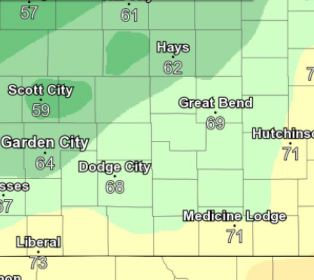
Cloudy, wet Monday

Monday Showers and possibly a thunderstorm. Some of the storms could produce heavy rain. Areas of fog before 8am. High near 65. South wind 8 to 14 mph. Chance of precipitation is 80%. New rainfall amounts between three quarters and one inch possible.

Monday Night Showers likely and possibly a thunderstorm. Some of the storms could produce heavy rain. Cloudy, with a low around 49. South southeast wind 10 to 13 mph becoming northwest after midnight. Chance of precipitation is 70%. New rainfall amounts between a half and three quarters of an inch possible.

TuesdayShowers likely and possibly a thunderstorm. Some of the storms could produce heavy rain. Cloudy, with a high near 55. North northwest wind around 11 mph. Chance of precipitation is 70%. New precipitation amounts between a half and three quarters of an inch possible.

Tuesday NightShowers likely, mainly before 8pm. Mostly cloudy, with a low around 38. North wind around 11 mph. Chance of precipitation is 60%. New precipitation amounts of less than a tenth of an inch possible.

WednesdayMostly sunny, with a high near 56.

Wednesday NightMostly clear, with a low around 37.

ThursdayPartly sunny, with a high near 52.

Thirsty’s Brew Pub and Grill for United Way Dine Out Day #5

Thirsty’s Brew Pub and Grill for United Way Dine Out Day #5

The United Way of Ellis County will be hosting a Dine-Out Day with Thirsty’s Brew Pub and Grill on Monday, October 8 from 11 a.m. to 9 p.m. at 2704 Vine in Hays.

Come join in the social media fun! A portion of the proceeds will benefit the United Way and their 15 partner agencies.

Watch for upcoming Dine-Out Days with participating restaurants online at www.liveunited.us.

Call 785-628-8281 for more information.

Former Newman coach to discuss living with mental illness

FHSU

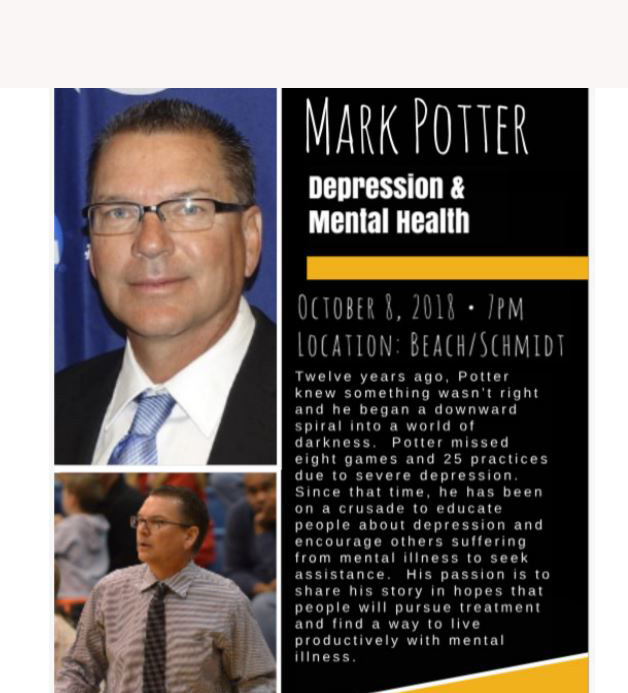
Former Newman University head basketball coach and motivational speaker Mark Potter will speak about living with mental illness in a free public presentation Monday, Oct. 8, 7 p.m., in the Fort Hays State University Beach Schmidt Performing Arts Center, Sheridan Hall.

Twelve years ago, Potter knew something wasn’t right and he began a downward spiral into a world of darkness.

Potter missed eight games and 25 practices due to severe depression.

Since that time, he has been on a crusade to educate people about depression and encourage others suffering from mental illness to seek assistance. His passion is to share his story in hopes that people will pursue treatment and find a way to live productively with mental illness.

If you have any questions, please email Amee Stapleton, assistant athletic trainer at [email protected].

KU grad, Young Invincibles Dir. of Civic Engagement in Hays Mon.

Clarissa Unger

Monday, October 8, 2018, Fort Hays State University’s (FHSU) American Democracy Project (ADP) will host Clarissa Unger, Director of Civic Engagement for Young Invincibles, to discuss civic engagement and student voting.

As the manager of the largest student voting campaign in the country, she will share her insights on opportunities for supporting young voters in the community. Young Invincibles is the nation’s largest young adult research and advocacy organization dedicated to advancing economic opportunity and democratic participation for 18 to 34 year-olds.

Prior to joining YI, Unger served as the Development Coordinator for the Robert. J. Dole Institute of Politics at the University of Kansas where she helped to promote civic engagement on campus. She holds a Masters in Public Administration from the University of Kansas and a Masters in Comparative European Politics from the Trinity College Dublin in Ireland.

Unger leads the Students Learn Students, Vote Coalition (SLSV), a coalition of over 300 organizations that reach more than 1,000 colleges campus nationwide to promote nonpartisan civic engagement on college campuses. Recently, SLSV helped organize more than 550 on-campus events for National Voter Registration Day to help young people register to vote.

Unger will speak at two public events in the Hays community:

When: Monday, October 8, 2018

Afternoon Event: Fort Hays State University – Pioneer Room in the Memorial Union

600 Park St,

Hays, Kansas 67601

2:30 PM – 3:30 PM

Evening Event: Hays Public Library

1205 Main St,

Hays, Kansas 67601

6 PM – 7 PM

– SUBMITTED –

🎥 Alley cleanup starts Oct. 22; put junk out now

The 18th annual Hays alley cleanup for residential refuse customers starts Oct. 22.

By BECKY KISER
Hays Post

You can start putting that unwanted junk out now for the 18th annual Hays alley cleanup which will start Mon., Oct. 22.

“This is a great opportunity to clean out your shed, attic, garage, basement or whatever else you might have,” says Marvin Honas, solid waste superintendent.

The free program is available to Hays residential refuse customers and will begin with curbside customers.

“We don’t want that stuff sitting along the streets any longer than necessary,” Honas explained.

Once the curbside collections are made, the four crews will move on to the alleys. Each site stop will be limited to 20 minutes. There is no set schedule.

Residents should sort their items into four piles:

1. Tree limbs and Brush–No longer than 12 feet in length or 6 inches in diameter

2. Construction and Demolition Debris–Lumber, drywall, bricks, sinks, tubs, wires, fencing, etc. (Please pull or bend over nails and place small quantities of concrete, bricks, and plaster in containers)

3. White Goods/Metals–Guttering, siding, washing machines, dryers, refrigerators, metal swing sets, etc.

4. Municipal Waste (All other items)–Furniture, carpet, TVs, foam, etc.

Items that will not be collected are tires, batteries, household hazardous waste, or medical waste. Tires should be disposed of at the Ellis County Landfill, and hazardous waste and batteries should be disposed of at the Ellis County Hazardous Waste Facility. Medical waste can be taken to the Ellis County Health Department.

According to Honas, the white goods will be recycled after they’re taken to the Ellis County Waste Transfer Station.

“The transfer station brings in another company that crushes this stuff and bales it  and then it is recycled.”

The trees and limbs will also have a second life.

“We do chip all the trees that we collect. The chips are taken down to the Parks Department, (1546 Highway 40 Bypass),  which uses them for their tree farm. A lot of landscapers do use the wood chips and citizens are also welcome to take them, free of charge.”

Last year’s alley cleanup yielded 850,000 pounds of junk. “We usually range between 750 and 850 thousand pounds,” Honas said, “although the first year we did this after not offering it for some time, we picked up 1.5 million pounds. It’s leveled out since then.”

Honas also noted the alley cleanup will not affect the regular collection of refuse and recyclables.

For more details, contact the Hays Solid Waste Department at 785-628-7350 or check the city’s website.

Indie folk artist Anna p.s. to appear in Hays

Anna p.s.

“Anna and her music are one and the same. Both are genuine. Both are honest. Both are irresistible. You’ll love the simple and true emotion of her songs, her spare instrumentation and the plaintive clarity of her vocals. As a bonus, if you get the chance to see her perform live and to chat with her, you’ll love her, too. ‘Umbrella’ is contemplative and reflective – it’s best listened to when you feel the same way, maybe with a glass of good wine. Treat yourself!” – Al Kniola, The Back Porch, 88.1 WVPE Public Radio 

Anna p.s. hit the road in 2016 for the release of first her full-length album, Umbrella. She spends much of her time on the road bringing music to listeners far and wide.

She grew up in southern Pennsylvania, began her music career with Shiny Shiny Black in northern Indiana, then set out on her own to pursue a solo music career. The project has reached maturity over the last few years of discipline, focus, recording, and connecting with folks along the way.

Connection is at the core of the Anna p.s. project. It is a theme throughout her emotive, old-souled music. She has been interviewed on WVPE’s, The Back Porch (South Bend, IN), and LCC’s The Coffee Break (Lansing, MI), and calls home many venues, and people, between the Midwest and the East. Her voice and style has been compared to Norah Jones, Sharron Van Etten, and Tracey Chapman. Her next album, In the Void, will be released later this fall, or early winter.

Anna p.s. will be performing at the following Midwest venues:

Gabe’s, Iowa City, Iowa – November 1st, 8pm
Boobie Trap Bar, Topeka, Kansas – November 6th, 10pm
The Laughing Goat, Boulder, CO – November 7th, 8pm
Speedtrap Bistro, Palmer Lake, CO – November 9th, 8pm
The Brew-on-Broadway, Englewood, CO – November 10th, 7pm
The Stone Cup, Lyons, CO – November 11th, 10am
Gella’s Diner and LB Brewing, Hays, Kansas – November 15th, 8 p.m.
Evangeline’s Bistro, St. Louis, MO – November 17th, 7pm

Poll: Young Americans say online bullying a serious problem

Sam Wordley / Shutterstock.com

By MATT O’BRIEN and BARBARA ORTUTAY
AP Technology Writers

WETHERSFIELD, Conn. — Teens and young adults say cyberbullying is a serious problem for people their age, but most don’t think they’ll be the ones targeted for digital abuse.

That’s according to a new poll from The Associated Press-NORC Center for Public Affairs Research and MTV, which also finds that about half of both young people and their parents view social media as having a mostly negative effect on the younger generation.

Fifteen-year-old Matty Nev Luby said she’s learned to navigate Instagram and other social media apps by brushing aside the anonymous bullies.

“When I see a really mean comment about my appearance or something I did, if someone said that to me online, it means nothing to me, but if I pictured someone I know saying that, I would be really upset,” Luby said.

Roughly three-quarters of 15- to 26-year-olds say that online bullying and abuse is a serious problem for their peers. Seven percent of young people say they have already been a victim of cyberbullying, with young women (11 percent) more likely to say they were bullied than young men (3 percent).

“People will make fun of their outfits or weight, their choices,” said Luby, who lives in a suburb of Hartford, Connecticut, and has been dabbling in social media since age 12.

Her popularity on the lip-syncing app Musical.ly, which merged this summer into the Chinese video-sharing app TikTok, helped win her some modeling contracts. Now she’s mostly focused on Instagram, where she follows makeup artists and fashion trends.

Her mother, KellyLynn Mahoney, said she’s impressed by her daughter’s ability to keep bullies at bay.
“Her responses blow my mind,” Mahoney said. “I’d be fists up at her age. She’s like, ‘I’m sorry you feel that way. You should probably think in a more positive way and then we’d have more peace on earth.'”

But she’s also vigilant about monitoring her daughter’s accounts, blocking any followers who seem creepy or fake and trying to steer her away from fixating on pages that degrade women.

“I have to constantly keep her grounded,” Mahoney said. “I’m thankful she’s aware that this is not real. It’s our jobs as parents to reel them back in.”

The poll shows majorities of both young people and their parents think parents have a responsibility to help prevent online harassment.

The long-documented problem with online bullying is that it is relentless. It doesn’t let up when kids get home from school, safely in their homes, or even when they move away from their tormentors. Still, like Luby, many young people tend to be more resilient to trolling from strangers online.

“If they don’t know who it is, it doesn’t seem to bother them as much,” said Justin Patchin, a criminal justice professor at the University of Wisconsin-Eau Claire and co-director of the Cyberbullying Research Center. “What concerns them is when it’s some kid at school.”

Patchin said that among adults, the people perpetuating harassment tend to be strangers, not people they know.

Leslie Hernandez, 39, said she thinks the impact of social media on people her age has been mostly positive.

“Adults tend to stay away from the drama that is part of adolescence,” said Hernandez, who lives in Tucson, Arizona. “It allows you to connect with people from your past.”

According to the poll, she is in the minority. Among parents of 15- to 26-year-olds, about a quarter, 23 percent, say social media has had a mostly positive effect on people their age, while 31 percent say it’s been negative; 45 percent say it’s neither positive nor negative. Among people aged 15 to 26, 47 percent say it’s had a negative effect on their generation, and 26 percent say it’s been a good thing, while another 26 percent think it’s neither. About half of parents, 53 percent, agree social media has had a mostly negative effect on their child’s generation.

No matter their age, the overwhelming majority say they see people using discriminatory language or posting such images. Seventy-eight percent of people aged 15 to 26 say they see such posts either sometimes or often, compared with 65 percent of their parents. Only 4 percent of young people and 10 percent of their parents say they never see discriminatory language or images.

Companies like Facebook and Twitter have been trying for years to clamp down on abuse and harassment, with varying degrees of success. Both parents (72 percent) and young people (67 percent) think the companies play a major role in addressing these problems.

Roughly two-thirds of parents also attribute responsibility to schools (68 percent), law enforcement (66 percent) and other users who witness the behavior (61 percent).

Currently, young internet users report using YouTube (48 percent), Facebook (47 percent), Instagram (40 percent) and Snapchat (39 percent) several times a day or more. Fewer use Twitter, Reddit, WhatsApp, Tumblr or LinkedIn as regularly. Parents who use the internet are most likely to report using Facebook (53 percent) several times a day or more, with few being heavy users of other social media sites.

Hernandez said she’s “pretty active” on Facebook, in part because of her job as a student housing manager at a college.

“Snapchat feels a little less personal to me,” she said. “On Facebook you can kind of follow people and see what’s going on in their lives in a more permanent kind of way. A Snapchat image, people will forget. On Instagram, people can enjoy the pictures but don’t really see a whole (life).”
___
The Youth Political Pulse poll was conducted Aug. 23 to Sept. 10 by the AP-NORC Center and MTV. The poll was conducted using NORC’s probability-based AmeriSpeak panel, which is designed to be representative of the U.S. population. It includes 580 young people ages 15-26 and 591 parents in the same age group. The margin of sampling error for all young people is plus or minus 6.6 percentage points and for parents is plus or minus 7.5 percentage points.

AP: Security industry sells lawmakers on school ‘hardening’

By REESE DUNKLIN
and JUSTIN PRITCHARD

Associated Press

Security companies spent years pushing schools to buy more products — from “ballistic attack-resistant” doors to smoke cannons that spew haze from ceilings to confuse a shooter. But sales were slow, and industry’s campaign to free up taxpayer money for upgrades had stalled.

That changed last February, when a former student shot and killed 17 people at a Florida high school. Publicly, the rampage reignited the U.S. gun-control debate. Privately, it propelled industry efforts to sell school fortification as the answer to the mass killing of American kids.

Since that attack, security firms and nonprofit groups linked to the industry have persuaded lawmakers to elevate the often-costly “hardening” of schools over other measures that researchers and educators say are proven to reduce violence, an Associated Press investigation shows.

The industry helped Congress draft a law that committed $350 million to equipment and other school security over the next decade. Nearly 20 states have come up with another $450 million, and local school districts are reworking budgets to find more money.

Most everyone agrees that schools can be more secure with layers of protection, such as perimeter fencing, limited entrances and hiding spaces inside classrooms.

But there’s no independent research supporting claims that much of the high-tech hardware and gadgets schools are buying will save lives, according to two 2016 reports prepared for the U.S. Justice Department. As with high-profile shootings in the past, that has not stopped industry representatives from rushing in, some misusing statistics on school violence to stoke fears that “soft target” schools could be victims of terrorist attacks or negligence lawsuits.

“School safety is the Wild, Wild West,” said Mason Wooldridge, a security consultant who helps school districts assess their vulnerabilities. “Any company can claim anything they want.”

Wooldridge knows from experience. Several years ago, he helped outfit an Indiana high school with a $500,000 security system that includes smoke cannons. Now out of sales, he says a school that wanted a system with the same level of security could get it for about $100,000, using less expensive but equally effective equipment.

Many proponents of hardening a school like an airport or police station have backgrounds in law enforcement or the military. Some have little experience or qualification. The Ohio man dubbed “Joe the Plumber” during the 2008 presidential campaign has been appearing on school safety conference panels to hawk a cheaper lockdown alternative.

Educators worry that hardening will siphon focus and money from programs that prevent bullying and counsel at-risk kids. Students have reported in government surveys that visible security measures like metal detectors and armed officers make them feel less safe.

Industry representatives say they support other solutions to preventing school gun deaths, but insist hardening hasn’t gotten the chance it deserves.

“There really needs to be a change in thinking that recognizes security is a primary need in schools,” said Jake Parker, director of government relations for the Security Industry Association, which has been central to the hardening effort. Also, he acknowledged, “The more schools protect themselves, the better it is for industry.”

Revenue for school security companies would grow even more than analysts project if the industry succeeds in plans to craft state legislation that would set minimum standards for campus equipment purchases.

There are no widely accepted, independent standards for school building security, as there are for the plumbing, fire protection systems and even athletic bleachers on campus. To fill that void, security companies have promoted their own takes on what “best practices” for school security should be. At least one state has turned such standards into law.

Industry-written guidelines set a steep price for cash-strapped districts. According to a nonprofit group formed by a major lock manufacturer, for example, upgrading an elementary school with basic security equipment costs at least $94,000 and a high school at least $170,000. If all the nation’s public schools were to follow those guidelines, the cost would total at least $11 billion, according to industry calculations.

Hardening advocates acknowledge that mass upgrades would not eliminate shootings. Many shooters are students whose familiarity with a school’s layout and security could help them outsmart even elaborate safeguards.

Low-tech solutions may also work just as well. Leaders at one school district in New Jersey heard a vendor’s pitch for classroom doors that lock automatically and simply mandated that teachers lock their doors during class, saving several hundred thousand dollars.

“If we’re just expecting technology to solve all these problems, I think we’re going to fall short,” said Ronald Stephens, executive director of the California-based National School Safety Center, created originally as a federal program under the Reagan administration. “And we may not like the climate we create.”

‘EXTREMELY SOFT TARGETS’
Max Schachter was grieving the loss of his son, Alex, and became enraged when he learned of the successive failures at Marjory Stoneman Douglas High School in Parkland, Florida.

School counselors and law enforcement had received warnings about the shooter’s worrisome behavior. His bullets shattered standard-issue classroom door windows, providing access to victims such as Alex, as the school’s only armed safety officer hid.

With one child still enrolled and a middle schooler on the way, Schachter searched for ways to make Stoneman Douglas High safer. He found Southwestern Junior-Senior High School in Shelbyville, Indiana. The campus had become known as the “Safest School in America” after the $500,000 retrofit that Wooldridge helped install for his step-father’s firm, NetTalon Security Systems.

The Indiana Sheriff’s Association, an early backer of NetTalon’s safety package, arranged a private tour. Schachter returned to Florida impressed. Putting his life insurance career on hold, he has fast become a leading school safety activist and important ally of the hardening movement.

“After 9/11, we hardened the cockpits and the airports,” Schachter testified during a hearing of the Federal Commission on School Safety created by President Donald Trump after Parkland. “The reasons these monsters are still attacking our schools is because they’re extremely soft targets.”

As horrific as they are, shooting rampages in America’s 122,000 public and private elementary and secondary schools are uncommon, though more prevalent than elsewhere in the world.

An AP analysis of FBI statistics showed 35 active shootings at elementary, middle or high schools, resulting in the deaths of 61 students and staff members, from 2000 to 2017, the last year included by the FBI. AP’s analysis shows that active shootings, defined by the FBI as a gunman trying to kill in a confined and populated area, had not appreciably increased at schools during that time. But in the first five months of this year, two major shootings — in Parkland, Florida, and at Santa Fe High School in Santa Fe, Texas — left 27 students or staffers dead.

In making a case for hardening, proponents have asserted big increases in school gun violence in recent years. Some have done so by including mass shootings that happened any place, not just those at schools. Others used data that included incidents at schools that weren’t attacks on students or employees, but were instead accidental discharges, suicides or community violence that spilled onto campus, sometimes after hours.

Many experts say that schools remain among the safest places for children. Rob Evans, a retired state police captain who is the Vermont education agency’s school safety liaison, calls school shootings “low-probability events” and noted kids are more likely to die in other ways — including, data show, crossing a street. But the horror of shootings jolts public policy, and schools race to show a nervous public they’re taking action.

“We’ve got to take the passion out of it,” Evans said. “If we’re going to spend a dollar, let’s spend a smart dollar.”

Education security revenue in the U.S. was about $2.5 billion in 2017, approximately 60 percent generated by elementary and secondary schools, according to the research firm IHS Markit. The firm had projected anemic growth for several years but, after Parkland, revised its forecast to $3 billion by 2019.
The flow of money has created opportunities for businesses new to school security.

“Joe the Plumber” Wurzelbacher is working with a company that incorporated two months after Parkland to sell a $139.99 “SwiftShield” that slides around a classroom door handle so a shooter cannot enter.

The company began sponsoring panels at school security conferences that featured the one-time political star. Wurzelbacher acknowledged skepticism at those conferences but said his concern is genuine: His adult son is a teacher, and he has three children ages 5 and under.

The SwiftShield barricade device, invented by a roofer, offers schools “unparalleled” safety, the company claims. It sells for one-twentieth the cost of some bullet-resistant doors or high-tech locking systems — and about 200 districts have expressed interest, Wurzelbacher said. Companies selling higher-priced security alternatives are protecting their turf when they argue barricade-style devices violate safety codes in many states, he said.

“There’s going to be a lot of money to be made here,” Wurzelbacher said. “I think there’s a lot of people who are offering school systems an illusion of security, as opposed to real security.”

Some educators fear that increased spending on school fortifications will lead to cuts to programs that involve human intervention, such as mental health care.

Campuses are safer when students feel comfortable reporting suspicious behavior and staff are trained in deciphering whether that behavior is dangerous, according to school psychologists like Tricia Daniel. Armoring schools like fortresses can make students feel like they are serving a sentence, she said, not getting an education.

“None of what works involves sound-bite solutions, the purchase of a single program or security system, and quite frankly the overhardening of our schools,” Daniel, who was inside a middle school in her Alabama district during a deadly 2010 shooting, told the federal safety commission.

The National Association of School Psychologists and dozens of other organizations endorsed a “call to action” after Parkland that advocated greater mental health services and a ban on assault-style weapons. The federal commission has shown more interest in fortifying buildings than in keeping guns away from students.

Schachter, the Parkland father, hopes the commission will adopt national hardening standards that he has been developing with the security industry and law enforcement.

In August, Schachter met privately with the four Cabinet secretaries on the commission. Then, in public testimony later that day, he praised the system in Indiana’s “Safest School,” saying it overcame the five central challenges in shootings: Authorities are immediately notified, ballistic-hardened doors shield classrooms, video cameras let law enforcement assess the scene, teachers can share real-time updates, and smoke cannons disrupt the shooter.

Those are the same talking points that NetTalon, the company that developed the system, and its law enforcement allies have used for years.

In an interview, Schachter repeated those points and objected when asked whether he knew of any research showing that hardening was the most effective security approach.

“I don’t think I need research,” he said, “to show me we need to do something differently.”

NATIONAL PLAYER
The man behind the “Safest School” is a former Army Ranger who has worked for a decade to turn his privately held company of fewer than a dozen employees into a national school security player.

Donald R. Jones Jr. says the ambushes he survived in Vietnam inform his approach, and he clocks the carnage as a school shooting unfolds. The first 911 call takes a few minutes. Police won’t arrive for several more minutes, longer in rural America. If the attacker has easy access to kids, he says, it will be a massacre. Like others in industry and some politicians, he cites global terror as a concern.

“What if the attackers are two ISIS guys?” asks Jones, one of NetTalon’s co-founders and now its president. “What if he shoots the classroom then throws a Molotov cocktail in the classroom and everybody dies of smoke inhalation or burns to death? We are just an event away from 100 or more kids being killed.”

When Virginia-based NetTalon started 20 years ago, its focus was on sensors, cameras and floor plans that helped first responders monitor buildings for intruders or fires. After the 2007 shooting at Virginia Tech University, NetTalon rebranded its system for campus security.

A rare buyer was a district in Baton Rouge, Louisiana, which reportedly spent $75,000 to create a subset of well-protected classrooms at McKinley Middle Magnet School. The system reduced “casualties” during a 2008 simulated attack, then-principal Herman Brister said. But in hindsight, he told AP, he would’ve preferred using the money to hire an armed resource officer.

Jones blamed poor sales on a bad economy, and the company’s attention turned to fire and security monitoring systems in the Middle East.

It again focused on schools after the 2012 attack at Sandy Hook Elementary in Connecticut.

NetTalon teamed up with the Indiana Sheriff’s Association — adding some security features at the group’s suggestion — and the system went live at Southwestern Junior-Senior High for the 2014 school year. The company absorbed nearly all the cost, with the district and state sharing the remainder. Not long after, officials with the National Rifle Association visited, and NBC featured it on a national broadcast.

Next up would be a lobbying effort to help NetTalon expand the “Safest School” model across the state. In 2016, while Vice President Mike Pence was Indiana’s governor, NetTalon and the Sheriff’s Association helped write into law minimum school security standards that prioritize hardening.

The effort was guided in part by Mason Wooldridge, the step-son of Jones, through a school safety nonprofit he had formed. But when questioned in a legislative hearing about whether he stood to receive “financial gain” from the legislation, Wooldridge did not acknowledge his family ties to NetTalon — or that he and Jones were named on a patent application for the system.

Wooldridge told AP that he had left NetTalon by then because of business disagreements, including the cost of its security system, and is unsure he’s entitled to profits based on the patent.

Wooldridge said he didn’t like having his integrity doubted and prefers working directly for schools on safety because he doesn’t have to “promote fear as the basis for a bottom line.”

“If you stay in that world,” he said of security sales, “you are a beneficiary of tragedy.”

NetTalon’s allies at the Sheriff’s Association helped craft guidelines that the new law required Indiana’s Department of Homeland Security to publish. The guidelines recommended an internet-based emergency response system like the “Safest School” and even mentioned “countermeasures” to disrupt an attacker, though not specifically smoke cannons, which some experts warn might also disorient students and police.

But the law made the standards voluntary and provided no funding. As with NetTalon’s first foray into schools, districts passed. To some, Wooldridge said, the system was not just expensive but also excessive. Ballistic doors NetTalon made cost $3,900 each, he said, but solid wood core or metal doors selling for hundreds of dollars would also protect classrooms.

Mike Kersey, a sheriff’s commander in Indiana who advised NetTalon, said the system’s price isn’t as shocking when paid in installments over time.

“It’s amazing to me sometimes that we can find $4 million to put in a football field,” Kersey said, “but then we can’t find a few hundred thousand to augment our schools and make them safer for kids.”

Jones acknowledged that his investors “would like to see a return on their money,” but said his insistence on selling an entire security system over individual products hasn’t been lucrative.

It wasn’t until early 2018 that NetTalon secured another school contract, worth around $1 million, with a rural district in Indiana. In the interim, the company faced lawsuits from a consultant and an investor claiming about $1.3 million in unpaid debts, records show.

Then Parkland happened. Within a month, Jones was invited to a school safety meeting that Schachter organized. Indiana’s attorney general bragged about the “Safest School” while seated next to Trump during a White House meeting. An Indiana congressman introduced federal legislation to help fund similar security systems.

Jones knows from experience that a new contract may be the exception, unless he can help schools get funding. He said legislation planned for 2019 in Indiana would let local districts vote to create fees to fund upgrades.

Such financing would remove the final obstacle to schools implementing the safety program his company helped develop, he said, and those that didn’t act would risk lawsuits.

“In other words, if there is a publicly known higher standard of care and you have done nothing to move to that standard of care and you have a massacre,” Jones said, “you’re negligent.”

‘THOUGHT LEADERS’
In a New Orleans hotel ballroom, the nonprofit Secure Schools Alliance and its panelists laid out the case for hardening schools to lawmakers and business leaders attending the American Legislative Exchange Council’s August conference.

The nonprofit had worked many months — and paid thousands of dollars, its executive director told AP — to make its pitch. And the reception was encouraging.

The U.S. Education Department’s deputy secretary promised to treat the group’s recommendations as “best practices.” And ALEC, a conservative organization known for shaping public policy in states, endorsed the nonprofit’s platform as the model for future state legislation.

What was left unsaid: The Secure Schools Alliance was created and funded by Allegion plc, a $2.4 billion publicly traded corporation that runs its U.S. business from Indiana and specializes in locks, doors and entry systems.

Like NetTalon, Allegion has positioned itself among the school security industry’s “thought leaders.” Allegion has worked through the Security Industry Association lobby group, in addition to the Secure Schools nonprofit, to get public dollars for hardening and push equipment recommendations for schools nationwide.

Allegion’s efforts date to 2014, after it embarked on a school sales campaign, offering free security assessments and updating its product line. The executive overseeing its U.S. business, Tim Eckersley, said its new classroom door lock — triggered by a wireless remote worn around a teacher’s neck and costing between $700 and $1,200 — was a product “this market needs to drive growth.”

But school spending lagged amid tight government funding, executives said in earnings calls. Less expensive door barricade devices were also gaining popularity. Eckersley later lamented that schools’ motivation for updating technology waned as time passed without a massacre like Sandy Hook.

“We can’t afford to wait until the next tragedy to do something,” Eckersley, who works at Ireland-based Allegion’s U.S. headquarters, implored in a news release.

Allegion formed the Secure Schools Alliance with a mission of “launching a national conversation” about school safety. Its job posting for an executive director was more specific. Priorities included influencing state policy, meeting with legislators, addressing conferences and creating best practices.
Allegion’s public affairs director, Maria Pia Tamburri, serves as the nonprofit’s board president.

Allegion has also given the nonprofit between about $100,000 and $200,000 annually over the last four years — virtually all its revenue since it was founded, according to records and interviews.

In two years of tax returns the nonprofit provided to AP, Secure Schools didn’t say Allegion was its creator. Nor do the nonprofit’s website or written materials make that relationship clear.

Tamburri has cited a moral obligation to promote school safety and told AP that business was not a factor in Allegion forming the nonprofit.

“Allegion founded the alliance because it’s the right thing to do and our people are passionate about school security,” she wrote in an email.

Robert Boyd, a former congressional chief of staff and Delaware school official, became the nonprofit’s executive director in 2015. Boyd said he understands that the nonprofit’s corporate ties might cause skepticism, but Allegion doesn’t expect a “return on investment” from funding it. He added that he supports other safety solutions, as well.

“This notion that the Alliance is out here as some patsy doing the bidding of corporate sponsors,” Boyd said, “is just absurd.”

Kenneth Trump, a former school administrator in Ohio who runs a training and security assessments firm, isn’t so sure.

“It basically comes down to Allegion, with a few others trailing behind them, setting the standards,” said Trump, who is not related to the president. He doesn’t believe that standards should be written by a “private business influencing legislators and changing laws and regulations, which, by no coincidence, benefits their bottom line.”

Allegion was also instrumental in creating a school security caucus in Congress. At the caucus’ 2016 launch event, two of the founding members — Rep. Susan Brooks, R-Indiana, and Rep. Rick Larsen, D-Washington — announced a bill to reauthorize a federal spending program for school infrastructure that had averaged about $15 million annually before lapsing in 2011.

The push for new funding didn’t get far — until the Parkland shooting. In a matter of weeks, the Senate and House passed legislation committing more money to security hardware, for more years, than industry had sought.

The Secure Schools nonprofit helped draft the legislation, Boyd said, including language that required product purchases be based on best practices, such as those developed by industry. In March, Trump signed the STOP School Violence Act, authorizing about $350 million for equipment and other security over a decade.

Boyd said the nonprofit and its allies also have met with deputy education secretary Mick Zais, who spoke in New Orleans, about letting schools make security purchases through a $1.1 billion program designed largely for academic enrichment programs.

Beyond money, the nonprofit has focused on getting industry-created best practices and equipment guidelines adopted nationwide. Boyd is working with groups that write building and safety codes, and with ALEC as a co-chairman of its homeland security task force. He said ALEC would soon develop model state legislation that members could introduce next year.

Allegion executives, meanwhile, have become upbeat during earnings calls.

In the months following Parkland, CEO David Petratis told financial analysts that the company had been working to “drive recognition of school security infrastructure needs” with government officials and expected business to be “extremely profitable for us going forward.”
___
Dunklin reported from Dallas and New Orleans. Pritchard reported from Los Angeles.

Ellis County, area high school seniors to be honored by KU

KU

LAWRENCE— This fall, the Kansas Honor Scholar Program, a longstanding tradition of the University of Kansas Alumni Association and KU Endowment, will honor more than 3,700 high school seniors throughout Kansas for their academic excellence and achievement.

Those from Ellis County are:

Ellis High School
Kaden Armbruster
Lane Fischer
Cameryn Kinderknecht
Logan Shaw
Cassie Waldschmidt

Hays High School
Rebecca Anderson
Braun Isabelle
Emma Brungardt
Madyson Flax
Johnny Fuller Jr.
Alexandria Hagerman
Cordelia Isbell
Cameron Karlin
Dezerae Kinderknecht
Kallie Leiker
Zoe Martin
Brittany Pflaum
Rebekah Porter
Savannah Schneider
Cole Schroeder
Alyssa Underwood
Sydney Winter
Spencer Wittkorn

Thomas More Prep-Marian High School
Paul Brull
Jillian Lowe
Tiffany Pfeifer
Leanne Rack
Emily Schulte
Kade Urban

Victoria High School
Ally Dinkel
Kali Weber
Ashlyn Windholz

Other northwest Kansas high school scholars are:

Golden Plains High School, Rexford
Amanda Kay Cheney
Kaycee Lynn Miller

Goodland High School
Austin Hahn
Ella Ihrig
Garin Ihrig
Ryan Lalicker
Sadie McCary

Greeley County High School, Tribune
Matthew Zorn
Brittany Luebbers

Hill City High School
Asa Brandyberry
Aaron McDowell
Alec Segarra

Hoxie High School
Matthew Diercks
Thaddeus Friess

La Crosse High School
Matthew Frick
Garrett Holopirek

Lakeside High School, Downs
Adrianna Bergmann
Megan LaRocque

Logan High School
Matthew Kirkendall

Natoma High School
Ethan Dickerson

Ness City High School
Tiana Epperson
Alysson Foos
Taylor Murray
Landon Reinhardt

Norton Community High School
Leah David
Allison Engelbert
Hadley Hauser
Taryn Kuhn
Raelynn Slipke
James Sturgill
Hayden Wiltfong

Oakley High School
Wyatt Abell
Kade Hemmert
Andrea Kuhlman

Osborne High School
Sarah Seifert

Otis-Bison High School
Kaleigh Maier
Hannah Tanger

Phillipsburg High School
Nikole Huntley
Ashlynn Kennedy
Mya McDonald
Nathan Moon
Trey Sides
Logan Solida

Plainville High School
Vincent McLaughlin
Alyssa Sowles

Quinter High School
Kourtney Davidson
Codi Kentner

Rawlins County High School, Atwood
Amy Crouse
Samuel Hurst
Taryn Sattler

Russell High School
Isabella Boxberger
Tayla Goodenough
Maria Hilger
Emma Morgenstern
Lauren Myers
Samuel Ochs
Andrew Oste

Smith Center High School
Tayln McKenzie
Holly Timmons
Sienna Wingerson

St. Francis Community High School
Lauren Johnson
Mason Schmid
Shalyn Zweygardt

Stockton High School
Emma Bedore
Katy Kriley

Sylvan-Lucas Unified High School, Sylvan Grove
Aundrea Haberer
Kylie Rahmeier
Taegen Walter

Thunder Ridge High School, Kensington
Leah Bienhoff
Brice Hendryx

Trego Community High School, WaKeeney
Julian Coker
Brenna Flax
Helen Giefer
Jenna Howard
Keagan Shubert

Triplains High School, Winona
Jess Schertz

Wallace County High School, Sharon Springs
Gabrielle Hammer
Makayla Kuhlman

Weskan High School
Brylee Aldridge
Josie Purvis

Western Plains High School, Ransom
Logan Mauch

Wheatland High School, Grainfield
Angel Mong

Wichita County High School, Leoti
Nicole Biermann
Lane Wells

Wilson High School
Ethan Dlabal
Kaleigh Hanzlick

Since 1971 the program has honored more than 140,000 high school seniors—from all 105 Kansas counties and approximately 360 high schools—for ranking academically in the top 10 percent of their class. The program is made possible by KU Endowment, alumni donations and proceeds from the Alumni Association’s Jayhawk license plate program, and allows the University and the Alumni Association to create more scholarship opportunities for Kansas students.

This year, the Association and KU’s Office of Admissions and Scholarships awarded five incoming freshmen from Augusta, Garden City, Lyons, Mulvane and Wichita one-time, $1,000 Kansas Honor Scholar Scholarships, funded entirely by alumni donations. In addition, two students from Liberal and Ulysses received the $1,000 renewable four-year Herbert Rucker Woodward Scholarship, given annually for the past 20 years to Kansas Honor Scholars. Since 1985, more than 17,000 Kansas Honor Scholars have attended KU.

Scholars and their families are invited to attend any of the 13 regional ceremonies that is most convenient in terms of date and location. Ceremonies will occur in:

Great Bend Oct. 2
Salina Oct. 3
Topeka Oct. 15
Garden City Oct. 17
Hays Oct. 18
Colby Oct. 22
Manhattan Oct. 23
Wichita Oct. 29
Emporia Oct. 30
Wichita Nov. 7
Hutchinson Nov. 8
Kansas City Nov. 14
Lawrence Nov. 28

Ceremonies will include speakers, recognition of the scholars, and a reception for scholars, families, school administrators and alumni. During the ceremony, students will receive distinctive Kansas Honor Scholar medallions that can be worn at their local graduations or recognition events. In addition, the Alumni Association will mail certificates to all high schools for distribution to all 3,700 Kansas Honor Scholars. For more information and to register online, visit kualumni.org/khs.

Ellis Co. brothers take part in cross county motorcycle race

By JONATHAN ZWEYGARDT
Hays Post

Two Ellis County men took their love of motorcycles on a more than 3,500 mile journey during the month of September as part of the Antique Motorcycle Club of America’s 2018 Cannonball.

Brothers Marty and Pat Patterson left for Portland, Maine, on Labor Day and spent the next three weeks riding their 1926 Harley-Davidson JD across the United States, from Maine to Oregon. Marty talked to the Hays Post about the brothers’ adventure and their love of bikes.

Their love of motorcycles started as little kids when their dad bought them dirt bikes. A few years later their dad bought a Harley-Davidson motorcycle, and they said they have been riding motorcycles ever since.

Marty’s first hands-on experience with the Cannonball motorcycle event was in 2016 when he worked as part of a support crew for two days from Wichita to Dodge City. His brother Pat also served on a support crew that same year, and they decided after that they wanted to take part in the event, which happens every two years.

After deciding they wanted to take part in the 2018 event, they had to find a motorcycle that fit the rules for that year’s event.

The Pattersons found a 1926 Harley-Davidson JD in Wichita. They purchased the bike from the original owner’s son who was 84.

Patterson said the bike was a, “barn find” and was in rough shape, so they began the process of completely rebuilding the bike.

While the bike was originally painted green, they decided to have it painted orange and black to pay tribute to the Ellis school district because they both attended high school in Ellis. It took them two years to rebuild and learn how to ride the antique motorcycle.

This year’s coast-to-coast ride began in Portland, Maine, and ended in Portland, Oregon.

Patterson with their bike at the old Rome Township

The brothers took turns riding the motorcycle the 3,574 mile-long route through the northern United States. They had their share of issues.

“On a 1926 motorcycle, they weren’t designed to run 300 miles a day,” Patterson said. “We were pushing these motorcycles to their extreme.”

Along the way they lost a battery cover, clutch rod and pieces of the gas tank and dealt with electrical issues throughout the race.

“It’s just a tough deal to keep an old, old motorcycle running through all those conditions and for 17 days in-a-row,” Patterson said.

But the biggest mechanical hurdle came in the Badlands of South Dakota when they scorched a cylinder and were forced to completely rebuild the engine in South Dakota.

“(We) tore it all the way done and rebuilt it all right there in Sturgis, South Dakota, and then were back up and running the next day,” Patterson said. “It took us about 22 hours.”

The Pattersons didn’t have a support team, like some of the other racers, it was just the two of them working to keep the bike on the road. Although they did get help along the way from a friend’s mechanic, Chris Coos.

“He’s just 20 years old. I think he’s forgotten more about these old motorcycles than I know,” said Patterson. “Chris was a big help.”

Patterson said the older motorcycles force you to go much slower and you can enjoy everything along the route.

“It makes you stop and you slow down and see what’s all around you,” Patterson said. “Coming across the United States was just absolutely wonderful at 40 miles per hour because you stop and pay attention to all the things that are around.”

Along the way they rode through the rolling hills of Pennsylvania, the Black Hills of South Dakota, and Patterson said the highlight of the trip for him was getting to ride through Glacier National Park in Montana.

“It was a beautiful ride through there,” Patterson said. “My motorcycle ran good that day. I lost a transmission bolt, but I used an earplug to stop up the hole and put more fluid in it and make it on in that night.”

Patterson said the Cannonball event also attracts large crowds along the way.

“There was 2,000 and 3,000 people at these Harley dealerships where we came in at night to see these 100-year-old motorcycles come in, and it was a lot of fun just to talk to everybody,” Patterson said.

With the mechanical issue, because they took turns riding the bike and the fact that they were among the youngest competitors of the race, the Pattersons finished 83rd, but he said it was more about the two of them spending time together.

“We decided to do it as a brother deal and to spend a month with your brother in our 50s was pretty neat,” Patterson said.

The AMCA will announce the rules and route for the 2020 race early next year, and Patterson said he plans to take part in the event again.

“Unless they get a motorcycle I can’t afford or rebuild, I might back out, but as for now, I am planning on riding in the 2020 (event),” Patterson said.

After taking part in this year’s race, Patterson said his advice to people who are thinking about starting off on an adventure is to, “quit talking about it and go do something!”

“If you can get it done, do it,” Patterson said.

Copyright Eagle Radio | FCC Public Files | EEO Public File