The Northwest Kansas Down Syndrome Society is sponsoring its inaugural Step Up for Down Syndrome run/walk on Saturday, Oct. 6 in Russell, and the event has already surpassed expectations.
More than 386 people making up 21 teams have already singed up for the event, which will raise money for the Down Syndrome Society. The event has 21 Stars registered, who are people who have Down syndrome.
Angie McKenna, founding member of the Northwest Kansas Down Syndrome Society, said she hoped the event will create more awareness about Down syndrome.
McKenna, whose 3-year-old daughter, Brooklyn, has Down syndrome, said she felt very alone and confused before she was able to connect with other parents who had children that have Down syndrome.
“When my daughter was born at HaysMed, they were great, but they told me she had Down syndrome and that was it. I didn’t know anything about Down syndrome. I didn’t get any literature. I just got a diagnosis and that was it. I didn’t know what to do.”
Someone in her home of Russell gave her some books on Down syndrome, and she spent seven days in the NICU reading everything she could.
The other parents in the group let her know that it as going to be all right.
“I have a normal kid,” she said. “She takes a little bit extra, and it may take her longer to reach her milestones, but it is worth more in the end.”
McKenna said the Down Syndrome Society also pushes for more funding, as Down syndrome is one of the most underfunded conditions. More attention and money needs to put toward inclusion and helping people with Down syndrome to live normal lives, she said.
“My daughter made me a better person,” she said. “I enjoy the little things more. I love seeing a smile on her face. She is always happy. I think I am more understanding.”
People from all over the region are set to attend the walk/run, including a group from the Hays ARC, said ARC director Kathy McAdoo.
McKenna said she and others had been traveling to a similar event in Clyde that was sponsored by the Northcentral Down Syndrome Society. Families wanted to be able to attend an event that was closer to home.
Registration will be taken the day of the event, and includes a T-shirt. T-shirts will be made on site, so even those who register late should be able to get one.
Registration will be from 6:45 to 8:30 a.m. Run registration will close at 7:45 a.m. The event will be on the new Russell Community Adventure Course at the Russell Recreation Center. McKenna said the surface is flat and smooth and should be good for people of all abilities.
Cost for the run is $25 for adults and $15 for children 12 and younger. Cost for the walk is $15 for adults and $10 for children 12 and younger. Cost for both registrations is $35 for adults and $20 for kids. There also will be a 50/50 raffle.
The run starts at 8 a.m., and the walk starts at 8:45 a.m. Breakfast concessions will be available.
The run is a 5K plus, which will be 3.21 miles. McKenna said this is significant because people who have Down syndrome have three copies of the 21st chromosome.
For more information on the run/walk or the Northwest Kansas Down Syndrome Society, visit its Facebook page or call McKenna at 785-769-3244.
LaPoliceFormer state Sen. Janis Lee of Hays will host an Alan LaPolice Meet and Greet from 5:30 to 7 p.m. Thursday at 1502 Vine.
LaPolice, a Democrat from Clyde, is running for the U.S. House of Representatives from the First District of Kansas. He is facing incumbent Roger Marshall, R-Great Bend, in the November general election.
“Over 30 current and former Kansas Leaders endorse LaPolice’s effort to bring Kansas common sense to Washington,” the campaign said in a news release.
The public is invited. There will be a question-and-answer session, and the public is encouraged to participate.
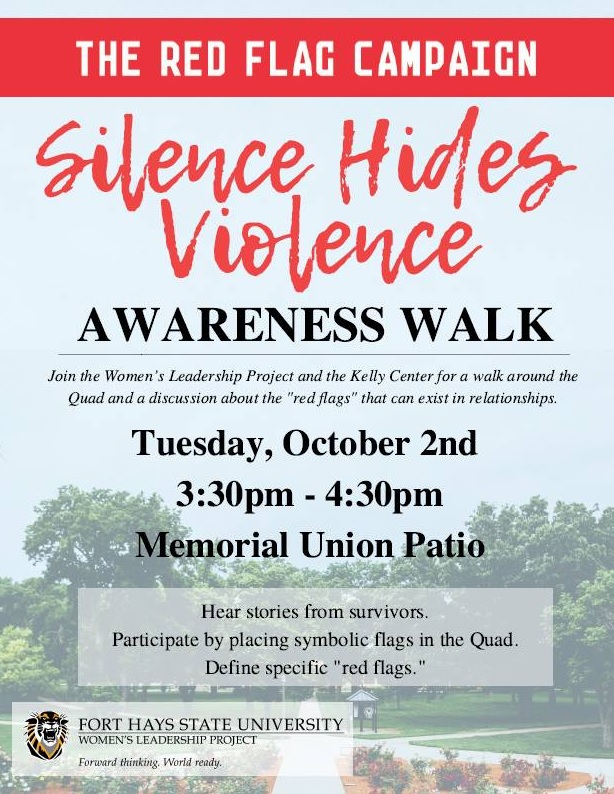
October is Domestic Violence Awareness month, and the Women’s Leadership Project at Fort Hays State University is hosting the Red Flag Campaign event on campus this week.
Elaine Parkinson, a WLP student co-coordinator, said the Red Flag event at FHSU is a month-long effort to raise awareness of domestic violence and to encourage to look at possible “red flags” they see in theirs or in others relationship.
“Red flags are something that you have to look at in relationships and you have to be on the lookout for,” said Parkinson, “because they can be really harmful to grow in relationships.”
Parkinson said red flags can be any form of unhealthy or abusive behavior in any relationship.
The WLP will kick off the month with the Silence Hides Violence Awareness Walk on Oct. 2nd from 3:30 p.m. to 4:30 p.m. on the FHSU campus.
Parkinson said the walk will take place around the FHSU Memorial Union Quad. There they will talk about Red Flags in relationships and then the walk will end with a presentation from survivors of sexual assault and domestic violence inside the union.
Parkinson said the campaign is geared toward college campuses but anyone is invited to attend.
During the month of October, the WLP will display red flags in the quad and will partner with the American Democracy Project for a Times Talk and several other displays and projects set up on campus to spread awareness about domestic violence.
“I hope students, faculty and members of the community are watching for this,” Parkinson said. “And really opening their minds to trying to understand and recognize red flags around them so they can learn to see them. Perhaps in themselves or in other people and try to put a stop to that and make people more safe in relationships.”
ELLIS – The interim director of Grow Hays, Doug Williams, will update the Ellis city council on economic development projects in Ellis County during tonight’s council meeting.
Council members will also consider approving an application for local incentives from Riverside Espresso & Café, LLC.
The complete agenda follows.
AGENDA
October 1, 2018
REGULAR MEETING OF THE CITY COUNCIL OF ELLIS
City Hall – Council Meeting Room
BILLS ORDINANCE REVIEW WORK SESSION BEGINS AT 7:00 P.M.
ROLL CALL AND MEETING CALL TO ORDER AT 7:30 P.M.
PLEDGE OF ALLEGIANCE
AMENDMENTS TO AGENDA (if needed)
CONSENT AGENDA
Minutes from Regular Meeting on September 17, 2018
Bills Ordinance #2054
(Council will review for approval under one motion under the consent agenda. By majority vote of the governing body, any item may be removed from the consent agenda and considered separately)
PUBLIC COMMENTS
(Each speaker will be limited to five minutes. If several people from the group wish to speak on same subject, the group must appoint a spokesperson. ALL comments from public on agenda items must be during Public Comment. Once council begins their business meeting, no more comments from public will be allowed.)
PRESENTATIONS OF AWARDS, PROCLAMATIONS, REQUESTS & PETITIONS (HEARINGS)
SPECIAL ORDER
Update on Ellis County Economic Development Projects – Doug Williams, Interim Director, Grow Hays
UNFINISHED BUSINESS
NEW BUSINESS
Consider Approval for Application for Local Incentives – Riverside Espresso & Café, LLC
Consider Approval of Bids for Shop Door
Consider Approval of Construction Materials and Services for South Park Bathrooms
Consider Approval of Street Repairs to Lakeview Street
Consider Approval of Repairs to Mack Truck
REPORTS FROM CITY OFFICIALS
Administrative
Public Works
KDHE Letter for Wastewater Treatment Permit Reissuance
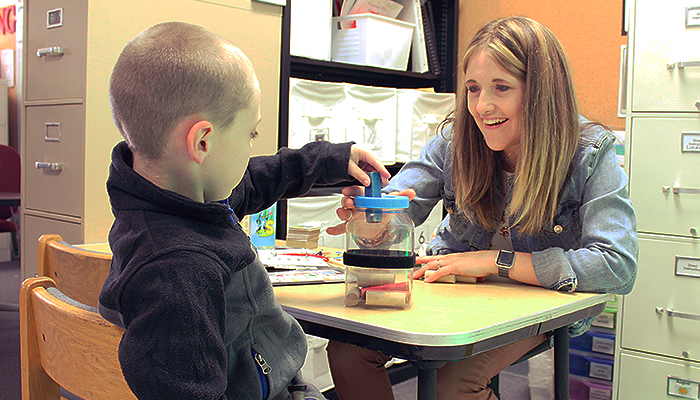
Lindy McDaniel, special education student, helps kindergartener Ryder McCormick with a lesson.
By CRISTINA JANNEY Hays Post
When teacher Lindy McDaniel brought the STAR program to Roosevelt Elementary School two years ago, she created a new family for her special education students.
She did not know at that time this tight-knit group of students, teachers, paras and parents would be struck with tragedy so soon.
Last year, a second-grader in the program, Kaylee, died unexpectedly. McDaniel said some of the children in the STAR program have fragile health, but it was a blow to all the children and adults who knew the student.
Danielle Scott, the girl’s aunt, said Lindy stepped up to not only comfort her students, but the little girl’s family.
“When my niece passed unexpectedly, she was right there to hug us and the STAR family,” Scott said. “Lindy went above and beyond to give my sister little treasurers from the classroom that Kaylee loved so much.”
McDaniel also included the family in special events for the STAR program.
All the children in the STAR class, as well as the general education second-grade students, painted ceramic stars for a special Christmas tree. McDaniel painted a larger star in Kaylee’s favorite colors. She invited Kaylee’s family to see Kaylee’s tree and the winter wonderland put together by the STAR students.
“Lindy, along with the staff in the STAR room spend countless hours planning and coordinating activities for the STAR students, and I forever have a special place in my heart for the STAR room, students and staff,” Scott said. “The STAR program wouldn’t be what it is without all of the staff, but especially Lindy for the love she shows for every student day in and day out.”
For this reason, Scott nominated McDaniel for Hays Post’s Teacher of the Month award.
When McDaniel heard it had been a member of Kaylee’s family who nominated her for Teacher of the Month, tears filed her eyes. She said the death brought the STAR children, staff and parents together as a family.
“You just want to give them the best they have in the time they are with us,” McDaniel said.
Although she said the death was difficult for all who knew Kaylee, she said she thought it brought out the best in her students.
“I have always thought of our kids knowing more than they could ever communicate because a lot of our kids our nonverbal,” McDaniel said. “And it was so intriguing to me how much they could sense the sadness of their staff and the sadness of the kids in the family. One little friend that is fairly nonverbal when the grandparents came to visit our program a couple days after, she knew immediately to give the grandpa a hug.
“It made me realize and continue to know these kids — they’re smart. They have a lot to offer us, and we can learn a lot from them.”
A memorial was set up in Kaylee’s name, and an equipment shed was donated to STAR in her honor. The STAR children watched the shed being put in by remote video and then helped paint it.
STAR stands for Systematic Teaching with Adaptations and Reinforcement. The teachers in the STAR rooms work to integrate their students into general education classrooms as much as possible. However, they have a safe place to be if they need more support.
The program at Roosevelt has grown from 14 to 34 students in just its third year.
The program encompasses four rooms. The first of which is academic.
The students in the program work at their own pace, and the program takes into account the students may be motivated in varying ways, McDaniel explained. A student who has autism is not going to be motivated by social interactions, such as recess. In fact, social interactions may cause them anxiety. One of the program’s students enjoys animals, so when the student has accomplished his task, they allow him to play with toy puppies.
“Because we have those opportunities for him to be reinforced by things he is interested in, he is going to work that much harder at building those reading skills to get to have time with his puppies or to get to have that music time for other kids,” McDaniel said.
The program has a social skills room that is more play based. The STAR program serves children pre-K through fifth-grade, but some of the students are developmentally pre-school age or toddlers. Play-based learning includes stations such as art or blocks.
A third room addresses life skills. This includes family-style lunch for children who need it. They can work on language skills, such as asking for more to eat, or motor skills, such as holding utensils.
The last room is STAR community, and each student has his or her own desk. They work in this room at in-seat desk behavior and other skills they would use in a general education classroom.
“I love getting to see that child who maybe wasn’t successful in a general setting get the interventions and supports they need to become successful. Getting that really close relationship with families to provide that to our kids is pretty awesome. In a general ed situation, you don’t necessarily get to know your families on this scale of how close we are in this program.”
McDaniel shows compassion to all the students at Roosevelt. During the Hays Post interview, she stopped for a moment to comfort a student who was upset. The girl began to cry, so she gently guided her to her mother, a fellow staff member.
She stopped on another day to comfort a young boy in the STAR program who was upset. She talked to him softly, encouraged him, and let him pick some lotion to smell and rub on his hands to calm and sooth him. The tears faded quickly, and he went on to his next assignment.
McDaniel, 37, has been teaching for 15 years. She took some time away from USD 489, where she started her career, to work for State Department to support children with autism and other disabilities. During that time she was exposed to different learning models, including STAR.
She decided the travel for that job was resulting in too much time away from her family. When she came back to the Hays district, an opportunity opened up in special education. She eventually was able to pitch STAR to district administrators.
The program has been highly successful and even garnered a visit from Kansas Education Commissioner Randy Watson.
McDaniel, a Quinter native and FHSU grad, said she would like to see the STAR program used across buildings in the district. She said using adaptations and reinforcement does not have to be reserved for students who have significant challenges.
“The commissioner of education came to visit our program last year, and his vision for the state of Kansas is that all kids can,” she said. “All kids should be a part of something bigger than themselves and get to learn with others in a way that suits them.
“If we have students that want to be teachers, they can come in and help teach our STAR kids or just different ways to help every kid feel a part of the building and feel like they have something to offer to a bigger community than just their classroom or themselves.”
Beginning Monday, Allen Street in Hays will be closed from the railroad tracks to the south side of the 13th Street intersection. Allen Street from the north side of the 13th St. intersection to the south side of 15th Street intersection will remain closed.
Signs will be in place to direct the traveling public. Motorists should use caution in these areas.
The City of Hays regrets any inconvenience this may cause to the public. If there are any questions, please call the Office of Project Management at 785-628-7350 or the contractor, Paul-Wertenberger Construction at 785-625-8220.
Steve Gilliland
As you can tell from recent columns, I love birds of prey, especially owls. Among my top ten favorite life experiences has been sitting on my brothers porch after dark, buried deep in the southeastern Ohio woods, listening to the sounds of the night.
There are whippoorwills and coyotes and all the small croaking, twittering creatures of the dark, but the main attraction is always the owls. From the eerie whines of tiny screech owls, to the deep, bass moans of great horned owls, and the tell-tale “Who cooks for you, who cooks for you too” cries of barred owls, the night time woods comes alive with owl calls.
A little known owl species here in Kansas is the burrowing owl, a medium sized owl without a unique, memorable sound, that make their home in abandoned badger and prairie dog dens. I was introduced to burrowing owls a few years back during an opening day pheasant hunt near my home. We were a large group of 15 or so hunters and were trudging across an overgrown CRP field. As we walked, birds identified by the landowner (who was with us) as hawks began taking flight, one-at-a-time from out of nowhere.
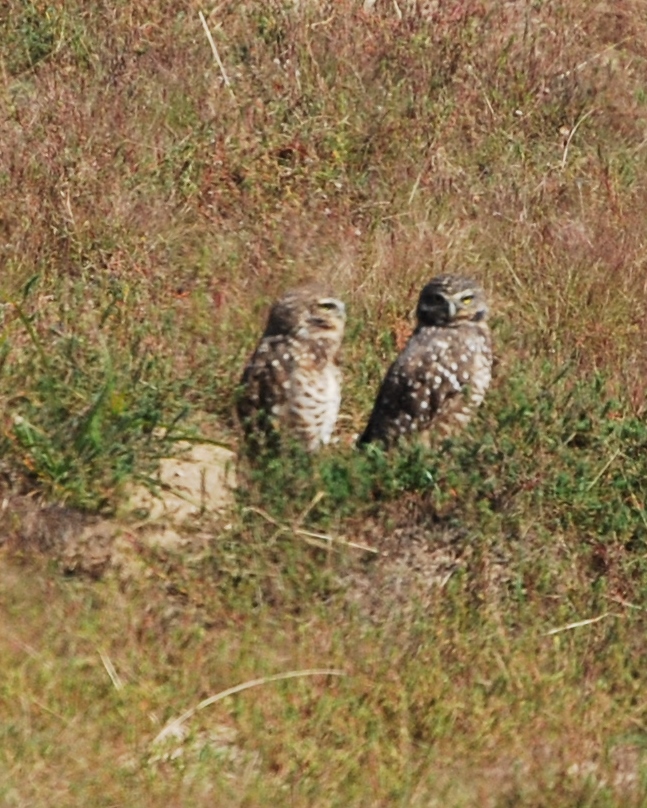
A pair of the burrowing owls near Hutchinson Walmart. Photo courtesy of Joyce Gilliland
Looking back, I believe those birds were in fact burrowing owls being spooked by our presence from their dens that were probably old abandoned badger holes.
Studies show burrowing owl populations to be in sharp decline, easily imagined here in Midwestern farm country where badger dens are not welcome and are filled-in when possible, and where prairie dogs towns as a whole are hard to come by anymore. They are listed as endangered in Canada, as threatened in Mexico and as endangered, threatened or of special concern in 9 of the United States.
Here in Kansas they are listed as “vulnerable.” Burrowing owls are active both day and night and often live in colonies of several mated pairs. They drag all manner of stuff into their dens as nesting material, and I found numerous mentions of cow manure being a favorite. Researchers believe the manure somehow helps control the microclimate of the den, plus attracts insects which the owls feed on.
Typical clutch sizes are from 3 to 12 eggs, and large families of chicks are often raised.
Their main diet is mice and moles during spring and early summer when they’re still feeding hungry chicks, then mainly grasshoppers and beetles as long as they can still be found. Burrowing owls stand 10 to 12 inches tall when mature and have long, featherless legs and white eyebrows above extremely large, bright and beautiful yellow eyes.
All birds make some sort of vocal sounds, and even though burrowing owl calls are not noteworthy at all compared to some of their vocal cousins, they do make a few cooing, chirping sounds, the most recognized being a 2-note sound reminiscent of a quail call.
We recently watched a TV documentary about swift foxes and burrowing owls living in suburban neighborhoods around Las Vegas. Since watching that documentary, we have found a couple dens of burrowing owls living in a sprawling prairie dog encampment near Walmart in Hutchinson. We can see their dens from a side street, so now every time we are in that part of town (which is way too often for me) we swing past, and if they are sitting at the entrance to their den, we stop and watch awhile. They are surrounded by active prairie dog dens and the dogs scurry about and graze as if the owls weren’t there at all.
In fact, the little owls probably benefit from the prairie dogs surveillance system. In an active prairie dog town there are always certain occupants designated as sentries whose job it is to keep watch for danger, and when intruders are spotted in the form of foxes, hawks or merely nosey humans, they sound an alarm by rising quickly up on their hind feet, stretching their heads skyward and emitting shrill high pitched chirps of danger, sending all their brethren scurrying for cover and affording the owls a chance to dive into their burrows too.
One of these days I’m going to wonder around through the prairie dog towns around Walmart to see if there are signs of any other little owls there. I’ve always wondered if there are prairie rattlesnakes living there amongst the prairie dogs too. They are common inhabitants of abandoned prairie dog dens, although not quite as cordial as the owls, given that they eat the landlords…. Continue to Explore Kansas Outdoors!
Steve Gilliland, Inman, can be contacted by email at [email protected].
PHILLIPSBURG – Beginning October 1, 2018, and lasting through the end of the year, for every gallon of E15, E20, E30 and E85 sold at USA Clean Fuels in Phillipsburg, three cent a gallon will be donated to the Phillips County Healthcare Foundation (PCHF).
USA Clean Fuels has partnered with PCHF to promote the health benefits of using ethanol blended fuel and giving back in a way that will leave a lasting impact on the well being of the community.
The Phillips County Healthcare Foundation is a local charitable organization whose mission is to foster and enhance resources of Phillips County for improvement of healthcare and well being of the community.
The beneficiaries of the PCHF are the Phillips County EMS, the Phillips County Health Department, the Logan Manor, the Phillips County Retirement Center, the Wellness Center, and Phillips County Health Systems.
If you fuel up using traditional petroleum-based gasoline, 20-30% of each gallon you put in your car is comprised of harmful aromatics such as Benzene, Toluene, and Xylene. These toxic additives cause heart disease, cancer and are connected to issues for our children such as asthma and even autism. Adding more ethanol to gasoline will reduce the harmful aromatic compounds, lowering tailpipe and greenhouse gas emissions while improving air quality and engine performance.
Fuel up at USA Clean Fuels on East Highway 36 in Phillipsburg to improve our air and support our healthcare October 1 through December 31.
Prairie Horizon’s USA Clean Fuels on East Highway 36 in Phillipsburg, KS offers the consumer a fuel choice that is cleaner, more affordable and better performing. Prairie Horizon Agri-Energy is a limited liability corporation, founded in November 2003 in the rural community of Phillipsburg, Kansas. Our company is owned by 300 area investors and employs 36 people. Annually, Prairie Horizon produces over 40 million gallons of ethanol and grinds 15 million bushels of grain, yielding just around 127,000 tons of high protein livestock feed. SUBMITTED
John Richard Schrock is a professor at Emporia State University.
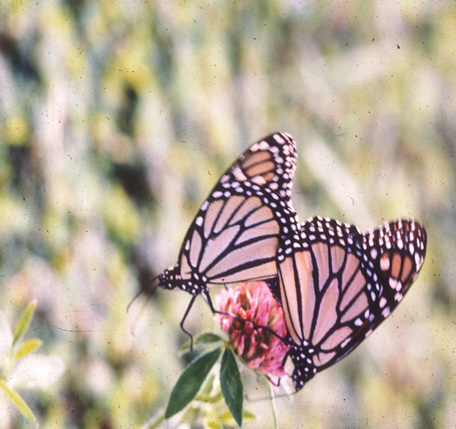
Large orange butterflies have been heading south through Kansas these last few weeks. They are monarch butterflies. This migration continues until the weather becomes cold.
Most local butterflies and moths have adapted to Kansas winters by laying eggs or overwintering in a cocoon or chrysalis stage. But monarch butterflies never evolved the cold-hardiness to survive harsh North American winters.
Populations on the West Coast migrate down to Pacific Grove, California, where they survive in milder conditions. East of the Rocky Mountains, our monarch butterflies are heading south by southwest into Mexico where they will overwinter on the hillsides of a few mountains. Their numbers will be so great that some tree limbs will break.
Monarch butterfly caterpillars feed on milkweed. The white sap that oozes from many milkweed stems contains a heart poison that seriously affects vertebrates. Very few animals can feed on milkweed without getting sick. However, monarchs are not harmed by these toxins. Not only are they one of a few insects that can eat milkweed, they keep the poisonous compound in their wings and outer exoskeletons, making monarch larvae and adult butterflies toxic to birds and other predators.
Instead of their caterpillars being green to hide from birds, they are brightly striped to advertise their bad taste. And the adults are likewise attractively bright orange. Once a young inexperienced bird tries to eat a monarch, it immediately vomits it back up. The bird has learned to leave the striped caterpillars and big orange butterflies alone.
Monarch butterfly development from egg to adult takes about 30 days. Therefore in the spring, the monarchs that move north and lay eggs in the southern U.S. will go through several generations. Those that make it to Canada will have a shorter time to cycle before fall signals it is time for their trip south.
Adult monarchs no longer grow, but they need to fuel their flight south to Mexico. Flower nectar is about 20 percent sugar and monarchs will visit many different flowers. They locate flowers by sight but use taste receptors on their feet to find the nectar.
During the summer, adults live for 2 to 5 weeks during which they mate and lay eggs. But the last generation that emerges in late summer or early fall must migrate to their overwintering grounds and will live for 8 or 9 months.
Research on monarch migration was conducted by the late Professor Lincoln Brower (September 10, 1931 – July 17, 2018) who marked monarch butterflies and then tried to trace their migration and estimate population numbers from recaptures. However, the migration was so large and the marked individuals so few that this was a difficult task.
It was Dr. Orley Taylor of the University of Kansas who expanded the research. Having worked on other butterfly research as well as the African honey bee problem, Dr. Taylor turned to the monarch migration puzzle. He enlisted school children and other members of the public nationwide in a massive tagging effort. By enlisting the aid of “citizen scientists,” it is possible to secure better estimates of the monarch population and the factors that influence its migration.
This data could not come at a better time, because the monarch migration appears to be declining in the long term. Many factors may be involved, but the use of herbicidal chemicals in the central United States has produced massive strips of farmland with beautiful crops and absolutely no weeds—including milkweed.
Monarch Watch is Dr. Taylor’s organization based at K.U. It is not only command central for receiving nationwide data on tagged monarch butterflies, but is involved in helping the public grow milkweed gardens and appreciate the need to leave some portion of roadsides uncut.
“Biology of the Monarch Butterfly” authored by Dr. Taylor is a Kansas School Naturalist issue available free upon request. It is also accessible online at www.emporia.edu/ksn and is available in print in Spanish as well. There is a lot more to learn about these beautiful butterflies flying south right now.
John Richard Schrock is a professor at Emporia State University.
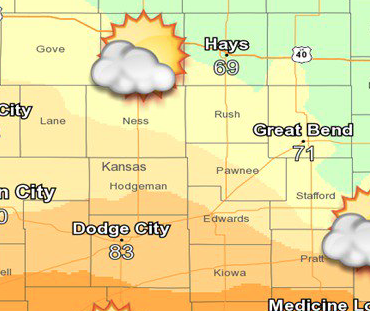
Today Patchy drizzle before 7am. Patchy fog before 10am. Otherwise, cloudy, then gradually becoming mostly sunny, with a high near 67. North wind 5 to 8 mph becoming south in the afternoon.
Tonight Patchy fog after 10pm. Otherwise, partly cloudy, with a low around 58. East northeast wind around 8 mph.
Tuesday Mostly sunny, with a high near 87. South wind 7 to 12 mph increasing to 13 to 18 mph in the afternoon. Winds could gust as high as 30 mph.
Tuesday Night Partly cloudy, with a low around 70. South wind 15 to 18 mph, with gusts as high as 29 mph.
WednesdayMostly sunny, with a high near 91. Breezy.
Wednesday NightScattered showers after 1am. Partly cloudy, with a low around 60. Chance of precipitation is 30%.
ThursdayScattered showers, mainly after 1pm. Partly sunny, with a high near 68. Chance of precipitation is 40%.
Thursday NightScattered showers and thunderstorms before 1am, then isolated showers. Mostly cloudy, with a low around 51. Chance of precipitation is 30%.
LOGAN – The Hansen Museum Continuing Education Program is proud to have certified Bob Ross instructors, T.R. Mathews and Sandy Seamone of Arriba, Colorado, at the Museum on October 20 and October 21 to teach two Joy of Painting classes.
On Saturday, October 20, 2018, the class will paint “Snow Scene,” and on Sunday, October 21, 2018, “Iris with Hummingbird.” Class runs from 9:00 a.m. to 3:00 p.m. with an hour lunch break each day.
Step-by-step, T.R. and Sandy reveal how fun and simple it is to paint using the Bob Ross method. Their tag-team approach to teaching keeps the classroom atmosphere light and entertaining. All painting supplies are provided, and no previous experience is necessary. Young and old alike will enjoy the camaraderie of these classes. Register by October 12 and pay $70.00 per day; after October 12, pay $75.00 per day. Discounts available for Patron and Sustaining Hansen Museum members.
This wonderful learning opportunity is brought to you through the Hansen Museum Continuing Education Program with funds from the Hansen Foundation. For more information, please call 785-689-4846.
The Dane G. Hansen Museum is open Monday through Friday 9-12 and 1-4; Saturday 9 -12 and 1-5; Sunday & Holidays 1-5. We are closed Thanksgiving, Christmas, and New Years. The Museum is handicapped accessible and admission is always free thanks to the generous support of the Dane G. Hansen Foundation. For more information or if you have questions, please contact us at 785-689-4846.
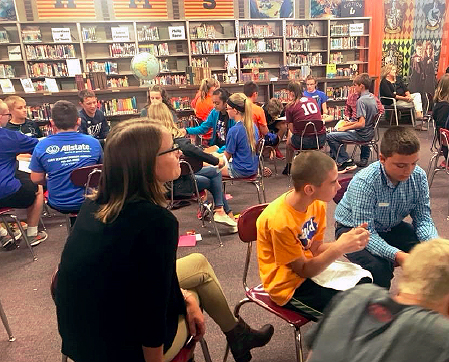
Hays Middle School Leadership CLASS students participated in a training provided by Joe Coles earlier this month.
Students worked with other leadership students from Otis-Bison and La Crosse. The training provided students with information about having a positive growth mindset, being accountable, and seeing the importance of positive choices and leadership skills.
The students will attend two more training sessions this year. The Leadership Team facilitators are counselors Deena Clark and Donna Lubbers.
Veteran Service Representative Schedule for October 2018
1st Tuesdays 10/2/18 Stockton Courthouse 9:30 – 11:30 AM
3rd Tuesdays 10/16/18 Osborne Veterans Building 9:30 AM – 11:30 AM
Russell City Hall 1:30 PM – 3:30 PM
4th Tuesdays 10/23/18 Phillipsburg EMS Building 9:30 AM – 11:30 AM
Smith Center Courthouse 1:00 PM – 3:00 PM
The Kansas Commission on Veterans Affairs assists veterans and authorized family members, free of charge, in matters pertaining to their VA claims and benefits.
All itinerants are on a first come, first served basis. No appointment needed.
For more information contact:
Douglas Storie, VSR
Douglas Storie, VSR
Kansas Commission on Veterans’ Affairs
Veteran Service Representative
205 E. 7th Suite 107
Hays, KS 67601
Phone: 785-259-0364
FAX: 785-650-0392
E-mail: [email protected]

 The Northwest Kansas Down Syndrome Society is sponsoring its inaugural Step Up for Down Syndrome run/walk on Saturday, Oct. 6 in Russell, and the event has already surpassed expectations.
















 USD 489