Today
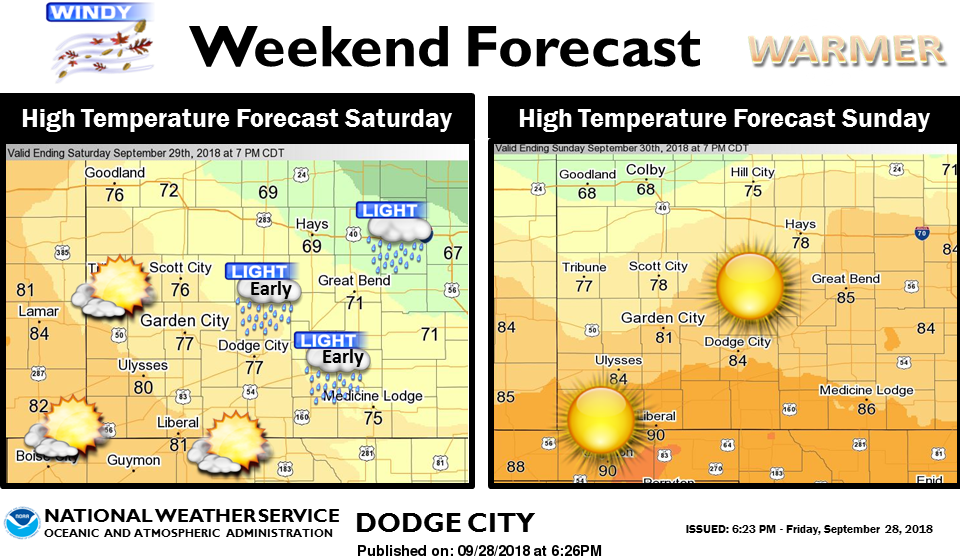
A chance of drizzle, mainly before 10am. Cloudy, then gradually becoming mostly sunny, with a high near 67. East southeast wind 8 to 18 mph becoming south in the afternoon.
Tonight
Partly cloudy, with a low around 58. Southeast wind 13 to 15 mph.
Sunday
Mostly sunny, with a high near 75. Southeast wind 10 to 14 mph becoming east northeast in the afternoon.
Sunday Night
Mostly cloudy, with a low around 57. Northeast wind 7 to 11 mph becoming south after midnight.
Monday
Mostly sunny, with a high near 77. West wind around 10 mph.
Monday Night
Partly cloudy, with a low around 58.
Tuesday
Mostly sunny, with a high near 85. Breezy.
Tuesday Night
Partly cloudy, with a low around 68. Breezy.
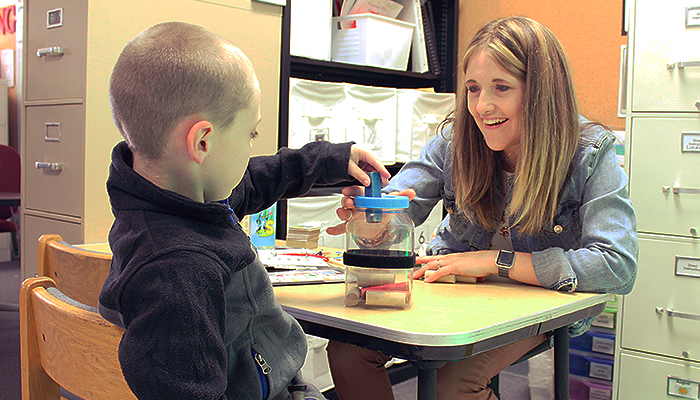
Lindy McDaniel, special education student, helps kindergartener Ryder McCormick with a lesson.
By CRISTINA JANNEY Hays Post
When teacher Lindy McDaniel brought the STAR program to Roosevelt Elementary School two years ago, she created a new family for her special education students.
She did not know at that time this tight-knit group of students, teachers, paras and parents would be struck with tragedy so soon.
Last year, a second-grader in the program, Kaylee, died unexpectedly. McDaniel said some of the children in the STAR program have fragile health, but it was a blow to all the children and adults who knew the student.
Danielle Scott, the girl’s aunt, said Lindy stepped up to not only comfort her students, but the little girl’s family.
“When my niece passed unexpectedly, she was right there to hug us and the STAR family,” Scott said. “Lindy went above and beyond to give my sister little treasurers from the classroom that Kaylee loved so much.”
McDaniel also included the family in special events for the STAR program.
All the children in the STAR class, as well as the general education second-grade students, painted ceramic stars for a special Christmas tree. McDaniel painted a larger star in Kaylee’s favorite colors. She invited Kaylee’s family to see Kaylee’s tree and the winter wonderland put together by the STAR students.
“Lindy, along with the staff in the STAR room spend countless hours planning and coordinating activities for the STAR students, and I forever have a special place in my heart for the STAR room, students and staff,” Scott said. “The STAR program wouldn’t be what it is without all of the staff, but especially Lindy for the love she shows for every student day in and day out.”
For this reason, Scott nominated McDaniel for Hays Post’s Teacher of the Month award.
When McDaniel heard it had been a member of Kaylee’s family who nominated her for Teacher of the Month, tears filed her eyes. She said the death brought the STAR children, staff and parents together as a family.
“You just want to give them the best they have in the time they are with us,” McDaniel said.
Although she said the death was difficult for all who knew Kaylee, she said she thought it brought out the best in her students.
“I have always thought of our kids knowing more than they could ever communicate because a lot of our kids our nonverbal,” McDaniel said. “And it was so intriguing to me how much they could sense the sadness of their staff and the sadness of the kids in the family. One little friend that is fairly nonverbal when the grandparents came to visit our program a couple days after, she knew immediately to give the grandpa a hug.
“It made me realize and continue to know these kids — they’re smart. They have a lot to offer us, and we can learn a lot from them.”
A memorial was set up in Kaylee’s name, and an equipment shed was donated to STAR in her honor. The STAR children watched the shed being put in by remote video and then helped paint it.
STAR stands for Systematic Teaching with Adaptations and Reinforcement. The teachers in the STAR rooms work to integrate their students into general education classrooms as much as possible. However, they have a safe place to be if they need more support.
The program at Roosevelt has grown from 14 to 34 students in just its third year.
The program encompasses four rooms. The first of which is academic.
The students in the program work at their own pace, and the program takes into account the students may be motivated in varying ways, McDaniel explained. A student who has autism is not going to be motivated by social interactions, such as recess. In fact, social interactions may cause them anxiety. One of the program’s students enjoys animals, so when the student has accomplished his task, they allow him to play with toy puppies.
“Because we have those opportunities for him to be reinforced by things he is interested in, he is going to work that much harder at building those reading skills to get to have time with his puppies or to get to have that music time for other kids,” McDaniel said.
The program has a social skills room that is more play based. The STAR program serves children pre-K through fifth-grade, but some of the students are developmentally pre-school age or toddlers. Play-based learning includes stations such as art or blocks.
A third room addresses life skills. This includes family-style lunch for children who need it. They can work on language skills, such as asking for more to eat, or motor skills, such as holding utensils.
The last room is STAR community, and each student has his or her own desk. They work in this room at in-seat desk behavior and other skills they would use in a general education classroom.
“I love getting to see that child who maybe wasn’t successful in a general setting get the interventions and supports they need to become successful. Getting that really close relationship with families to provide that to our kids is pretty awesome. In a general ed situation, you don’t necessarily get to know your families on this scale of how close we are in this program.”
McDaniel shows compassion to all the students at Roosevelt. During the Hays Post interview, she stopped for a moment to comfort a student who was upset. The girl began to cry, so she gently guided her to her mother, a fellow staff member.
She stopped on another day to comfort a young boy in the STAR program who was upset. She talked to him softly, encouraged him, and let him pick some lotion to smell and rub on his hands to calm and sooth him. The tears faded quickly, and he went on to his next assignment.
McDaniel, 37, has been teaching for 15 years. She took some time away from USD 489, where she started her career, to work for State Department to support children with autism and other disabilities. During that time she was exposed to different learning models, including STAR.
She decided the travel for that job was resulting in too much time away from her family. When she came back to the Hays district, an opportunity opened up in special education. She eventually was able to pitch STAR to district administrators.
The program has been highly successful and even garnered a visit from Kansas Education Commissioner Randy Watson.
McDaniel, a Quinter native and FHSU grad, said she would like to see the STAR program used across buildings in the district. She said using adaptations and reinforcement does not have to be reserved for students who have significant challenges.
“The commissioner of education came to visit our program last year, and his vision for the state of Kansas is that all kids can,” she said. “All kids should be a part of something bigger than themselves and get to learn with others in a way that suits them.
“If we have students that want to be teachers, they can come in and help teach our STAR kids or just different ways to help every kid feel a part of the building and feel like they have something to offer to a bigger community than just their classroom or themselves.”
Hays Mayor James Meier toasts the Oktoberfest 2018 crowd late Friday morning.
By BECKY KISER Hays Post
The Volga German Society of Ellis County and Rush County, the Sunflower Chapter of the American Historical Society of Germans from Russia, and the Ellis County Historical Society welcomed revelers to the 2018 Hays Oktoberfest on a cool Friday.
The weather forecast called for an overcast sky with the temperature to reach only to the low 50s. Preparations in Municipal Park for the 46th annual event were done under much warmer conditions and a sunny sky as Thursday’s high was 83 degrees.
In greeting the crowd, Ellis County Commissioner Dean Haselhorst, who was attending his 36th Oktoberfest, said “I don’t think the weather is ever the same from one year to the next. I can remember a 100 degree temperature day with a dust storm to the south of us, and one year it was 20 degrees with blowing snow, drizzle and freezing rain.”
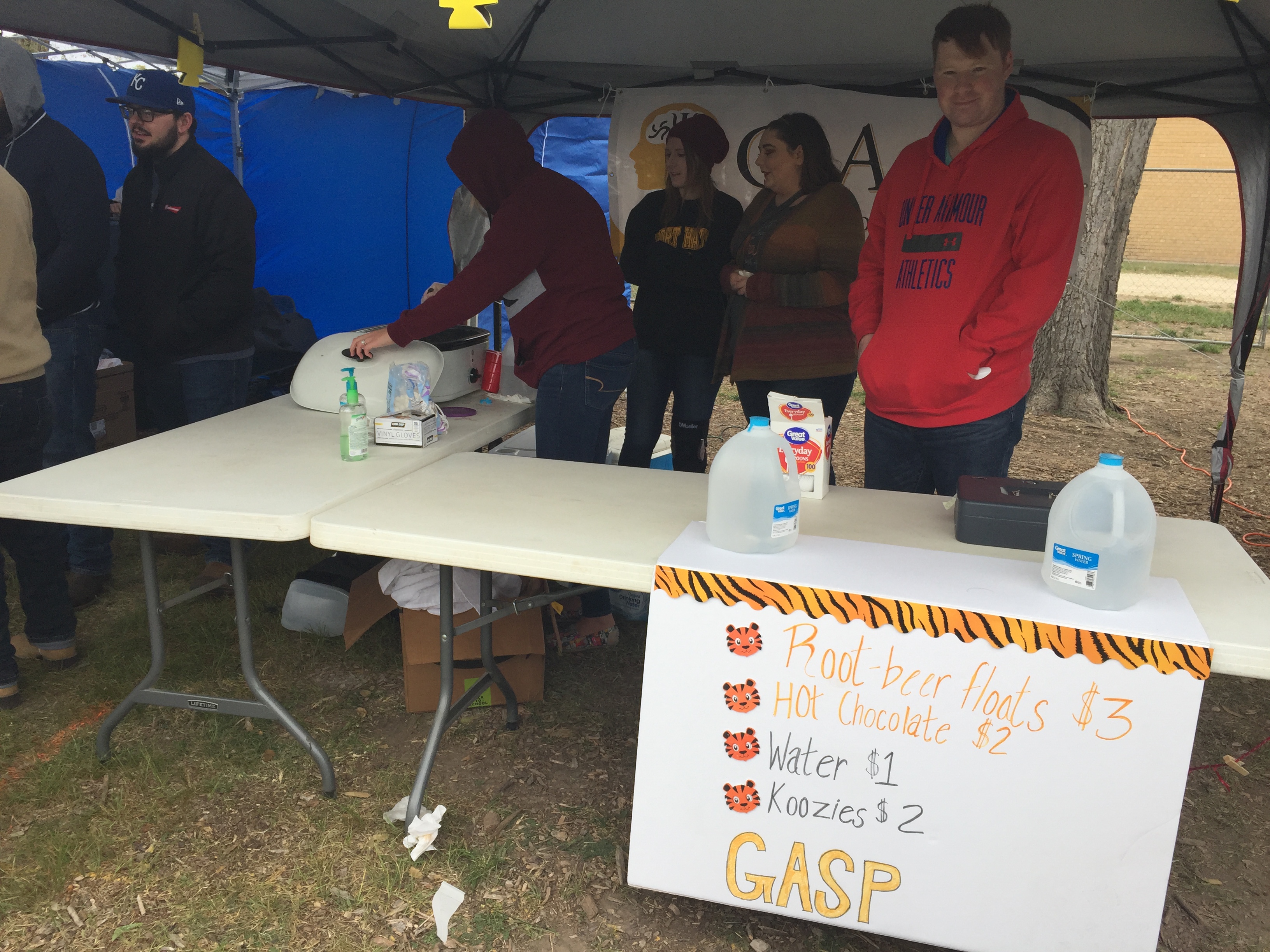
FHSU GASP students sold more hot chocolate than root beer floats.
The hot chocolate was selling much faster than the root beer floats, according to the Fort Hays State University students manning the booth for the Graduate Association of Students in Psychology.
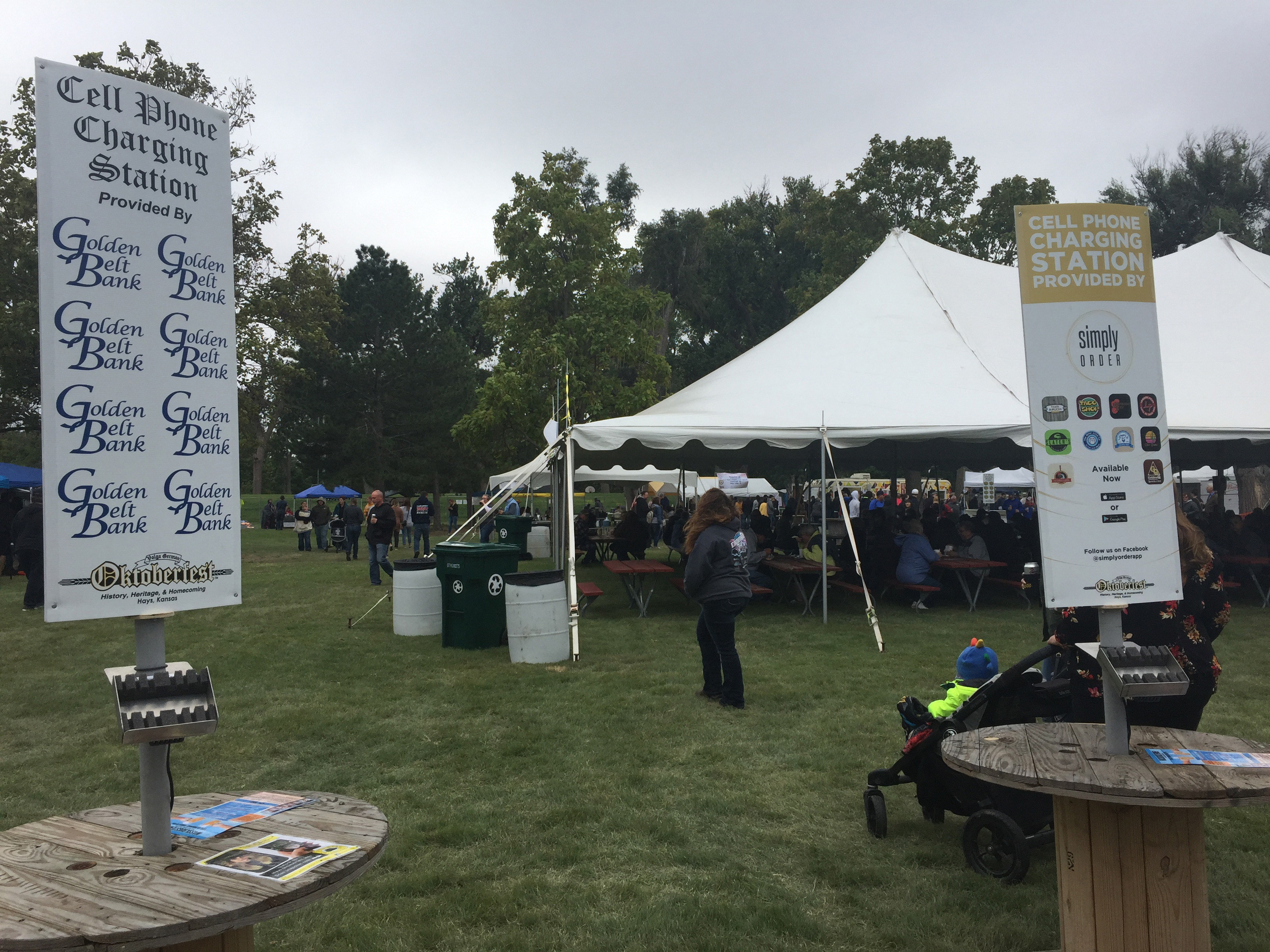
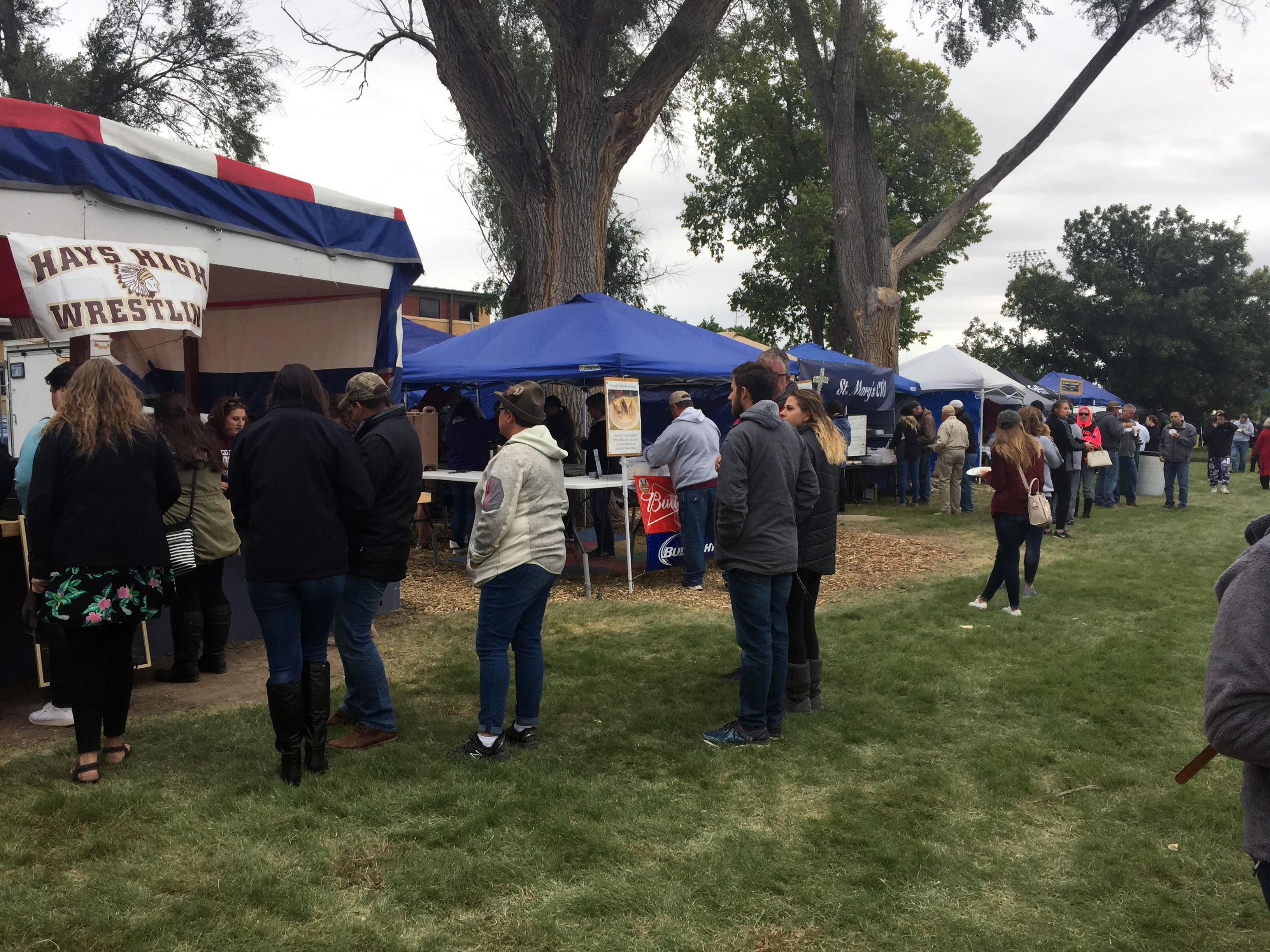
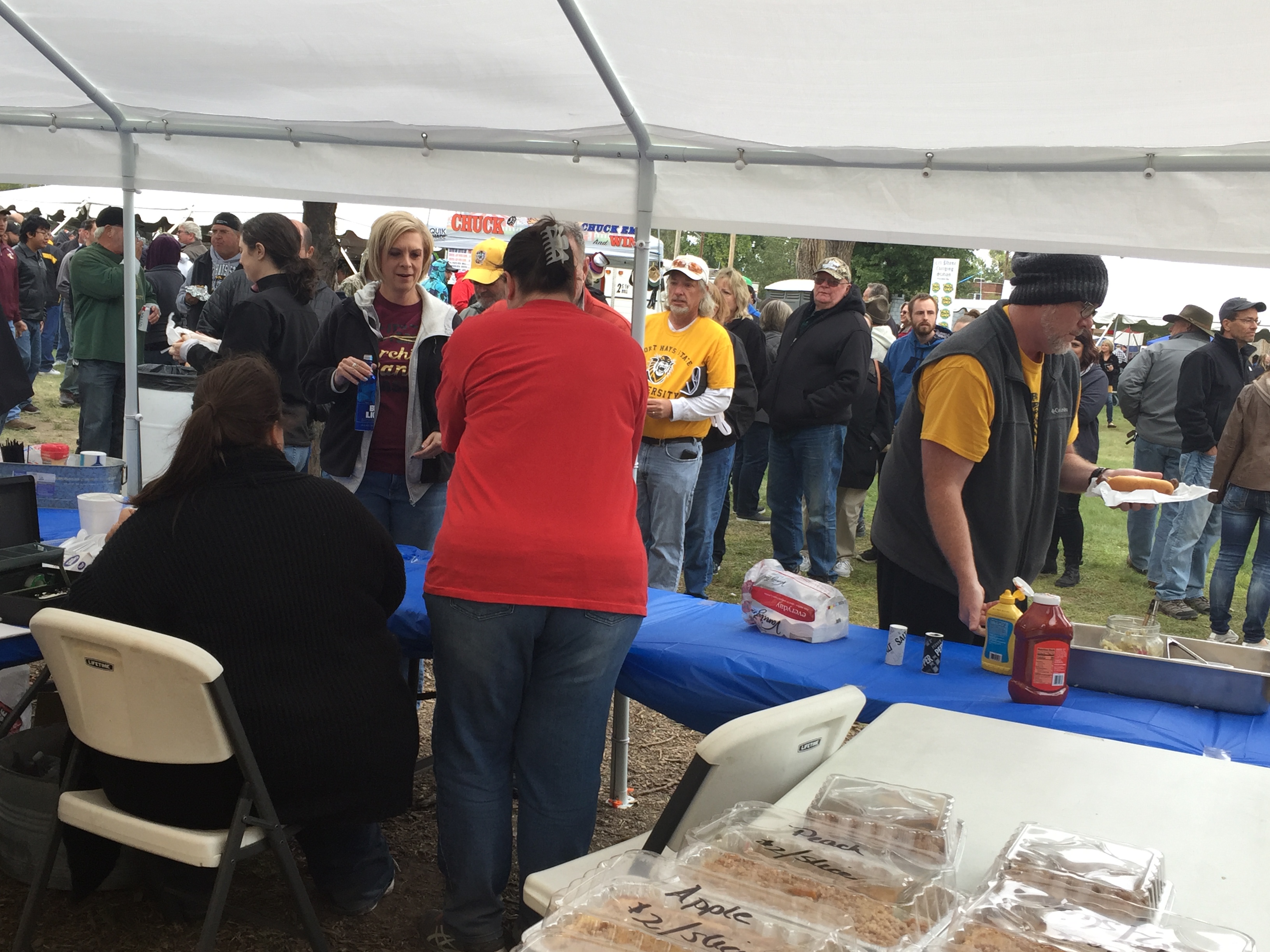
Thirty FHSU organizations and 19 community groups, filled the festival ground with booths selling everything from homemade traditional German foods and beer to “everything bacon,” tacos, collectible T-shirts, steins and koozies, and crafts.
The cool temperature didn’t keep away the crowd.
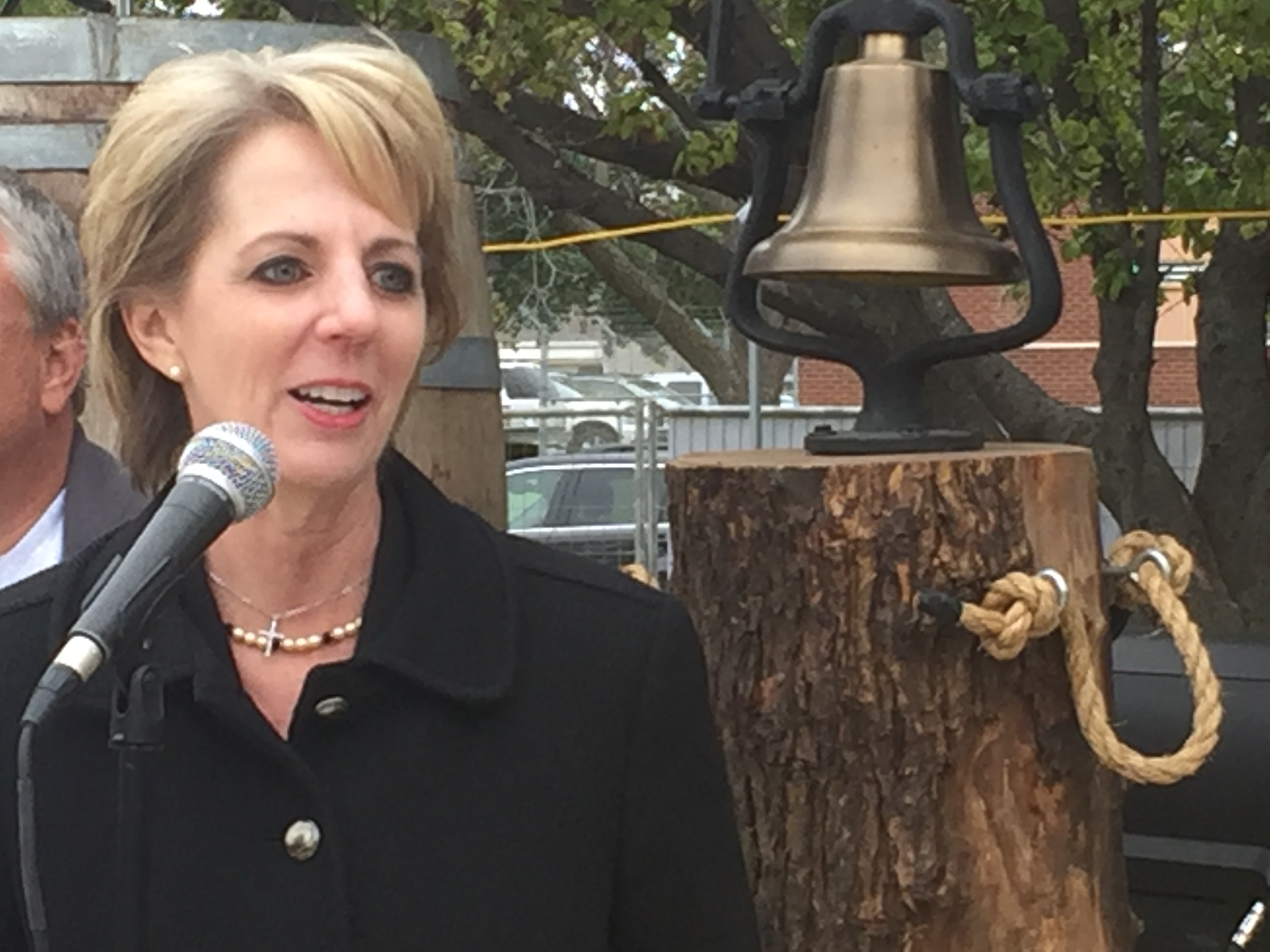
The opening ceremony and official tapping of the keg by Hays Mayor James Meier, was emceed by Mike Cooper of Eagle Communications and included greetings from Nick Werth, president of the Volga German Society.
“We want everybody to really enjoy your day. We couldn’t do it without all of our great sponsors and participants,” Werth stressed.
Dr. Tisa Mason, FHSU president
He recognized several people for their involvement and contributions, including graphic artist Mary Ridgway, a FHSU employee who has designed the Oktoberfest logos for many years.
Oktoberfest is held on Fort Hays State University Homecoming weekend. This was the eighth Oktoberfest for newly installed President Tisa Mason who preciously served FHSU as vice president for student affairs.
“Home is not the university. It’s the community,” she told the crowd, adding that this is the 46th year Fort Hays State has partnered with the Volga German Society for the celebration, which also funds an annual student scholarship.
FHSU student Alyssa Miller received a $500 scholarship from the Volga German Society.
This year’s $500 award went to Alyssa Miller, Holdrege, Nebraska, who is of Volga German descent.
Werth and NCK Tech president Eric Burks announced a second annual scholarship will awarded to students at the technical college beginning in February.
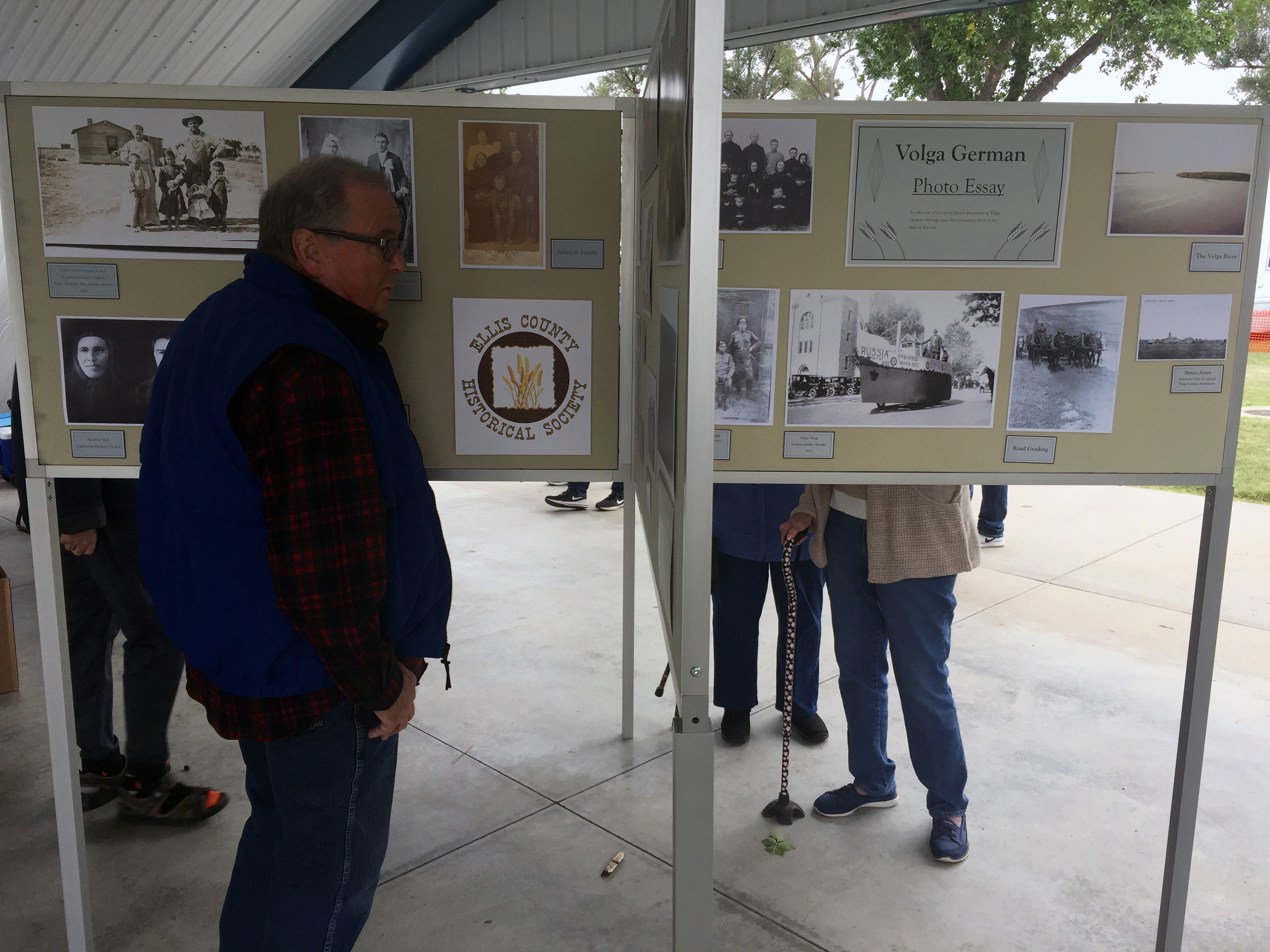
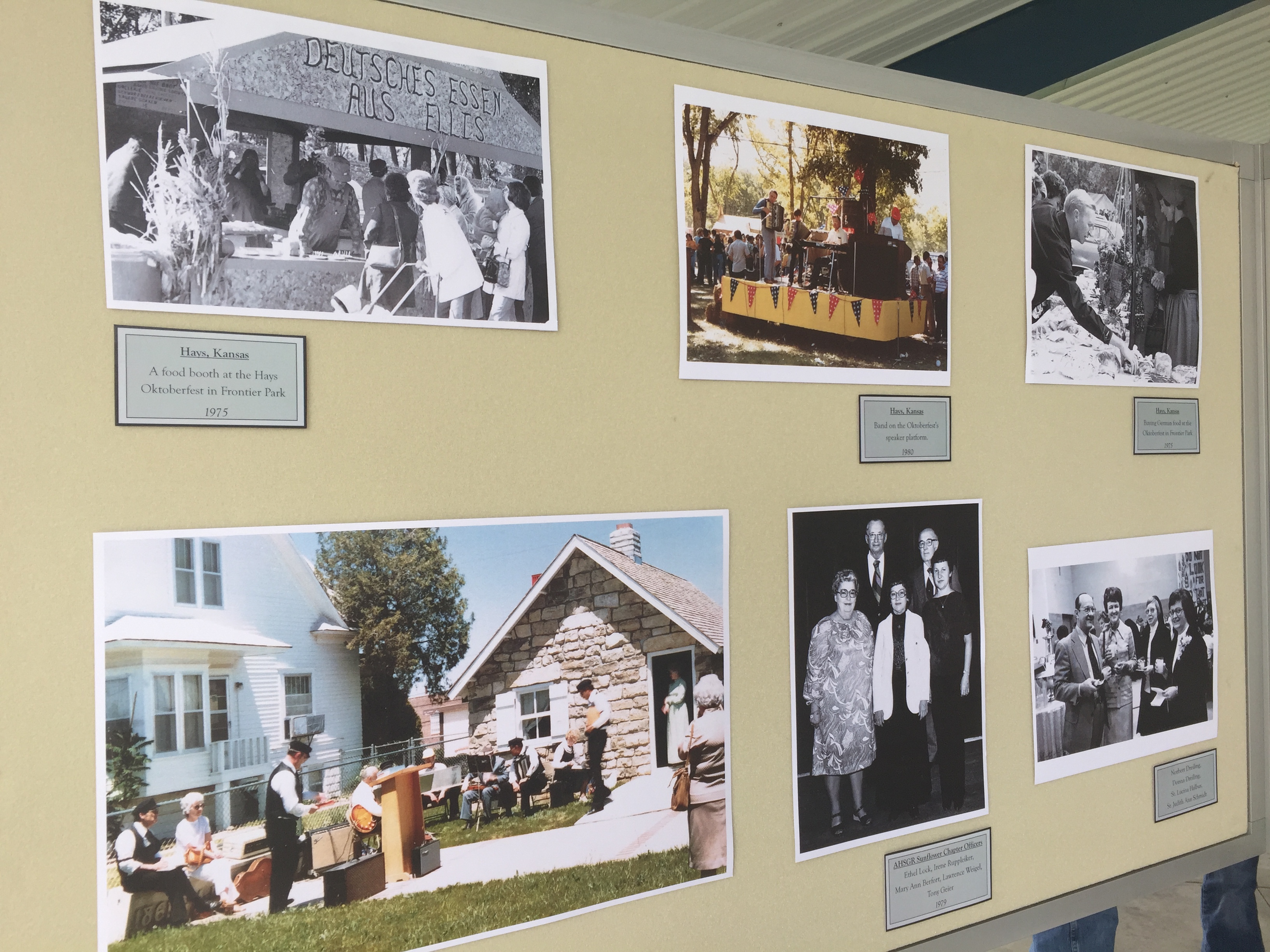
Hays Oktoberfest promotes the rich heritage of the Volga German and Bukovina Germans who settled in Ellis County, Kansas. It also celebrates the history of early settlers in Ellis County, which was created in 1867.
Following a prayer and blessing from Fr. Reggie Urban, Volga German Society Dialect Historian Tom Haas gave tribute to those settlers.
Starting his remarks in German, Haas translated them into English as he went along.
“Today we certainly don’t want to forget our ancestors who came to America. Because of their efforts, we are here today,” Haas said.
“They came here with a purpose, the first purpose being to be free. The very first thing that they did was build a church in their own communities.” Last weekend, the 100th anniversary of Holy Cross Catholic Church was celebrated in Pfeifer.
Two FHSU exchange students from western Germany were introduced during the opening ceremony. Katherine Ermisch, Bochum, and Janine Gebhard, Gladbeck, are both studying English.
FHSU exchange students from German Kathrin Ermisch and Janine Gebhard taste the
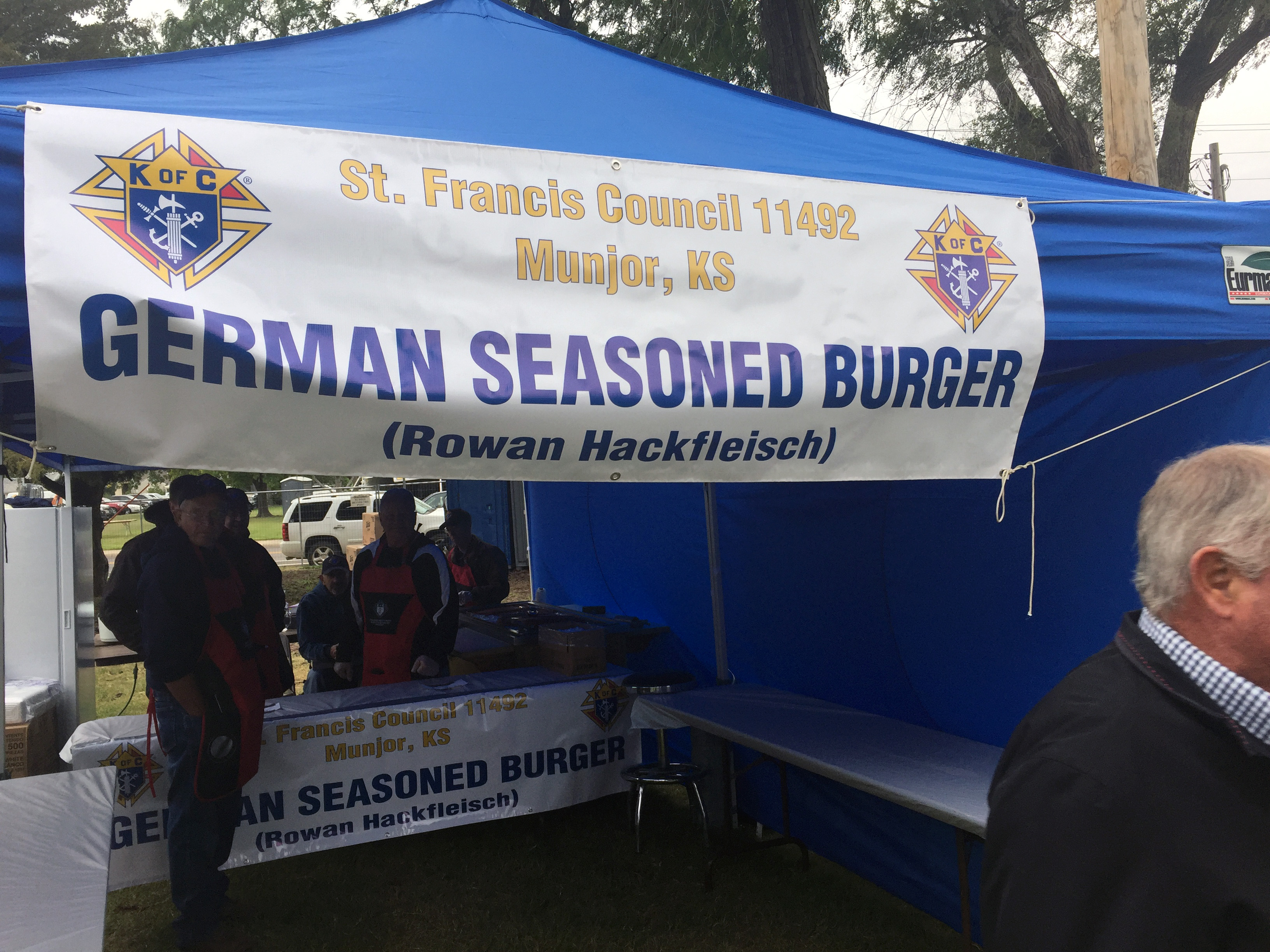
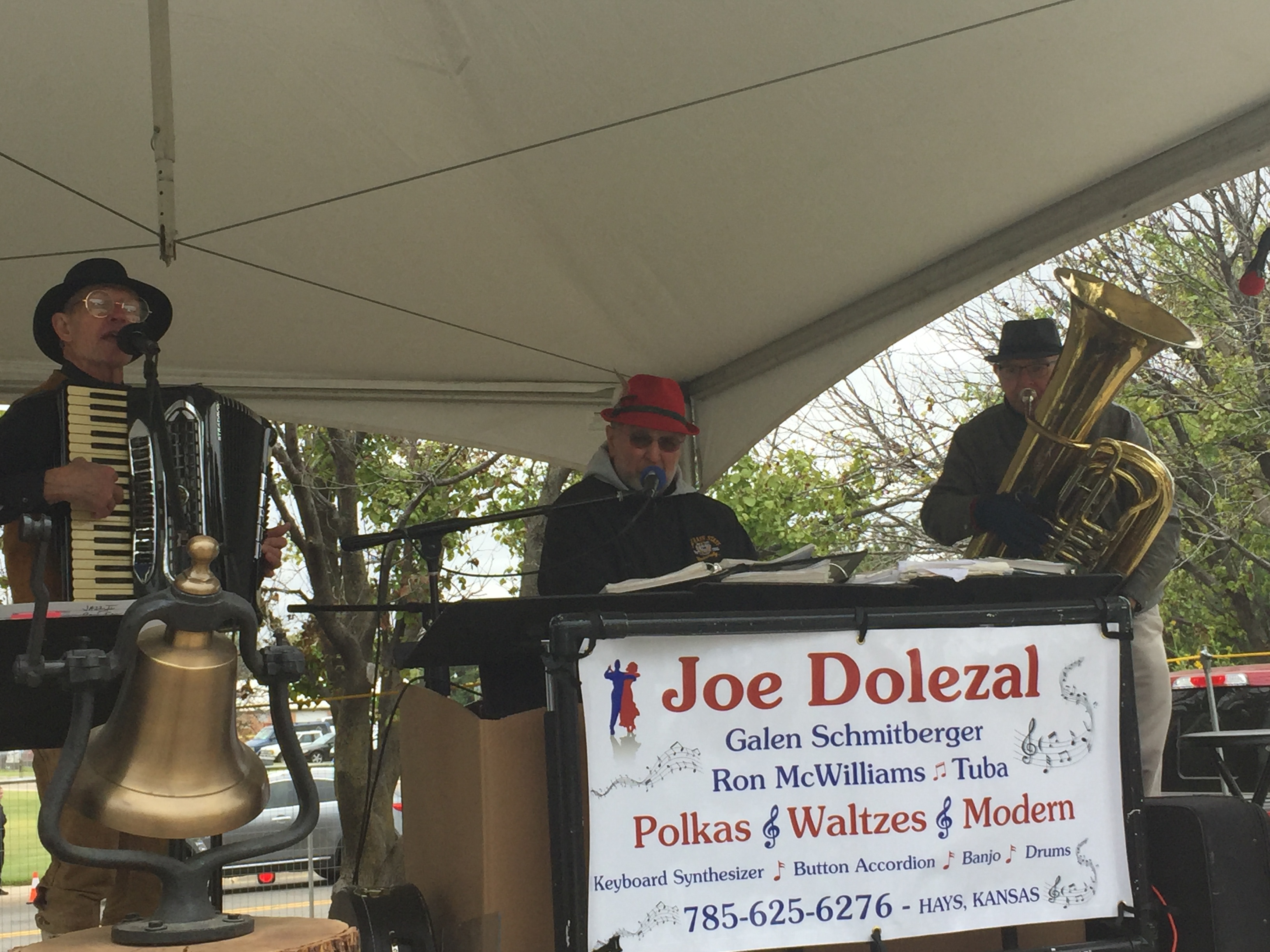
They were happy to hear the polka music performed by the Joe Dolezal band, which they said was just what they would enjoy at an Oktoberfest in Germany. Both women gave a thumbs-up to the Rowan Hackfleisch (German season burger) prepared by the Munjor Knights of Columbus. They said it compares to their own Mett, a hearty breakfast bread topped by raw pork or beef with raw onions added. There are no seasonings in Mett and the pair say they like the local delicacy, commonly called “rawburger,” much better.
“We were told there’s no Wienerschnitzel sold here but we can really recommend the season meat over there. It’s really good,” Gebhard told the audience. “Thank you for having us and Prosit,” wished Ermisch.
Also enjoying the local flavors were dad and daughter Roger and Mikala Barnhart, St. George.
Mikala Barnhart, 11, and her dad Roger Barnhart, St. George
Roger, a 1995 FHSU graduate, chose green bean dumpling soup, while Mikala, 11, declared the soup “too creamy” and instead went for the fried dumplings and sausage.
The Barnhart family will participate in Saturday morning’s FHSU Homecoming 5K race, in honor of Roger’s brother Robert, a ’94 FHSU alum, who died three years ago on the day of Oktoberfest.
One of the duties of Hays Mayor James Meier toasts the Oktoberfest 2018 crowd late Friday morning.
FHSU exchange students from Germany Kathrin Ermisch and Janine Gebhard taste the
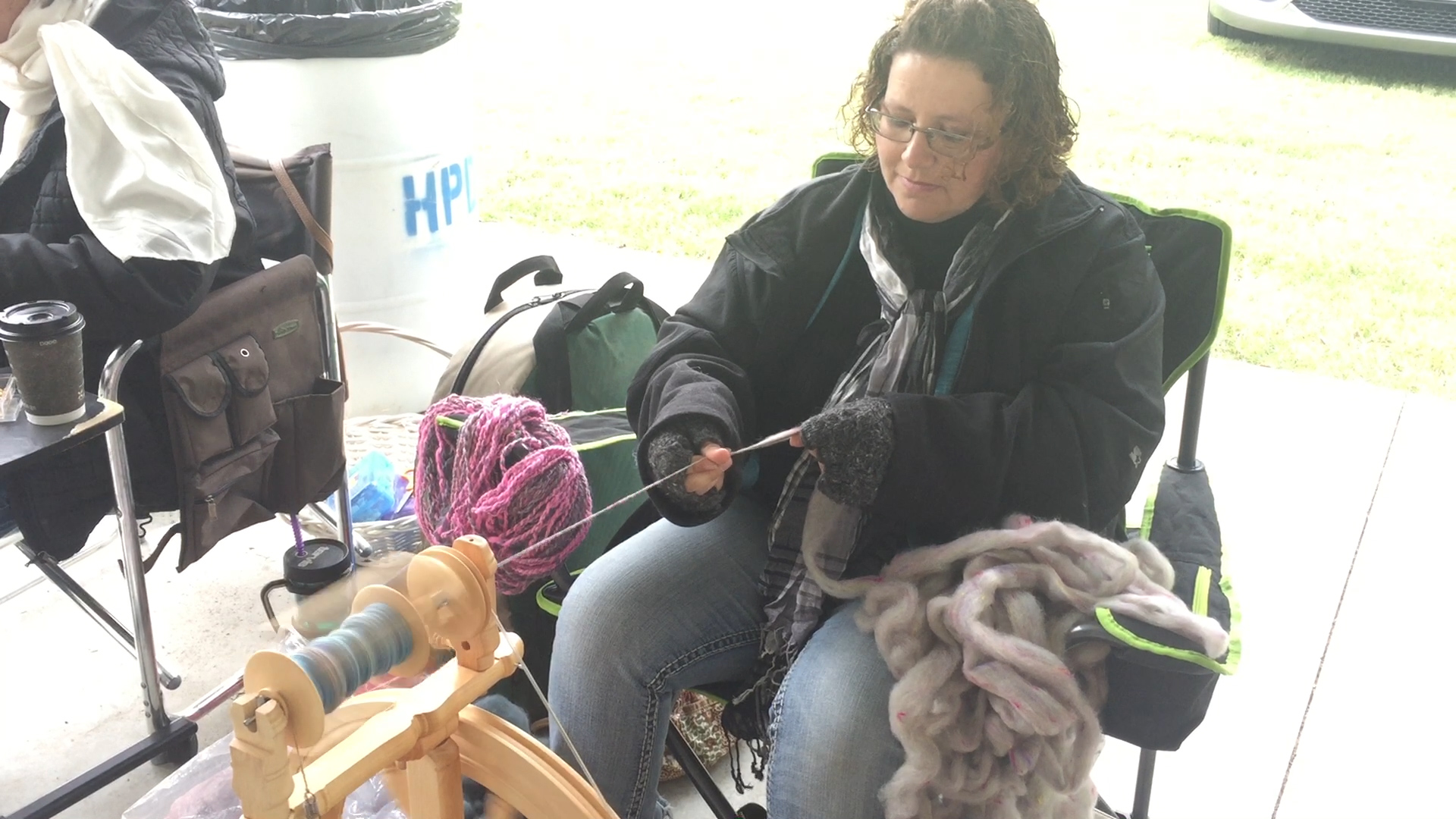
Mindy Lamont, Phillipsburg, spins alpaca and merino wool into yarn.
“Catherine the Great” greets her former subjects from the Volga River area of Russia.
Brats made by the Ellis grocery store
300 pounds of rawburger
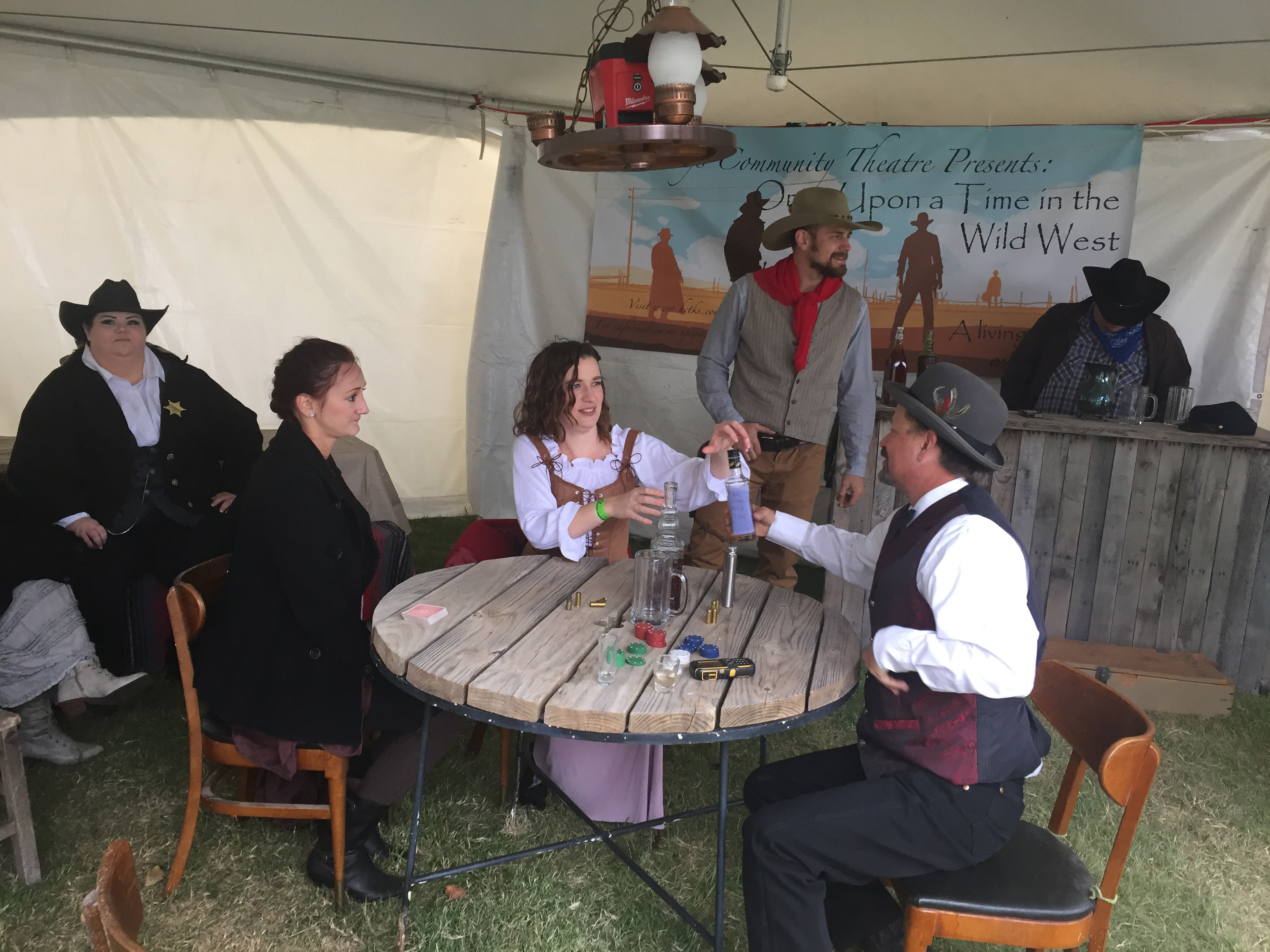
Hays Community Theatre members
Mikala Barnhart and her dad Roger of St. George
American Legion Riders & Ladies Auxiliary booth
Official Oktoberfest band
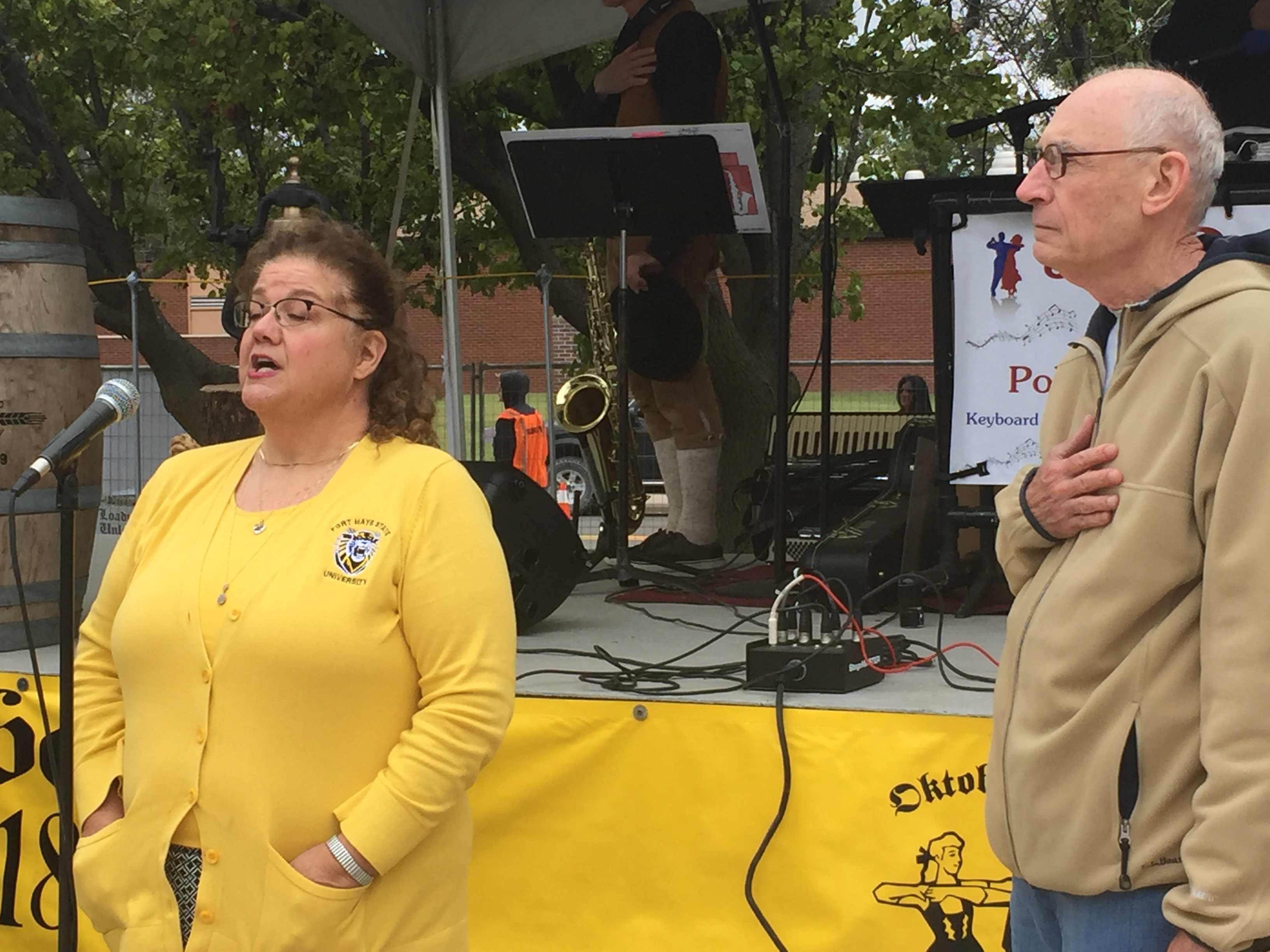
Emcee Mike Cooper with Jackie Maxwell singing the national anthem
Souvenir beer mugs
Volga German Society scholarship award
FHSU President Dr. Tisa Mason
FHSU GASP students sold more hot chocolate than root beer floats.
Natalia Figuerea-Rodriguez, HHS senior, was honored with the September student Best of the Best award.By CRISTINA JANNEY Hays Post
Hays High School senior Natalia Figuerea-Rodriguez has maintained a 3.9 grade point average.
But Figuerea-Rodriguez has a unique set of challenges she has had to overcome to earn that honor.
Figuerea-Rodriguez is from Puerto Rico. She and her family settled in Hays after being displaced by Hurricane Maria. Figuerea-Rodriguez’s native language is Spanish.
Figuerea-Rodriguez was nominated by Suellyn Stenger, HHS counselor, and Linda Mayer, English language learners teacher for the USD 489 Best of the Best award.
“She literally lost a lot of things,” Stenger said, “friendships, home, belongings. She came here with her native-speaking language being Spanish. If I had two words to describe Natalia, it would be resiliency and perseverance.”
Stenger emailed the Best of the Best nomination form to Figuerea-Rodriguez’s teachers.
One teacher said, “I never knew the circumstances around Natalia’s transfer to Hays High School. I just knew she had an incredible intellect and work ethic.”
Another teacher said, “I absolutely love having her in class. Her effort is worth a million bucks.”
Her ELL teacher spoke to the school board in Spanish to illustrate how difficult it is to try to understand a school lesson spoken in language that is not your own.
“If you found it a little bit difficult to understand what I was saying, then you understand what Natalia has been going through for the past year, and she has done it exceptionally well with a 3.9 cumulative GPA in her content classes in her second language. We are extremely proud of her,” Mayer said.
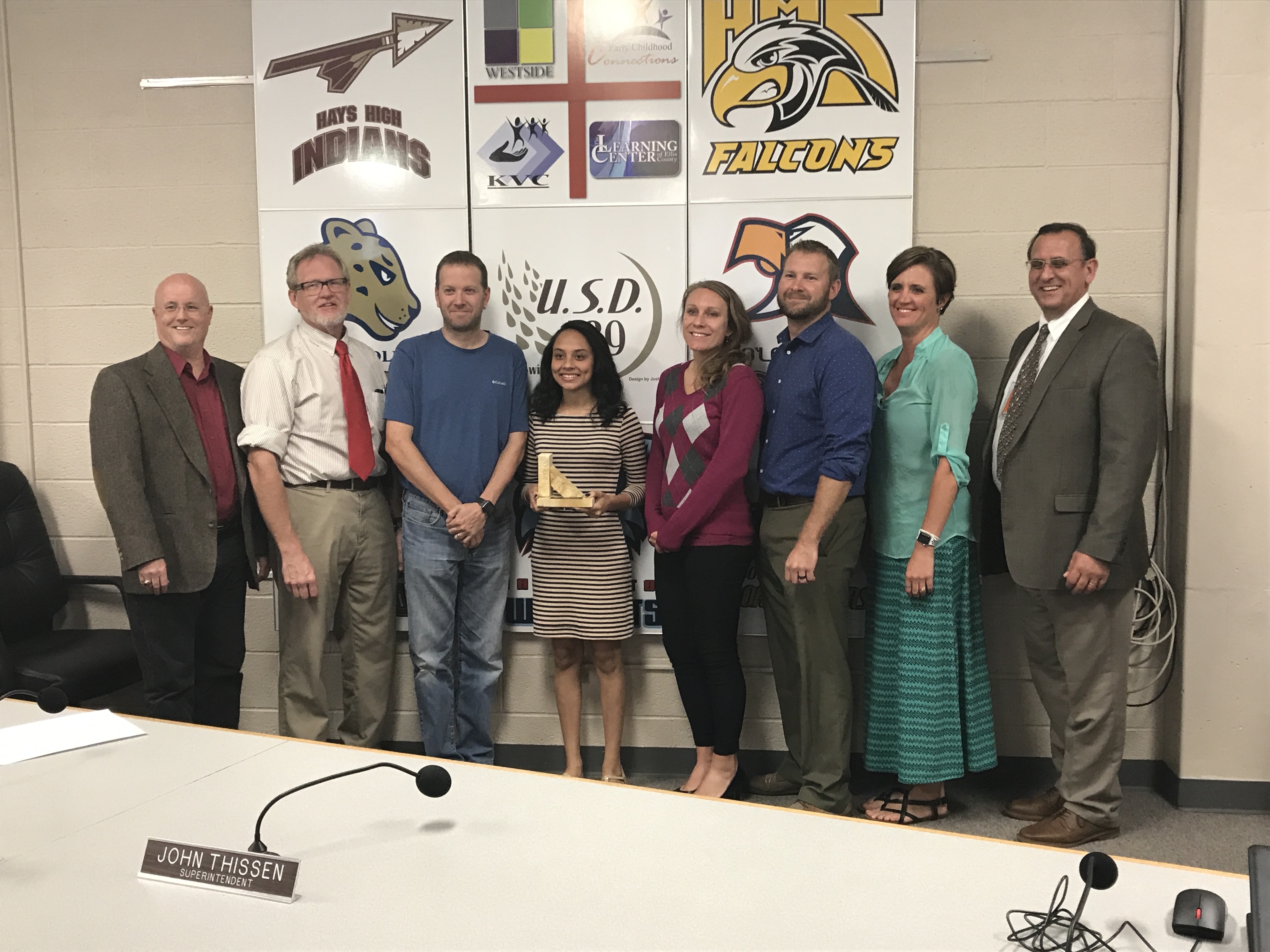
Candace Sage, a second-grade teacher at Wilson Elementary School was honored with the staff Best of the Best award. She is pictured center with school board members and members of the Haas family, who nominated her for the award.
The staff member who was honored with the Best of the Best award was Candace Sage, a second-grade teacher at Wilson Elementary School.
Parent Laycie Haas, along with her two sons and daughter, Kaden, Konner and Khloe Haas, nominated Sage for the Best of the Best award.
Sage taught all three of the Haas children. Khloe, the youngest, is in her class now.
“She goes above and beyond for all of her students in her classroom,” Laycie said. “Every year she implements new ideas and learning opportunities with her students.”
This year Sage added monthly ag lesson, which Laycie said was important to her family because they live on a farm.
With her sons, Laycie had the opportunity to volunteer in the Sage’s class. She said she was able to witness Sage’s amazing teaching techniques.
“She does so many other things like taking the kids to Via Christi to interact with the residents,” Laycie said. “Both of my older two had the same resident, and even today they will still talk about him and his stories. They had an awesome bond. That is something that is an awesome skill — to learn how to interact with people who are older than you are.
“Along with school work, she teaches them life lessons and rewards their hard work and dedication with fun Friday activities.”
Laycie’s son had an assignment in his last weeks of elementary school to write a letter to the teacher who had the most impact on him. He wrote about Sage.
“We are extremely blessed to have met her, and I am so blessed that my kids were able to have her as a teacher,” Laycie said. “She has left a life-long imprint on our family’s lives. Her dedication is top-notch, and I believe without a doubt that she is an awesome recipient of this award.”
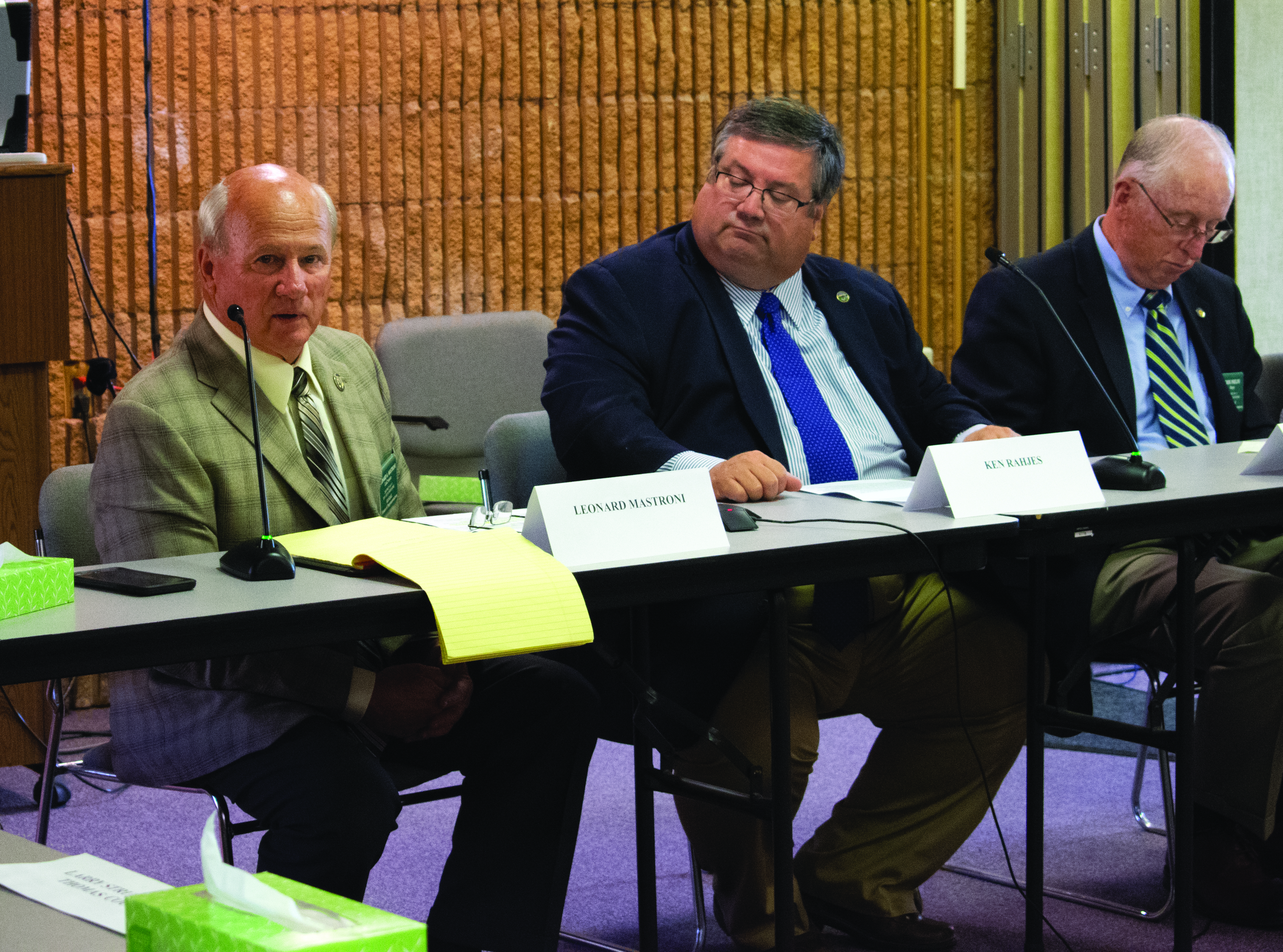
From left Reps. Leonard Mastroni, R-La Crosse, Ken Rahjes, R-Agra, and Eber Phelps, D-Hays, discuss mental health issues with the High Plains Mental Health Board on Thursday. Kaley Conner/High Plains Mental Health
By CRISTINA JANNEY Hays Post
Board members at High Plains Mental Health advocated for Medicaid expansion in Kansas during a discussion with state legislators and legislative candidates Thursday.
Rep, Troy Waymaster, R-Bunker Hill, who has been chairman of the House Appropriations Committee, said finding the estimated $31 million to $40 million to match the federal dollars to the state would be difficult.
About 52 percent of the state budget goes to K-12 education, and the state is facing a Kansas Supreme Court decision that will require additional funds. Once higher education is added to the equation, education accounts for 65 percent of the state budget.
Richard Miller, HPMH board member and former CEO of the Norton County Hospital, expressed his frustration the Legislature had not yet passed Medicaid expansion.
“To those of us who have been in health care and community mental health services, the $31 million I know, Troy, is tough to come up with, but look what it is costing the hospitals and mental health centers and putting it on the backs of the county commission and they [also] have their local hospitals to support. …
“It would just make a lot of sense, and if it is not a priority, get it up there as a priority because it would benefit so many people and so many health care facilities and mental health centers just by taking the 90 percent from Washington. To me, it becomes a red and a blue thing. In my opinion, had that been a proposal that had come from Republicans at the national level, it might get a different consideration here.”
Rep. Eber Phelps, D-Hays, pointed out Medicaid expansion passed both houses, but was vetoed by Gov. Sam Brownback. There were not enough votes for a veto override. Gov. Jeff Colyer was the architect of the privatization of Medicaid, so the Legislature did not think expansion would receive the governor’s signature in 2018, Phelps said.
The state has lost about $2.9 billion in federal funding by not expanding Medicaid in the state, Phelps said.
Phelps said he was hopeful some of the funds that were cut from mental health services after tax cuts were implemented in 2012 could be restored during the next session.
“One thing that has really struck me about the whole issue of mental health besides the growing number of suicides in rural Kansas and the number of suicides among young people, not just in western Kansas, but all over,” Phelps said. “Apparently, as a country, we have lost our focus a little bit on mental health after making a lot of strides in years back.”
Phelps raised concern about the number of people who have mental health issues that are ending up in jail instead of in treatment. He cited a report by NPR on the Cook County Jail, where out of 2,500 inmates about 50 percent suffer from mental health issues.
In that report, inmates said they were intentionally getting arrested because that was the only way they could receive psychiatric treatment.
He said he thought those percentages could be extrapolated to our Kansas jails.
“What we have gotten ourselves into as a country and a state is a model that is totally wrong,” Phelps said, “because we are incarcerating people who shouldn’t really be there. They are sick. …
“I think most legislators if they are paying attention in their districts and visiting with their county sheriffs, they are realizing they are taking on a burden, as I mention with Cook County. The No. 1 mental health provider in the nation is the Cook County prison. We have got to get away from that model and get back to looking at preventive and maintenance and taking care of these people who need our help.”
Board member Jan Badsky commended Phelps on highlighting the need for prevention. However, she noted with all the bureaucracy and funding challenges, it can be easy for people to fall through the cracks. Then that person ends up in a state hospital, such as Larned.
Rep. Leonard Mastroni, R-La Crosse, and a former HPMH board member, expressed his frustration with the Kansas Department of Administration’s hiring practices, which he said makes it difficult for even entry-level personnel to qualify for positions at state hospitals. This has left many positions open. For example, a person can’t qualify for a state hospital job if they owe state back taxes.
In terms of funding, Rep. Ken Rahjes, R-Agra, said mental health is battling with many other issues and government agencies for funding and attention. In dealing with his constituents and farmers, mental health is only coming in at No. 13 or 14 on a long list of priorities.
Rahjes encouraged outside-of-the-box thinking, cooperation with other agencies and development of grant funding as means to expand services.
Walter Hill, HPMH executive director, said High Plains is trying to maximize its resources to reach as many people as possible by using programs such as telemedicine. The mental health center is also sending clinicians to the Ellis County Health Department, HaysMed and the Phillips County Hospital to try reach more people.
The board members also expressed concerns about dealing with the administrative arms of state government.
Rahjes said he too had struggled with the Kansas Department of Aging and Disability and had to call the agency on behalf of constituents.
Waymaster said his constituents were regularly calling him with difficulty working with the private companies that have been contracted to handle Medicaid claims under KanCare. He described a case in which a family was waiting for Medicaid approval for their father who was in nursing care. The man died before his application was approved, and the family was sent a bill for $18,000.
Waymaster made a call, and the application was “miraculously” approved after a six-month wait.
He acknowledged families should not have to go through this, but the Legislature does not hire and fire individuals in the administrative branches of government. They just approve funding.
Kim Thomas, former Stockton mayor and candidate for the 110th District seat, and Jerry Hill, candidate for the 120th District seat, also attended the meeting.
OAKLEY — The Oakley Police Department is on the lookout for a suspicious vehicle in the area of Oakley schools.
The OPD received a call about 3:25 p.m. Thursday about the vehicle. A check of the Texas plate number returned the vehicle as a dark blue 2013 Tesla.
“Officers have searched the area and been on the lookout for the vehicle and it has not been located in Oakley,” the OPD said in a social media release. “There have been additional calls, but they appear to all lead back to the original incident and there have not been multiple sightings. We are still watching for the vehicle.”
Anyone with information should call the department at (785) 671-3219.
Starting Sunday, retail purchases made in Ellis County will cost slightly less.
The half-cent county sales tax, which has been in place five years, ends Sept. 30.
Ellis County voters approved the sales tax in 2013 for two building projects, the remodeling of the downtown courthouse and law enforcement center, and construction of the new Emergency Services Building at 1105 E. 22nd Street in Hays.
“These projects were part of a comprehensive plan of facility modernizations that included relocation of various county operations to the Administrative Center at 718 Main Street and the about-to-be-completed repairs to the Extension Offices at 601 Main Street,” said Ellis County Administrator Phillip Smith-Hanes in a news release.
“As promised to voters at the time of the election, the county successfully paid off the bonds used for remodeling and construction of the courthouse, Law Enforcement Center and Emergency Services Building within five years.
“Accordingly, the half-cent voter-approved countywide sales tax is no longer needed and will ‘sunset’ as of Sunday, September 30, 2018,” Smith-Hanes said.
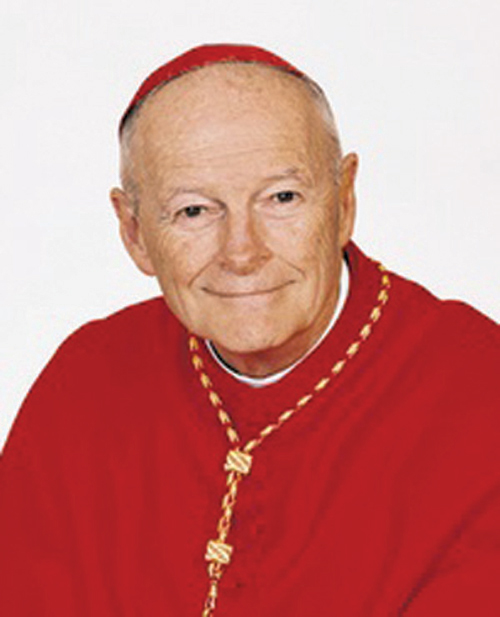
Cardinal Theodore E. McCarrick, 88, the former archbishop of Washington, D.C., who resigned July 27 from the College of Cardinals after allegations he had sexually abused minors and adult seminarians, will be residing at the St. Fidelis Friary in Victoria.
According to a news release from the Salina Catholic diocese, the Archdiocese of Washington, D.C. announced today that “Archbishop McCarrick will live a life of prayer and penance” and is “excluded from any public appearances and ministry.” The diocese of Salina is not incurring any costs during the arrangement.
McCarrick’s resignation was accepted July 28 by Pope Francis. McCarrick remains a priest pending the outcome of a Vatican trial.
Included in the news release is a letter from recently installed Salina diocese Bishop Gerald Vincke who explains “Why I said ‘Yes.’
Vincke’s letter is below.
By Most Reverend Gerald L. Vincke Bishop, Diocese of Salina
“The Church needs to be open, honest and transparent.
“On September 13, 2018, I received a phone call from His Eminence, Cardinal Donald Wuerl of Washington, D.C. After brief pleasantries, he got right to the point. He asked for my permission for Archbishop Theodore McCarrick to reside at the St. Fidelis Capuchin Friary in Victoria, Kansas, to live a life of prayer and penance. Archbishop McCarrick is 88 years old. Cardinal Wuerl already received permission for this arrangement from Father Christopher Popravek, the provincial of the Capuchin Friary in Denver. I said, ‘yes.’
Vincke
“I realize this decision will be offensive and hurtful to many people. Archbishop McCarrick is, in many ways, at the forefront of the recent firestorm in the Church. Many of us are confused and angry by what Archbishop McCarrick is alleged to have done several decades ago. The Holy See stated on July 28 that Pope Francis “accepted his resignation from the cardinalate and has ordered his suspension from the exercise of any public ministry, together with the obligation to remain in a house yet to be indicated to him, for a life of prayer and penance until the accusations made against him are examined in a regular canonical trial.” Please know that I agreed to this arrangement with the understanding that Archbishop McCarrick is excluded from any public appearances and ministry. Our diocese is not incurring any cost in this arrangement.
“I believe in justice. Recently, the administrative committee of the United States Conference of Catholic Bishops stated their support of a full investigation into the allegations surrounding Archbishop McCarrick. The committee has recommended that the investigation be done by lay experts in relevant fields, including law enforcement and social services. Currently, a timeline for that investigation is unknown.
“I also believe in mercy. In saying “yes,” I had to reconcile my own feelings of disappointment, anger and even resentment toward Archbishop McCarrick. I had to turn to Christ for guidance. Jesus is rich in mercy. He did not come to give us permission to sin, he came to forgive our sins. We know that Christ has compassion and mercy for all who repent of their sins. The cross is a place of love and mercy. It is not a place of retribution. If our actions do not have mercy, then how can it be of the Church?
“Jesus reminds us to “be merciful, just as our Father is merciful.” Many years ago, I received a relic of Saint Maria Goretti, who was canonized in 1950. When Maria was almost 12 years old, she was attacked by a 19-year-old man named Allesandro Serenilli. After she rebuffed his sexual advances, Allessandro stabbed her 14 times. On her deathbed, Maria’s last words were, “I forgive Alessandro Serenelli … and I want him with me in heaven forever.” She forgave her assailant. Yet, there was also justice. Allesandro spent a number of years in prison. During this time, he had a deep conversion and spent the rest of his life in a monastery. I have the relic of Saint Maria Goretti beside the tabernacle in my chapel with a prayer that I say often. The opening line is “Dear Saint Maria Goretti, your heart was so full of mercy that you gladly forgave your assassin and prayed that he might be saved.” I think Saint Maria Goretti is a saint today because she forgave Allesandro.
“Sometimes, it can take a long time to forgive.
“At this time, I would like to take the opportunity to say how deeply sorry I am to all the victims of abuse. My heart aches for you and your families. I am unable to comprehend the extent of your suffering. Sadly, many times the victims did not receive an adequate response from the Church regarding the abuse they endured and the life-long pain and suffering that accompanies such evil. As a Church, we are extremely sorry and ask for forgiveness. Because of the courage and perseverance of the victims who came forward, they have become the source of much needed change in our Church and our culture. I pray that this may bring about greater purification and healing for our world.
“This is a difficult time for the Church. This purification of the Church by God is painful, but much needed. We need the eyes of faith as we suffer through this. “Faith is not a light which scatters all our darkness, but a lamp which guides our steps in the night and suffices for the journey (Lumen Fidei #57).” Jesus is with us as light in the midst of darkness.
“We trust that God will bring good out of this situation. Please join me in praying for Archbishop McCarrick as he now leads a life of prayer and penance. Most of all, let us pray for all victims of abuse so they may experience the healing presence of Jesus and the tenderness and compassion of our Blessed Mother.”
The news release also offered information for abuse victims.
“The Salina Diocese adheres to Safe Environment procedures; anyone harmed by Church personnel should immediately report the matter to the Salina Diocesan Office of Safety and Security Hotline at (785) 825-0865 or [email protected], so that the diocese can
offer assistance with healing and reconciliation.”
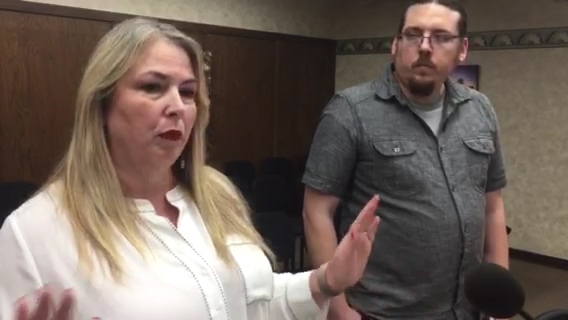
Options Executive Director Jennifer Hecker with Tim Tarkelly, Options Community Services Coordinator
By BECKY KISER Hays Post
Sex trafficking is on the increase in Kansas, even in Hays.
Jennifer Hecker, executive director of Options Domestic & Sexual Violence Services, told city commissioners Thursday night the local organization has joined the state’s “Demand An End” campaign. Attorney General Derek Schmidt, along with statewide partners, launched the campaign in July. Kansas became the 11th state to join a national project that works to discourage demand for commercial sex – especially with children.
“We’re addressing the people who are purchasing sex that help to facilitate and keep that cycle of human trafficking going. As long as people are buying the services, traffickers are going to be in the market for victims,” Hecker said.
“Traffickers come to Hays to take our children, our citizens, and take them out of the state either to Colorado or to Texas. Those are the two biggest hubs.”
Options has been operating for 35 years. Through the main office in Hays and a satellite office recently reopened in Colby, the non-profit serves 18 counties in northwest Kansas, about 17,000 square miles. There is a safe shelter in Ellis County, staffed 24/7, and another shelter is planned for Colby.
“People can walk into our Hays office without an appointment and receive free, voluntary, confidential services. If transportation is an issue, we can travel to them, wherever they are in our service area,” noted Hecker.
Legal advocacy is also provided.
“We can go with people to court to support them, help them understand what their rights are,” said Tim Tarkelly, community services coordinator. “We’re not lawyers, obviously, but we have a referral process with Kansas Legal Services and we have some extra resources through the Kansas Coalition Against Sexual and Domestic Violence.
“The same situation occurs when law enforcement calls. We respond to those. We also respond to the hospital for Sexual Assault Nurse Exams (SANE) exams,” Tarkelly added. “We can accompany survivors to any legal or medical appointment that pertains to their abuse situation.”
The number of survivors helped by Options has increased dramatically.
According to Hecker, the 20 paid staff members of Options, along with a handful of survivors, served 3,200 people last year and 7,000 so far this year.
Tarkelly and Hecker stand beside Hays Mayor James Meier who proclaimed October as Domestic Violence Awareness Month.
Prior to the Hays city commission meeting, Mayor James Meier signed a local proclamation for national Domestic Violence Awareness Month in October.
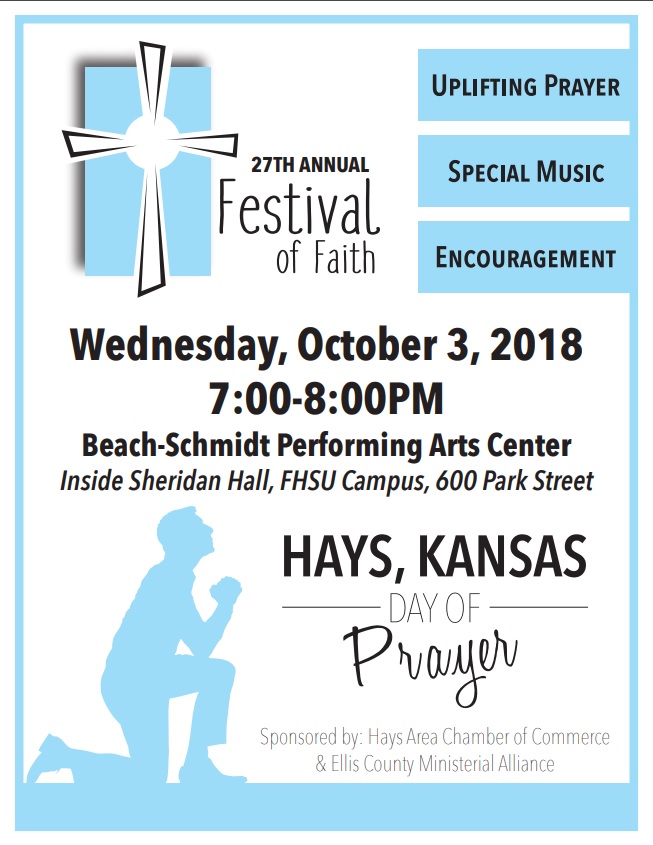
The annual Festival of Faith returns to Hays on Wednesday at Beach-Schmidt Performing Arts Center.
This year marks the 27th year for the annual event celebrating faith and unity.
The 2018 Festival of Faith is a call to area Christians to come together in prayer.
“This is an event where Christians from all different churches come together for one common service,” Brandon Prough, head of the committee that puts together the Festival of Faith said. “The last couple years we have been focusing on prayer for our community. It’s a way for us Christians to get outside of our normal churches and come together to lift up our community.”
Wednesday’s event runs from 7 to 8 p.m. at the Beach-Schmidt Performing Arts Center on the campus of Fort Hays State University.
The annual Festival of Faith will once again be rebroadcast on Eagle Cable Channel 14. Check Hays Post for broadcast times.
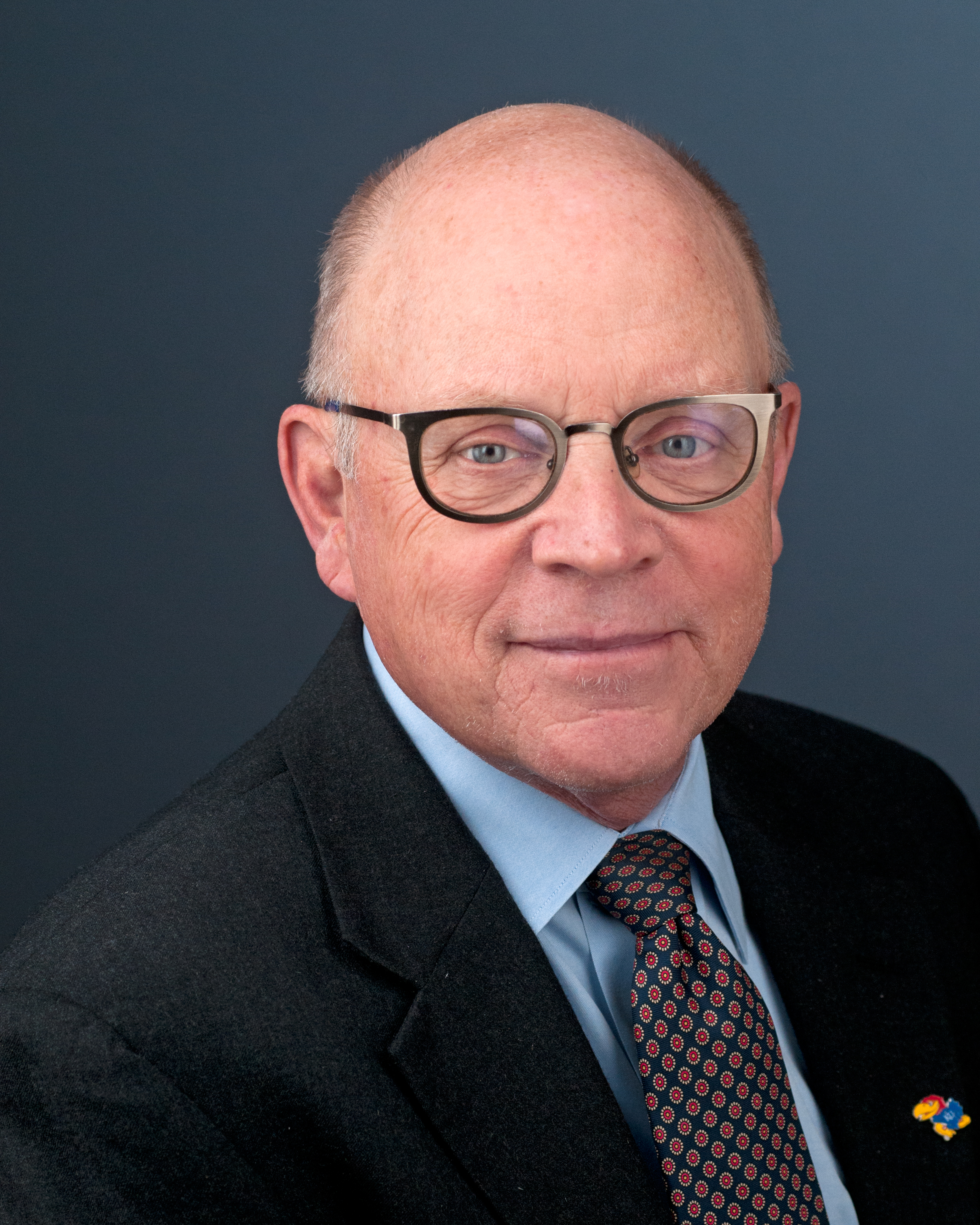
Burdett Loomis, Professor, Political Science, College of Liberal Arts and Science, University of Kansas
From the vantage point of November 2019, the chaos of Kris Kobach’s initial year as governor seems inevitable. The ambitious Kobach, much like Sam Brownback, assumed that a small-state governorship could propel him into the national spotlight.
Remarkably, it has taken Kobach only a year to crash and burn, compared to Brownback’s entire first term.
In 2018, a clear majority of Kansas voters chose someone other than Kobach, who defeated Democrat Laura Kelly, 45%-44%, with 11% of the electorate selecting Independent Greg Orman (8%) or two other Quixotic candidates. Although Republicans captured both legislative chambers, just half of these GOP legislators have actively supported him.
With little popular or legislative support, his agenda — lower taxes, less spending, fewer immigrants, more stringent voting restrictions, less regulation, and limits on judicial review of education spending through a constitutional amendment – proved dead on arrival. But Governor Kobach didn’t seem to care, even as his taxing and spending proposals foundered in the Legislature.
Like his fellow far-right governors in Illinois (Bruce Rauner) and Maine (Paul LePage), Kobach embraced bruising battles with legislators and the resulting policy deadlock.
When the Kansas Supreme Court ruled that schools needed an additional $200 million to resolve the “adequacy” question, Kobach essentially said, “Over my dead body,” and vetoed a series of legislative attempts to address the issue.
Unsurprisingly, Kobach turned to executive actions to seek some victories. First, he categorically rejected accepting any federal funds for social services, saying, “Our goal is to reduce dependence and get everyone back into the workforce.”
Subsequently, after legislators rejected his proposal to strip in-state funding from undocumented Kansas high school graduates, Kobach threatened to withhold funding for institutions that offered such rates. This accompanied his budget proposal to reduce higher education funding by ten percent.
Kobach also vowed to make Kansas the test case for aggressive cooperation with Immigration and Customs Enforcement to deport undocumented immigrants. The ACLU immediately sued, noting its overwhelming record of victories over Kobach in litigation. Kansas farmers, ranchers, and meatpackers immediately felt the pinch of a declining work force, with no native Kansans picking up the slack. The governor expressed no concern, arguing that undocumented immigrants and their families were simply “self-deporting.”
As the legislative session wrapped up, the moderate-conservative majority passed omnibus funding that increased state spending by four percent, less than the revenue gains over the previous year. Governor Kobach rejected that budget, provoking a back-and-forth round of budget bills and gubernatorial vetoes.
By June 30, the end of the fiscal year, neither school finance nor the overall budget had been resolved. The Supreme Court threatened to take over Kansas schools, but demurred, waiting for a special session to address school finance.
Kobach began the July special session by demanding that lawmakers reduce the budget and resist the Supreme Court’s dictates. Around the state, newspapers unanimously condemned his positions; this simply strengthened the governor’s resolve.
The special session ended in deadlock, redeemed only by the passage of the first of month-to-month continuing resolutions that maintain current spending levels.
Despite the governor’s policy debacles, he continues to appear on Fox, write for Breitbart, and appeal to the farthest right third of the electorate, all the while claiming his administration as a great success. (Sounds familiar?)
That’s where we stand now, a year after Kobach’s narrow victory. Fiscal deadlock, no policies, a constitutional crisis, and, once again, an ambitious, delusional governor who makes Kansas the butt of jokes across the country and around the world.
Burdett Loomis is an emeritus professor of political science at the University of Kansas.
The Department of Leadership Studies at Fort Hays State University has selected its 2018-2019 scholars for the Voss Advanced Leadership Undergraduate Experience.
To complete the program, students will plan and implement a project in either civic and non-profit leadership, corporate leadership or leadership research. Mentors will coach students throughout the academic year. Scholars are awarded a $350 stipend each semester.
VALUE is a year-long, co-curricular experience designed to challenge and develop leadership skills in upperclassmen. The program has two objectives: 1) to teach students how to put ideas into action and implement, execute and transform a vision into reality; and 2) to promote teamwork and collaborative skills in order to be successful.
Applicants must be juniors or seniors in good academic standing during their time in the program who have completed the leadership studies certificate and are willing to commit themselves to a deep degree of scholarship and service. Faculty and staff can also make nominations.
Scholars are listed alphabetically by hometown: Diane Hernandez-Ramirez, a senior majoring in organizational leadership and sociology, Kansas City, will be mentored by Katie McKee, assistant professor of leadership and social justice at North Carolina State University, Raleigh. Jonathan Jett, a senior majoring in organizational leadership from Prattville, Ala., will be mentored by Dr. Brent Goertzen, professor of leadership studies at Fort Hays State. Allison Muth, a sophomore majoring in organizational leadership from Great Bend, will be mentored by Laura Dougherty, director of operations at the FHSU Foundation. Dane Murzyn, a sophomore majoring in organizational leadership from Brighton, Colo., will be mentored by Randy Flowers, assistant dean of students and director of student life at Baker University. Raenee Patterson, a junior majoring in organizational leadership from Norton, will be mentored by Tammy Wellbrock, executive director of the Hays Area Chamber of Commerce. Larisa White, a junior majoring in organizational leadership and social work from Sabetha, will be mentored by Kendal Carswell, assistant professor of social work at Fort Hays State.
About VALUE
The Voss Advanced Leadership Undergraduate Experience is designed to develop the most promising undergraduates into powerful agents for good, following their educational experience at Fort Hays State University. The VALUE program is a year-long curricular and co-curricular experience for upper-division students. Students will be challenged to embrace and dedicate themselves to deeper individual development. Students choose to complete a project in the areas of leadership scholarship/research, non-profit/civic leadership, or corporate leadership
To learn more about the VALUE program and this year’s scholars, visit https://www.fhsu.edu/leadership/value/.
For more information, contact Kaley Klaus, director, at [email protected] or 785-628-4384.
 Today
Today