We have a brand new updated website! Click here to check it out!

HAWVER: Cross-party endorsements and ‘has-beens’

Martin Hawver
Boys, remember when your father told you to “think twice” before you speak on a first date?

Girls, remember when your mother told you that you can tell a lot about a boy on a first date by quick responses to questions—that those quick retorts are really what the guy thinks?

Who would ever think that those teenager tips from parents would turn out to be important or not when you’re voting for a governor?

We’ll likely see how that advice turns out in the governor’s race, whether an ill-considered slap at “tired has-beens clinging to the part pretending to be Republicans when they so clearly left the party a long time ago…” will split the Republican vote.

That remark came from Republican Secretary of State Kris Kobach’s campaign spokeswoman last week after former U.S. Sen. Nancy Landon Kassebaum, R-Kan., endorsed Democrat Sen. Laura Kelly for governor.

The split: A longtime respected Republican from back in the “old days” when there was more governing and less political sloganeering in campaigns, and today, when there appears to be more catch-phrase and sloganeering in political races.

Now, this may just turn out to be an issue where Democrats can hold the coats of Republicans of all ages while they fight it out under the sheets for just who Republicans want running Kansas, who they want running their political party.

***

There are still some of those Republican “has-been” voters out there who remember back to 1978–yes, 40 years ago–when they elected the first-ever woman U.S. senator to a full Senate term and didn’t just fill out the remainder of the term of her husband.

That was a pretty progressive move for Kansas Republicans who can remember the days when cars had bench seats and an FM radio was an extra-cost option on a new car.

Democrats last week just fired back that the “has been” remark was impolite and inferred that even though it was a fight within the Republican party, it wasn’t respectful.

How would you like to campaign against a candidate who had insulted many members of his own political party, a party that once had elected Kobach to the state party chairmanship? Probably not a bad deal…

***

The whole concept of cross-party endorsements is relatively new to Kansas. It was the 2014 gubernatorial election cycle when a few former GOP leaders endorsed a Democrat for governor. It didn’t work, and Gov. Sam Brownback was elected to a second term in office.

But the effect of that intra-party jab might show up in a gubernatorial election this year. And Kassebaum joined the list of other former Republican leaders who are endorsing Kelly.

Of course, there are a lot of other issues besides endorsements that are in play in the gubernatorial election. And many are relatively party-line issues, ranging from welfare and Medicaid to school and highway finance and tax policy.

There’s the chance that the “has been” voters will just put aside that intra-party jab as an ill-considered remark from youngsters.

Key is that no party has “extra” voters that they can lose through an off-hand remark.

The numbers, remember, are that in Kansas there are about 796,000 registered Republicans, 436,000 registered Democrats, 558,000 unaffiliated voters…oh yes, and 16,800 Libertarians.

Not sure how many Republican votes that Kobach can afford to lose or whether the remark gets him unaffiliated votes. Or whether there are young Democrats out there who aren’t sure why a Republican would support a “real” Democrat.

This is another one to see how it comes out…

Syndicated by Hawver News Company LLC of Topeka; Martin Hawver is publisher of Hawver’s Capitol Report—to learn more about this nonpartisan statewide political news service, visit the website at www.hawvernews.com

Ensemble music group Saint Louis Brass to perform at Beach/Schmidt

FHSU University Relations

Saint Louis Brass quintet, delivering top notch performances all over the country since 1964, will be at Fort Hays State University at 7:30 p.m. Tuesday, Oct. 2, in the Beach/Schmidt Performing Arts Center.

Trumpet players are Allan Dean, Yale University, Miki Sasaki, New York City, and a recent Indiana University graduate, Victoria Knudtson. Daniel Perantoni, Indiana University, is the tubist, and Melvyn Jernigan, formerly with the St. Louis Symphony Orchestra, is on trombone.

They will play many musical selections from their newest CD, “Pops Music of the Americas.” The concert will also include movements from three of their commissions over the years.

New additions for the tour include Anthony Plog’s “Animal Ditties” with music behind the Ogden Nash poem, a new jazz medley, “Tribute to Pops” and “St. Louis Blues” with hits from Louis Armstrong, and the hard driving tango “Libertango” by the Argentinian composer Astor Piazzolla.

The quintet brings with them many ancestors of the brass family of instruments, including the animal’s horn and the conch shell, as well as a short trumpet that was found in King Tut’s tomb. The group also has a straight trombone from the 14th century, a time before man knew how to bend metal.

Saint Louis Brass will also offer free master classes earlier, at 1:30 p.m. in Malloy Hall, open to the public.

Tickets are $5 for the public and free for FHSU students with their student ID. For more information about the concert and the Saint Louis Brass, visit https://bit.ly/2MNnTqP.

SCHLAGECK: Keep kids safe this harvest

John Schlageck writes for the Kansas Farm Bureau.

Keeping children safe while they live, play and work on farms can be challenging. It’s even more difficult during harvest season – a peak time for agricultural injuries.

Long hours, a flurry of activity, less-than-ideal weather conditions and work involving large machines make corn, milo and soybean harvest a potentially dangerous period.

Fall harvest marks the pinnacle of a half year’s effort to produce these crops. During harvest, farmers work long, hard hours. Fifteen-minute meal breaks are about the only real time off in days that often stretch 10 hours. People and machines are pushed to their limits.

While every machine – combine, truck, tractor, grain cart or auger – provides its own unique hazards, operator stress or error account for most harvest accidents. Years of safety features built into these machines are useless without operator safety. Exceed human limitations and accidents are bound to follow.
Carrying an extra passenger is also a safety concern. Children or young adults can fall from cabs. It’s instinct to hold onto something when jarred off balance. Some people have reached for the door handle, accidently hitting the latch and fallen out.

Operator knowledge and attitude remain the key to a smooth, well-oiled fall harvest. A safe operator knows his or her skills, limitations and condition, both physical and emotional.

The safety-conscious operator knows each piece of equipment, its condition, capacities, limitations, hazards and safety equipment. Such an operator is constantly monitoring field and weather conditions.
It’s critical to train young people and go over safety precautions before harvest begins. Beyond the tasks associated with driving harvest equipment, recognizing potential hazards should be discussed.

Consider these safeguards:
Securely fasten seat belts.
Avoid ditches, embankments and holes if possible.
Reduce speed when turning, crossing slopes and on questionable surfaces.
Avoid slopes too steep for operation.
Do not allow passengers – buddy seats may be a safer way.
Be sure everyone is a safe distance before moving.
Operate combines, tractors, trucks and grain carts as smoothly as possible.

Every fall In Kansas, thousands of acres of corn, milo and soybeans add to the pressure of slicing through those crops before foul weather or winter comes to call. With this added pressure comes the desire to take chances, short cuts and extend working hours. Such behavior only adds to fatigue and high levels of stress and tension.

Remember, harvest will take its toll if you don’t take breaks. Eating balanced meals, even if you only take 15 minutes is important.

Stop the machine. Crawl off and relax a few minutes while you’re eating.

Drink plenty of water, tea or other cold liquids during what can be hot, dry days. Jump out of your machine for such breaks at least every hour.

Walk around the machine to limber up. This will also allow you to check for possible trouble spots on your machinery.

Before harvest begins, check your equipment and perform the proper maintenance. Consult your operator’s manual or dealer if you have questions. Well-maintained machinery reduces the chance for breakdowns and related aggravation in the field.

Delays due to breakdown only force harvest crews to work longer and harder to catch up. Such delays also increase the chance of accidents during this catch-up period.

Pulling pre-harvest maintenance is easier and less frustrating than fixing such problems in the cold or heat, dirt and sweat of the harvest field. Reduce your chances of aggravation now – it will be worth it.

John Schlageck is a leading commentator on agriculture and rural Kansas.

Windy, cooler Tuesday

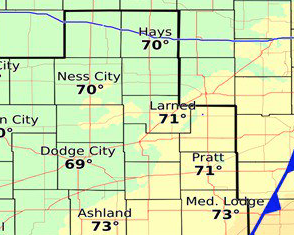
Today A 20 percent chance of showers before noon. Cloudy through mid morning, then gradual clearing, with a high near 69. Windy, with a north wind 9 to 14 mph increasing to 23 to 28 mph in the afternoon. Winds could gust as high as 39 mph.

Tonight Mostly clear, with a low around 43. North wind 5 to 14 mph.

Wednesday Mostly sunny, with a high near 70. North northwest wind 5 to 8 mph becoming south southeast in the afternoon.

Wednesday Night Mostly clear, with a low around 48. South wind 8 to 10 mph.

ThursdaySunny, with a high near 78.

Thursday NightMostly clear, with a low around 52.

FridayA 20 percent chance of showers after 1pm. Mostly sunny, with a high near 65.

AAA: Kansas gas prices up, in contrast to national trend

Average Kansas per-gallon price up 4 cents to $2.70; regional refinery maintenance blamed

AAA

TOPEKA – Despite a majority of states across America experiencing falling or flat gas prices, Kansas was part of a regional trend that saw prices at the pump rise over the past week. The average cost of a gallon of regular gas in Kansas rose four cents this week to $2.70. Several Great Lakes and Central states experienced increased gas prices due to shutdowns of a half dozen refineries in the region because of maintenance issues.

“Generally this time of year, we see gas prices that trend downward, and that is the case in much of the country,” said Shawn Steward, AAA Kansas spokesman. “The refinery issues in our part of the country just go to show you that retail fuel prices are always evolving, sometimes impacted by unexpected factors and, overall, hard to predict. Kansas does still fare very well, though, with gas prices 15 cents below the national average and 12th cheapest in the nation.”

Of the 10 Kansas cities regularly highlighted by AAA Kansas (see chart below), seven saw their gas prices increase, led by Salina (+10 cents), Garden City (+6) and Wichita (+5). Hays, Kansas City, Kan. and Lawrence all saw a 1-cent decline at the pumps.

Click to expand

According to AAA Kansas, this week’s Kansas gas price extremes are:
HIGH: Kensington (Smith County) – $3.01
LOW: Newton (Harvey County) – $2.56

National Perspective
Motorists in 32 states are welcoming cheaper or stable gas prices at the start of the workweek. Today’s national gas price average is $2.85, which is the same price as last Monday, one-cent more than last month and 27-cents more expensive than this time last year.

The latest Energy Information Administration (EIA) data reports that both U.S. gasoline demand and stocks declined signaling supply and demand are in sync post the summer. This is true for most regions, except in the Great Lakes and Central region where prices are increasing due to maintenance at a handful of refineries.

While the national gas price has remained stable throughout September, the price of crude oil started to increase in the last week.

“Crude oil prices pushed past $70/bbl for three days last week,” said AAA Kansas’ Steward. “If they trend above this level for a sustained amount of time, we could see a national trend reversal in pump prices meaning it may cost more to fill-up as we get closer to the end of the year.”

Today’s national gas price extremes:
High: Hawaii – $3.78
Low: Alabama and Mississippi – $2.53

Western Kan. law enforcement on lookout for pickup involved in chase

Law enforcement authorities are on the lookout for a vehicle involved in a chase Monday.

According to a release from the Sherman County Sheriff’s Office, police are looking for a new, dark red quad-cab Dodge pickup that was involved in a short chase in Rawlins County.

“If spotted call 9 1 1 and do not approach,” the department advised. “This warning is being broadcast in the Sherman County area because the vehicle was spotted in Cheyenne County on Highway 36. The vehicle may be looking for fuel. Please make sure your vehicles and fuel sources are secure. Again this will be a newer Dodge quad cab pickup truck. Dark red in color with Colorado temporary tag. Call 911 if you see this vehicle.”

Police: Suspects involved with home break-ins along I-70

TREGO COUNTY — Law enforcement authorities are investigating a report of suspicious activity in Trego County.

On Monday police received information of an unknown couple in the Hays area who are possibly westbound on Interstate 70, according to the WaKeeney Police Facebook page.

The couple are suspected of breaking into homes. They allegedly approach homes and the woman will knock on the front door. If there is no answer, her accomplice will enter the residence from the rear.

The only information available is a white female with a ponytail on the top of her head in the company of a black male, according to the police department post.

If anyone suspicious is seen knocking on doors or if someone comes to your residence that you are suspicious of and you don’t feel comfortable answering your door, contact the WaKeeney Police Department at 785-743-5711 or, if immediate assistance is needed, call 911.

News From the Oil Patch, Sept. 24: Ellis Co. state’s top producer

By JOHN P. TRETBAR

The Kansas Geological Survey reports Kansas producers pumped just shy of three million barrels of crude in June, bringing the mid-year total statewide to 17.558 million barrels. The state is about half a million barrels behind the running total at this time last year, which was the worst year for Kansas oil production since 2005.

Ellis County leads the way through June of this year with 1.31 million barrels produced, adding about 218,000 barrels for the month. Haskell County was next with 1.25 million barrels through June. Finney County’s six-month total was just over 875,000 barrels, beating out Barton County with 855,000. Rounding out the top five was Russell County with 792,000 barrels produced through June. Stafford County weighs in with more than 520,000 barrels for the first six months of the year.

Total oil production through June of 2018:
State total: 17,558,505 bbl
Ellis County: 1.315M bbl
Haskell County: 1.253M bbl
Finney County: 875K bbl
Barton County: 855K bbl
Russell County: 792K bbl
Stafford County: 520K bbl

Out of just nine completed wells reported across Kansas last week, four were dry holes, including all three completions in western Kansas (in Rooks, Finney and Ness counties). Weekly reports from Independent Oil & Gas Service show six newly-completed wells in eastern Kansas, including five producing oil wells and one dry hole in Bourbon County. So far this year, Kansas operators have completed 1,117 wells, including 230 dry holes (about 20%). By this date five years ago, operators had completed more than 4,500 wells. Out of those, 829 were dry holes (that’s about 18%).

Operators filed 39 new drilling permits across Kansas last week, 15 in Western Kansas and 24 east of Wichita. There are two new permits in Barton County and one in Stafford County.

In Kansas the active rig count was up nearly seven percent. Independent Oil & Gas Service reports 13 rigs in eastern Kansas, and 34 rigs west of Wichita that are drilling or preparing to, which is up three for the week. Operators are preparing to spud one well in Barton County, three in Ellis County and one in Stafford County. Baker Hughes reported 1,053 active drilling rigs across the U.S. Friday, down two for the week. Texas reported an increase of six rigs, Oklahoma was down three. Canada reports 197 active rigs, down 29 for the week.

Weekly crude-oil inventories continue to drop. The U.S. Energy Information Administration on Wednesday reported the fifth straight weekly decline, a drop of more than two million barrels for the week ending September 14. U.S. stockpiles are about 3% below the five-year average for this time of year. Imports are on the rise, averaging nearly 7% more than a year ago.

The government reported a slight increase in U.S. crude production, reaching 10.97 million barrels per day last week.

Russia is once again setting post-Soviet records for crude oil production, between 11.29 and 11.36 million barrels per day. Those numbers top their record set in October 2016 just before Russia’s production cut deal with OPEC began.

At least one Russian oil firm is bracing for possible new U.S. sanctions. Traders who deal with the firm told Reuters that Russian oil producer Surgutneftegaz is pushing buyers to agree to pay for oil in euros instead of dollars if the need arises. Russian firms inclusion on a Treasury Department blacklist effectively cuts them off from conducting any deals in dollars, which is the lifeblood of the global oil industry. The company’s chief executive is already on that blacklist.

One of the largest oil and gas drillers in West Texas has bought an interest in a sand mine there, as the market value for frack sand more than triples. Pioneer Natural Resources announced an agreement with U.S. Silica Holdings to buy a 15-year interest in the LaMesa sand mine north of Midland, Texas. The mine is expected to provide Pioneer at least 2 million tons of sand a year by 2020, and could cut their sand costs in half. Pioneer continues its sale of assets in the Eagle Ford play and elsewhere to become a Permian Basin “pure play.”

Pipeline capacity shortages and higher prices continue to drive up the amount of oil being transported by rail. According to the Association of American Railroads, the U.S. moved 11,649 petroleum tanker cars during the week ending September 8. That’s up 47% from the same week a year ago. So far this year, we’re averaging more than 10,000 oil by rail cars per week, an increase of 12.7% from a year earlier. In Canada, the average is more than 8,000 rail cars of crude per day, up nearly 17% from last year.

Ellis schools on temporary lockdown Monday morning

ELLIS — USD 388 schools were on temporary lockdown late Monday morning, while local and county law enforcement searched for a burglary suspect, the district informed parents via email early Monday afternoon.

“We were informed by police that were was no danger to USD 388 school buildings, but a lockdown was instituted for precautionary measures,” the district said in the message to parents.

The Ellis Police Department was unavailable for comment early Monday afternoon.

Check Hays Post for more as details become available.

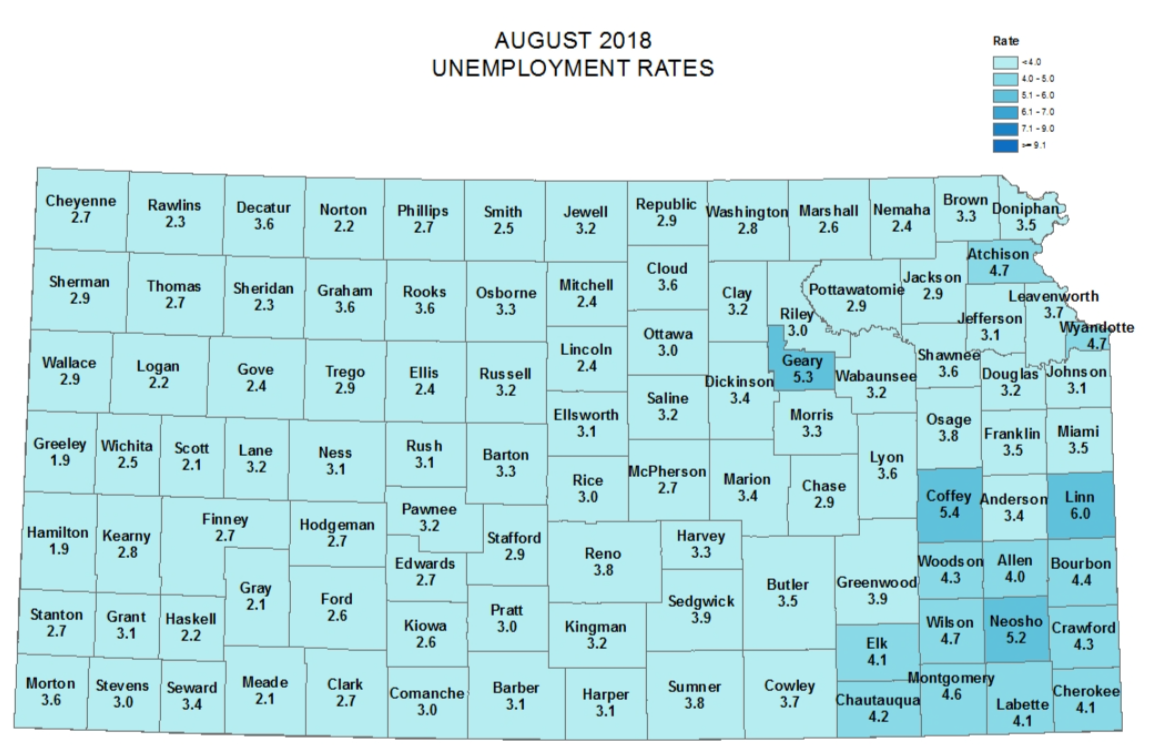
Ellis County unemployment rate dives to 2.4 percent in August

Preliminary estimates reported by the Kansas Department of Labor (KDOL) and Bureau of Labor Statistics (BLS) show a seasonally adjusted unemployment rate of 3.3 percent in August. This was down from 3.4 percent in July and down from 3.6 percent in August 2017.

The unemployment rate in Ellis County fell nearly half a percentage point to 2.4 percent in August.

The jobless rate in July was 3 percent.

Every county in northwest Kansas posted rates below the 4 percent mark, with Rooks and Decatur having the highest unemployment rate at 3.6 percent.

Greeley County in far western Kansas posted the state’s lowest jobless rate at 1.9 percent.

Seasonally adjusted job estimates indicate total Kansas nonfarm jobs increased by 3,600 from July. Private sector jobs, a subset of total nonfarm jobs, increased by 300 from the previous month.

“August estimates indicate a tightening labor market in Kansas. The number of private sector jobs continued to increase and employers reported over the year growth in average weekly earnings for both goods producing and service providing industries,” said Labor Economist, Emilie Doerksen. “The household survey also shows a tightening labor market, with the unemployment rate falling to 3.3 percent.”

Since August 2017, Kansas gained 26,600 seasonally adjusted total nonfarm jobs and 21,000 private sector jobs.

InVEST education program names Hays man national volunteer of the year

Education program honors Kansas insurance professional and New York high school teacher

Independent Insurance Agents and Brokers of America

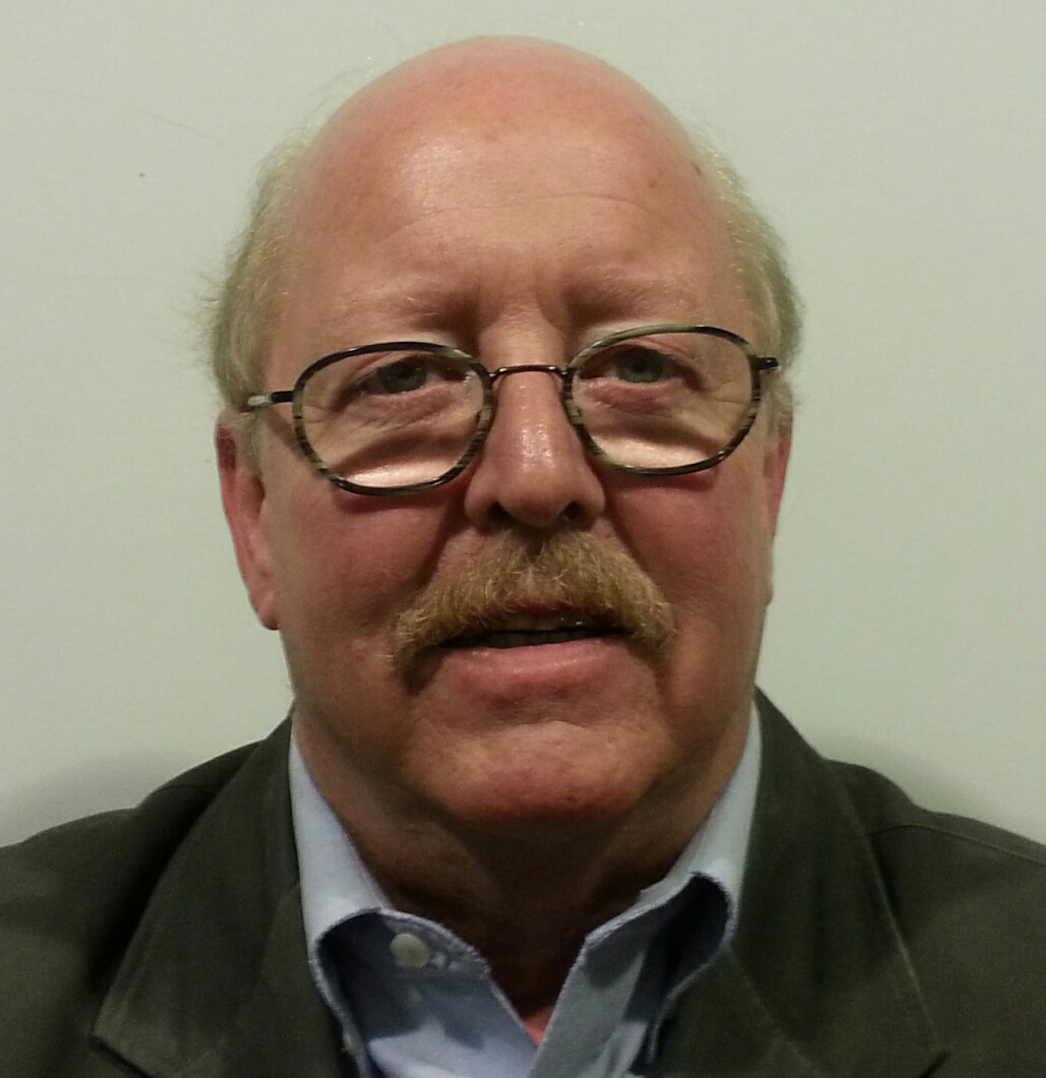
ALEXANDRIA, Va. – InVEST has awarded the 2018 InVEST Teacher of the Year Award to Linda Bruno, a business teacher at Dryden High School in upstate New York and the 2018 InVEST Volunteer of the Year award to John Scheck, a claims representative at Insurance Planning Inc. in Hays.

Founded in 1970, the InVEST program offers free online insurance education, lesson plans and activities to teachers and insurance professional volunteers nationwide. Currently there are 890 InVEST programs throughout the United States with over 31,000 students participating in the insurance education program. InVEST is a key driver in attracting new talent into the insurance industry which is estimated to have 400,000 open positions in the next decade.

Scheck, IIABA photo

The annual awards honor an InVEST teacher and an InVEST volunteer who have made substantial contributions to their students by teaching them about insurance through the InVEST online curriculum. Teachers and volunteers also work to highlight the diverse career options in the insurance industry by bringing professionals to speak in their classrooms and arrange field trips to insurance agencies and companies.

“Dedicated teachers and volunteers like Linda and John are key to the success of the InVEST program which provides much needed financial literacy education,” says Lindsey Shank, InVEST board chair and vice president at McGriff Insurance Services in St. Petersburg, Florida. ” InVEST is proud to have stellar instructors like Linda and John as part of our program.”

InVEST teachers educate their students about insurance through an interactive and engaging curriculum. Bruno’s students enjoy field trips to local insurance agencies where they can job shadow insurance professionals. They also role play with agents who visit their classroom in scenarios like buying auto or homeowners insurance or even starting their own (simulated) insurance agency.

“I’m so proud when InVEST graduates return to my class as active workers in the insurance industry to give presentations to my current students,” Bruno says.

As an InVEST volunteer, John Scheck has made a significant contribution in fostering the growth and development of young people in the insurance industry. Scheck currently champions the InVEST program in a local public school and is introducing the program to several other central Kansas high schools.

A strong advocate for inviting insurance representatives to get in front of students and share their experiences and expertise, Scheck even encourages his students to attend local conferences or seminars to learn even more about the industry.

“InVEST has given me the opportunity to give back to my community,” Scheck says. “I see the program helping to create a youth movement to develop new talent for the insurance industry.”

Founded in 1970 and based in Alexandria, Virginia, InVEST promotes insurance education to attract individuals to pursue a career in the insurance industry. Each year, the program prepares thousands of students for insurance-related careers with a hands-on curriculum taught in high schools, adult education centers and colleges. As a 501(c)(3) educational trust, InVEST benefits from the support of numerous insurance organizations, hundreds of agencies, brokers and volunteers.

The Independent Insurance Agents and Brokers of America (IIABA or the Big “I”) was founded in 1896 and is the nation’s oldest and largest national association of independent insurance agents and brokers, representing a network of approximately a quarter of a million agents, brokers and their employees nationally. Its members are businesses that offer customers a choice of policies from a variety of insurance companies. Independent agents and brokers offer all lines of insurance — property, casualty, life and health — as well as employee benefit plans and retirement products.

Copyright Eagle Radio | FCC Public Files | EEO Public File