PRATT – Experience Kansas state parks in a whole new way: a group bike ride! As part of the Adventure Cycling Association’s biggest event in North America – “Bike Your Park Day” – outdoor lovers from all over will come together September 29 to enjoy the fun and beauty of our state parks and public lands by bicycle.
If you’ve got air in your tires, staff at select Kansas state parks have events for you to participate in! And to really add to the celebration, you can win prizes, too. Everyone who registers (www.adventurecycling.org) will receive a special “Bike Your Park Day” sticker by mail and will be entered for a chance to win a Co-Motion Cycles Divide bike or two Amtrak tickets to Glacier National Park.
Participating Kansas State Parks Cedar Bluff State Park-WaKeeney
Course location: North side of the park
Time: 8 a.m.
Distance: 3 miles
This course is all pavement, with some hills. Participants can expect an easy to moderate ride. Following the ride, participants can enjoy refreshments inside the park office.
Contact: (785) 726-3212
Glen Elder State Park
Course location: Waconda Trail
Time: 9 a.m.
Distance: 3 miles
Participants can expect an easy ride, but if a little extra “adventure” is desired, both “advanced” and “kids” obstacle courses will be set up.
Contact: (785) 545-3345
Meade State Park
Course location: Eagle Trail
Time: 2 p.m.
A mix of pavement and hard earth make up the terrain for this course. Participants can expect an easy to moderate ride, which will begin at the west side of the park office parking lot.
Contact: (620) 873-2572
Pomona State Park
Course location: Flint Hills Nature Trail
Time: 10 a.m.
Distance: 24 miles
Participants will meet at Pomona State Park, take a quick tour of the area, and then bike to Pomona, KS and back. A support team will be with the group, and the ride will include two rest stops.
Prairie Dog State Park-Norton
Time: 8 a.m.
Distance: 5 miles
Though one mile of this course is gravel, the majority of the ride will take black on asphalt. Participants can expect a moderate ride.
Contact: (785) 877-2953
There is no cost to participate; however, participants must bring their own bike and have an annual vehicle permit or purchase a daily vehicle permit, $5.00, to enter a Kansas state park.
The United Way of Ellis County will be hosting a Dine-Out Day with Whiskey Creek on Monday, September 24 from 5 p.m. to 9 p.m. at 3203 Vine St. in Hays.
Come join in the social media fun! A portion of the proceeds will benefit the United Way and their 15 partner agencies.
Watch for upcoming Dine-Out Days with participating restaurants online at www.liveunited.us.
Edward Cross is president of the Kansas Independent Oil & Gas Association.
By EDWARD CROSS Kansas Independent Oil & Gas Association President
More often than not, activists’ comments and media accounts continue to get it wrong when it comes to the issue of injection wells and induced seismicity. Whether this frustrating pattern is due to a deliberate mischaracterization of the facts or if an honest lack of understanding of the issue is to blame, the unfortunate byproduct in both instances is a misinformed public. The information provided by activists and media often confuses the public with assertions that are out of context and need more information for a complete and informed discussion. So, it is worth examining some of these claims to see just how much they diverge from reality.
Regarding seismic activity in Kansas, here are some facts. Prior to 2015, there were very few seismic monitors in Kansas. Therefore, very few seismic events were recorded. When the State Task Force on Induced Seismicity was formed in 2014, one of the first things they did was install additional seismic monitors in south-central Kansas. When you install more monitors, you will almost assuredly measure more seismic activity. With these new monitors installed, more seismic events were recorded (most which are not felt earthquakes). But, that is not to say these events were not occurring prior to 2015, only that they were now being recorded.
The Kansas oil and gas industry has taken the issue of induced seismicity very seriously. The Kansas Geological Survey, Kansas Corporation Commission and Kansas Department of Health & Environment are devoting significant resources to analyzing seismicity causes. Industry has supported these efforts to provide assurance that an improved understanding of seismic issues is available to all. These efforts are producing results. The latest data (September 13, 2018) shows a 41% decrease in seismic activity in Kansas since January 2015.
Let’s look at the injection well application notice issue. Here are the facts. Between October 2008 and February 2018, about 4,300 injection well applications were reviewed by the Kansas Corporation Commission (KCC). From these reviews, 1,007 applications regarding 2,111 wells were issued injection permits after operators published notice of the permit application with a 15-day notice instead of the required 30 days. The average time between KCC’s receipt of an injection well permit application and issuance of the permit during that 2008-2018 period was about 90 days. Only 29 applications, or 2.88% of the 1,007 applications, were issued a permit in less than 30 days. It should be noted that 21 of the 29 applications were issued at 28 or 29 days, probably allowing for mailing time.
The injection wells permitted in the 2008-2018 period met the regulatory requirements, protected usable water and correlative rights and helped prevent waste. The discrepancy between the notices published by the operators and the legal protest timeframe is a harmless error that did not violate any KCC regulation. The law is clear that such discrepancies were not fatal defects to the KCC’s jurisdiction or authority to approve the injection applications. Finally, there is no evidence that any person’s due process rights were affected by the publications.
The KCC’s September 6th Order saying no action shall be taken by the KCC against the subject permits in the docket was very pragmatic and appropriate. Arguments by those who called for the KCC to revoke the permits offered no real evidence and used weak logic.
Mischaracterizing oil and gas activity has been and continues to be a common practice and strategy of activist groups across the nation. This pattern of accusation without scientific evidence is intended to create public anxiety about oil and gas production and to discredit effective regulatory programs. Activists across the country commonly assert that the oil and gas industry is under-regulated or even unregulated. These are false assertions. Examination of the issues demonstrates its mendacity.
Nevertheless, they continue tactics to denigrate and demean current state regulatory programs. This is a tired, worn-out, unsuccessful strategy and we now see this happening in Kansas.
We continue to see activist groups attempt to advance political agendas by using fear. Fear has become a principal means of directing public opinion away from the facts, and in the case of injection wells and earthquakes, it is occurring with a well-known and historically acceptable process associated with recovering oil and gas from the earth. Fear of the unknown is primal and instinctive and is part of all of us. I cannot, and will not, criticize the fear of those who are afraid of what they do not know.
Rather, I applaud those who raise relevant questions and want answers concerning activities they do not understand. My criticism is reserved for those who exploit and pander to fear by repeatedly citing unproven anecdotes to advance political agendas.
Several recent studies and reports have found very few injection wells have been linked to induced seismicity, and the risk from these wells is low.
The most recent comprehensive study based on data from the U.S. Geological Survey (USGS) and peer-reviewed studies found that less than one percent of injection wells across the nation and in Kansas have been linked to induced seismicity.
The USGS states in its Myths and Misconceptions regarding induced seismicity that “Most injection wells are not associated with felt earthquakes.”
A report conducted by StatesFirst, an initiative of the Ground Water Protection Council and Interstate Oil & Gas Compact Commission, took a comprehensive look at potential induced seismicity associated with injection wells. The report finds that seismicity linked to oil and gas development is rare; that the risk associated with these rare occurrences are minimal; and that understanding of induced seismicity is growing and mitigation techniques are proving effective. The report also notes that a “vast majority of earthquakes are tectonic, or attributable to natural causes.”
The EPA says Class II injection wells are “a viable technique for subsurface storage and disposal of fluids when properly done.” There is extensive information available on the EPA’s website, which describes how Class II wells “protect drinking water resources” and “prevent surface contamination of soil and water.” A separate section of EPA’s website describes all injection wells, not just the Class II variety, as a “safe” option for disposal.
The bottom line is these studies and more confirm what have long been true – that seismicity induced by injection wells is rare and certainly not a widespread issue. Despite misleading claims exaggerating risks and incorrectly linking seismicity to injection wells, the risk of induced seismicity from injection wells is small, rare, and manageable.
The problem with activist and media reports on injection wells and induced seismicity is they work backward from a conclusion. They try to support their ideas by cherry-picking and misrepresenting data and information to suggest a problem, conveniently ignoring crucial details that would provide a more complete representation of the issues discussed. Their condemnations do not hew to strict scientific precision, but instead are hyperbole, heated rhetoric, and non-verifiable statements of subjective opinion. The reality is this. State regulators, in conjunction with the EPA, carefully oversee injection wells with tight regulations and high operating standards.
Activists and media have the responsibility of reporting and clarifying the facts regarding injection wells and induced seismicity. The facts are readily available. Facts are stubborn things; and whatever may be our wishes, our inclinations, or the dictates of our passions, they cannot alter the state of facts and evidence.
Neither fear-mongering nor unproven anecdotes can conceal or deny that Class II injection wells are safe and well-regulated.
Let’s not be afraid of injection wells.
Edward Cross is president of the Kansas Independent Oil & Gas Association.
Gene PolicinskiTo err is human — but, it would seem, corrections are not seen by many as divine.
Inevitably, when journalists in all kinds of mediums start fresh each day, sometimes assembling the equivalent content of a paperback book, mistakes will be made.
Once upon a time — ironically, in a time when a free press was held in higher public esteem though mistakes were made — corrections were made less frequently and, at least in newspapers, often placed in lesser-read spaces.
As first thought, efforts to correct errors more quickly and prominently should bring both praise and satisfaction from news consumers — and for some, it does. But for others, the mere existence of corrections (and let’s count the lesser cousin, “clarifications” too) are signs of media malfeasance, proof that so-called “fake news” exists or is grounds for online versions of public floggings.
There’s no question that news operations should be called out when mistakes are made. Social media has made that calling much easier and much louder.
Case in point: The New York Times’ correction in print editions after the Emmy Awards, noting “A picture caption … using information from a photo agency, misidentified a woman presenting the award for outstanding lead actress in a comedy series. The woman was Angela Bassett, not Omarosa Manigault Newman.” An earlier tweet from the Times said that while the caption error was first made by Getty, the photo provider for the image, it was a mistake that should have been spotted and corrected by the Times.
The Twittersphere lit up as critics slammed the newspaper and its website for sins ranging from embarrassing carelessness to the much more serious reminder of the error’s racial overtones. One online post asked, “Do all dark-skinned black women look the same to your editors??”
There is value to be found in considering the full spectrum of those criticisms, particularly if we can avoid simple social media “piling on” that can distract from that value.
But from photo captions and factual errors to plagiarism and invented sources, what other profession fixes missteps so quickly, so publicly and so thoroughly? Answer: Few come to mind, if any.
While examples are available from any number of news outlets that make corrections quickly and publicly, for this discussion, let’s stick with corrections the Times published Sept. 18:
• “The Here to Help column on Friday about three books on the sexism women face in Hollywood misstated the year that ‘Bossypants’ was published. It was 2011, not 2018.
• “An article on Monday … gave an incorrect title for Jens Stoltenberg of NATO. He is the organization’s secretary general, not its general secretary.
• “An article on Sunday … misspelled the surname of the European Union’s Brexit negotiator. He is Michel Barnier, not Bernier.
• “An article on Monday … misidentified the winner of a game between the Los Angeles Rams and the Arizona Cardinals. The Rams won by a score of 34-0.”
None of these corrections — save perhaps the last one, for Cardinals fans — involved an earth-shattering mistake. None rose to the level of whatever fluid description applies today to the highly politicized “fake news.” Clearly, mistakes of facts, not of motives; more oversight than heinous skullduggery.
Yet, even as such corrections take place daily, in pages and online, from news organizations large and small, those who would weaken, restrict or even do away with a free press find traction in such open admissions. Better to continue in a combined effort to make news reports as accurate as possible — and perhaps to extend such self-reviews to social media posts.
Another case in point, yet again from the Times, from its Sept. 19 report about “Debunking Five Viral Rumors about Christine Blasey Ford, Kavanaugh’s Accuser” — in each of the five cited rumors, the newspaper reported, misinformation was conveyed online by a variety of individuals or groups, noting the misidentification and errors remained, days later, uncorrected or without factual support.
An unfortunate truth about the unprecedented Age of Information in which we now live is the huge amount of misinformation or outright fabrication that now clogs the systems bringing us news and information. So let’s end with a very proactive step by the Times in which, on Sept. 17, it invited the public to join its efforts to avoid misinformation.
The item, “If You See Disinformation Ahead of the Midterms, We Want to Hear From You,” says that “as November’s midterm elections approach, The New York Times is looking for examples of online ads, posts and texts that contain political disinformation or false claims and are being deliberately spread on internet platforms to try to influence local, statewide, and federal elections.”
“Times journalists are hoping to use your tips to advance our reporting. If you see a suspicious post or text, please take a screenshot and upload it” using a form provided by the newspaper.
Making corrections in a very public way will not restore all public confidence in a free press — that may be better achieved by not making mistakes in the first place — but fixing errors and taking proactive steps to sort out deliberate misinformation ought to be encouraged, not weaponized.
Gene Policinski is president and chief operating officer of the Freedom Forum Institute. He can be reached at [email protected], or follow him on Twitter at @genefac.
Today
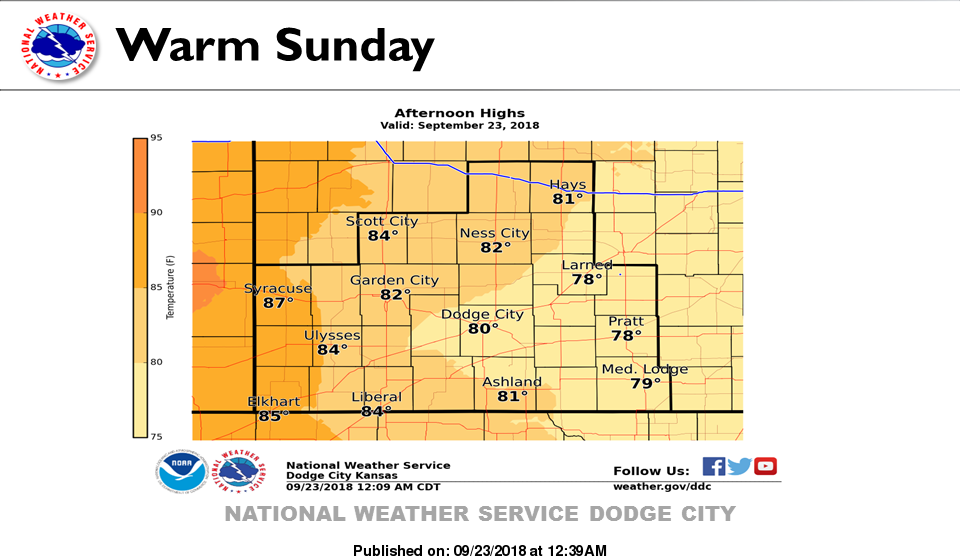
Sunny, with a high near 81. South wind 6 to 16 mph.
Tonight
Clear, with a low around 58. South southeast wind 9 to 11 mph.
Monday
Sunny, with a high near 82. South wind 10 to 14 mph.
Monday Night
A 20 percent chance of showers after 1am. Partly cloudy, with a low around 57. Southeast wind around 8 mph becoming northeast after midnight.
Tuesday
A chance of showers, with thunderstorms also possible after 1pm. Mostly cloudy, with a high near 68. North wind 7 to 17 mph. Chance of precipitation is 30%.
Tuesday Night
Partly cloudy, with a low around 48.
Wednesday
Mostly sunny, with a high near 67.
Wednesday Night
Mostly clear, with a low around 50.
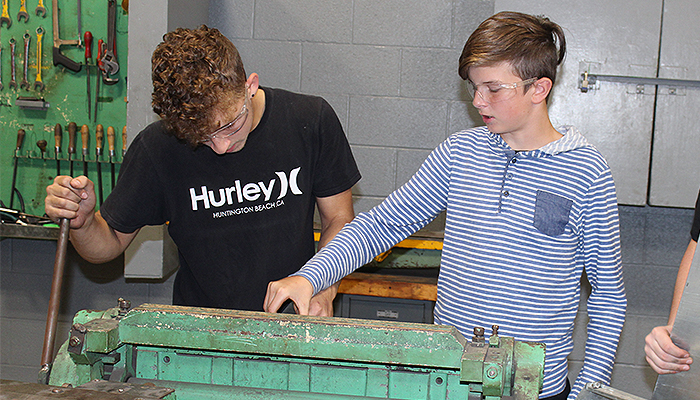
Larry Defoi, sophomore, and Devin Mayfield, freshman, work on a project in a beginning metals class at Hays High School. The Kansas Department of Education has 16 pathways in its Career Technical Education program.
Editor’s note: This is the second in a series about technical training for a new workforce.
By CRISTINA JANNEY Hays Post
At one time, students in high school were told the passport to prosperity led through college and was stamped with a four-year degree.
Although for certain students this is still going to be the case, the Kansas Department of Education has begun to acknowledge in its new accreditation process four-year degrees are not the answer for all students.
“They want to make sure we are tending to the needs of the students from the point of not just focusing on four-year college or four-year university degrees,” Hays USD 489 Superintendent John Thissen said. “They definitely want to focus on trying to prep children to work on HVAC systems, to be plumbers, to end up being an electrician, to be a welder.
“All of these are important jobs, and they are needed and they pay quite well too. We have a history in our school of not paying as much attention to prepping students for those areas.”
The new push is to create individual plans of study that highlight students’ strengths and allow them to explore career opportunities. This is includes many current and emerging careers that will require some sort of post-secondary trade education or certification. The students take surveys through the Career Cruising program that help them refine career choices.
Thissen said the assumption used to be “smart kids” all went to college. That now is not necessarily the case.
“It is crazy to think we would expect our kids to graduate from high school, go to a university, spend four years there and then realize that what I really want to do is be an electrician. That is ludicrous. It doesn’t make sense,” Thissen said. “We should do a better job of prepping the kids through public schools in K-12 that at least they have a good enough direction that they know what they want to do and they are not wasting their own time and their money.”
Sabrina Brown and Luke Letters, both HHS freshman, work on metals projects. The state’s new accreditation project includes individual plans of study, which allow students to explore careers.
KSDE supports 16 career pathways, which are careers the State of Kansas deems as high-tech, high-demand and high-wage, said Chris Dinkel, HHS industrial technology teacher.
Some of these include construction trades; metals and manufacturing; agriculture; business; consumer science; and radio/TV. Many of the pathways require a two-year degree or certificate and then students can go straight to work.
The demand for skilled workers is increasing, and so the education model needs to change with it, according to Dinkel.
Since the turn of the century, about 20 percent of the population were professionals, Dinkel said. They have at least a four-year degree and perhaps higher. These are doctors, lawyers, accountants, therapists, etc. That percentage has not changed per capita much in the last 80 years.
The majority of the remaining workers in the 1920s were unskilled. That has flipped in the last 30 years to a high percentage of skilled laborers.
“Kids coming out of school need to have some type of training, period,” Dinkel said.
Thissen said the KSDE is pushing districts to offer students paths to trade certifications while still in high school. This could be a welding, OSHA safety or Microsoft Office certification.
Matthew Bollig, HHS freshman, handles a piece of sheet metal. HHS teachers work with students on soft skills as well as learning trade skills in the CTE program.
Thissen said students are responding to Career and Technology Education offerings at the high school. The district is considering changing its hiring to accommodate what are now oversized welding classes.
Dinkel, who has been a CTE teacher for almost 30 years, said this need for skilled workers has been recognized, but states, including Kansas, still have challenges in meeting the needs of industry.
Focus on core curriculum and four-year professional training is an important part of K-12 education and must be an academic focal point, he said. However, it’s as important educators recognize the academics and skills needed for those students choosing CTE paths, Dinkel said.
Students who are in CTE pathways might not need calculus, but they might need industry-relevant math and English.
CTE has become increasingly oriented on cooperative learning and project learning. A student learns skills and practices them by building something in metal shop or wood shop. Students take a project from beginning to end and fit their skill sets into that project. There is more focus on skill development than there used to be, Dinkel said.
Schools are also trying to build cross-disciplinary cooperation. Students in a drafting class develop plans for a metal project or part. They learn in metals class how to use those plans to program the CNC plasma cutter. They then use welding skills to assemble the pieces into a final product.
The math instructors are also seeking floor plans from building trades teachers to create real-life problems to use in their classes.
Thissen said the district continues to try to expand its hands-on experiences for students. Hays High students can gain on-air experience on a new HHS radio station that launched last school year. The district IT department is also in talks with the administration about involving students in helping other students or teachers solve technology issues.
In some pathways, students can work in their fields through summer jobs or internships. However, now legally you have to be at least 18 to even operate a drill on a construction site. However, Dinkel said even working entry-level, service job can show a future employer a young person has the soft skills they need to be successful in a trade job later.
Another important thread is providing parents with information about careers within CTE pathways and the opportunities they provide.
Starting wages for technical school graduates are now higher than those for four-year college graduates.
Dinkel said he sees his job as preparing students to have the ability to make a choice between going straight to work, going to a technical school or to a four-year college or higher.
The Career and Technical Education program or CTE has an advisory board made up of people who work in the pathways the high school offers.
They generally say they have three levels of employee. The first level is entry-level. An employee can read, write, do basic math, show up to work on time and has the ability to work with others.
The second level is an employee is someone with some training. They may have a skill, such as welding.
The third level is a person with formal training, certification or experience.
“What industry is telling us is that if I can get someone to show up on time, to be honest and be able to work cooperatively, many of them will say, ‘I will train the rest because I can’t even find that,’ ” Dinkel said. ” ‘I can’t even find someone to show up on time and put in an eight-hour day.’ ”
Thissen said he also hears from employers their need for soft skills among future workers.
“They are finding there are a lot of students that graduate high school who may be knowledgable, but are very much lacking in what we would almost say are common-sense issues,” Thissen said.
Thissen said teaching students these needed skills is almost a hidden curriculum across all classes. He gave the example of mock interviews that were being conducted at the high school by the English department. Students not only learn how to create a written resume, but the practical skills of how to dress and speak during an interview.
“We even see people who are coming in for jobs for the school, and they come in 10 minutes late for an interview. That is already not a good sign, and they may show up in shorts and a tank top—very inappropriate dress for an interview,” Thissen said.
Dinkel said he thought young people have high expectations.
“Young people want to come in and make 12 bucks an hour right off the bat,” he said. “That salary is just not going to be there. That’s not high, but if they can’t make $10 plus an hour, it is below them.”
Dinkel said educators continue to struggle to keep up with evolving industries they are training young people to enter after graduation. Recently the metal shop received a grant to purchase a computer numerical control plasma cutter. Dinkel said CNC is really the direction industry is headed, but Hays is behind other schools who have had the technology for years.
For most, HHS needs another CTE instructor. The school can’t offer robotics, code reading, CNC, or materials and processes, which includes plastics, because the school does not have the staff or the space to do so.
Wood shop classes have 20 to 25 students, which Dinkel said borders on dangerous.
The district sought to expand and remodel its CTE space as part of a recent failed bond election. Thissen said he would still like to see work down in this area of the high school to better use the space and expand the school’s class offerings.
Dinkel sad he thought more young people would stay in the Hays area if there were more high-tech, high-paying jobs. However, the most abundant jobs continue to be lower-paying service jobs.
“It is kind of like fighting Peter to pay Paul,” he said. “Service-related jobs are not going to provide the type of salary that people need to live in this area because the cost of living is pretty high. It is a nasty circle here, because if you bring high-tech jobs in, what are you going to need — more service-related jobs. So which pool are you pulling from?”
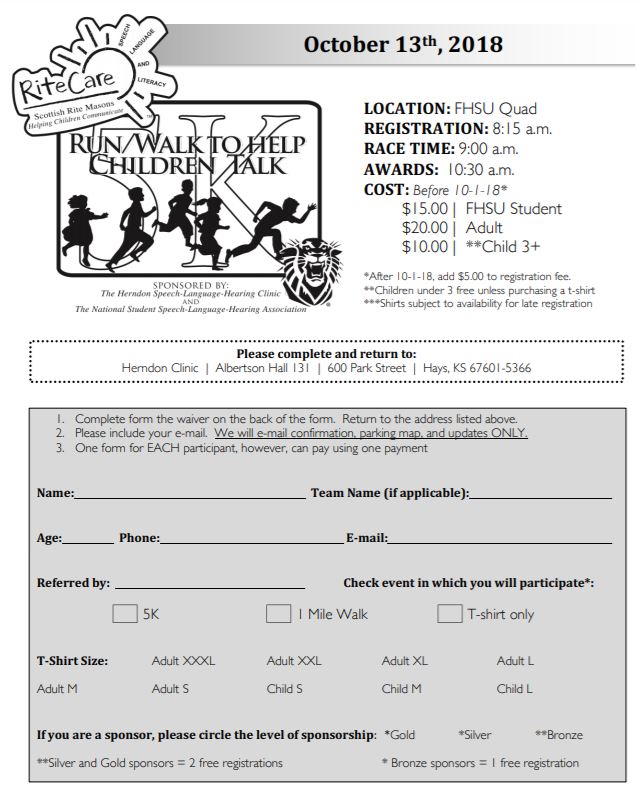
The 6th annual “Run/Walk to Help Children Talk” will be on Saturday, Oct. 13, hosted by Fort Hays State University’s Herndon Speech-Language-Hearing Clinic in partnership with the FHSU chapter of the National Student Speech-Language-Hearing Association.
Registration begins at 8:15 a.m. in the FHSU Quad outside the Memorial Union. Participants can sign up for a one-mile walk, a 5K walk or run, or just for a t-shirt and breakfast at the event. The race route is wheelchair and stroller accessible.
The race, starting at 9 a.m., helps to raise money for child scholarships for speech-language-hearing services and clinic materials at the Herndon Clinic on FHSU’s campus.
“Unfortunately, not all insurances cover speech-language-hearing services or coverage is limited,” said Breanna Taylor, assistant clinical coordinator of the Herndon Clinic and an instructor in the CSD department.
“Scholarships can help these children receive the services they need,” she said.
Registration is $15 for FHSU students, $20 for adults and $10 for children. The early registration deadline is Oct. 1. After the early deadline, registration increases by $5. Breakfast and a t-shirt will be provided at the race for those registered.
Those who cannot attend the race can still sponsor the event or donate to the cause. Sponsors can earn special rewards such as names on the back of the t-shirts.
All proceeds will go towards scholarships for children’s services and clinic materials at the Herndon Clinic.
TOPEKA – The Kansas Department of Health and Environment (KDHE), in conjunction with the Kansas Department of Wildlife, Parks and Tourism (KDWPT), has issued public health warnings for some Kansas lakes for the upcoming weekend and week.
If a lake is under a public health warning for blue-green algae, activities such as boating and fishing may be safe. However, direct contact with water (i.e., wading, skiing and swimming) is strongly discouraged for people, pets and livestock. The lakes currently under a public health advisory:
Warning: Atchison Co. Park Lake, Atchison County
Warning: Carbondale West Lake, Osage County
Warning: Central Park Lake (Pond), Shawnee County
Warning: Frazier Lake, Grant County
Warning: Hodgeman County SFL, Hodgeman County
Warning: Lake Afton, Sedgwick County
Warning: Lake Wabaunsee, Wabaunsee County
Warning:Lakewood Park Lake, Saline County
Warning: Marais Des Cygnes Wildlife Area, Linn County
Warning: Melvern Outlet Pond, Osage County
Warning: Melvern Outlet Swim Pond, Osage County Beach Closure – Visitors can utilize Eisenhower State Park Swim Beach.
Warning: Overbrook City Lake, Osage County
Warning: Rock Garden Pond, Gage Park, Shawnee County
Warning: South Lake Park, Johnson County
Warning: Webster Lake, Rooks County – Beach is closed. Webster State Park remains open. Drinking water and bath house facilities are not affected by the algae bloom.
Watch: Atchison Co. SFL, Atchison County
Watch: Lake Scott State Park, Scott County
Watch: Mary’s Lake, Douglas County
Watch: Melvern Lake, Osage County Beach Closure – Visitors can utilize Eisenhower State Park Swim Beach.
Watch: Pomona Lake, Osage County
Watch: Tomahawk Parkway North Pond, Johnson County
The warning on Atwood Township Lake in Rawlins County and the watch on Council Grove City Lake in Morris County have been lifted.
A closed or closure status indicates that conditions are extremely dangerous for humans and pets. Harmful algal toxins and cell counts are at dangerously high levels. Any kind of contact with the waterbody is prohibited.
Lakes under a warning are not closed. Marinas, lakeside businesses and park camping facilities are open for business. If swim beaches are closed, it will be specifically noted. Drinking water and showers at parks are safe and not affected by algae blooms. Boating and fishing are safe on lakes under a warning but contact with the water should be avoided. Hands should also be washed with clean water after handling fish taken from an affected lake. Zoned lakes may have portions fully open for all recreation even if other portions are under a warning.
Kansans should be aware that blooms are unpredictable. They can develop rapidly and may float around the lake, requiring visitors to exercise their best judgment. If there is scum, a paint-like surface or the water is bright green, avoid contact and keep pets away. These are indications that a harmful bloom may be present. Pet owners should be aware that animals that swim in or drink water affected by a harmful algal bloom or eat dried algae along the shore may become seriously ill or die.
When a warning is issued, KDHE recommends the following precautions be taken:
Lake water is not safe to drink for pets or livestock.
Lake water, regardless of blue-green algae status, should never be consumed by humans.
Water contact should be avoided.
Fish may be eaten if they are rinsed with clean water and only the fillet portion is consumed, while all other parts are discarded.
Do not allow pets to eat dried algae.
If lake water contacts skin, wash with clean water as soon as possible.
Avoid areas of visible algae accumulation.
KDHE samples publicly-accessible bodies of water for blue-green algae when the agency receives reports of potential algae blooms in Kansas lakes. Based on sampling results, KDHE reports on potentially harmful conditions.
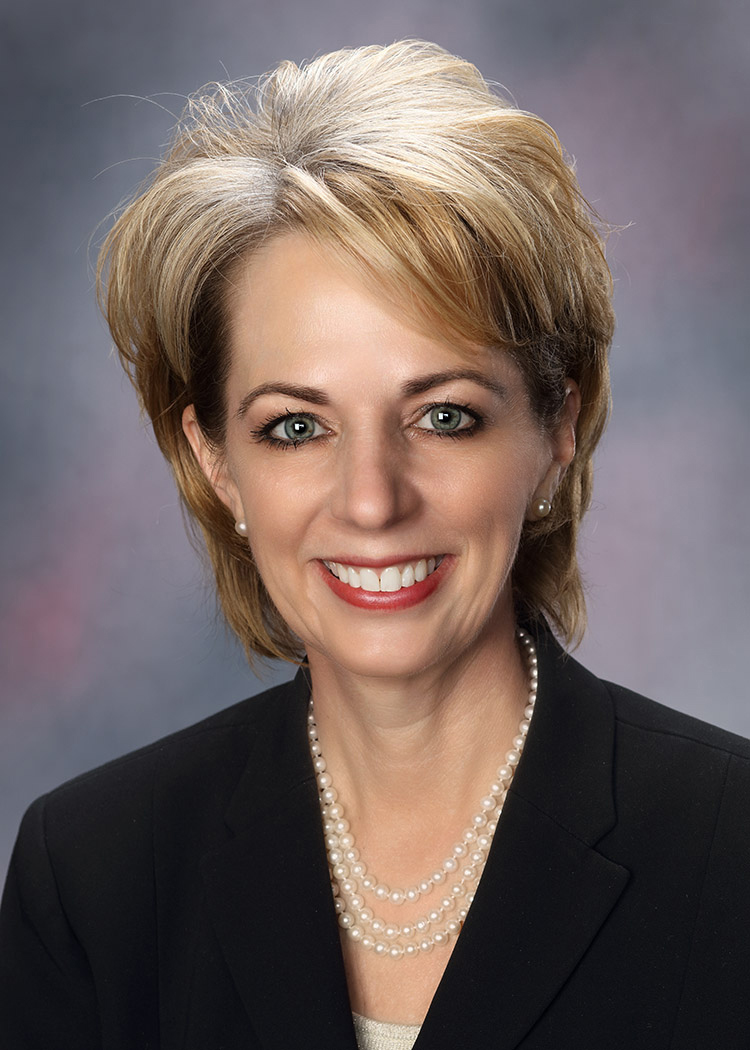
FHSU President Tisa Mason will be the keynote speaker at the semi-annual Young Readers’ Conference, held in Fort Hays State University’s Beach/Schmidt Performing Arts Center.
“Reduce, Reuse and Recycle” is the theme for the 2018 Young Readers’ Conference to be held from 8:45 a.m. to 2:30 p.m., Tuesday, Sept. 25.
The students, third- through fifth-graders, will then move to the Memorial Union and the Center for Applied Technology for a day filled with activities on the theme “Reduce, Reuse and Recycle.”
The conference is sponsored by the Department of Teacher Education and the College of Education. Students from the Kansas Academy of Mathematics and Science, through the Science and Mathematics Education Institute, will assist with activities throughout the day.
For more information, contact Dr. Beth Walizer at [email protected] or (785) 628-5579
The Downtown Hays Market third-annual Farm to Fork dinner is closing in on a sellout.
Only 30 out of 100 tickets remained as of Friday afternoon.
“We want people to have an intimate evening on the Bricks. We want people to have conversations with people they have never met before,” said Sara Bloom, Downtown Hays Development Corp. executive director. “We want them to interact with our Downtown Hays Market vendors who are able to attend. Some of the uniqueness of this event is the local meats and produce used in this meal, and we want people to be able to ask questions about what they are eating and share why they are there.”
The event will be 6 to 9 p.m. Friday, Oct. 12, at the Downtown Hays Pavilion.
Gella’s executive chef Manuel Hernandez will transform food from local producers into a an elegant five-course meals. Bloom said Hernandez really makes the event as he helps serve the food, talks about the ingredients and shares his passion for local produce and ingredients.
Diners will start with a choice of five appetizers, including honey chicken, roasted corn salsa and chips, bacon-wrapped dates, mushroom quesadillas, grilled and chilled veggies, and watermelon and mint salad. The soup course will be cream of asparagus. Then a cantaloupe, jamon, serrano and arugula salad will be served. The entrée will be a paella with sausage, pork, chorizo, chicken and seafood served with saffron rice. Home and pear cardamon cake will be served for dessert.
This will be the first year the dinner will be in the Pavilion.
“To be able to have an outdoor fall event in the Pavilion where the market actually happens and be hosting an event that benefits the market, it is going to be a really unique addition to the event,” Bloom said. “I am really excited to see decorations and the lighting underneath the Pavilion. It is going to be amazing.”
Flower arrangement will be done by Regeena’s Flowers, which may use flowers from Bethesda Place if they are available. Svaty’s Produce will provide miniature pumpkins as gifts to all the guests. Centerpieces will also be coming from Personalize It by Rhiannon.
Music will be provides by a jazz group from Fort Hays State University.
A Celebration Community Church group will be servers this year.
Tickets can be purchased while they last on the DHDC website or at its new location at 1200 Main St.
All proceeds from the event support the marketing fund for the Downtown Hays Market. It allows the market to offer its spaces at no cost to its vendors.
The Downtown Market moved to the new Downtown Pavilion at 10th and Main streets this season, which Bloom said has been a great success.
She said people have loved having the market under the Pavilion instead of across the street out in the sun.
“It has given the market another environment and a special aura to it,” she said. “With it being under the Pavilion, people grab a free cup of coffee, they stay all day, they shop and they talk and it is has really become the gathering place that we have always pictured what the Downtown Hays Market could be.”
More than 60 vendors registered with the market this season with as many as 37 selling at a single market.
The market brought in vendors this year from the Nebraska border to Stafford to west of Colby and from as far east as the Salina area.
“For people to see the value in our market and to drive that far every week on a consistent basis really speaks not only for our market, but for the Hays community,” Bloom said. “It is generating sales tax on a weekly basis, not only from their sales, but they are eating breakfast here. They are eating lunch here. They are getting gas in their tanks before they leave. I think the economic impact of the market is bigger than a lot of people in our community realize. That is really exciting for us, and we can’t wait to see how it is going to grow.”
There will only be five weeks left in the market including this Saturday. The last market Saturday will be Oct. 20. The market is open 7:30 to 11 a.m. Saturdays spring through fall.
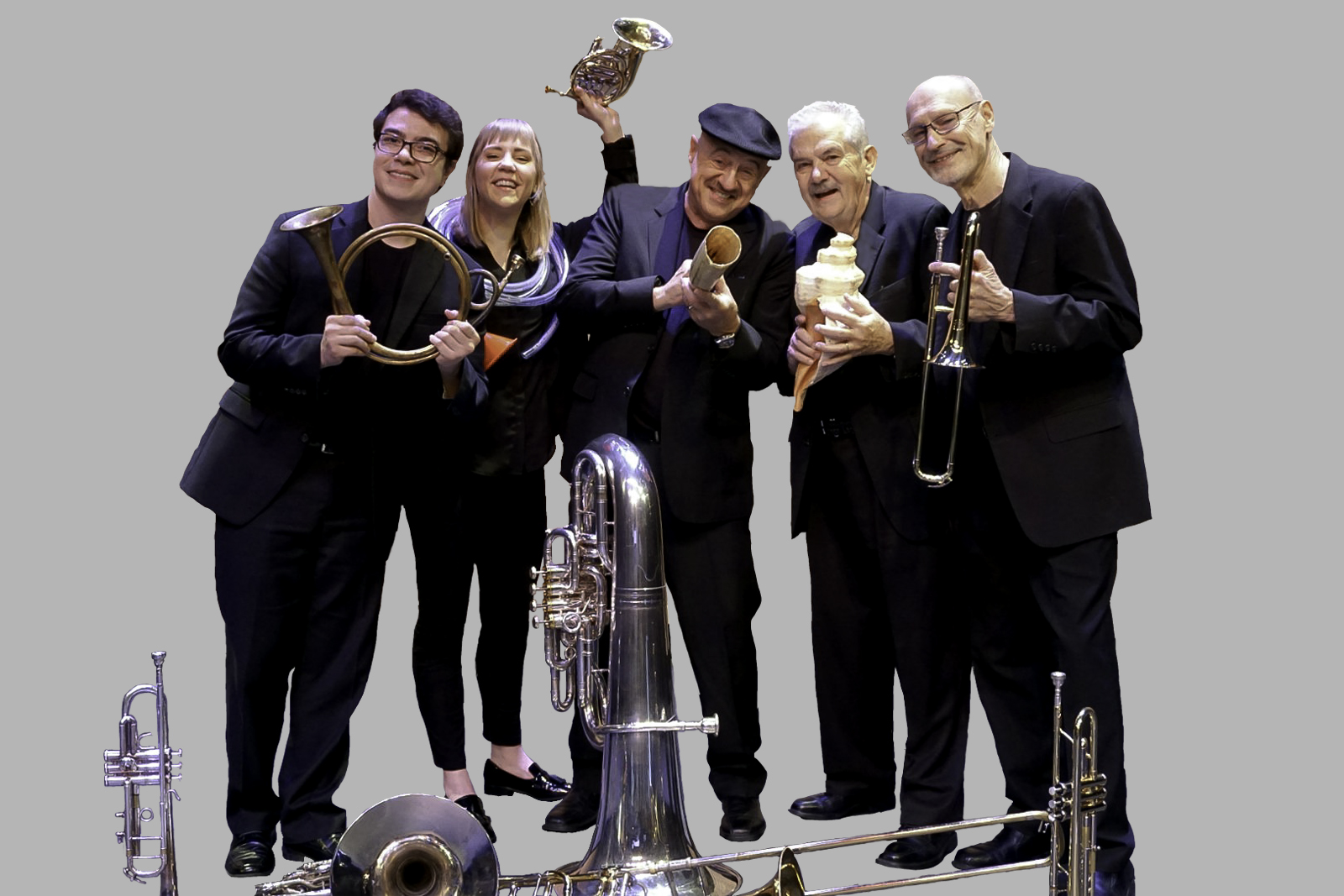
COLBY — One of America’s longest standing brass quintets is coming to northwest Kansas. Western Plains Arts Association is pleased to bring the Saint Louis Brass Quintet to Colby Community College’s Cultural Arts Center at 3 p.m., Sunday, Sept. 30. Admission is by WPAA season ticket or adults $20, students $10, at the door.
This project is generously funded by the Mid-America Arts Alliance, the National Endowment of the Arts, and the state arts agencies of Arkansas, Kansas, Missouri, Nebraska, Oklahoma, and Texas.
Locally, the Dane G. Hansen Memorial Foundation, Logan, Kan., is a major contributor to all WPAA programs this season.
Founded in 1964, the Saint Louis Brass Quintet, was originally formed by members of the St. Louis Symphony to play children’s concerts around the St. Louis area. Soon though, they had expanded to present full length concerts funded by the National Endowment for the Arts, the Missouri Arts Council and the Mid-America Arts Alliance. Now, 54 years and more than 3,000 engagements later, the only original member still in the group — and the only one who actually lives in St. Louis — is trombonist Melvyn Jernigan – who retired from the Saint Louis Symphony after 35 years. The other quintet members hold top positions across the United States. The quintet averages more than 25 engagements per year, including master classes, clinics, school concerts and formal concerts.
Members include: Allan Dean, Trumpet, professor of music, Yale School of Music; Mikio Sasaki, freelance trumpet player in New York; Victoria Knedtson, principal horn of the Columbus Indiana Philharmonic; Melvyn Jernigan, trombone player and executive director, Primo Concerts; and Daniel Perantoni, tuba player, professor of music, Indiana University.
The Saint Louis Brass Quintet performs the entire spectrum of great music for brass – from the works of today’s composers to Baroque and Renaissance music transcribed for modern instruments. For many audiences they also offer lighter fare: popular music of the Americas, jazz arrangements of standards by Ellington/Strayhorn, Gershwin and Cole Porter, lighthearted pieces for narrator and brass; and a tongue in cheek survey of the history of the brass instruments.
The group now performs three ten day concert tours throughout the United States each year, plus recording and international touring. The SLBQ was featured at the Norway Brass Band Festival in 1994, at a festival in Bombay, India in 1995, and they performed a two-week concert tour in Japan in 1997. In May of 1999 the quintet toured Mexico, and in October of 2001 they toured Germany. June 2003, they were performing in Sweden.
The SLBQ sees itself foremost as a serious chamber music group, but also recognizes the importance of education and entertainment in its programming. Finding this balance is an exciting challenge that is vital in keeping both the group’s members and its audiences satisfied. Visit the group’s website at saintlouisbrass.com
The fall season is a great time to plant trees, and shrubs as well. During the spring, soils are cold and may be so wet that low oxygen levels inhibit root growth. The warm and moist soils normally associated with fall encourage root growth. Fall root growth means the tree or shrub becomes established months before a spring-planted tree and is better able to withstand summer stresses. Moreover, the best time to plant is in early September to late October. This is early enough that roots can begin to develop and become established before the ground freezes.
Fall-planted trees and shrubs need some special care. Remember that roots are actively growing even though the part of the plant above ground is dormant. Make sure the soil stays moist, but not soggy. This may require having to water them not only in the fall but also during the winter months, especially if the winter is dry and/or unusually mild. Mulch can be helpful because it minimizes moisture loss and slows the cooling of the soil so root growth continues that much more.
Note; there are certain trees that are an exception, as they do not produce significant root growth during the fall and are better planted in the spring. These include beech, birch, redbud, magnolia, tulip poplar, willow oak, scarlet oak, black oak, willows, and dogwood.
In either case, fall or summer, here are some hints you can remember when planting containerized trees and shrubs;
Dig the hole no deeper than the container bottom to the root flare or crown of the plant; on trees the flare needs to be slightly above the soil grade when done.
Dig the hole two to three times the diameter of the root ball or container, and the bottom of the holeneeds to be undisturbed (not loosened).
When placing the plant into the hole, disturb the root ball as little as possible. Lift potted plants by the container, not by the trunk, stems or branches. Be sure to not allow the root system to dry out before or during planting.
Tip the container on its side and slide the plant from the container. Place the plant in the hole by lifting the root mass. If the roots are tightly matted, use a knife to score the root mass in several places and gently loosen the root ball.
Add backfill soil to the planting hole until it comes about halfway up the root ball. At this point the soil can be lightly packed by hand or foot, or by placing the hose in the hole and letting water run until the back filling is complete.
Construct a 3–4″ high ridge of soil around the outer edge of the planting hole. This berm will create a basin to hold irrigation water, concentrating it over the roots.
Next week; Part 2 of this article, discussing how to transplant a shrub or tree from one location in your yard to another.
Rip Winkel is the Horticulture agent in the Cottonwood District (Barton and Ellis Counties) for K-State Research and Extension. You can contact him by e-mail at [email protected] or calling either 785-682-9430, or 620-793-1910.

 KDWPT
KDWPT






 Today
Today