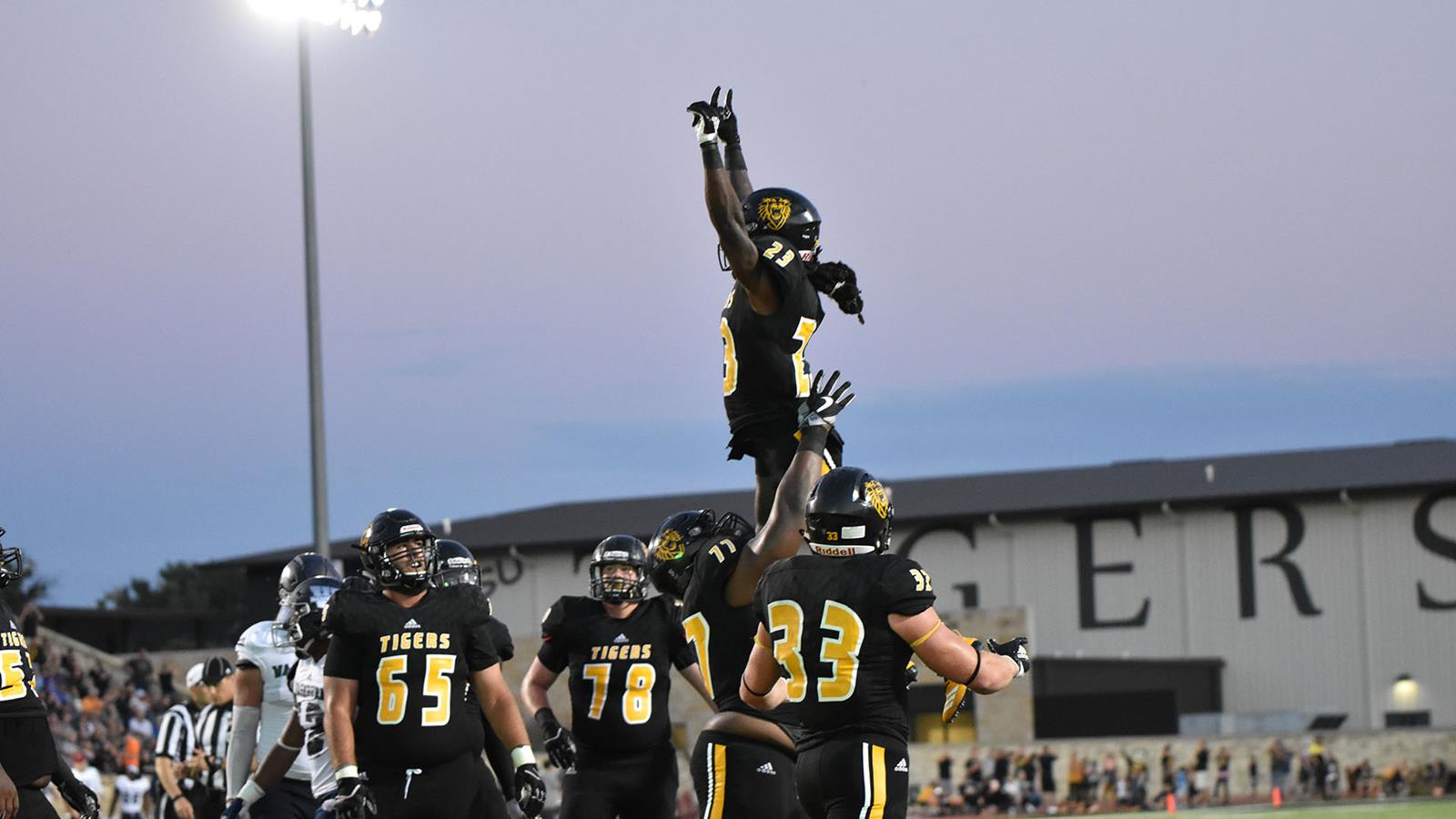
HAYS, Kan. – Fort Hays State scored 14 points off four Washburn turnovers and built a 20-point fourth quarter lead then held off a Washburn comeback attempt and beat the Ichabods 30-24 in front of 6,938 Saturday night at Lewis Field.
The Tigers (2-1) led 30-10 following Jacob Mezera’s 17-yard touchdown pass to former quarterback and current tight end Jacoby Williams, but the Ichabods (1-2) would score 14 unanswered before the Tigers recovered an on-side kick with a little over a minute to play to seal the victory.
Chris Brown Postgame Press Conference
Charles Tigner Postgame Interview
Keylon Kennedy Postgame Interivew
Game Highlights
Up 30-17, the Tigers intercepted backup quarterback Mitch Schurig late in the game near mid field but linebacker Austin Tillman intercepted a Jacob Mezera pass and return it 63 yards for a touchdown with 1:09 to play. The pick-six came after the Tigers appeared to convert on third down but were penalized for holding
Mezera completed 15 of 24 passes for 130 yards and two touchdowns and the interception. His 26-yard scoring strike to Harley Hazlett put the Tigers up 7-3 with 5:47 to play in the first quarter. The Tigers also scored on a four-yard run by D.J. Hickman and a two-yard run by Charles Tigner to build a 20-10 halftime lead.
Dante Brown booted a 42-yard field goal on the Tigers first possession of the third quarter for the only points of the period and push the Tigers lead to 23-10.
FHSU rushed for a season-high 130 yards led by Charles Tigner who ran for 98 yards on 20 carries. Isaiah Truss added 31 yards on six rush attempts.
Backup quarterback Chance Fuller saw his first action of the season. The redshirt freshman completed 3 of 6 passes for 35 yards.
The Tigers are on the road next Saturday at Missouri Southern State who lost 63-0 to Northwest Missouri State earlier in the afternoon.
Early Childhood Connections in Hays received an extra bus and playground equipment from the Junction City Head Start program.
Dave Staab, Vyrl Brown and Robert Bohlen in the Transportation Department worked diligently over several days to help disassemble the playground equipment and have it transported back to Hays.
The gentlemen pushed through working in the rain and the mud to finish the job.
“Early Childhood Connections extends its sincere gratitude to these three men for going above and beyond in the line of duty,” the school district said in a news brief.
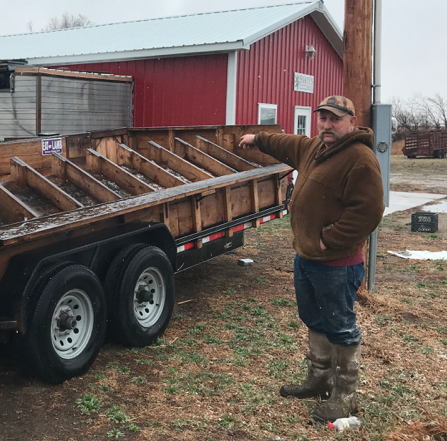
Svaty built a market trailer with a drop-down side that holds flat crates of produce; a walkway where the Svatys stand to sell from; a spot for a freezer to hold the meat; and large bins for melons, potatoes and other larger, heavier crops.
First in a series of five farmer feature profiles
By JENNIFER KONGS Kansas Rural Center
KANOPOLIS — Dave Svaty has farming in his family’s roots. He grew up on a farm down the road from where he and his wife, Connie — along with his son, Caleb and his family — are tending cattle, pigs, sheep, and vegetables growing in fields and inside hand-built hoop houses near Kanopolis in Ellsworth County.
Dave and Connie have raised livestock and sold vegetables from a roadside stand for more than 25 years. Dave, who has a degree in Agronomy from Kansas State University, started working 17 years ago at the local co-op to provide a source of steady income. Three years ago, Dave left the co-op job and at about the same time, his son also lost his teaching job. Connie continues to work as a teacher’s aide, largely to keep the family covered with health insurance. The Svatys wanted to try making the combination of meat and increased vegetable production a go, with a focus on high-value crops, like tomatoes, grown in hoop houses. KRC visited Svaty’s Produce on March 30, a muddy, blustery day, to learn more about their operation and get a tour of their production.
The Svatys have been able to expand their operation and create a unique setup with ingenuity and DIY skills. Dave custom-built his farmers market trailers to pull behind a truck. The wooden frame features a drop-down side that holds flat crates of produce; a walkway where the Svatys stand to sell from; a spot for a freezer to hold the meat; and large bins for melons, potatoes and other larger, heavier crops. The produce is held at eye level for the customer and everything is easily accessible by the person handling sales at market that day. Dave and Caleb liked the first one so much, Dave built a second one, so they could both have one at each Saturday market where they are vendors.
For the folks who want the on-farm experience, the family built a shop on-site, with customer-friendly reach-in coolers, a walk-in cooler for crop storage, and shelves and boxes for produce sales. The investment, Dave says, would be worth it to save the driving time to multiple markets each week, and of course, the family hopes for added income from the set daily operating hours of 3 to 7 p.m. on weekdays. The space also has a back room, which has already provided value in getting the produce-washing and storage out of their house. Before the building, washing, storage and prep on Fridays before the big Saturday markets all happened inside Dave and Connie’s home, where she bakes and packages homemade kolatches by the tens of dozens for market sales.
In late March, Svaty’s hoophouse featured fresh greens and onions ready for market.
Dave and Caleb have been smart about how they re-purpose materials and incorporate made-to-fit solutions for season-extension and crop protection. For example, the calving barn is built with bridge planks Dave bought from the county. He moved an unwanted wooden hoop house frame from Ellsworth high school, which came complete with plastic covering. When their second hoop house, which has gone through four seasons, kept losing its plastic covering, Dave boxed in the ends with wooden frames to keep the hoop house together better.
Turns out, wind is often a specialty-crop farmer’s most challenging nemesis. The shape of the hoop house has other shortcomings: “I made a mistake in buying a round hoop house. I should have bought one with sidewalls, because I can’t get in close enough along the sides with equipment,” Dave says in retrospect.
Dave has built a lean-to greenhouse onto his home, heated with the home’s old woodstove. “I came home one night, and told my wife I was going to build a greenhouse. So, I dug this space with a skid loader.”
When I visited, the greenhouse was full of green, growing life. Because of a previous year’s infection, the family now primarily raises tomato varieties resistant to tomato spotted wilt virus, including ‘Mountain Glory’ and ‘Skyway 687.’ They are trying some varieties—especially cherry tomatoes—that are not resistant, such as ‘SunGold,’ because of their popularity with customers. The greenhouse held dozens of flats filled with starts of tomatoes, sweet peppers, hot peppers, cauliflower, cabbage, broccoli, Brussels sprouts, celery and herbs. Once I left, he was planning to plant three colors—red, yellow and orange—of seedless watermelons on electric heating mats to keep the soil warm enough for germination.
There are also fig trees in buckets in the greenhouse that Caleb and Dave are planning to experiment with based on expertise from a fellow farmer in New York. Caleb, his father says, connects to other growers online who are also trying unique setups around the country. I joked with Dave about him being cutting edge, and he smiled, but readily reminded me it was Caleb who was making the new connections.
The farm’s growth and diversification has not come without its struggles. “The first year was great. The second year, we lost all of our tomatoes to tomato spotted wilt virus. We have also lost tomatoes after uncovering them to spray drift,” Dave says. Their history with a nearly complete crop failure caused by TSWV is why the family emphasizes TSWV-resistant varieties for their tomatoes and peppers.
After losing the tomato crop two years ago, Caleb needed to take on off-farm job working on wind turbines. “He has three kids, and we had nothing to fall back on, so he had to get a job for security. He wants to farm and he has a space, and we have markets to go to, but you need health insurance and you need steady income, and you can’t do that as a starting specialty crop farmer,” Dave says.
The family still raises close to 60 acres of conventional wheat and soybeans, accounting for an estimated 20 percent of the family’s farm income. Dave says the farm gets better returns on the vegetables than the meat, especially the lamb and chicken. The pork and beef, largely because they are more popular meats in his area, have higher profit margins. The family has about 200 head of sheep, a dozen cattle and fewer than 10 hogs.
Dave has his concerns for the future of vegetable farming. One is FISMA, the Federal Information Security Modernization Act, and how to update to meet all of the requirements, especially regarding his family’s combination of livestock and vegetables. His lambing barn, which is separated by a barrier wall but connected under one roof with a growing spot for early greens to take advantage of the animals’ heat, would likely be forbidden.
“I’m an exemption, but we try to be up to speed. It is overwhelming, some of the specific rules and the amount of written documentation that would be required. My wooden picking crates wouldn’t be allowed, I couldn’t let my dog go into the field with me when I pick, but we have rattlesnakes and I want my dog with me.”
Dave also wonders whether having multiple weekday markets in different parts of town — rather than a concentrated time in one spot — is best for farmers’ sales. The most economical setup for where and when to hold markets is a commonly discussed direct-sale farmer struggle. “In summer, we saw more foot traffic to the farm store, which is ideal for us, but winter has been harder,” Dave adds.
He worries about new farmers getting started, and existing farmers adding or diversifying their operations, with the heavy financial burden associated, given the current structure for financing and health insurance. Working without a fall-back, as he is now, leaves “no margin for error” with the growing and marketing.
When asked what changes could help his farm be more successful, Dave responds that he feels strongly that the sales tax on food should be eliminated, for the sakes of both farmers and consumers. “It is difficult to track, and compared with neighboring states, we’re putting a tax on poor people trying to buy groceries.”
He also recognizes a need for a better system to protect against drift for sensitive crops. “I have neighbors that do their best to be careful, but even on windless days, we see the damage.” He also suggests that when feedlots or other concentrated operations move in nearby, that the specialty crop farmers who need clean water be protected. As his farm shows, there are multiple ways to grow food and build livelihoods through agriculture in Kansas, and he would like to see them all treated with equal protection.
Despite his concerns, as we walked through the fields, Dave’s love of growing food and raising animals was tangible. He proudly pointed out the field planted days before with 2,200 pounds of potatoes (he named the dozen or so varieties off the top of his head); his sandy soil that grows juicy melons; and the baby lambs he has protected with their mamas in the barn.
Dave shared new ideas he wanted to test this year—clearly skilled at coming up with unique solutions to the various challenges farmers face. He spoke of incorporating oats as a cover crop before planting melons; a new method for stringing and covering tomatoes he’s keen to experiment; harvesting asparagus throughout the year; and more. When he spoke of challenges, he appeared distraught and overwhelmed by handling the bulk of the work solo, as if he were watching the end of an era.
But, while visiting the farm, it’s hard to see anything but hope and potential while watching the lambs bounce, listening to the calves call, and passing through the warming hoop houses filled with new life.
Jennifer Kongs is a freelance writer with Bark Media in Lawrence, Ks. who produced this story as part of KRC’s Specialty Crop Block Grant funded by the Kansas Department of Agriculture through USDA’s SCBG Program.
Once again, the Hays Arts Council is bringing back Jay and Leslie Cady—known as “Laughing Matters”—for an exciting, entertaining and educational program from Sept. 17 through 21.
This year, they’ll bring a new interactive school literacy program entitled “Tales with a Point: Fables and Fairy Tales.”
Their 45-minute performance will bring fables and fairly tales to life as they help children analyze the stories by identifying characters, settings, plots, and morals. The Cadys will use theatricality, humor, circus skills and audience participation to create unique versions of four well-known stories.
Full-time professional entertainers since 1980, Jay and Leslie Cady have performed more than 6,000 times in 36 states and seven foreign counties. These Kansas City artists are highly acclaimed, bringing a special brand of entertainment and education to their programs.
For this year’s public performance, the Hays Arts Council has arranged for Laughing Matters to participate in Early Childhood Connection’s “Go Truck, Go!” event on Thursday, Sept. 20 with their roving performances taking place from 5:30 to 6:30 p.m. at the National Guard Armory in Hays.
Katlin Senst was recently welcomed to the staff of the Fort Hays State University Foundation as an accountant.
Senst is a 2014 graduate of FHSU. She earned her certified public accounting license in 2016 and previously worked at Adams, Brown, Beran & Ball, Chartered, in Hays.
“I am excited for the opportunity to assist in the advancement of the university I attended and love,” said Senst.
Senst will support the financial well-being of the FHSU Foundation by preparing, maintaining, monitoring and analyzing accounting transactions, entries and reports. She will also serve as an in-house consultant for staff on accounting matters.
Established in 1945, the FHSU Foundation is committed to cultivating lasting relationships with alumni, friends, corporations and other organizations that have a passion for Fort Hays State and who want to continue its legacy of excellence.
As an independent, non-profit organization, the Foundation’s donors have an impact on all facets of university life, and their support continues to translate into success for students at Fort Hays State.
Ron Wilson is director of the Huck Boyd National Institute for Rural Development at Kansas State University.
By RON WILSON Huck Boyd National Institute for Rural Development
The Sunflower State. That is a fitting nickname for Kansas, especially when we learn about innovative farm family members in the northwest region of the state who are adding value to their sunflower production.
Dennis Wright and his father Don are the founders of Wright Enterprises and the makers of Wright Farms Sunflower Oil near Bird City. “We are fourth generation farmers here,” Dennis said. “My great-grandfather first homesteaded the place.”
Dennis grew up on the farm with his parents Don and Donna and went to Fort Hays State where he met Dana. They married and lived in Hays for a few years. “When we had our first child, we decided Bird City would be a good place to raise a kid,” Dennis said. They now have three children.
Dennis and Dana moved back to Bird City and joined the family farming operation in 2005. “The only constant in farming is change,” Dennis said. The Wrights looked to expand or diversify their operation, which included sunflowers and other crops. “We were asking, how can we make what we raise more valuable?” he said.
Since they produced sunflowers, they researched the possibility of producing sunflower oil and found that most such oil is sold as a refined product. The Wright’s focus groups identified consumer interest in health-conscious items. The niche which the Wrights pursued was in unrefined sunflower oil.
“Refining uses heat and chemicals to deodorize and treat the oil,” Dennis said. “Instead, we use a cold-pressing process with an expeller press that squeezes the oil while keeping all the nutrients and vitamins in it.”
They then use a plate filtering system with multiple layers of vegetable cloth to clean the oil further before bottling it. They built a plant in a small building on the original homestead. “Dad is an electrician,” Dennis said. “We were able to set up our own automation system where the seeds can feed into the press and stop automatically. It’s farmer ingenuity,” he said with a smile.
They call the product Wright Farms Sunflower Oil. The Wrights also joined the “From the Land of Kansas” program at the Kansas Department of Agriculture. “They’ve been awesome,” Dennis said of the program’s staff.
Today, the Wright’s sunflower oil is available for sale online and at approximately 30 independent grocery, gift shop, and museum stores across Kansas. “Unrefined sunflower oil is high in Vitamin E and has a lot of antioxidant properties,” Dennis said. “It’s a healthy oil in that it has a higher ratio of unsaturated fats to saturated fats. It has a lower smoke point so it is suited for low- and medium-heat cooking, rather than deep fat frying. My cousins say it is perfect for sauteeing. We use it as a marinade too. It’s more like olive oil.”
Sunflower oil also has other uses. “I call it the WD-40 of cooking oils,” Dennis said. Because it has high vitamin E, it is good when applied to skin or hair. I use it to oil chains or moisturize my hands.”
Wright Farms Sunflower Oil has been included in the “From the Land of Kansas” gift baskets which have gone from coast to coast and beyond. Since their plant was built on the original homestead, their production literally goes from field to finished product on the farm, which is located near the rural community of Bird City, population 447 people. Now, that’s rural.
“We do tastings and bread dippings,” Dennis said. “We’ve been told it cooks just like butter with a nutty taste. We also designed a continuous filtration process so it has a nice mild flavor.”
Since Kansas is the Sunflower State, how fitting that a sunflower oil production process would be designed by an innovative Kansas farm family. We commend Don and Donna and Dennis and Dana Wright for making a difference with entrepreneurship and innovation in value-added agriculture. I think this sunflower oil process is in a good state.
The city of Hays has a $2 million line of cyber liability in its commercial insurance policy with MPR (Midwest Public Risk), a group of public pooling entities across Missouri and Kansas.
Cybersecurity insurance is being sought by an increasing number of U.S. cities, according to a survey by the Wall Street Journal.
Hays has two main data centers located at city hall and at the police department, with 48 network routers and approximately 248 PCs and servers in 11 locations.
The IT Department, which recently relocated from the downtown city hall to a larger space in the Hays Welcome Center, 2700 Vine, provides Geographic Information Services, telecommunications services and support for citywide software applications. The five-person IT staff also maintains the city’s website, www.haysusa.com, and online utility bill payments. One technician is dedicated to the police department and security; another technician takes care of everything else in the city. The GIS Specialist is a shared position with Ellis County.
Chad Ruder, Director of Information Technology, who has worked for the city 19 years, recently reviewed the city’s computer network connectivity with the Hays city commission.
He told commissioners the city currently has fiber optics in place between city hall and the police department, between city hall and the water treatment plant and public works, and to the visitors center.
“We’ll soon have fiber optics to the wastewater treatment plant and the parks department. All that we have left for fiber optics is the recycling center, which currently bounces off the Sternberg water tower and the airport,” Ruder reported.
He is especially proud of the network’s “uptime” and credits that to redundancy consisting of backup domain controllers at the police department and city hall, high availability gateway firewalls in the city hall data center, and extra network equipment in the city’s inventory. “We don’t have every piece, but in order to get a building running, we’re prepared.”
The city’s financial and street infrastructure softwares are hosted in the local data center. “That’s the kind of thing you want to hold on tight, locked in that room. You want to know what’s going on.”
Email and web services, along with online bill payments, are hosted by an outside server.
“When we meet with our peers, from local to international, 90 percent of our talk is now about cyber security,” Ruder said. “That’s not an exaggeration. It’s frustrating, and it’s so important.
“There are two peer entities of mine in the state of Kansas, one of which had a payroll server taken down and the other one lost everything for two weeks. It was terrible.”
In order to protect itself, the city is always looking at user awareness, which Ruder considers “our first line of defense. Always.”
“We have layered security, but I’ll be honest with you, there’s only one piece of about four layers that looks at what’s going on. The other ones can be bypassed if a user does something they shouldn’t. If they click on something they shouldn’t, they can bypass a lot of what we do and you can’t have business continuity without that.”
Each city of Hays employee is trained the day they start work with a new computer users orientation. As issues arise, Ruder sends employee emails showing real world examples.
“Above all that, we do things on the back end that people don’t know about, thousands and thousands of things that we block every day,” he said.
Ruder is a little concerned there may be too many mandatory video trainings but concluded “it’s not enough. I don’t want to get to where I’m tricking my own users (into clicking on something they shouldn’t) and I don’t want to overwhelm them where they think I’m crying wolf. I think I’m in a good position here, but we can always improve.”
“Just making employees aware (computer hacking) is happening close to us, should scare everybody to death,” said Commissioner Sandy Jacobs. “It scares me.”
“It just takes one, though. That’s the problem,” interjected Mayor James Meier.
Commissioners and City Attorney John Bird mentioned hacker attacks on websites for the cities of Wichita and Great Bend.
Security software that can search and look for unwanted “bad things” on a computer is not foolproof, reminded Ruder.
“Somebody can change one piece of code and then that will slip through until the definitions catch it later in the day. It’s rough.”
The Hays IT Department also goes through audits and scans, both financially and through the police department.
The IT employees bounce ideas off their peer groups on how to stay ahead of would-be hackers. Local peer groups include Ellis County, HaysMed, USD 489 and the business community. There are also quarterly meetings of the Kansas chapter of Government Management of Information Science and the national organization. Ruder is vice-president of KS-GMIS and expects to become president next month.
Hays participates in a listserv which distributes relevant messages to subscribers on an electronic mailing list.
The city has a detailed cyber response plan from the insurance company “if we’re breached and have to start dealing with what’s been let out. I hope that never happens,” Ruder said. City Attorney Bird also looks at the legalities of the cyber response plan.
“The Department of Homeland Security has the best thing I’ve ever dealt with when it comes to free government programs, ” Ruder told the commission. “It started when Sept. 11th (terror attack) hit.”
DHS partners with the MS-ISAC (Multi-State Information Sharing & Analysis Center), the “go-to resource for cyber threat prevention, protection, response, and recovery for U.S. state, local, tribal, and territorial (SLTT) government entities”, according to its website. The MS-ISAC is recognized as the national ISAC for SLTTs to coordinate cyber readiness and response.
“They monitor our computer traffic daily. They monitor the internet for anything that has to do with @haysusa.com. Somebody will get an email that looks like it’s from the city manager, Toby Dougherty. Hackers target the ‘whales.’ It’s called spear phishing.”
“Kim Rupp (Finance Director) gets (fake) emails from me sometimes,” Dougherty confirmed, “that say please send me that invoice or wire me those funds.”
That spear phishing is monitored by MS-ISAC. “I can forward that on to this group and they spread that out,” explained Ruder. “The FBI gets involved.”
Image-based backups are performed in the IT Department and can be used by the city in an emergency operation or disaster recovery.
“I love my job and I have an amazing staff. Cyber security keeps me up at night. Scary,” Ruder concluded.
Ruder also noted the city’s website, designed in 2002, is undergoing a major redesign and will be content management driven. He hopes to be able to show the commission some proposed improvements by the end of the year.
GOVE COUNTY — One person was injured in an accident just after 11p.m. Friday in Gove County.
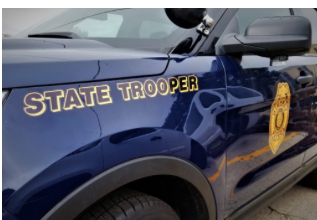
The Kansas Highway Patrol reported a 2003 Chevy Silverado driven by Abby Rose Herl, 17, Quinter, was northbound on Castle Rock Road three miles south of Quinter.
The driver lost control of the vehicle. It exited the roadway to the right and rolled multiple times, landing on the wheels in a field.
Herl was transported to Gove County Medical Center. She was not wearing a seat belt, according to the KHP.
At approximately 5:20 p.m. Sept. 13, a Grand Junction Police officer was dispatched to a report of a runaway. The reporting party stated that when she arrived home from work that afternoon, she discovered that her 15-year-old son, as well as his belongings, were missing from the hotel at which they had been staying.
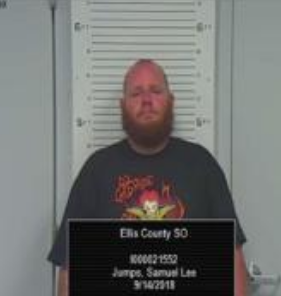
The reporting party spoke with other occupants of the hotel to ask if they had any information. She discovered that another occupant of the hotel, who she was familiar with, had possibly left the area that day, telling staff he was considering a return to the Front Range, where he had family. An additional witness claimed to have seen the 15-year-old male get into a vehicle, described as a red SUV, with the other male earlier in the day and leave the hotel. The tenant, identified as Samuel Jumps, age 27, was discovered to have a felony warrant out of Arapahoe County for a sex offender registration violation.
Jumps
Continued attempts to contact the 15-year-old via his cell phone were unsuccessful. The victim was entered into a national database as a missing and endangered person as the investigation continued.
It was determined that Jumps drives a red Mercury Mountaineer, and registration and license plate information was obtained. The registered owner of that vehicle was contacted and stated that he had spoken to Jumps earlier in the day, and that Jumps told him that he was planning to travel to South Carolina.
A detective with the Grand Junction Police Department was able to make contact with Jumps via his cell phone. Jumps denied knowing where the 15-year-old boy was, and stated he was currently driving through the state of Kansas. Through numerous conversations, Jumps continued to deny having any knowledge as to where the boy was, and eventually agreed to drive to the nearest law enforcement agency to let officers search his car.
During this time, another detective was able to reach the victim via his cell phone, and determined that he was in Ellis and was unharmed. The boy was contacted and picked up by local law enforcement. Meanwhile, Jumps was contacted at a gas station in Hays by law enforcement who were aware of this investigation and had a description of the vehicle in which Jumps was suspected to be traveling. Jumps was detained and ultimately held on a GJPD warrant for kidnapping and false reporting to authorities.
“We commend our officers and detectives for their diligent work in locating the victim in a matter of hours, so that he could be reunited with his family. We’re grateful for the information shared by witnesses, as well as the cooperation of law enforcement agencies across state lines who assisted in bringing this incident to resolution,” the GJPD said in a news release.
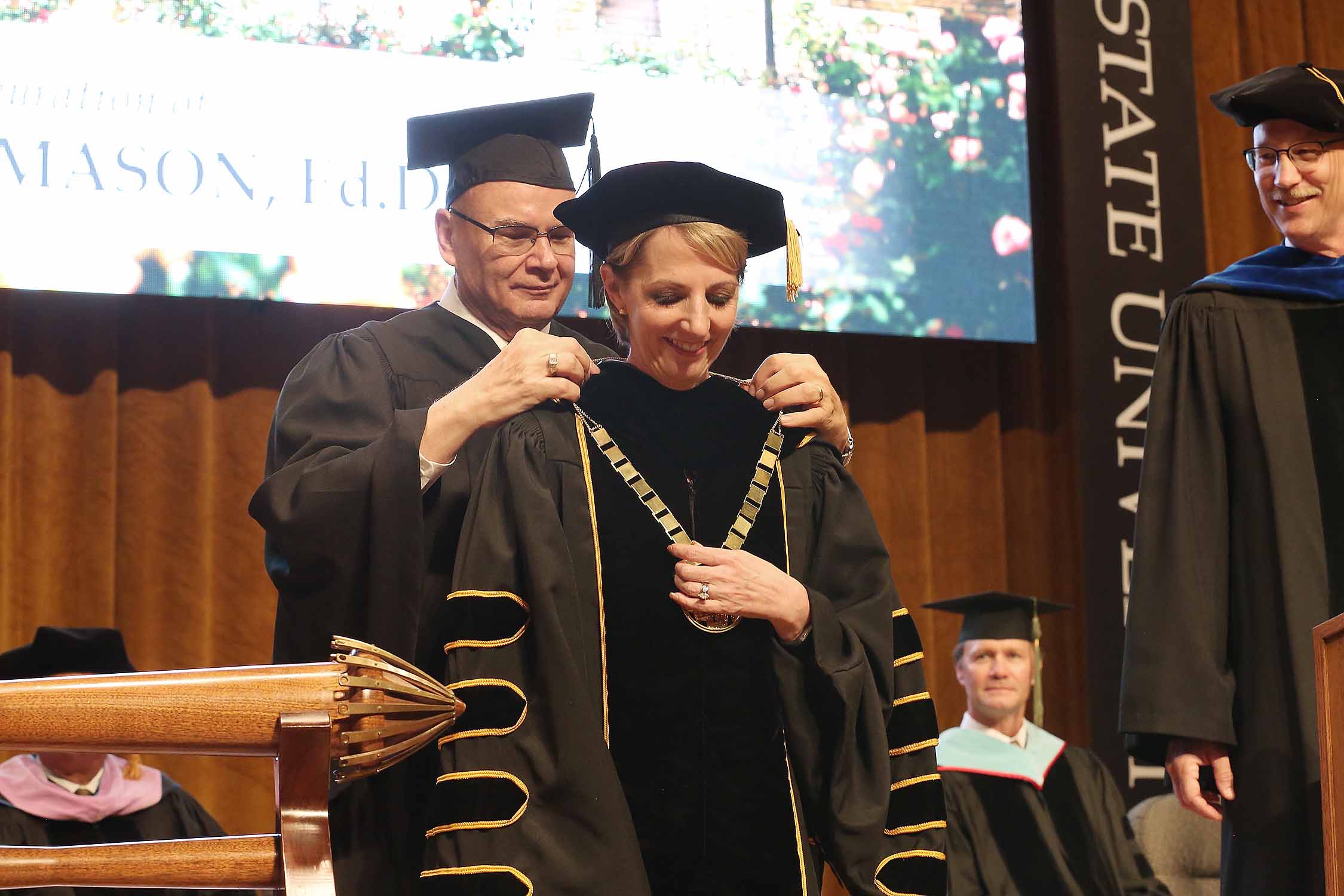
Dennis Mullin, Kansas Board of Regents Chairman, with Dr. Tisa Mason at Friday’s inauguration ceremony at Fort Hays State University.
FHSU University Relations
Proclaiming a theme of “Unlocking Untapped Potential,” Dr. Tisa Mason was inaugurated today as the 10th president of Fort Hays State University in a ceremony in Gross Memorial Coliseum at Fort Hays State University.
She noted that the inauguration is for her a personal and a professional privilege, citing the six and a half years she spent as Fort Hays State’s vice president of student affairs before leaving to be president of Valley City State University in Valley City, N.D.
She said of her previous time at Fort Hays State, “It was during that time that I came to know and love the students, the faculty, the staff, the city and the unique personality of this place.”
“For six and a half years,” she said, “Fort Hays State challenged me and supported me, showing me over and over again the power of hard work and commitment, the value of personal investment, the importance of true community, and the transformative change that happens through innovation.”
“For 116 years,” she continued, leading into the first of three videos that were part of her inauguration address, “these pillars, these lessons I’ve learned, have stood at the core of Fort Hays State University. They are the secret of our ongoing success. They are the ingredients that set us apart. They are the definition of who we are. Our journey has shaped us. Our history has built us. But our story is still being written.”
A transcript of her remarks follow. The address, and the videos that were part of her presentation, are available online at www.fhsu.edu/potential.
Leading into the third and final video, Dr. Mason said, “Today is a formality, but it is not a celebration of me. It is a celebration for us – an inauguration not of a person, but of an institution. Today is our opportunity to pause and reflect on the things that make Fort Hays State University so special: Our spirit of hard work. Our remarkable community. And our enduring legacy of innovation.”
Transcript of Dr. Mason’s prepared remarks
Regent Mullin and members of the Board, thank you for the wonderful investiture ceremony and especially for your support and the trust you have placed in me to join my colleagues in leading this incredible University. It is truly an honor. I proudly accept the responsibility to serve and wholeheartedly pledge to relentlessly pursue the very best for Fort Hays State University.
Wow. I have to tell you the audacity of this moment is surreal. I am truly humbled.
I wish to express my gratitude to a select few. To the inauguration committee and the facilities staff: thank you for planning and flawlessly executing a very personal and memorable set of inaugural activities. I am so extremely grateful.
Heartfelt appreciation to everyone who has spoken so graciously on my behalf and sent notes of congratulations.
My amazing parents, Doug and Arlene Mayer, are here today. I am also joined by my brother-in-law Mac Mason. Other members of my family are joining us virtually. There is nothing more potent in pursuing and achieving dreams than the love and support of a family. Thank you so much for sharing this day with me.
To my mom: Thank you for being an incredible role model, source of strength and inspiration, and my best friend.
I am so fortunate to have a loving and dedicated husband in Bill Mason. Bill, I thank you for being you and especially for always putting me first – changing your career plans and following me all over the country so I could do the work I was called to do. You support me without question and make it possible for me to have so much with little regard for yourself. I hope a small part of you recognizes that this is your day too. I am truly blessed to have you in my life.
I also want to extend a very personal thank you to my many friends and colleagues who have traveled far to be here today representing so many moments in time on my journey both to and back to Fort Hays State University. Please know how grateful I am and that you fill my heart with joy.
Welcome everyone and thank you for being present today as we celebrate this remarkable university. Throughout its 116-year history Fort Hays State University has been blessed with a community that consistently rallied its support around her, a committed faculty and staff, engaged students, and a strong legacy of presidents. It is on the shoulders of the nine presidents who served before me – as well as Regents, legislators, civic and business leaders, and alumni – that we share this privileged journey forward.
To everyone in this room today, to every member of our global community, to all who have been or will be impacted by our work, it is on your behalf that I proudly accept the responsibility to serve, to lead and to give all that I can to fulfill the mission of Fort Hays State University.
To stand before you today is not just a professional privilege, it is a personal one. As many of you know, this remarkable institution has been immensely formative in my own journey. For six and a half years, I had the opportunity to serve this community as the vice president for student affairs. It was during that time that I came to know and love the students, the faculty, the staff, the city and the unique personality of this place.
For six and a half years, Fort Hays State challenged me and supported me, showing me over and over again the power of hard work and commitment, the value of personal investment, the importance of true community, and the transformative change that happens through innovation.
For 116 years, these pillars, these lessons I’ve learned, have stood at the core of Fort Hays State University. They are the secret of our ongoing success. They are the ingredients that set us apart. They are the definition of who we are. Our journey has shaped us. Our history has built us. But our story is still being written.
Our theme today is “Unlocking Untapped Potential.” I hope that phrase resonates with you as strongly as it does with me. It is a refinement of our mission and our vision, our past and our future. The specifics may change shape, but that vision remains. It is why we exist. Together, all of us are here to unlock the untapped potential of our students to empower our campus, our community and our world for even greater success.
Take for example this letter recently written to a freshman seminar instructor by Logan – a May 2018 graduate. And I know in my heart the essence of this letter could have been written to anyone who teaches at Fort Hays State.
Logan writes:
“I just wanted to reach out to let you know that I am doing well. My life is busier and fuller than I ever could have imagined. And through it all, I have never forgotten what you did for me. During freshman seminar, we took a self-evaluation quiz. Afterwards, I met with you in your office, where we learned that the evaluation gave me a 25-percent chance of ever earning a college degree. I was devastated. Until I heard your response: ‘That’s a bunch of BS.’ Those words gave me motivation like you wouldn’t believe. You gave me confidence that I could actually graduate. You even gave me a graduation tassel to keep me focused on that goal.
“This past May, I received a Bachelor of Science degree in geology, with a minor in business administration, and a certificate in geographic information systems.
“I never thought I would be half as successful as I have already been, and each time I achieve something new in my career, the first thing I think of is my time at FHSU, sitting in your office, scared that I would never graduate. I think of the motivation and confidence you provided that put me in the position I am in today.
“That graduation tassel still hangs on my wall as a reminder of all the opportunities I had because you invested in me.”
Every single day, we are investing in students with the personal care and innovative education that will become the foundation for their success.
These aren’t just words, they are our reality. Take the student who wrote that letter. While Logan was a student at Fort Hays State, he used all of the same technology that he now uses in his career – from powerful microscopes to proprietary software to oil well data and more.
Logan had incredible opportunities to get hands-on experiences through classes that brought him out into the field to study rock formations and mapping. Immediately after graduation, he got a job working with a consulting company where he does on-site geology work on drilling rigs.
Today, innovation at Fort Hays State University looks like Logan. Innovation looks like Leadership 310 teams bringing community-changing service-learning projects to every corner of the globe. Innovation looks like the Forsyth librarians teaming up with faculty from new media studies to give access to modular smart classrooms that will enable students to stand inside life-size 3D models, to manipulate interactive data visualization, and to experience interactive exhibits where students can walk through history or a virtual art gallery. Innovation looks like a state-of-the-art applied technology building, where students are learning the latest in metal working, robotics, electronics and more. Innovation looks like our Maker Van, promoting STEM learning opportunities for students and teachers throughout Western Kansas. And that just scratches the surface.
Fort Hays State University truly is transforming students through innovation in education. We are creating a ripple effect that spreads throughout the state of Kansas and ultimately impacts students, families, industries and communities around the world.
Today is a formality, but it is not a celebration of me. It is a celebration for us – an inauguration not of a person, but of an institution. Today, is our opportunity to pause and reflect on the things that make Fort Hays State University so special: Our spirit of hard work. Our remarkable community. And our enduring legacy of innovation.
Together we thrive. Thank you for joining me to celebrate our bright future as we continue to write this transformative story together.
Groups throughout Fort Hays State University – whether it be a student organization, department or team – have a new way to gain financial support of their needs. As the fundraising arm of the university, the FHSU Foundation has evolved its annual I Fed the Tiger campaign into a year-round online crowdfunding platform, which has launched in conjunction with the inauguration of the university’s 10th president, Dr. Tisa Mason.
“Launching I Fed the Tiger with inauguration seemed like a natural way to allow the Tiger family to honor President Mason and to welcome her back home to Fort Hays State,” said Jason Williby, FHSU Foundation president and CEO.
Williby
The crowdfunding site – www.ifedthetiger.com – is live and offers fundraising campaigns for the Student Emergency Assistance Fund, as well as the need for additional football helmets and new Tiger Marching Band uniforms.
President Mason created the Student Emergency Assistance Fund in 2013 while serving as FHSU’s vice president for student affairs. The fund supports students facing financial adversities, which impact their ability to stay enrolled at Fort Hays State, their health or overall well-being.
“The Student Emergency Assistance Fund is close to President Mason’s heart, and football and the marching band help unite our community,” said Williby. “I strongly believe that donor support of Fort Hays State and the funding needs featured on ifedthetiger.com will change lives.”
I Fed the Tiger empowers FHSU organizations to share their fundraising projects with the campus community, alumni, family and friends of the university in a convenient online approach – each for approximately a month’s time.
“This will make an incredible impact on the projects our students are passionate about,” said Williby. “Every year, student organizations raise funds to carry out their goals and fulfill their needs. I Fed the Tiger streamlines that process and allows each member of a group to quickly and easily share their group’s initiative with their network and gain the needed support.”
Gifts to the featured campaigns may be made at www.ifedthetiger.com. New campaigns will launch throughout the year on the website to help FHSU’s various organizations achieve their goals.
To learn more about the Fort Hays State University Foundation and the funding needs of Fort Hays State, visit https://foundation.fhsu.edu, call 785-628-5620 or email [email protected].









 Today
Today