Upcoming workshops about federal contracting programs on Sept. 5 at the Kansas Small Business Development Center headquartered at Fort Hays State University. Attend the session that applies to your business.
The woman owned small business federal contracting program authorizes contracting officers to set aside certain federal contracts for eligible women & economically disadvantaged women-owned small businesses. Register online by clicking HERE!
8:00 – 8:15 REGISTRATION
8:15 – 8:30 KANSAS SBDC and GROW HAYS
8:30 – 10:00 WOSB/EDWOSB FEDERAL CONTRACTING PROGRAM
The 8(a) Program is a nine year program designed to assist eligible socially and economically disadvantaged individuals grow and succeed in their business ventures through various means of support. Certified 8(a) firms are considered small disadvantaged concerns for federal contracting purposes. Register online by clicking HERE!
10:00 – 10:15 REGISTRATION
10:15 – 10:30 KANSAS SBDC and GROW HAYS
10:30 – 11:45 IS THE 8(A) PROGRAM RIGHT FOR YOUR BUSINESS?
The All Small Mentor Protégé Program helps small businesses access Federal contracts by fostering private-sector relationships between approved small business mentors and protégés. Register online by clicking HERE!
1:15– 1:30 REGISTRATION
1:30 – 1:45 KANSAS SBDC and GROW HAYS
1:45 – 3:15 ALL SMALL MENTOR PROTÉGÉ PROGRAM
Presenters:Teri L. Taylor, SBA Business Development Specialist; and a representative from the Kansas SBDC at Fort Hays State University
As the 2018-19 concert season begins, excitement is running high among the members and friends of the Hays Symphony Orchestra. Fresh from a hugely successful concert at the Los Angeles Hollywood Bowl, pianist Behzod Abduraimov will perform the “Piano Concerto in A minor,” opus 16 by Edvard Grieg with the Hays Symphony, conducted by music director Shah Sadikov.
The concert, Saturday, Sept. 8, in the Beach/Schmidt Performing Arts Center (7 p.m. for an introductory talk by Sadikov, 7:30 p.m. for the concert) is free and open to the public, but tickets are required. Tickets are available at the Hays Convention and Visitors Bureau, the Downtown Hays Development Corporation, in the lobby 30 minutes before the performance, and on the new Hays Symphony website (www.hayssymphony.org).
Even for the most jaded audiences, the concerto, one of the most popular works in concerto literature, never fails to raise goose bumps where it is dramatic and sighs of pleasure where it is calm and melodious.
Born in Tashkent, Uzbekistan, Abduraimov has performed throughout Europe and Asia, as well as with major U.S. symphony orchestras. Critics praise him unanimously. Rick Schultz, writing in the Los Angeles “Arts and Culture Newsletter,” calls him, “One of the finest musicians of his generation.” Tony Frankel says, Abduraimov “combines superlative technique with energetic experimentation, soul, and discovery” (“Music and Theater in Los Angeles”).
In addition to the Grieg concerto, the orchestra will perform several shorter pieces that never fail to please – Felix Mendelssohn’s lyric “Calm Sea and Prosperous Voyage,” Bela Bartok’s “Concerto for Orchestra,” and Claude Debussy’s “Prelude a l’apres-midi d’un faune” (“Prelude to the Afternoon of a Faun”).
Just in case you’d like to know – this is the prelude, not the longer ballet, and a faun is a mythological being, half man and half goat, not a baby deer.
A post-concert reception, sponsored by Werth Wealth Management, will give the audience and musicians a chance to mingle over some lavish refreshments.
Many thanks for the generous donations that make this concert possible go to Auto World (Dick and Kay Werth) and NAVO, an Overland Park organization of international artists dedicated to encourage world-class performances in the Midwest region.
So, for an evening of good music, fun, and refreshments, mark your calendar for 7 p.m. Sept. 8 in Beach/Schmidt.
YODER — Fifty-three new law enforcement officers graduated from the Kansas Law Enforcement Training Center on Aug. 10. University of Kansas Chancellor Douglas A. Girod was the speaker for the ceremony in KLETC’s Integrity Auditorium.
The new officers were members of the 251st basic training class at the center. Located one mile west and one mile south of Yoder, near Hutchinson, the center is a division of University of Kansas Professional & Continuing Education.
The graduates, who began their training April 30, represented 38 municipal, county and state law enforcement agencies from across Kansas.
Graduates receive certificates of course completion from KLETC and Kansas law enforcement certification from the Kansas Commission on Peace Officers’ Standards and Training, the state’s law enforcement licensing authority. The training course fulfills the state requirement for law enforcement training. Classroom lectures and hands-on applications help train officers to solve the increasingly complex problems they face in the line of duty.
Established by the Kansas Legislature in 1968, the center trains the majority of municipal, county and state law enforcement officers in Kansas and oversees the training of the remaining officers at seven authorized and certified academy programs operated by local law enforcement agencies and the Kansas Highway Patrol.
About 300 officers enroll annually in KLETC 14-week basic training programs. The center offers continuing education and specialized training to over 10,000 Kansas officers each year.
Graduates who granted permission to release their names are listed below by agency.
Cheyenne County
St. Francis Police Department; Makayla Kennedy; patrol officer; St. Francis
Ellis County
Ellis County Sheriff’s Department; Andrew Powers; deputy; Hays
Dave RamseyDear Dave,
I just graduated from college recently. Is it a waste of time to apply for a job if you have a degree in the proper field, but no real work experience?
Daniel
Dear Daniel,
Absolutely not! The only sure-fire way to ensure you’ll miss out on a job is by not applying for the position.
Send a copy of your resumé to every job opportunity for which you have a reasonable chance of being hired. Then, when you get an interview, go in there with your head held high. Be articulate, enthusiastic, and carry yourself with purpose. Use your style, intelligence, education, and confidence to sell yourself and your ability to jump in, learn quickly, and get the job done.
I’ve met lots of people who say they have 20 years of experience. But in a lot of cases it’s more like one year of experience 20 times. That kind of “experience” is useless. I’ve also met many sharp, educated people without experience, but you can tell they’re the kind who will put their minds to work, think outside the box, and figure out a way to get the job done with excellence.
As an employer, if I’ve got a choice between the two, that’s the one I want on my team!
Dave Ramsey is CEO of Ramsey Solutions. He has authored seven best-selling books, including The Total Money Makeover. The Dave Ramsey Show is heard by more than 14 million listeners each week on 600 radio stations and multiple digital platforms. Follow Dave on the web at daveramsey.com and on Twitter at @DaveRamsey.
John Richard Schrock is a professor at Emporia State University.
A classic song from “Bye Bye Birdie” asks “Why can’t they be like we were, perfect in every way? What’s the matter with kids today?” If you read those lyrics with the tune in mind, you are definitely well on your way towards retirement. Most of today’s students not only do not recognize that parody of Elvis Presley, but they are also clueless about “My Fair Lady” and “West Side Story.”
Grieving over the young generation has a long history, going back to the Greeks and Romans. But the changes in culture are accelerating. The Zeitgeist or “spirit of the time” is changing more dramatically as technology, music and clothing styles evolve ever faster. So we classify students into generational groups.
The Silent Generation is the cohort of persons born before 1946 and after approximately 1928. They are now 72-90 years old. Most grew up in the Great Depression. They are frugal, hard-working and do not waste food. Surviving World War II produced loyalty. And the G.I. Bill provided returnees an education. They were optimistic and expected their children to live even better, just as they experienced a better life in post-War modernization.
The baby boomer generation was born between 1946 and 1964. Colleges and universities expanded—and in some cases overbuilt. A high school education came to be expected of most. Larger numbers attended college. From President Eisenhower through Kennedy, the Cold War was ever-present but the race to the moon inspired many Americans. A series of assassinations ended the optimism and SAT scores plummeted. Baby boomers are now in the midst of retiring.
Generation X or “Gen-X” was born between 1965 and 1976 (or some say 1961 to 1981). Unlike baby boomers, they are more likely to borrow money and are less certain that Social Security will be there when they retire. By this time, both parents had to work to maintain an average standard of living; thus many came home from school as “latchkey kids.” No longer sure that their future will be better than their past, they are portrayed as more pessimistic. Some pundits have labeled them the “slacker generation.”
Some describe a Generation Y or “Gen-Y” for those born between 1977 and 1984.
But the generation that came of age after the turn of the century were the “millennials.” Born from 1981 to 1996, they are now 22-37 years old. Millennials are the first generation to grow up with the internet and smart phones. Nearly half are still living at home with their parents. If they marry, it is usually later in life. For many millennial boys, videogame addiction resulted in higher school dropout rates and extensive lack of employment.
The young students attending college this fall are the first wave of “post-millennials” or Generation Z. They were born between the late 1990s through 2010. While many remain “technology-addicted,” they appear to be aware of how isolating digital media can be and prefer to communicate face-to-face.
For over two decades, Beloit College issued an annual “mindset list” that described to professors the experience base of this year’s first-year college students—it will end after this year as a Beloit College product. It helped professors understand that these new students have always had a “phone” in hand that was both videogame and library. They have always had Wikipedia available and used emojis, etc. And Prius had always been on the road, etc.
To the teacher, whether K–12 or university level, understanding how students’ experience base is changing is critical to effective teaching. To communicate clearly and correctly requires common experiences that provide common meaning. When the next generation no longer shares experiences that were common among prior students, a teacher has to seek common ground through classroom discussion and exchanges, provide labs and field trips, and attempt to supplement the experiences lost to students immersed in a virtual or evolving world.
As a child, I remember the news reporting the death of the last Civil War child-soldier, who had lived past 100. Today’s students would now think of World War I in the same way. Boy, do I feel old!
John Richard Schrock is a professor at Emporia State University.
Gene PolicinskiDoes former CIA director John Brennan have a First Amendment case against President Trump for pulling Brennan’s national security clearance?
Definitely — in the court of public opinion, if not automatically in a court of law.
Our freedom of speech is most protected when we chose to speak out on matters of public concern; in short, when we join in “political speech.” We are protected against government censorship in advance of such speech, and from government retaliation afterwards, and even — though least often considered — also protected against being forced to speak if we chose not to.
So when Trump yanked Brennan’s clearance, while also threatening to do the same to about a dozen other former or current government officials, we all should view this with concern — the nonpartisan kind of concern, about constitutional rights, as tough as that may be to do in these times.
Clearly, Brennan is a vocal, frequent critic of Trump’s conduct in office: after Trump participated in July in a joint press conference with Russian President Vladimir Putin, Brennan said Trump’s failure to vigorously confront Putin over Russian meddling in U.S. elections was “nothing less than treasonous” and “giving aid and comfort to the enemy.”
Brennan often appears on NBC and MSNBC — frequent targets of Trump’s criticism of the news media as “fake news” — where he is a paid contributor, and also he offers commentary in The New York Times and other cable and print news outlets.
From a First Amendment standpoint, none of those “credentials” would automatically justify government retaliation — paid, unpaid, on network TV or in a letter to a friend, political ally or foe, free speech protection still applies. And as yet, there’s no claim from the White House of some action by Brennan that would historically justify pulling his access, such as revealing classified information.
The White House has made some effort to counter free speech concerns. What Trump termed as Brennan’s “increasingly frenzied commentary” feeds into “the very aim of our adversaries which is to sow division and chaos,” White House Press Secretary Sarah Huckabee Sanders said a day after the revocation — adding that such actions were “inconsistent” with holding a national security clearance.
But the president later said in a Wall Street Journal interview that, “Mr. Brennan was among those he held responsible for the investigation…looking into whether there was collusion between the Trump campaign and the Kremlin” — which would seem to place things back into the area of attempt to chill the speech of those who would question or oppose him.
Such a flap over national security clearances is apparently unprecedented — but attempts by government to censor contrary speech are not. From action against war protesters to attempts to stifle the free speech and free press rights of civil rights organizations and figures, the First Amendment has repeatedly had to shield those whom government officials would attempt to stifle or frighten into silence.
Over the years, the First Amendment’s protection of free speech has been buttressed by a host of U.S. Supreme Court decisions dealing with direct and indirect challenges, from protests involving the U.S. flag, to Civil Rights era attempts to silence the NAACP through a demand for its membership lists, to providing protection even for inadvertent errors in comments about public officials and public figures.
It was in the seminal 1964 Supreme Court decision involving public figures, New York Times v. Sullivan that — in a bit of name-related irony — the late Justice William J. Brennan wrote of a “profound national commitment to the principle that debate on public issues should be uninhibited, robust and wide-open, that it may well include vehement, caustic, and sometimes unpleasantly sharp attacks on the government and public officials.”
Armed with those words, Trump’s action would seem to be out of order — at least in the court of public opinion. But in the actual courts, great deference is generally given to the President absent some specific constitutional restraint. As an example, see the courts’ reluctance earlier this year to limit Trump’s restrictive immigration regulations.
The aforementioned “division and chaos” rationale might well be enough for a court to turn back a legal challenge by Brennan — though if Trump extends the revocations to others without more justification than a link to the Russian election investigation, it would seem more vendetta than vetting.
Yes, Brennan has not been silenced by losing his clearance. But others less well off or more dependent on such clearances to continue in government jobs or work with outside contractors may well decide not to speak for fear of such “punishment.”
Our nation’s founders built into the Bill of Rights such unprecedented protection for free speech, because they had first-hand experience with a system stacked to prevent and punish critics of the Crown.
Those founders saw — as did Justice Brennan two centuries later — the value to the nation and to democracy of unrestrained debate and discourse on public issues in what has come to be called “the marketplace of ideas.”
Clearly, we need to hear from Trump, Brennan and former and current officials and government staffers on matters that are controversial. Let the comments — and tweets — fly, for us all to hear.
A good approach in the era of King George, and no less valuable in the time of Trump.
Gene Policinski is president and chief operating officer of the Freedom Forum Institute. He can be reached at [email protected], or follow him on Twitter at @genefac.
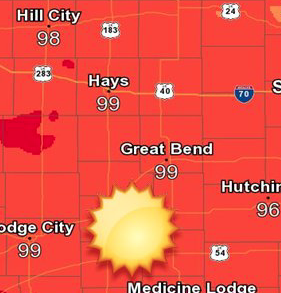
Today Sunny, with a high near 99. Breezy, with a south southwest wind 17 to 24 mph.
TonightMostly clear, with a low around 72. South wind 11 to 15 mph.
Tuesday Mostly sunny, with a high near 84. West southwest wind 9 to 15 mph becoming north in the afternoon.
Tuesday Night A 30 percent chance of showers and thunderstorms, mainly after 1am. Mostly cloudy, with a low around 60. North northeast wind 8 to 14 mph.
Wednesday Sunny, with a high near 81. North northeast wind around 8 mph becoming east in the afternoon.
Wednesday NightA 20 percent chance of showers and thunderstorms after 1am. Partly cloudy, with a low around 64.
RUSSELL COUNTY — One person died in an accident just before 3p.m. Sunday in Russell County.
The Kansas Highway Patrol reported a 2005 GMC pickup driven by Steven C. Greenwood, 21, Burneyville, OK., was eastbound on Interstate 70 just east of the Gorham exit.
The pickup entered the south ditch and collided with and flipped over the guard rail and rolled.
Greenwood was transported to Hays Medical Center where he died of his injuries.
Three passengers Jesse D. Dominguez, 23 and Joseph A. Boatner, 22, both of Marietta, OK., and Tyler A. Bates, 22, Ardmore, OK., were also transported to Hays Medical Center.
Greenwood and Boatner were not wearing seat belts, according to the KHP.
———–
RUSSELL COUNTY — One person was injured in an accident just before 3p.m. Sunday in Russell County.
The Kansas Highway Patrol reported a 2005 GMC pickup driven by Steven C. Greenwood, 21, Burneyville, OK., was eastbound on Interstate 70 just east of the Gorham exit.
The pickup entered the south ditch and collided with and flipped over the guard rail and rolled.
Greenwood was transported to Hays Medical Center. He was not wearing a seat belt, according to the KHP.
Sherry Dryden, executive director of the United Way of Ellis County
By BECKY KISER Hays Post
The United Way of Ellis County (UWEC) celebrates its 65th anniversary this year.
Organized in 1953, the earliest financial records Executive Director Sherry Dryden could find date back to 1965.
“Since then, $11.5 million dollars has been raised here in Ellis County,” Dryden announced Friday to the applause of the crowd gathered in Hays for the 2018 campaign kickoff luncheon.
There are currently 15 partner agencies working with the United Way which have provided more than 8,000 services over the past year, according to Dryden.
The 15 agencies offer 21 programs for the health, education and financial stability of Ellis County residents:
AMERICAN RED CROSS – Disaster Services, Health and Safety, Services to Armed Forces, Biomedical Services
BIG BROTHERS/BIG SISTERS – Mentoring Program
CANCER COUNCIL – Counseling Services
CATHOLIC CHARITIES – Counseling Services
CENTER FOR LIFE EXPERIENCES – Childcare Expansion Program
CEREBRAL PALSY RESEARCH FOUNDATION – Family Support Services
COURT-APPOINTED SPECIAL ADVOCATES – Improving Quality of Services to Volunteers and Children
DEVELOPMENTAL SERVICES OF NORTHWEST KANSAS – Job Placement Follow Along Program
EARLY CHILDHOOD CONNECTIONS – Connections Summer Preschool
FIRST CALL FOR HELP – Backpack for Kids, Info/Referral Program, Meals on Wheels
HAYS AREA CHILDREN’S CENTER – Early Intervention Services
OPTIONS – Shelter House Services
PARENTS AND CHILDREN TOGETHER – Ten Steps to Positive Parenting
SALVATION ARMY – Project Suitcase
WESTERN KANSAS ASSOCIATION ON THE CONCERNS OF THE DISABLED – Transportation Work Vouch Program
Nancy Jeter co-chairs the Wonder Women League.
Another program, Wonder Women League (WWL), was organized during last year’s United Way campaign.
Nancy Jeter, a previous UWEC campaign chairman and now co-chair of WWL, said she thought “there are a lot of women in the community that felt like they wanted to do more but didn’t know where to start.”
The new group recently opened the Born Learning Trail in Sunrise Park with the help of volunteers from the Hays staff of Adams, Brown, Beran and Ball.
Scott Boomer, operations director of Hays Eagle Radio and co-host of the morning show on 101.9 The Bull KKQY, is chairman of this year’s United Way fundraising campaign.
Boomer is familiar with the local United Way, having conducted many radio interviews over the years about the organization and its partner agencies. He’s also been the announcer for the United Way during homecoming parades as volunteers collect change in their bright orange plastic pumpkins from the crowds.
He decided to accept the campaign chairmanship because of the many ways the community has supported him and his family.
“Life happens. There are things you don’t plan for, and that happened in my family about five years ago. “My wife, who’s had diabetes since she was a little girl, had to have a kidney transplant to save her life,” said Boomer.
“So we know what it’s like to depend on other people, even though I’m the type of person that doesn’t like to ask for help.
“But these different entities that the United Way helps and donates to and gets involved with, are so very important because everybody has times in their life when they need help. All of us.
“There’s nothing to be ashamed of. There’s no reason not to ask for help.
“So it’s wonderful when you live in a community like this and the people donate like they do and give like they do, that we have these organizations to help.
“No donation is too big or too small,” Boomer noted. “Everything helps. Whatever the organization is, it’s helping somebody.”
This year’s campaign goal is $400,000.
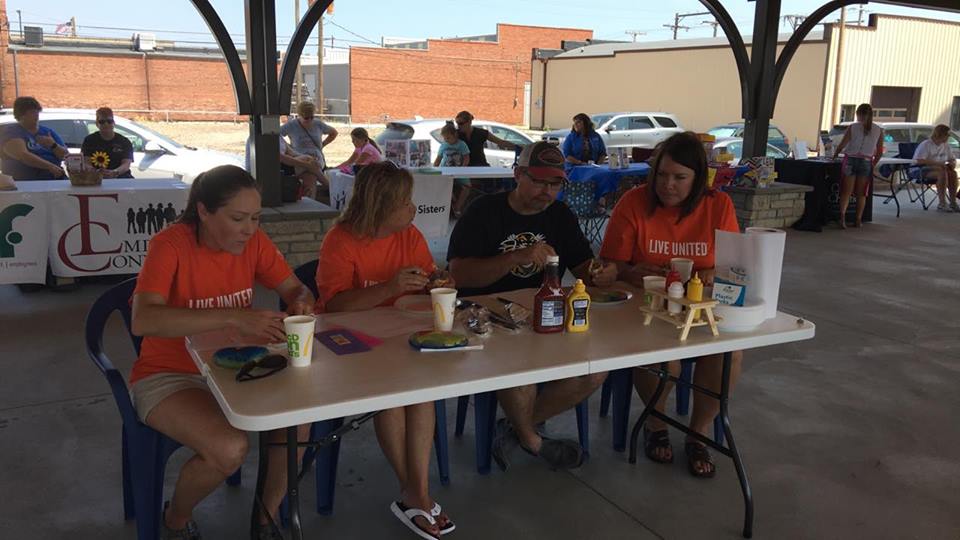
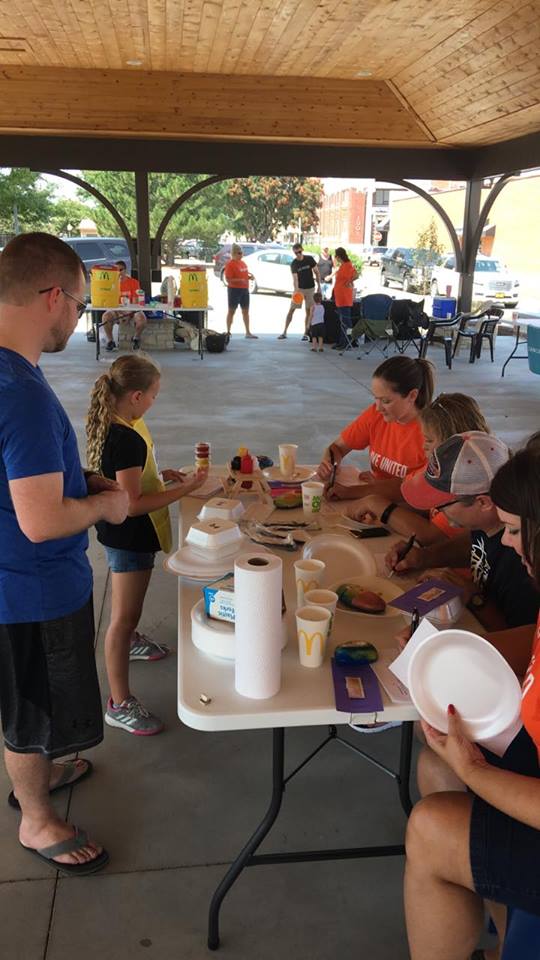
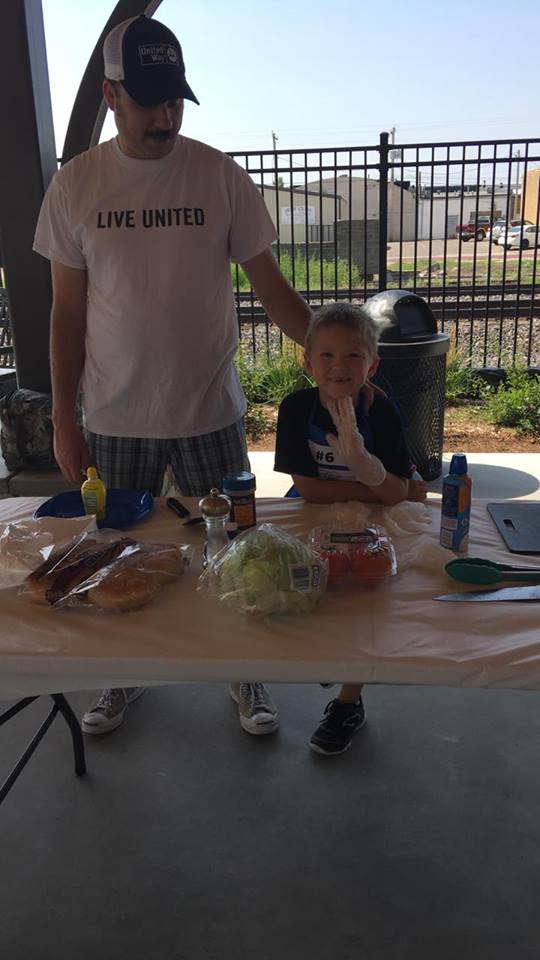
The United Way celebrated its community kick-off on Saturday with a children’s cook-off and adult scavenger hunt co-sponsored with area businesses. Dakota Schmidt won first place, Bryson Fairbank took second and Caydance Lang took third, all of Hays.
More information about the United Way of Ellis County is available at liveunited.us and on Facebook. Donations may be made online.
After two years of work, the Sternberg Museum of Natural History has launched for the first time a database showcasing pictures and information about the fossils that are housed at the museum.
“Museum paleontology specimen data are now available to educators, students, researchers and the general public around the world,” said Dr. Laura Wilson, curator of paleontology at the Sternberg Museum and an associate professor of geosciences at Fort Hays State University.
Funding came from a National Science Foundation grant awarded to Wilson.
“Making specimen data easily and openly accessible is a huge push in the museum community,” said Wilson. She said data accessibility is one of the main goals of the National Science Foundation.
Christina Byrd, paleontology collections manager at the Sternberg Museum, and students from FHSU worked with Whirl-i-Gig, “a software developer who designed the database CollectiveAccess, to customize the database to fit our data and needs,” said Wilson.
Sternberg Museum’s database is known as a relational database, meaning each specimen’s data is stored in tables, and those tables are linked together by common information. This is helpful when researching because with one search you can pull more relevant information. Wilson said, “Overall, a relational database is more easily searchable and makes data more accessible.”
A STEM (science, technology, engineering and mathematics) workshop in June allowed educators from different parts of the state to interact with the database as well as create activities for the classroom. Students involved in these lessons will have the opportunity to “build big datasets, analyze actual data to test ideas, collect their own data, ask questions, and explore images of Kansas fossils” said Wilson.
The database can be found at https://sternbergca.fhsu.edu/ and is available to the public.
HAYS – Ellis County Public Works crews will be conducting an asphalt overlay on a portion of Toulon Avenue on Monday, Aug. 27.
According to Public Works, crews will begin working at the north ramp of the intersection of Toulon Avenue and Interstate 70 and continue north for a half-mile ending at the intersection of Toulon Avenue and Air Base Road.
This stretch of Toulon Avenue will be closed to through traffic on Monday and expected to reopen when construction is complete. Work is expected to take one day to complete.
Motorists in the affected area should use alternate routes of travel until the project is complete.
The work was originally scheduled for Aug. 20 but was delayed because of the weather.
Direct any questions to the Ellis County Public Works Department at (785)-628-9455.
Suicide is the tenth leading cause of death in the United States, yet suicide is preventable, according to the Centers for Disease Control and Prevention (CDC). In 2014 (the most recent year for which full data are available), 42,773 suicides were reported, making suicide the 10th leading cause of death for Americans. In that year, someone in the country died by suicide every 12.9 minutes.
Dozens of people from throughout northwest Kansas are expected to participate in the Out of the Darkness Hays Walk hosted by the Greater Kansas Chapter of the American Foundation of Suicide Prevention at 1 p.m., September 15, 2018 at Municipal Park in Hays. This fundraising walk supports the American Foundation for Suicide Prevention’s local and national education and advocacy programs and its bold goal to reduce the annual rate of suicide 20 percent by 2025.
“We walk to help others seek help when they need to and to help community members respond to loved ones who may need help. Suicide affects so many and can have a big impact on rural communities. We hope that by walking we save lives and bring hope to those affected by suicide,” said Kyle Carlin, Greater Kansas AFSP volunteer.
The Out of the Darkness Hays Walk is one of more than 375 Out of the Darkness Community Walks being held nationwide this year. The walks are expected to unite more than 250,000 walkers and raise millions for suicide prevention efforts. Last year’s Hays Walk included over 80 people from northwest Kansas.
Check-in and same-day registration will begin at 1:00 p.m. at Municipal Park, and the walk will begin at 2:00 p.m. Anyone who would like to form a team, join a team, or walk as an individual, and/or donate is encouraged to register at www.afsp.org/hays. There is no cost to participate in the walk or remembrance activities.
“These walks are about turning hope into action,” said AFSP CEO Robert Gebbia. “Suicide is a serious problem, but it’s a problem we can solve. The research has shown us how to fight suicide, and if we keep up the fight the science is only going to get better, our culture will get smarter about mental health, and we’ll be able to save more people from dying from depression and other mental health conditions.”
The American Foundation for Suicide Prevention is dedicated to saving lives and bringing hope to those affected by suicide. AFSP creates a culture that’s smart about mental health through education and community programs, develops suicide prevention through research and advocacy, and provides support for those affected by suicide. Led by CEO Robert Gebbia and headquartered in New York, and with a public policy office in Washington, D.C., AFSP has local chapters in all 50 states with programs and events nationwide. Learn more about AFSP in its latest Annual Report, and join the conversation on suicide prevention by following AFSP on Facebook, Twitter, Instagram, and YouTube.
Ron Wilson is director of the Huck Boyd National Institute for Rural Development at Kansas State University.
By RON WILSON Huck Boyd National Institute for Rural Development
The bronze sculpture depicts a rider atop a rearing horse. It is a famous work of art created by Frederic Remington. One can find a copy of it in the Oval Office of the White House – as well as in the Kansas high school which bears Remington’s name. Today, the Frederic Remington Area Historical Society honors the legacy of this famous artist and others who lived in this rural region of south central Kansas.
Melvin D. Epp is a retired scientist, author, and president of the Frederic Remington Area Historical Society. This society’s goal is to preserve the local history in the area bounded by the Whitewater, Kansas school district, USD 206, which includes land once owned by artist Frederic Remington. Whitewater is a rural community of 718 people. Now, that’s rural.
Melvin grew up on a farm here. His family was active in the Mennonite church. Melvin attended Berean Academy (which his father helped found) and went on to earn a biology degree from Wheaton College, a master’s in botany from the University of Connecticut and a Ph.D. in genetics from Cornell University. Melvin Epp’s career as a botanical research scientist led him to St. Louis, the Philippines, and California.
In 1990 he moved back to Kansas. He ran the organic garden for the restaurant at the Riordan Clinic in Wichita and was named an honorary Master Gardener in Sedgwick County. He also got involved with the Frederic Remington Area Historical Society, for which he has served as president since 2007.
The high school in Whitewater is named for Frederic Remington because Remington once lived in this region. Remington had grown up in New York and shown an early aptitude for drawing. Horses were his favorite subject.
Remington traveled west and sketched a scene which became published in Harpers Weekly in 1882. It was Remington’s first commercially published work of art.
As of 1883, the wool trade was booming in the U.S. A friend of Remington’s convinced him to come to Kansas and try to make money in the sheep ranching business. Remington bought two quarter sections of land near Whitewater for his enterprise but chose to sell in 1884. He moved to Kansas City and eventually to New York for a career as painter, sculptor, and author. He was later termed one of our nation’s “great American painters.”
Remington’s first and most famous sculpture was the one he called “The Broncho Buster,” spelled with an extra “h” in broncho as was the spelling of the time. This sculpture has been called its century’s most popular small American bronze sculpture. After the Spanish-American War, Teddy Roosevelt’s Rough Riders presented him an original cast of this statue in appreciation. As mentioned, a copy stands in the Oval Office as well as at Whitewater’s Frederic Remington High School, in honor of its namesake.
Melvin Epp’s great-grandfather married a daughter of the man who sold Remington his farmland in 1883. A display of information about Remington stands in the high school today.
There is other rich history in the region as well, particularly about the Mennonite church. Melvin wrote a book, The Petals of a Kansas Sunflower, which describes the migration of Mennonites from West Prussia to Kansas in the 1870s, due to government regulations requiring them to join the Prussian army.
Melvin’s mother, Marie Harder Epp, was born in America to these relocated immigrants. “My mother was the village poet,” Melvin said. “People would ask her to write poems to honor someone.” Her first poem was written in 1929 and her last in 1991. The book includes 103 of her poems and describes the changes and challenges faced by these German-speaking Mennonite farmers. The book is available at booksellers such as www.amazon.com and others.
More information about the historical society can be found at its website.
Today, casts of the famous statue by Frederic Remington can be found from Washington, D.C. to rural Kansas. We commend Melvin Epp and all those involved with the Frederic Remington Area Historical Society for making a difference by preserving and sharing this history. Their commitment is like a beautiful work of art.

 SBA
SBA