We have a brand new updated website! Click here to check it out!

HINEMAN: Proxy Voters

The Kansas Secretary of State has estimated that only 26% of registered voters will vote in the Kansas primary election on Tuesday. And amazingly, if it works out that way, that would be the highest participation rate in a decade.

There is plenty of reason to sigh and shake our heads at such a sorry turnout and bemoan the lack of participation in democracy.

But there is a different perspective.

If only one out of four registered voters will vote, its like three of your friends saying they trust your instincts and political viewpoint enough that they are willing to give you their proxy in the election. So when you vote, you aren’t just casting your own vote, you are voting for three of your absentee friends as well. Think of the power that gives you! Don’t let those “proxy voters” down. Be part of the 26% who show up and fill out a ballot.

Remember, the world is run by those who show up.

Don Hineman (R-Dighton) is the District 118 Representative and Kansas House Majority Leader.


HaysMed welcomes new Emergency Department physician

Aaron Pfeifer, M.D.
HAYSMED

Dr. Aaron M. Pfeifer, MD, has joined the medical staff of HaysMed as a full time physician. Dr. Pfeifer, a Hays native, will join Drs. Gerald Matzke, Rob Miller and Derek Yarmer in the Emergency Department.

Dr. Pfeifer is a Thomas More Prep alumnus and graduated from Fort Hays State University. He completed medical school at The University of Kansas School of Medicine, Kansas City. He did his residency training in emergency medicine at Western Michigan Homer Stryker, MD, School of Medicine, Kalamazoo, Michigan.

For more information on emergency services at HaysMed go to haysmed.com/emergency-department.

FHSU debuts online bookstore for 2018-19 school year

By DIANE GASPER-O’BRIEN
FHSU University Relations and Marketing

In keeping with its mission of considering the needs of students first, Fort Hays State University is now offering a less expensive method of buying books.

FHSU this summer launched an online bookstore for the 2018-19 school year, rising to the forefront as the first Kansas Regents university to offer the purchase of books exclusively online.

“It’s exciting,” said Edie McCracken, director of the Memorial Union. “It’s innovation, which Fort Hays State is known for. An online store has a different business model.”

With the current contract for the University Bookstore set to expire this summer, a request for proposal (RFP) or selection committee was formed and chaired by McCracken. FHSU joined the National Association of College Stores (NACS) last fall in an effort to determine new trends and best practices for the sale of books to students.

McCracken said the committee was intrigued by a “hybrid model,” one that features online book purchasing but with the traditional campus store still serving a purpose.

The committee chose Akademos, a virtual course material store, as the online vendor for purchasing textbook material, and indiCo, a subsidiary of the NACS, as the vendor for the Tiger Spirit Shop. That shop, which occupies the main floor of the former University Bookstore, will carry merchandise such as FHSU clothing and gifts, school supplies, technology accessories, etc.

“We were really open to new things,” McCracken said. “We wanted to do what was the best fit for students. The affordability of text materials was the driving point, and an online store has a different business model. It focuses on affordability.”

The RFP committee found that Akademos and indiCo have partnered on other campuses so they already had a relationship.

“We’re so pleased to be partnering with Akademos and indiCo to launch such an innovative bookstore solution,” said Dr. Joey Linn, vice president for student affairs. “This decision contributes to our overall strategy to provide our students with all of the tools they need to succeed, by expanding our offering of course material formats, lowering the costs associated with them, and providing our students with general merchandise and fan shop items that contribute to a complete and successful college experience.”

During the research process, FHSU’s selection committee formed focus groups to learn buying preferences of students. The online purchasing model can provide up to 25 percent savings for students.

McCracken said they were impressed with how easily accessible the online model would be for faculty, staff and students.

“That was very important to us in terms of an online bookstore,” she said.

Students have been buying books online for several years, so the RFP committee thought it would be a fairly easy transition.

“We have found that the majority of students were already buying their books online except for last-minute purchases,” McCracken said. “The great thing now is that data will be available to us to see how and when they are purchasing books. We will know what the trends are and can do some assessment of our own.”

McCracken said she thinks the biggest change will be for students who have a tendency to wait until late in the game to purchase their books.

“If students wait until the last minute to get their books, this is going to be a little bit different for them,” McCracken said.

Training for staff began this summer – sessions for deans, department chairs and administrative assistants. Training sessions for faculty will be scheduled throughout the semester, beginning with the university’s Professional Development Day on Aug. 14.

Akademos will hire two students to provide training for students and parents. McCracken will be their main contact on campus to assist with their training and connect them to campus resources.

A users’ guide is online, as is information on how to contact the store for questions or if students want to clarify something before they purchase their books.

“The Memorial Union has always had a strong tie to the bookstore, and we want to continue that connection,” McCracken said. “We still want the union to be the place to go to get your questions answered.”

There are links all across the FHSU website on how to order, and the direct link is: fhsu.textbookx.com. Students can log in with their Tiger ID, and their Tiger Enroll account is linked to their courses in which they pre-enrolled for fall semester 2018 as well as the material those courses will require.

They have the option to have books shipped to their addresss or to the Tiger Spirit Shop, where they can be picked up.

The online bookstore opened in late June, and McCracken said that “so far, students are receiving their books rather quickly – have had a great response time.”

Faculty are able to log onto a portal and adopt a book for their classes after reading the analytics for their courses.

McCracken gave credit to Dr. Tim Crowley, associate provost for academic affairs, for helping make the changes go as smoothly as possible.

“He has been a great resource, helping with communicating to faculty about the new process,” she said. “Partnering with our staff has been a key part of this transition.”

Working with indiCo offers several advantages, McCracken said.

With larger corporate vendors, McCracken explained, those vendors do the buying for the university.

“With this model, our store staff works with their buyers and gets to make all the selections,” she said, “so if faculty and alumni want smaller quantities of a certain item, that can be ordered separately.”

The new hybrid model also holds optimism for the future.

“One of the perks is that in a few years, the union will be looking to reimagine,” McCracken said. “We will be able to get that storage space in the basement (of the bookstore) and open up more space for students.”

While McCracken said the union is not close to exploring that step yet, it’s something to look forward to.

“We’re trying to be a trailblazer,” she said. “If it’s what’s right for students, it’s what we’re going to do.”
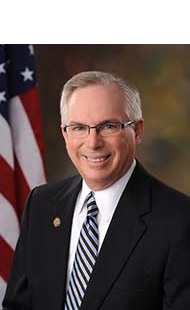
HAWVER: Worker Comp and the 14th Amendment

Martin Hawver

Remember the last time the dinner table conversation was about Worker Compensation? Or maybe the last time that you went through all those Bill of Rights numbers, and came down to No. 14 for a debate?

Well, a Kansas Court of Appeals panel last week agreed 3-0 that the state’s worker compensation law was amended by the newly turned-conservative 2013 Kansas Legislature back then in a way that damaged that 14th Amendment right of Kansas workers.

Oh, the 14th Amendment? It’s the one that that prohibits states from depriving “any person of life, liberty or property without due process of law.” Pretty good little amendment. Not as political as the 1st (free speech) or 2nd (guns) but one that probably is important to everyone who works for a living.

That case the justices decided told the Legislature that back in 2013, it passed a work comp damages provision that essentially eliminated that “due process of law” provision.

Here’s what happened:

The Legislature in 2013 amended the Kansas Worker Compensation Act to sharply reduce the damages that an injured worker could receive for a job-related injury. Technically, it moved from the American Medical Association’s Edition 4 schedule to the AMA’s Edition 6 schedule. And the Edition 6 provides lower percentages of compensation than did Edition 4. That newer edition didn’t consider in computation of impairment returning to work, just basic activities of life.

Weird, but the newer version of the disability compensation doesn’t make provisions for, say, lifting boxes in the warehouse, or standing to operate a cash register…

Remember that worker compensation began as an agreement between workers and their employers. A worker is hurt? The American Medical Association has publications that assess the injury and the effect that injury has on an employee’s ability to perform his/her job. The deal between employers and their workers is that injured workers will be fairly compensated for their injuries without having to sue the employers, and the employers defending every job injury. Saved everyone a lot of money, and time. That was the deal.

Oh, and it might not become part of a bet at a bar, but Kansas and Washington state were the first to enact work comp laws, back in 1911.

Well, the Court of Appeals panel decided that the state’s 2013 change of reference for determining disability and payment to injured workers tilted the deal so that it wasn’t a fair trade, workers giving up the right to sue for damages in return for employers providing adequate and fair compensation (through their insurance policies) to those injured workers.

The issue came to the court when a Kansas delivery driver was hurt on the job, and the new disability guidelines book computed his impairment of 6 percent while the older version put his disability at 25 percent. The dollar difference? It was $14,810 for that persistent back injury, while the older AMA book put the disability award at $61,713—a difference of about $47,000.

Now, there undoubtedly have been other workers injured and compensated under the new law, but it took a specific set of circumstances, effective dates of bills and such, to make this case eligible for Court of Appeals consideration, not just the decision of the Workers Compensation Board.

This decision to return to that old Edition 4, with its consideration of not just whether you can survive but actually return to work at some point, sounds reasonable.

Sounds like a fair trade…we’ll see whether the decision is appealed to the Kansas Supreme Court…and how that goes…

Syndicated by Hawver News Company LLC of Topeka; Martin Hawver is publisher of Hawver’s Capitol Report—to learn more about this nonpartisan statewide political news service, visit the website at www.hawvernews.com.

Hays USD 489 board approves budget for publication with mill levy decrease

By CRISTINA JANNEY

Hays Post

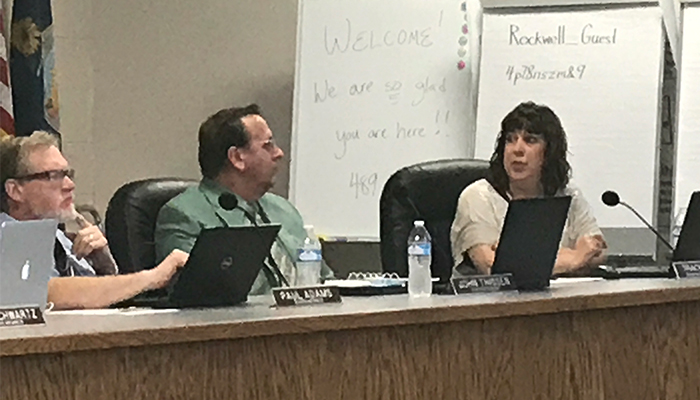
The Hays USD 489 school board approved its 2018-19 $48.7 million budget for publication Monday night with a mill levy decrease.

The .767-mill levy decrease was the result of the end of a special mill levy of 0.646 mills for declining enrollment and an increase in assessed valuation.

The total mill levy for the school district will be 42.799 mills. The district’s local option budget will increase from 29 percent to 30 percent. The local option budget is taxes approved by a local school board and levied locally for the benefit of the local school district.

The capital outlay mill levy, which is used for maintenance, technology, vehicles and other large purchases, will stay at 8 mills.

The school board members said little about the budget at the meeting Monday.

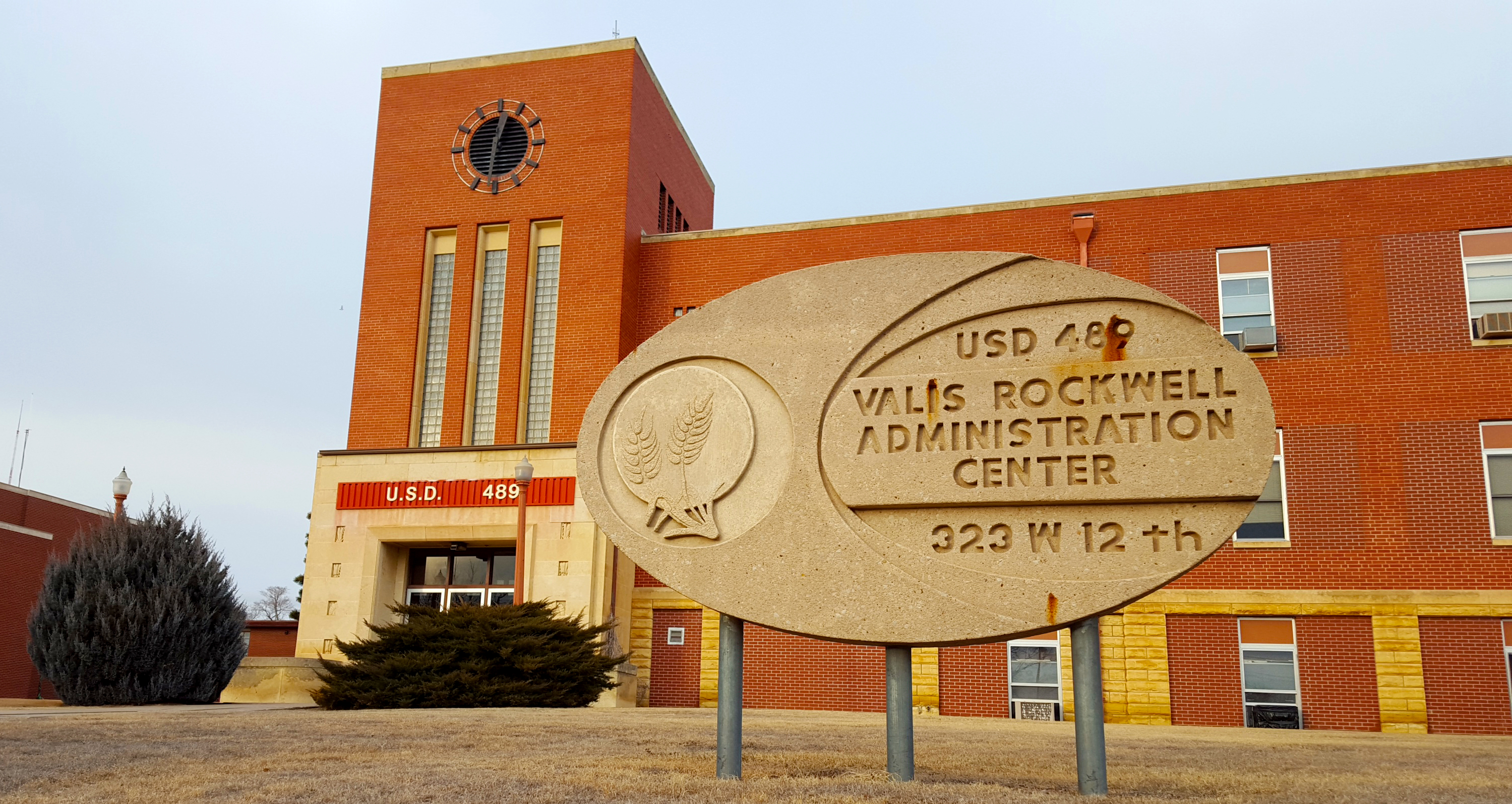
The public hearing on the budget was set for 6:30 p.m. Aug. 20 at the Rockwell Administration Center, 323 W. 12th St. Members of the public can speak at the budget hearing. Once the budget is published, the district can spend less than it has budgeted, but can’t spend more without republishing a new budget.

The school district also levies taxes for the Hays Recreation Commission. The rec commission’s general mill levy will stay at 3 mills, but its employee benefits and special liability levy will increase from 1.141 mills to 1.391 mills.

The school district has no control over the rec commission levy.

Assessed valuation for the district increased by almost $1.3 million to more than $316 million. The districts bonded indebtedness also dropped by more than $1.3 million.

The State of Kansas passed a school funding plan that will increase school funding by more than $500 million statewide over the next five years.

Hays’ total state funding increase will be about $2.1 million. The district also is forecasting it will see a federal funding increase  of $156,040. However, once the loss of the declining enrollment levy, which was a temporary program, is figured into the budget, the district will gain less than $1 million in additional revenue for the coming school year.

Tracy Kaiser, director of finance, noted most of the additional funds will go toward, instruction, student support services and instructional support services.

Although the district’s total budget is $48.7 million for publication, the district will likely will not spend all of that money, as it will have carry over in funds such as capital outlay and nutrition services. The district had about $2.7 million in capital outlay carry over as of July 1.

The general fund budget is set at $18.9 million.

“The budget looks strong this year,” Kaiser said. “I feel really good about it.”

Enrollment

The school board also heard a report from assistant superintendent Shanna Dinkel on enrollment. She estimated about 89 percent of the district’s students were enrolled as of central enrollment last week. More than 1,300 of the district’s almost 3,000 projected students enrolled online prior to in-person enrollment.

Further information on enrollment numbers will be released at a later date.

The district also approved an agreement with Fort Hays State University on the use of Lewis Field.

Sunny, warm Tuesday with a chance for thunderstorms

Today A 10 percent chance of showers and thunderstorms before 7am. Partly sunny, with a high near 88. North wind 6 to 8 mph.

Tonight Mostly clear, with a low around 65. Northeast wind 5 to 7 mph becoming light and variable after midnight.

WednesdayMostly sunny, with a high near 89. South southeast wind 5 to 7 mph.

Wednesday NightMostly clear, with a low around 64. Southeast wind 5 to 7 mph becoming west southwest after midnight.

ThursdaySunny, with a high near 91.

Thursday NightMostly clear, with a low around 66.

FridayMostly sunny, with a high near 91.

News From The Oil Patch–Aug. 6

By JOHN P. TRETBAR

The Kansas Corporation Commission reports 182 new intent-to-drill notices filed during the month of July, up from 179 in June, and 103 a year earlier. There are 11 new intents in Barton County, 11 in Ellis County, three in Russell County, and five in Stafford County.

Baker Hughes reported a drop in its drilling rig count last week to 1,044 active rigs nationwide, down two oil rigs and down three rigs seeking natural gas. Colorado and New Mexico each dropped two rigs, and the count in West Virginia was down three. Independent Oil & Gas Service reports 15 active drilling rigs in eastern Kansas, up one, and just 28 west of Wichita, down five rigs. They’re moving in completion tools at three leases in Barton County and six in Ellis County. Operators were about to spud one well in Barton County, two in Ellis County, and one in Stafford County.

So far this year, operators have filed one thousand permits for drilling at new locations in Kansas, including 45 filed last week. There are two new drilling permits in Barton County, one in Russell County and two in Stafford County.

Independent Oil & Gas Service reports 19 newly-completed wells across the state for the week, 917 so far this year. There were nine east of Wichita and ten in western Kansas, including one in Barton County.

According to a new report, Russia smuggled $238 million worth of crude oil to North Korea from 2015 to 2017, ten times more than previously reported. Voice of America news reports the Russians helped North Korea evade UN. sanctions by setting up an illicit trade network, which a South Korean research group says is likely still being used.

The proposed Keystone oil pipeline expansion gets a “mostly clean” environmental review from the State Department. The report might provide fodder for both proponents and detractors of the project. Bloomberg reports it notes “no significant impacts on water and wildlife,” but minor to moderate impacts in several areas. While TransCanada is planning some preparatory work for this fall, the pipeline still is facing a challenge before the Nebraska Supreme Court, which is expected to wrap up early next year, as well as legal challenges to the project’s U.S. presidential permit. TransCanada has yet to officially declare it is building the project, despite U.S. and state approval. The second international crossing would add nearly half a million barrels to the existing Keystone system, which moves heavy crude from Alberta, Canada to Cushing, the Texas coast, and the refining cluster in southwest Illinois.

The State of Idaho is hoping to get a boost in the oil patch by letting the federal government take over regulation of saltwater disposal wells. The U.S. Environmental Protection Agency on Monday issued a final rule transferring a portion of the state’s Underground Injection Control program to its control. At least one producer says its production in the state has dropped because of the high cost of trucking oilfield wastewater to evaporation ponds. That’s about $9 a barrel, whereas an injection well could lower that disposal cost to $2 per barrel.

BP’s recovery from the Deepwater Horizon disaster eight years ago has been remarkable. They appear to have nearly covered their financial costs from the tragedy. Last week they agreed to spend $10.5 billion for a new swath of US shale assets. And this week they announced their second-quarter profits quadrupled from a year ago to $2.8 billion. The company announced a 2.5% increase in its dividend, the first such raise for stockholders since the price crash of 2014.

From the heart of the Bakken, the second-largest shale oil play in the country comes word of a refinery proposing to convert to vegetable oil instead of petroleum. Andeavor, formerly known as Tesoro, hopes to produce renewable diesel fuel from local soybeans for export to high-demand markets in California. According to the Bismarck Tribune, Andeavor formally applied to the Health Department for the permit needed to convert the facility.

Hays USD 489 to review budget

By CRISTINA JANNEY

Hays Post

The Hays USD 489 school board will vote on a draft of its 2018-19 budget at its meeting tonight.

The board will meet at 6:30 p.m. in the Toepfer Room of the Rockwell Administration Center.

The board will set the budget for publication and is anticipated to have a public budget hearing at 6:30 p.m. Aug. 20 at the Rockwell Administration Center, 323 W. 12th St.

Once the budget has been published, the district can decrease the amount spent, but can’t increase the amount spent without republication of the budget.

The budget process was delayed this year because the state was waiting on a Kansas Supreme Court ruling on the adequacy of state funding. The court ruled the Legislature has not provided enough money to public schools, but has given the state another year to increase funding.

Because of this delay, the USD 489 budget was not yet available to the public as of this publication of this story.

The board is also set to review enrollment data and vote on an agreement with Fort Hays State University on the use of Lewis Field.

Following storm, St. Mary’s School start date pushed back

This is an update to previously reported information regarding the structural damage to St. Mary’s School in Ellis, KS, following the storm on July 25th, 2018.

Previously, following a building assessment by a structural engineer on St. Mary’s school, it was reported that the building would be unsafe for students for the 2018-2019 school year due to significant damage to the east wall of the school’s gymnasium and the gymnasium roof. At that time school staff began to explore options to include securing mobile classrooms for students with the intention to start school as scheduled on August 23rd, 2018.

During the time that information was being received on the logistics of mobile classrooms, Father Dana Clark met with a design engineer and an architect who have surveyed the building damage. After this assessment, the structural engineer, design engineer, and architect have met and determined that the damaged gymnasium wall can be structurally supported with temporary bracing, which will allow the remainder of the school to be safe for students to attend class this year.

In light of the recent developments, Father Dana Clark, Principal April Pfeifer, and St. Mary’s School Council have determined the need to push back the first day of school to September 10th, 2018. This will allow time for a contractor to brace the damaged wall, as well as secure the damaged roof of the gymnasium to make the school building safe for students. Additionally, this will allow time to repair the damage which occurred inside the classrooms so that they will be ready for students when they arrive for the first day of school. Should these repairs be completed ahead of schedule, parents will be notified in advance if St. Mary’s is able to start school prior to September 10th, 2018.

St. Mary’s School continues to appreciate all those who have helped with the current situation we face ahead. Volunteers are still needed to prepare the school for the upcoming repairs. Volunteers are asked to check in at the school no earlier than 9am.

Monetary donations to assist with the replacement of damaged school supplies continue to be accepted and can be sent to Equity Bank, Attn: St. Mary’s, PO Box 255, Ellis, KS 67637.

Updates will continue to be posted to the St. Mary’s Catholic School K-6 or St. Mary’s Church Ellis, KS Facebook pages.

– SUBMITTED –

NW Kansas part of Rep. Marshall Community Coffee Tour

OFFICE OF REP. MARSHALL

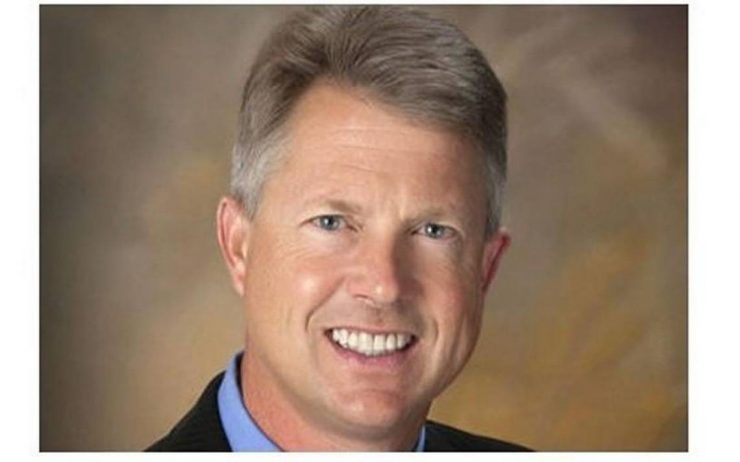
WASHINGTON, D.C. – This month Congressman Marshall will be traveling 2,500 miles across the Big First District hosting community coffees. Thursday, Aug. 9, Rep. Marshall will begin his Community Coffee Tour in Meade County. He will make 19 stops, finishing in Lincoln County on Sept. 1.

“I was elected to be the First District’s microphone in Washington,” Rep. Marshall said. “I look forward to being back in Kansas this month where I can sit down with constituents and hear their stories and better learn what issues are most important to them. We have accomplished a lot this year, but there is more work to be done.”

These community coffees are open to the public, and we hope to see you there!


New location for Heartland Community Foundation and DHDC

The Heartland Community Foundation, which serves Ellis, Rooks and Trego Counties, has relocated to an office suite at the Chestnut Building in downtown Hays. The foundation joins two other nonprofits in the building, which is located at 1200 Main St.

Also relocating to the Chestnut Building is the Downtown Hays Development Corporation. “We welcome you to stop in and enjoy a cup of coffee while we show off our beautiful new space located right on the first floor,” said DHDC Executive Director Sara Bloom.

HCF was previously housed in the Hays Welcome Center, 2700 Vine. DHDC was located in the 100 block of West 12th, just a block west of its new locale.

“It is going to be a dynamic environment full of nonprofit synergy,” added HCF Executive Director Sandy Jacobs.

With assets totaling more than $3.1 million, the community foundation helps donors pursue their charitable interests and supports local organizations through its competitive grants program. During the 2018 fiscal year, HCF awarded $353,581 in competitive grants among the three counties in its service area. Applications for the upcoming fall grant cycle will open on September 15.

Learn more about the Heartland Community Foundation at www.heartlandcommunityfoundation.org.

– SUBMITTED –

Hansen Foundation offers free crowd funding and capital campaigns webinar

DGHF

LOGAN – Within each of our communities and counties there is an endless list of wants and needs. We strategize, set priorities and start work on having our projects come to life. But along the way we get slowed down by the need to raise funds.

To learn more about raising funds, in particular crowd funding and capital campaigns, plan to participate in a free one-hour webinar hosted by the Dane G. Hansen Foundation and K-State Research and Extension on Tuesday, August 14, at 6:30 p.m.

Josie Hammer with JenRuss Freelance will be sharing information on crowd funding and Betty Johnson, of Betty Johnson & Associates and Nancy Wolff, of the Harvey Nonprofit Development, will share on capital campaigns.

To register for “Crown Funding and Capital Campaigns” email Nadine Sigle at [email protected]. Upon registration a link will be sent. The webinar will be recorded and stored on the Dane G. Hansen website under the Northwest Initiatives tab.

For further details please contact Sigle.

Copyright Eagle Radio | FCC Public Files | EEO Public File