WICHITA, Kan. – Tyler Blomster struck out six without a walk and gave up only one run over 6 2/3 innings to lead the Hays Larks to a 7-2 victory over the Clarinda (IA) A’s in their opening game of pool play in Championship Week at the NBC World Series at Lawrence-Dumont Stadium.
Frank Leo Postgame Interview
Game Highlights
The Colorado School of Mines standout allowed only two Clarinda baserunners into scoring position over the first six innings before yielding a run in the seventh. Blomster scattered six hits for his fifth win of the season.
Carlos Tavera struck out A’s leadoff hitter Reid Bonner to end the Clarinda threat in the seventh and allowed one run on one hit with three strikeouts. Shane Browning faced the minimum in the ninth to close out the game.
The Larks (35-10) jumped out to a 5-0 lead over the first five innings. After a leadoff double, Ryne Randle scored on a Wyatt Divis single in the first. Jacob Boston’s two-out two-run triple scored RJ Williams and Divis in the third.
The Larks would add single runs in the fourth and fifth before Nic Gaddis hit a two-run homer down the left field line in the seventh.
Sean Bergeron (4-1) allowed five runs – two earned- on nine hits over 4 1/3 for Clarinda (23-27) who committed three errors in the game.
The Larks will face another former Jayhawk League member Sunday when they play Wellington at 7 pm. The Heat, who have won two-straight Kansas Collegiate Baseball League regular season and tournament titles, held off the San Diego Stars 7-4 in the first game of the day Friday.
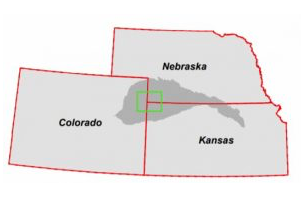
TOPEKA, Kan. (AP) — Colorado has agreed to pay Kansas $2 million in a settlement resolving claims regarding Colorado’s past use of water under the Republican River Compact.
KDA image
Kansas Gov. Jeff Colyer said in a news release Friday that the settlement is an investment in the basin to ensure a better future for Kansas water users.
The Republican River Compact allocates the waters of the basins between the states of Colorado, Nebraska and Kansas.
Under the provisions of the settlement , Kansas agreed to pursue “a good faith effort” to spend the money Colorado paid for the benefit of the South Fork of the Republican River Basin within Kansas.
Colorado also agreed to pursue an effort to spend an additional $2 million by 2027 in the basin within Colorado
Ron Wilson is director of the Huck Boyd National Institute for Rural Development at Kansas State University.By RON WILSON Huck Boyd National Institute for Rural Development
In the hurricane’s aftermath, workers race to help stranded victims. They are aided by drones which fly overhead and capture images which direct the rescuers to the people who need them. If only there was a practical way to keep multiple drones powered and in the air. That vision inspired two entrepreneurs who are building such a system in the middle of Kansas.
Jean Harrison and Kim Ringwald are the founders of H & R viZion in Great Bend. They were inspired by the notion of what drones – sometimes called unmanned aerial vehicles – could do.
Jean grew up in Stafford County, married a farmer, and worked in Great Bend after he passed. Kim grew up in a Navy family. When her dad went overseas, she and her mom stayed at her grandparents’ farm near the rural community of Bison, Kansas, population 255 people. Now, that’s rural.
Eventually Kim’s family settled at Ellinwood. Kim married and later moved to Great Bend where she met Jean. They worked at the same business and became longtime friends. Now both are retired.
“I was at home watching what was happening with Hurricane Harvey,” Kim said. In 2017, Hurricane Harvey caused $125 billion in damages and multiple fatalities. Kim saw a rescue worker struggling to unload a drone and other equipment at the disaster site. “Helicopters were trying to rescue flood victims by lowering baskets to them, but it took hours to find the victims,” Kim said.
Kim thought to herself that there had to be a better way to power and deploy drones to help this situation. She sat down at a TV tray and started drawing designs, one after another. “I took the idea to Jean, and she said, `I think this will work,’” Kim said.
After lots of research, the two women formed an LLC to develop and commercialize this concept. Using the initials of their last names and an eye-catching version of the word vision, they named it H & R viZion – spelled with a Z. “Catch the viZion” is a company motto.
Essentially, the business is finalizing development of portable drone charging stations which help to keep multiple unmanned aerial vehicles in the air. “Presently drones can only fly 30 to 35 minutes,” Jean said. Their onsite charging station could service multiple drones and allow a fleet of drones to be kept in the air 24-7. Jean and Kim are now seeking investors to help grow their company.
What are the possible applications of such technology? “We’re a couple of farm girls,” Jean said. “At first, we thought about agriculture.” She remembered a bad winter storm when a friend’s cattle were scattered and drones could have helped locate them. Drones would also be helpful in finding and checking cows which might be calving and need assistance.
Other possibilities are virtually endless. In the case of an aforementioned natural disaster, drones can provide the aerial view to safely and quickly find victims and identify problems. It’s safer to have a drone check a damaged roof than ask a person to go up on the roof, for example. Drones could be used for surveillance, inspection, construction, transportation, insurance, law enforcement, and national defense purposes also.
In October 2017, the Kansas Small Business Development Center hosted an event called Encountering Innovation where innovative small businesses could present their concepts to representatives of potential federal customers, primarily the Department of Defense. H&R viZion made a presentation at that session. “We have moved to high tech materials for our final models,” Jean said. “With the round of investment we’re currently raising, we will then be ready to manufacture our product and make our dream a reality.”
Another round of Encountering Innovation will be held in October 2018 in Johnson County. For information on that session, see www.encounteringinnovation.com.
Whether assisting with natural disasters, aiding homeland security, inspecting bridges or helping with business applications, aerial views can be extremely important. We commend Jean Harrison and Kim Ringwald for making a difference with innovative technology. It is helpful to catch the viZion from above.
Two kayakers near Hell Creek Bridge at Wilson Lake.
By CRISTINA JANNEY Hays Post
On the map: Wilson, Kansas Distance from Hays: 50 miles Drive time: 48 minutes
On my travels across Kansas, I have been to the Irish Festival in Chapman, the Scottish Festival in McPherson, Midsummer’s Festival (Swedish) in Lindsborg and, of course, Octoberfest in Hays.
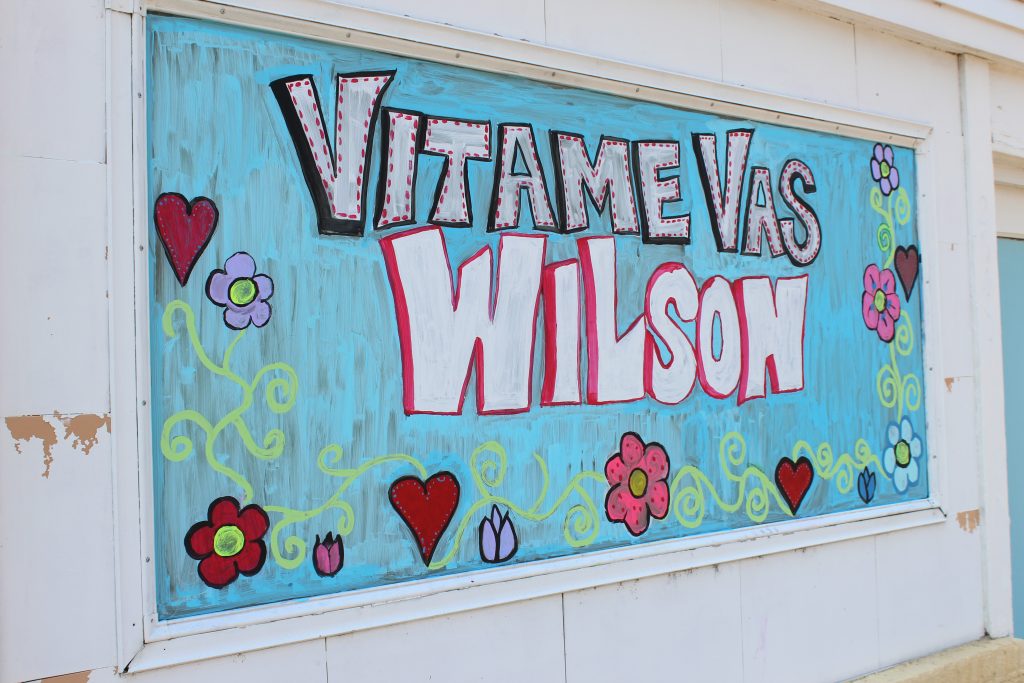
Wilson is not shy about promoting its Czech heritage. In that vein, it commissioned a 20-foot-tall Czech egg, which stands in the center of town.
Christine Couch Slechta, Czech egg painter and designer of the giant Czech egg in Wilson.
Christine Couch Slechta was this year’s Czech Festival grand marshal. An art teacher, Slechta was the artist who designed the giant 7,000-pound fiberglass Czech egg.
Although she does not have any Czech heritage, she is known for her Czech egg art. Slechta, a long-time Wilson resident, learned the art from a Czech descendant who lived in Wilson. She gave me the lowdown on the eggs.
The eggs were originally given by young ladies to young gentlemen in Czechoslovakia during the Easter season. Symbols on the eggs indicated strength and positive outlook for the future. Slechta paints chicken, goose and ostrich eggs in both traditional Czech patterns and modern designs. The designs are painted first, and then the egg is punctured to empty the contents.
Czech immigrants settled in the Wilson area in 1874. Last weekend, the community celebrated its annual Czech Festival.
Giant Czech egg in Wilson.
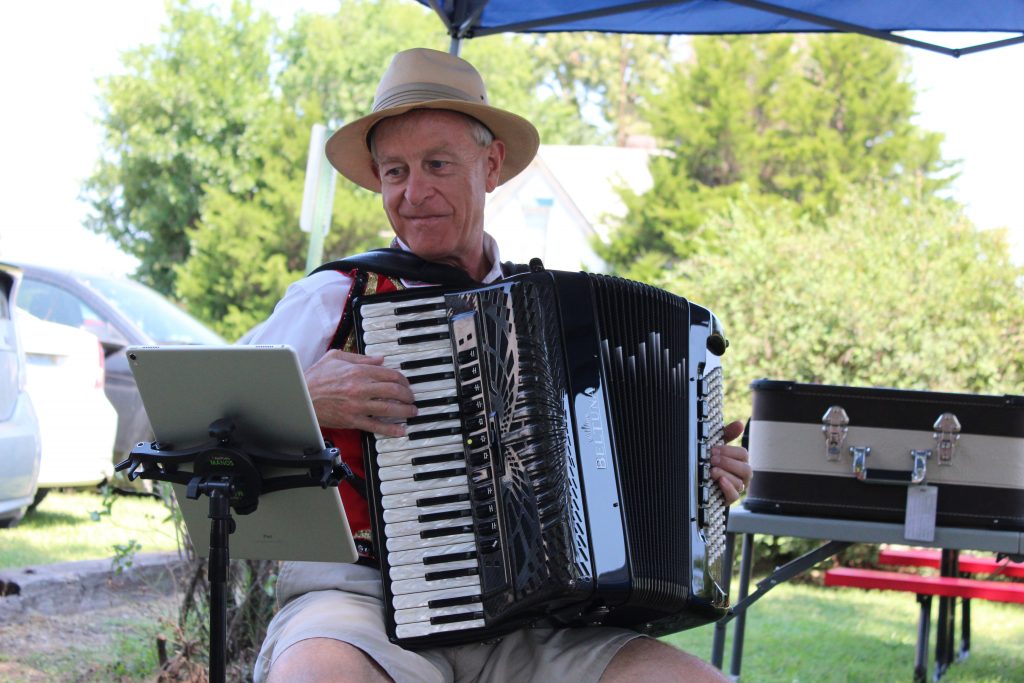
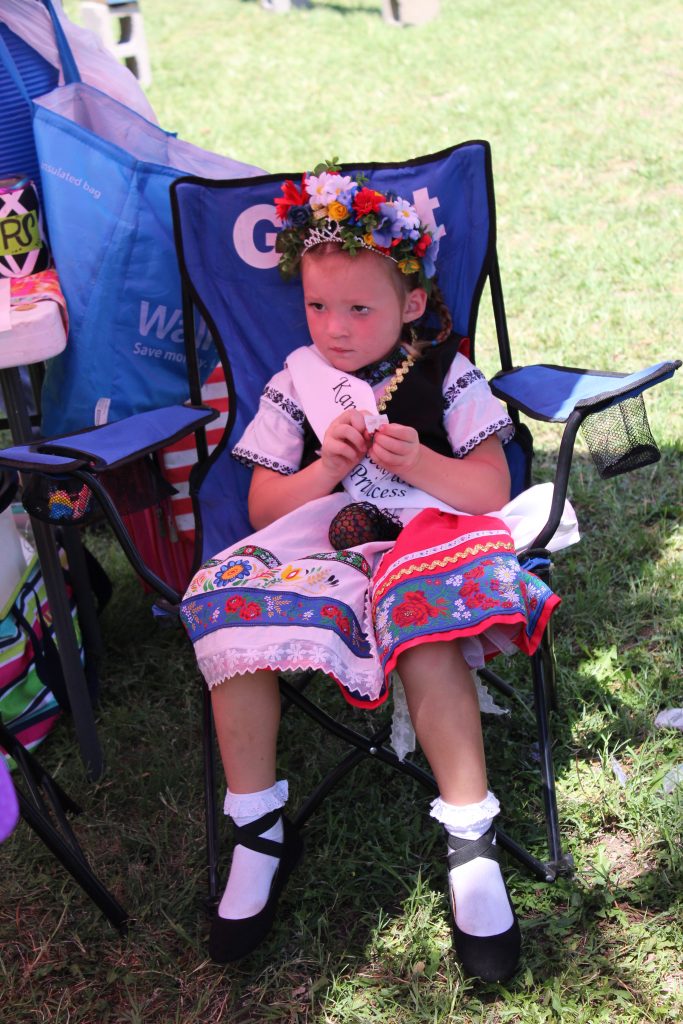
If you have a fine ear for polka, this definitely where you want to be. Young ladies also wear traditional dress to practice Czech folk dances.
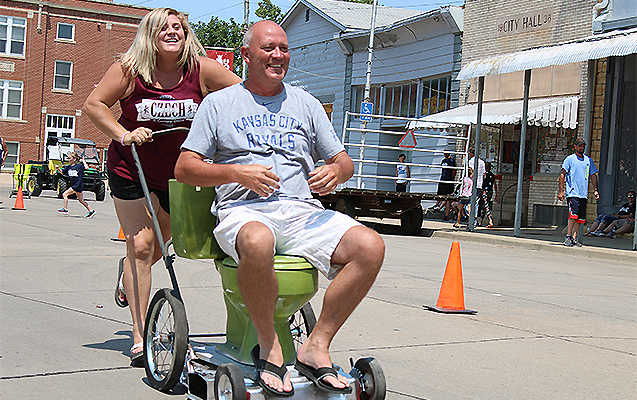
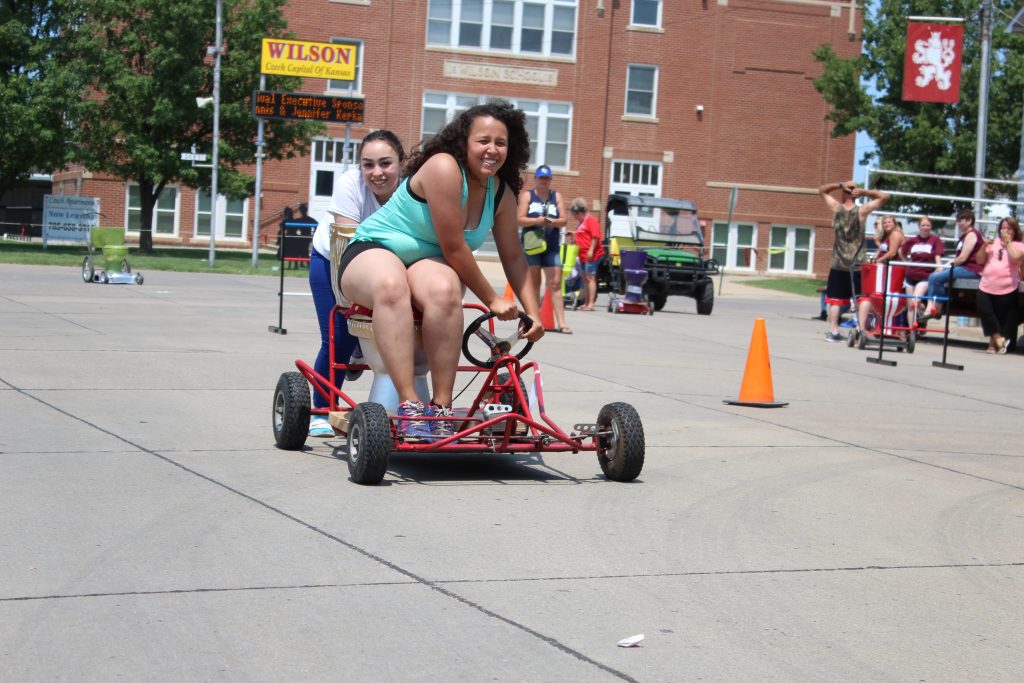
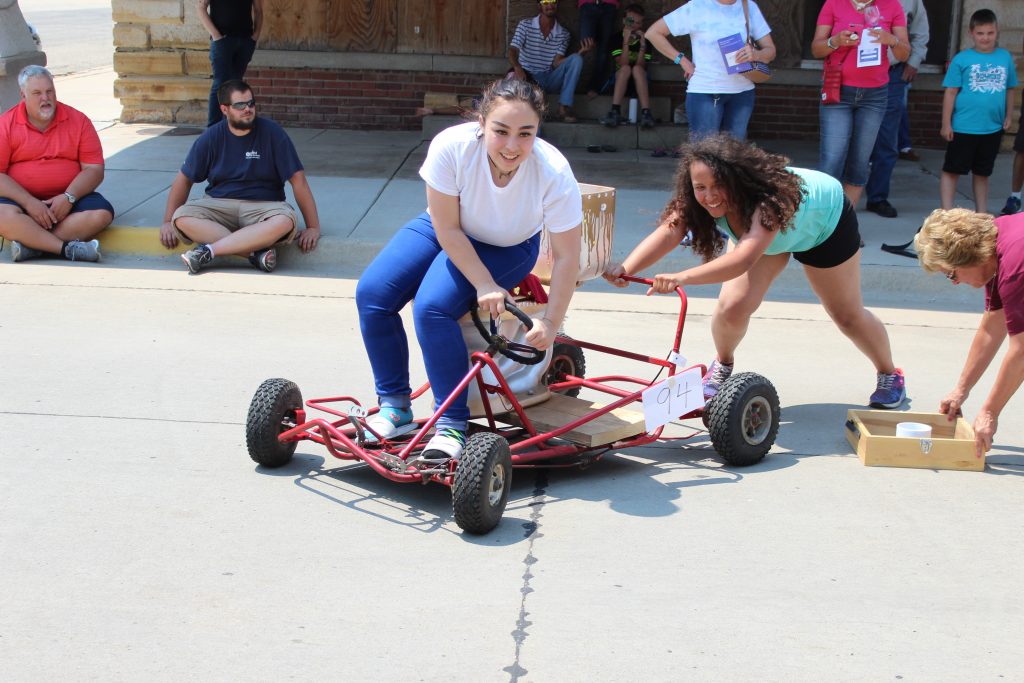
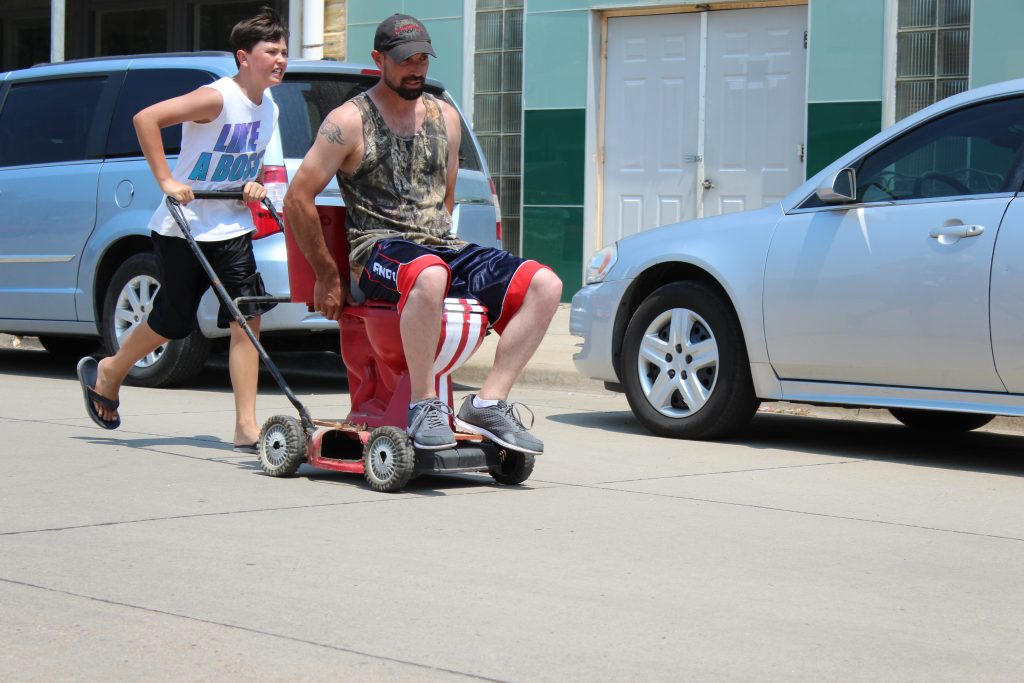
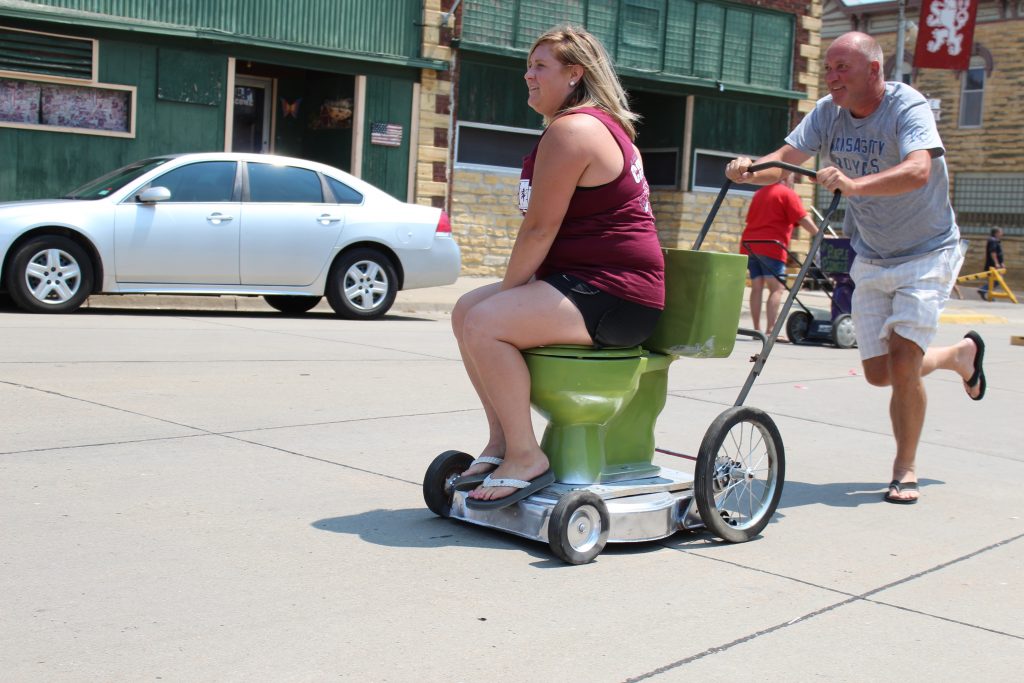
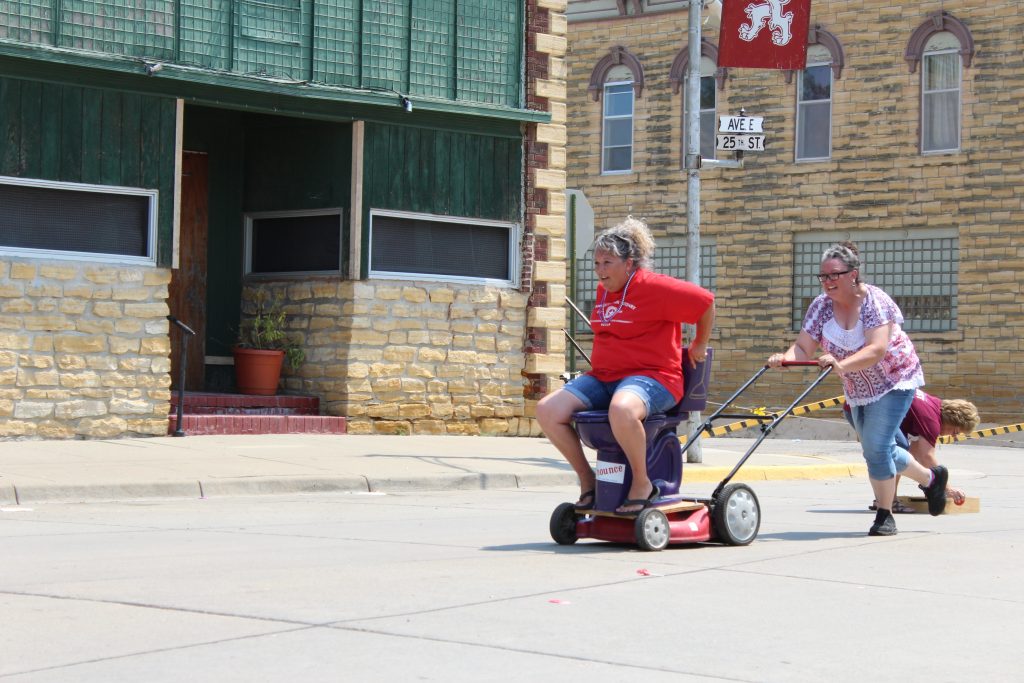
I don’t think this is Czech at all, but one of the featured events at the Czech Festival is toilet bowl races. Toilet bowls are mounted on old push lawnmower frames. One person rides, and the other person “drives” through an obstacle course. I have to give the people of Wilson points for creativity. It was a spectacle, but a bit anticlimactic. Even souped-up toilet bowls don’t go too fast.
If you are in Wilson for Czech Festival or during any other time of the year, there are a couple of foods you need to know about. One is the kolache. This is a sweet bread roll with a topping of fruit preserves. The other are case noodles. I was told this dish varies, depending how Czech you are. They are dough triangles containing cottage cheese and onion. They are usually boiled. Some serve them almost like a soup.
So I sampled both of these at Made from Scratch diner. They had a buffet and abbreviated menu due to all the visitors for Czech Fest, but look for a regular diner menu of stick-to-your ribs homestyle cooking, which includes gigantic bierocks and scrumptious pie. Don’t forget the homemade ice cream.
Enjoy the atmosphere of a 1950s soda fountain at Grandma’s Soda Shop and Diner, 2524 E. Owens, where you also can order kolaches and bierocks.
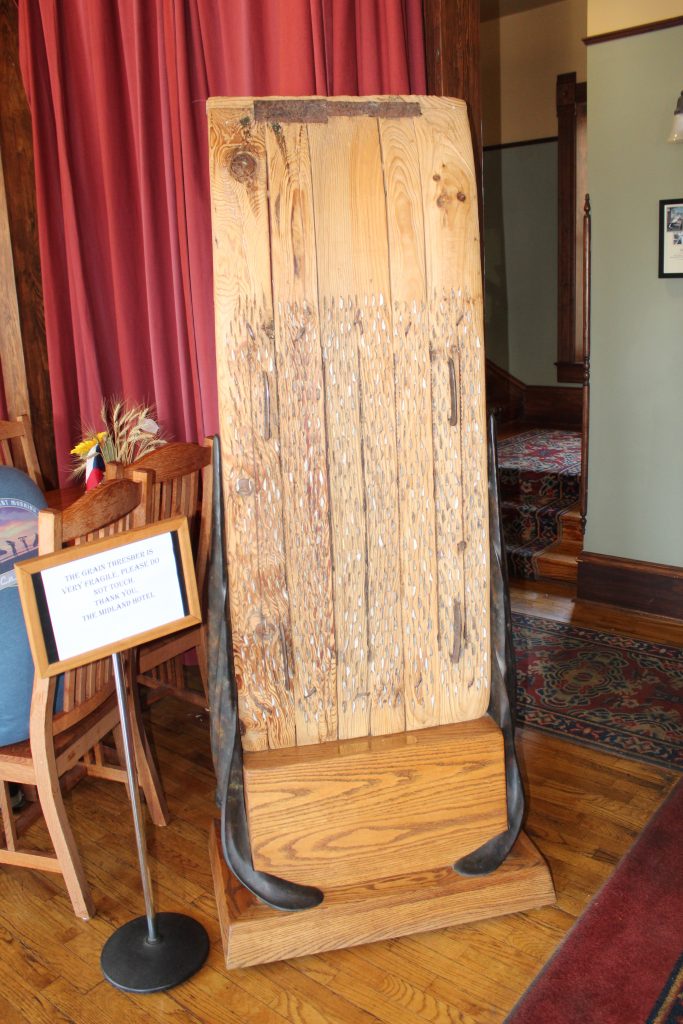
Antique threshing board on display at the Midland Railroad Hotel in Wilson.
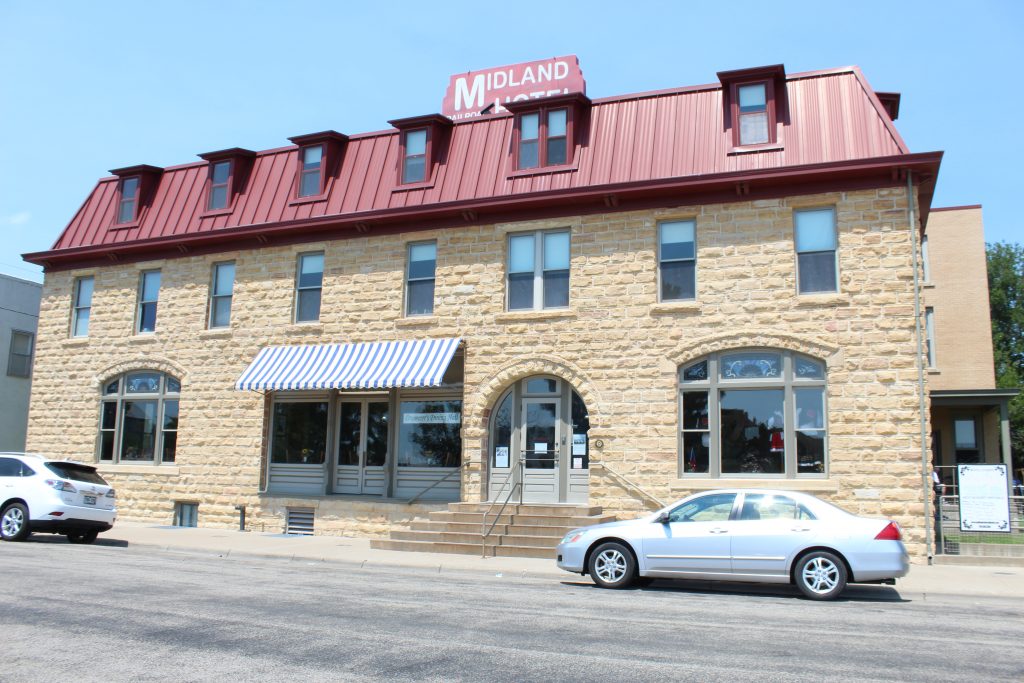
The Historic Midland Railroad Hotel, 414 26th St., offers steaks, sandwiches and pasta in the downstairs Sample Room, so named because the hotel was a popular stop on the Union Pacific route from Kansas City to Denver and businessman used the hotel to show off their wares.
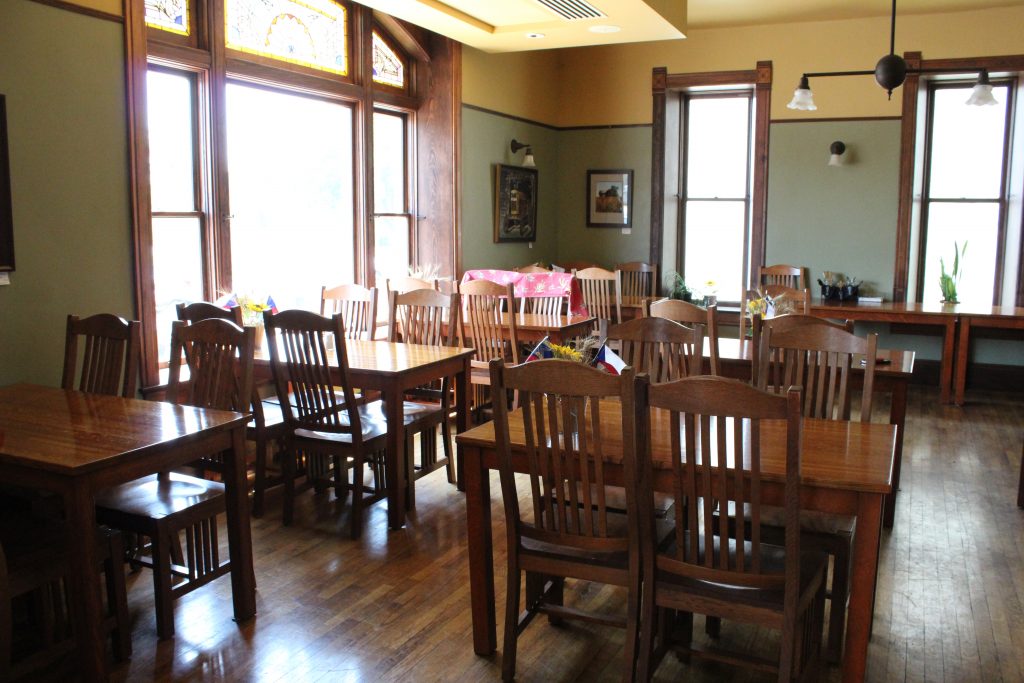
The Drummer’s dining hall on the ground floor is available as an events venue. The hotel also offers special dinner events. Check their website for details.
The limestone three-story hotel was built in 1899 and is on the National Register of Historic Places. The hotel underwent an extensive $3.2 million renovation and reopened in 2003 with an interior reminiscent of its 1920s glamor. Today, the hotel has 28 rooms decorated with mission-style furniture, but with modern amenities like satellite TV.
Film buffs may recognize the building as a backdrop in the 1973 film “Paper Moon,” starring Ryan O’Neal and daughter Tatum.
Wilson’s round jail.
Also on the National Register of Historic Places is the town’s circular stone jail. The circular limestone structure was built as a water tower in 1907. It was used as a jail until 1963 to hold prisoners until they could he transported to the county jail.
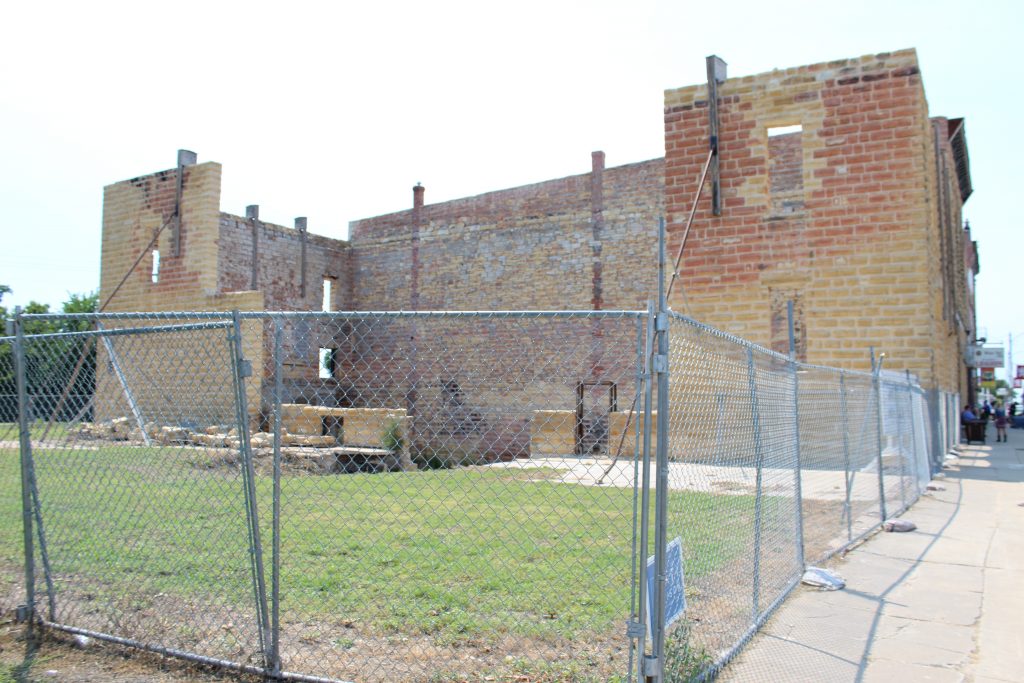
Unfortunately, one of the iconic Wilson landmarks, the limestone Wilson Opera House, built in 1901, burned in 2009. You can still see the shell of the building on Old U.S. 40 just down the street from the giant Czech egg. The opera house used to serve as the community’s historical museum, the Museum of Memories. The community hopes to resurrect the opera house by using the old stone to create a new pavilion.
Burnt metal, wood and nails left from the 2009 Wilson Opera House fire.
Almost all of the historical items in the former museum were lost to fire or water damage. After almost 10 years, a new museum, the Wilson Heritage Museum, has opened in the former Wilson World newspaper office, 411 24th St.
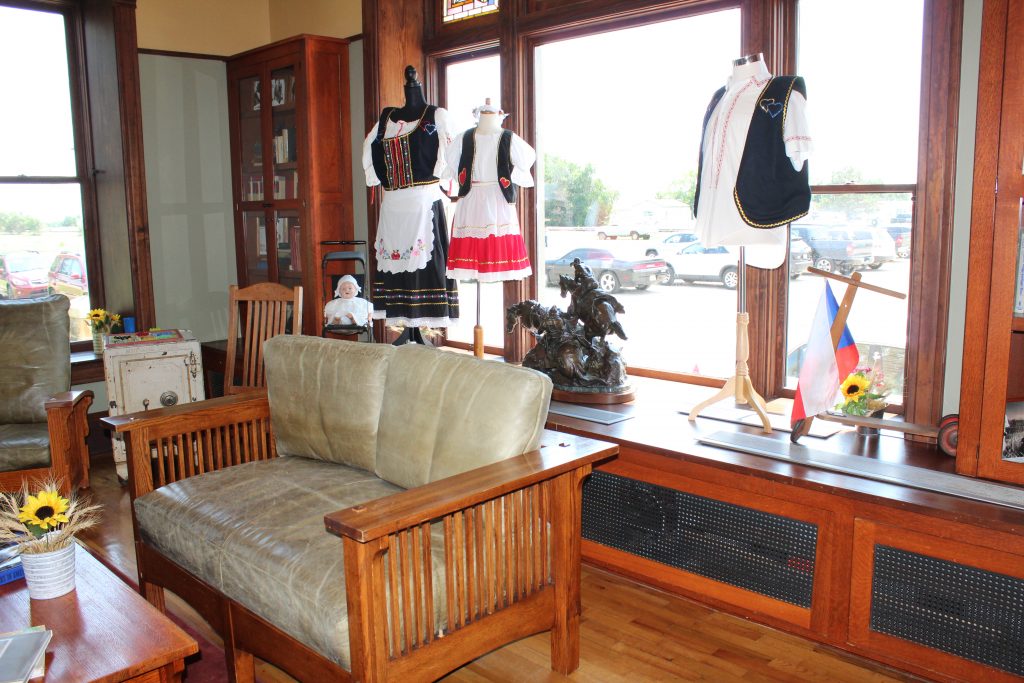
The museum has been open for less than a year, and had many visitors during the Czech Festival this weekend. The museum contains items from Wilson schools, business, veterans and churches. In addition, the museum has a small collection of items commemorating the community’s Czech heritage, including dolls in traditional dress and Czech glass. In a tribute to the fire, the museum has on display a piece of molten debris that was salvaged from the opera house fire.
Also of note are two military monuments in the community. The Wilson Cemetery at 1916 Second St. features a granite statue of Civil War Union soldier, and a metal lion’s head that once filled horse troughs. In 1919, the community dedicated the World War I monument in Legion Park that features a U.S. infantry soldier.
Kansas Originals is not in Wilson, but just north of Interstate 70 at the Wilson exit. The store is run by the Post Rock Opportunities Foundation, a nonprofit corporation. Its missionis to provide marketplaces for the work of Kansas artists, craftsmen and food producers and to promote tourism, according to its website.
This is more than a tourist trap. It houses a variety of handmade products, such as jewelry, blown glass and wood products. You can also pick from a variety of Kansas-made food products, like popcorn, salsa and sauerkraut. A bookworm, I always make a quick perusal of the book section, which features Kansas authors and topics. The store carries fiction, non-fiction, guidebooks and children’s books.
Boater at a dock at Wilson Lake, just below the dam.
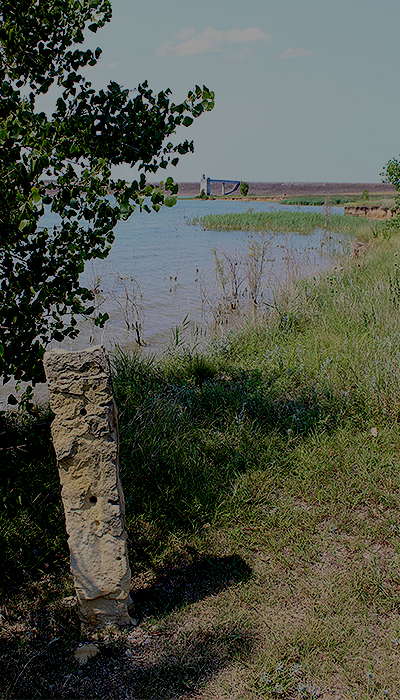
We can’t talk about Wilson without talking about the 9,000-acre Wilson Lake. The Wilson I-70 exit will take you to the east end of Wilson State Park and is the best access to the dam. You can also access the Minooka Park section of the lake via I-70 exit 199 Dorrance and the Wilson Wildlife Area via exit 193, Bunker Hill.
You will need a state park pass to legally enter the state park. You can buy a year-long State Parks Passport for $15.50 when you pay your annual tags and taxes for your vehicle. You can also self-pay day passes or buy yearly passes for slightly more at a park office. The annual passes are good for any state park.
With its picturesque cliffs, Wilson is a popular spot with kayakers. There are plenty of places along the shoreline to put in, and the water is fairly clear for a Kansas body of water.
However, you do not have to have a boat to enjoy Wilson, the state park is internationally known for its 25-mile Switchgrass Bike Trail, which winds throughout the park and will take you through native grasses and wildflowers and near impressive rock features. There are shorter loops for those who aren’t up to riding the whole trial. You can hike and run sections of the trail, but it is recommended you go counterclockwise to bikers to avoid crashes.
A swallow takes off from a nest under Hell Creek bridge at Wilson Lake.
The trail head is at Switchgrass campground on South Shore Drive west of the Hell Creek Bridge. I picked up a Wilson Lake guide, printed by the Wilson Lake Area Association at Kansas Originals at the Wilson exit, which contains a state park map.
Wilson also offers both natural and paved hiking trails. The Cedar Trail in the Otoe area is a one-mile paved loop.
The second-annual Lovegrass Music Festival will be Aug. 10-12 at Lovegrass campground at Wilson Lake. It will feature country, bluegrass and folk music. For more information, contact Aimee Riegle at [email protected].
I usually shoot pictures rather than creatures; however, in addition to being a good locale for white bass and striped bass, the state park offers 8,069-acres of public hunting at Wilson.
If you travel to Wilson Lake dam via K-232, you will be on the Post Rock Scenic Byway, giving you beautiful views of the Kansas short-grass prairie and worth an afternoon drive in and of itself.
If you reach the dam, you will be fairly close to Lucas via Kansas Highway 232. Lucas, north on K-232, is worth a stop as well, but that adventure will be for an upcoming Day Trippin’. If you do decide to take the byway north to Lucas, look for faces carved into the region’s iconic post rock fence posts thanks to artist Fred Whitman.
Honestly, my next road trip is still up in the air, but I will definitely see you on the road soon!
The burned out shell of the Wilson Opera House.
Other links to check out while you are planning your trip:
TOPEKA – The Kansas Department of Health and Environment (KDHE), in conjunction with the Kansas Department of Wildlife, Parks and Tourism (KDWPT), has issued public health warnings for some Kansas lakes for the upcoming weekend and week.
If a lake is under a public health warning for blue-green algae, activities such as boating and fishing may be safe. However, direct contact with water (i.e., wading, skiing and swimming) is strongly discouraged for people, pets and livestock. The lakes currently under a public health advisory:
Warning: Atchison Co. Park Lake, Atchison County Warning: Hodgeman County SFL, Hodgeman County
Warning: Perry Lake, Zone B (the Slough Creek arm), Jefferson County
Warning: Marais Des Cygnes Wildlife Area Lake, Linn County
Warning: Carbondale West Lake, Osage County
Warning: Melvern Outlet Pond, Osage County
Warning: Melvern Outlet Swim Pond, Osage County Warning: Webster Lake, Rooks County
Warning: Frazier lake, Grant County
Warning: South Lake Park, Johnson County
Warning: Lake Wabaunsee, Wabaunsee County
Warning: Lake Afton, Sedgwick County
Watch: Overbrook City Lake, Osage County
Watch: Rock Garden Pond, Gage Park, Shawnee County
Watch: Mary’s Lake, Douglas County
Watches have been lifted at Rooks County State Fishing Lake in Rooks County and Central Park Lake (Pond) in Shawnee County.
Lakes under a warning are not closed. Marinas, lakeside businesses and park camping facilities are open for business. If swim beaches are closed, it will be specifically noted. Drinking water and showers at parks are safe and not affected by algae blooms. Boating and fishing are safe on lakes under a warning, but contact with the water should be avoided. Hands should also be washed with clean water after handling fish taken from an affected lake. Zoned lakes may have portions fully open for all recreation even if other portions are under a warning.
Kansans should be aware that blooms are unpredictable. They can develop rapidly and may float around the lake, requiring visitors to exercise their best judgment. If there is scum, a paint-like surface or the water is bright green, avoid contact and keep pets away. These are indications that a harmful bloom may be present. Pet owners should be aware that animals that swim in or drink water affected by a harmful algal bloom or eat dried algae along the shore may become seriously ill or die.
When a warning is issued, KDHE recommends the following precautions be taken:
Lake water is not safe to drink for pets or livestock.
Lake water, regardless of blue-green algae status, should never be consumed by humans.
Water contact should be avoided.
Fish may be eaten if they are rinsed with clean water and only the fillet portion is consumed, while all other parts are discarded.
Do not allow pets to eat dried algae.
If lake water contacts skin, wash with clean water as soon as possible.
Avoid areas of visible algae accumulation.
KDHE samples publicly-accessible bodies of water for blue-green algae when the agency receives reports of potential algae blooms in Kansas lakes. Based on sampling results, KDHE reports on potentially harmful conditions.
For information on blue-green algae and reporting potential harmful algal blooms, please visit www.kdheks.gov/algae-illness/index.htm.
FHSU President Tisa Mason testifying before Higher Education Budget Committee.
FHSU University Relations
Invitations are being sent this week for events celebrating the inauguration of Dr. Tisa Mason as the 10th president of Fort Hays State University.
President Mason will receive the symbols of her office – the mace and the presidential medallion – in a ceremony at 10 a.m.Friday, Sept. 14, in Gross Memorial Coliseum. The inauguration will be streamed live. The link will be announced closer to the event.
“The inauguration is intended to be a community-friendly series of events to mark the change of leadership and celebrate Fort Hays State University’s place in the region, state, nation and world,” said Janette Meis, chair of the Inauguration Committee and event planner for the Office of the President.
“The inaugural event is where the past and present come together,” said Meis. “As Dr. Mason is officially installed as the university’s president, we honor the strengths of our history and traditions, and at the same time we put our focus on the future. All members of the Fort Hays State community and public are making a commitment to each other, that whatever challenges and innovations are coming, we will face them together.”
Activities begin with the opening of an exhibit of letters and certificates of congratulations in Forsyth Library. A special worship service before and a festival on the Quad afterward will bracket the inauguration ceremony on Friday. The celebration continues on Saturday with a service project event for SWIPEOut Hunger and the Tiger-Ichabod football game Saturday night.
Deadlines apply for some events:
• Faculty, staff and academic delegates who plan to march in the inaugural procession must RSVP by Aug. 24.
• The deadline for ordering regalia for the march is Aug. 20.
The appropriate forms for responding are available through the RSVP link in the sidebar of the inauguration home page at www.fhsu.edu/inauguration/.
An RSVP is also requested for persons who plan to participate in the Celebration on the Quad, which will begin at 11:30 a.m. following the inauguration ceremony. That RSVP form is also available through the RSVP link on the inauguration home page.
The inauguration home page also has links to:
• A biography of President Mason.
• A map of the campus with parking and shuttle information.
• A section on the university’s inaugural traditions, including the history of the mace and medallion.
• A link to the FHSU Alumni Association’s Send a Greeting page to offer congratulations to President Mason.
• A listing of local hotels that are participating in special block rates.
• A link to information on special inauguration deals on merchandise from the Tiger Spirit Shop, located in the university’s Memorial Union; Tiger Book Shop, 507 W. Seventh; and from Tiger Gold on Friday partners.
• The schedule of events.
The schedule of events is also presented here:
Wednesday, Sept. 12
Dr. Mason Inauguration Exhibit Opening
Forsyth Library – 11:30 a.m. to 12:30 p.m.
View an exhibit of letters and certificates of congratulations, on display through Homecoming weekend (Sept. 27-29).
Friday, Sept. 14
Community Event
Worship Service, Celebration Community Church, 5790 230th Ave. Gather at 7:30 a.m.; Service at 8 a.m.
Ceremony Lineup Cunningham Hall – 9:15 a.m.
FHSU faculty and staff (current and retired) and academic delegates from other universities who are marching in the ceremony will begin lining up in Cunningham Hall, adjacent to the coliseum, at 9:15 a.m. RSVPs, through the links on the website, are required.
Inauguration Ceremony
Gross Memorial Coliseum – 10 a.m.
RSVPs are not required to attend the inauguration ceremony.
Celebration on the Quad
FHSU Quad – 11:30 a.m. to 1 p.m.
Dr. Mason’s inauguration will be celebrated with food and activities on the Quad and will include an opportunity to congratulate Dr. Mason in person. RSVPs are requested through the links on the inauguration Web page to assist in planning food quantities. Shuttle service will be available from the Coliseum, Gate 2, to the Quad.
Morning classes will be cancelled until 12:30 p.m. for FHSU students.
Inauguration Service Project: SWIPEOut Hunger Event
Forsyth Library – 10:30 a.m. to 12:30 p.m.
In partnership with FHSU’s Global Leadership Project and Numana, volunteers will participate in a festive, hands-on opportunity to “roll up your sleeves and feed the hungry.”
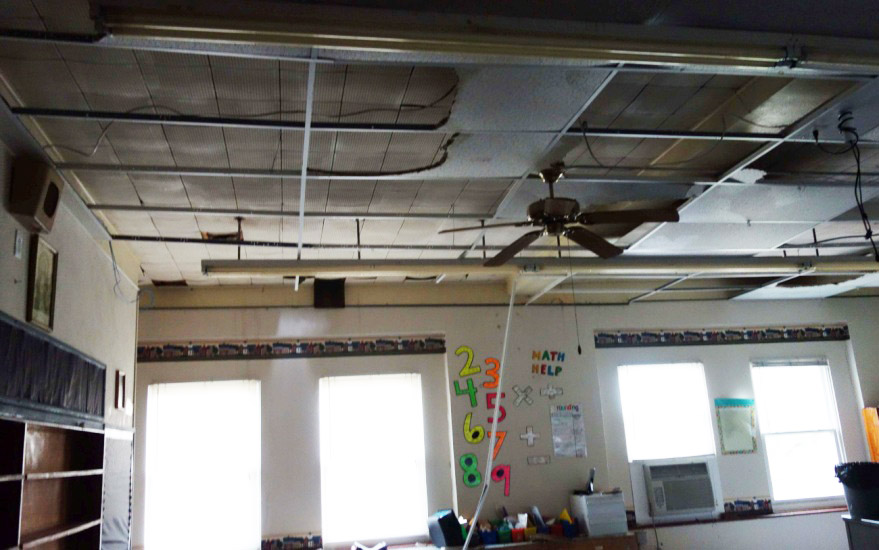
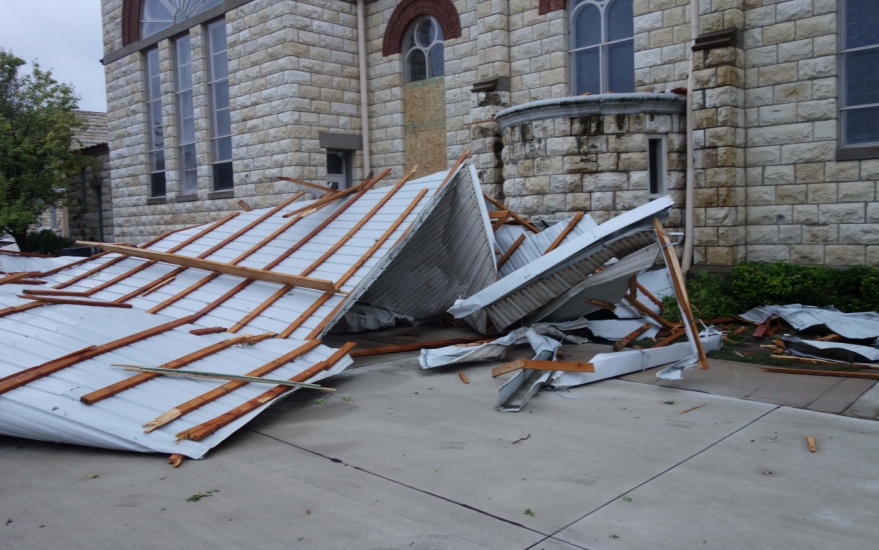
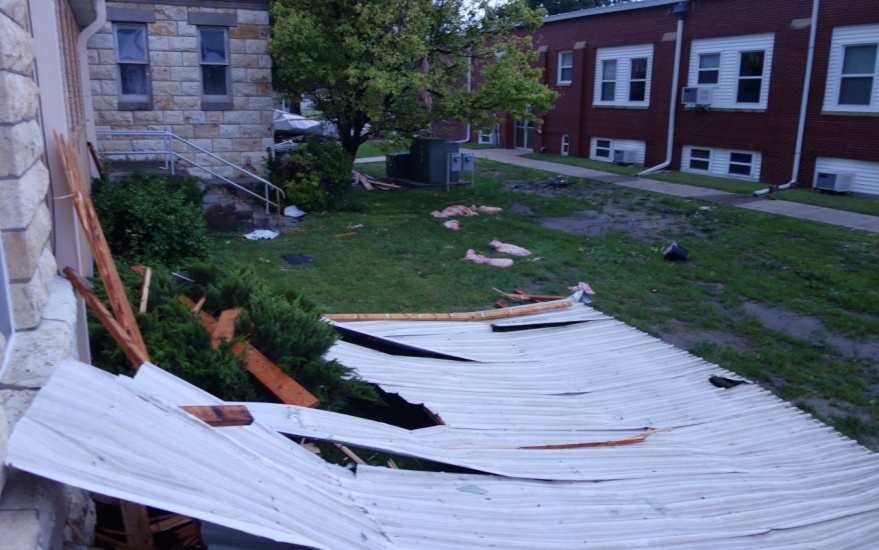
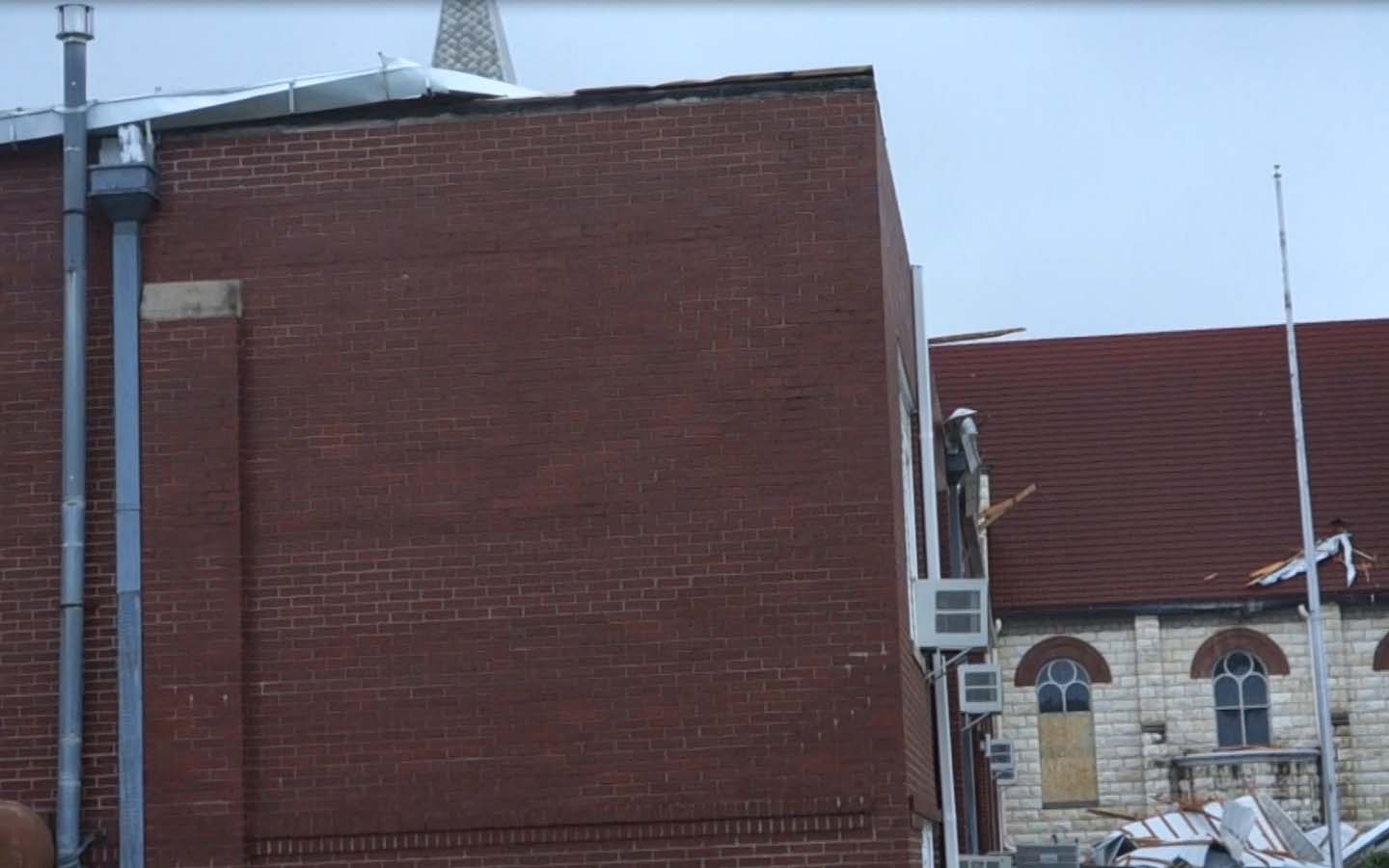
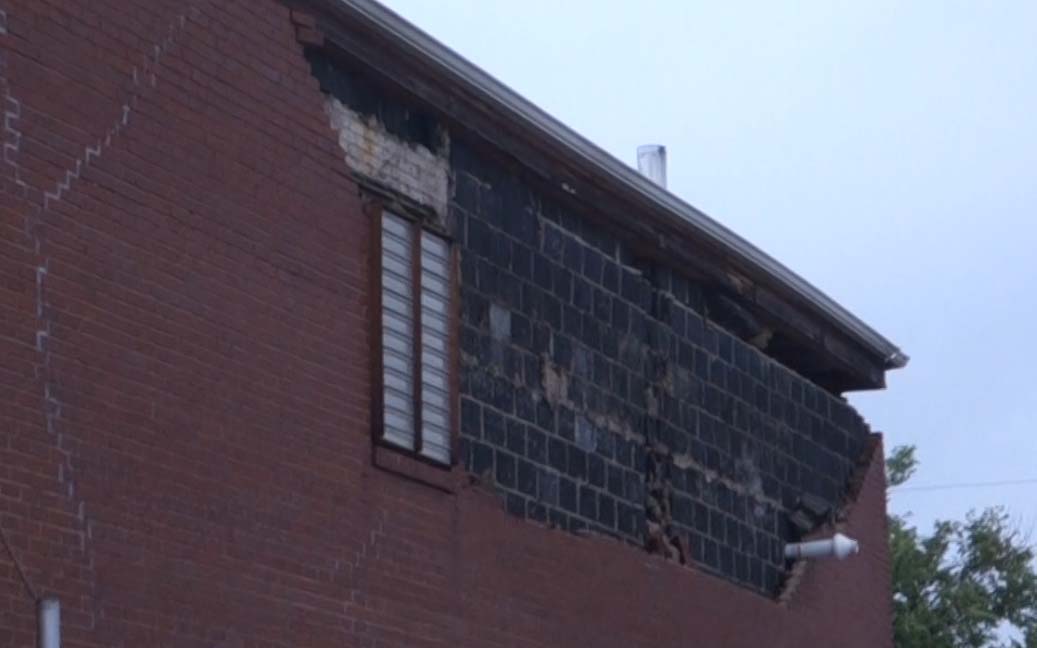
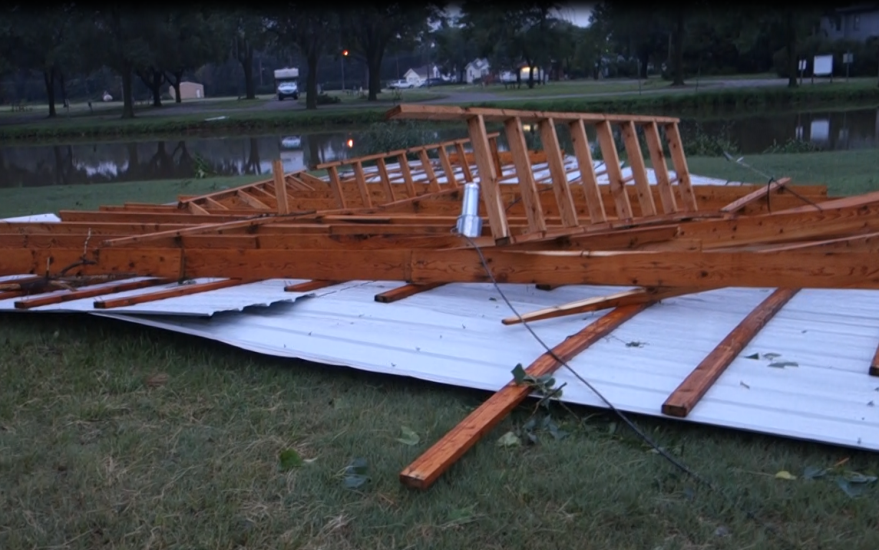
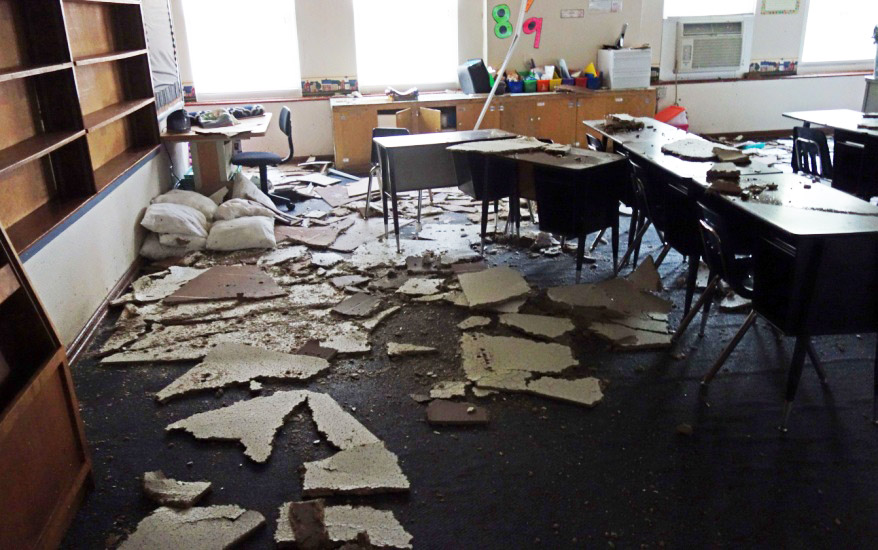
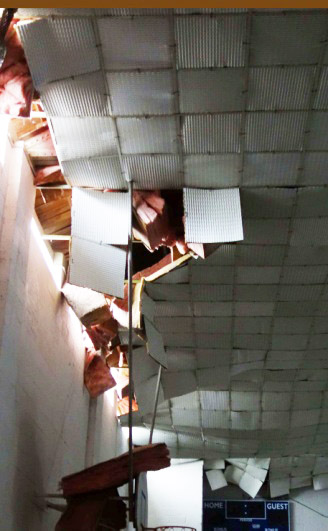
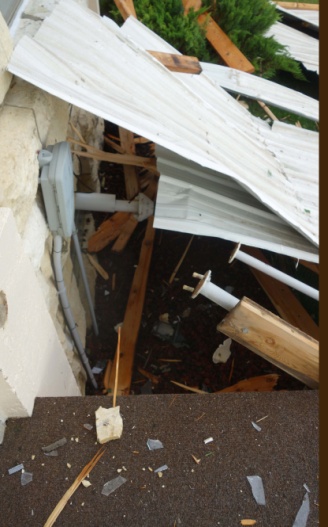
Portions of the roof were blown off, the east wall of the gymnasium was damaged, and five out of eight classrooms plus the office had significant water damage. The school was hit by what the National Weather Service calls a microburst.
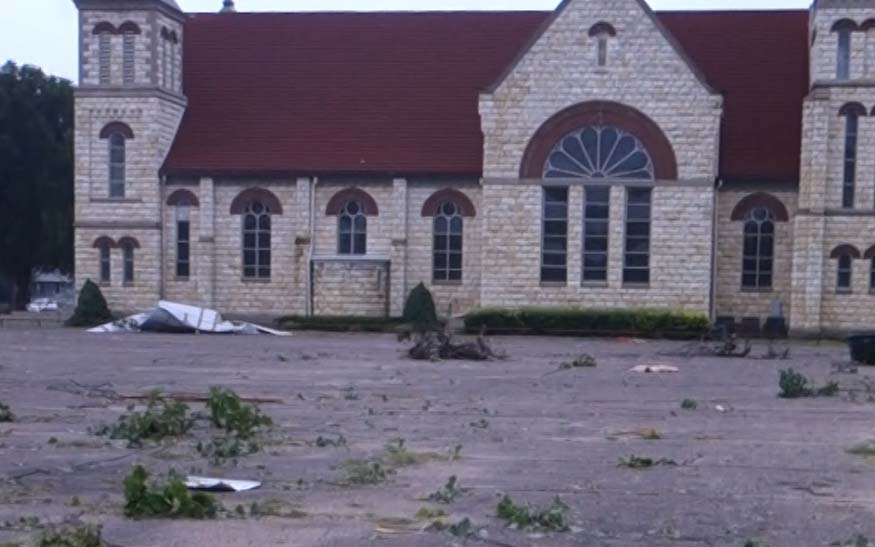
Flying debris also knocked out two stained glass windows in the adjacent St. Mary’s Church and five windows in the rectory. Lumber pieces pierced several holes in the tin roof of the rectory and made a five inch hole in the church roof.
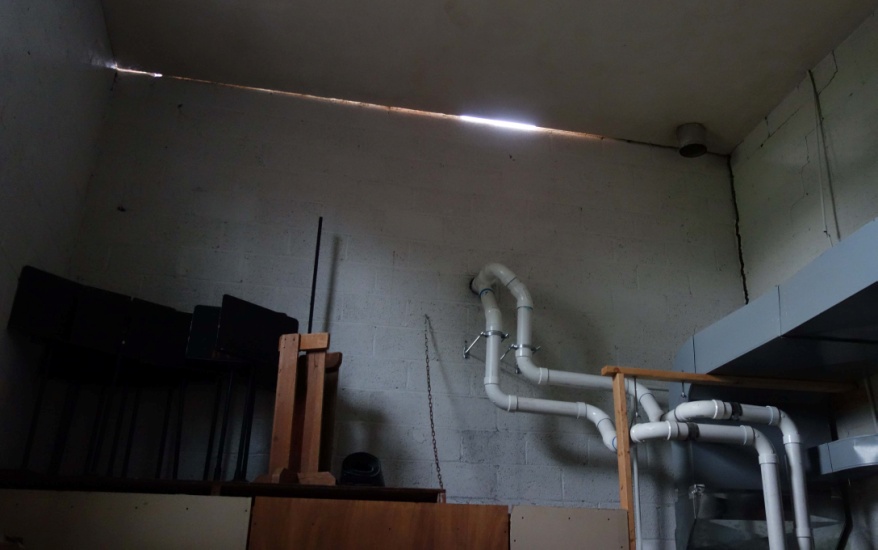
As the microburst formed and the roof of the school began to come apart, a lot of pressure was created in the school and gym causing the east wall of the gym to “blow out” to release the pressure. There is about a 3 to 4 inch gap between the wall and roof in part of the east wall.
Emergency personnel and volunteers assisted that evening to cover broken windows of the church and rectory, as well as relocate undamaged items in the school to keep from further water damage with future rain forecasted that night.
The next day there was emergency planning meeting with key members of our parish, school, city officials and some contractors to access the problems and begin initial planning. The roofing company gave us a great overview of the damage and the plan for a temporary roof to keep the inside dry. It was decided that we could probably start school as scheduled, and if necessary to rent mobile classrooms.
The roof is being temporarily fixed. This will give us several months to decide what permanent roof system to install.
Since then there has been wonderful support of our school, parish, and community to start cleaning up. There has been storage containers rented to store the undamaged supplies from the school so the major clean up can start after the engineer and inspector review the building.
The school and church do have insurance. The insurance policy we have is a “cash value” policy, which means the 30-year-old roof will be depreciated. The amount received from insurance will probably not completely cover cost of the new roof.
An engineer visited St. Mary’s School Monday and let us know that parts of the building are not structurally sound for students at this point, and we will not be able to use it for this school year.
Repairs will take some time, and so we are securing mobile classrooms for the start of school. We will know more once the architect has analyzed the building this week.
We are optimistic that school will start as scheduled on August 23. Monetary donations can be sent to Equity Bank, Attn: St. Mary’s, PO Box 255, Ellis, KS 67637.
TOPEKA – Tyler and Kassie Remington will host the August 13 Kansas Livestock Association (KLA)/Kansas State University Ranch Management Field Day at their ranch near Quinter. The Remingtons own and operate a diversified farming and cow-calf enterprise. They grow wheat, corn and forage for their cowherd on irrigated and dryland acreage. Cover crops and annual forages are used for grazing and harvested for silage.
Utilizing cover crops and annual forages to boost grazing opportunities will highlight the field day program. K-State Agronomist John Holman and a panel of western Kansas producers, including Tyler Remington, Larry Manhart of Quinter and Charlie Kraus from Hays, will share their experiences with incorporating these forages into their grazing programs. Holman has conducted 10 years of research on the viability and advisability of planting annual cover crops or forages in conjunction with conventional dryland cropping systems in western Kansas. He will discuss his findings during the presentation.
Also on the field day program will be Jami Seirer, northwest district forester with the Kansas Forest Service in Hays. Seirer will explain the process of renovating old and/or environmentally stressed windbreaks, planning and establishing new windbreaks and plant selection. She also will provide tips on managing wind and snow distribution. Options for financial assistance through federal and state cost-share programs will be discussed, including the Conservation Stewardship Program and Environmental Quality Incentives Program, which the Remingtons utilized to establish and renovate several windbreaks at their ranch headquarters.
Agra View’s Amy Roeder and Steve Vollrath will share timely information about programs provided to livestock producers through the USDA Risk Management Agency. Insurance plans to be discussed will include the Livestock Risk Protection Program, Livestock Gross Margin Program and Rainfall Index Program, which protects against the loss of precipitation in key months of pasture, rangeland and forage growth.
KLA Chief Executive Officer Matt Teagarden will provide an overview of the new cattle traceability pilot project. KLA, K-State and the Kansas Department of Agriculture launched CattleTrace June 30. The project will involve an end-to-end disease traceability system beginning with cow-calf producers and ending at the beef processing plant. The goal is to develop a system that can operate at the speed of commerce.
The August 13 field day will begin with registration at 3:00 p.m. and conclude with a free beef dinner at 6:45 p.m. All livestock producers and others involved in the business are invited to attend. Remington Ranch is located near Quinter in northeastern Gove County. From Interstate 70, take exit 107 toward Quinter and briefly travel south on Castle Rock Road. Westbound travelers will go under the interstate after exiting I-70. Immediately north of the Conoco station, turn west onto County Road Z. Go west on County Road Z two miles to ranch headquarters. Directional signs will be posted.
Russell and C.J. Blew will host the August 6 KLA/K-State ranch field day near Medicine Lodge. Loma Land & Cattle of La Cygne will be the site for the final field day August 16. Bayer Animal Health and the Farm Credit Associations of Kansas are sponsoring all three field days. For more information, go to www.kla.org or call the KLA office at (785) 273-5115.
Alicia BoorAs of Jan. 1, Kansas was the 6th top producer of beef in the nation. Most of the cattle spend a majority of their lives on grass in our native pastures.
But as a rancher, are you taking care of your grass for optimal production? Many producers practice continuous grazing for the management of their pastures. This consists of allowing the livestock to selectively choose what forage they want to eat in a large pasture over an entire growing season.
Sometimes, the struggle to ensure that your livestock have forage all winter long can be a challenge, especially in dry years. Managing your available forages throughout the year can be an issue, but there is information and practices that may help make it easier and more profitable.
On August 16th at 9:00 am, K-State Research and Extension Cottonwood District will host a Rotational Grazing in the Rangeland workshop. The workshop will consist of a tour of Greg Axman’s rotational grazing and haying operation. Keith Harmoney, KSRE Rangeland Specialist will be there to discuss the basics of managing your rangeland including stocking rates, continuous and rotational stocking along with other subjects. Augustine Obour, Associate professor of Soil Science will also attend and speak with the producers about cover crop forage production potential and grazing impacts on your soil’s health.
There will be a meal to follow the tour with the availability to discuss practices and ask questions. To RSVP for an accurate meal count, call 620-793-1910 or email [email protected]. The meal and beverages for the workshop have been sponsored by Barton County Conservation District and The Great Bend Coop.
Alicia Boor is an Agriculture and Natural Resources agent in the Cottonwood District (which includes Barton and Ellis counties) for K-State Research and Extension. You can contact her by e-mail at [email protected] or calling 620-793-1910.
Ron Wilson is director of the Huck Boyd National Institute for Rural Development at Kansas State University.By RON WILSON Huck Boyd National Institute for Rural Development
The farmers in Uganda are meeting to discuss farm issues. The person with whom they are meeting is a young woman from a farm family halfway around the globe in rural Kansas. Like them, she and her family are working to promote local foods and local farmers.
Rosanna Bauman is the young woman meeting with Uganda farmers. Rosanna and her family own Bauman’s Cedar Valley Farms and related agribusinesses in Anderson County, Kansas. Rosanna’s dad’s family came to Kansas in the 1960s. At a church gathering, he met the woman who he ultimately married. In 2001, they bought 160 acres and moved to the farm. They had six children of whom four were boys and two were girls, Rosanna being the oldest daughter.
“We are members of the Old German Baptist Brethren,” Rosanna said. “It’s our faith that has driven our desire to work together.”
The parents and children joined in to operate the farm from scratch. “We had the handicap – and the blessing – of not being able to say, `this is the way we’ve always done it,’” Rosanna said. They were also working with limited acreage.
“We saw large farms that were having a hard time financially, so we knew we needed to do things differently,” Rosanna said. “Organic farming and direct marketing were alternative ways that could maximize income.” Each family member pitched in and eventually took responsibility for different elements of the operation as it grew and diversified.
Over time, the Baumans rented ground, grew crops and livestock, and developed related processing and services. Today they farm 1,000 acres of non-GMO crops and raise cattle, sheep and poultry.
“We take the approach that we shouldn’t gripe that something isn’t being done if it’s within our capacity to do it,” Rosanna said. This led them to start several related businesses. They also work with neighboring farms. “Everything we do has a neighbor component,” she said.
In addition to the home place, Cedar Valley Farms, they now have ANCO Processing (for poultry), Bauman’s Butcher Block in Ottawa, Bauman’s Farm Feeds, Bauman Brothers Custom Ag Services, and Bauman Pet Products which uses animal byproducts for pet food. Other than the butcher shop with its retail outlet in Ottawa, all these businesses are based on the family farm.
Bauman’s Cedar Valley Farms is located near Cedar Valley Reservoir in a rural setting between the towns of Garnett, population 3,264, and Westphalia, population 163 people. Now, that’s rural.
The Baumans deliver their self-processed non-GMO feed to feed stores in eastern Kansas. They also aggregate grains with neighbors. Their custom planting, spraying, harvesting and trucking business has grown to cover 30,000 acres. In addition to the butcher shop in Ottawa and sales on the farm, their meat products are sold through a mobile meat market which goes to farmer’s markets.
“We were brainstorming about how to sell our meat and poultry, but carrying a bunch of ice chests to lots of farmer’s markets wasn’t practical,” Rosanna said. “So we got a 20-foot enclosed trailer where we can display our vacuum packaged meats behind glass-doored freezers, and people can walk through and pick what they want,” she said. Baumans’ custom-made brats and burgers are a specialty.
“We like to be face to face with our customers,” Rosanna said. They also belong to the Kansas Department of Agriculture’s “From the Land of Kansas” program.
In 2017, USDA Rural Development awarded a grant which supported the work of K-State’s Heather Morgan to support the growth and development of local foods in southeast Kansas. Heather points to the Bauman family businesses as examples of local food production and entrepreneurship which could be emulated and encouraged.
Two years ago, Rosanna went to an international rural conference and connected with a woman from Uganda. That has led to international exchanges about agriculture.
“We believe our small family farm in Kansas can have an impact in the state, nationally, and internationally,” Rosanna said.
It’s time to leave this farm gathering in Uganda. We salute Rosanna Bauman and all the Bauman family for making a difference in agriculture, in Kansas and around the world.
LEXINGTON, Ky. — Kansas state Sen. Richard Billinger, R-Goodland, is among the 48 state leaders from across the country selected to participate in The Council of State Governments’ 2018 Henry Toll Fellowship, the nation’s premier leadership development program for state government officials.
The members of the Class of 2018 hail from 32 states and Guam and represent all three branches of state government. A committee of program alumni reviewed applications and selected the class.
“I want to learn from others in the program, to both gain insights and become a better leader, as well as have the opportunity to share my experiences from public service,” Billinger said.
The Toll Fellowship, named for CSG founder Henry Wolcott Toll, has convened a group of the nation’s top officials for this intensive six-day, five-night intellectual boot camp for more than 30 years in Lexington, Kentucky. The 2018 program will be held Aug. 24-28.
The program’s agenda includes a lineup of dynamic sessions designed to stimulate personal assessment and growth, while providing networking and relationship-building opportunities. Each year’s program is unique, but previous programs have included sessions on leadership personality assessment, media training, crisis management, appreciative inquiry and adaptive leadership.
“The CSG Toll Fellows are a remarkable group of state leaders,” CSG Executive Director/CEO David Adkins said. “We have designed the fellowship to expand their leadership capacity with a strong focus on collaboration, communication and teamwork skills. Politics today are often characterized by polarization and gridlock. Toll Fellows learn how to overcome differences to serve the common good. These dedicated public servants leave the program energized and ready to return to their states and continue to make a difference.”
Adkins was a 1993 Toll Fellow when he served as a Kansas state representative.
Toll Fellows alumni include Cheri Beasley, associate justice of the North Carolina Supreme Court; Oregon Gov. Kate Brown; Delaware Gov. John Carney; Idaho U.S. Attorney Bart Davis; Arizona Gov. Doug Ducey; Maine Secretary of State Matthew Dunlap; Tennessee Secretary of State Tre Hargett; former Delaware Gov. Jack Markell; Anne McKeig, associate justice of the Minnesota Supreme Court; Arkansas Secretary of State Mark Martin; Alabama Secretary of State John Merrill; Tennessee U.S. Attorney Doug Overbey; Iowa Secretary of State Paul Pate; U.S. Rep. Todd Rokita, a former Indiana secretary of state; former U.S. Labor Secretary Hilda Solis; and Rhonda Wood, associate justice of the Arkansas Supreme Court.
“The continuation of leadership training is critical for all leaders, especially state officials, because problems, solutions and the political landscape of this country are constantly changing and evolving,” Billinger said. “With that, leaders need to not only keep an open mind, but actually work on their skills as representatives of their constituents to make sure they are best serving their community, whether it is a town, county or entire state.”
About The Council of State Governments
The Council of State Governments is the nation’s only organization serving all three branches of state government. CSG is a region-based forum that fosters the exchange of insights and ideas to help state officials shape public policy. This offers unparalleled regional, national and international opportunities to network, develop leaders, collaborate and create problem-solving partnerships. For more information about CSG, visit www.csg.org.
To celebrate the 14,000-follower mark on Facebook, Hays Post and Eagle Communications are giving away a cool tumbler and an Amazon Echo Dot to one lucky winner!
To enter for a chance to win, visit the Hays Post Facebook page, then LIKE and COMMENT on the contest post (pinned to the top of the page) with YOUR FAVORITE PRO, COLLEGE or HIGH SCHOOL sports team!! Tag a friend and spread the word!
The winner will be announced next week. Thanks for reading!!