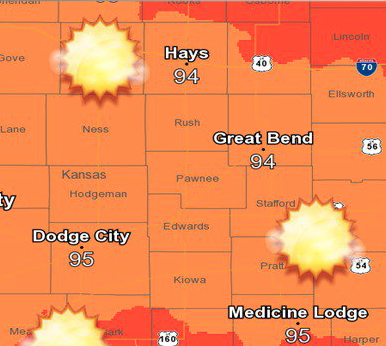
Tonight A 50 percent chance of showers and thunderstorms, mainly after 1am. Increasing clouds, with a low around 71. Breezy, with a south southeast wind 14 to 22 mph.
Saturday A 20 percent chance of showers and thunderstorms before 1pm. Mostly cloudy, then gradually becoming sunny, with a high near 92. Breezy, with a south wind 13 to 20 mph.
Saturday Night Mostly clear, with a low around 70. South wind 10 to 18 mph.
Sunday Sunny, with a high near 96. Breezy, with a south wind 10 to 15 mph increasing to 16 to 21 mph in the afternoon.
Sunday Night A 30 percent chance of showers and thunderstorms. Partly cloudy, with a low around 71. Breezy.
GOVE COUNTY —Two people were injured in an accident just before 6p.m. Thursday in Gove County.
The Kansas Highway Patrol reported a 2004 Ford F350 driven by Suzanne M. Lawrence, 65, Fort Worth, TX., was eastbound on Interstate 70 just east of the Grinnell exit.
The driver lost control of the pickup as she attempted to pass another vehicle. The pickup rolled, slid into the south ditch and came to a rest on its top.
Lawrence and a passenger Christine M. Daniels, 59, Parker, CO., were transported to the Logan County Hospital. They were properly restrained at the time of the accident, according to the KHP.
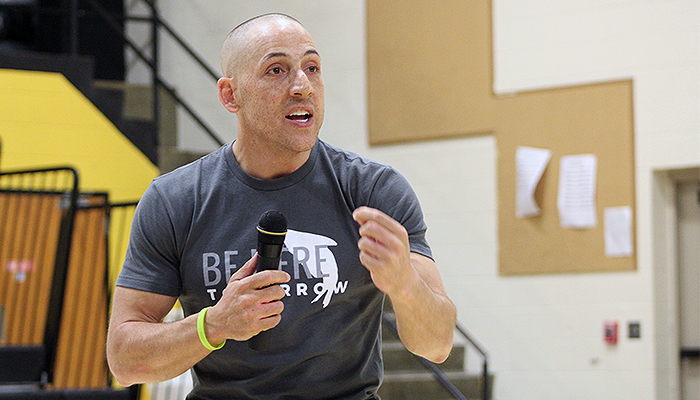
Kevin Hines’ message to the world is “Be here tomorrow!”
The message is all the more powerful because he was almost not here to share tomorrow.
Hines is one of only 36 people in 80 years to survive a jump from the Golden Gate Bridge. He is only one of five to be able to still walk and run.
“I am not just lucky to be alive,” he said. “I am blessed that I get to exist.”
To a packed crowd at Hays Middle School on Wednesday, Hines shared his journey from that dark day when he tried to kill himself by throwing himself off the bridge to a life of light.
Kool-Aid, Coca Coal and sour milk
Hines, 37, had difficult beginnings. Both of his parents were drug addicted. Hines and his infant brother were left regularly in seedy motels so his parents could score or sell drugs.
The boys were fed what their parents could steal — Kool-Aid, Coca Coal and sour milk.
When a hotel attendant finally reported the neglect to the police, the court documents read, “The children lie there in their own filth, screaming and crying not to be neglected, lying next to dangerous drug paraphernalia that had they touched it would have killed them.”
Although they entered the foster system, Hines and his brother both contracted a vicious case of bronchitis, and Hines’ brother, Jordache, died.
“People have looked at me as an adult and asked me, ‘Kevin, why does that matter? You were an infant. How can that affect you?'” Hines said. “If you don’t know, the first three to nine months of an infant’s life are the most crucial to their ability to connect, adapt, attach and be well in any future. If your first nine months of your life are filled with nothing but consistent trauma, at some point, something is going to give and you are going to have a hard time. And I would have that hard time and then some.”
Hines was in foster care for the first nine months of his life, but then he was adopted by Pat and Deborah Hines. Deborah wanted to adopt a sister for daughter, but after seeing Kevin in his red rubber ducky overalls, she fell in love.
Pat and Deborah took Kevin in, but he was violently ill over the next 30 days. No doctor could determine what was physically wrong with him. The medical profession finally concluded that his physical symptoms were all emotional.
Kevin’s biological father fought for custody of Kevin for two years before finally outside of a courtroom, he told Pat and Debbie, “‘Patrick, Deborah, I can do this no longer, please take care of my son.’ ”
Blessed childhood
“And they did,” Kevin said. “They took care of me, and they made me theirs. And I am a Hines.”
Kevin’s mother, Debbie, was an incurable optimistic, to the point of annoyance. Pat was not an optimist. He was tough. He played goalie in hockey without a mask.
“Pat Hines is a pragmatic pessimistic and stone-faced man,” Kevin said. “He is a man void of true emotion in my life, a man I had never seen cry in 19 years up to that point, not through hard times, not through deaths, not a tear dropped from that man’s eyes. I would not learn until years later when he and I would go to therapy why he was such a hardened soul and why he was so hard on me. He was like a drill sergeant who was never in the military.”
Pat’s father was in the military and was in the Battle of Okinawa. When he came home, he was a changed man. Pat’s parents, just like Kevin’s biological parents, had substance abuse issues. They were alcoholics and died of cirrhosis very young. Pat was left almost penniless to make his way in the world, Kevin said.
Pat and Debbie, who were white, adopted two other children. Kevin is mixed race, his brother is black and his sister is white. People stared, but Kevin said, “We were a family filled with love unconditionally, hope for the future and possibility. I thought growing up I had that traumatic infancy, but a beautiful childhood and adolescence. I thought to myself, How could anything go sideways from here?’
“I am going to grow up. I am going to go to that good school my dad’s always talking about. I’m going to get that great job he is always speaking of. I’m going to live the American dream. Then it happened.”
Things go sideways
“At 17 and a half years of age, it all came tumbling down, because of one thing — my brain.”
Hines was eventually diagnosed with bipolar disorder with psychotic features.
His mind was telling him things like he was a horrible person and he had to die.
“All of which was untrue,” he said. “I wish I know then what I know now, which is that my thoughts do not have to become my actions. …
“In the realm of suicidal thinking, this is very important because we think our thoughts own, rule and define our actions. Yet, in a suicidal crisis, they do not have to take us. We can always stay here.
“If you realize those thoughts don’t have to lead to an attempt, you can always survive. I live with chronic thoughts of suicide. They will never take me. Because every time I think of them, I will turn to the person to my right or the person to my left and say four simple and effective words, ‘I need help, now.’ ”
Hines said his family and friends know what that means and know what his triggers are. He has an emergency plan that he has shared with his loved ones.
“Even when I go sideways and I can’t see it, they have got my back,” he said.
He began to have delusions that the postal service was trying to kill him. If he saw a postal truck, he would run home, causing him to go into a debilitating asthma attack.
‘I wanted to tell’
Hines went from natural euphoric highs to the dark abyss that is depression.
“I would come crashing down into an insurmountable amount of pain that I could not bare on my shoulders,” he said. “At 19 I was done. I wish that morning that I attempted that I told my father the truth. …
“I wanted to tell the one man who loved me more than anything else in the world, arguably, the truth, but I couldn’t get the words out. Every time I wanted to tell my father what I was thinking, the voices in my head, (I had been hearing auditory hallucinations that no one else could hear) told me that I had to die.”
Every day, Hines would see death in the form of the grim reaper hover in through his window.
“Do you think I told anybody? No, I kept it inside, because I thought if I tell somebody what I am seeing, well, they are going to think I am crazy. I don’t use that word lightly.”
He buried all of his symptoms for two years. He silenced his pain.
“My new friends, if I am going to help you learn one thing today, and one thing only I have to ask that it be this,” he said. “When you go about the rest of your natural lives, when you walk out those doors, and you go about your day, do me a favor and learn from my mistakes and never again silence your pain. Your pain is valid. Your pain is real. Your pain is worth your time and others’ and your pain matters, ladies and gentlemen because you do.
“When we silence our pain and our struggle and our hardship, and we tell no one, it just grows and festers and morphs into rage and violence and substance abuse or domestic disputes, suicidal thoughts or actions.”
Life is a gift, Hines said, but he could not see that and on the Sept. 25 he boarded a bus for the Golden Gate Bridge.
‘Why doesn’t anybody care?’
He sat in the middle seat in the back row of the bus. He began to cry, softly at first, and then harder until finally tears streamed down his face. He then began to yell back to the voices in his head that were telling him to kill himself.
“Leave me alone, but I don’t want to die. I am a good person, why do you hate me so much? What did I ever do to you?”
The 100 people on the bus, said nothing … except for one man, with a smirk on his face said, “What the hell is wrong with that kid?”
“That is what is wrong with some of our society, today” Hines said, “our innate human ability to see someone who is in potentially the greatest pain they are ever experiencing and feel nothing for them, but fear of them and apathy toward them. That is a real problem. I believe if nothing else, this one thing — we are our brothers’ and sisters’ keepers.”
When Hines reached the bridge, still sobbing, he desperately wanted someone to stop him and ask him if he was OK. He wanted someone to stop him, to save him.
“All I wanted to do was live, while my brain was trying to kill me,” he said.
Bicyclists, joggers tourists and even police officers there to look for jumpers, passed him for 40 minutes and did not stop.
Although police are now trained to look for suicidal individuals at the bridge, a person still dies at the bridge every seven to 10 days.
Finally, a woman started to walk toward him, he thought finally someone is going to help me.
“I thought, ‘This is it! I don’t have to die today,” he said.
She reached out and handed him a camera and asked him to take her picture. Hines took the picture, she walked away.
“I used to be upset about this woman. I used to think, ‘Why doesn’t anybody care?” he said. “Everybody cared. Every member of my family, every one of my friends, my acquaintances would have been there to rip me from that rail to safety if they knew where I was and what I was doing. They would have saved me, guaranteed, and so would have yours because you care and you do matter. I couldn’t see it. I thought nobody cared. The voice in my head said, ‘Jump now,’ and I did.”
A friendly shark
Falling 225 feet, 25 stories at 75 mph in four seconds, he said he realized his value. He prayed to live.
“I had the instant recognition that I had made the biggest mistake of my life, and it was too late.”
He hit the water and it felt like hitting a brick wall. It shatter three vertebrae in his back, and the fragments came millimeters from severing his spine.
“I swam to surface, using only my arms, 70 feet with one breath and one thing on my mind — all I needed to do was live. I remember thinking that ‘If I die here, no one will know I didn’t want to. No one will ever know that I knew I made a mistake.”
As he struggled to stay afloat, something began to circle beneath him. He thought it was a shark. It pushed him up. He thought it was odd to have such a friendly shark. He named him Herbert. Much later, after doing a television interview about his experience, Hines received a letter from someone who had been standing on the bridge next to him on the day he jumped. He told Kevin, it had not been a shark that saved him, but a sea lion.
Why?
The Coast Guard pulled Hines from the water. As he was strapped to the backboard, a rescuer asked him, ‘Why?’
“You must stop asking why,” he said. “It is the wrong question. We don’t know what someone is going through up here. You never can entirely,” he said. “What we need to ask ourselves is ‘how.’ How do we look to the living and through community and togetherness to move forward?
“I don’t think we can move on from a suicide,” said Hines, who said he has lost seven people to suicide. “I think that is impossible. If someone tells you to move on from suicide, you tell them that Kevin Hines told you to tell them to sit down. You get to grieve those you love until the end of time. If you are not done grieving, you’re not.”
Uncle George
Hines still had a long road ahead. He was hospitalized for his suicidal depression seven times during the next 11 years. He had electroshock therapy after one stay in the hospital that included 60 days of suicidal crisis.
His Uncle George had been driving six hours to visit Kevin during each hospitalization. On his third hospitalization, his uncle brought him a magazine article.
His uncle said to him, “Kevin, your family can help you until you are blue in the face, but until you take 110 percent responsibility, young man, for the fact you have this disease and fight it tooth and nail every day with every fiber of your being, kid, ain’t nothing gonna change and you are going to be in and out of these places for the rest of your life. Is that what you want?”
Kevin responded, “No.”
George said, “Get it together, kid, we are counting on you.”
Kevin read the article. He learned there were techniques he could use to help his brain by creating routine—eating healthy most days, exercising, educating yourself about your diagnosis to learn tools to fight the disease. Music therapy at the hospital helped him to start sleeping again.
He read that 23 minutes of rigorous exercise lead to 12 hours of better mood.
He was finally honest in therapy.
Hines finally started to feel better. He met the woman who would become his wife.
“If we can find hope in the darkness of our hours, we can find purpose, and if we can find purpose, we can always stay here,” he said.
To end his presentation, Hines asked the audience to raise their cellphones and repeat after him …
“Be here tomorrow!”
If you or someone you know is struggling with depression, suicidal thoughts or mental illness, you can reach services through High Plains Mental Health by calling the center’s emergency line at 1-800-432-0333 24 hours a day.
You can also reach the National Suicide Prevention Lifeline 24/7 at 1-800-273-8255 or visit suicidepreventionlifeline.org.
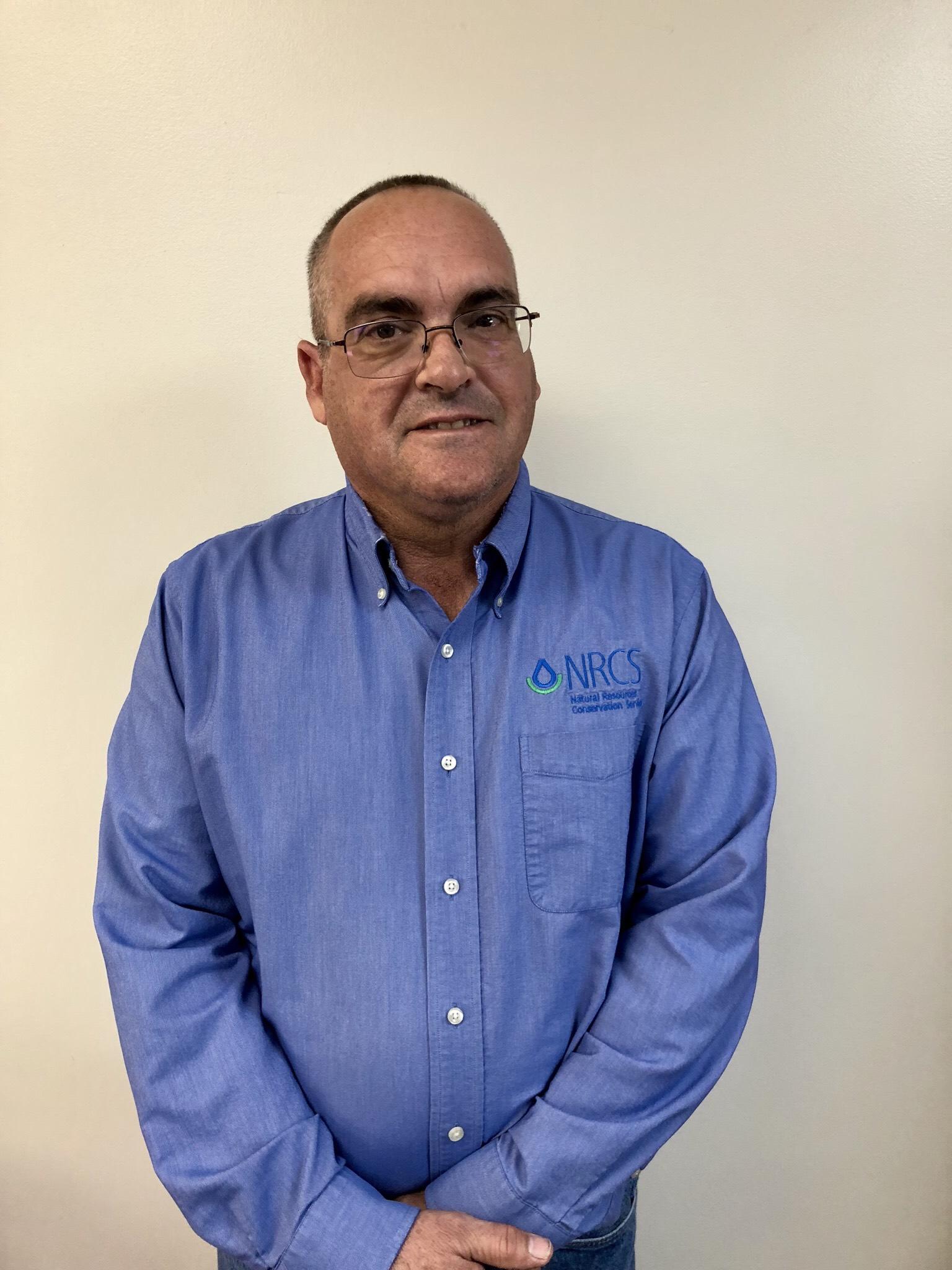
Dale Younker is a Soil Health Specialist with the USDA Natural Resources Conservation Service in Jetmore.
Today I would like to talk about soil water infiltration and what we might be able to do to improve it. The recent heavy rainfall many areas of western Kansas has resulted flooding and soil erosion indicating that water infiltration is limited. This is especially true on cropland fields that are being followed and conventionally tilled. There will always be large rainfall events where we will have some runoff. But in our semi-arid environment it is important to capture as much rainfall as we can when we get it and effectively store it in our soil so it is available to our crops when they need it.
So what is limiting our infiltration rates? There are a lot of different factors involved, including soil types, the amount of residue and/or canopy cover a field may have and so on. But the biggest reason is soil compaction and lack of good stable soil aggregation. They kind of go hand in hand but let’s take a little closer look at each of these factors.
When the soil is compacted soil particles are compressed into a smaller volume, which reduces the size and amount of pore space available. In a compacted soil water has difficulty passing t through those compacted layers to reach the deeper parts of the soil profile. Compaction can be caused by heavy equipment, such as grain carts and combines crossing the field, especially when the soil is wet. As the equipment gets bigger the higher the concern is for creating compaction.
Tillage also causes compaction. This is often referred to this as the tillage pan. This pan gets worse and more compacted when the field is wet when completing a tillage pass. Road construction companies actually use tillage implements, like a disc, to build new roadbeds. The disc helps compacts the soil and reduces the size and amount of pore spaces for water to infiltrate into the roadbed. Continued use of tillage equipment in the field, especially when conditions are wet, can create the same result.
Soil aggregates are groups of soil particles that are bound together by organic matter and plant exudates excreted through plant roots. Soil aggregate stability refers to the ability of soil aggregates to resist being broken down into the individual soil particles of sand, silt and clay. Once the soil is down to those into individual soil particles they will close up soil pore spaces when it does rain and will not allow water to infiltrate. Without good soil aggregation the soil surface also tends to crust and seals up so when rain does fall it just runs off. Excessive tillage destroys aggregates by physically breaking them apart and by incorporating air into the soil, stimulating soil microbes to increase the rate of organic matter decomposition. This organic matter is lost to the atmosphere as carbon dioxide. Over time this results in less organic material to help bind soil aggregates together.
The bottom line is we can increase infiltration rates by reducing tillage. There may be times, for certain producers, in specific cropping systems that tillage may be the most appropriate tool to use. But when it is used exclusively over and over, year after year, we can expect decreased water infiltration rates which will result in more flooding and erosion.
For more information about this or other soil health practices you can contact me at [email protected] or any local NRCS office.
Dale Younker is a Soil Health Specialist with the Natural Resources Conservation Service in Jetmore.
For voters planning to cast a primary election ballot for governor on Tuesday, your choice is move forward and away from the Brownback era or turn back toward it. Candidates have defined this choice on the major issues of the campaign.
H. Edward Flentje is professor emeritus at Wichita State University.
Most Kansans do not see abortion and guns as their chief concern, but candidates have spent an inordinate amount of time addressing voters who choose a candidate solely on one or the other of these two issues. Like Brownback, Republican candidates Jeff Colyer and Kris Kobach have aligned themselves with special interest groups demanding more restrictions on abortion or fewer restrictions on guns. In pandering for endorsements, they came to a draw, Colyer slightly favored.
Somewhat surprisingly two leading Democratic candidates, Laura Kelly and Josh Svaty, sparred at length over their legislative voting records on abortion and guns. In the end both, as well as Democratic candidate Carl Brewer, defend women’s access to reproductive health care—with Kelly earning endorsements for her long record on the issue. Svaty and Brewer spoke out more forcefully in calling for action to end gun violence.
Taxing and spending issues have consumed state lawmakers for the past seven years, as well as candidates this year, with Brownback’s tax experiment framing the debate. Lt. Governor Colyer championed the experiment as unbalanced budgets, unfair taxes, and record debt piled up and service deteriorated. As governor, however, he has happily signed off on spending new revenues generated by abandonment of the experiment last year.
In dramatic contrast, Kobach embraces the Brownback experiment and wants to double down with a new round of tax and spending cuts—with little mention of where spending reductions should occur.
The remaining four candidates, including Republican Jim Barnett and all three Democrats, strongly defend lawmakers’ restoration of state finance and steps that begin to repair the damage to services. Kelly’s direct legislative experience on these matters gives her an advantage in charting a new direction away from Brownback on taxing and spending.
A similar alignment holds for two major spending issues—education and Medicaid. Kobach has condemned court interference in school finance and attacked Colyer for signing legislation that addressed court action on school funding. Both candidates voice support for a constitutional amendment that removes school funding from court review—as did Brownback.
Democrats Brewer, Kelly, and Svaty, as well Republican Barnett, champion high quality schools as crucial to economic advancement and voice support for cooperating with the courts in resolving funding issues.
In 2017, Brownback blocked extending Medicaid to 150,000 Kansans, even with 90 percent of the cost federally funded. Colyer and Kobach agree. Barnett, Brewer, Kelly, and Svaty favor Medicaid expansion.
Six leading candidates offer primary voters the choice of moving forward or turning back—between charting a new course on fiscal sanity, education, and health care or reverting to the miserable experience of the last seven years.
Colyer has made modest moves away from Brownback, but he mostly aligns with his former patron. Kobach wants to relive the discredited tax experiment even more harshly than before. Barnett offers Republican primary voters a forward-looking centrist alternative.
Democrats Brewer, Kelly, and Svaty vary in particulars, but all want to put the Brownback’s years in a rear-view mirror.
Primary voters have clear choices in empowering new leadership for the future of Kansas.
H. Edward Flentje is professor emeritus at Wichita State University and served with Kansas Governors Bennett and Hayden.
If you’re interested in introducing your child to the world of shooting sports, hunting, fishing and other outdoor-related activities, make plans to attend the 21st Annual Youth Outdoor Festival on Aug. 18. The event will provide a day of free target shooting and other outdoor activities for youth 17 and younger at the Hays City Sportsmen’s Club, 1/4 mile north of I-70, Exit 157.
Staff from the Kansas Department of Wildlife, Parks and Tourism, as well as members of Hays area businesses, conservation groups and local shooting sports groups will collaborate to offer instruction on trap and skeet shooting, archery, as well as air rifle, muzzleloader and small-bore rifle marksmanship. There will also be a casting competition, paintball activities and a furharvesting demonstration. Events begin 9 a.m. on Saturday morning and end at 3 p.m.
Youth will be closely supervised at each station by experienced volunteer instructors, and all equipment will be supplied. Hunter Education certification is not required, but youth must be accompanied by an adult. Registration for the event can be completed onsite the day of the event. A free lunch will be provided by Eagle Communications and the Hays Chapter of Pheasants Forever. Youth will also have chances to win prizes, including guns, fishing tackle and other outdoor equipment.
For more information, contact Kent Hensley at (785) 726-3212 or Troy Mattheyer at (785) 726-4212.
Hays Public Library will host “The Kansas City Monarchs in Your Hometown,” a presentation and discussion by Phil S. Dixon on Aug. 5 at 1:30pm in the Schmidt Gallery of the Hays Public Library. Members of the community are invited to attend the free program.
Contact Marissa Lamer, Kansas Room Librarian, at 785-625-9014 for more information. The program is made possible by Humanities Kansas.
Formed in 1920, the Kansas City Monarchs revolutionized baseball; not only were they charter members of the Negro National League and the first professional team to use outdoor lighting, the Monarchs also sent more players to the major leagues than any other Negro League franchise. This presentation will explore the early barnstorming days of the Monarchs and highlight great players such as Wilbur “Bullet” Rogan, Satchel Paige, and Jackie Robinson.
Phil S. Dixon, co-founder of the Negro Leagues Baseball Museum in Kansas City, is the author of nine books about baseball, including biographies about Wilber “Bullet” Rogan and John “Buck” O’Neil. In the course of his research, he has interviewed over 500 former Negro League players and family members. Dixon will share stories of particular interest to Hays and surrounding areas. The Kansas City Monarchs made many trips to the area.
“The Kansas City Monarchs in Your Hometown” is part of Humanities Kansas’s Movement of Ideas Speakers Bureau, featuring presentations and workshops designed to share stories that inspire, spark conversations that inform, and generate insights that strengthen civic engagement.
Page 2 – Presentation Explores Legacy of African American Baseball Team
For more information about “The Kansas City Monarchs in Your Hometown,” contact the the Hays Public Library at 785-625-9014 or visit www.hayslibrary.org.
Phil Dixon is co-founder of the Negro Leagues Baseball Museum in Kansas City, Mo.
About Humanities Kansas
Humanities Kansas is an independent nonprofit spearheading a movement of ideas to empower the people of Kansas to strengthen their communities and our democracy. Since 1972, our pioneering programming, grants, and partnerships have documented and shared stories to spark conversations and generate insights. Together with our partners and supporters, we inspire all Kansans to draw on history, literature, ethics, and culture to enrich their lives and serve the communities and state we all proudly call home. Visit humanitieskansas.org.
ELLIS — The annual “Just Breathe” disc golf tournament in memory of Ellis resident Bryce Stropes will be held Sunday, Aug. 5, Sky Vu Disc Golf Course in Ellis.
Registration begins at 9 a.m., with play beginning at 10 a.m.
Cost is $20 per team of two, and there will be a cash payout for first through third finishes.
A 14-year-old Ellis resident, Bryce Stropes drowned while playing in the city swimming pool July 22, 2010, despite the efforts of lifeguards, a volunteer firefighter who was also at the pool and EMS personnel. His death was determined to be from shallow water blackout drowning.
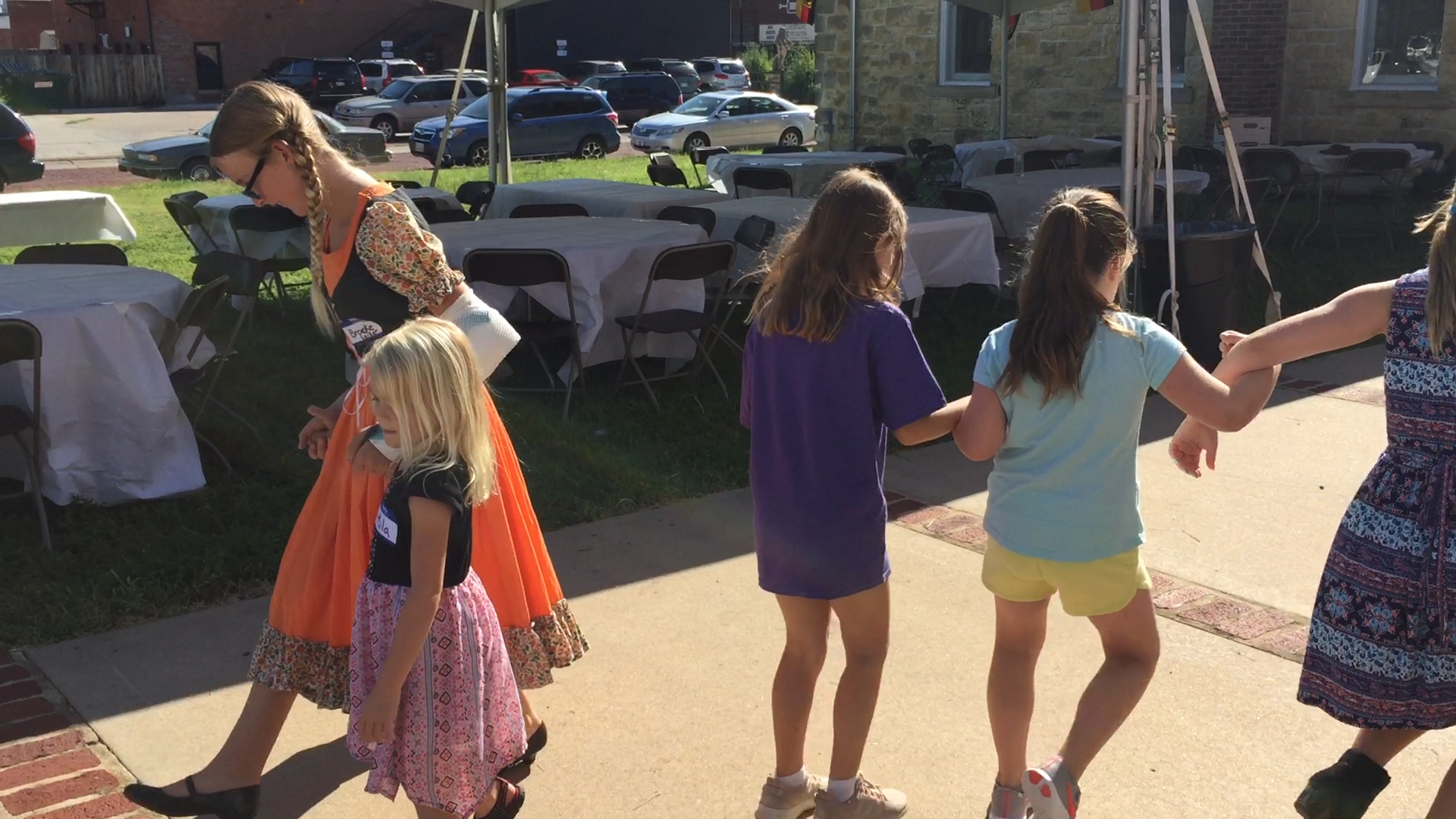
Brooke Leiker, Munjor, teaches the polka at Kindertag, part of the AHSGR International Convention in Hays.
By BECKY KISER Hays Post
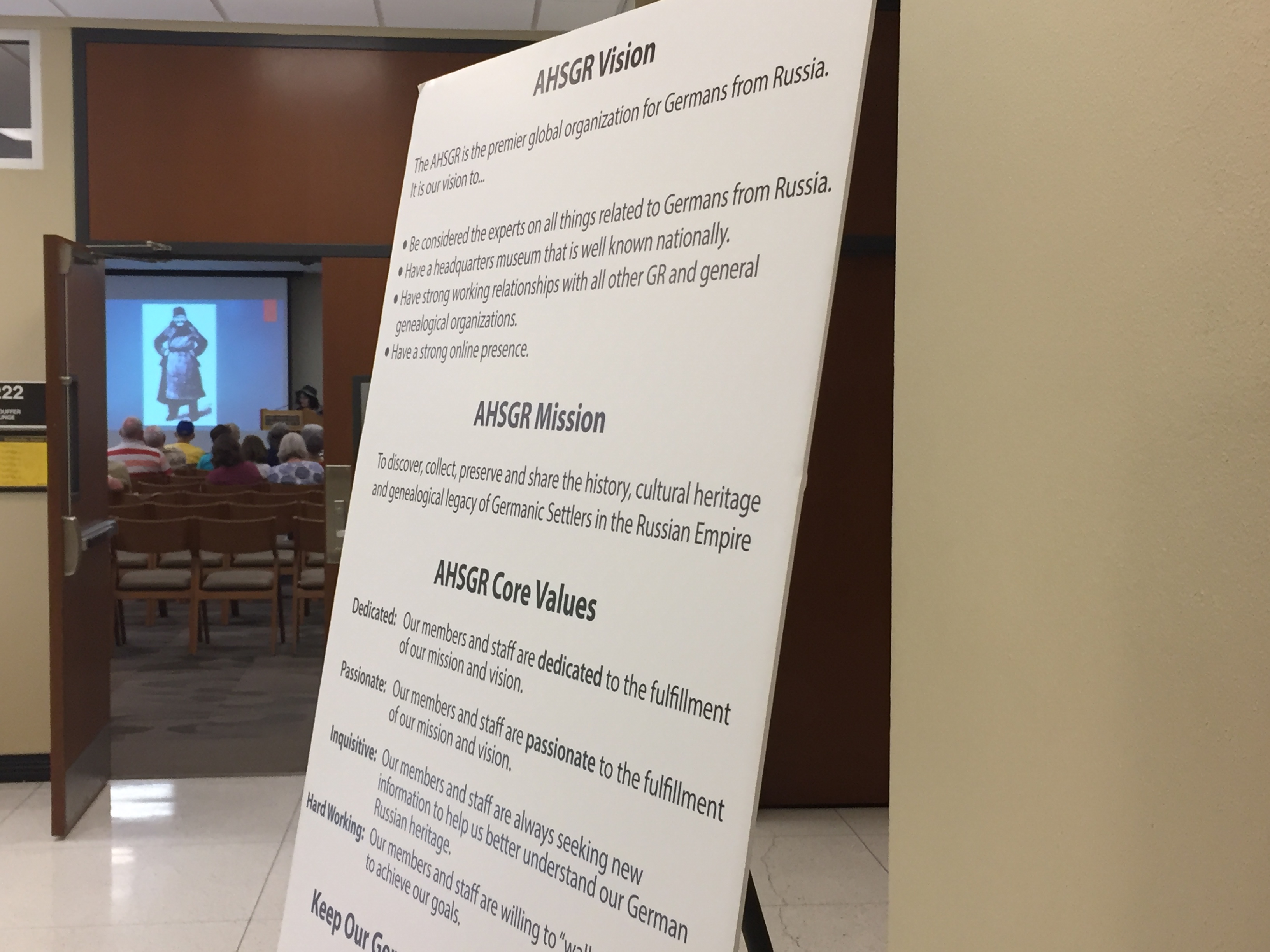
It was perfect polka weather Wednesday morning for Kindertag, a youth heritage outdoor day presented in connection with the 49th annual international convention of the American Historical Society of Germans from Russia underway in Hays.
More than 350 people from across the United States as well as Canada, Germany and Russia are attending the four-day convention headquartered in the Fort Hays State University Memorial Union.
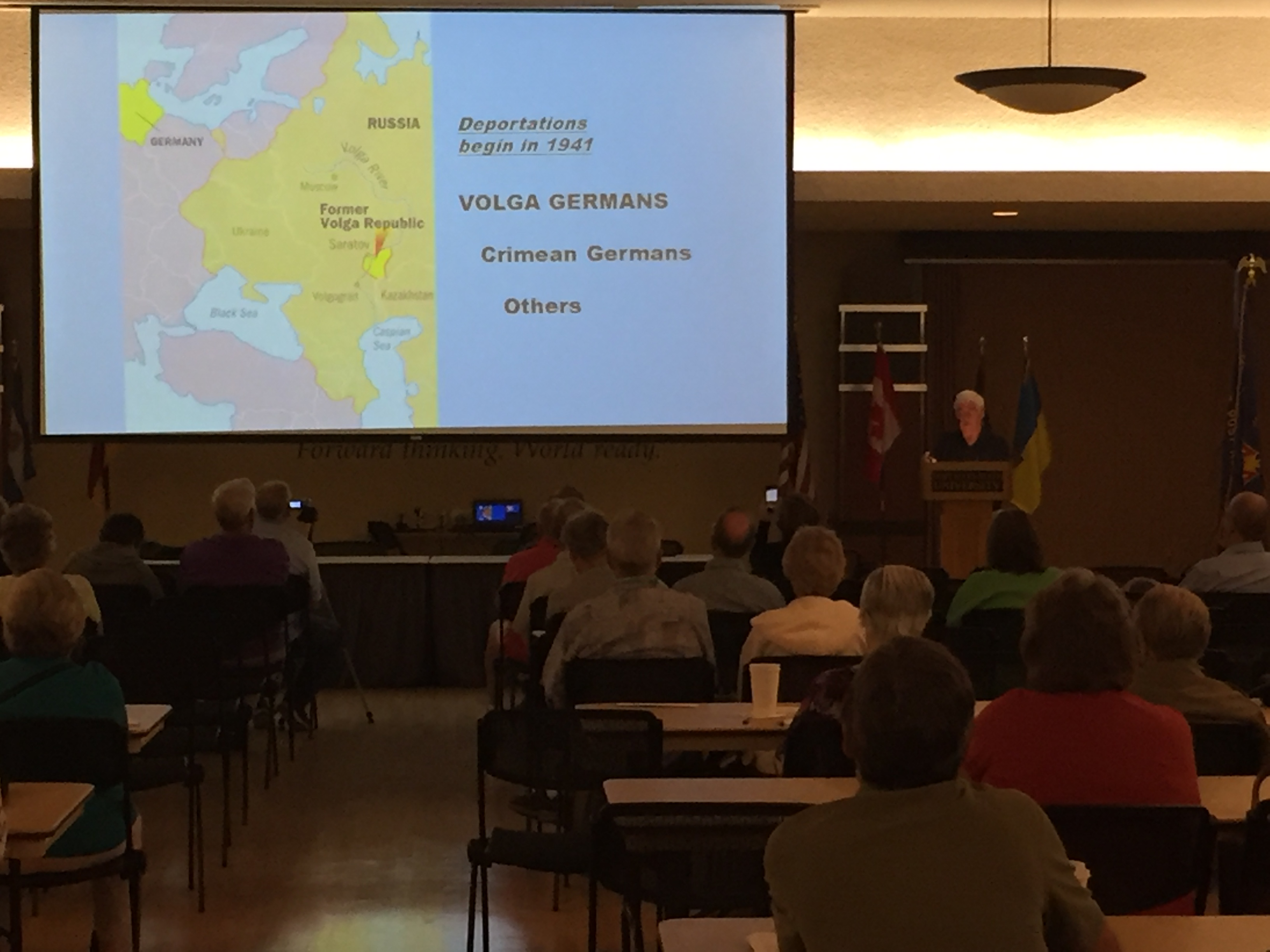
Themed “The Storm,” participants are learning about life in the Germanic colonies of the Russia Empire as the 1917 Russian Revolution began. They’re also looking for and sharing information about their German-Russian ancestors and heritage.
The international society is headquartered in Lincoln, Nebraska, where the 50th anniversary will be celebrated in 2019. Executive Director Sherry Pawelko describes herself as “100 percent Volga-German, from both sides of the river.”
“We represent all different regions of settlements where German people were in Russia, including the Volga (river) area and of course, there are a lot of Volga-Germans in the Hays area,” she said.
“We have a rich heritage and we don’t want to forget it.”
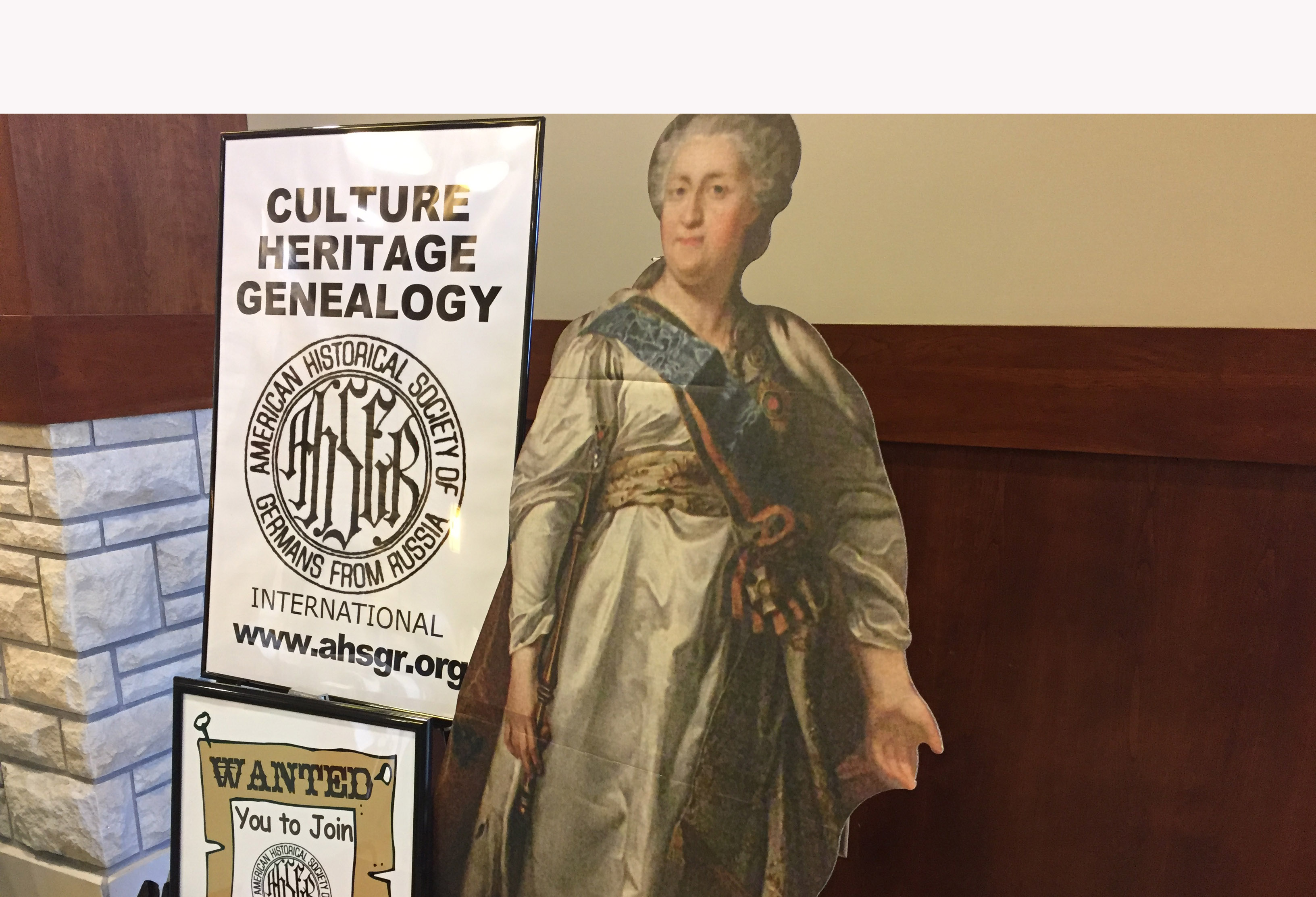
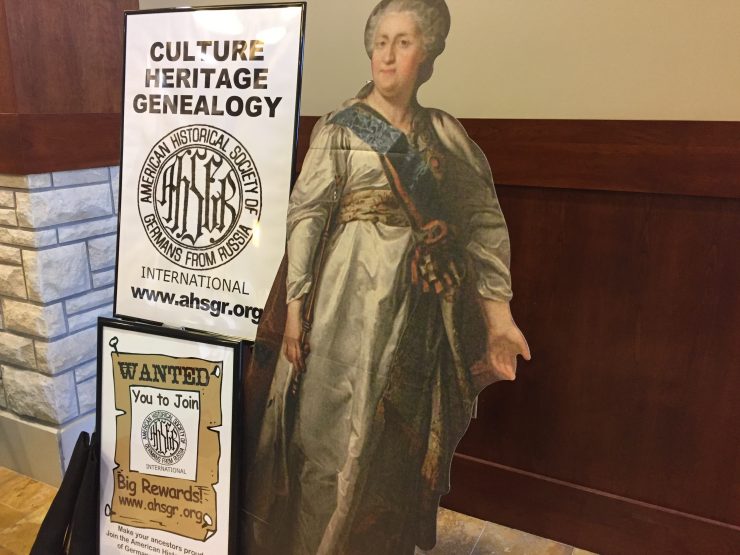
According to the society’s website, the Germans from Russia story begins in 1762 with the Manifesto issued by Catherine the Great. By the end of the 19th century, there were about 1.8 million Germans in Russia. In 1872, the Germans in Russia began to emigrate to the United States, Canada, Brazil, and Argentina.
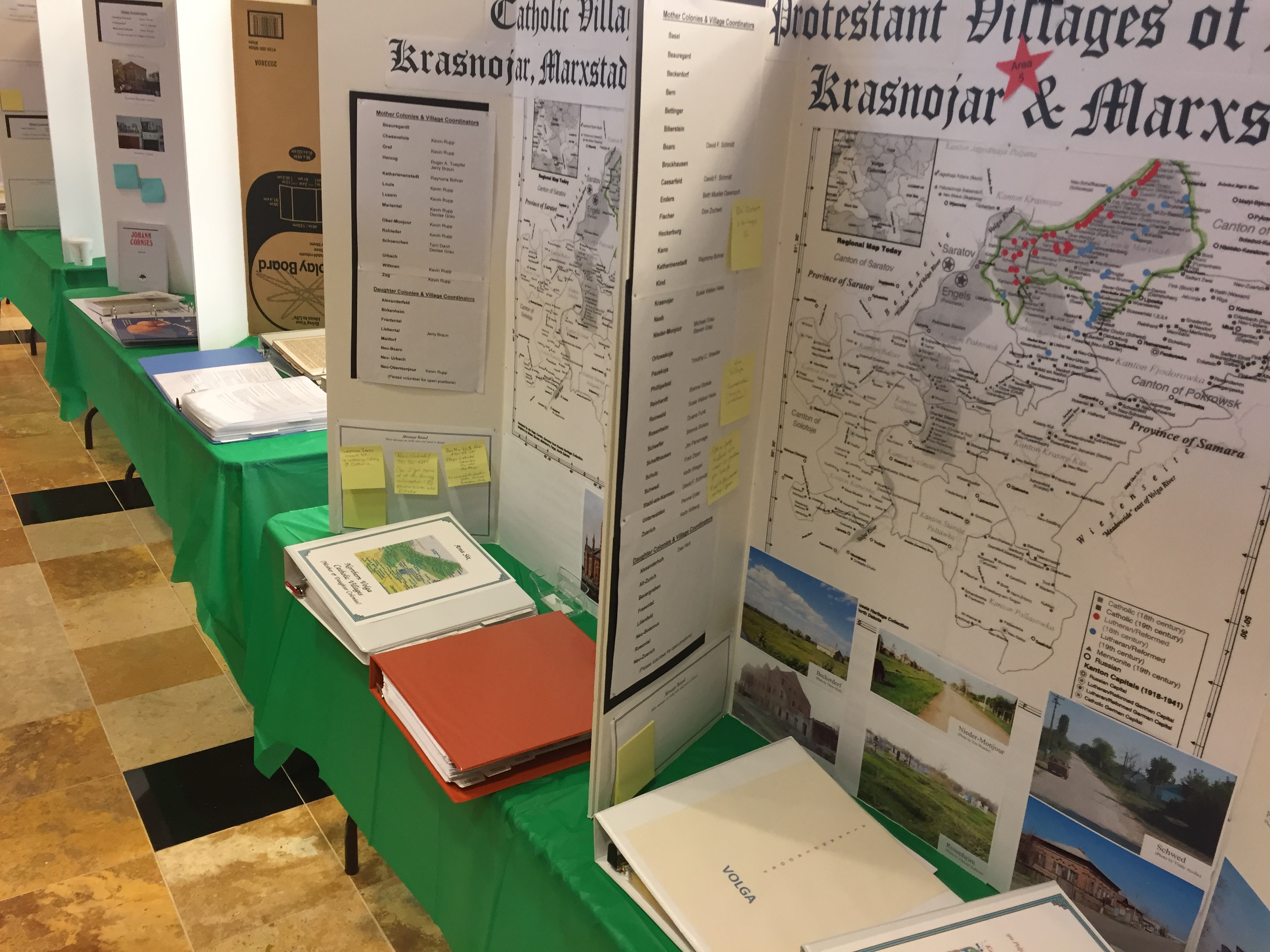
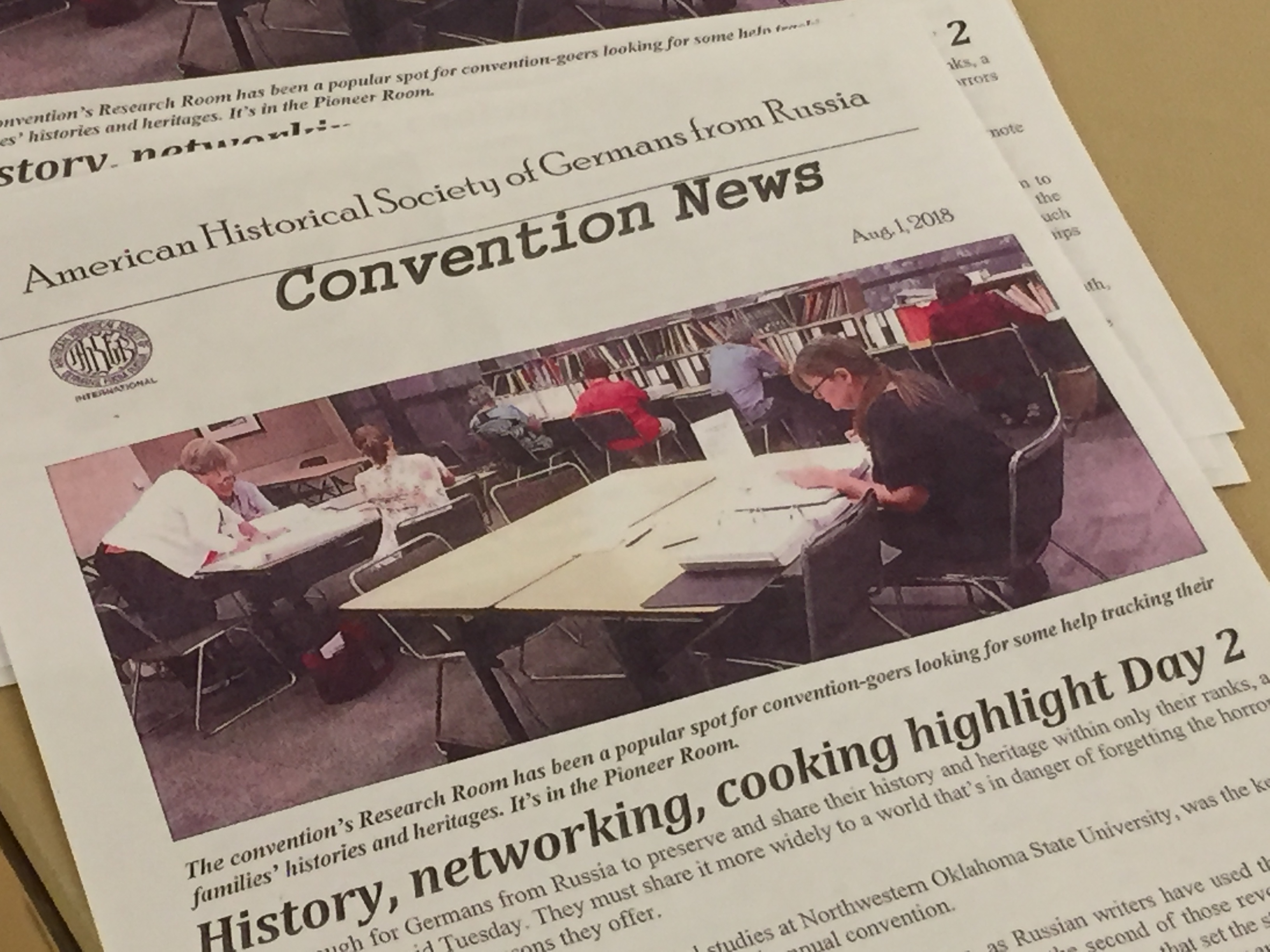
Research Room
The society focuses on research. “We want to be here for future generations to do research, to find out about their families and their heritage,” Pawelko stressed.
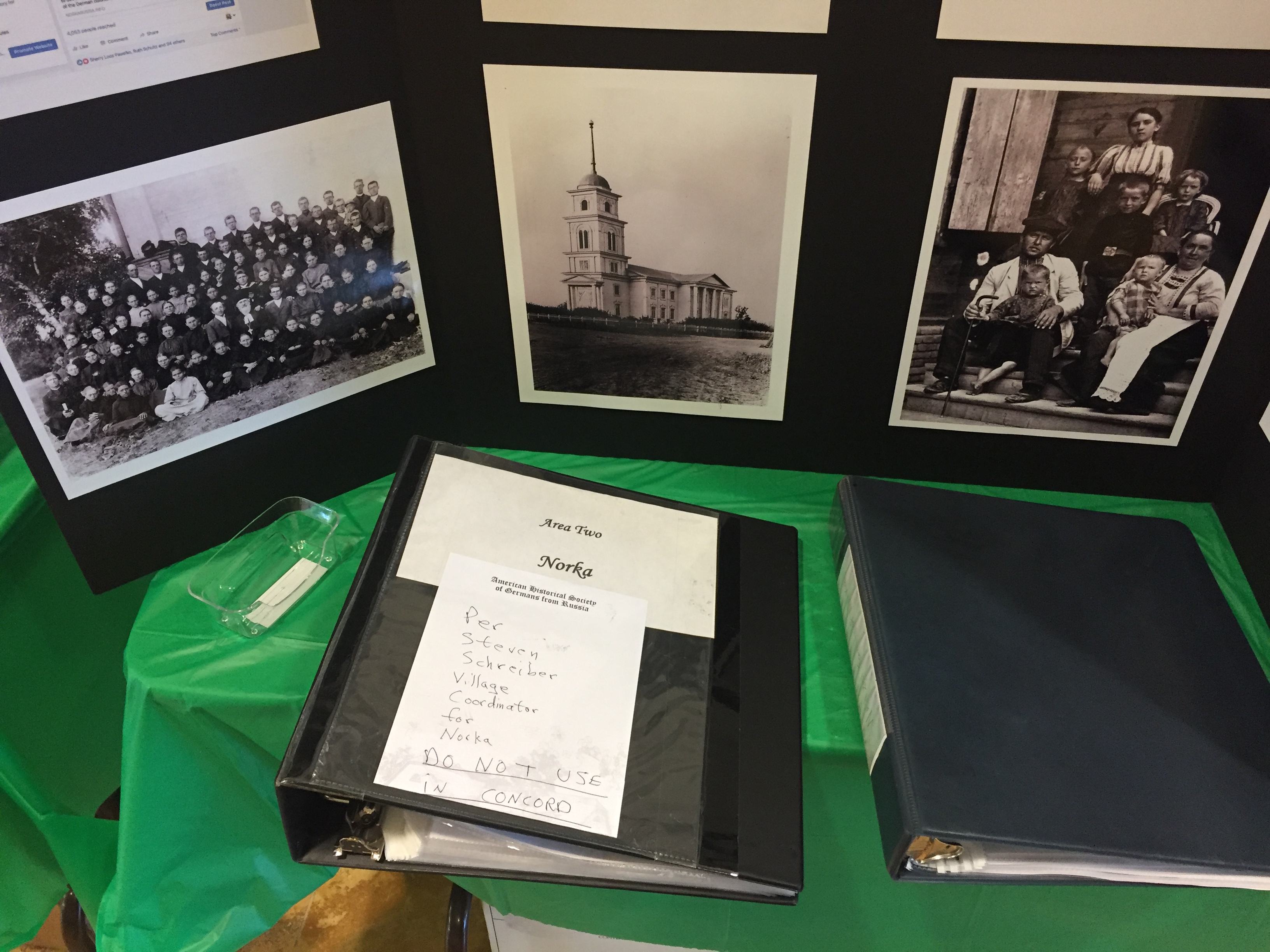
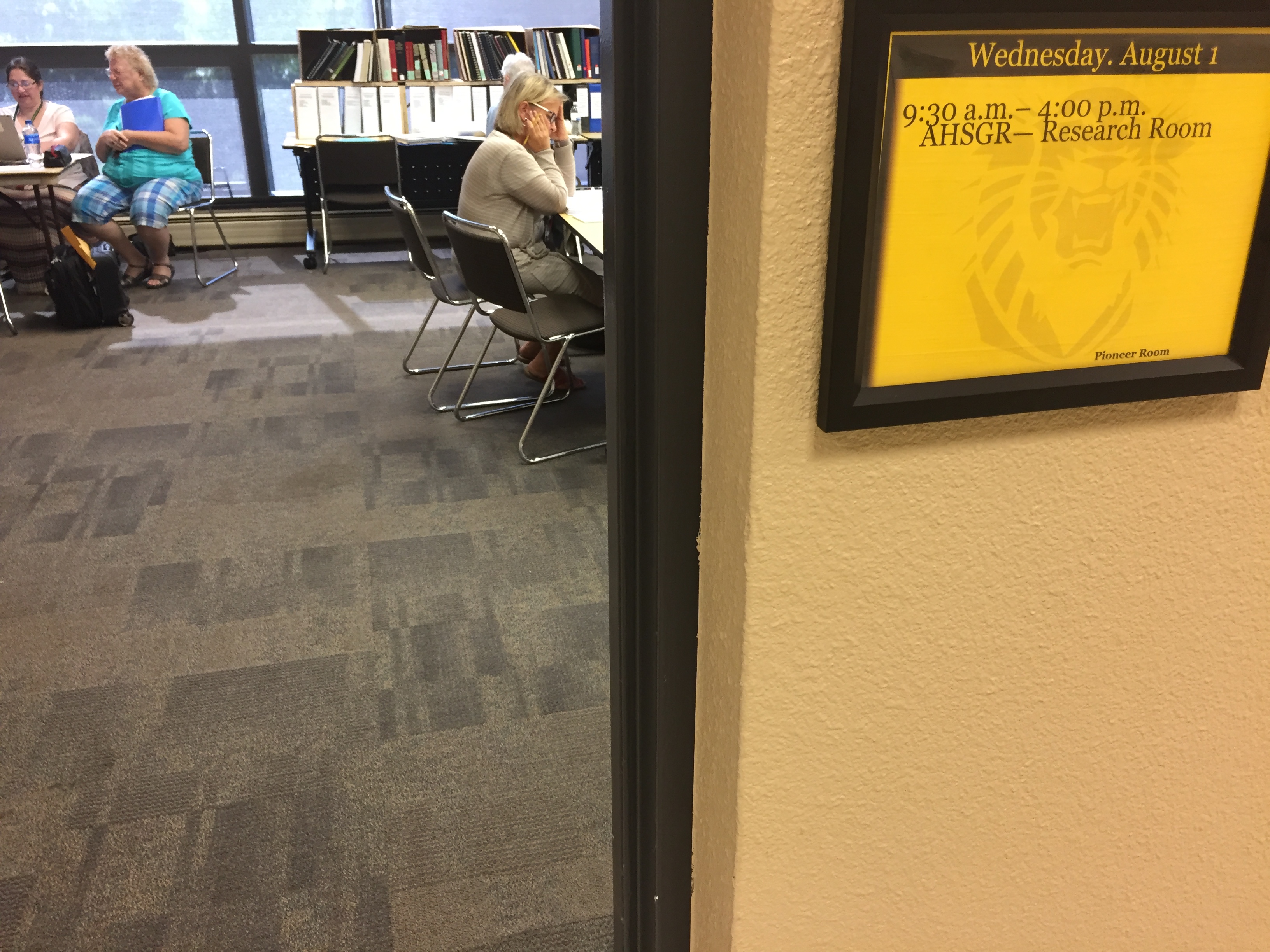
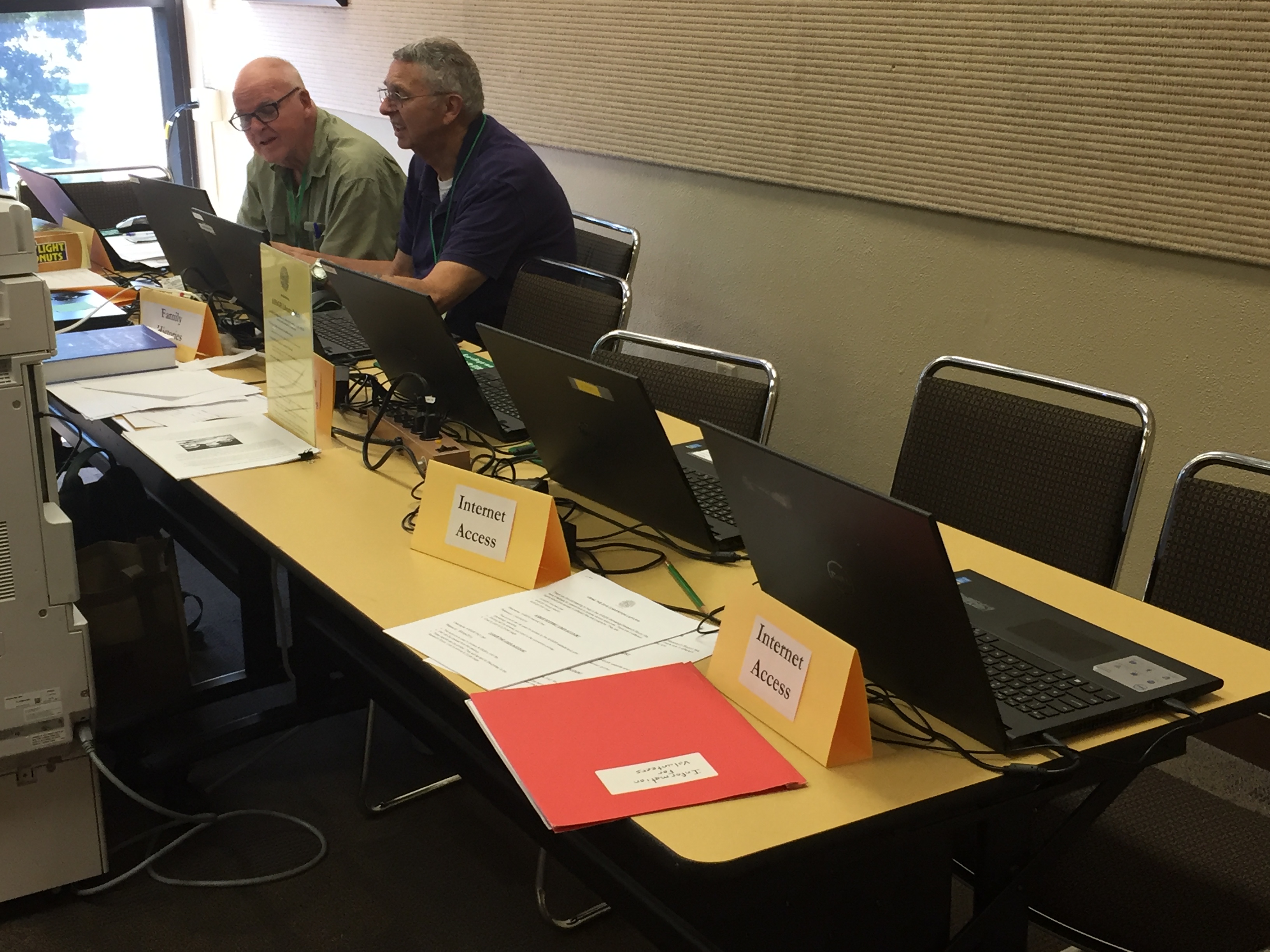
One of the rooms in the Memorial Union is entirely lined with reference materials, computers and internet connections to aid in that research.
The future generations were also doing some research of their own at the Ellis County Historical Society Museum in downtown Hays.
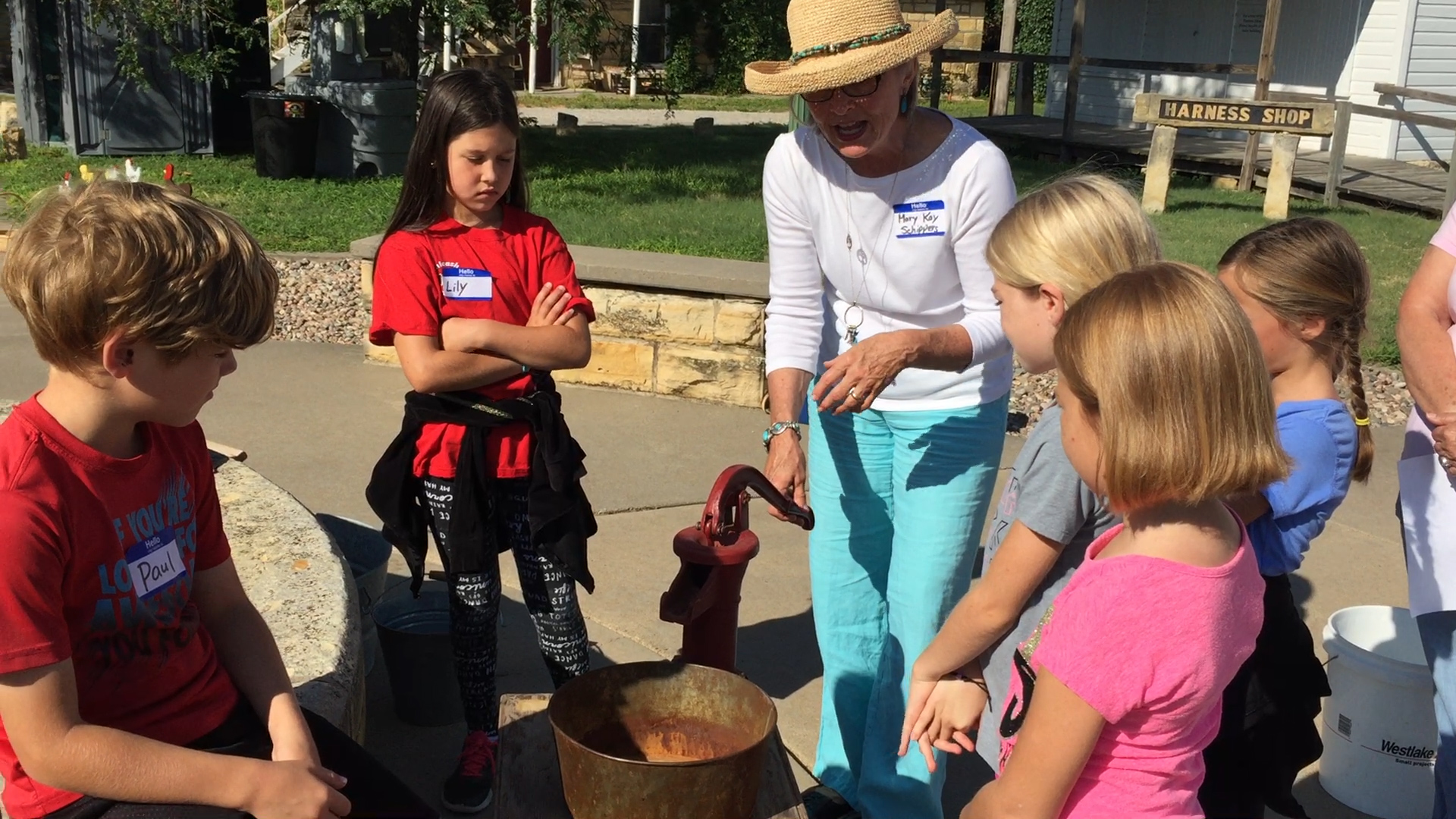
Mary Kay Schippers demonstrates how water was brought into a farm home.
Educational activities showed how Germans from Russia lived, many of them on farms or in rural villages. The nearly 60 children learned from local volunteer Mary Kay Schippers how sauerkraut and butter were made, how clothes were cleaned before the advent of electricity and where eggs actually come from.
After the chores were done, children and adults enjoyed leisure activities including dances and games.
Munjor residents Sarah Leiker and her daughter Brooke, who was wore traditional German garments, taught the young participants how to polka.
“They were really good,” Brooke said.
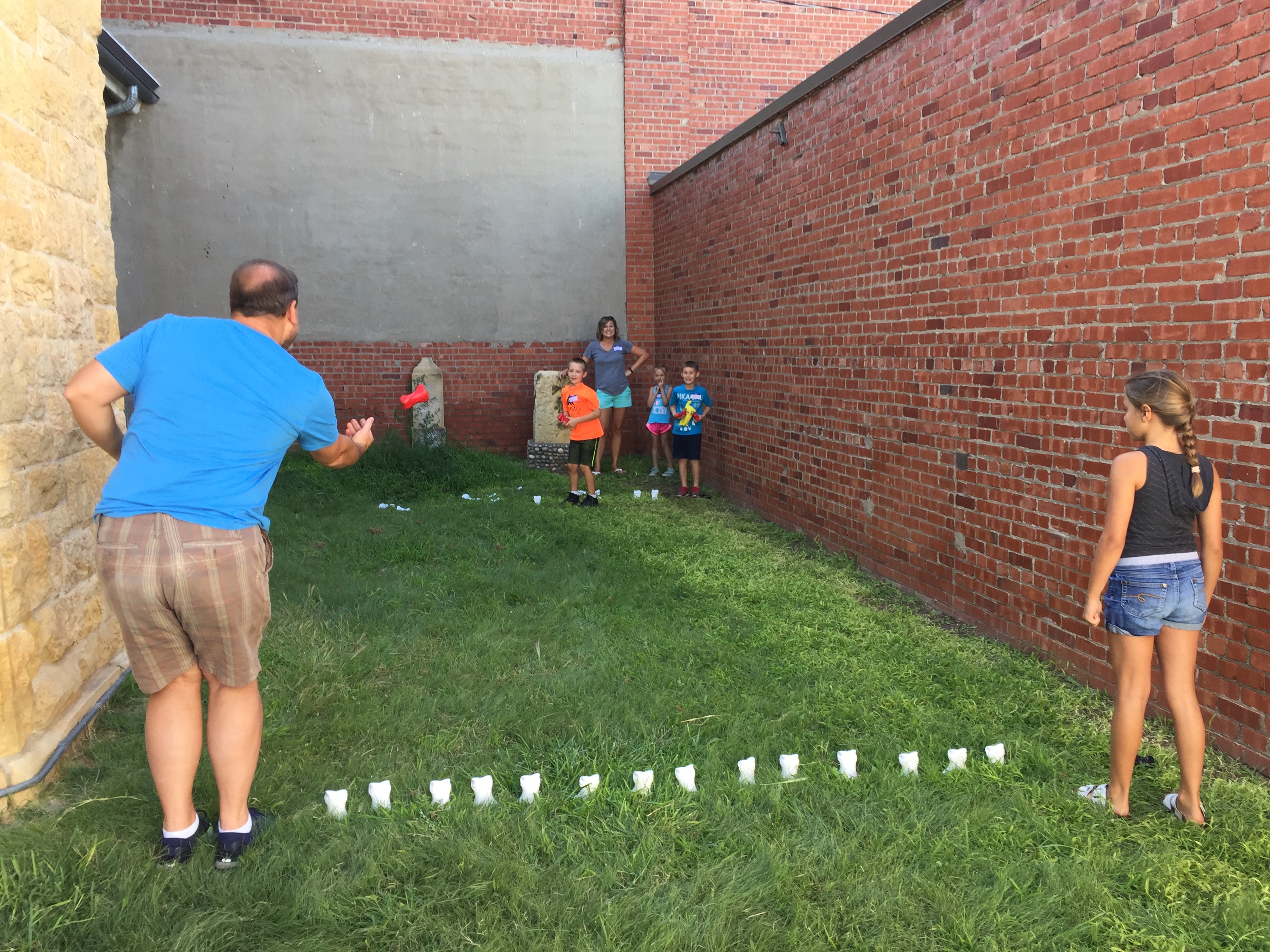
Jerry Braun pitches Bunnock
Hays resident Jerry Braun organized a rousing game of Bunnock, “The Game of Bones,” which originally used horse knuckles tossed between two teams trying to knock down all their opponent’s “bones” with the fewest number of throws.
“Bunnock began as a pastime by those in Russian military service and the soldiers brought it back to their families,” Braun explained. Today, Bunnock tournaments thrive in Canada, he added. It’s one of four countries where the Germans in Russia began to emigrate in 1872, along with the United States, Brazil, and Argentina.
Another popular game was Durak, the card game of “The Fool.” “You must lose your cards to win,” grinned Braun, “and the last player with cards is the Durak or Fool.”
Sylvan Grove resident Jana Wehrman brought her daughters Emma, 10, and Eastin, 8, to learn more about their dad’s side of the family.
“We homeschool our two girls and this is a good way to start our school year,” Wehrman said as she watched Schippers demonstrate life on the farm in the old days.
“We live on a farm but they’re learning what it used to be like for their grandmas and grandpas. They weren’t sure about the sauerkraut,” she laughed, “but they were excited to learn about some of those traditions.”
Wehrman is a former science teacher at Sylvan Grove High School and uses those skills in homeschooling her young daughters.
“Last week we looked up where Germany is. We talked about their great-grandparents and how they got to the United States. Eventually in this school year, we’ll probably do a unit on Europe.”
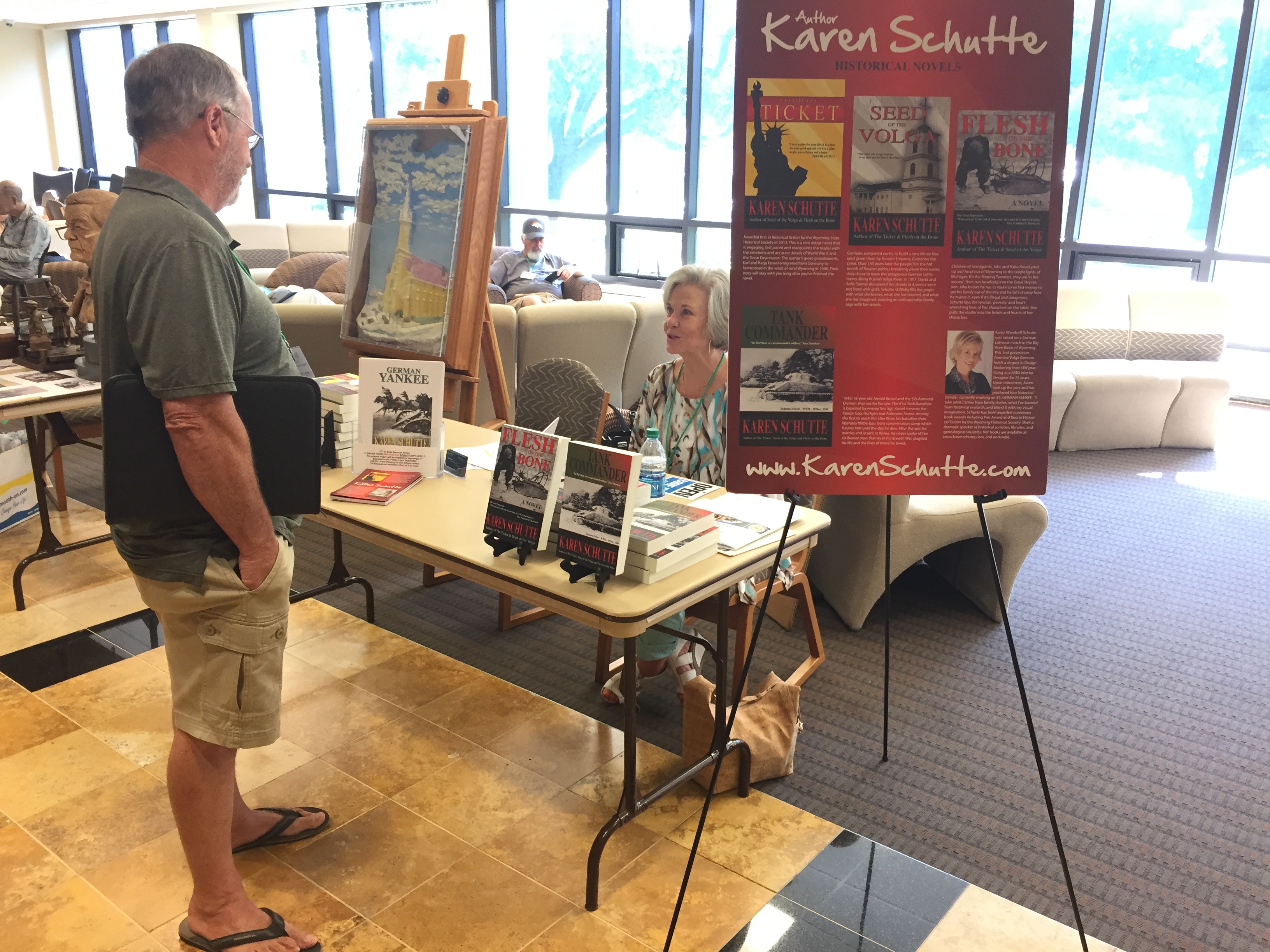
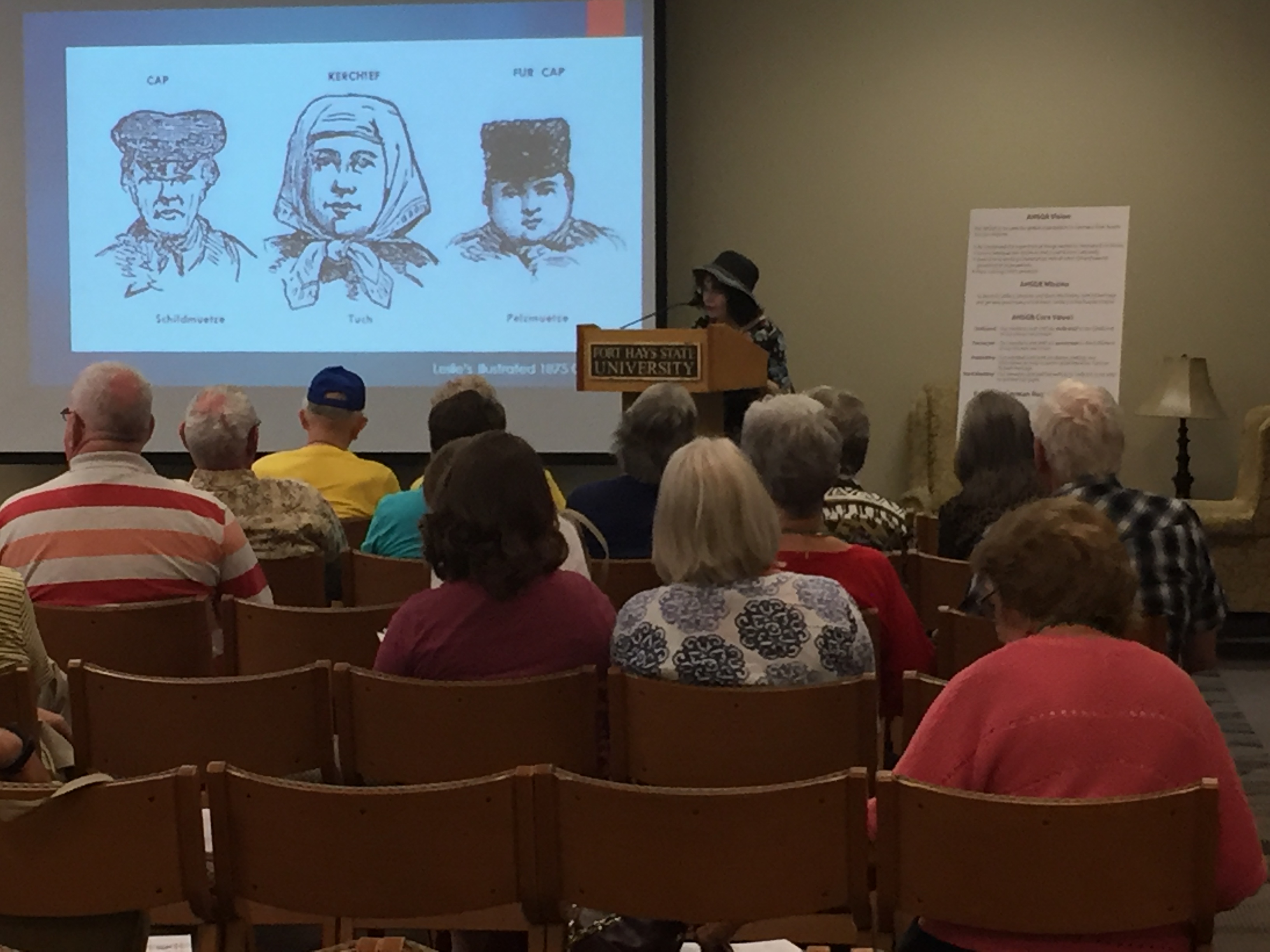
Concurrent sessions at the convention include DNA analysis, ethnic clothing, religious persecution, folklore, religious architecture, music, and authors discussing their books related to German-Russian stories and history.
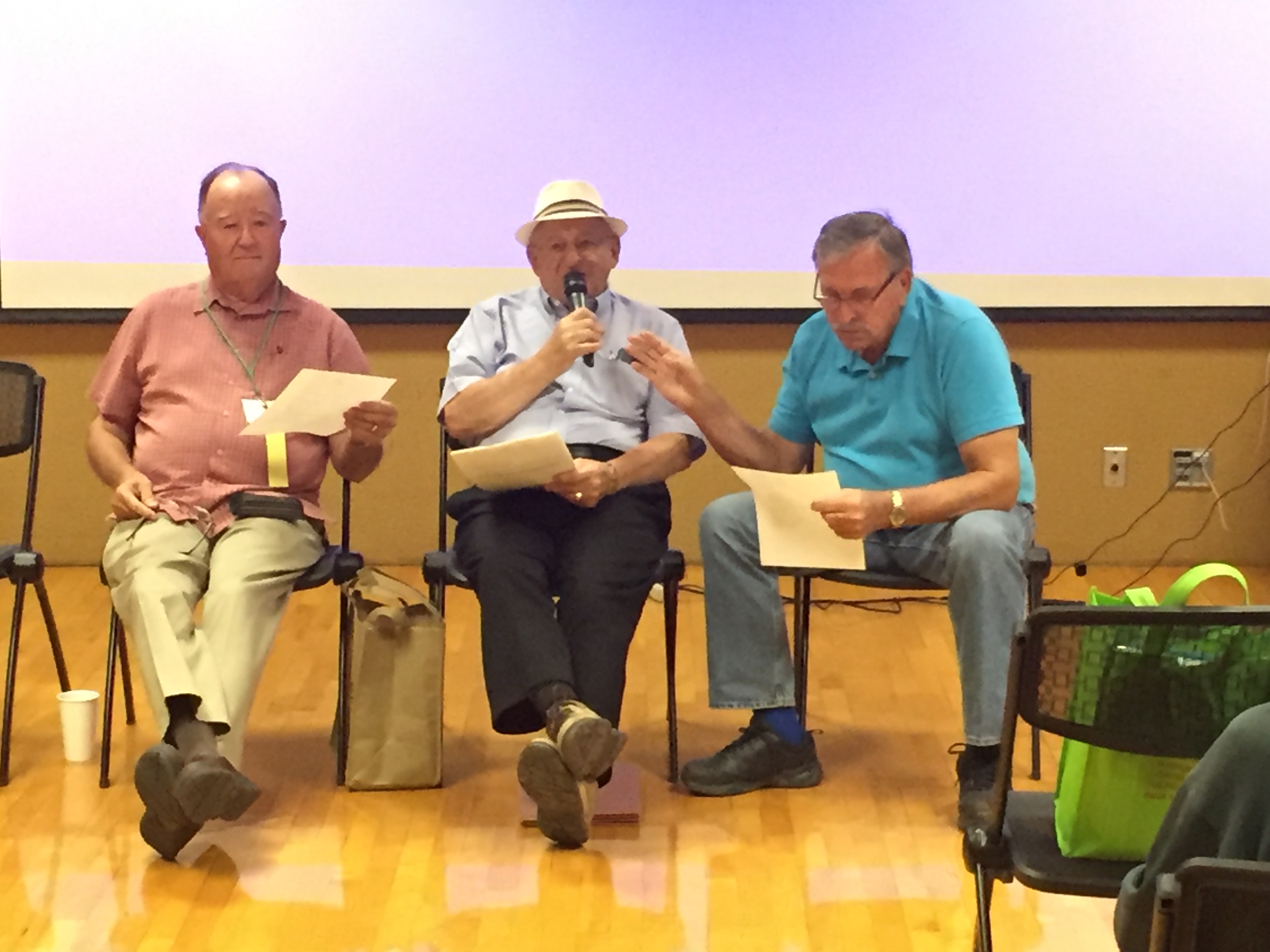
Tom Haas, Leo Dorzweiler, and Ray Breit explain different German dialects.
Area residents Tom Haas, Leo Dorzweiler and Ray Breit translated a German conversation into the local dialects spoken in Munjor, Catherine and Pfeifer.
Tours of historical and cultural sites were offered to the Volga-German “villages” in Ellis County and their famous limestone churches built by immigrants.
Pete Felten’s limestone sculpture in Victoria of a Volga-German family. A replica sits at the AHSGR headquarters in Lincoln, Nebraska.
Pawelko was especially excited to tour the studio of Hays limestone artisan Pete Felten.
“We have a copy of Felten’s statue that’s in Victoria in Lincoln, and so that was pretty thrilling to see the original.”
They also have toured the Bukovina Society Museum in Ellis and the Ellis County Historical Society Museum.
Sam Brungardt along with Charlie Dorzweiler, who recently opened Das Essen House restaurant in downtown Hays, held cooking demonstrations of traditional German dishes including potato and dumplings and Christmas cookies.
“It’s just been a little something for everyone,” Pawelko said with a smile. “Kevin Rupp (Hays) and Leonard Schoenberger (Ellis) of the AHSGR Sunflower Chapter have just been incredible in organizing this.”
Also assisting with the convention are the Kansas Northeast Chapter and the Golden Wheat Chapter, along with the Hays Convention and Visitors Bureau. It continues through Thursday.
The international convention was last held in Hays in 2007.
Heritage Hall
Tom Haas, Leo Dorzweiler, Ray Breit
The Germans from Russia story begins in 1762 with the Manifesto issued by Catherine the Great.
Jerry Braun pitches Bunnock
Research Room
Mary Kay Schippers demonstrates how water was brought into a farm home.
Fort Hays State University is currently accepting applications for the position of University Police Officer. For a full description and a list of requirements go to https://fhsu.wd1.myworkdayjobs.com/CAREERS.
Applicant must be at least 21 years of age, no felony convictions, no convictions for domestic violence, and must maintain a valid Kansas driver’s license.
Technology keeps evolving to help crop producers make every drop of water count on the fields. To demonstrate the latest in crop irrigation technology, farmers in numerous counties are teaming with the Kansas Water Office and Kansas State University to present Water Technology Field Days in several locations in August.
“I’m pleased to see the growing interest in Water Technology Farms across the state,” said Kansas Water Office Director Tracy Streeter. “We continue to see outcomes from these farms suggesting that water use reductions, coupled with irrigation technology adoption and water management improvements are leading to positive effects on the aquifer as well as the producer’s bottom line.”
The field days are designed for producers to see how the newest research and technology is being applied in real-life settings in different areas of the state. Three more Water Technology Farm projects were implemented in 2018 with a total of 10 Water Technology Farm projects, on more than 35 fields overlying the High Plains Aquifer.
The upcoming field day dates and locations include:
* Aug. 7 – Pawnee County – WaterPACK & ILS Farm – 2 p.m.
* Aug. 15 – Finney County – Garden City Co. & Roth Farm – 10 a.m.
* Aug. 16 – Harvey County – Weber Farm – TBD
* Aug. 16 – Sedgwick County – Jacob Farm – TBD
* Aug. 28 – Finney County – T&O Farms – 10 a.m.
* Aug. 28 – Seward County – Hatcher Land & Cattle – 2 pm.
* Aug. 29 – Sherman County – NW KS Tech College Farms – 9 am. (multiple events)
* Aug. 30 – Scott County – Circle C Farms – 10 a.m.
* Aug. 30 – Wichita County – Long Water Tech Farm – 5 p.m.
* Aug. 31 – Ford County – Harshberger Farm – 10 a.m.
For the second year Northwest Kansas Technical College is also participating by providing learning and workforce development training for its students. Northwest Kansas Technical College’s Precision Agriculture department and landowners in the surrounding counties have partnered to develop 10 Water Technology Farm projects. In these projects, the students and landowners receive in-field training and hands on experience implementing water efficiency technologies. With supplier partnerships, students will be exposed to multiple types of soil moisture probes, pivot controls, irrigation scheduling systems and other water management tools.
KWO provides financial assistance to Kansas State University’s efforts to give technical support to each technology farm. K-State is deeply involved in establishing and monitoring the farms to help answer the producers’ specific questions and concerns about the new technology.
“K-State is working with partners to help address questions and concerns about the new irrigation technologies so in the future, farmers will fully embrace the technology appropriate for their operation and situation,” said Jonathan Aguilar, water resource engineer with K-State Research and Extension, based in Garden City, Kansas. “Each farm is set up slightly different, depending on the primary concern the producer has. For example, one farm has three adjacent spans with different modes of application for comparison purposes. In most fields, soil moisture sensors are installed and tested for accuracy as feedback or for its performance in the different soil types.”
The Water Technology Farms wouldn’t be possible without key public-private partnerships and support from the following:
Kansas Water Office; K-State Research and Extension; Kansas Corn Commission; Northwest Groundwater Management District No. 4; Groundwater Management District No. 1; Seaman Crop Consulting; Servi-Tech Expanded Premium Services, LLC; United Sorghum Check-Off Program; Garden City Coop; SW KS Groundwater Management District No. 3; Kansas Department of Agriculture; Conestoga Energy Partners; Teeter Irrigation; Dragon-Line; Helena; Kansas Geological Survey; Ogallala Aquifer Program; Syngenta; Hortau; Kansas Farm Bureau; KSU Mesonet; AquaSpy; Kansas Grain Sorghum Commission; Crop Metrics; Netafim; Valley Irrigation; Presley Solutions, American Irrigation; WaterPACK; Pioneer Hi-Bred International; Western Irrigation Supply House and Ag Systems, Inc.; Tri-State Irrigation; John Payne; TerrAvion; Phytech; Great Plains Precision Ag; Western Sprinkler; Finney County Conservation District; On Target Solutions;Lindsay Corporation; Woofter Irrigation; Agrela Ecosystems; BASF Corp; AgSense; Golden Harvset; Red Barn Enterprises, Inc.; Todd and Diana Long; Groundwater Management District No. 2; Heartland Soil Services; Ag Systems, Inc.; T&O Farms; Valmont Industries; 21st Century Equipment; AgVenture; AMVAC; Dane G. Hansen Foundation; DEKALB; DigiFarm; DJI; Kansas Corn Growers Association; Kansas Department of Commerce; ModernAG; Nash Water Well Service; Nex-Tech; NW Kansas Technical College; Precision Planting; SatShot; The Climate Corporation; Trimble; Northwest Kansas Groundwater Conservation Foundation; 96 Ag & KITS; DataFarm; Sand-D-Akr Farms; Senniger; Davis; Fontanelle; Golden Plains; Outback; Simplot; SST-Proagrica; Komet; Veris
For more information visit: www.kwo.ks.gov or contact Armando Zarco, Water Resource Planner at (620) 276-2901.
TOPEKA – Governor Jeff Colyer and the Kansas Department of Health and Environment (KDHE) announce that Vital Statistics certified records are now available through the State of Kansas’ iKan app. The application allows residents to request birth, marriage, divorce and death certificates from their computer or mobile device, eliminating the need to visit a physical office in person.
In March, Governor Colyer introduced the iKan app to allow users to interact with multiple State services in a single self-service, intuitive experience from their mobile phones, tablets and computers. At the initial launch, the app allowed Kansas residents to remotely renew their vehicle registration. The app, which now includes Vital Statistics records, makes it easy to request official documents from anywhere with an internet connection and using technology most people carry with them everywhere.
“In today’s rapidly changing world, it is becoming increasingly important that we ensure government keeps pace with innovation and that we are taking advantage of technology to provide the best possible experience to those we serve. By quickly giving Kansans access to this important information, we are taking steps to do just that,” said Governor Colyer. “I’m excited to add another State agency to the list of iKan participants.”
Kansas Department of Health and Environment (KDHE) Secretary Jeff Andersen, added “iKan has already partnered with State government to facilitate vehicle registrations and other services. Today’s announcement is great news for Kansas and will make obtaining vital records much easier, while also decreasing lines and wait times in government offices.”
iKan is made available through PayIt, a Midwest-based technology firm specializing in the simplification of government transactions across the country, including taxes, utilities, court records, and more as part of their cloud-based platform. PayIt has provided the myKTag app for the Kansas Turnpike since 2014.
Once a Vital Statistics record is requested using iKan, depending on the delivery method selected, the requestor will be notified by text when the record is available for pick up or have it delivered within seven to 10 business days. Cost for a record and the processing fee through the app is $20. To download the app, search “iKan State of Kansas” on your iPhone and Android devices.