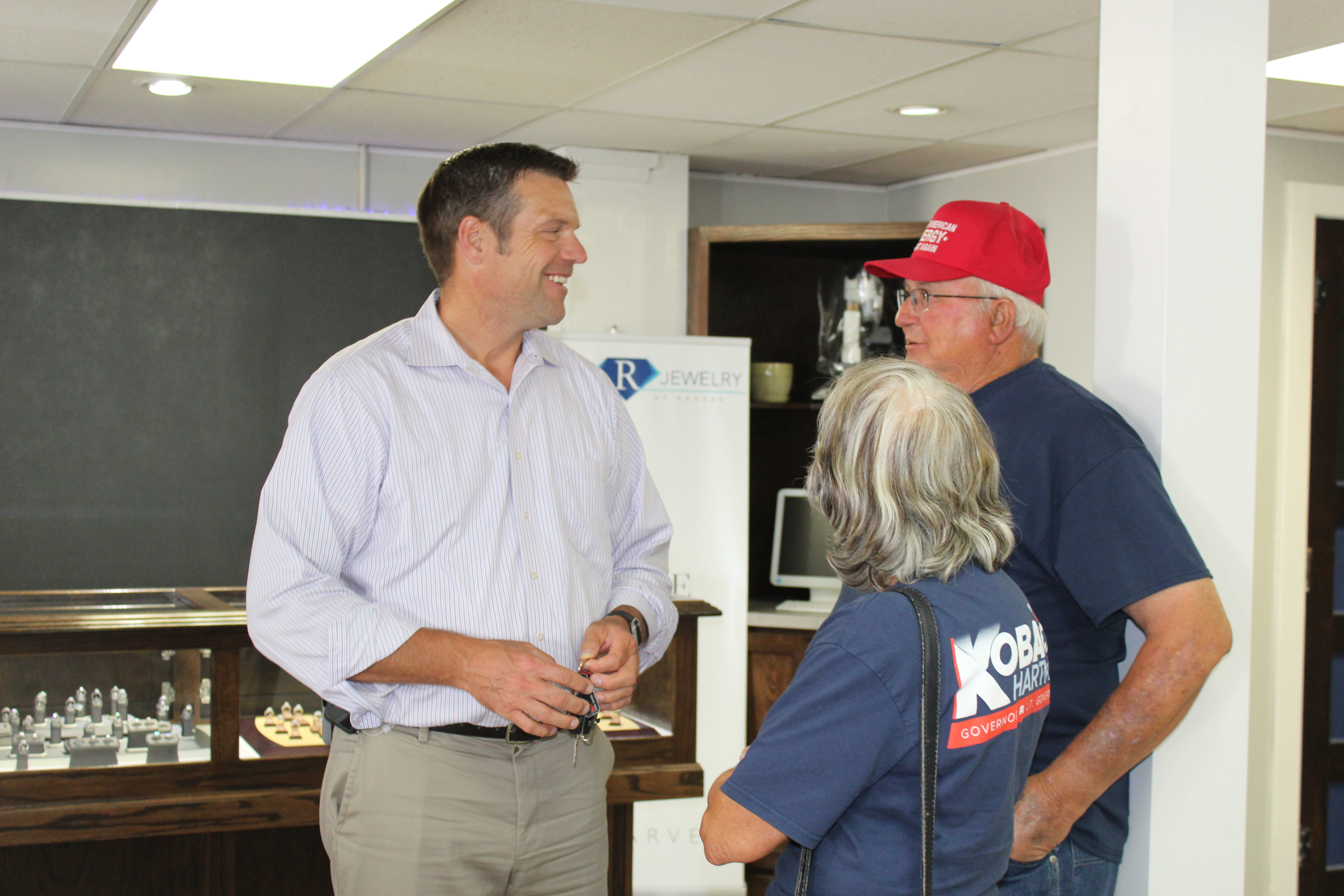
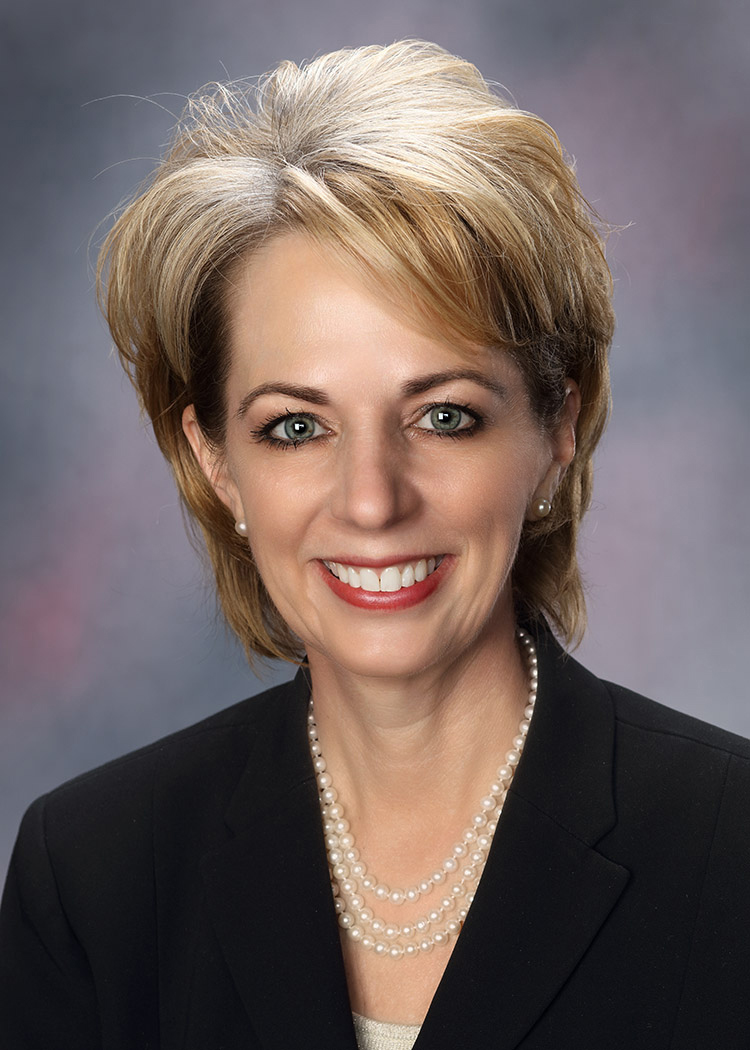
Republican Kris Kobach speaking to voters Tuesday at Diamond R Jewelry in Hays.By CRISTINA JANNEY Hays Post
Republican candidate Kris Kobach has pledged to cut taxes and reduce government spending if he is elected governor.
Kobach and running mate Wink Hartman were in Hays on Tuesday at Diamond R Jewelers for a campaign stop ahead of the Tuesday primary.
Kobach said his position on taxes separates him from a crowded ticket of Republicans, which also include Gov. Jeff Colyer, Insurance Commissioner Ken Selzer, Jim Barnett, Patrick Kucera, Tyler Ruzich and Joseph Tutera Jr.
Kobach is the only candidate in the race who signed a no-tax-increase pledge.
“Our objective is to cut taxes,” he said. “We are the high-tax state in the five-state area. It is ridiculous. Our sales taxes are eighth highest in the country. Our income taxes are highest in the region. Our property taxes are 15th highest in America. We are taxing our citizens to death here in Kansas. It has got to stop.”
Kobach claimed because of a combination of sales and income tax hikes in 2015 and 2017, the average Kansas family of four is paying $900 more in taxes.
“That’s money you save for the kids’ college. That’s a vacation. That’s food on the table. That’s a lot of things that the state of Kansas is now taking out of your pocket,” Kobach said. “Wink and I have a different attitude. It’s your money. It’s not the state’s money. We should be doing every single thing we can to try to get that money back to you, not thinking of ways to spend money.”
When federal tax reform was passed, the state saw a windfall of tax revenue. The Legislature chose not to pass that windfall back to Kansas residents. Kobach said he would use that additional revenue to implement a tax cut.
Brownback and Colyer made the mistake of making the tax cut in 2012, but not cutting the budget, Kobach said.
One way he would cut the budget is to reduce the state workforce through attrition. Kobach touted the cuts he made in his own department during his two terms as Secretary of State. Kansas ranks third in the nation for state and local employees per capita. He said that indicates there is room to cut.
Kobach said he would charge Hartman with helping find cuts in the state’s budget.
Kris Kobach’s running mate Wink Hartman with Diamond R Jewelry owner Dustin Roths.
“Under his direction, I will go to each department, each secretary,” Hartman said. “I will go through budgets, and we will cut unnecessary and wasteful spending without sacrificing service for the people of Kansas. You have got to be very careful.”
Kobach said he hoped tax cuts would draw new businesses to Kansas, but he said he would also work to contain or slow the growth of utility rates in the state. Kansas’ average electric rate is 13.4 cents per kilowatt-hour, but the surrounding states’ average 10.9 cents per kilowatt-hour.
Kobach also talked on illegal immigration, which has been not only a major point of his gubernatorial run, but a major issue in his stint as Kansas Secretary of State. He pushed for a law that required proof of citizenship in order to register to vote in Kansas, but that measure was challenged by the ACLU. The provision was struck down on appeal in May.
Kobach is now pushing to end in-state tuition for undocumented Kansas residents.
To qualify for the program, students have to have lived in the state since they were young children and graduated from a Kansas high school. As of fall 2017, 670 were using the program within the Kansas Regents system.
“The average college student graduates with $28,000 in debt,” he said. “Why is the state spending money to subsidize illegal aliens, paying two-thirds of their tuition when we have all this debt that Kansas kids are burdened with and many can’t even afford to go to college because of that debt? We should be taking that subsidy, those millions of dollars, and subsidizing Kansas kids, maybe not raising their tuition every single year. We could use that money to help our own kids to attend college.”
Kobach wishes to eliminate the last three sanctuary cities in the state.
“Some politicians are uncomfortable talking about the problems of illegal immigration,” he said. “They are too politically correct. They don’t want to make anyone angry. I don’t care. That is not me. I am happy to make people angry, because if you do the right thing, you are going to make some people angry.”
Kobach said he supports the president and his efforts on trade. Kobach pointed out he lives on working farm and has crops in the ground right now.
“It is counterproductive if people in the United States shoot darts at the president’s back while he is going into the negotiations with the Chinese, so I think we need to say we are behind him whatever the president does in these negotiations, we are with him,” Kobach said, “because if we don’t, we weaken the United States’ position.”
Also to help farmers, Kobach would seek to put a 2 percent lid on increases in ag property tax appraisals and limit reappraisal to once every three years, instead of every year, which is the current state policy.
Water is another issue that will need to be addressed to keep Kansas ag successful. Kobach said he supports local enhanced management areas, also known as LEMAs, which have been successful in other areas of the state.
Kobach also emphasized his pro-Second Amendment and pro-life stances.
He said he had goal of Kansas being the No. 1 state in the nation for protecting run rights, citing a slight slippage in the state’s ranking in a pro-gun poll for a law that prohibits carrying guns in medical facilities.
Kobach also told the crowd he supported term limits.
“We are one of the only states in the region that does not have term limits, and we need them,” he said. “Contrary to some people on the left, term limits don’t result in disaster for states or don’t result in legislators who don’t know anything. It results in new blood coming in — fresh blood, good ideas.”
The Kansas Water Congress will hold its 2018 Summer Conference Thursday and Friday at the Robbins Center on the campus of Fort Hays State University.
The mission of the Kansas Water Congress is to promote wise management and stewardship of the state’s water resources and to protect, conserve, and develop Kansas water resources for the benefit of the state’s present and future generations.
The KWC is a nonprofit entity funded primarily by annual membership fees. The organization was established in 2002, and seeks to provide a forum where water users strive to:
• reach consensus on water issues;
• advocate positions on water policy;
• promote and advocate interactions between water-related state agencies and water districts;
• provide education and information on water issues affecting Kansas; and
• promote a broad base of membership, to include both sustaining and individual members representing a diversified base of water interests and users.
“The Kansas Water Congress Summer Conference is held each year to shed factual light and discussions on water issues significant to local, state, and national interests,” said KWC President David Brenn. “Our agenda for this year is no exception.”
Topics to be covered at this week’s event include updates on state and federal legislation and policy, watershed district reports, water banking, water transfers, aqueducts, and water quality in Kansas.
Hays City Manager Toby Dougherty will speak on the R9 Ranch project in Edwards County, a large-scale water-transfer project with the goal of securing a long-term municipal water source for the city.
Jeff Crispin, Director of Water Resources for the City of Hays, will lead the group on a bus tour that includes a look at the ongoing construction of the city’s new Waste Water Treatment Plant.
Registration is $80, and the public is welcome to attend. The meeting will adjourn by noon Friday.
More information on the Kansas Water Congress Summer Conference can be found at www.kswatercongress.org. To register, email [email protected] or call 620-287-4541.
KANSAS CITY, Kan. – The University of Kansas Health System announced today it has completed the purchase of Great Bend Regional Hospital and its affiliated clinics, including Central Kansas Family Practice and Heartland Regional. Terms of the sale were not disclosed.
Great Bend Regional Hospital will become part of The University of Kansas Health System, which includes The University of Kansas Hospital in Kansas City, HaysMed in Hays, St. Rose Health Center in Great Bend, Pawnee Valley Community Hospital in Larned and The University of Kansas Health System St. Francis Campus in Topeka (in partnership with Ardent Health Services). Great Bend Regional Hospital will be renamed The University of Kansas Health System Great Bend Campus.
HaysMed, St. Rose, Great Bend Regional and Pawnee Valley Community Hospital have historically competed for patients and market share. Now they will be part of one system, with complementary services and providers, not competing but collaborating, focusing together on the needs of the community.
“Our mission is to provide the highest quality care to Kansans. As healthcare across the country evolves, we are taking a new approach in Kansas. Our health system providers in Great Bend, Hays, Larned, Topeka and throughout the Kansas City metro area are keeping care close to home while expanding access to the most advanced treatment options only an academic medical center can provide,” said Bob Page, president and chief executive officer of The University of Kansas Health System. “Together, we can ensure people in Great Bend and across the state of Kansas have access to the right level of care, delivered in the most effective way.”
The University of Kansas Health System Great Bend Campus will remain a strong employer and healthcare provider for the Great Bend community as a result of this purchase. Great Bend physicians, nurses and staff will be important additions to the health system, with substantially all the current workforce remaining in place. Patients will continue to receive care from their current doctors and practices. Moving forward, The University of Kansas Health System Great Bend Campus will be led by local management, and The University of Kansas Health System will establish a local board for the hospital and clinics.
On Aug. 7, 2018, The University of Kansas Health System Great Bend Campus will celebrate the integration of the Great Bend hospital and affiliated clinics with physicians, nurses, staff and local community partners. On the same day, St. Rose Health Care, purchased by HaysMed in 2017, will be renamed “The University of Kansas Health System St. Rose Medical Pavilion.”
There is still time to buy your ducks for the Big Brothers Big Sisters Duck Derby on Aug 8. at the Hays Aquatic Park.
There will be thousands of ducks racing around the Lazy River at Hays Aquatic Park. The festivities will be 5:30 to 8:30 p.m.
The ducks will be split into heats of about 2,500 ducks per heat. The top 500 ducks (from each heat) will get to compete in the big Championship Race. Prizes will be awarded to the first 10 ducks crossing the finish line at the Championship Race.
This year’s grand prize is a 2017 Nissan Versa.
Other prizes include Royals tickets, tickets to the Wildcat Classic, Bronson Traeger Grill, Amazon Echo and
six months of high-speed Internet, two all-sport FHSU general admission tickets, $250 Walmart gift card, golf outing, wine gift basket and beauty gift basket.
All proceeds from the event go to supporting the Big Brothers Big Sisters of Ellis County’s mentoring programs.
File photo
Jenny Bates, BBBS director, said at a recent Rotary meeting the local chapter currently has 130 matches.
“That means there are 130 volunteers in the community that are spending their time loving on these kids, just helping them and letting them know that they can get out of what is going on and do more,” she said.
Bates told the story of one young man who had a difficult home life. His mother was disabled and his older brother struggled with addiction. His Big mentor helped him get signed up for football.
“He made friends through that and was able to feel as if he was included in something and a part of something,” Bates said. “When he first started in the program to talk to him, he would never make eye contact.”
By the time this young man graduated, he had started to come out of his shell, and you could make eye contact with him, she said.
“When you are supporting the Duck Derby and adopting ducks to win these amazing prizes, you are also supporting these kids in the community, who need that help,” Bates said.
Bates also read a thank you note from a young lady who recently graduated high school. She had been matched since she was 5 along with her siblings in the BBBS program. She will be attending FSHU to study nursing.
“Thank you for all you do for the Bigs and Littles involved in the Big Brothers Big Sisters program,” she wrote.
You can adopt ducks at Bank of Hays, Big Brothers Big Sisters, Car Zone, Downtown Hays Development, Eagle Radio, Golden Plains Credit Union, Hays Hobby Shop, James Motor Company and Kwik Shop.
Cost for ducks:
Single Duck – 1 Duck for $5
Gaggle – 6 Ducks for $25 (1 free)
Flock – 12 Ducks for $50 (2 free)
Colony – 25 Ducks for $100 (5 free)
The Duck Derby Race is sponsored by Paul Wertenberger Construction & Insurance Planning. The Duck Dash is sponsored by the Cooper Family. Eagle Communications is a presenting sponsor.
There will be a Duck Dash for children younger than 12 years of age with brightly colored ducks sold for $2 per duck. There is no limit on number of ducks that can be bought. Each child will get to keep one of their ducks after the race to take home. The grand prize for the Duck Dash is a $125 gift certificate to Escape Hays. See the BBBS website for details on other prizes.
Grilled hot dogs, chips and water will be available starting at 5:30 p.m. sponsored by Midwestern Pipeworks and served by Horizon Appliance
Other children’s activities will include a Hula Hoop contest and duck waddle races sponsored by by Aflac and Bieker Insurance Agency.
File photo
Back again this year is the cardboard boat races dubbed the Western Well Regatta.
Businesses and teams of individuals are encouraged to build a “yacht” made solely of cardboard and duct tape to race in the Soggy Bottom Challenge. There will be four races with six boats participating in each race. The winner of each race will be awarded a Pizza Party for their business and receive five complimentary entries in the Duck Race. The boat with the fastest time will have the honor of naming the Soggy Bottom Challenge next year. Entry fee is $500. Call at 785-625-6672 for more information.
HPD Community Night Out 2017 at the Hays Aquatic Park
By BECKY KISER Hays Post
Free swimming and free eats.
That’s what residents can enjoy Thu., Aug. 2, during the Hays Police Department’s third annual Community Night Out.
It all takes place at the Hays Aquatic Park, 300 Main, from 5 to 8 p.m.
Police Chief Don Scheibler calls it an “exciting time.”
“We’ll have free hamburgers and hot dogs cooked by some of our retired officers. There’ll also be free swimming,” Scheibler said.
“It’s truly an opportunity for us to talk with and meet Hays residents and thank the community for their support of the police department.
“We truly encourage everybody to come out and join us. It’s really a great time for us.”
Scheibler also thanked sponsors for the event including Walmart, Hays Recreation Commission, Pepsi, Crawford Supply, Fraternal Order of Police Lodge 48 and Phaze 2.
Advanced voting continues through Monday, Aug. 6, with the primary election less than a week away.
In Ellis County, advanced voting is available at the Ellis County Administrative Center from 8 a.m. to 4 p.m. Monday through Friday.
Ellis County Clerk Donna Maskus said there has been a steady stream of people taking advantage of advanced voting.
Voters can get a preview of the Aug. 7 ballot by visiting ellisco.net and clicking on the August 7, 2018, ballot link. From there, click on the registration information link and enter your information.
The Ellis County website also provides a link to the candidate filings, information on voter IDs and the registration process.
Anyone with questions is also encouraged to contact the county clerk’s office at (785) 628-9410.
Bill and I took a long weekend early this month to celebrate his mother’s 94th birthday in Norfolk, Va. My mother-in-law is amazing. She still lives alone in her home and is very engaging and loving. We made a special birthday dinner complete with cake, candles, and wishes of continued good health.
But things were a bit different this year. Her best friend from childhood passed away earlier in the year, at the age of 97, leaving a definite void in the celebration. Her husband has been gone now for almost 20 years. There are very few friends left as most have passed.
My time in Virginia really got me thinking about how blessed I am to have good health and a wonderful family. It also reminded me about how proud I am to be part of a university that excels in outreach and service – or as I wrote in a previous column – serving as a steward of place.
Four Fort Hays State University programs in particular came to mind: our Senior Companion Program, the Foster Grandparent Program, the Neuromuscular Wellness Center, and our Active Aging Program. A common thread through all of these programs, and central to who we are as a university, is the focus on being a caring provider. Our faculty, staff, and students are driven by compassion, warmth and a desire to care for others.
The Senior Companion Program is a perfect example of people helping people. Volunteers age 55 and over are connected with adults who need help to remain independent. The volunteers help with chores, provide transportation, monitor medication, provide respite care and keep people in contact with the broader community. “Companions,” says the program’s statement of purpose, “help aging Americans maintain their dignity and quality of life while enriching their own lives through service.”
FHSU supports 108 Senior Companion volunteers who serve 370 frail, disabled or homebound adults in a 14-county service area of western Kansas. Sponsored by Fort Hays State University since 1974, this program was the first in the nation to be sponsored by an institution of higher education. What an incredible gift of service it provides.
Senior Companions and the next example, Foster Grandparents, are primarily funded through grants from the Corporation for National and Community Service, but funding also comes from Fort Hays State and local agencies.
Foster Grandparents provide “volunteers age 55 and over with opportunities to provide one-on-one mentoring, nurturing and support to children with special or exceptional needs, and who are at an academic, social or financial disadvantage.” The essence of the program is matching children who don’t have an adult to care about and love them with seniors who have love to spare. In 2018, FHSU’s Foster Grandparents served in schools, day care settings and Head Start Centers and were matched with 197 children.
The Neuromuscular Wellness Center, in our Department of Health and Human Performance, provides health-related fitness activities, functional movement, fall prevention and clinical exercise training for community members dealing with neuromuscular conditions. Individuals served may be stroke survivors or have been diagnosed with conditions such as Parkinson’s disease, paralysis, multiple sclerosis, or a variety of similar conditions. Individuals who are at risk from falling benefit greatly from the program, which helps individuals improve balance and walking through the use of exercise as well as through the use of assistive devices.
As the website says, this is not a rehabilitation program as in a hospital, but a fitness program, a “next step” for someone who has completed physical therapy. The staff creates a customized exercise routine and provides tools and support to promote movement, improve cardiovascular health and increase stamina. The program advertises a “do it yourself” approach, with the ultimate goal of keeping people self-sufficient, independent and in their homes.
I think my mother-in-law would absolutely love our Aquacize and Active Aging programs, also sponsored by the Department of Health and Human Performance, which aim to improve the health and wellness of Hays-area community members. One can get in shape, make new friends, or add variety to an exercise routine. Regular exercise strengthens the heart and lungs, helps prevent chronic diseases, and can improve mood. These unique fitness programs, staffed by trained students supervised by faculty members, meet the needs of a range of community members. Thinking about this program made me smile. I was ready to buy my mother-in-law a really cool bathing cap for her birthday!
Our celebration with Bill’s mother was filled with fun memories and stories and much joy. My mother-in-law is a perfect example of someone whose love always outshines her losses. Her friendliness, positivity, and attention to others brings smiles to those around her. She would fit well in Hays, America, and would love, as I do, this community and this university.
Not a day goes by that we don’t hear something in the news that involves the abuse of drugs. Whether it is a crime spree with the perpetrator high on drugs or an accident caused by someone unable to drive safely while taking a prescription medication – the opioid epidemic has become a public health crisis with devastating consequences.
A couple of years ago when I broke my arm in a cycling accident I needed pain medication to get me through the rough times. I didn’t like the way I felt while taking the prescribed pain pills so worked hard to get off of them as quickly as possible. I was happy to get completely off of the pain medicine a few weeks after surgery and get back to my normal routine.
So, what exactly is an opioid? Opioids include powerful prescription pain medications and the illegal drug, heroin. The statistics show that 25% of patients prescribed opioids for pain misuse them. This misuse translates to 115 Americans who die each day from opioid overdose. Another eye-opening statistic is that 80% of heroin users first used prescription opioids.
Opioids work by binding to opioid receptors in your body to relieve pain. Prescription opioids can be an important part of treatment but carry significant risks for addiction and overdose because of the addictive euphoria they create and the tolerance that occurs after repetitive dosing. There are effective treatment options for opioid dependence, yet only 10 percent of people who need such treatment receive it. Naloxone, also called Narcan or Evzio,(both registered trademark names) can completely reverse the effects of an opioid overdose and prevent death.
To avoid opioid misuse and overdose:
Do not take more medication than what is prescribed.
Do not take other people’s prescriptions.
Do not mix opioids with alcohol, antianxiety medications, muscle relaxants, sleep aids, and other opioids.
Be proactive in addressing pain. Experts suggest exploring various methods of alleviating pain, such as over-the-counter pain medications, exercise, or alternative therapies.
There are several signs to watch out for if you think someone might be experiencing an opioid overdose.
These include:
Shallow breathing
Gasping or choking for air
Pale skin
Blue lips and/or fingertips
Small, pinpoint pupils
Unconsciousness
Erin Yellend, a specialist with K-State Research & Extension, has written an excellent educational fact sheet titled, “The Opioid Crisis: What You Need to Know”. It covers all of the information I have shared today in great detail. You can download and print a copy by visiting the KSRE bookstore and typing in publication MF3404.
Donna Krug is the Family & Consumer Science Agent and District Director for the Cottonwood Extension District. You may reach her at: (620)793-1910 or [email protected]
John Richard Schrock is a professor at Emporia State University.
The first months of 2018 have seen a flurry of research on human aging. Some news reports predict humans will soon be living much longer. But new science research indicates otherwise.
Birth and early childhood were a historically risky time. Tetanus, whooping cough and a range of infections took a severe toll on youngsters. Pioneer families had large numbers of children but few would survive and grow up to take care of their parents in old age. Today, half a century into the use of vaccines and antibiotics, couples average two children and they survive.
Average life expectancies have increased in the last century. A child born in America in 1900 would on average live to be 49. Today, average American life expectancy is up to 79. Worldwide, women tend to live longer and men live shorter lives. The current longest average life expectancy is 83 years in Japan.
But today’s increase in older populations is not an extension of maximum human longevity. Back in Greek and Roman days, a few people lived into their eighties and nineties. Today, many more folks are living to that age. But the maximum life expectancy has remained about the same.
In 1997, Jeanne Calment died in a nursing home in France at the age of 122, the oldest person with a confirmed birth date. However, the likely maximum old age for most people is 115, according to research by Vijg and colleagues (“Evidence for a limit to human lifespan” in the journal Nature 538: 257–259).
In the early 1800s, Benjamin Gompertz in Britain examined extensive death records and did the math. After age 30, a person’s risk of dying doubles about every 8 years. This formula, called the Gompertz law, applies to other adult mammals as well. For individuals who make it to 100 years, their chances of having a birthday at 101 drop to about 60 percent.
But then a strange turn occurs at age 105. In this June 28 issue of the journal Science, Italian researcher Elisabetta Barbi and colleagues examined an extensive Italian database and found that the risk of dying no longer increases after 105. They do not know the cause for this “risk plateau.”
Long ago, Leonard Hayflick had described our decline into old age as our inability to completely repair the cell damage we accumulate. So perhaps, at age 105, our body lives at a slower rate and produces less cell damage. This would then allow us to repair more of our cells, a theory that will require further research.
However, turtles—that are not active mammals and therefore live at a much slower rate—do live for much longer times without any reduction in physical abilities. This is where science makes a careful distinction. “Aging” is merely the passage of time. “Senescence” is a decrease in ability over time. Therefore turtles “age” without “senescence.”
Yet, even if we retained all of our youthful strength and vigor in old age, there would still be a limit on our lifespan. This is the “broken test tube hypothesis.” Glass test tubes do not weaken over time. But some can be broken each year, just as some living organisms die due to diseases or predators each year. So we can take a set of perhaps 10 test tubes and randomly break three each year. We then replace them with three new ones (reproduction). As years go by, although there is no difference in each test tube’s strength, this random breakage of test tubes will produce an average “age limit.” The chances of any test tube avoiding the random one-in-four breakage year-after-year will make it unlikely any test tube survives more than 12 years. This may explain why slow-living turtles eventually die.
But high-energy mammals such as humans must have been selected to have a limited life span.
A famous scientist once remarked that new ideas in science do not get accepted because of the force of their arguments, but because the old scientists with old ideas die off. Or to put it into an everyday setting, if you are over 60 and trying to work that new smartphone, you probably have to ask for help from a youngster. In a changing world, there is natural selection for re-starting the learning process. And whether we decline in ability with age, or are random broken test tubes, death is good for the species.
John Richard Schrock is a professor at Emporia State University.
Norton resident Deb Christy rounds the barrels at the 2017 Cheyenne Frontier Days. The barrel racer will compete in Phillipsburg during slack on Tuesday, July 31. Photo courtesy Deb Christy.
PHILLIPSBURG – The first weekend of August in Phillips County always means rodeo time, and for the 89th time, Kansas Biggest Rodeo will be in Phillipsburg August 2-3-4.
Nearly 450 cowboys and cowgirls will make their way to north central Kansas for the chance at over $118,000 and beautiful gold buckles for the champions of each event.
Among those contestants are two local barrel racers who won’t have to travel far for the rodeo.
Deb Christy and Jenna Rolland will compete at the rodeo during slack on Tuesday, July 31.
Christy, who is married to long-time rodeo committee member Steve Christy, trains horses and will have been at futurities in South Dakota the week before the rodeo. Because her younger horses will have run at the futurities, she’ll give them a break and run one of her older horses, probably Blitz.
Blitz, a ten-year-old gelding, is a full brother to Christy’s famous horse The Chocolate Dash, who passed away seven years ago. Blitz looks like his brother but has a different personality. He’s very fast, and he loves running, Christy said. “He has such a joy for life. He loves to run.”
Christy broke her leg last April and wasn’t able to rodeo till early July, so she isn’t in the standings for any of the associations in which she usually competes. She knows she won’t be going to any of the association finals, so she’s chosen to pro rodeo with another barrel racer, Jenna Rolland.
Ten years ago, Rolland, who grew up in Hays, called Christy, asking to learn how to barrel race. Rolland was an accomplished breakaway roper and team roper, and Christy began to mentor her.
Deb Christy competes at the 2017 Phillipsburg rodeo. Photo by Jacque Bretton.
The two will compete at pro rodeos this summer, Christy showing Rolland the ropes. Rolland will run at rodeos in Burwell, Crete and Wahoo, Neb., before meeting up with Christy as the two haul together to Phillipsburg, Hill City, Abilene, and Sidney and Carson, Iowa.
Rolland looks forward to pro rodeo with Christy. “I’m so excited,” she said. “It’s like when you’re a little kid and you see these rodeos on TV. I get to live that dream this summer.”
Christy speaks highly of her protégé, who is a high school English teacher at Northern Valley School in Almena. “She is doing phenomenal,” Christy said of Rolland. “She has turned into an incredible trainer. It’s been fun for me, because she wasn’t even out of school when I started working with her. Now she has her master’s degree. I’ve watched her grow up, and it’s been fun.”
Rolland loves her job at Northern Valley High School as much as she loves running barrels. “I have the best job in the world,” she said. Her students are special to her. “They are wonderful. I cannot tell you how wonderful they are.”
And she’s excited to be on the rodeo road, running barrels. “I can’t believe I’m living this life. Who wouldn’t want to?”
The 2017 Phillipsburg barrel racing champion Christine Laughlin returns to defend her title.
The Pueblo, Colo. woman rounded the barrels at last year’s rodeo in 17.05 seconds to win first place and the buckle.
This year, as of press time, she was ranked twenty-second in the world standings and fighting to get into the coveted top fifteen in the world, who go on to the Wrangler National Finals Rodeo. Laughlin, who will run during slack on August 1, wasn’t sure which of her horses she will ride in Phillipsburg. She won last year’s rodeo on Jessi, a nine-year-old mare owned by Jack Vanwey. Jessi does well on softer ground, because “she uses her rear end quite a bit,” Laughlin said. “She prefers something she can get in and slide.” If Jessi isn’t her mount, Laughlin will ride her thirteen-year-old gray gelding named Six Pack, on whom she made the WNFR in 2014.
Laughlin has competed everywhere from Cheyenne to Salinas, Calif., Nampa, Idaho, and Ogden and Salt Lake City, Utah before coming to Phillipsburg. It takes a team to keep a barrel racer and her horses going on the road. Laughlin’s best friend, Josey Groves, drives a second truck and trailer, and Laughlin’s fiancé, Dean Derenzo, also drives. Derenzo’s sister, Doreen Wintermute, owns one of Laughlin’s backup horses. Making the WNFR is the ultimate goal, she said. “It’s how we make our living. We compare the WNFR to the super bowl, and like any pro athlete, it’s what you work for all year long.”
She is amazed at the prize money a town the size of Phillipsburg is able to raise. Rodeos in big towns in her home state don’t add as much to the purse as Phillipsburg. “It’s a really good rodeo to hit. Phillipsburg is so little, and they add more money. That’s just nice.”
Among the nine champions from the 2017 Phillipsburg rodeo, seven of them return: bareback rider Steven Dent (Mullen, Neb.); steer wrestler Tom Lewis (Lehi, Utah); team roping header Tyler Wade (Terrell, Texas); tie-down roper Blane Cox (Cameron, Texas); Laughlin; bull rider Wyatt Edwards (Sulphur, Okla.) and all-around hand Trevor Brazile (Decatur, Texas).
Twenty-five states and one Canadian province are represented among the contestants.
The rodeo begins with slack, the extra competition that doesn’t fit into the performances, on July 31 and August 1 at 7 pm both nights. The performances are August 2-3-4 at 8 pm each night.
Tickets range in price from $15 to $18 for adults and $11-14 for children ages 3-12, and can be purchased at Heritage Insurance Co. in Phillipsburg (685 Third Street) or over the phone (785.543.2448). They are also available at the gate.