We have a brand new updated website! Click here to check it out!

SouthWind CrossFit under new ownership, adds classes

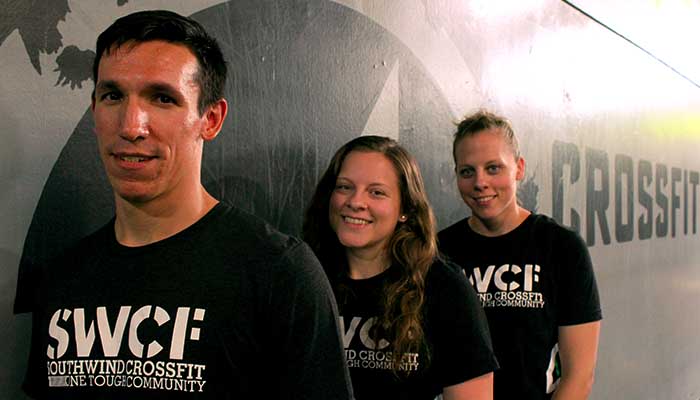
Anthony Fox, owner; his fiancé Becky Meagher, and Melissa Meagher, owner, took over the SouthWind CrossFit, 229 W. 10th St, Hays, in August.

By CRISTINA JANNEY
Hays Post

New owners have taken the helm of SouthWind CrossFit and are bringing new offerings to the fitness club.

 Melissa Meagher, 33, and Anthony Fox, 28, took over the business, 229 W. 10th, in August.

Both Fox and Melissa have a backgrounds in fitness and athletics, and Melissa and Fox were both coaches at the SouthWind before they purchased the business.

Fox has a bachelor’s degree in health and human performance and a master’s degree in movement and sports studies. He also has a certification to train college athletes. He was also formerly a trainer at the Center for Health Improvement.

Fox said he spends a lot of time watching people’s movement and trying to help them improve their technique.

“I think that keeps people safe,” he said. “I want to push people to get stronger, but I also know where to ride that line of what is going to push you to get better without you getting hurt.”

Melissa is a level 2 CrossFit coach. She was a Division I volleyball player at Central Connecticut State University and also an assistant high school volleyball coach at TMP.

Melissa said after her college sports career was over, she was dealing with a lot injuries. She joined SouthWind as what she characterized as “broken.” The gym worked with her at the level she was at and helped her rebuild her strength.

She said she is now in the best shape of her life, even better than when she was playing college sports.

“[The gym members] get to ask me questions about how did you do that. I can talk to them about how recovery is really important — how to take care of your body while you are trying to get your body back to shape,” Melissa said.

She added it helps people to be able to see others have been in their shoes and have been able to get back in shape.

In addition, her high school coaching experience, Melissa said, helps her connect with her athletes and work with large groups.

“That is really important in this gym too,” she said. “You get to know every single person in class. I can look at every single person, and I know all of their names. I know all of their injuries. I know what goals they are going for. Nobody gets neglected in this gym.”

The new owners have varied the classes offered at the gym. In addition to the 60-minute CrossFit classes, they now offer 45-minute Get Fit classes, 30-minute Quick Fit classes, an endurance course on Saturdays, open gyms, CrossFit Kids and an Athletic Development Program for high school athletes who want to work on strength and conditioning in the offseason.  

Get Fit classes are for people just learning CrossFit or people who want the CrossFit class but are not involved in competitive sports.

“They want to get the good workouts in and learn more in technique and learn more in movement,” Melissa said.

Quick Fit classes are for those who don’t have very much time. They don’t use barbells, but they use all of the other equipment.

The gym is continuing its Legends course, which is geared to people who are 50 years and older. It is 60 minutes three days a week.

CrossFit Kids is aimed at getting kids involved while their parents are working out, Fox said.

“We are very about family,” he said. “As they see their parents doing something that is healthy and good for them, we are hoping they will follow in their footsteps as well.”

CrossFit is defined as using constantly varied functional movements at high intensity, Fox said. This includes a lot of squatting and lunging, and pushing and pulling.

These movements apply to daily activities. Getting out of chair is similar to a squat. Lifting groceries is similar to a dead lift, Fox said.

Especially in the Legends class, the coaches are working on improving strength for daily life activities. Some of the gym members said they were unable to kneel at church, and their goal was to be able to do that again.

Melissa and her sister Becky’s mom joined the gym. She has had two total knee replacements. If she was sitting in a chair and holding a grand-baby, she had to have someone there with her, because she couldn’t get out of the chair with one her grand-babies in her arms. Through the CrossFit class, she was able to build enough strength so she could do that.

“You don’t have to have the goal be awesome or to be a competitor,” she said. “You can just have a goal as simple as I want to be able to get our of a chair on my own. We will work with you.”

CrossFit is more focused on functionality and not how your body looks, and everyone’s workouts are individualized, the duo said.

Gym membership costs vary depending on what type of classes you want to take. Endurance courses are $19 per month, Kids CrossFit is $29 per month, the Legends class is $49 per month, Quick Fits are $69, Get Fits are $89, CrossFit is $99 and full access is $119.


K-27 roadwork starting in Cheyenne County

The Kansas Department of Transportation expects to begin work on a mill and overlay project on a portion of K-27 in Cheyenne County the week of Oct. 7.

The project covers a 13-mile area starting at the Sherman County line and extending north to the east U.S. 36 junction. Traffic will be reduced to one lane through the construction zone and directed by flaggers and a pilot car during daylight hours. Minor delays not exceeding 15 minutes should be anticipated. Work is expected to be finished by the end of November, weather permitting.

Venture Corporation is the primary contractor for the project with a total contract cost of approximately $2.2 million.

E-bikes now allowed in Kansas state parks

E-bikes are now permitted in Kansas state parks.

KDWPT

PRATT – In a 5-1 vote, Kansas Wildlife, Parks and Tourism (KWPT) Commissioners approved the use of electric-assisted bicycles, or e-bikes, at Kansas state parks. The decision was made during the Commission’s Sept. 19 public hearing at the Kansas Wetlands Education Center in Great Bend.

E-bikes, also referred to as pedal-assist bikes, have a small motor that engages when a rider pedals. Once engaged, the motor provides a “boost” of acceleration, allowing the rider to more easily maneuver hills and rough terrain. Only e-bikes that cease to provide assistance when the bicycle reaches a maximum of 20 miles per hour may be used at Kansas state parks. E-bikes will also only be allowed on trails already approved for bicycle use.

“We have over 500 miles of trails at Kansas state parks,” said Linda Lanterman, Kansas state parks director. “E-bikes will allow more users to enjoy these trails, including individuals who have previously been unable to because of age, disability, or physical capacity. We’re really excited about the opportunities this will open up.”

State park staff plan to increase public education efforts promoting safe trail use and trail etiquette, as well as increase signage on trails where bicycles are allowed. For a complete list of trails at Kansas state parks, including biking trails, visit ksoutdoors.com/trails.

The next KWPT Commission meeting will be Nov. 14 at the William Carpenter 4-H Building in Scott City.

For more on the Commission, visit ksoutdoors.com/KDWPT-Info/Commission.

Census Complete Count Committee forms in Ellis County

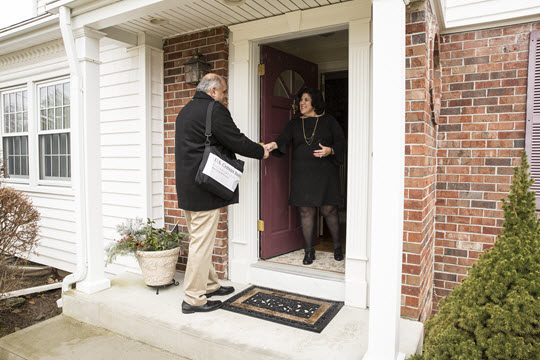
Photo courtesy of the U.S. Census Bureau

By CRISTINA JANNEY
Hays Post

Ellis County has organized a group of 17 community members who want to make sure everyone in the county is counted in the 2020 census.

The response rate for the state of Kansas in 2010 was 73 percent. Ellis County was about 82 percent. The census would like to see a count rate above 90 percent.

Complete Count Committees are nonpartisan groups set up by states to make sure everyone in their state is counted on April 1, 2020. Hays Mayor Henry Schwaller is on both the state Complete Count Committee and the Ellis County Complete Count Committee.

Some of the people on the Ellis County Complete Count Committee, include HaysMed’s Edward Herrman, Hays City Manager Toby Dougherty, Ellis County Administrator Phillip Smith-Hanes, USD 489 Superintendent Ron Wilson, and Ellis County Commissioner Dustin Roths.

Other organizations represented include Grow Hays, United Way of Ellis County, First Call for Help, City of Ellis, City of Victoria, Ellis County Ministerial Alliance, Hays Public Library and the Hays Area Chamber of Commerce.

“We wanted to create a body to cover every single pocket of people in Ellis County,” Schwaller said, “particularly those who have been hard to count.”

Schwaller said the census is an economic and social issue.

Although the census is used to establish representation in both Topeka and Congress, census numbers are also used to determine funding for a slew of federal program.

Schwaller gave the example of the Northwest Business Corridor project. The city and county are currently seeking federal grant funds for road improvements on 230th Avenue north of Interstate 70. If the county’s population is not counted correctly, that funding could be in jeopardy.

Funding for transportation, hospitals and education facilities are also determined by census numbers.

“(For) every individual in Ellis County who is not counted, we will lose over $2,000 per non-counted person per year for the next 10 years,” Schwaller said. “That could really hamper our efforts to, again, build roads, assist Fort Hays in getting proper financial aid for students and help the medical center.

“The federal funding is key to keeping the community alive.”

Accurate population counts are also important in recruiting new businesses.

“As we talk about recruiting new businesses, either retail or tech firms, they look at whether a community is growing or not and whether we have the population to support them,” Schwaller said.

The census has determined certain populations are hard to count. These can include older residents, who might not have access to technology, college students and children ages birth to 5.

Students who are living in Hays as of April 1 need to count themselves in the census as Hays resident, Schwaller said. FHSU will have its own Complete Count Subcommittee to target the student population.

The committee can look at data on the census site, not only who was counted in 2010, but what areas may be being underreported in 2020.

“In the past, the census counts in Ellis County have been questioned,” Schwaller said. “In the 2000 census, we were a little short after having some growth in the ’90s. That really hurt the community — the City of Hays and Ellis County — because it meant we couldn’t unlock some federal programs to help us with our airport, maintain major streets in the city and get funding for programs. We just didn’t qualify.

“Their participation not only benefits the community as a whole, but it benefits them because they are counted and they are shown as living here. They’ll have better roads, better access to better services.”

Between now and the end of 2019, the committee will develop a plan to get the word out about the census. In late January, the committee will begin to promote that message, including notification that local residents will receive information on how to log on to the census website and complete their census surveys. This is the first year you will be able to complete the census online.

Schwaller said the committee hopes to have personnel at the Hays Public Library and Forsyth Library who can help residents log on to the site census website.

He emphasized the census website is encrypted and  secure, and none of your personal information will be released to businesses or other government agencies. When the census data is released, it is released as aggregate data, which omits details such as your name.

Other states provide funding to promote the census — Kansas does not. The Kansas Health Initiative is providing funding to the Kansas League of Cities to promote the census. Ellis County’s committee plans to apply for a grant through that program, Schwaller said.

RELATED STORY: Census: Inequality grew, including in heartland states

RELATED STORY:Census to go online for 2020 count

RELATED STORY: With Millions In Federal Aid At Stake, Kansas Urges Latinos Not To Skip 2020 Census

🎥 Ellis Co. residents invited to Strategic Doing Re-Start

By BECKY KISER
Hays Post

The Ellis County Strategic Doing Re-Start drew approximately 100 people to Hays on Sept. 9.

At a followup meeting on Oct. 8, “we’ll begin uncovering needs, wants, visions, dreams and plans of the great group of folks who attended,” said Sandy Jacobs, executive director of the Heartland Community Foundation.

Jacobs encouraged any interested Ellis County resident to attend next week’s meeting.

“We need you to participate whether you attended the first meeting or not. Your input is extremely important to the process of defining Ellis County now and in the future,” she said.

The overriding theme last month was the senior community, according to Jacobs.

A number of attendees organized themselves into a specific group to address issues for seniors. They talked about retirees moving into Hays from rural areas, intergenerational childcare, neighborhood community centers, and memory care units available outside of medical care facilities.

Others talked about the need for a larger domestic and sexual violence center, regional transportation, especially for seniors and youth, and recreational activities for middle and high school age students.

An entire wall was papered with sticky notes on which project suggestions were written by the participants.

Facilitator Betty Johnson has compiled the information into themes and will return with them Tuesday. Johnson’s position is funded by the Dane G. Hansen Foundation in Logan.

“We will share the six to eight themes and people can pick one they want to be a part of. That’s when the groups will actually form again,” explained Jacobs.

A project doesn’t have to be grandiose.

She points to last year’s “The Neighbor Project” as an example, which came from the theme of becoming a more inclusive community.

“I think the group was first looking at a grand outcome. Then they understood it’s a step at a time.

“Rather than creating new events to bring people together, they would take themselves into an existing event and bring conversation cards and a table for people to sit around and talk. Bringing people together who had never met each other or reaching out and inviting different ethnicities to be a part of what they’re doing.”

Jacobs says she gets goose bumps thinking about what “The Neighbor Project” is doing.

“Just one step at a time, they’re quietly taking care of business and I’m really proud of them.”

After meeting recently with Johnson, the group is working on a new project called “Donuts on the Drive.” They’ll provide the donuts and coffee, set up in a neighborhood yard, and invite all the nearby residents to join together.

“I think it’s a wonderful idea. It’s all about gathering people.”

Strategic Doing Re-Start begins at 6 p.m. Tuesday at the Rose Garden Banquet Hall, 2350 E. 8th St. A meal will be served. RSVP to [email protected] or call 785-621-4090.

“If you have or know of a project that has stalled, is needing to uncover resources or just wants more participants , come join us,” urges Jacobs. “Let us help find what you need.”


Now That’s Rural: Phil and Sharron Knox, AgSun in Thomas Co.

Ron Wilson is director of the Huck Boyd National Institute for Rural Development at Kansas State University.

By RON WILSON
Huck Boyd National Institute for Rural Development

Would you like corn flakes for breakfast? Cows would like corn flakes for breakfast, too. Today we’ll learn about an innovative Kansas farm family that is utilizing a steam flaking technology to improve feed quality for their livestock operation and others around Kansas.

Phil and Sharron Knox farm in northwest Kansas. Phil is a native of the Brewster area. He went to Kansas State and majored in agricultural economics. While attending a Farm Bureau scholarship dinner, he met Sharron who was studying dietetics. The two married and began a long life together.

Phil went on to earn a master’s and Ph.D. in agricultural economics from the University of California at Berkeley, where Sharron earned her master’s in public health nutrition. She worked as a consulting nutritionist and Phil took a position as assistant professor at Colorado State before moving back to his family farm near Brewster.

Today, the family farming operation consists of no-till corn and wheat on 9,000 acres of which 1,800 acres are irrigated. They also have a 200 head cow and calf operation on 2,100 acres of pasture land. The cattle are finished, along with purchased calves, in a 2,500-head feed lot. The fed cattle are marketed through the Knox’s membership in U.S. Premium Beef.

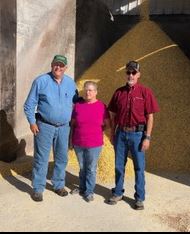
Phil and Sharron Knox and Don Allen, AgSun manager

“You have to do things a little better, you have to change,” Phil said.

“He does research, he has ideas,” Sharron said. “I’m a detail person.”

One of Phil’s ideas was to improve the feed efficiency of his cattle feeding operation. “I talked to a friend who was working in feed technology,” Phil said. That led to the creation of a steam flaking enterprise in 2004.

Feed corn is converted into flakes by processing in a steam chamber. This breaks down the cell walls and gelatinizes the starch. The result has proven to be a highly desirable cattle feed. In fact, the feed worked so well that the Knoxes not only feed the flakes to their own cattle, they market the flakes to other feedlots and dairies in western Kansas.

The flaking business is known as AgSun LLC. The company’s flakes have been shown to be a better source of energy than rolled or ground corn because cattle digest and utilize the flakes better. For feeder cattle, the flakes allow up to a 15 percent improvement in energy values.

For dairy cattle, starch availability is also improved, giving cows a better source of energy. This produces more energy for more milk production.

AgSun LLC has the capacity to process 2.5 million bushels of corn a year, with one third of that coming from the Knox’s own production. Their son Daniel, an industrial engineering graduate of K-State, helped design the automated controls and programming for the equipment. It is a state-of-the-art, computer-operated facility. The production from the plant could feed up to 40,000 to 50,000 head per day.

“The staff at AgSun is hard-working, friendly and always willing to help us,” said one customer. “The flakes are the best quality for our cattle.”

Another customer commented: “The quality of the product is second to none and is always very consistent. AgSun produces what they advertise and they do things the right way the first time. Our production is always good with AgSun’s cornflakes in our ration. We appreciate their service.”

Sharron is a board member of the Northwest Kansas Farm Management Association. Phil has served on the Northwest Kansas Groundwater Management Board. They are members of Kansas Farm Bureau and Kansas Corn Growers.

“We felt called to do more,” Phil said. He also serves as the volunteer pastor at the local Lutheran church.

“We enjoy living here, it’s like a big family,” Sharron said. Brewster is a rural community with a population of 305 people. Now, that’s rural.

For more information about the steam flaking business, see www.agsunllc.com.

Would you like corn flakes for breakfast? So would your cattle. We commend Phil and Sharron Knox for making a difference with agricultural entrepreneurship. Corn flakes can help make a better breakfast, better beef, and better business.

FHSU freshman from Ellis wins 2019 Omoksee Queen Contest

O-Mok-See – the name means “riding big dance,” which originated with the Blackfoot Indian Tribe. It was a war ceremony that was meant to get courage for battle. The warriors would wear costumes and decorate their horses, ride a distance away from camp, then ride together at a great speed back to the camp circle where the rest of the tribe sang songs and beat drums. The horsemen would ride their horses to the rhythm of the singers and drummers. At various times during the “big dance,” the warriors would dismount and dance on foot. If anyone fell off their horse during the ritual, it was a sign of bad luck.

The Kansas Omoksee, this being the fourth year, was held Sept. 7 and 8 in Lyons. Riders from all over participated in events such as Keg Bending, Top N’ Turn, and Western Relay, among others. The two-day show was a competition among the participants to earn points that would be totaled at the end of the competition. There were various age groups with the highest scorer of each age group winning a saddle. Awards were given to the top 10 riders of each age group.

Also, during the Kansas Omoksee, the first ever Kansas Omoksee Royalty Contest was held. Contestants had the responsibilities of keeping their horses clean, fed, watered, as well as keeping their stall clean. A dress code where long sleeved, collared shirts, western boots and belt, jeans, and a western hat were to be worn at all times during the competition. The contestants were also responsible for a fundraiser of their choice, donating an item to a live auction, helping in the arena, and making everyone feel welcome and at home at the Kansas Omoksee. The contestants were being judged all day Saturday by two secret judges, as well as an interview judge and a horsemanship judge.

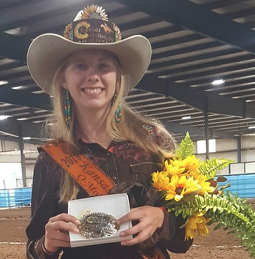
Cameryn Kinderknecht, Ellis, was the winner of the Kansas Omoksee Queen. This was her first royalty competition and she welcomed others as well as offered arena workers, judges, and audience members bottled water and a good conversation over the joys of horses and friendly competition. Her responsibilities during this next year include appearances in a variety of events, fundraising for Kansas Omoksee, and raising awareness for the sport of Omoksee. This was Kinderknecht’s second year at the Kansas Omoksee. She and her horse, Kita, placed 5th out of over 20 women in the competition portion over the weekend.

Kinderknecht is a freshman at Fort Hays State University.

— Submitted

KWEC to host Fort Hays State astronomy club

Dr. Jack Maseberg

FHSU University Relations

Join the Fort Hays State University Astronomy Club at the Kansas Wetlands Education Center from 8 p.m. to 10 p.m. on Friday, Oct. 18, for an evening of night sky observations and astronomical activities.

Led by Dr. Jack Maseberg, associate professor of physics, and Dr. Paul Adams, dean of the College of Education, the Astronomy Club will bring their telescopes to KWEC and educate participants about different cosmic objects.

That night, Saturn, Jupiter, and Messier Galaxy Objects will be in view. Messier Objects include nebulae, globular and open clusters, and galaxies discovered by Charles Messier in the 1770’s as he was searching for comets.

KWEC will also provide refreshments, a galaxy craft and other activities inside the center.

KWEC is located at 592 NE HWY K156 in Great Bend. For more information call 877-243-9268.

Oberlin native joins ABBB in Hays

The certified public accounting firm of Adams, Brown, Beran & Ball, Chartered recently announced the addition of Baron Green to their professional team.

Green joins ABBB as a staff accountant and will work in the firm’s Hays office. He completed an ABBB internship in 2018 and subsequently served as a student worker for the firm.

“We are pleased that Baron decided to establish his career with ABBB,” said Brian Staats, CPA, CGMA, managing partner of ABBB. “We got to know him well during his time as an intern and student worker, and we look forward to witnessing his continued growth as an accounting professional.”

A recent graduate of Fort Hays State University, Green holds a Bachelor of Business Administration in Accounting. Raised on a farm in Oberlin, Kansas, he now lives in Hays.

Adams, Brown, Beran & Ball, Chartered provides a wide range of traditional and non-traditional CPA and consulting services to clients throughout Kansas, including agriculture organizations, construction companies, feed yards, financial institutions, governmental and not-for-profit organizations, manufacturers, medical practices, oil and gas companies, professional service firms, real estate companies and small businesses. Founded in 1945, today the firm maintains 13 office locations throughout the state. For more information about Adams, Brown, Beran & Ball, please visit www.abbb.com.

— Submitted

UPDATE: Homicide investigation in Rooks County closed

ROOKS COUNTY – The Kansas Bureau of Investigation, along with the Rooks County Attorney, and the Rooks County Sheriff’s Office, shared that the investigation into the murder of Mark Reif has now been closed.

Following an extensive and thorough investigation, it was determined Jon Flowers, 47, Inman, was responsible for the murder of 56-year-old Mark Reif. No evidence exists indicating any other person was involved in the crime.

Forensic testing has now been completed in this case and it revealed that a fired cartridge case located at the murder scene was fired from a pistol belonging to Flowers that KBI agents collected during the investigation. The bullet removed at autopsy from Reif was also determined to have been fired from the same firearm.

Additionally, when Flowers was discovered dead in his home, a suicide note was nearby that claimed responsibility for killing Reif.

The preliminary autopsy of Flowers concluded that his death was the result of suicide. The investigation is officially being closed.

— KBI

Copyright Eagle Radio | FCC Public Files | EEO Public File