Today
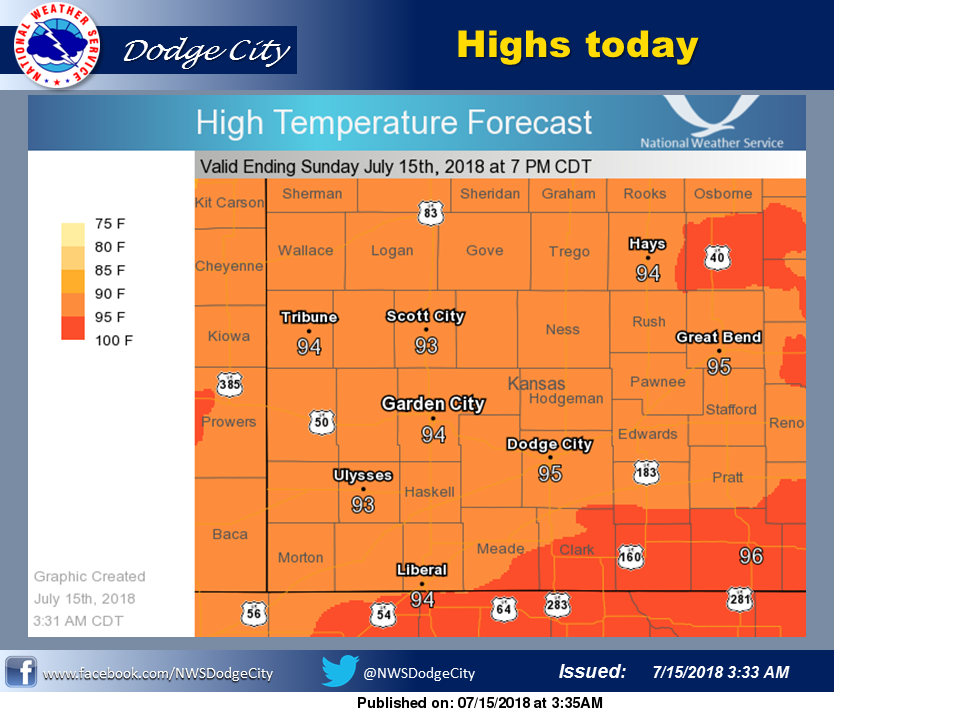
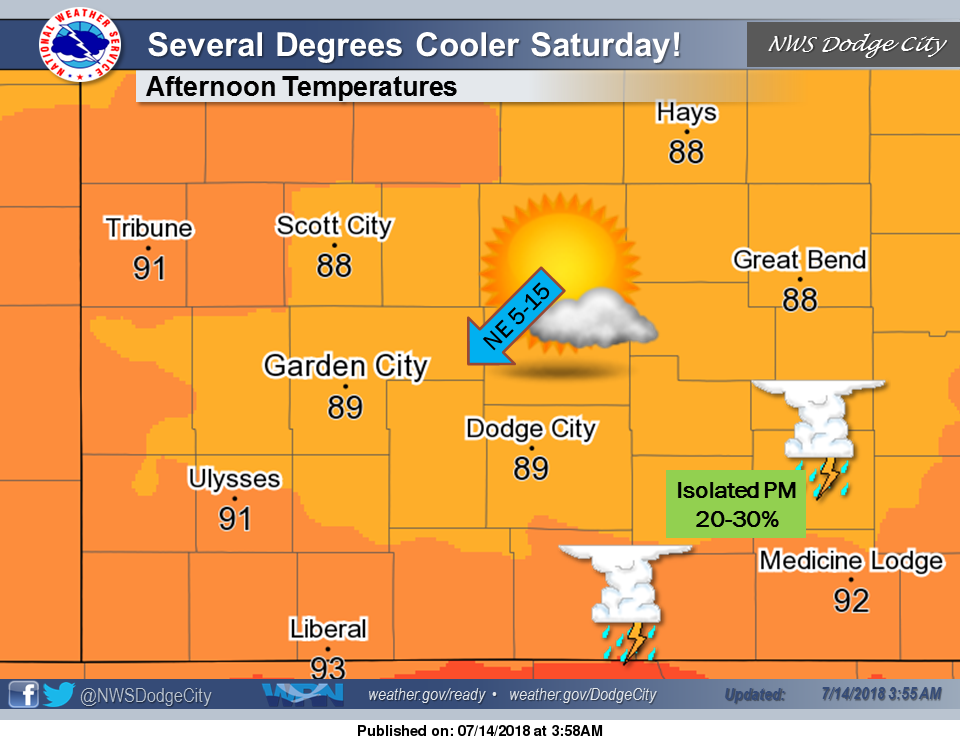
A 20 percent chance of showers and thunderstorms after 4pm. Patchy fog before 9am. Otherwise, mostly sunny, with a high near 93. Light southeast wind becoming east 5 to 9 mph in the morning.
Tonight
A 40 percent chance of showers and thunderstorms, mainly before 1am. Mostly cloudy, with a low around 69. Northeast wind 7 to 9 mph.
Monday
A 30 percent chance of showers and thunderstorms, mainly after 1pm. Partly sunny, with a high near 87. East wind 6 to 8 mph.
Monday Night
A 50 percent chance of showers and thunderstorms. Mostly cloudy, with a low around 68. East wind 5 to 9 mph.
Tuesday
A 50 percent chance of showers and thunderstorms. Mostly cloudy, with a high near 87. Southeast wind 6 to 11 mph.
Tuesday Night
A 40 percent chance of showers and thunderstorms. Mostly cloudy, with a low around 69.
Wednesday
A 20 percent chance of showers and thunderstorms before 1pm. Mostly sunny, with a high near 92.
Wednesday Night
Mostly clear, with a low around 68.
For hundreds of years, the human race has used organic farming practicing, fertilizing with manures and manually pulling or hoeing weeds from gardens. Within the last 100 years, farmers and home gardeners have turned to chemicals to control weeds and pests to what a local herbalist argues is the detriment of wildlife, pollinators, plants and people.
Pam Herl, a local herbalist, recently presented a program to the Hays Public Library Herb Study group on organic gardening.
“They had very strong work ethics,” Herl said of historic home gardeners. “They worked in their gardens. Whereas today, we tend to reach for the bottle of Roundup or 2,4-D instead of bending over and pulling the weed. We spray and then we go to Curves or the health center and exercise. You get a lot of exercise [in your garden].”
You can burn about 300 calories for one hour of gardening, depending on the type of work and your body type. It is the equivalent of one hour of intensive work in a gym.
Hoeing can help cut down on grasshoppers, Herl said. The insects lay their eggs in the top layer of the soil. If you turn over the soil with a hoe, it exposes the eggs to sunlight and heat and kills them.
Dangers of chemicals
“It has polluted our food source, it’s polluted our air, it’s polluted our water source, and yet we are still reaching for that bottle of chemicals for spraying insects, for fertilizing, for spraying weeds,” Herl said. “We are constantly reaching for that bottle.”
Use of pesticides has increased by 50 percent over the last 30 years, Herl said. 2.5 million tons of commercial pesticides are used annually in the U.S., according to a study published by the American Institute of Biological Sciences.
“That is a lot of money we are pouring into an industry that is killing us spray by spray,” Herl said.
The chemicals can leach into ground water or run off into watersheds such as streams, rivers and lakes, all sources of drinking water and places were people swim and enjoy water sports.
“Every time you see someone spraying that bottle of 2,4-D,” Herl said, “I can guarantee it is going to go down in the water and the ground and the water source and it is going to end somewhere it is not supposed to be.”
Pesticides and herbicides can kill beneficial insects along with ones that would destroy crops. Less than 1 percent of the world’s insects are considered pests to farmers. The rest play a vital role in our food chain, Herl said.
Herl expressed concerns about how the use of pesticides is affecting pollinators. Despite her use of organic gardening practices in her herb garden in WaKeeney, she has seen a marked reduction in the number of bees and butterflies.
Herl said chemical fertilizers can disrupt beneficial bacteria and fungi in the soil. They also may not replenish trace elements plants need. Chemicals can also negatively affect the pH in the soil.
Herl called out some specific chemicals of concern to her.
Glyphosate, a chemical found in many herbicides, is affecting butterflies, Herl said.
Neonic, a chemical used to treat corn seeds, has been linked to bee kills and been found in honey. 80 percent of the 92 million acres of corn in the U.S. were treated with the chemical as of 2011.
Herl said there are a few exceptions of invasive plant species that are very difficult to kill unless you use chemicals or a weed torch. These include bindweed and puncture weed. Weed torches are not recommended when conditions are very dry as they could ignite wildfires.
Weeds that are not weeds
The group talked about the classification of plants as weeds. Some plants that are categorized as weeds, such as dandelions have benefits, produce nectar for pollinators and are used by some for medicinal purposes.
“It depends on the person and the location of your garden,” Herl said. “If you have a pristine formal garden, any of these are going to be a weed. They don’t want them in their garden. Now if you have a cottage garden like mine, they would be welcome. I had a lady who was there for the garden tour and she said, ‘Oh, you have a dandelion in your garden.’ I said, ‘I have a lot of dandelions in my garden because this is a herb garden. It is not a flower garden, so there is a lot of dandelions in my garden. There sure is.”
Herl also has wild lettuce in her garden. Other gardeners chimed in and said they had yarrow, lamb’s quarters, hog weed and dock in their gardens, all of which are categorized by some as weeds.
“These are all that people spray,” Herl said. “They spray these. These are all used medicinally, and they spray them. We are a chemically enhanced generation. We are all about chemicals. We want the fast fix whether it is an antibiotic, an insecticide or fertilizer. It is all about the fast fix. We are worried about today and not tomorrow and we are killing ourselves, slowly but surely. We won’t be around to see it, but our kids or grandkids probably will.”
Even if you want to take your garden or your farm organic, it is difficult to get away from all the chemical use around you, Herl said. Land has to lay fallow for seven years to certify crops on it organically grown, Herl said, and then the land is periodically checked to make sure there are no chemicals in the water or land.
“You would have to grow that whatever crop you want certified organically on an island in the middle of the ocean because you can’t control what goes in your groundwater,” she said. “You can’t control what a neighbor three miles from you has a crop duster spray and the wind blows your direction. You can’t control what the county worker is doing when he is driving a truck down the road spraying the ditch with Roundup. How can you grow anything certified organically grown?”
Natural pest repellents
Herl gave some examples of plants and natural substances that can be used to repel animals and unwanted insects:
Recipe for animal repellant
2 T of powdered red pepper
1 gallon of water
6 drops of soap
• Rabbits can be repelled with powdered aloe vera.
• Aphids, white flies and beetles can be repelled with garlic spray. Use a bulb of garlic in four teaspoons of mineral soap and let it set overnight. Strain the garlic, add two pints of water and one teaspoon of Dawn. Use as a spray.
• Botanical sprays can be purchased over the counter. Rotenone, which is derived from the derris root, kills aphids and grasshoppers. Sabadilla powder, liquid or seeds are used against grasshoppers, corn borers, codling moths, squash bugs, aphids, web worm and cabbage loopers.
• Toads and frogs can be beneficial to garden as insect-eating machines. One toad can eat up to 10,000 insects in three months. They eat crickets, grubs, rose beetles, caterpillars, squash bugs, potato beetles, flies and slugs. They just need shelter, water and light. A solar light in the ground near water will attract insects for the toads. However, toads and frogs are very sensitive to chemicals in the environment.
• Some flowers also have insecticidal qualities, including aster, mums, cosmos, coreopsis, nasturtiums, and French and Mexican marigolds. You can dry the flowers and turn them into powders. You can also use the green flowers, soak them in alcohol, strain, add Dawn, add a little oil and use as a spray. Planting marigolds in your garden can help repel nematodes, which attack vegetables’ root systems.
• Cornmeal spread at the base of roses can prevent black spot.
Natural fertilizer
Herl also discussed the use of natural fertilizer, including animal manure. Cow manure contains high amounts of nitrogen, phosphates and potassium, as well as calcium, magnesium and sulphur. Herl also uses fish fertilizer.
“You have to remember, this is free,” she said. “You can go out in the country and you can get a lot of cow manure yourself. Just let it dry. You get free exercise, and you get to go out into the country for a good drive.”
Earthworm castings are excellent for gardens as well.
Attract worms to your garden by taking newspaper, laying it flat on the ground, wetting it and spreading mulch over the top. It will prevent weeds from growing, it breaks down naturally and earthworms will love it, Herl said.
OSBORNE—Girl Scouts of Kansas Heartland honors new Girl Scout Gold Award recipient, Ashton Baxa of Osborne for creating a new literacy program in her community.
Earning the Gold Award is one of the most challenging, exciting and rewarding experiences a Girl Scout can have and one of the most prestigious recognitions she’ll accomplish. The Girl Scout Gold Award stands as the highest achievement a Girl Scout can earn, comparable to the Eagle Scout rank in Boy Scouts.
The award recognizes girls in grades 9 through 12 who demonstrate extraordinary leadership through Take Action projects that have a sustainable impact in their communities and beyond. Girl Scout Gold Award recipients who join the armed forces enter one rank higher than other recruits, and they qualify for exclusive scholarships.
“Earning the Girl Scout Gold Award is truly a remarkable achievement, and the young women who earn this award exemplify leadership in all of its forms,” said Liz Workman, chief executive officer of Girl Scouts of Kansas Heartland. “They saw a need in their communities and around the world, and took action. Their extraordinary dedication, perseverance and leadership is making the world a better place.”
Baxa focused her efforts on the reading ability of youth in her community with “Buddies and Books.” The project created a mentorship program with volunteers in her local community spending time with youth, listening to them read and helping them along the way.
The goal was to establish an initiative to improve reading abilities, a life skill that will stay with them forever. “Buddies and Books” was developed with the intention of volunteers sustaining the program long after Baxa leaves for college through Facebook pages and a partnership with the Osborne Public Library.
On earning her Gold Award, Baxa said her leadership skills “became even stronger as I handled the children and learned how much they actually do look up to you. From this program, I learned that I love working with kids and I am going to school to study pharmacy, but I learned that I would like to take that career and work in a children’s hospital.”
Neal Allen is an Associate Professor of Political Science at Wichita State University.
Life tenure for Supreme Court Justices, combined with increasing partisan polarization, is a toxic combination that is poisoning our democracy.
It is time to find a better way that preserves judicial independence while reducing the level of conflict over nominations. A move to a non-renewable 18-year term is a one way to reduce the stakes of confirmation battles, while preserving judicial independence.
Soon after Associate Justice Anthony Kennedy announced his resignation, President Donald Trump said “We have to pick a great one, we have to pick one that’s going to be there for 40 years, 45 years.”
While this statement will likely be a talking point for Democrats who oppose Judge Brett Kavanaugh, Trump’s 53-year-old nominee for Kennedy’s seat, it also accurately describes the way Supreme Court nominees are currently chosen.
Supreme Court nominations have become a way to preserve a party’s policy positions even after those policies cannot command a majority of voters in national elections. This practice is good for the party that has the Presidency when a vacancy occurs, and wonderful for relatively young lower-court judges who have a record that predicts ideological purity on the Court.
But it is bad for our democracy in general. It creates incentives for Senate leaders to use all means available to block nominees from the President of the other party, and to then push through the most conservative (or liberal) nominee possible. The norms of democracy and civility have not withstood such pressure, as shown by the unwillingness of Senate Republicans to grant President Obama’s nomination of Merrick Garland a vote.
One way to lower the temperature in Washington would be to lower the stakes of Supreme Court nominations. Judicial independence does not require a Justice serve as long as they live (or decide to retire after decades of service), but only that they are not susceptible to removal by a President or Congress.
Eighteen years is not the only number that would work, but it would have the advantage of ensuring that every President would get at least one appointment during their term. Thus we would avoid situations like in Democrat Jimmy Carter’s only term or Republican President George W. Bush’s first term, where a democratically-elected President had no appointments. A long, but defined term would also increase the likelihood that qualified potential appointees in their 60s would be considered.
The extreme partisanship of our current nomination politics makes such a proposal highly unlikely to even get a vote in either house of Congress, let alone enough support to begin the necessary process of constitutional amendment. But de-escalation must start somewhere, and ideally with the actions of a President or Senator.
Kansas Senators Pat Roberts and Jerry Moran, while loyal Republican partisans throughout their careers in elected office, are ideal candidates to start a conversation on reform of the Supreme Court nomination process. Neither one is in electoral danger, with Moran overwhelmingly reelected in 2016 and Roberts serving what is likely his last term. They could both withstand the pressure that would surely come from questioning the wisdom of the current nomination process when their party is on the verge of locking in their desired policy positions for a generation or more.
If either Kansas Senator would use their leverage in the current 50 Republican/49 Democrat Senate, they could at least secure a pledge from Majority Leader McConnell to schedule debate after the November elections on nomination reform. It is in their long-term interest, and the interest of Kansans in general, to reduce the level of partisanship on judicial nominations.
The Democratic Senators that are excluded from the nomination process will be less likely to collaborate with Senator Roberts on agriculture issues. When Senator Moran continues his fight to preserve rural Post Offices, he will need the help of Democratic Senators who also represent states with large rural populations.
Scorched-earth politics on nominations will not be contained to just Supreme Court nominations, but will continue the degradation of the personal relationships that are crucial to good-faith negotiation across party lines.
Senators Roberts and Moran would be wise to consider how to preserve the Senate as a broadly-representative governing institution, instead of continuing the destruction of bipartisan norms.
Neal Allen is an Associate Professor of Political Science at Wichita State University.
WICHITA — Wichita State University has announced the names of more than 2,750 students who were on the WSU dean’s honor roll for spring 2018.
To be included on the dean’s honor roll, a student must be enrolled full time (at least 12 credit hours) and earn at least a 3.5 grade point average on a 4.0 scale.
The following northwest Kansas students were included:
The Fort Hays State University Alumni Association will host a golf tournament Friday, Aug. 3, at Meadow Lake Golf Club, 1085 East Golf Club Dr in Colby. Golf enthusiasts are invited for a relaxing day on the greens while raising funds in support of Fort Hays State University student scholarships.
The tournament begins with registration at 8 a.m. followed by tee time at 9 a.m. Registration fees are $90 per golfer or $300 for a team of four.
Special guest FHSU Athletic Director Curtis Hammeke will offer an update on Tiger athletics and the university after the tournament. Non-golfers are invited to stop by the golf course at approximately 1:30 p.m. to hear the latest in FHSU news.
For more information and to register for this event, visit www.goforthaysstate.com/events, email [email protected] or call 785-628-4430 or toll free 1-888-351-3591.
Golf enthusiasts are invited for a relaxing day on the greens while raising funds in support of Fort Hays State University student scholarships.
The FHSU Alumni Association is hosting golf tournaments Friday, July 27, at Buffalo Dunes Golf Course, 5685 US-83 in Garden City and Saturday, July 28, at the Liberal Country Club, 1900 North Kansas Ave. in Liberal.
Both tournaments begin with registration at 8 a.m., followed by a 9 a.m. tee time. Registration fees are $90 per golfer or $300 for a team of four.
Head football Coach Chris Brown, coming off an 11-0 regular season and the 2017 MIAA Championship – a first in FHSU history – will be the special guest at the Garden City and Liberal tournaments. He will be joined by FHSU Sports Information Director Ryan Prickett after tournament play in Garden City to discuss the upcoming season of Tiger Athletics as well as an update on the university.
Non-golfers are welcome to stop by either golf course at approximately 1:30 p.m. to hear the latest in FHSU news.
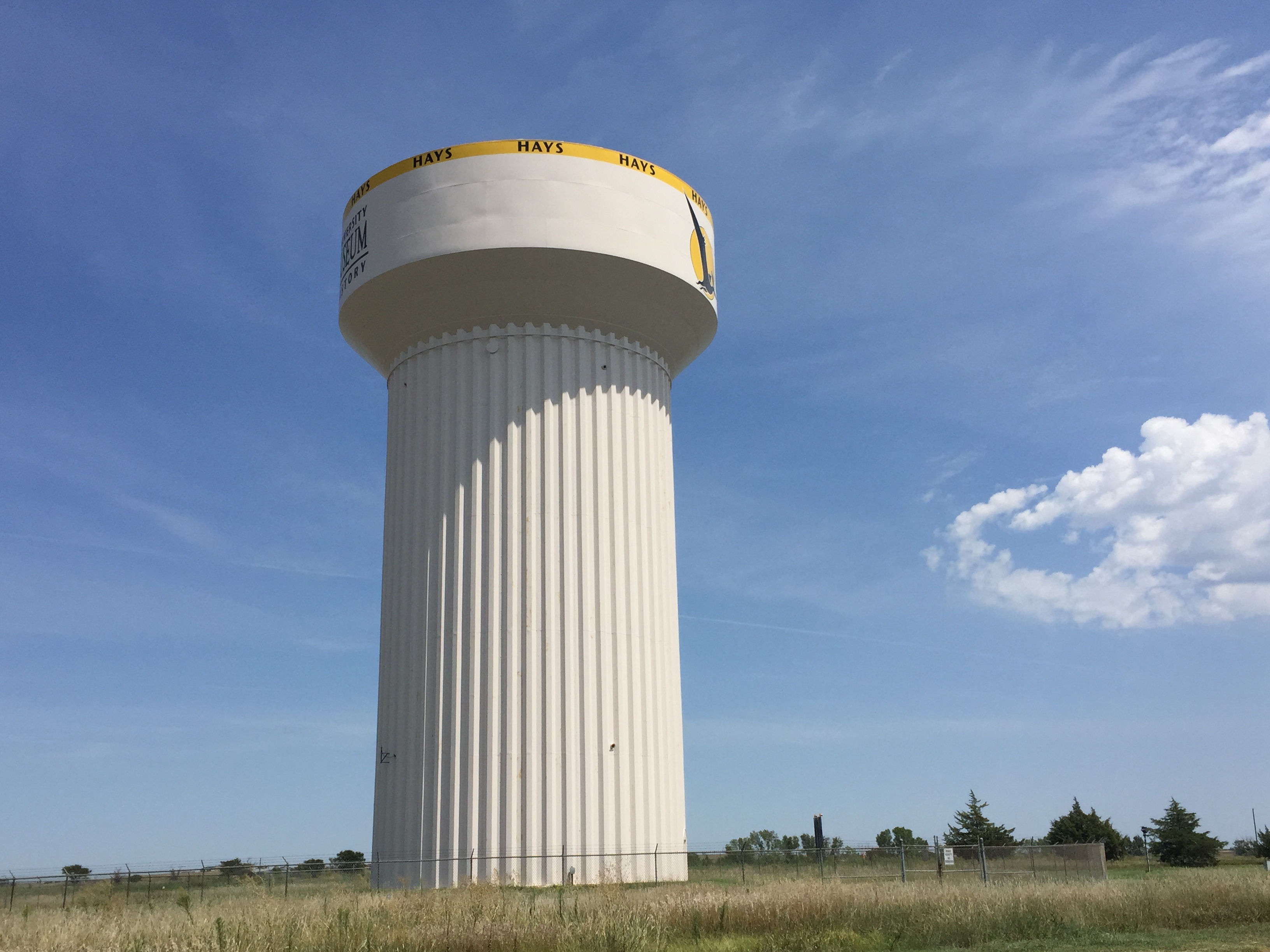
Beginning Sunday, July 15, 2018, the remediation and painting of Hays’ 1 million gallon water tower next to Sternberg Museum, 3000 Sternberg Dr., will begin.
This project should take approximately 6 weeks to complete, weather pending. Crews may be working outside business hours and during the night if wind conditions are not favorable for this type of project to be working on during business hours.
Customers may notice changes in their water pressure system during the scope of the project.
The city of Hays regrets any inconvenience this may cause to the public. If you have any questions please do not hesitate to call the Department of Water Resources at 785-628-7380.
The ARC of the Central Plains announced its goal of creating an accessible recreation complex in Hays during a Hays Area Chamber of Commerce event Friday.
The complex would include a playground, splash pad and baseball diamond.
The proposed $1.6 million project would be paid for through a fundraising campaign that will ramp up this fall, and the organizers hope to break ground on the first phase of the project by mid-2019. The first phase would be the playground, then the ball diamond and then the splash pad. Start and completion of the project is contingent on fundraising.
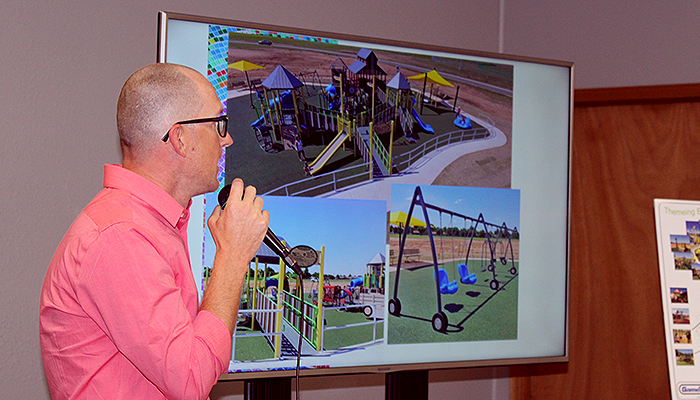
Brent Kaiser, ARC activities director, goes over features of a proposed accessible recreation complex in Hays during a Hays Area Chamber of Commerce Chamber Chat Friday morning.
The ARC is working with the city parks department on the project and will likely present to the city commission in the coming weeks. They are suggesting two locations for the park—one at Aubel Bickle Park and the other at Seven Hills-Optimist Park, which is in northwest Hays. Seven Hills is the ARC’s preferred location. It already has a shelter house and bathrooms. However, they do not know if parking would need to be added. The current park only has on-street parking.
No tax dollars will go toward this project. The ARC has set up a separate fund for its fundraising efforts for the project under its non-profit status. The group developing the park hopes to eventually gift the park to the city of Hays when it is completed.
The cost quoted for the park includes a turnkey facility. This includes landscaping, cost of equipment and labor.
Sarah Meitner of the Northwest Kansas Down Syndrome Society and mother of 4-year-old Abe who has Down syndrome, has been a champion of the project.
When Abe was a toddler, his physical abilities mirrored those of his peers. However, now Abe, who has hypotonia, has difficulty moving his muscles. His brain sends signals to his muscles about how and when to move, but sometimes those signals are delayed or he retains stiffness. He does not have the core strength to climb and swing like his peers.
Abe Meitner, 4, and his sister, Julia, 13, of Hays in a face-to-face Expression swing at an accessible park in Wichita. (Courtesy photo)
“What we would like to create is something that he could explore independently and feel that sense of empowerment while doing so and play collaboratively with his siblings or with other kids who are there,” Meitner said. “They won’t necessarily notice that he is a little bit slower and he is jumping a little bit lower.”
Abe is not alone. There are about 1,400 people with disabilities in the community who could also use this park.
“The impact of play is not just for fun,” Meitner said. “The impact for [Abe] when he plays, it is gross motor skill development, it’s cognition development, it’s fine motor [development] and therapy uses. There are really a host of benefits that can make this even more important.”
The recreation complex would be the only one of its kind in western Kansas and on the Interstate 70 corridor between Kansas City and Denver. Brent Kaiser, ARC director of activities, said he envisioned the park being a destination spot for people from all over the area who come to Hays to shop, do business and for recreation.
All the parks in Hays have wood or rubber chips, which are considered ADA compliant, but Meitner noted they can be difficult for people who use wheelchairs or walkers or who have limited mobility to maneuver in. The playground will have a rubber pad. The ball diamond will have turf with bases level with the ground to prevent tripping hazards for people with limited mobility.
Last year, the ARC started a co-ed softball team, but Kaiser said some ARC participants can’t play because of the uneven fields. The choice was made to use turf so all players in the community could use the space for games and practices.
“I would like to reach as many people as possible in this community, and an inclusive baseball field would be a big part of that,” Kaiser said.
The recreation complex would not only have accessible surfaces, it would have ramps, shaded areas, sensory elements and a shaded quieter area for children who have autism and may be easily over stimulated by sound and bright lights.
Example of an accessible splash pad in another community.
“We want to reiterate this complex is not just for children and adults with disabilities,” Meitner said. “This is for children and adults with all abilities, so they can play together. We don’t want anyone to feel excluded. We don’t want whoever in their house to say, ‘We don’t need a park for those people with disabilities.’ That is not it. This is bringing something new and exciting to our community for the whole community.”
The group is looking at using an ag and oil theme in the park to promote Hays. Kaiser talked about some of the features the group is seeking to install in the park. Some possibilities include slides with rollers and overhead hand holds to allow someone to slide without friction, a disabled accessible merry-go-round, monkey bars that are height accessible for people in wheelchairs and various types of swings for people with physical limitations.
Kaiser showed three types of swings: a harness swing, a disc swing in which someone can lie down, and a face-to-face swing. The group is shying away from wheelchair swings, because people can be injured if they are hit with the swing, and they can be pinching hazards.
Other features will generate light or music.
Examples of accessible sensory equipment.
Various features can be built side by side with features for able-bodied peers, such as monkey bars or swings. Side-by-side play has been found beneficial to children with disabilities, Kaiser said.
The splash pad will use recirculated water to preserve water resources.
Any amount will be taken as a donation for the recreation complex. However, sponsorship opportunities are available. They start at $500 and go up from there. The ARC will also be seeking letters of support for the rec complex to submit as they apply for grants and go before the Hays City Commission for approval.
If you have questions on the recreation complex or wish to donate, email [email protected]. You can also follow the Hays Accessible Recreation Complex on Facebook.
 Today
Today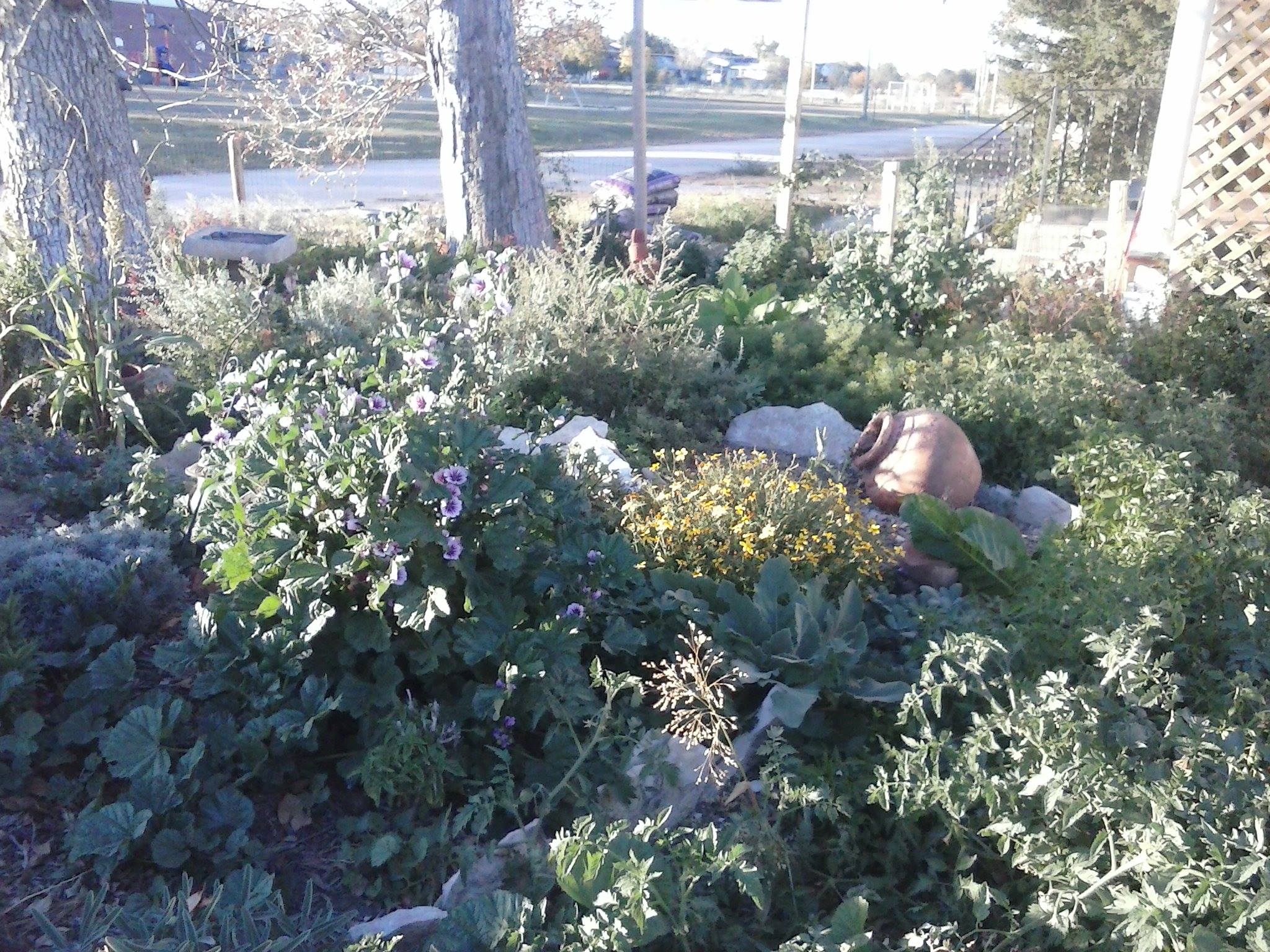







 Today
Today