TOPEKA – The Kansas Department of Health and Environment (KDHE) has issued an Emergency Order of Suspension to Mighty Mites and Little Tikes, a licensed day care home located 480 N. Riddle, in Colby.
State law allows the Secretary of KDHE to issue such an order when, in the opinion of the Secretary, the order is necessary to protect children in the home from any potential threat to health or safety. The order is subject to appeal.
The Emergency Order of Suspension can be read here. It cites two separate incidents occurring June 28 and July 12 at the home while children were in care.
Compliance history on this day care facility can be found by searching the Child Care and Early Education Portal for license No. 0048645 at https://www.kdheks.gov/bcclr/capp.htm.
The deadline to register to vote in Kansas in the Aug. 7 primary is Tuesday, July 17.
Maskus
There are 18 voter registration locations throughout Ellis County. Those include the city offices in Hays, Ellis and Victoria, the Hays and Ellis Public Libraries and the County Clerk’s Office in Hays. A complete list of those locations can be found on the Ellis County website.
Earlier this year a judge ruled the Kansas law requiring people to provide proof of United State citizenship to register to vote was unconstitutional, so you do not have to provide that documentation.
“The ruling is that we cannot ask for proof of citizenship,” said Ellis County Election Officer Donna Maskus, “so no more will anyone be required to show proof of citizenship.”
The ruling gave official voter status to several thousand Kansans who had their status suspended. Maskus said that affected some Ellis County residents.
When registering, people only have to fill out the registration card and declare they are a citizen of the U.S. and they will be 18 on or before Election Day, according to Maskus.
Even though residents do not have to provide ID when registering to vote, they will still need to have an ID when they head to the polls.
“You still have to show your ID before you vote,” Maskus said.
That would include a driver’s license, a government ID, a concealed handgun license, military ID or student ID, according Maskus.
The Ellis County Elections website also has a link to preview the ballot, a list of candidates and a list of polling sites.
For more information you can also contact the Ellis County Elections office at 785-628-9410 from 8 a.m. to 4 p.m.Mondays through Fridays.
TOPEKA – The Kansas Department of Health and Environment (KDHE), in conjunction with the Kansas Department of Wildlife, Parks and Tourism (KDWPT), has issued public health warnings for Carbondale West Lake, Clarion Woods Park Lake, Webster Lake, Atchison County Park Lake, Melvern Outlet Pond, Melvern Outlet Swim Pond, Topeka’s Central Park Lake (Pond), Lake Afton, Rooks County State Fishing Lake and Salina’s Jerry Ivey Pond for the upcoming weekend and week.
If a lake is under a public health warning for blue-green algae, activities such as boating and fishing may be safe. However, direct contact with water (i.e., wading, skiing and swimming) is strongly discouraged for people, pets and livestock. The lakes currently under a public health advisory:
Warning: Carbondale West Lake, Osage County
Warning: Clarion Woods Park Lake, Shawnee County
Warning and Beach Closed: Webster Lake, Rooks County
Warning: Atchison County Park Lake, Atchison County
Warning: Melvern Outlet Pond, Osage County
Warning: Melvern Outlet Swim Pond, Osage County
Warning: Central Park Lake (Pond), Shawnee County
Warning: Lake Afton, Sedgwick County
Warning: Rooks County State Fishing Lake, Rooks County
Warning: Jerry Ivey Pond, Saline County
The U.S. Army Corp of Engineers has stated swimming is not allowed at the Melvern Outlet Swim Pond Beach and all wading and contact with algae is highly discouraged. Melvern Lake Visitors can utilize Coeur d’Alene Swim Beach which sets on the main body of the lake, located west of the U.S. Army Corps of Engineers Project Office. The present algae bloom is isolated to the Outlet Pond and Outlet Swim Pond, Melvern Lake is not affected.
Lakes under a warning are not closed. Marinas, lakeside businesses and park camping facilities are open for business. If swim beaches are closed, it will be specifically noted. Drinking water and showers at parks are safe and not affected by algae blooms. Boating and fishing are safe on lakes under a warning, but contact with the water should be avoided. Hands should also be washed with clean water after handling fish taken from an affected lake. Zoned lakes may have portions fully open for all recreation even if other portions are under a warning.
Kansans should be aware that blooms are unpredictable. They can develop rapidly and may float around the lake, requiring visitors to exercise their best judgment. If there is scum, a paint-like surface or the water is bright green, avoid contact and keep pets away. These are indications that a harmful bloom may be present. Pet owners should be aware that animals that swim in or drink water affected by a harmful algal bloom or eat dried algae along the shore may become seriously ill or die.
When a warning is issued, KDHE recommends the following precautions be taken:
Lake water is not safe to drink for pets or livestock.
Lake water, regardless of blue-green algae status, should never be consumed by humans.
Water contact should be avoided.
Fish may be eaten if they are rinsed with clean water and only the fillet portion is consumed, while all other parts are discarded.
Do not allow pets to eat dried algae.
If lake water contacts skin, wash with clean water as soon as possible.
Avoid areas of visible algae accumulation.
KDHE samples publicly-accessible bodies of water for blue-green algae when the agency receives reports of potential algae blooms in Kansas lakes. Based on sampling results, KDHE reports on potentially harmful conditions.
For information on blue-green algae and reporting potential harmful algal blooms, please visit https://www.kdheks.gov/algae-illness/index.htm. Human and animal illnesses potentially related to harmful algal blooms can also be reported through this website or by calling the KDHE Epidemiology Hotline at 1-877-427-7317.
David NorlinTwo stories in the June 30 Salina Journal feature Kansas Republican office-holders in “Good Samaritan” mode, namely Governor (Dr.) Jeff Colyer and First District Congressman (Dr.) Roger Marshall.
The Colyer story recounts the Governor having his driver stop his car as it went by an accident scene on a campaign trip. There Colyer made sure a heat-exhausted truck-trailer driver had a bottle of water, then took him to the trooper’s car to sit in air-conditioning.
Says his paid spokeswoman, apparently the source of this stand-alone story, “This is just what he does,” also citing his running to the aid of an injured wrestler at a tournament.
The second story details Congressman Marshall’s account of his visit to 360 mostly Central American boys separated from their parents at an ‘immaculate’ detention center or ‘camp’ near the border. Citing his own mission work in Central America, Haiti, and Kenya, Marshall said the camp’s ‘loving and caring’ workers who also ‘look at it as a mission project,’ are “bringing teddy bears from home and getting them food.”
To further comfort the children, Marshall played soccer with them.
Thus calling to mind the January 31st story of the Congressman administering CPR to one of three garbage truckers hit by him and more than half the other Republican Senators and Representatives in a chartered train enroute to a West Virginia retreat.
Good for them! Compassion is a scarce commodity these days. When our public officials demonstrate it, shouldn’t we be the first to thank and congratulate them? Of course.
When anyone faces such need up close and personal, Hippocratic oath or not, the urgency of the moment and our best human instincts (usually) come into play. For that impulse, we can all be grateful.
But we should beware the Missionary Mentality. The automatic label of “Good Guy.” The feeling that by taking some saving action, we have done our best—and our duty–to our fellow humans. This applies to all of us, but especially Elected Officials and People in Charge.
It cannot go unnoticed that these stories appear in an election year. That their origins are with the officials themselves, or their surrogates. And that they might just seem deliberately calibrated as free campaign advertising.
Far more importantly, that their seemingly benevolent actions are in stark contrast with the harm inflicted by their public policies. Policies that, potentially or actually, directly harm the very people they are ‘helping.’
Imagine Colyer’s truck-trailer driver has a disabled daughter needing ongoing care, care denied by the KanCare company putting off or denying payment to the facility or physician offering her services—for their own personal enrichment.
A Kan’t Care system created by whom? Governor Colyer. A system the Guv wants to change to limit help to 36 months, and not allow help for anyone the Guv’s worker bees say won’t work for their benefits.
If our 150,000 Kansas neighbors not insured against financial disaster (because the Guv staunchly opposes expanding Medicaid) were sitting in the heat by the side of the road, would a water bottle and air-conditioned trooper car provide sufficient relief?
Will a soccer game with a U.S. Congressman and Teddy Bears from their captors get these kids back to their parents and out of prison (where they are held without their consent)?
Don’t be ridiculous.
The onus is on us, friends. When you read these Teddy Bear stories (and there’ll be more), it’s your responsibility to see the larger picture—and to Vote Accordingly!
David Norlin is Chairman of the Salina Planning Commission, former President of Salina Access TV, and a former College Director of Broadcasting and English Department Chair. He has twice run for Kansas State Office.
Beginning Friday, July 13, 2018, the intersection of 19th and Allen Street in Hays will be opened and the intersection of 17th and Allen will be closed. Allen Street will be closed from north of 16th Street to south of 19th Street. The intersection of 18th and Allen remains closed.
This work is part of the Allen Street Reconstruction Project.
Signs will be in place to direct the traveling public. Motorists should use caution in these areas.
The city of Hays regrets any inconvenience this may cause to the public. If there are any questions, please call the Office of Project Management at 785-628-7350 or the contractor, Paul-Wertenberger Construction at 785-625-8220.
The Kansas Department of Transportation expects to begin a resurfacing project on a portion of U.S. 281 in Russell County the week of July 16.
Crews will be working on a 15-mile stretch from the north Russell city limit to the K-18 junction. Traffic will be reduced to one lane and directed through the work zone via flaggers and a pilot car during daylight hours. Minor delays not exceeding 15 minutes should be anticipated.
KDOT expects work to be completed by the end of August, weather permitting. Venture Corporation is the primary contractor with a total contract cost of $1 million.
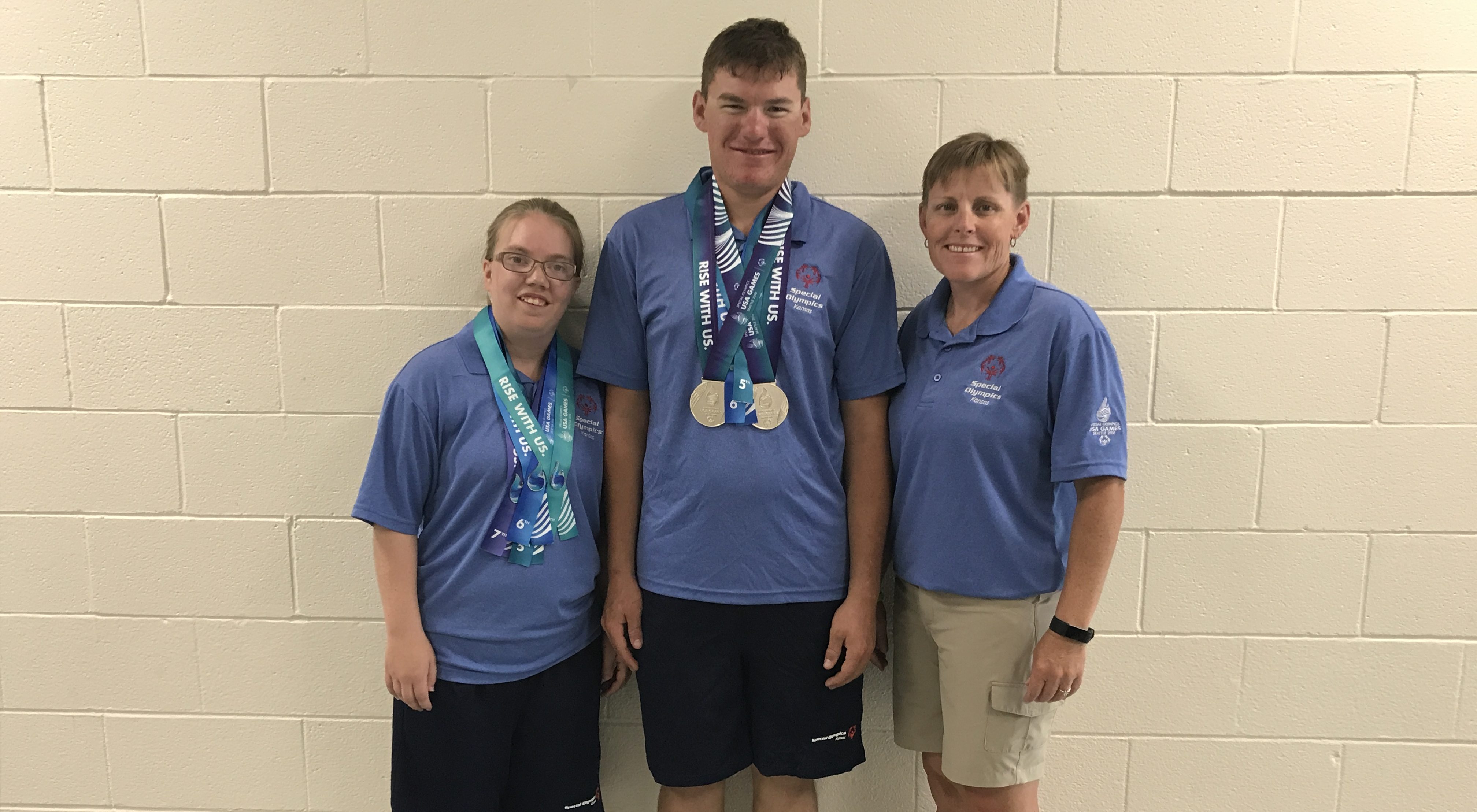
Kacey Dannels and Joseph Reed, Hays Special Olympics athletes, show off their national medals with coach Noalee McDonald-Augustine.
By CRISTINA JANNEY Hays Post
Two Hays Special Olympics athletes returned from the Special Olympics USA Games in Seattle last week, both with fists full of awards.
Kacey Dannels and Joseph Reed both participated in track events.
Reed won silver medals in the 5,000 and 10,000 meters. He placed fifth in the 3,000 and sixth in the 4X100 relay.
Dannels placed fourth in the mini javelin, fifth in the shot put, seventh in the 100 and was also on the Kansas 4X100 relay team that placed sixth.
Both Reed and Dannels are athletes in The ARC of the Central Plains program and run with the local 5K Club, coached by Noalee McDonald-Augustine of Hays, who was the track coach for the Kansas team in Seattle.
The Special Olympics USA Summer Games are conducted every four years. They attract athletes of varying abilities from all 50 states. The participants ranged from 8 years old to athletes in their 60s. Both Dannels and Reed had to complete a lengthy application process to be selected to participate in the games. They also participated in fundraising for their trip.
Although winning medals is great, both of the athletes and their coach said meeting other athletes from across Kansas and nation was the best part of the games.
“It was a lot of fun getting to meet new people,” Dannels said. “We became close with team Kansas. I have several people on Facebook who have added me. We talked. It was awesome to meet everyone.”
Joseph Reed, Noalee McDonald-Augustine, coach, and Kacey Dannels, along with other athletes at a Special Olympics USA Games ceremony. Courtesy photo
Dannels said she became close with a fellow team Kansas tennis player as well as an athlete from Maryland.
The athletes stayed in dorms in an Olympic-village style setting. All of the Kansas athletes stayed on the same floor, which tightened the bonds between the team members.
The athletes were given pins representing their home states. They were encouraged to trade the pins as a means to become acquainted with athletes from other states. At closing ceremonies the athletes could trade T-shirts.
The athletes participated in a health fair at the games as well. Brooks Sports gave away new running shoes to any athlete who completed at least four stations of the health fair. Dannels brought home a new pair of shoes. She also received a new mouth guard from another station. The Lions Club performed vision screenings and gave away glasses and sunglasses to those who needed them.
“It was so neat that they came prepared for all of us,” Dannels said. “They were treating us like we were athletes. We had all sorts of levels, and they treated everyone like they were at the same level instead of one lower and one higher.”
Joseph Reed, Hays Special Olympics athlete, after winning one of his medals. Courtesy photo
Dannels and Reed with other members of the Kansas team watched their teammates participate in bocce and tennis. The team also took a boat tour of the harbor and a Mariners game, which was Joseph’s first trip to a professional baseball game.
Dannels said she enjoyed opening ceremonies and getting to march into a stadium full of people. As the athletes made their way from the dorms to the stadium, people lined the walkway almost a mile to cheer for the athletes. Members of Dannels’ family made the trip to Seattle to cheer for her during her competition, and Joseph had his own cheering section.
“It was nice that we had that support and people willing to travel and come up and see us,” Dannels said.
Both athletes said the competition was tougher than at their state meets.
Reed ran very closely with an athlete from Florida. He said the runner pushed him to go faster. He finished his 10K in 48:08, which was about 4 seconds faster than his previous personal best.
“It was hard,” he said. “We pushed each other.”
Hays Special Olympics athletes and their coach with two of their fellow athletes in Seattle. Courtesy photo
McDonald-Augustine was impressed with not only Reed’s performance, but her other Kansas athletes and the whole field of competitors.
“Not just Kacey and Joseph, but I had two other track athletes from Kansas,” she said. “All four of them performed great. They worked hard, certainly gave it their all. It was just really awesome to see them compete against others of similar and higher capabilities.”
She said some athletes were running the 100 meters in high school and college times. One of the runners in another section of the 10K posted a time of 35 minutes. McDonald-Augustine really said high performing athletes help inspire others to push themselves further.
Dannels’ next goal is to compete at the national games again in four years in Orlando. Reed is training for a half marathon and hopes to run in the Prairie Fire half marathon in October in Wichita.
The ARC is always in need of volunteer coaches. To learn more, contact Brent Kaiser, activities director, at 785-639-4010 or by email at [email protected].
Today A 40 percent chance of showers and thunderstorms, mainly after 3pm. Mostly sunny, with a high near 96. South wind 7 to 15 mph.
Tonight Showers and thunderstorms likely, mainly between 7pm and 1am. Mostly cloudy, with a low around 71. South wind 5 to 11 mph becoming east southeast in the evening. Chance of precipitation is 70%. New rainfall amounts between a quarter and half of an inch possible.
Saturday A 20 percent chance of showers and thunderstorms before 1pm. Partly sunny, with a high near 91. Southeast wind around 6 mph becoming north northwest in the morning.
Saturday Night Mostly clear, with a low around 69. East wind 5 to 8 mph becoming north after midnight.
Sunday Sunny, with a high near 94. Northeast wind 5 to 8 mph.
A storm is brewing over equitable education funding in Kansas.
Last month, the Kansas Supreme Court passed down a decision upholding the state legislature’s five-year, school funding proposal of $522 million in new spending. The court required only that additional resources to sufficiently account for inflation be added and gave the lawmakers almost a year to carry out the new directive.
Sharon Hartin Iorio is Professor and Dean Emeritus at Wichita State University College of Education.
The justices did not compel all the additional funds to be implemented immediately. Nor did the court stop the flow of state education funding which would have closed schools until a larger amount was put forward.
In the opinion of many Kansans, it was a decision that considered state coffers as well as educational needs. However, some legislators were dissatisfied and began again to call for a Constitutional amendment that would give the legislature sole power over school funding with no opportunity for judicial review to determine the adequacy of funding.
Rather than backing a Constitutional amendment to increase legislative power over education finance, lawmakers might want to “lean in” and ask education leaders and the public to help them match education needs to state appropriations.
A Constitutional amendment could set the stage for larger problems instead of ameliorating education issues.
Take, for example, the tempest that continues to rage in Oklahoma, a state where legislative control overrides the courts. This spring, amid teacher walkouts, sit-ins, a Pastors for Kids organization founded at First Baptist Church in Oklahoma City enlisted 95 pastors and hundreds of parishioners to support teachers. That plus a citizens’ march from Tulsa to Oklahoma City exacerbated political turmoil.
Support for teachers was widespread. By April a law passed that raised teacher salaries which were among the lowest in the nation.
However the conflict didn’t end; within a few weeks, a former U.S. Senator led support for a petition to repeal the pay-raise taxes. The Oklahoma courts rejected the proposal on the technicality that not each of the separate taxes to be raised was listed on the petition. The storm continues.
What can Kansans learn from the Oklahoma story?
Depending on how the data is diced, the teacher walkouts resulted in schools closed, parents scrambling for suitable caretakers for their young and classroom learning at a standstill—costing families and the general public much unrest and the Oklahoma economy considerably more than the $22 million over several years that Kansas school districts paid in attorney’s fees during the Kansas court dispute.
Education funding decisions should be about how to provide 21st Century education for students–difficult to imagine, since in 2017 school funding in both Oklahoma and Kansas was near the bottom of states experiencing a 10 percent or greater reduction in per student state spending during the past 10 years. Oklahoma was last and Kansas was listed fourth from the bottom.
Neither legislative primacy nor judicial oversight can end battles over school funding, but legislative primacy can, as in Oklahoma, be costly, lengthy, aggravate political contention and fail to nurture public education. Kansans would do well to leave their Constitution as is.
Sharon Hartin Iorio is Professor and Dean Emeritus at Wichita State University College of Education.
Catholic Charities has announced it will offer assistance to those affected by the July 6 flash flood that hit Hays.
Cash assistance as well as food or clothing is available.
Catholic Charities offers non-denominational assistance. Proof of income is not required, but the organization would like to record addresses of those affected.
Jeanie Warner, Catholic Charities marketing, media and data coordinator, said the organization has contacted the city about the flood damage, but has not been able to determine who or how many people may have been affected.
To receive help, call 785-625-2644 or visit the Catholic Charities office at 122 E. 12th St. in Hays. The local office is open 8 a.m. to 5 p.m. Mondays through Thursdays and 8 a.m to 2:30 p.m. Fridays.
BOISE, Idaho – Earlier this year, the Western Association of Fish and Wildlife Agencies (WAFWA) announced it would conduct a series of aerial surveys in five states to document lesser prairie chicken population trends. Results from the surveys, conducted March 16 through mid-May, are in and the outlook is promising. Continuing an upward trend for the species over the last few years, the newest data shows an estimated breeding population of 38,637 birds this year, compared to 29,934 birds last year.
“This approximately 30 percent annual increase is good news, but we know that year-to-year fluctuations are the norm with upland birds like the lesser prairie chicken,” said Roger Wolfe, WAFWA’s Lesser Prairie Chicken Program manager. “The most encouraging result from the survey is the steadily increasing population trend over the last six years, which likely reflects improving habitat conditions.”
Lesser prairie chickens are found in four ecoregions in five states: Kansas, Colorado, New Mexico, Oklahoma and Texas. Many wildlife biologists attribute the species’ fluctuation in numbers to changes in habitat conditions, largely influenced by weather patterns. More favorable weather patterns this past year contributed to apparent increases in three of four ecoregions. There is concern that moderate-to-severe drought over portions of the lesser prairie chicken range this year may lead to a downturn next year.
The shinnery oak ecoregion of eastern New Mexico and the Texas Panhandle saw the biggest annual increase in birds, followed by the sand sagebrush ecoregion of southeast Colorado and southwest Kansas. The shortgrass ecoregion, which covers northwest Kansas, also registered an annual increase in the number of breeding birds. The estimated number of birds in the mixed-grass ecoregion – spanning the northeast Panhandle of Texas, northwest Oklahoma and south-central Kansas – is similar to last year’s estimate.
The annual population surveys are conducted as part of the Lesser Prairie Chicken Range-wide Plan, a collaborative effort of WAFWA and the Kansas Department of Wildlife, Parks and Tourism, as well as state wildlife agencies in Texas, New Mexico, Oklahoma, and Colorado. It was developed to ensure the conservation of the lesser prairie chicken with voluntary cooperation of landowners and industry, and allows agricultural producers and industry to continue operations while reducing impacts to the bird and its grassland habitat.
“We’re encouraged by this year’s numbers but are mindful that successful conservation of the lesser prairie chicken will require decades of consistent progress,” said J.D. Strong, Chairman of the Lesser Prairie Chicken Initiative Council and Director of the Oklahoma Department of Wildlife Conservation. “The continued success of the range-wide plan depends on ongoing participation by industry partners, and we are grateful for the support shown thus far. The U.S. Fish and Wildlife Service will be making another ruling on the status of the lesser prairie chicken later this year, and industry support of the plan is more important than ever. At such a critical juncture in the conservation of this important but imperiled prairie grouse, we encourage industry to contact us and get involved.”
For more information about the Lesser Prairie Chicken Range-wide Conservation Plan, contact Wolfe at [email protected].
The American Historical Society of Germans from Russia will hold their 49th Annual International Convention in Hays, Kansas Monday, July 30 – Thursday, August 2, 2018. Scheduled speakers will travel to the event from multiple U.S. states – some from as far as Germany and Russia.
This convention, titled “The Storm,” centers on the effects of the 1917 Russian Revolution on the Germans from Russia. It will also celebrate the traditions, history, genealogy, music, and food of Germans from Russia.
Attendees will have access to a research area for genealogy, AHSGR bookstore, silent auction room, and more. The convention begins with registration Monday, July 30, and will conclude on Thursday, August 2 with a banquet and polka dance.
All convention activities will be held at the Memorial Union on the Fort Hays State University Campus, except for Kindertag, a youth day for children to learn more about their German from Russia heritage. Kintertag will be held from 8:30 a.m. – 3:25 p.m. on Wednesday, August 1 at the Ellis County Historical Society Museum, 100 W. 7th Street. The day will be filled with educational activities to show how the Germans from Russia lived, including sauerkraut and butter making, dancing, traditional games, German language, cooking, and life on the farm.
Registration is required and walk-ins are welcome. Registration for the entire convention is $125 for AHSGR members and $145 for non-members.
Ticket options are also available for individual meals, events, and tours, such as the Foundation/Society Recognition luncheon, Village Tour, Museum Tour, and Artisan Tour. Three German Cooking classes will be offered by Sam Brungardt and Charlie Dorzweiler for $10 per session.
Those interested can find details, register for the conference, and purchase individual tickets at www.ahsgr.org.
Talks for the event include:
Finding Your Ancestors
The German Russian Communities in the Age of Stalin’s Great Terror
Germans in Russia: History Milestone (Celebrating the 100th Anniversary of the Volga German Autonomy)
Masterpieces of German Religious Architecture on the Volga
Remembering a Ravaged Century: The German Colonies Caught in ‘The Storm’ of the Russian Revolution
Letters to Pauline (Schlegel) Lehi: Volga German Family Correspondence from Russia to Oklahoma, 1913-1937
DNA 1: The Basics of Life / DNA 2: Analyzing Your DNA Results
Ethnic Clothing for Mennonites and Other Germans from Russia
Mennonites in Russia after the Revolution
The Immigrant Woman
Dutch Hop: Music of the Volga Germans
History of the HFDR (Historical Research Association of Germans from Russia)
Lives of Ethnic Germans in Soviet Exile during and after WWII
FHSU Ethnic Studies Center: A Roomful of History – The Volga Germans of Ellis and Rush Counties in Kansas
Speakers include:
Olga Litzenberger (Russia)
Michael Wanner (Germany)
Eric Schmaltz (University of Oklahoma, Norman, OK)
Maggie Hein (Chicago, IL)
Ulrich Merten (Florida)
Peggy Goertzen (Wichita, KS)
Norma Pipkin (Hays, KS)
Terry Batt (Denver,CO / Russell, KS)
Alex & Nancy Herzog (Boulder, CO)
Sisters Alice Ann Pfeifer, Mary Ann Schippers, and Mary Elise Leiker (Wisconsin/Hays, KS)
Brent Mai (Connecticut)
Patty Nicholas (Fort Hays State University, Hays, KS)
The American Historical Society of Germans from Russia is located in Lincoln, Nebraska, and houses one of the largest repositories for German Russian studies in the U.S. It includes, books, records, maps, photos and many more items.
The Sunflower Chapter of AHSGR, Hays, is a local Chapter of AHSGR striving to promote the heritage of the German Russian on a local level.
For more information on attending the AHSGR Hays Convention can be found at by contacting the national AHSGR office at 402-474-3363 or [email protected] or Kevin Rupp at 785-656-0329 or krupp@ruraltel,net.
The City of Hays has filed suit against Nex-Tech, LLC; Big River Telephone Company, LLC; and Eagle Communications, Inc., related to the imposition of franchise fees for services provided to customers in the city.
The suit, which was filed July 9 in Ellis County, seeks a court order requiring Big River to enter into a franchise agreement with the city intended to collect city franchise fees for Big River’s service to Eagle Communications for Eagle Communications’ IP-delivered telephone service. Cities with franchising authority currently collect franchise fees on traditional switched telephone service delivered through traditional methods, but not IP-based service, which is delivered entirely via internet.
The suit also asks the court to make a determination as to whether or not Eagle Communications, with or without services from Big River, should be required to enter into a franchise agreement to provide its internet-based telephone service. And, the suit seeks to establish that the city can continue to require Nex-Tech to enter into a franchise agreement to provide its service in Hays based on the technology Nex-Tech utilities.
“We have enjoyed a good and long-standing working relationship with the City of Hays and believe we have complied with all of the past franchise requirements and the legal requirements for delivering VoIP (Voice over Internet Protocol) technology,” said Eagle President and CEO Gary Shorman. “We are disappointed the city chose to use this process to pursue additional fees from our customers for the city, and we think the law is clear that no such fees are appropriate for the service and technology we provide.”

 KDHE
KDHE