If you are a Kansas homeowner or a Kansas renter, can you answer basic questions about your insurance?
Whether you are a renter or a homeowner, you should consider an annual review of your homeowners or renters insurance policy, a review strongly recommended by our staff at the Kansas Insurance Department (KID). Reviewing your coverages lets you evaluate whether the coverage is still adequate (or too much) for your current situation. When you (and your local insurance agent) review your policy, be sure to find the answers to the following three questions.
What does my homeowners or renters policy cover?
A homeowners insurance policy covers the structure, belongings and legal obligations if someone is injured at your home. A renters policy does not insure the structure, but otherwise provides similar coverage.
Check the type of replacement value provided in the policy. Actual cash value (ACV) is the amount it would take to repair damage to a home or to replace its contents, after allowing for depreciation. Replacement cost is the amount it would take to rebuild or replace a home or its contents with similar quality materials or goods. Understand, however, that in order to receive the full replacement cost, most companies require you to show proof of replacement or repair before issuing the total amount. This also requires you to submit the proof within a certain time specified by your policy.
Liability insurance protects you from legal obligations arising from accidents involving visiting non-residents. With a few exceptions, such as auto or boating accidents, all-purpose liability coverage follows wherever you go. An umbrella policy can extend the liability limits of a homeowners or renters policy if the policy limit is insufficient.
Homeowners and renters policies typically include limited medical expense payments for injuries occurring on your premises to visiting non-residents.
How much coverage do I need?
Making a home inventory is the best way to determine the appropriate level of coverage needed for contents. An inventory is also a useful tool to have in case of a loss. When compiling the inventory, make sure to include as much detail as possible about the items.
Homeowners do not need to insure the value of the land a home sits on, but coverage should include any outdoor structures on the property.
What are my deductibles and discounts?
Deductibles and discounts are generally the easiest places to save money. Most companies offer discounts for people who have more than one type of insurance policy with them, and for people who have had few claims or are long-term customers.
When it comes to the deductible — which is the amount you have to pay if there is a loss — usually the higher it is, the lower the premium. It’s normal to consider raising a deductible to save on your premium, but remember, your share of the bill will be that much more following a claim.
After reviewing the policy, you might also ask these questions:
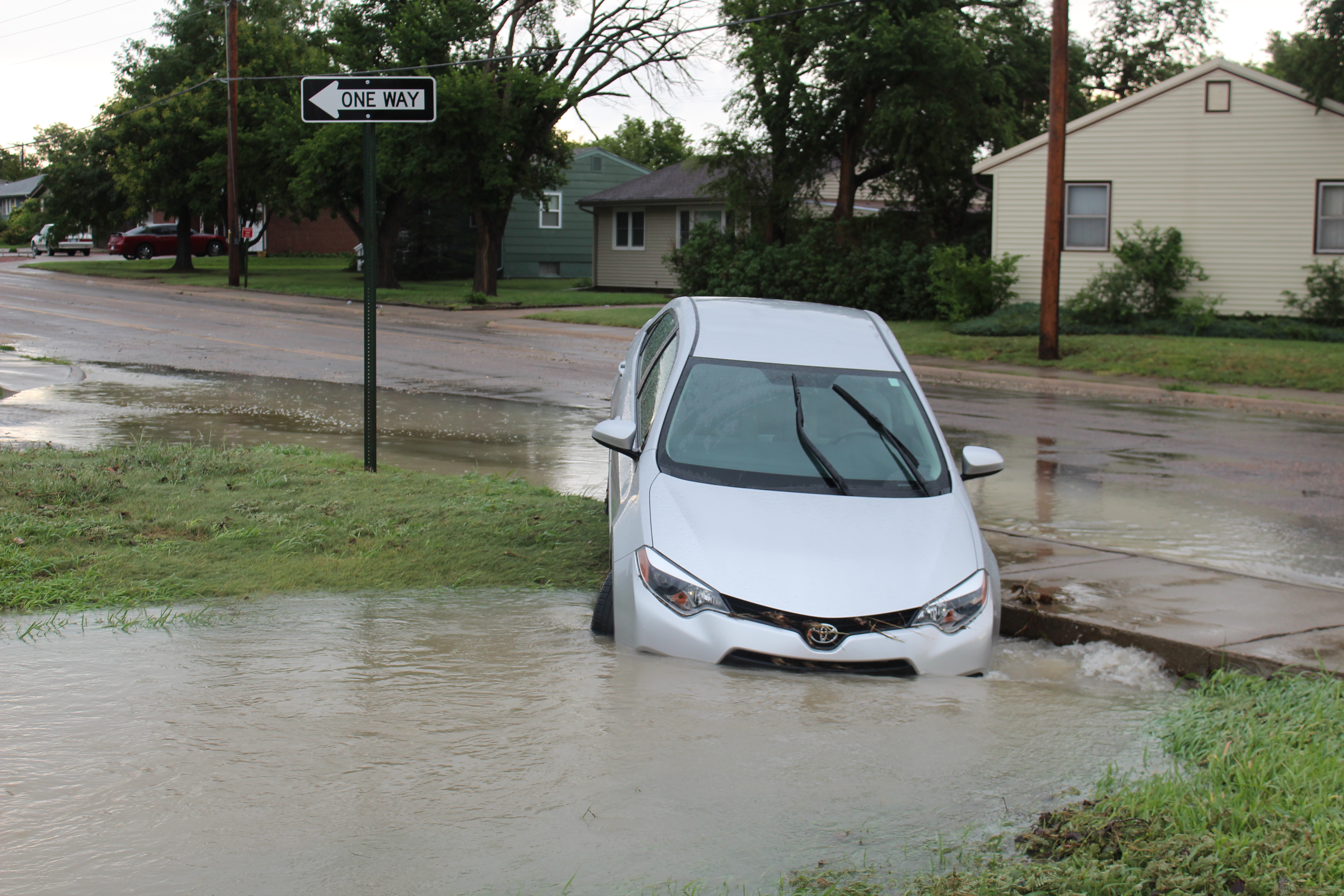
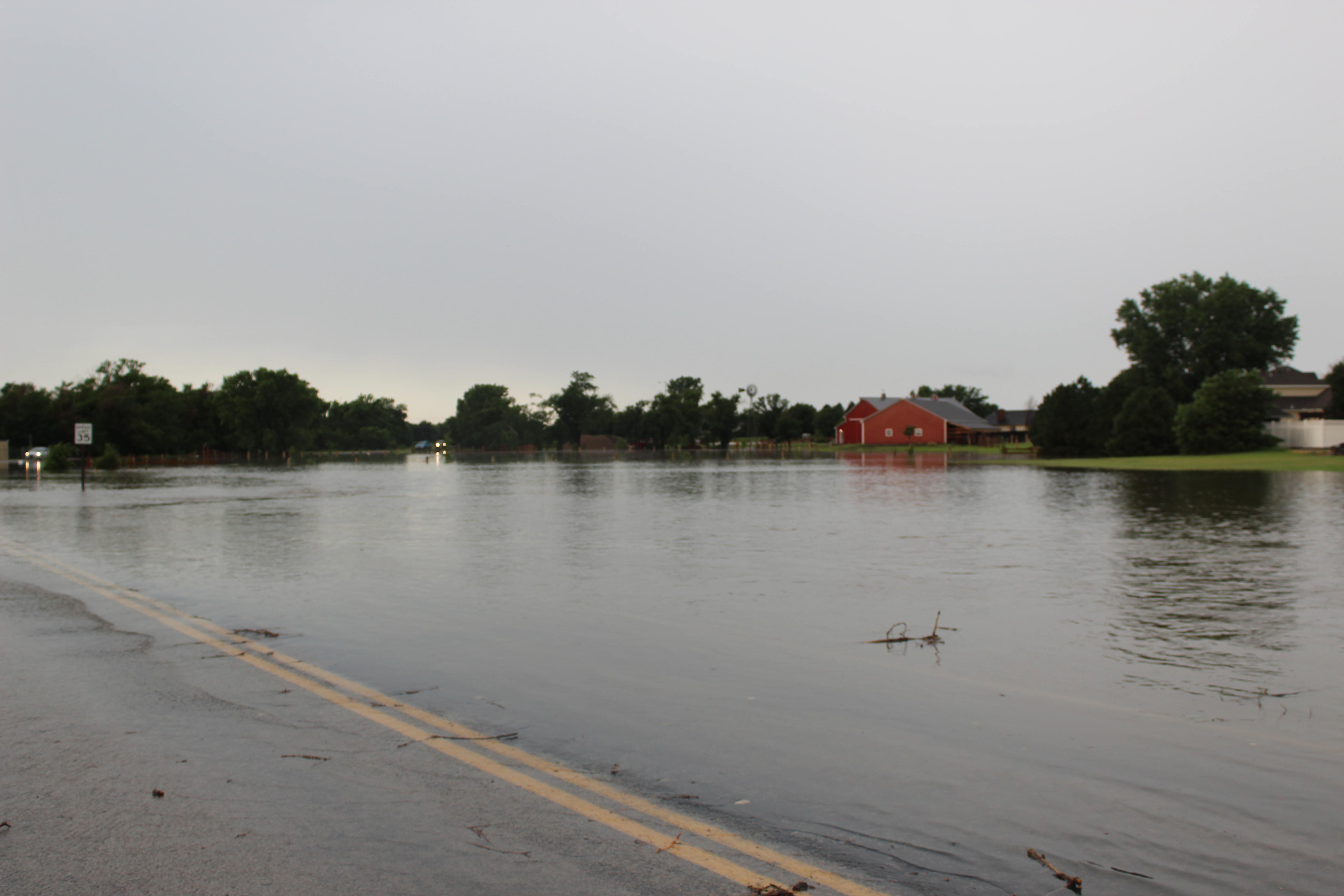
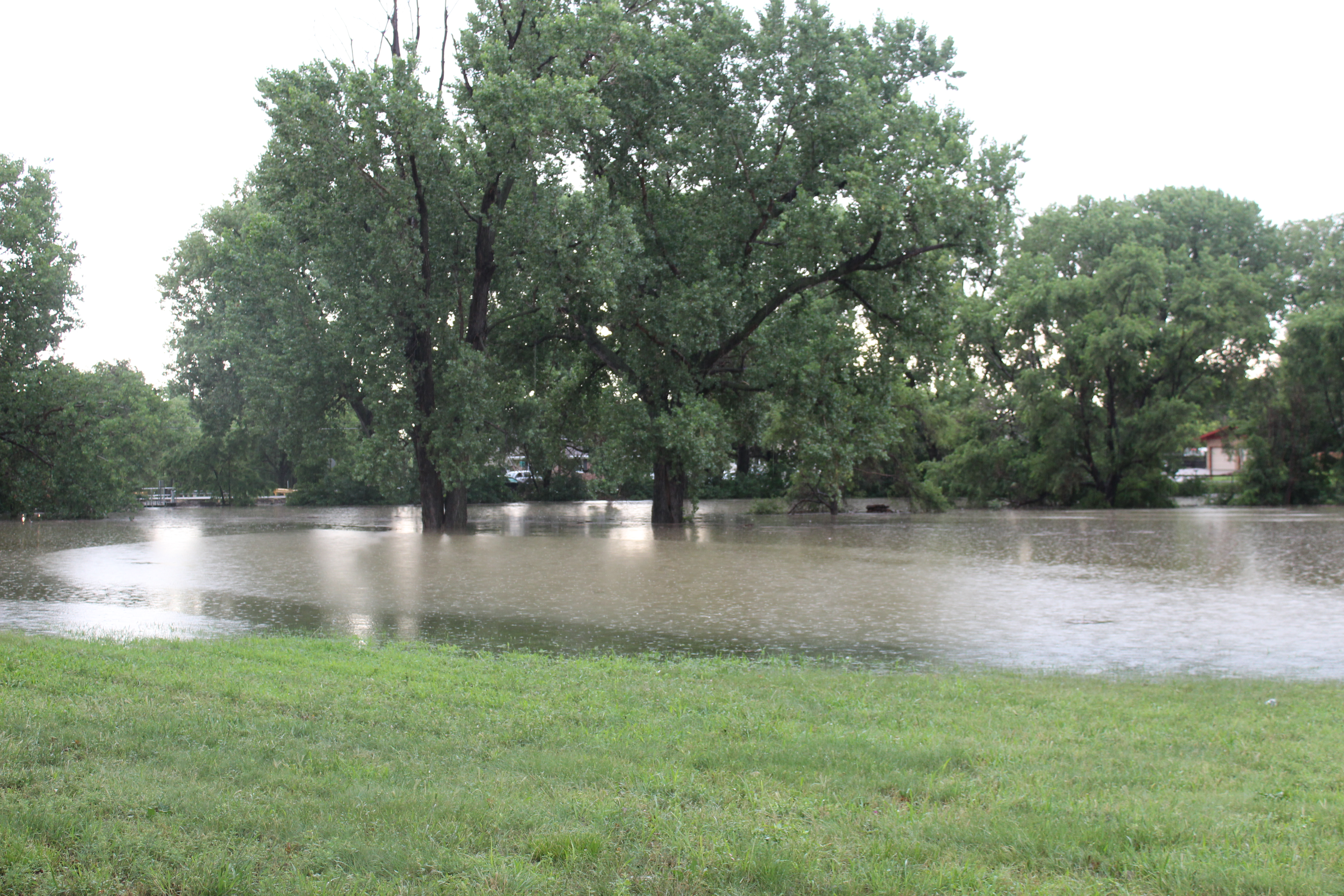
Are there any losses – like flood or earthquake – I need to worry about that are not covered in my current policy? Neither flood nor earthquake is covered by a standard homeowners or renters policy. There are optional insurance policies or riders for both disasters.
Has anything changed in my coverage in the last year? When talking with an agent, ask if there are any anticipated changes when the policy renews.
More Information
For more general information about homeowners or renters insurance and the basic coverages in a policy, go to www.ksinsurance.org and read or download our publication “Homeowners and Renters Insurance.” You can download our Personal Inventory publication there as well.
For specific questions about coverages or about an insurance company or agent, use the KID online chat feature on the home page of our website, or call the KID Consumer Assistance Hotline (in Kansas) at 800-432-2484.
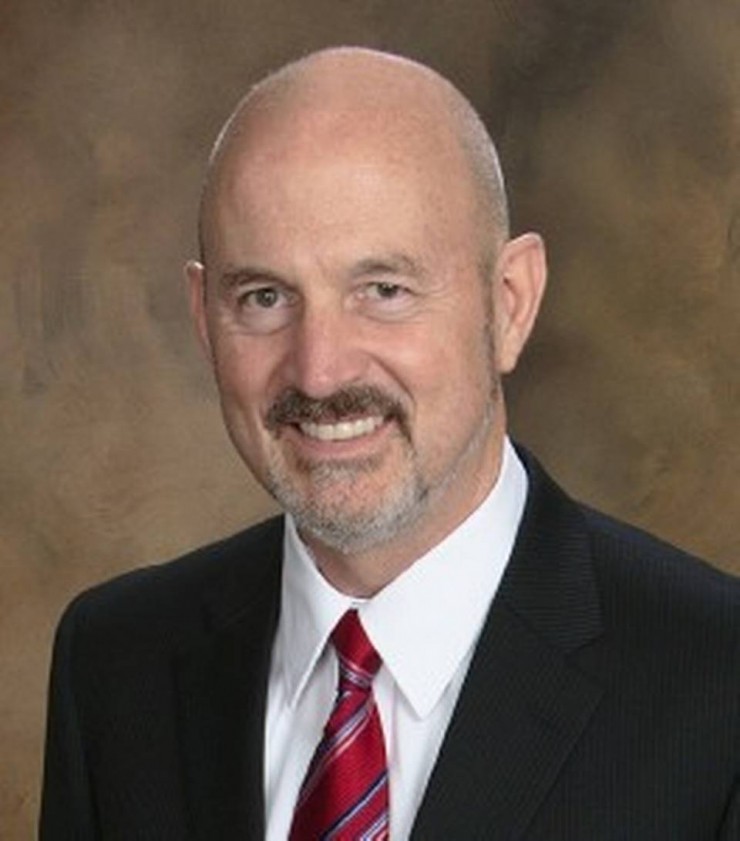
Ken Selzer, CPA, is the Kansas Commissioner of Insurance.
Sometimes, telling a story can save a person’s life. That’s what motivates internationally known speaker and mental health advocate Kevin Hines to tour the nation, telling audiences of the bleak day in September of 2000 when he catapulted himself over the side of the Golden Gate Bridge in an attempted suicide.
He describes the “instant regret” he immediately felt, and how in the seconds as he was free-falling, all he wanted to do was live. Hines brings a message of healing and hope to his audiences, and soon will be sharing his story with northwest Kansas.
Hines will speak at 7 p.m. Aug. 1 at Hays Middle School, 201 W. 29th, in Hays. The event is free and open to the public; no need to obtain tickets or RSVP. A book signing of Hines’ personal memoir, “Cracked, Not Broken,” will follow the presentation. Books will be available to purchase on-site.
The event is sponsored by High Plains Mental Health Center and Heartland Community Foundation, with sup- port from Hays USD 489, Fort Hays State University’s Kelly Center, NAMI Hays, The Center for Life Experiences and Breathe Coffee House.
“Suicide prevention is a critically important topic, and these are the kinds of conversations our communities need to begin having. Kevin will address this difficult subject in a way that sheds light on the struggles of mental illness but also brings hope to those who need it,” said Walt Hill, executive director of High Plains Mental Health Center. “We are thrilled to bring Kevin to northwest Kansas. We believe his story will benefit people in all walks of life and encourage you all to join us for this exciting opportunity.”
This presentation is timely and relevant, given Kansas’ suicide rate is up 45 percent since 1999 — one of the high- est increases nationwide. Rural Kansas has been particularly affected, with the least populated counties having the highest rates of suicide deaths in 2016. Data indicates agricultural workers are particularly at risk for mental illness, perhaps partly due to high stress and economic difficulties.
One of only 34 people to survive a jump off the iconic bridge, Hines is the only one who regained full physical mo- bility. Hines, diagnosed with bipolar disorder as a teenager, will share his remarkable story of survival and recovery.
Today, Kevin dedicates his life to saving others by spreading his message of hope and sharing his journey toward mental wellness. Thousands of people have told him his story helped save their lives.
Hines is one of the most respected and admired voices of lived experience. His story is a testament to the strength of the human spirit and a reminder for us to love the life we have. His personal mantra is, “Life is a gift, that is why they call it the present. Cherish it always.”
Hines also is a filmmaker and is featured in a full-length documentary produced this year, “Suicide: The Ripple Effect.”
He was awarded a Lifetime Achievement Award by the National Council of Behavioral Health. Kevin also has been awarded by SAMSHA as a Voice Awards Fellow and Award Winner, an Achievement Winner by the U.S. Veterans Affairs and is a recipient of several military medals.
The event is intended to help break the stigma surrounding mental illness and to provide hope for those who might currently be struggling. Hines’ presentation also can offer hope and help for family members and friends to help iden- tify and support loved ones experiencing mental illness.
High Plains Mental Health Center is a licensed community mental health center dedicated to the aggressive pursuit of providing a comprehensive mental health program to residents of northwest Kansas. Embodied in this pursuit are fundamental principles of establishing quality services as close to home as possible, at an affordable fee and delivered in the least disruptive manner available. High Plains offers 24/7 emergency services to all residents within 20 north- west Kansas counties. Call toll free anytime at (800) 432-0333 for crisis support or to schedule an appointment with a qualified mental health professional.
The main office is located at 208 E. Seventh in Hays, with branch offices in Colby, Goodland, Norton, Osborne and Phillipsburg. Community outreach services are available in Atwood, Hoxie, Oberlin, Quinter, Russell, Smith Center, WaKeeney, Hill City, Plainville, La Crosse, St. Francis, Sharon Springs and Oakley.
On the map: U.S. Highway 36 Norton to St. Francis Distance from Hays: 189 miles Drive time: 3 hours
I can’t really call my latest adventure in northwest Kansas a Day Trip.
My nephew and I were on our way to Denver for the an extended weekend and decided to take the scenic route. However, you could complete our U.S. Highway 36 odyssey from Hays to St. Francis in a day if you wished. Diverting from the usual route to Denver, we turned off Interstate 70 at WaKeeney and headed north on U.S. 283.
Norton
Although you pass through Hill City and very close to Nicodemus, which is just west of Hill City on U.S. Highway 24, our first stop was in Norton.
Norton Theater
For such a small community, Norton has done much to preserve its historic architecture. Forty-four properties in the downtown are part of the Norton Downtown Historic District, which is on the National Register of Historic Places.
Three gas stations from the 1920s and 1930s have been restored in downtown Norton. All three are on the National Register of Historic Places. The 1934 Kent Filling Station was donated to Norton County and houses the Norton Area Convention and Visitors Bureau, Norton City/County Economic Development and Norton Area Chamber of Commerce.
Norton County Courthouse
We stopped into the office and someone from economic development loaded us up with information on history, attractions and businesses in the county and all along the U.S. 36 corridor. The Underwood Conoco Station, Main and First, circa 1928, is still used as a garage by a local classic car enthusiast, and the Sinclair Station, circa 1925, Washington and First, is used as an office building. The Norton County Courthouse, built in 1929, is also on the NRHP.
The historic Heaton Building, built in 1906, 112 S. Kansas, was recently restored. It houses retail businesses and a coffee shop on its lower floor and offices upstairs. It has beautiful skylights on the second floor. Also in the historic district is the Norton Theatre, built in 1906. The stucco building still has its original green marquee. Today it is run by volunteers.
Destination Kitchen, 115 Main, is filled with kitchen gadgets and premium cookware. They serve lunch in the back, which includes sandwiches, soups and brick oven pizza. The city of Norton was under a boil water advisory during our visit, so we decided to press on to Oberlin for lunch.
“They Also Ran” Gallery
A couple of doors down from the Destination Kitchen is “They Also Ran” Gallery. If you don’t pay attention, you will miss it because it is located on the upper floor of First State Bank. The gallery includes photos and information on all the major candidates who ran and lost their bids for U.S. President. You will likely recognize many names on the walls as people who at some time later won a bid for the country’s highest office.
However, there are also those who tried, tried again, tried yet again and still never had political success, such as Henry Clay who ran repeatedly from 1924 to 1948 for president and was never elected. Two native sons of Kansas are among the also ran. Republican Sen. Bob Dole lost to Bill Clinton in 1996 and Republican and former Kansas Gov. Alf Landon lost to Franklin Roosevelt in 1936 in a landslide. Landon won only two states and neither was his home state of Kansas. Admission is free. Donations are accepted.
Frederic Remington sculpture in lobby of First State Bank in Norton.
The bank also has a number of Frederic Remington sculptures, among them a cowboy on horseback in the main lobby. Remington was noted for his vivid bronze depictions of life in the Wild West.
The Pike’s Peak Express stagecoach once stopped in what is today Norton on its run from Leavenworth to Denver. A replica of Station 15 on the line offers a self-guided tour to see what the station would have looked like circa 1859. William Russell, partner in the Pike’s Peak Express, later was a partner in the Pony Express. According to information on Station 15, William Bonney Sr. was a station manager on the line and William Bonney Jr. AKA “Billy the Kid” was born in one of the line’s stations.
Prairie Dog State Park
Prairie Dog State Park is four miles west of Norton on U.S. 36. Just inside the park entrance is a prairie dog town. You can pull off and take pictures or just observe in a shaded picnic area. Prairie dogs have been historically thought of as vermin by farmers and ranchers, but biologists believe the animals are essential to the prairie ecosystem, turning soil with their burrows and channeling water into the water table. I think they have a high cuteness factor. My nephew was excited to have the opportunity to see the animals for the first time in the wild. A set of binoculars or a telephoto lens will help you get a better look.
Keith Sebelius Reservoir at the park also offers fishing, walk-in hunting, nature trails, water recreation and camping. You will need a state park permit to enter the park. Day permits run $5 per vehicle.
U.S. 36 runs from Indianapolis to Denver, including the entire length of Kansas. We did not stop there, but there is a U.S. Highway 36 Museum in Norcatur, 15 miles west of Norton. The museum is in a former bank and seeks to preserve the history of the highway and the U.S. 36 Association, which was formed in 1913. The association sponsors an annual garage sale during the third week of September that runs 400 miles from border to border. This year it will be Sept. 14-16.
Oberlin
Hungry, we were looking for an interesting place to eat in Oberlin, and we found it. We stopped at the Teller Room Restaurant/ Landmark Inn, 189 S. Penn. The 1886 brick bank, which is on the NRHP, serves lunch during the week and dinner on the weekends on the ground floor and has suites on the second floor. The menu changes daily. My nephew and I enjoyed quiche with fresh fruit and toast. The formal setting of the restored bank building had my 13-year-old nephew displaying high manners, including a napkin in his lap.
Stroll under the covered canopies downtown to explore a variety of shops and antique stores. As you drive through the community note the barn quilts in residents’ yards. A tour list is available at area business. The Teller Room had information the day we were there.
Oberlin pioneer family sculpture by Hays’ Pete Felten.
The Decatur County Last Indian Raid Museum is an extensive network of historic buildings chuck full of artifacts from the community. The name pays homage to the last known Native American raid in the area in 1878. Cheyenne Chiefs Dull Knife and Little Wolf were fleeing their Oklahoma reservations, seeking to return to the Black Hills. The raid left 19 settlers dead. A monument to those settlers who died in the raid is at the Oberlin Cemetery just off U.S. 36. Admission to the museum is through donation.
If you are in Oberlin during the first week of August, you can attend the longest-running home-owned carnival in Kansas. The carnival has a Ferris wheel and other spinning rides.
A nice photo op is the pioneer sculpture in the middle of Penn St. It was created in 1971 by Hays native Pete Felten.
St. Francis
My brother-in-law has been a long-time Harley owner, so my nephew deemed a stop at the St. Francis Motorcycle Museum, 110 E. Washington, a must. The museum houses more than 115 motorcycles, including rare early Harleys and Indians.
The museum exhibits one of only two known 1902 Orient motorcycles—the earliest manufacturer to use the term “motorcycle.” The museum also houses 30 motorcycles older than 1929 (several of which only five or fewer are known to exist), according to its website. The museum is open seven days a week. Admission is a $7 suggested donation.
Parched from the road, we stopped in Fresh Seven Coffee at Union Square, 312 W. Washington. This coffee house started as a food truck and now is in an enclosed space that is reminiscent of a backyard patio with graffiti art on the concrete ways and brick pavers on the floor. Fresh Seven serves breakfast, lunch and dinner as well as cocktails. Find more on this quirky little coffee shop on the High Plains on Facebook.
Other stops of note in St. Francis are Sawhill Park, which contains a band shell that was constructed by the WPA. It is on the National Register of Historic Paces. The Cheyenne County Courthouse, 212 Washington, is also on the NRHP. The Quincy Gallery and Cheyenne Center for Creativity, 109 N. Quincy, features local and regional artists.
Philip and I’s original intent was to travel up to the Arikaree Breaks, which run north of St. Francis into Nebraska. However, we were tired and decided to press on to Denver. The breaks are sometimes referred to as Kansas’s grand canyon. You will encounter dry-weather roads. Maps are available at the Cheyenne County Museum in St Francis.
West from St. Francis on U.S. 36 a mile and a half and then north on U.S. Highway 27 is the Cherry Creek Encampment. The site was a place of assembly for Native Americans after a massacre of Cheyenne at Sand Creek on Nov. 29, 1864. Members of the Cheyenne, Sioux, and Northern Arapahoes gathered and formed an estimated group of 1,000 warriors to attack Julesburg on the South Platte River in retaliation. They attacked the stage station there on Jan. 7, 1865, and returned to Cherry Creek with plundered supplies to celebrate their victory. Today metal sculptures by Tobe Zweygardt mark the spot.
My next trip will be to Wilson Lake and the City of Wilson to explore Czech heritage in Kansas. See you on the road!
Other links to check out while you are planning your trip:
During today’s flooding in Hays at 11:34 a.m., Hays police officers were dispatched to a report of a man stealing another person’s 1997 Ford Explorer in front of Southside Convenience Store at 703 Vine Street.
The man who stole the vehicle drove south on Vine Street and left the vehicle in a field south of Hays.
The Kansas Highway Patrol, the Ellis County Sheriff’s Office and the Hays Police Department established a perimeter and began searching for the man. The man was tracked down and apprehended by a Kansas Highway Patrol K9.
He was later identified as 24 year old Dru A. Stropes. Stropes was arrested for felony theft of a vehicle and is currently in the Ellis County Jail, according to a news release from the Hays Police Department.
Stropes is considered innocent until proven guilty by a court of law.
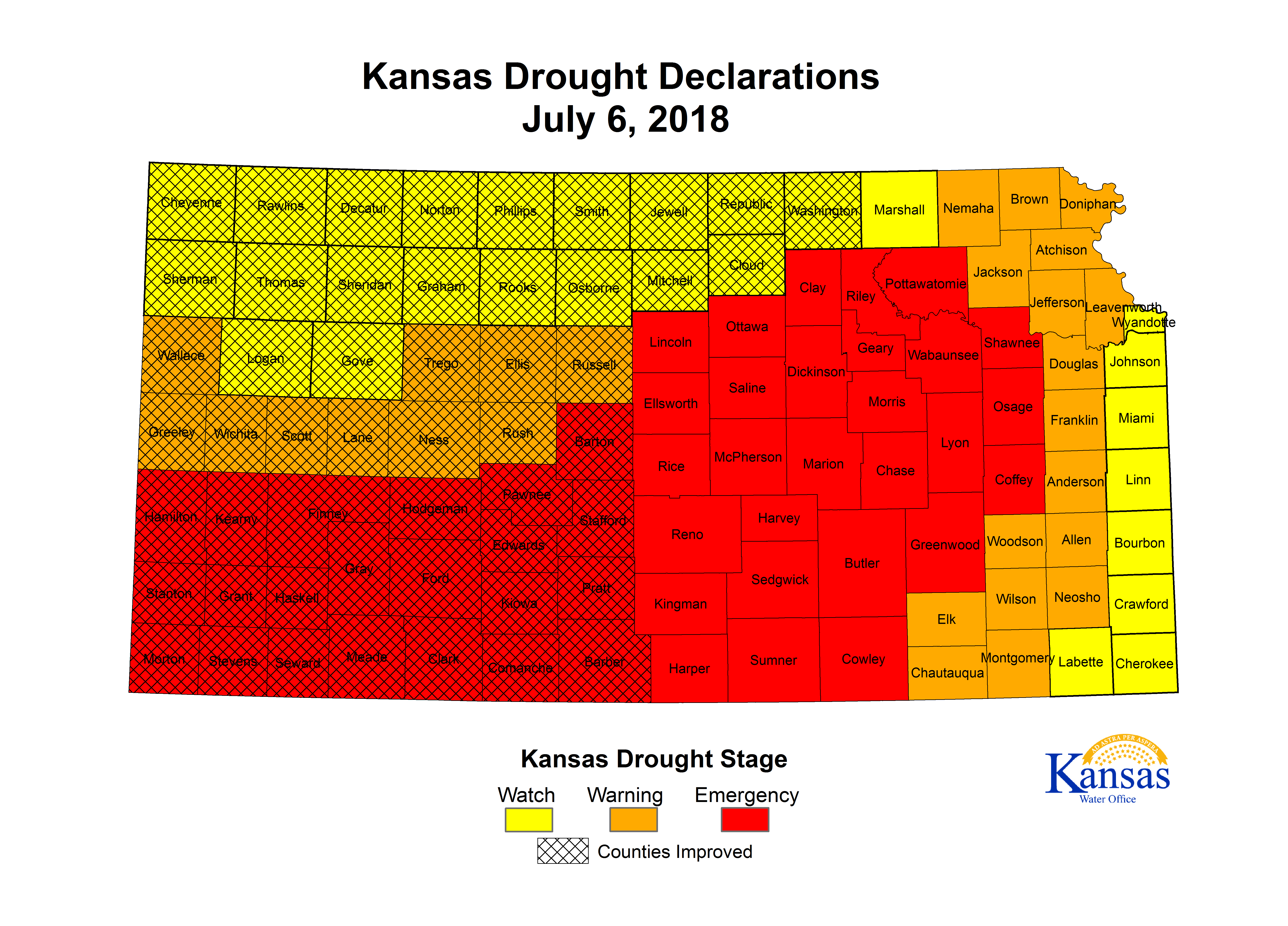
TOPEKA – While there have been some recent rains, drought conditions for many areas of Kansas continue to worsen. Today Governor Jeff Colyer updated the Drought Declaration for Kansas counties with Executive Order 18-16 (attached). The update includes all 105 counties either in an emergency, warning or watch status. This order places nearly half of Kansas counties in an emergency drought status.
“Kansans need to know no matter where you live in the state, the drought is not over,” said Governor Jeff Colyer. “I’ve heard many concerns from producers and have seen the conditions first hand. We appreciate our federal partners at the Natural Resources Conservation Service as well as the Kansas Association of Conservation Districts— when we asked them to identify additional sources of assistance they responded quickly to help producers address these extreme drought conditions.”
The updated drought declaration has 50 counties in emergency status, 27 in warning status while 28 counties are in watch status. This action was recommended by Tracy Streeter, Director of the Kansas Water Office (KWO) and Chair of the Governor’s Drought Response Team.
“With reported livestock water shortages, low flows at some of our reservoirs and monthly outlooks favoring persistent drought we know it’s imperative to monitor conditions closely,” said Tracy Streeter. “Some areas of Kansas are behind more than 15 inches in moisture for the year and outlooks favor above normal temperatures and below normal precipitation in July.”
Counties in emergency stage are eligible for emergency use of water from certain state fishing lakes due to the KWO Memorandum of Understanding (MOU) with the Kansas Department of Wildlife (KDWPT). They also become eligible for water in some Federal reservoirs.
Individuals and communities need to contact KWO for a water supply request prior to any withdrawals from lakes. They will in turn be referred to the appropriate office to obtain the necessary permit to withdraw the water.
This Executive Order and any authorized upgrade shall remain in effect for those counties so identified until rescinded by Executive Order or superseded by a subsequent Executive Order revising the drought stage status of the affected counties. Effective immediately:
Declare a Drought Emergency, Warning or Drought Watch for the counties identified below;
Authorize and direct all agencies under the jurisdiction of the Governor to implement the appropriate watch or warning level-drought response actions assigned in the Operations Plan of the Governor’s Drought Response Team.
The Governor’s Drought Response Team will continue to watch the situation closely and work to minimize the effects the drought has on Kansans.
For more detailed information about current conditions, see the Kansas Climate Summary and Drought Report on the Kansas Water Office website at: www.kwo.ks.gov.
TOPEKA – The Kansas Department of Health and Environment (KDHE), in conjunction with the Kansas Department of Wildlife, Parks and Tourism (KDWPT), has issued public health warnings for Carbondale West Lake, Clarion Woods Park Lake, Webster Lake. Atchison County Park Lake, Melvern Outlet Pond, Melvern Outlet Swim Pond and Topeka’s Central Park Lake (Pond) for the upcoming weekend and week.
If a lake is under a public health warning for blue-green algae, activities such as boating and fishing may be safe. However, direct contact with water (i.e., wading, skiing and swimming) is strongly discouraged for people, pets and livestock. The lakes currently under a public health advisory:
Warning: Carbondale West Lake, Osage County
Warning: Clarion Woods Park Lake, Shawnee County
Warning and Beach Closed: Webster Lake, Rooks County
Warning: Atchison County Park Lake, Atchison County
Warning: Melvern Outlet Pond, Osage County
Warning: Melvern Outlet Swim Pond, Osage County
Warning: Central Park Lake (Pond), Shawnee County
The U.S. Army Corp of Engineers has stated swimming is not allowed at the Melvern Outlet Swim Pond Beach and all wading and contact with algae is highly discouraged. Melvern Lake Visitors can utilize Coeur d’Alene Swim Beach which sets on the main body of the lake, located west of the U.S. Army Corps of Engineers Project Office. The present algae bloom is isolated to the Outlet Pond and Outlet Swim Pond, Melvern Lake is not affected.
Lakes under a warning are not closed. Marinas, lakeside businesses and park camping facilities are open for business. If swim beaches are closed, it will be specifically noted. Drinking water and showers at parks are safe and not affected by algae blooms. Boating and fishing are safe on lakes under a warning, but contact with the water should be avoided. Hands should also be washed with clean water after handling fish taken from an affected lake. Zoned lakes may have portions fully open for all recreation even if other portions are under a warning.
Kansans should be aware that blooms are unpredictable. They can develop rapidly and may float around the lake, requiring visitors to exercise their best judgment. If there is scum, a paint-like surface or the water is bright green, avoid contact and keep pets away. These are indications that a harmful
bloom may be present. Pet owners should be aware that animals that swim in or drink water affected by a harmful algal bloom or eat dried algae along the shore may become seriously ill or die.
When a warning is issued, KDHE recommends the following precautions be taken:
Lake water is not safe to drink for pets or livestock.
Lake water, regardless of blue-green algae status, should never be consumed by humans.
Water contact should be avoided.
Fish may be eaten if they are rinsed with clean water and only the fillet portion is consumed, while all other parts are discarded.
Do not allow pets to eat dried algae.
If lake water contacts skin, wash with clean water as soon as possible.
Avoid areas of visible algae accumulation.
KDHE samples publicly-accessible bodies of water for blue-green algae when the agency receives reports of potential algae blooms in Kansas lakes. Based on sampling results, KDHE reports on potentially harmful conditions.
For information on blue-green algae and reporting potential harmful algal blooms, please visit https://www.kdheks.gov/algae-illness/index.htm. Human and animal illnesses potentially related to harmful algal blooms can also be reported through this website or by calling the KDHE Epidemiology Hotline at 1-877-427-7317.
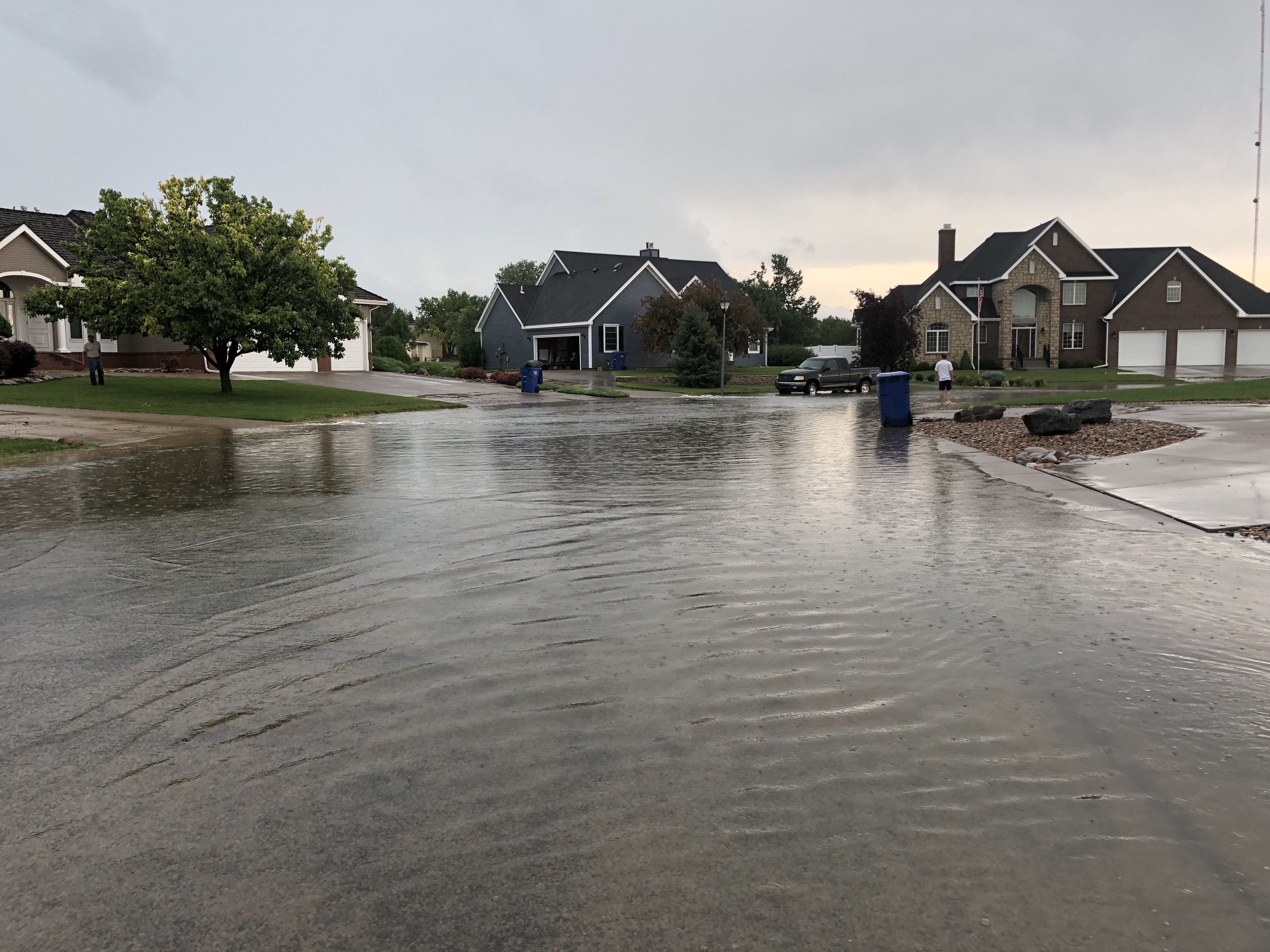
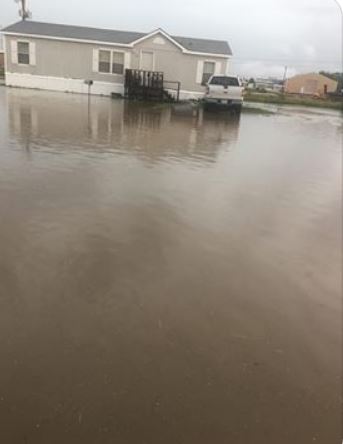
Southgate Homes, 1590 E Hwy 40 Bypass (Courtesy Stacey Holley)
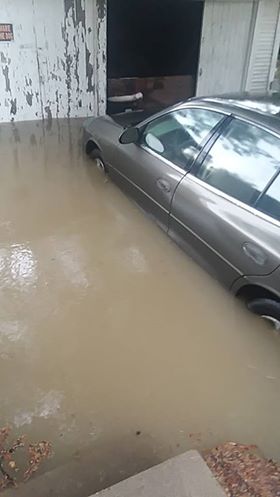
Backyard view in 200 block W. 17th (Courtesy Joe Crees)
Pershing Court (Courtesy Autumn Betts Omwenga)
UPDATE 12:45 p.m.
The Flash Flood Warning for central Ellis County has expired.
UPDATE 11:54 a.m.
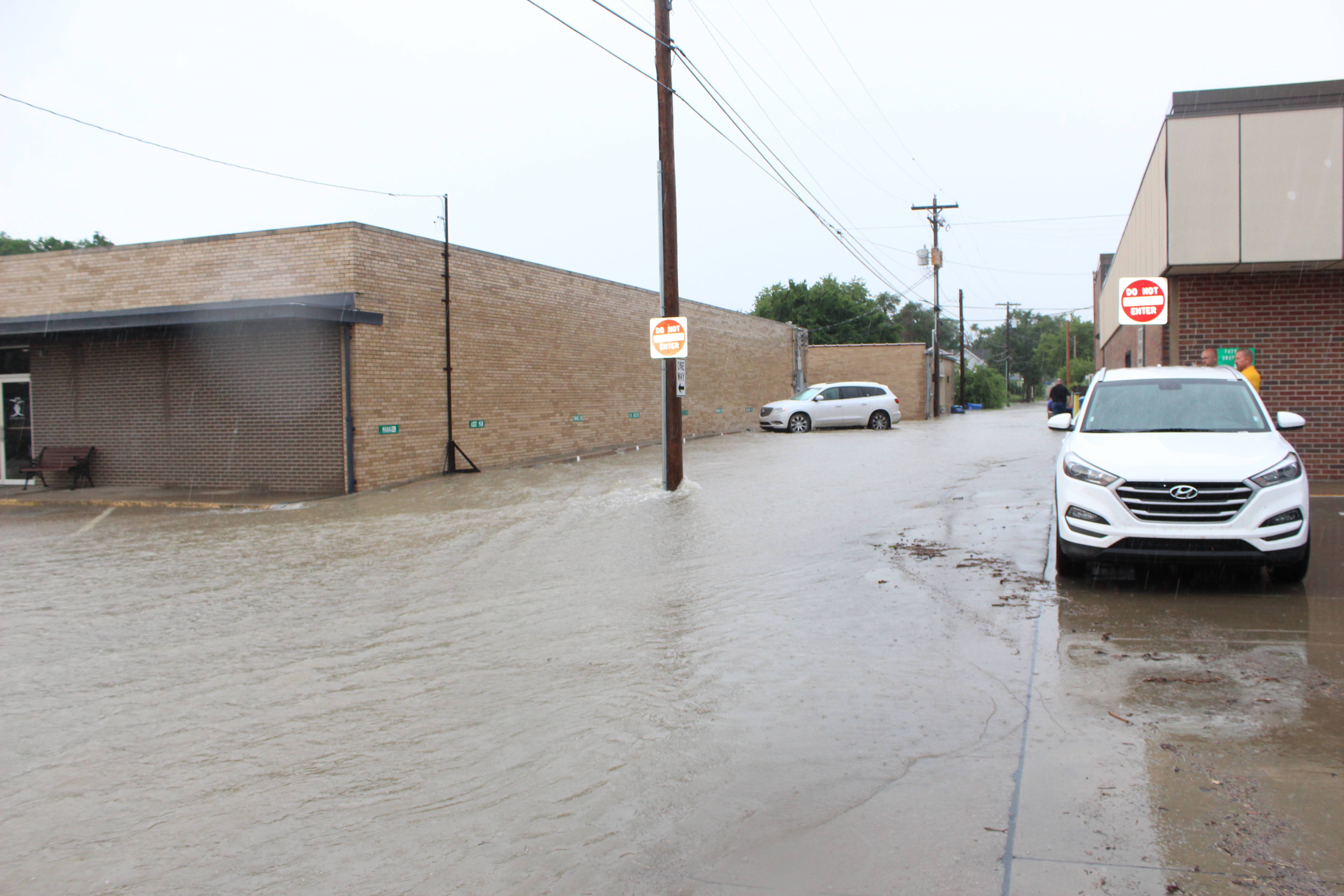
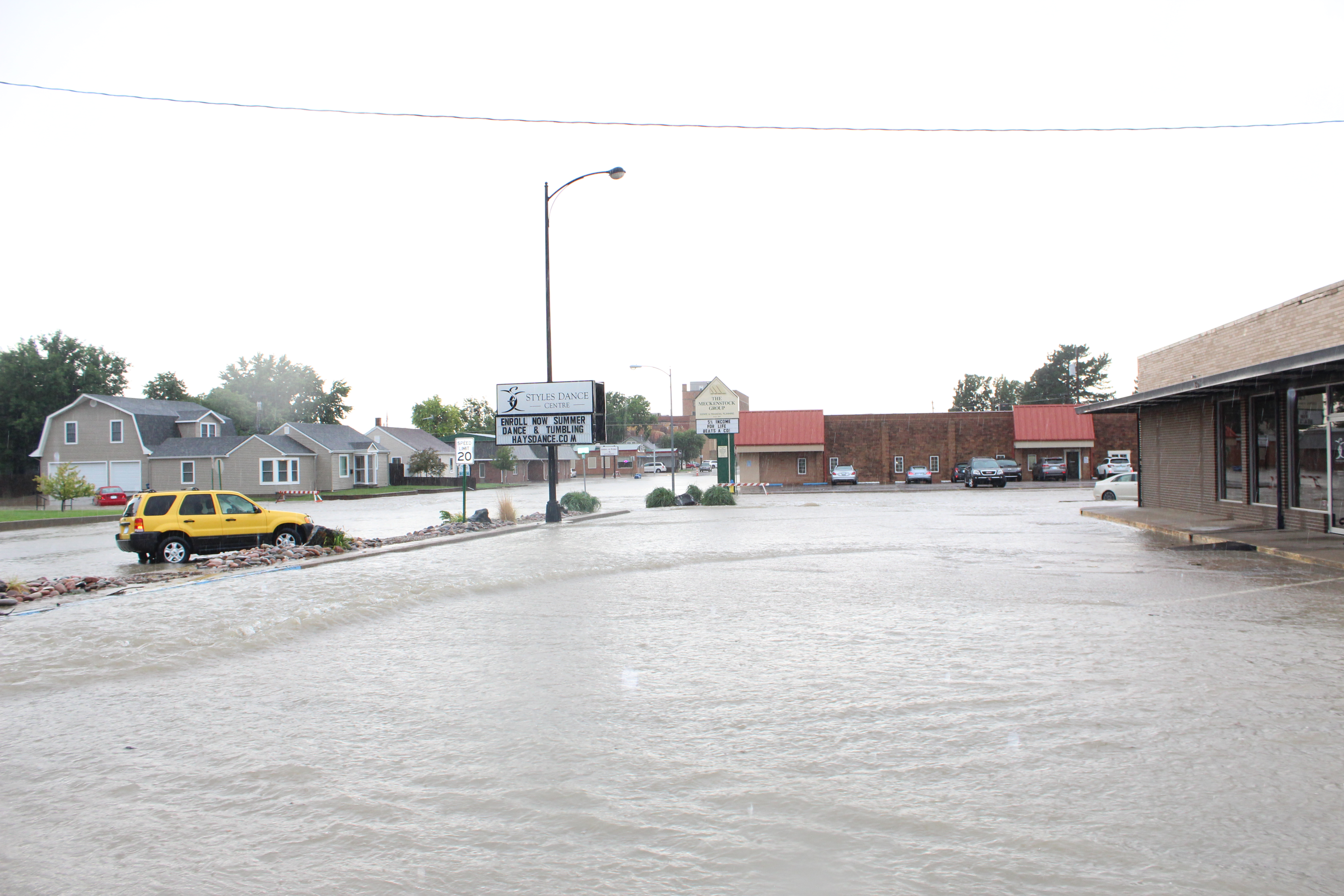
Police scanner reports indicated emergency responders were rescuing people from homes on Ash Street and on 17th Street due to flooding.
The following streets were impassible:
17th and Fort— Water was approaching homes in this area.
15th and Main streets
Thunderbird and 27th Street— Water is over the roadway on 27th Street. No traffic is recommended north of Hall Street.
UPDATE 11:20 a.m.
Sandbagging occurring around Hays City Hall/Hays Fire Station at 1507 Main
UPDATE 11:10 a.m.
3.45″ rain measured at Eagle Media Center, 2300 Hall
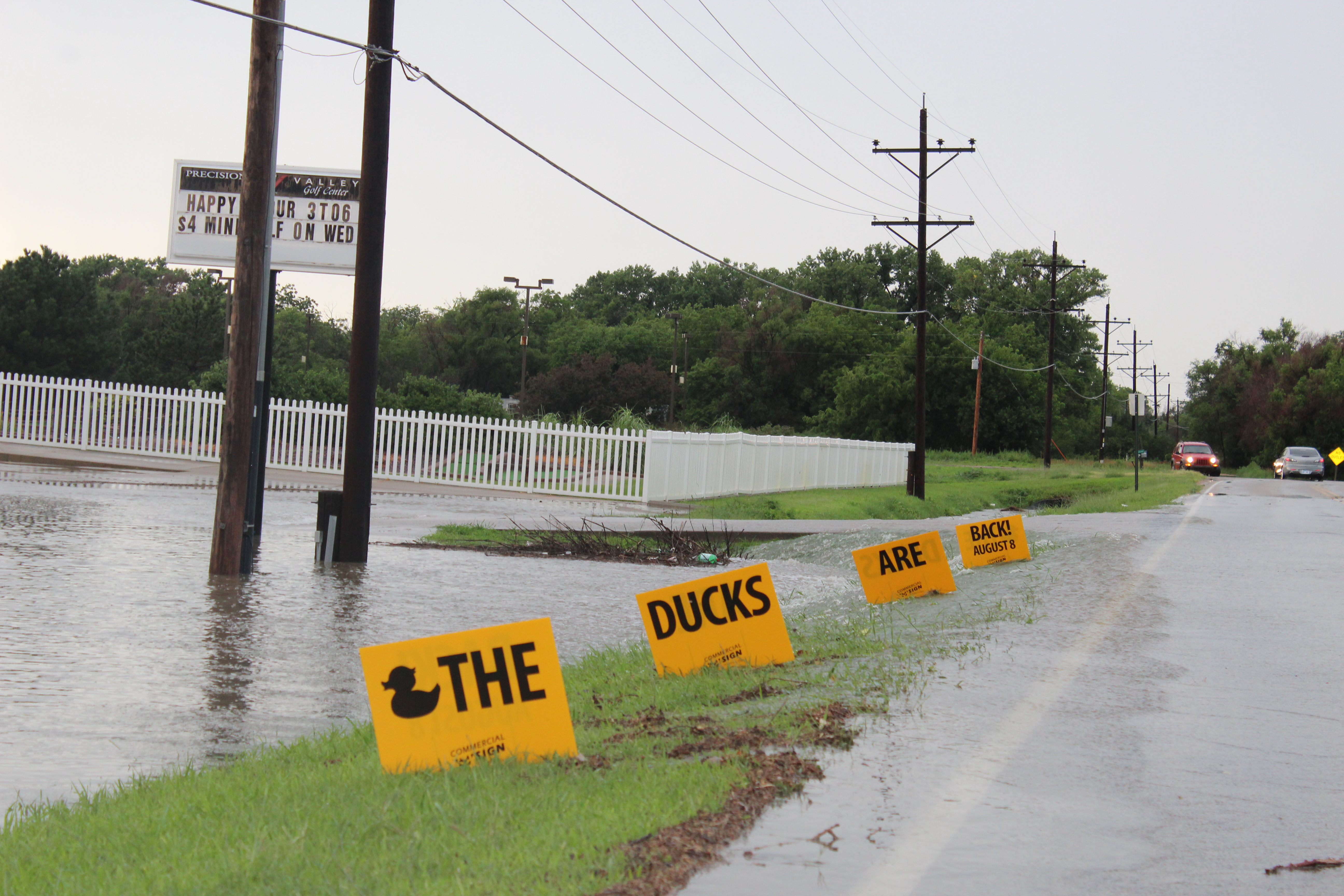
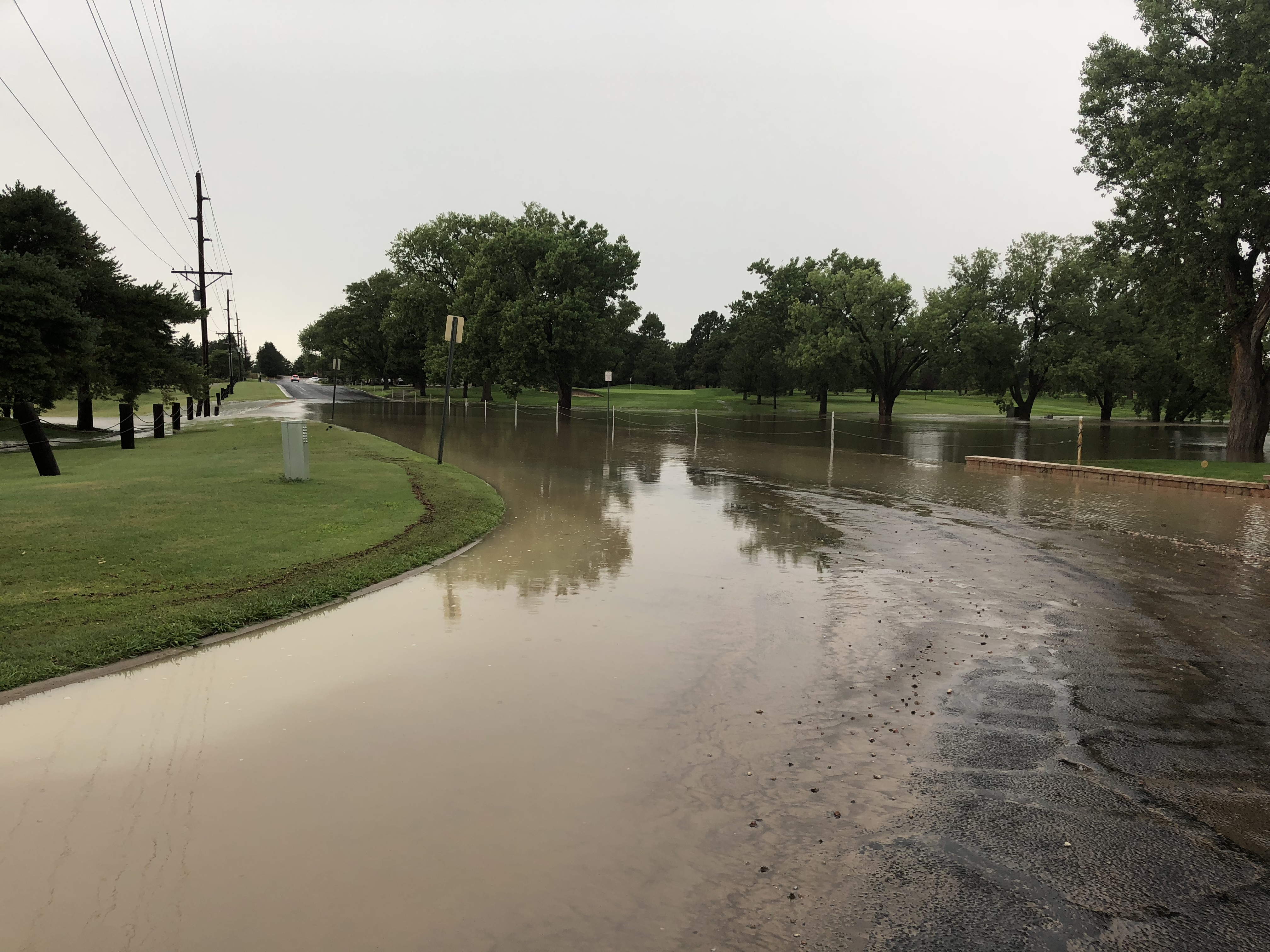
8th and Ash flooding (Photo courtesy Roger Agnew)4.20″ at 10:35 a.m. on north side of 27th Street just north of Precision Valley Golf & Bike Center (Photo courtesy Kris Munsch)
UPDATE 10:57 a.m.
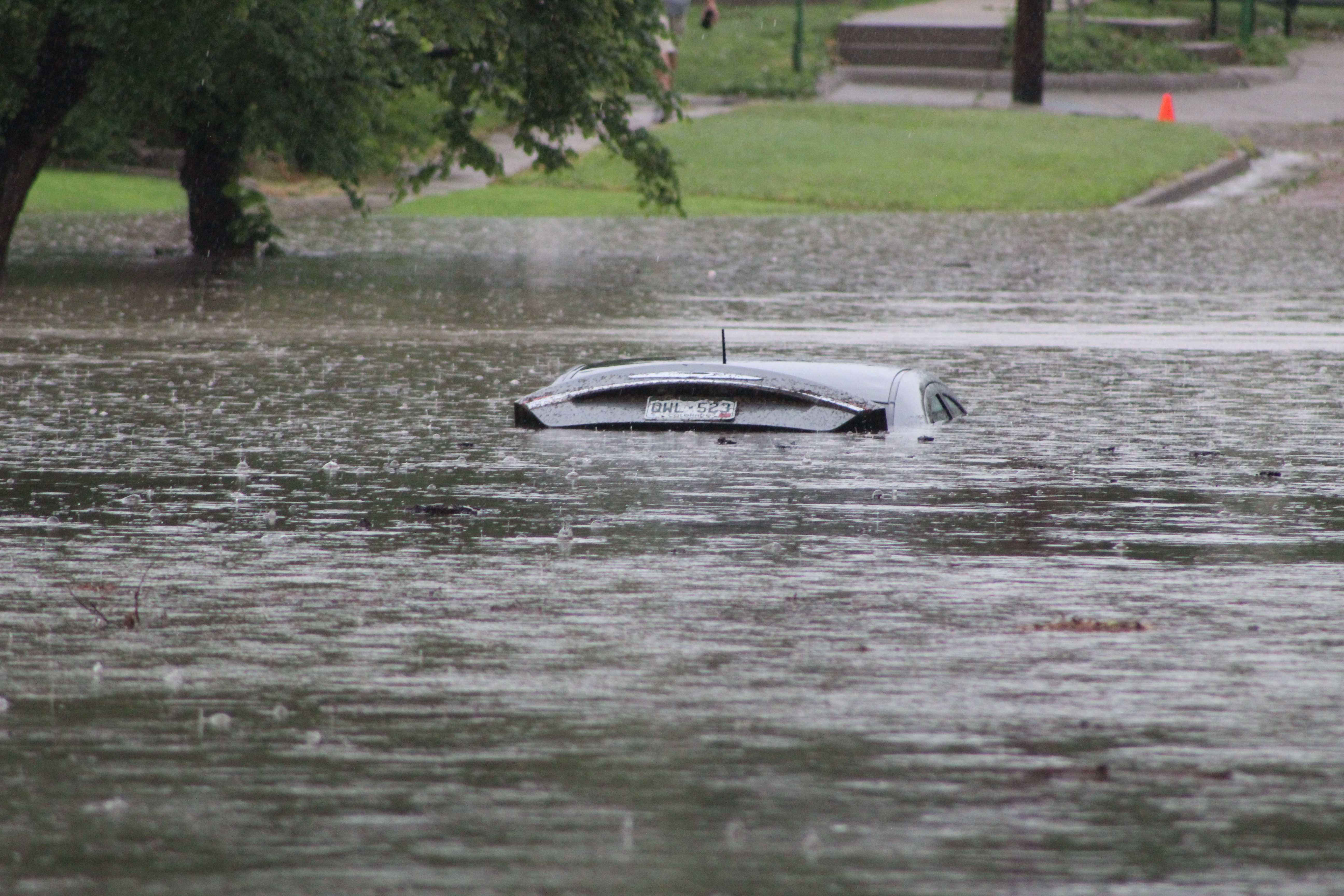
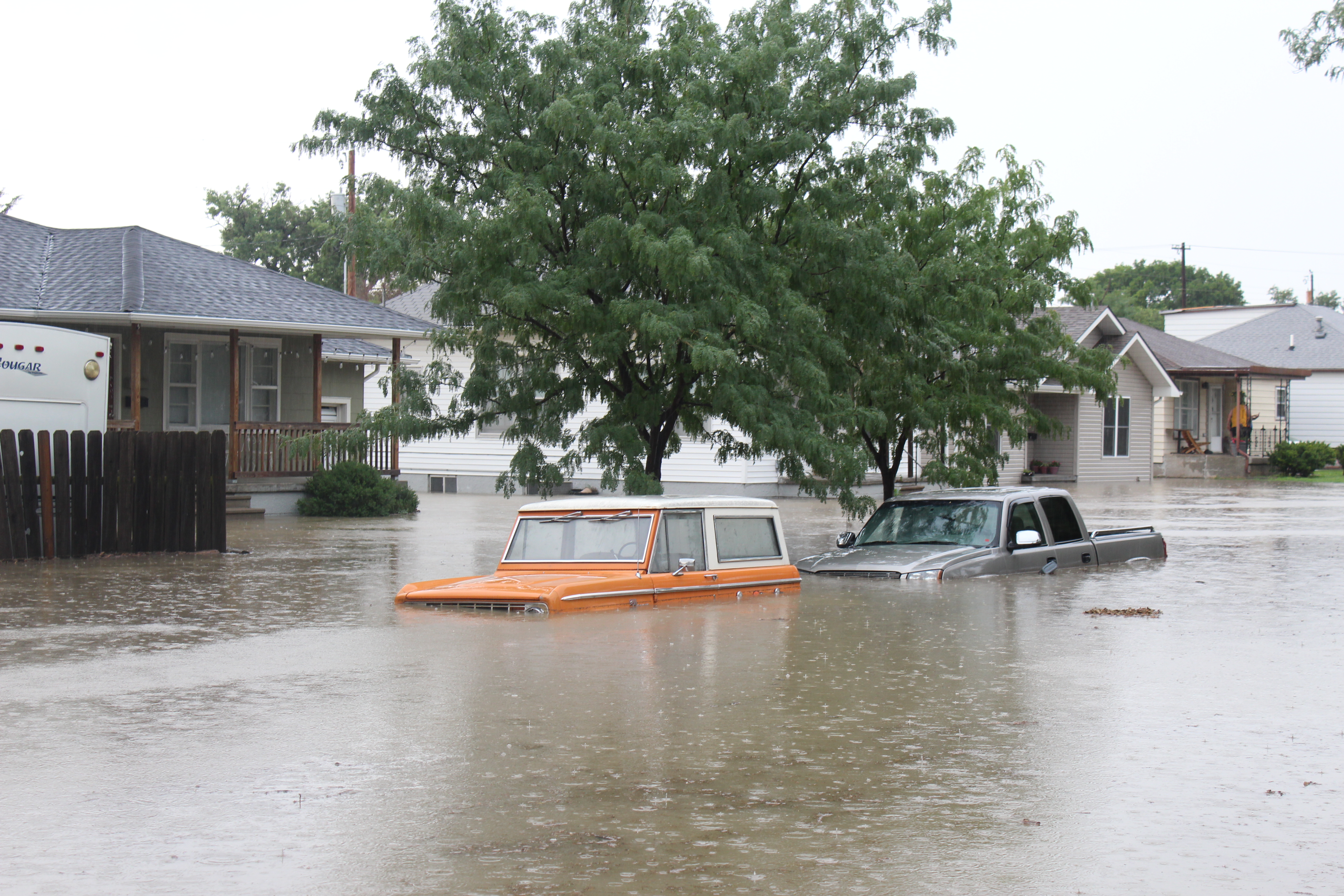
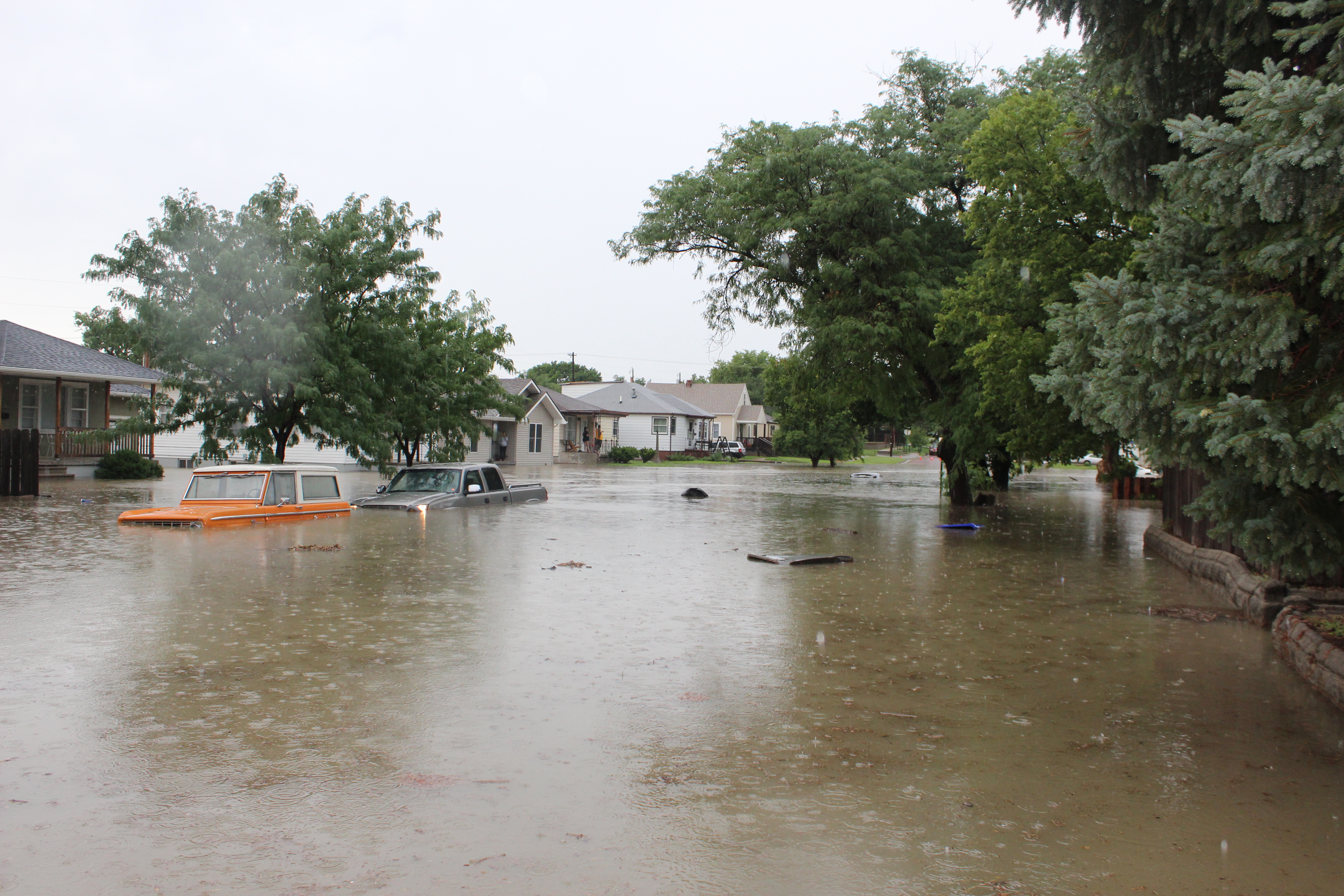
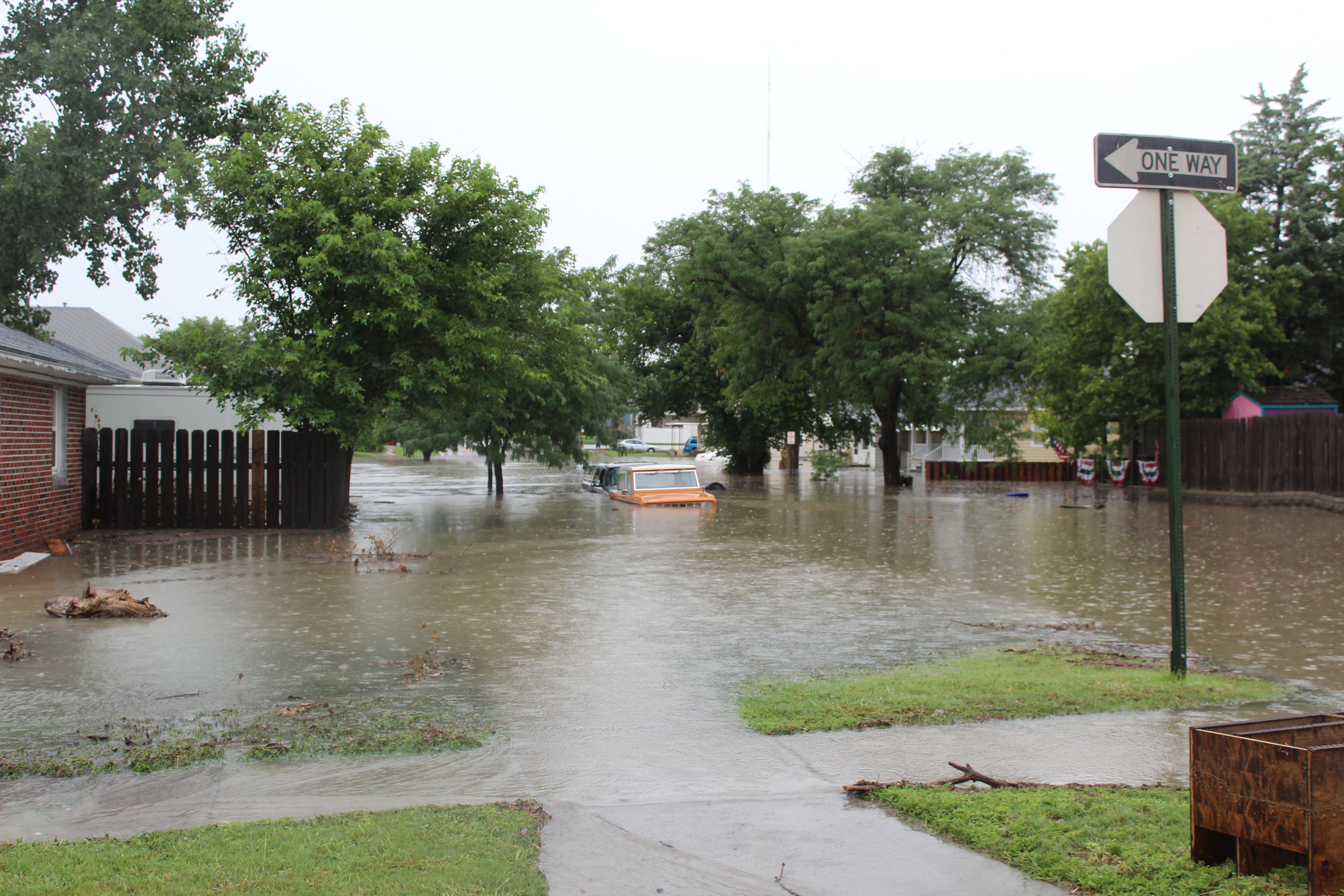
Vehicle with water up to roof reported just west of 17th and Fort
UPDATE 10:42 a.m.
Disabled vehicle in at 2700 Thunderbird Drive
UPDATE 10:31 a.m.
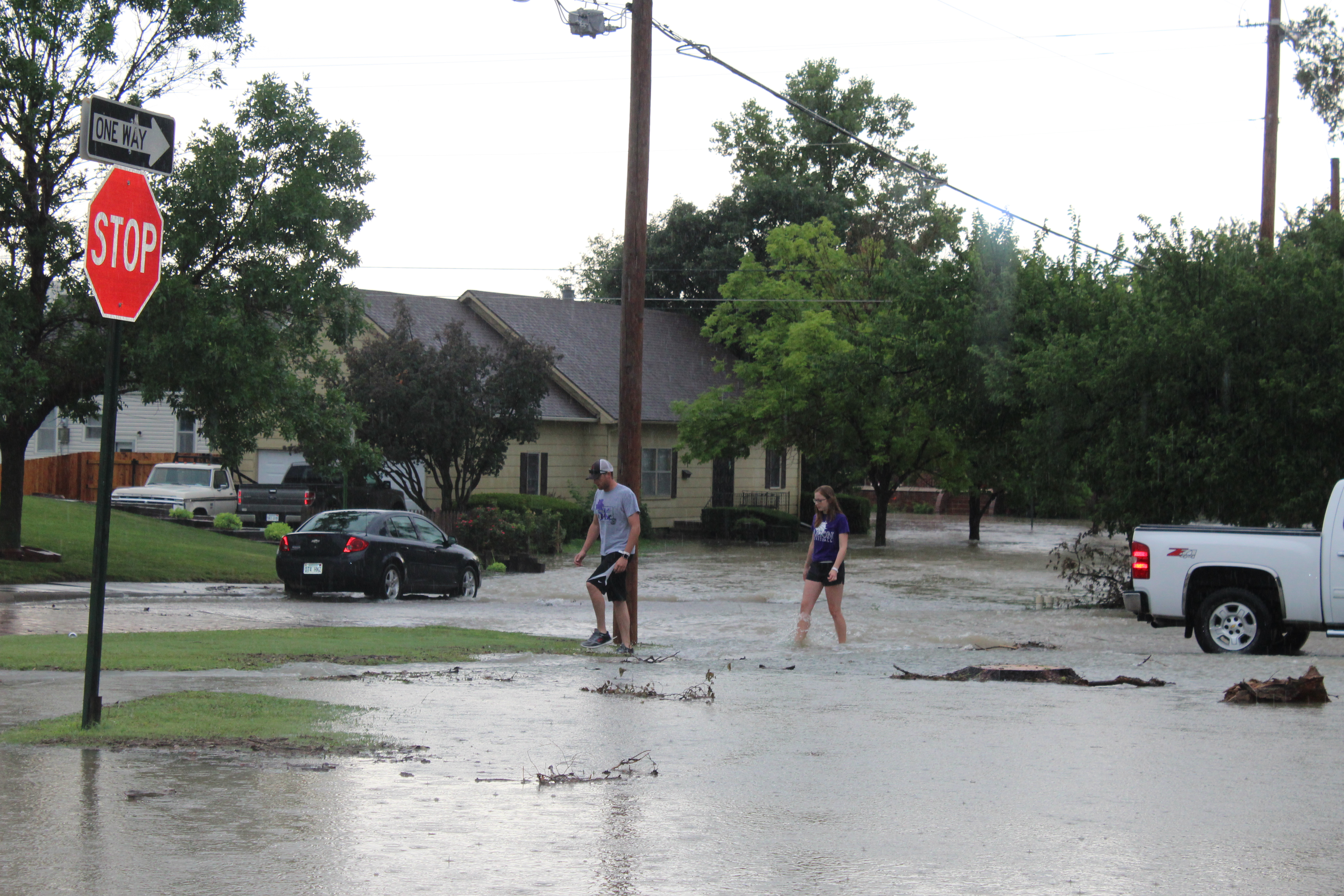
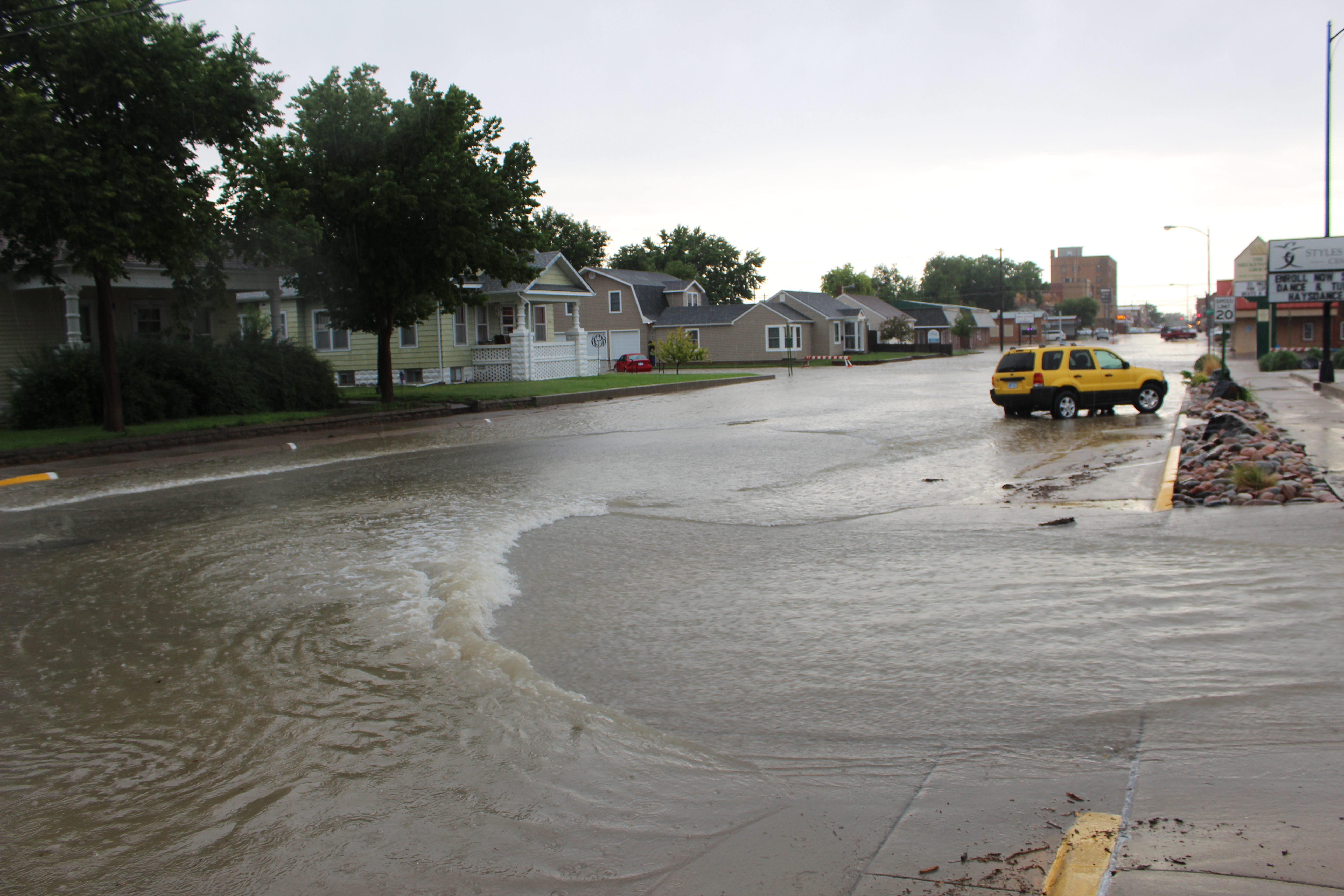
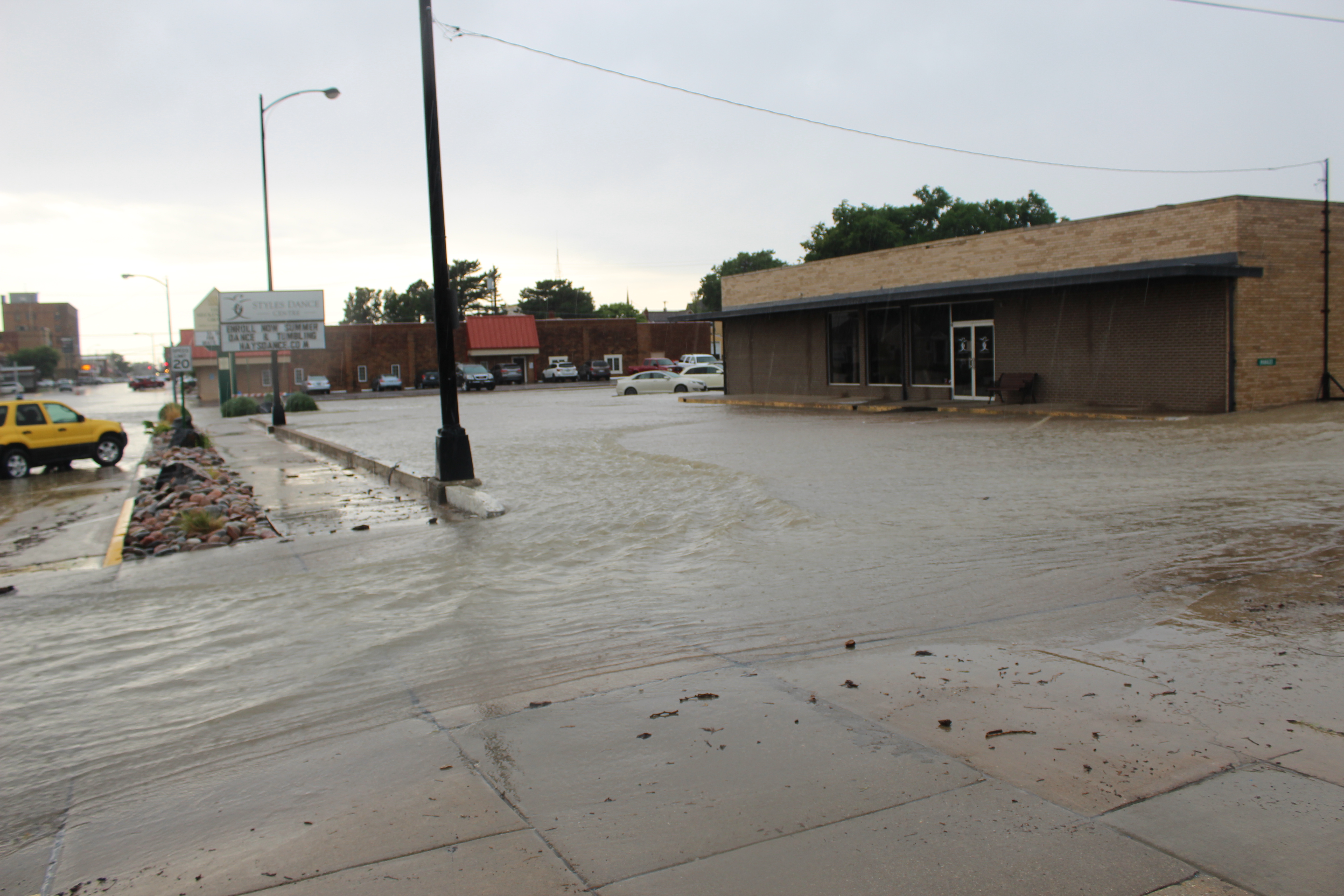
Hays Fire Dept. reports the Lincoln Draw has water flowing south over the bridge at 20th and Lincoln; 20th Street flooded from Main to 13th and impassable; Disabled vehicle in 200 block of W. 17th–driver out and okay.
UPDATE 10:27 a.m.
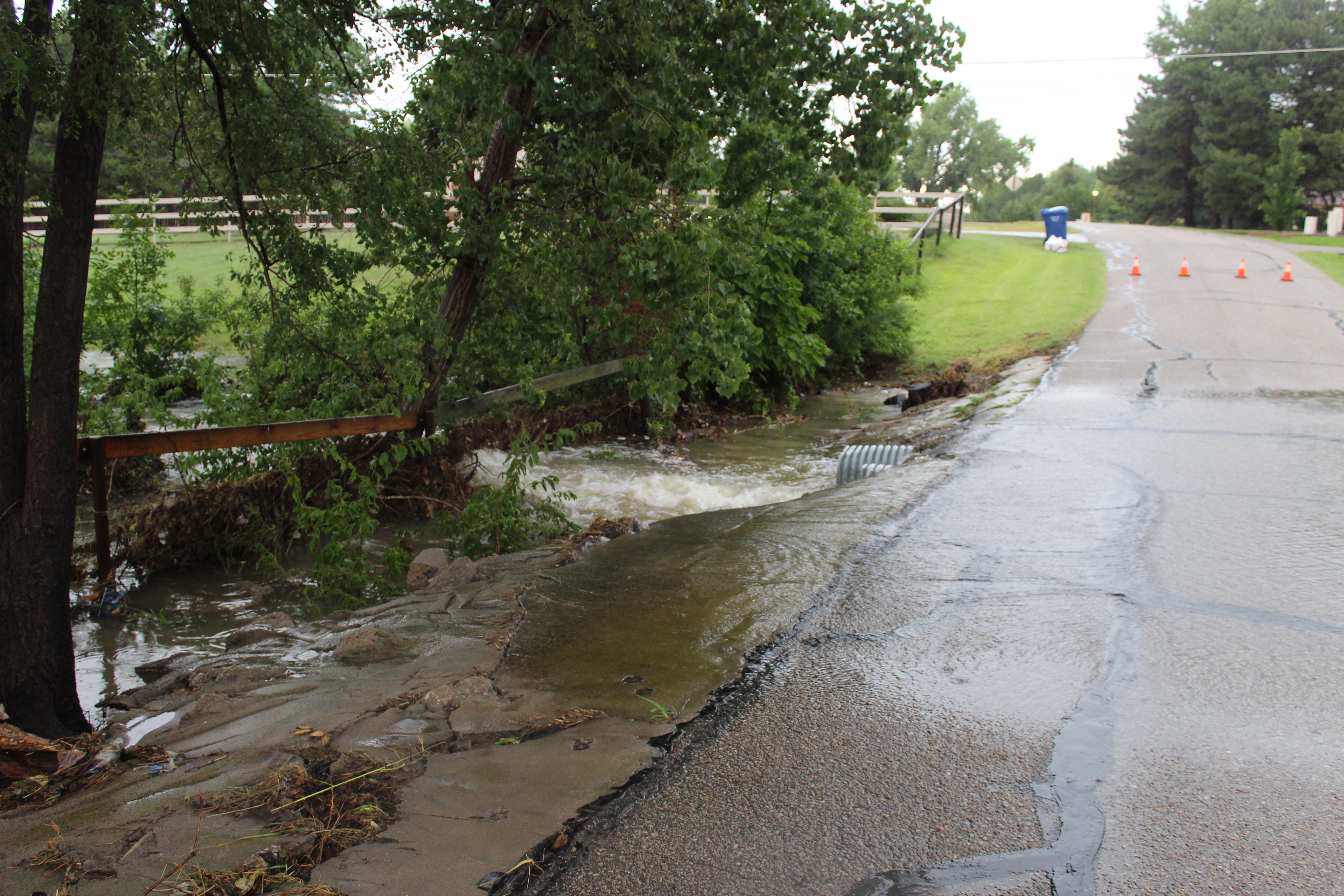
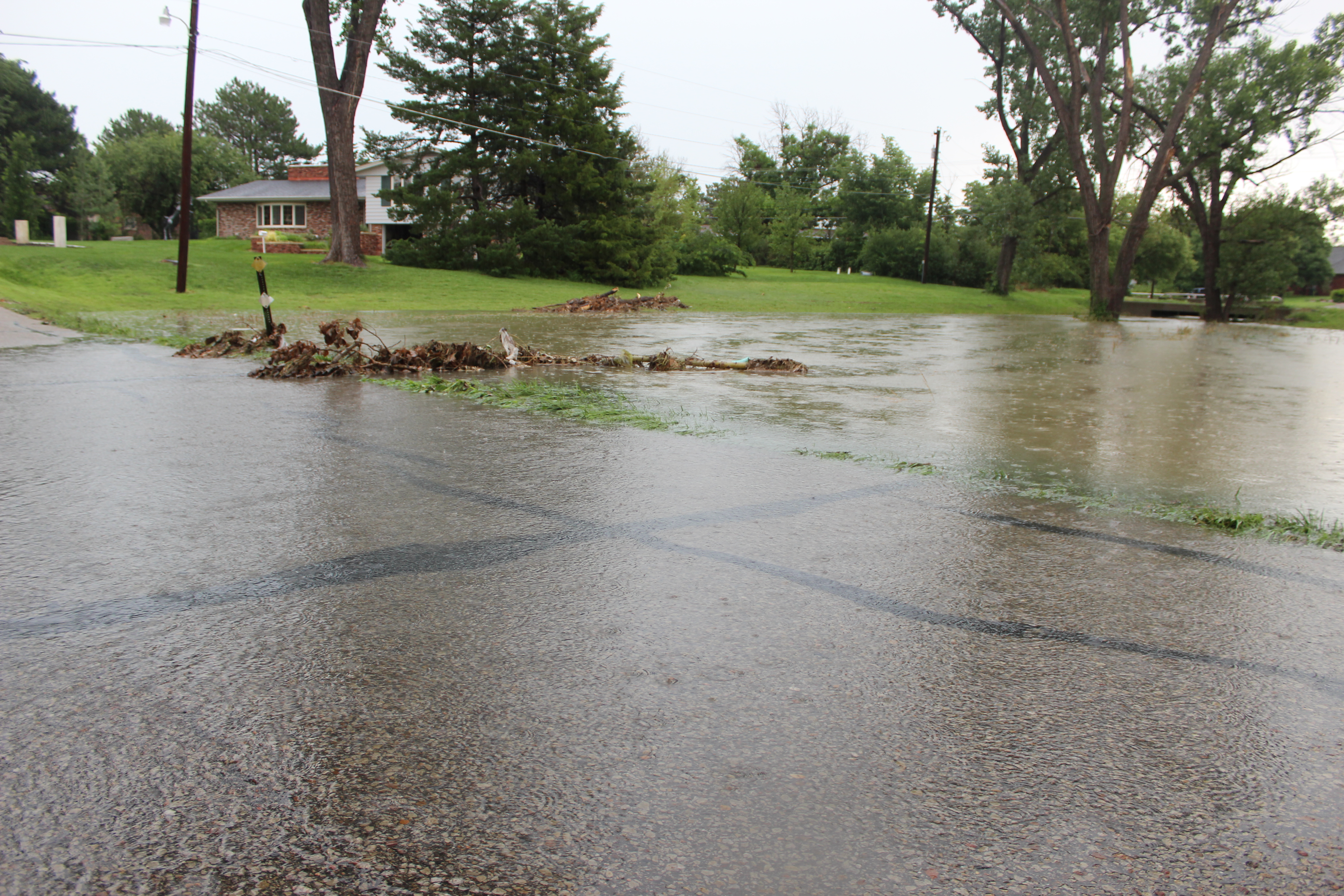
Rain flowing from VanDoren Pond (27th & Cottonwood) south across 27th into Lincoln Draw (Photo courtesy Heidi Van Doren Weis)
Vehicle stranded at 20th and Oak, area to be blocked. VanDoren Pond (27th and Cottonwood) is flooding. First responders checking Lincoln Draw flow to the south.
UPDATE 10:22 a.m.
Hays Police Chief Don Scheibler is urging Hays residents to stay off the streets.
“We have got street flooding all over town. It is going to get worse before it gets better, I think,” he said.
UPDATE 10:15 a.m.
Emergency responders called out for two stalled vehicles, one taking on water; High water alarm activated at VanDoren Pond at 27th and Cottonwood Lane
UPDATE 10:08 a.m.
National Weather Service reports more than 1 inch of rain in Hays falling in less than 20 minutes.
UPDATE: 9:52 a.m.
Hays police are reporting street flooding at 20th and Vine and the 2100 block of Main.
NWS
DODGE CITY – The National Weather Service in Dodge City has issued a
* Flash Flood Warning for…
Central Ellis County in central Kansas…
* Until 1245 PM CDT.
* At 937 AM CDT, Doppler radar indicated heavy rain across the warned
area. Flash flooding is expected to begin shortly.
* Some locations that will experience flooding include…
Hays, Victoria, Catherine, Yocemento, Toulon, Munjor and Emmeram.
Charlene Weber is retiring as the Ellis City Clerk. (Photo courtesy city of Ellis)
CITY OF ELLIS
The city of Ellis invites the public to a retirement reception in honor of Charlene Weber as she retires after 32 years of dedicated service as Assistant City Clerk.
The reception will be held on Friday, July 13, 2018 from 1:00 to 4:00 p.m. in the City Council Chambers at 815 Jefferson.
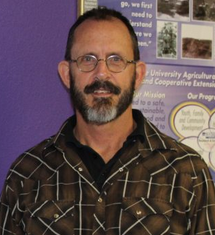
Ron Wilson is director of the Huck Boyd National Institute for Rural Development at Kansas State University.
By RON WILSON Huck Boyd National Institute for Rural Development
“1 Kansas farmer feeds more than 155 people + You!” Signs proclaiming this message are frequently seen along the highways and byways of Kansas. These signs demonstrate the passionate advocacy for agriculture which is found in an innovative farm family in rural Kansas.
Jeanne and Harold Mertz were the farm couple who initiated this farm sign project and other projects to benefit agriculture. Harold grew up on a farm southeast of Manhattan. He was a charter member of the Zeandale 4-H Club. During his last year in 4-H, he showed the grand champion steer at the American Royal.
Harold attended K-State where he met Jeanne, who was born in Kansas City, Kansas and had grown up in Oskaloosa. They married and moved back to his family farm, which was named River Creek Farms because it was situated in the Kaw River valley between the Kansas River and Deep Creek.
The Mertzs were grain farmers and producers of cattle and sheep. Harold would feed thousands of lambs in a typical winter. The Mertzs also raised five children: Joe, Tom, Bob, Jane, and Jon.
Harold and Jeanne were both strong leaders. They were named Master Farmer and Master Farm Homemaker in 1987. Harold served on state and national sheep association boards, farm co-op boards, and the school board. He also served as a long-time community leader for the Zeandale 4-H Club. Jeanne was a state and national president of farm women organizations now known as Kansas Agri-Women and American Agri-Women.
Both were strong advocates of agriculture. In the 1970s, Jeanne suggested a way to inform the general public about the benefits of farm production. She proposed, and the farm women’s organization agreed, to put up signs along the highways. These signs depicted a sack full of groceries with the wording “1 Kansas farmer feeds 55 people + You!” When the first signs were erected, the number fed per farmer was 55. As agricultural productivity grew through the years, the number increased and the signs were updated.
Maybe that is like the way McDonald’s used to put on its signs the numbers of hamburgers it sold. Anyway, the most recent Kansas Agri-Women signs now say “more than 155 people + You!”
This sign project generated lots of visibility. At one point, some 60 signs were located around Kansas. Someone observed that Harold enjoyed working with Jeanne on this project, but at the time he didn’t realize that he would become the chief project manager in charge of erecting the signs all across Kansas roadways!
In more recent years, Kansas Agri-Women is working with a sign company to have the signs produced on vinyl and has adapted those signs into magnets, smaller metal signs and posters. One such sign was put on display at the Flint Hills Discovery Center and more than 18,000 people have viewed the sign there.
On National Agriculture Day in 2016, Jeanne arranged to have these magnets placed on the statehouse desks of every Kansas representative.
Over time Harold and Jeanne’s sons Joe and Bob came back to join the family farming operation, along with Joe’s wife Kim and Bob’s wife Mary and the next generation of children.
Harold passed away in fall 2015 and Jeanne passed 14 months later. At the time of her death, she had 11 grandchildren, two step-grandchildren, seven great grandchildren, and five step-great grandchildren. Those great grandchildren would be the sixth generation to farm in this fertile Kansas River valley. That also makes for a big family photo.
These family ties are deeply rooted at River Creek Farms, located just east of the rural community of Zeandale which has a population of perhaps 50 people. Now, that’s rural.
“1 Kansas farmer feeds more than 155 people + You!” That message conveys the importance and productivity of Kansas farmers. We salute Jeanne and Harold Mertz for their family farm and their advocacy of agriculture. We are lucky to be so well-fed.
And there’s more. The next generation of the Mertz family is carrying on this agricultural tradition and moving it up to another level. We’ll learn about that next week.
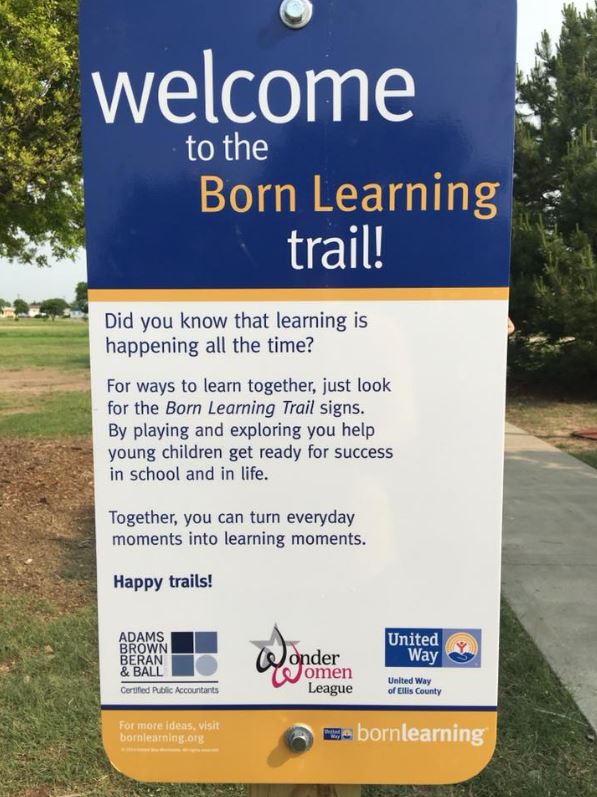
Adams, Brown, Beran and Ball staff complete the installation of the Born Learning Trail at Sunrise Park just south of Roosevelt School June 1. (Photo courtesy UWEC)
UWEC
The Wonder Women League of the United Way of Ellis County and Adams, Brown, Beran, and Ball, are pleased to announce the ribbon cutting of the of the Born Learning Trail at 10:00 a.m. on July 10, 2018 at Sunrise Park, 19th and Lawrence Drive, Hays. The public is invited.
The Wonder Women League’s mission is to inspire and empower women to affect change in our community.
Sherry Dryden, executive director of the United Way said “the Wonder Women are just that. They are determined, strong women continuously forging forward for the betterment of Ellis County. This trail is the first community impact project of the WWL. The trail was installed by the staff of Adams, Brown, Beran and Ball for a community volunteer project. They will also be maintaining the trail for years to come.”
“This collaboration between the Wonder Women League and Adams, Brown, Beran and Ball truly shows what Ellis County is all about – Living United. The United Way is very proud of these women and their accomplishments,” Dryden added.
In comparison to another county of a population of over 300,000, that United Way’s first convening of their Women’s United organization only gathered 30 members and it took two years for their first fundraiser and project. The first six months of the Wonder Women League of the United Way of Ellis County gathered 35 members, did one fundraiser and completed their first Community Impact Project.
Additionally, they are already working on their next two projects and fundraiser. Membership is continuously welcomed. For more information go to www.liveunited.us/wonder-women-league.
Rip WinkelDo you have tomato plants that are blooming but not setting fruit? There are a number of reasons why this might be happening. One obvious reason could be that there is an excessive amount of nitrogen (i.e. fertilizer) the plant has access to. Nitrogen causes plants to emphasize vegetative growth, often to the detriment of flower production, hence no fruit. Moreover, over-fertilization can lead to a delay in flower production and/or a decrease in fruit-set among the flowers produced.
Another possible problem with no fruit-set is the lack of pollination of the tomato flowers. Tomatoes are typically wind pollinated, therefore are not dependent on pollinators. Having said that though, tomatoes normally won’t set fruit if the night temperature is below 50o F due to sparse production of pollen. Temperatures that reach up to and remain above 750 F at night and day temperatures above 950 F coupled with dry, hot winds will cause poor fruit set on tomatoes, (cherry tomatoes, however, seem to be much more heat tolerant than slicers). It is these high temperatures that interfere with pollen viability and/or cause excessive style growth leading to the lack of pollination, ergo low to no fruit set during the extreme summer heat.
If the temperatures are ideal, and a tomato flower becomes pollinated, it usually takes about 3 weeks for it to develop into fruit about the size of golf balls. Growth then becomes more rapid with the mature size being reached in an additional three to six weeks.
A few more days are then needed to change color.
Although there are “heat-set” slicing tomato varieties, such as Florida 91, Sun Leaper and Sun Master that will set fruit at “higher temperatures”, the difference is normally only 2 to 3 degrees…which is not really that much. It is the cooler temperatures that will allow flowers to resume fruit-set.
Furthermore, the extremely hot weather we have here in this area of Kansas not only interferes with flower pollination, it can also affect how quickly fruit matures. The best temperature for tomato growth and fruit development is 850 to 900 F. When temperatures exceed 1000 F, the plant goes into survival mode and concentrates on moving water to the leaves. Fruit development slows to a crawl. When temperatures moderate, even to the low to mid 90s, the fruit will then continue to ripen more quickly.
Tomato color can also be affected by heat. When temperatures rise above 950 F, red pigments don’t form properly though the orange and yellow pigments do. This results in orange fruit. This doesn’t affect the edibility of the tomato at all, just it’s presentation.
So, can we do anything to help our tomatoes ripen and have good color during extreme heat? You bet there is. One can pick tomatoes when they are in the “breaker” stage. Breaker stage tomatoes are those that have started to turn color. At this point, the tomato has cut itself off from the vine and nothing will be gained by keeping it on the plant. If tomatoes are picked at this stage and brought into an air-conditioned house, they will ripen more quickly and develop a good, red color. Indoor temperatures ranging around 750 to 850 F will work best.
Rip Winkel is the Horticulture agent in the Cottonwood District (Barton and Ellis Counties) for K-State Research and Extension. You can contact him by e-mail at [email protected] or calling either 785-682-9430, or 620-793-1910.
All five seats on the Hays city commission are once again filled.
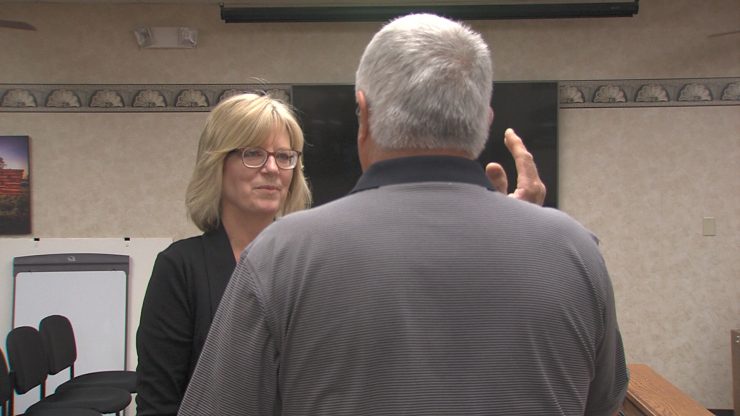
Ron Mellick was sworn in Thursday night by City Clerk Brenda Kitchen during the commission’s work session. Mellick fills the seat vacated June 20 by Chris Dinkel who is moving to New York City to attend law school this fall.
“I want to thank the commission for entrusting me with the responsibility of filling Commissioner Chris Dinkel’s vacant term,” said Mellick.
“I will try very hard to serve all the people of Hays.” The unexpired term runs until 2020.
Mellick previously served two terms as a city commissioner from 2007 to 2015, including a stint as mayor.
His experience was cited by the other commissioners when they voted June 28 to appoint Mellick to the unexpired term.
“I appreciate that you’re willing to step forward, Commissioner Sandy Jacobs said last night. “It’s nice having the experience and the background especially as we’re entering the budget process. So we appreciate you wanting to serve.”
City Manager Toby Dougherty then reviewed highlights of the 2019 budget proposal, noting the mill levy will remain unchanged at 25 mills. The commission asked for a few revisions and additional information which will be presented at the July 19 work session.