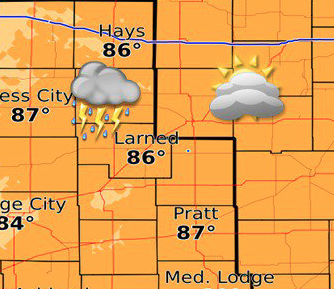
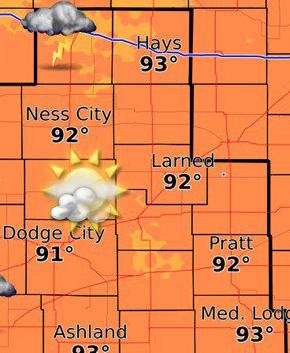
Today A 30 percent chance of showers and thunderstorms, mainly after noon. Patchy fog before 9am. Otherwise, mostly cloudy, with a high near 87. East wind 7 to 10 mph.
Tonight A 10 percent chance of showers and thunderstorms before 7pm. Partly cloudy, with a low around 67. Southeast wind 5 to 9 mph becoming light south southeast after midnight.
Saturday Mostly sunny, with a high near 90. South southeast wind 6 to 11 mph.
Saturday Night Mostly clear, with a low around 66. South southeast wind 8 to 11 mph.
SundaySunny, with a high near 93. South wind 7 to 11 mph.
Despite the bangs and pops over the last several days, the Hays Fire Department reported only a couple of minor incidents related to fireworks.
The HFD responded to two small grass fires that were quickly extinguished. Just after midnight Thursday morning, spent fireworks left on a porch reignited and melted siding on a home at 312 E. 13th.
Interim Fire Chief Ryan Hagans said the damage was confined to the exterior of the home and no one was injured.
Hays Police Chief Don Scheibler said the city received 16 fireworks complaints from June 27 through Thursday morning. Most of those complaints were made on Tuesday and Wednesday and were regarding fireworks being shot between 11 and 11:59 p.m., after the hours allowed by city ordinance.
Although the city will continue to track complaints through today, fireworks in the city of Hays are prohibited as of 11 p.m. last night. No tickets were issued, Scheibler said.
He urged people who may have shot fireworks over the holiday to make sure any trash is picked up and any debris cleared from the roadway.
Scheibler also said traffic control for those watching fireworks went smoothly Wednesday night.
Both chiefs said Hays had a quiet and safe Fourth of July holiday.
TOPEKA – The Kansas Department of Health and Environment has rescinded a boil water advisory for the city of Natoma, located in Osborne County. The advisory was issued because of a line break resulting in a loss of pressure in the system. Failure to maintain adequate pressure may result in a loss of chlorine residuals and bacterial contamination.
Public water suppliers in Kansas take all measures necessary to notify customers quickly after a system failure or shutdown. Regardless of whether it’s the supplier or KDHE that announces a boil water advisory, KDHE will issue the rescind order following testing at a certified laboratory.
Laboratory testing samples collected from the City of Natoma indicate no evidence of contamination and all other conditions that placed the system at risk of contamination are deemed by KDHE officials to be resolved.
Kansans should expect candidates seeking state office this year to address state laws and practices that discriminate against LGBT persons. Governor Jeff Colyer recently signed a bill that allows faith-based adoption agencies that receive state funds to refuse service to gay and lesbian couples based on religious beliefs. This law creates a license to discriminate, and LGBT Kansans should rightly wonder what laws the state will pass next that target their rights.
Patrick R. Miller is an Assistant Professor of Political Science at the University of Kansas.
Defenders of the bill have contended that the new adoption law does not change existing practices. True, to an extent, but that argument misses the point.
Private adoption organizations previously have been able to exclude LGBT couples over religious beliefs, and the state made an administrative choice to work with them without any law directly addressing the situation. The new law formally recognizes that exclusion as “religious freedom” and codifies that state dollars can support groups that discriminate against LGBT Kansans.
If you are a LGBT Kansan, the state has essentially singled you out and placed you in a formal “separate but equal” system. If you want to adopt, there are some services that you can access, and others that you cannot even though the state is using your tax dollars to pay for them. And because states are increasingly moving toward adoption systems that rely on private organizations, in the long run this new law risks creating a system where LGBT Kansans in theory have a right to adopt but in practice do not.
What other groups does our state treat in this way?
The deeper issue here is that sexual orientation and gender identity are not protected under state non-discrimination laws in the same way that race or religion are, for example. That is precisely why overt discrimination against LGBT people, whether based on religious belief or not, is legal in Kansas.
Let’s take a different issue. Technically under Kansas law right now since sexual orientation is not protected under non-discrimination laws, an employer can refuse to hire gays or lesbians, and legally fire employees solely for coming out as gay or lesbian. That is legal from the state’s perspective given the absence of any formal protection for LGBT Kansans under state law. But, because religion is protected under non-discrimination laws, an employer cannot fire someone solely because they discover, for example, that their employee is Evangelical Christian or Catholic.
“Religious freedom” bills in others states have had provisions protecting the right of employers to not hire or to fire people strictly because of their sexual orientation or gender identity. Imagine that Kansas passed a religious freedom law that formally recognized that practice, actually writing into law a license to discriminate against LGBT Kansans in employment. Should LGBT people feel okay that no practices actually changed even though Kansas now formally singled them out for legal discrimination? Likely not.
Yes, some people see not associating with LGBT individuals as their religious right and want that perceived right protected by the state, but others understandably see that as discrimination. So, does the state choose equality for all, or does it choose a system where one citizen has the license to limit another citizen’s rights? Further, where does the state draw the line? If we protect discrimination in adoption, is employment or housing next? Our political candidates should have the backbone to let voters clearly know where they stand on these questions.
Patrick. R. Miller is an Assistant Professor of Political Science at the University of Kansas.
MANHATTAN — From the Land of Kansas brings to you its first-ever agriculture experience dinner: “The Taste of Kansas.” The dinner will allow guests to experience the diverse tastes of food grown, raised, or produced in Kansas; meet Kansas agriculture producers and business owners; and enjoy a relaxing evening as they celebrate and appreciate Kansas.
The event will take place on Saturday, August 4, at Shiloh Vineyard and Winery, located outside of WaKeeney. Shiloh Vineyard is a family-owned winery founded in 2008 by Kirk and Treva Johnston in a quest to bring wine-making to the plains of western Kansas.
The evening will begin with a cocktail hour and entertainment, followed by a multi-course dinner crafted by chef Ean Mong. Ean, raised in WaKeeney, began his career at the Culinary Institute of Las Vegas. He worked and honed his skills in restaurants from Las Vegas to Kansas City to South Carolina, and finally returned home to family in WaKeeney. After moving back to Kansas, Ean started a catering company, “Leap of Faith Catering,” which has been operating for over ten years. A drink pairing will accompany every course.
Lucas Maddy
Entertainment will be provided by country singer Lucas Maddy from Norton County.
All food and beverages provided at this event will be those grown, raised, or produced in Kansas. As guests take time to eat and enjoy the flavors of Kansas, they will hear the stories behind the production and cultivation of the food on their plates from fellow Kansans, who will share the history and passion behind their products.
Tickets for this event can be purchased at shop.fromthelandofkansas.com/tasteofkansas for $70 each. Attendees must be 21 years of age or older. There are no additional costs at the event and all food, drink and entertainment fees are included.
The From the Land of Kansas state trademark program at the Kansas Department of Agriculture will host this event with trademark program members. From the Land of Kansas is designed to promote and celebrate agricultural experiences and products grown, raised or produced in Kansas. The program offers an array of incentives to Kansas companies — big and small — who grow, raise or produce products in the state.
For more information about this event or about the trademark program, go to fromthelandofkansas.com or contact From the Land of Kansas coordinator Lexi Wright at 785-564-6755.
HOXIE – The Dane G. Hansen Foundation, Logan, Kansas, has awarded the Main Street Arts Council (MSAC) a $15,000 grant in support of the council’s 2018 Main Street Summer Theater Festival. The festival, in its seventh year, provides performance opportunities for Northwest Kansas area youth.
Under the direction of Bonnie Cameron, executive director of the MSAC, the festival will feature performances throughout July in three locations: Atwood, Hoxie and Goodland. Cameron is assisted by student interns Mattie Higley, Atwood; Sophia Hampton, Atwood; Tabor Rucker, Hoxie; Jacqueline Chacon, Atwood; and Kathryn Haffner, Hoxie. Kayla Tiemeyer, Rawlins County High School music teacher, is directing the Atwood production.
“We are extremely grateful to the Dane G. Hansen Foundation for their generous support,” said Cameron. “The kids participating have been working very hard, and we look forward to sharing our love of music and the performing arts with the communities throughout Northwest Kansas. The Hansen Foundation has enabled us to grow our program and for that we are very thankful.”
Performances include Disney’s “The Jungle Book – Kids” on Friday, July 6 at 7 p.m. and Sunday, July 8 at 3 p.m., at Rawlins County High School, 205 N 4th St, Atwood; Dreamworks’ “Shrek the Musical Jr.” on Friday, July 13 at 7 p.m. and Sunday, July 15 at 3 p.m. at Hoxie High School Auditorium, 1625 Queen Ave, Hoxie; and Disney’s “Cinderella – Kids” on Friday, July 20 at 7 p.m (MT) and Sunday, July 22 at 5 p.m. (MT) at Goodland High School, 1209 Cherry Ave, Goodland.
Auditions were held in each location earlier this spring for area youth aged 5-18. There is no fee to participate and all children interested were cast in each respective show. More than 90 kids from 10 communities are set to perform in this year’s festival.
Tickets for each show are available for purchase from cast members or at the door. Tickets for the Atwood and Goodland performances are $12 adults and $8 kids aged 6-12. Hoxie performance tickets are $15 adults; $10 kids aged 6-12; Children 5 and under are free at all three locations.
Additional festival contributors include DuPont Pioneer Giving Program, Sheridan County Community Foundation, Ogallala Commons, Hoxie Feedyard and Oscar’s. MSAC expresses its sincerest gratitude to all contributors and sponsors. For more information regarding sponsorship opportunities, visit www.mainstreetartscouncil.com/sponsorship-opportunities.
About the Main Street Arts Council
The Main Street Arts Council is an organization dedicated to promoting the arts, encouraging creativity, serving the Arts community and acting as an advocate for the Arts. We believe the arts are essential to the life of the community. The Main Street Arts Council strives to be a model organization for the Northwest Kansas region, ensuring access to the arts for all ages, encouraging a community passion for the arts and successfully supporting, partnering and collaborating with others committed to the arts.
The 35th Infantry Division Band, the official band of the Kansas National Guard, has announced its summer concert series.
The free public summer concert series will be presented in a number of communities across the state. Audience attendance for past concerts has averaged from 400-500 people per concert.
The Marching Band will be presenting the National Anthem July 4 at the Kansas City-T-Bones game and July 6 at the Kansas City Royals game.
The Music Performance Teams of the 35th Division Band and the music each plays include:
Concert Band – Military, Contemporary, Popular
Bullseye Brass (Brass Quintet) – Chamber, Contemporary, Popular
Heartland Brass (Brass Quintet) – Chamber, Contemporary, Popular
Prairie Winds (Woodwind Quintet) – Chamber, Contemporary, Popular
Sounds of Freedom (Small Brass Ensemble) – Chamber, Contemporary, Popular
Hard to Handle (Rock Band) – Top 40 Hits
Night Breeze (Jazz Combo) – Jazz Standards
All concerts will last approximately an hour and 15 minutes.
Courtesy photo
The summer schedule is:
July 8
Scott City – El Quartelejo Museum, 902 W 5th St., 2 p.m. – Heartland Brass and Prairie Winds
Cimarron – Cimarron Crossing Park, South Main St., 7 p.m. – Sounds of Freedom and Bullseye Brass
Sublette – Municipal Park, 7 p.m. Night Breeze
July 9
Greensburg– Twilight Theater, 200 S. Main St. 7:30 p.m. – Concert Band
July 10
Dodge City – Public Library, 1001 N. 2nd Ave., 12 p.m. – Prairie Winds
Dodge City – Wright Park, 7:30 p.m. – Concert Band
July 11
Hugoton – Senior Center, 624 S. Main St., 11:30 a.m. – Sounds of Freedom
Liberal – Tobias Park, 430 N. Grant St., 12 p.m. – Night Breeze
Hugoton – City Park, 300 S. Main St., 7 p.m. – Hard to Handle
Johnson – Stanton County Junior/Senior High, 200 W. Weaver, 7 p.m. – Bullseye Brass
Leoti – District Courthouse Lawn, 206 S. 4th St., 7 p.m. – Sounds of Freedom
Soldiers and Airmen with the Kansas National Guard marched, rattled and rolled down the perimeter streets of the Kansas Statehouse as American flag waving parade-goers looked on, cheering and saluting the procession of the third-annual Veterans Day Parade in Topeka, Kansas, Nov. 7, 2015. The procession included vintage cars, civic groups, floats and military equipment. Maj. Gen. Lee Tafanelli, the adjutant general of Kansas, and Command Chief Master Sgt. James Brown, senior enlisted advisor, KSNG, served as grand marshals of the parade.(U.S. Army National Guard photo by Sgt. Zachary Sheely/Released)
July 13
Great Bend – Public Library, 1409 Williams, 10:30 a.m. – Bullseye Brass and Prairie Winds
Garden City – City Park, 7 p.m. – Concert Band
July 14
Liberal – Liberal High School, 1611 W. 2nd St., 7 p.m. – Concert Band
July 15
WaKeeney – Trego Community High School, 1200 Russell Ave., 7 p.m. – Concert Band
July 16
Hays – Schmidt Gallery, Hays Public Library, 1205 Main St., 12 p.m. – Bullseye Brass
Smith Center – Wagner Park, 200 E. 3rd St., 1 p.m. – Hard to Handle and Night Breeze
Hays – Fort Hays State University, 600 Park Street, 7 p.m. – Concert Band
July 17
Hays – Schmidt Gallery, Hays Public Library, 1205 Main St., 12 p.m. – Night Breeze
Great Bend – Courthouse Square, 1400 Main St., 7:30 p.m. – Concert Band
July 18
Hays – Fort Hays Historic Site, 1472 Hwy 183 Alt, 11 a.m. – Prairie Winds and Heartland Brass
Oakley – Fick Fossil Museum/Library, 700 W. 3rd, 12 p.m. – Hard to Handle
Russell – Public Library, 126 E. Wisconsin, 1 p.m. – Sounds of Freedom
Colby – Colby Community College, 1255 S. Range Ave., 7:30 p.m. – Concert Band
July 19
Hays – Schmidt Gallery, Hays Public Library, 1205 Main St., 12 p.m. – Hard to Handle
Logan – Public Library, 109 W. Main St., 1 p.m. – Prairie Winds
We hate false information on social media even more than “hate speech” or personal attacks, says the 2018 State of the First Amendment survey released Thursday by the First Amendment Center of the Freedom Forum Institute.
The same survey also found that a majority of us want the social media companies like Facebook, Twitter and Instagram to do the false news takedown, not some government authority or official truth czar.
Overall, 83 percent of Americans agree that social media companies should remove false information, compared to 72 percent who agree such companies should remove “hate speech” and 68 percent who would have personal attacks taken down.
Those with a high school education or less were significantly more likely (87%) than those with a college education (77%) to agree that false information should be removed. There were no statistically significant differences among income groups.
The survey was conducted by Fors Marsh Group, an applied research company based in Arlington, Va., which speculates that those less educated may rely more heavily on social media as a source of news and therefore worry more than others about whether they are getting truthful information.
We strongly believe that social media companies should on their own initiative be monitoring and removing such objectionable content. But hold off on those free expression celebrations: When asked directly, respondents were about evenly split on whether to go a step further and empower the government to require those companies to “monitor and remove.”
In total, the survey sample included 1,009 adult respondents, with a margin of error of 3.7 percent — meaning it’s likely that if you asked another 1,009 adults the same questions, the results might go up or down by 3.7 percent.
When it comes to speech on campus, the survey showed that the public leans toward hearing from controversial speakers over cancelling invitations to speak — though support drops significantly when the speech is likely to cause violence.
Solid majorities favored going ahead with such speakers at colleges and universities even when the remarks were likely to offend some groups or individuals (55%).The nation was closely divided (51%-45%) on withdrawing an invitation if the speaker was likely to provoke “large-scale protests from students” or when the speech was supported by public funds (47%-46%). Small percentages in both cases declined to response or “didn’t know.”
Only when violence was likely to occur did 70 percent favor withdrawing an invitation to speak.
The survey found that the more we know about our First Amendment freedoms, the less likely we are to agree with placing limits on those freedoms.
But again, the warning buzzer sounds: As found consistently over the last 21 years of survey results, many of us know very little about those basic rights. According to this year’s survey, 40 percent of us cannot even name one First Amendment freedom. For the respondents who could, unprompted, name a First Amendment freedom, freedom of speech (56%) was the most commonly recalled, followed by religion (15%), press (13%), assembly (12%) and petition (2%). Two percent mistakenly guessed the right to vote, while the right to bear arms (9%) was the most common mistake.
Anything less than overwhelming support for freedom of religion and free expression brings cold comfort to those who see democracy’s base as resting on both. Even finding that about three-quarters of respondents (74%) see a role for the news media in holding government accountable, a slight uptick from last year’s 68 percent, means that around one in four of us does not see the news media as such a needed “watchdog.”
We can take heart that this year’s survey findings bend toward free expression and freedom for the press. But, we ought to be more than just concerned that a sizeable number of us seem willing to disavow those core freedoms for one reason or another — or can’t even be bothered to remember them.
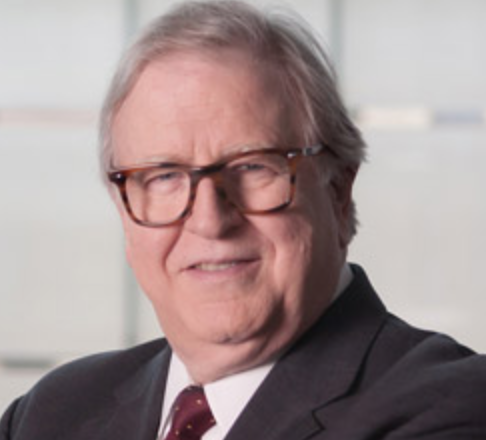
Gene Policinski is president and chief operating officer of the Freedom Forum Institute. He can be reached at [email protected], or follow him on Twitter at @genefac.
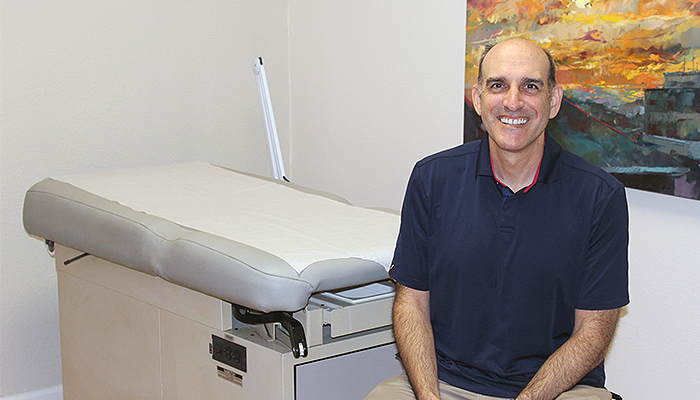
Avalon Advanced Health is providing a new health care model in Hays — direct primary care.
Dr. Marshall Eidenberg’s practice does not bill third-party insurance.
Dr. Marshall Eidenberg’s direct primary care practice, Avalon Advanced Health, opened in April.
Instead, patients pay a monthly fee for services some of which include sick visits, weight management, house calls, pre-operation visits, in-office ultra sound, sports physicals, diabetes management, and pediatric sick visits and well checks.
By eliminating its back office staff, Dr. Eidenberg is able to provide services less expensively and more efficiently. He said 90 percent of services are covered under the monthly service fee, which starts at $75 for an individual. Per-person prices decrease for family memberships.
Eidenberg is the former director of the ER department at HaysMed. His medical background includes 12 years in the Army as an emergency medical physician. During that time he also worked in population health and preventive medicine. He also spent four years at Via Christ in Wichita in its ER department.
During his time as an ER physician, he learned the value of preventive care. He said he appreciates being able to spend more time with his patients in his new practice.
Whereas a visit to a physician in a typical clinic might last 20 minutes, appointments at Avalon can be 30 to 90 minutes. This time allows him the opportunity to counsel and educate and decrease patients’ need for medicines. In a fee-for-service model, clinics and doctors make more money if they see more patients and perform more procedures, Eidenberg said.
“By having the time and answering all the questions, making a comprehensive plan with the patient, we actually save them time because then they don’t have to make that appointment next month to come back in and pay another co-pay for the office visit,” he said. “We believe in the value of the comprehensive visit.”
The practice has on-site lab services. Eidenberg can draw labs at the beginning of the appointment and have results back before the patient leaves the office.
Eidenberg recommends patients still keep major medical insurance, but most direct primary care patients can increase their deductibles and save money. His family moved to a higher deductible and is saving $400 to $500 per month.
He said his experiences in the ER lead him to think there was a more efficient way to provide health care.
“I was the chief of the ER here at HaysMed, and we had no clue of what was being billed in our name. We were being given just a salary. My wife was injured and ended up going into the ER,” he said. “We had very good insurance, and there was still a $1,000 co-pay. Just from there, we figured there had to be a better way. Health care does not need to cost as much as it does.”
Of the 30 heads of the Blue Cross and Blue Shield organizations, they made more than $100 million in 2016, Eidenberg said.
“That didn’t keep anybody’s rates down. In fact, most people saw an increase in their insurance rates,” he said.
Eidenberg compared health insurance to car insurance. Direct primary care takes care of the day-to-day needs of patients like changing the oil in a car, and health insurance is saved for major occurrences we hope never happen like heart attacks.
Eidenberg offers after-hours care, which can save costly trips to the ER for conditions that would normally be dealt with in a clinic setting.
“If you are a mother at 2 in the morning with three kids and one of them is sick, do you want to package everyone up at 2 in the morning to go to the ER?” he said. “We can make house calls and save that mother the time and effort and the cost. The ER is allowed to charge an after-hours fee, and believe me they do. I think we are an option for everybody if you want that personalized care.”
By providing easy access to primary care, Eidenberg said he hopes to free the ER to care for true emergencies.
The practice tries to limit specialist referrals by trying to have minor questions about ongoing care answered electronically through email. The practice also tries to save time and money when referring to a specialist by contacting the specialists about labs and studies that need to be done. Those labs can be done in advance. This allows the specialist to address issues in a single visit.
The practice also works with employers to perform site visits to identify instances in which an employee might be injured.
The clinic, 2703 Hall, Ste. 13, opened in April. Eidenberg said he has had good response from the community, including clients from the hospital.
He said he sees direct primary care as a growing trend. There are more than 1,000 practices across the country, although few at present in the state of Kansas.