Today
Beoming Mostly sunny, with a high near 95. Windy, with a south wind 15 to 25 mph.
Tonight
A 20 percent chance of showers and thunderstorms before 3am. Mostly cloudy, with a low around 73. Breezy, with a south wind 17 to 22 mph decreasing to 11 to 16 mph after midnight.
Monday
Mostly sunny, with a high near 94. South southwest wind around 14 mph.
Monday Night
A 50 percent chance of rain and thunderstorms. Mostly cloudy, with a low around 67. South wind 6 to 11 mph becoming northeast after midnight.
Tuesday
A 30 percent chance of rain and thunderstorms. Partly sunny, with a high near 88. East northeast wind 6 to 10 mph becoming south southeast in the afternoon.
Tuesday Night
Rain and possibly a thunderstorm. Low around 65. Chance of precipitation is 80%. New rainfall amounts between a half and three quarters of an inch possible.
Wednesday
Rain likely and possibly a thunderstorm before 1pm, then a chance of rain and thunderstorms after 1pm. Mostly cloudy, with a high near 81. Chance of precipitation is 60%. New rainfall amounts between a quarter and half of an inch possible.
Wednesday Night
A 40 percent chance of rain and thunderstorms. Mostly cloudy, with a low around 62.
Whizzer Motor Co. started in 1939 in Los Angeles as Breene-Taylor Engineering, a manufacturer of airplane parts. Whizzer then started to sell motor “kits” for bicycles as a way to make them motorized. After sales of engines proved to be an unsuccessful endeavor in 1942, Whizzer lobbied the United States government for the right to continue production, claiming that the the Whizzer motor was a way for defense workers to travel to and from work.
In 1946, Whizzer moved its main production facilities to Pontiac, Mich., allowing the company to take advantage of auto-production facilities to outsource the manufacturing of most of the Whizzer components. It was in 1947 when a young Harold Kraus visited Hays City Auto Tops in Hays and purchased a new Whizzer “H” motor kit from owner Swede Gilberg for $110.
“He liked to tinker. He was able to save up money working odd jobs for family members while still in high school,” said Paul Kraus, son of Harold. “He drove the family car to school and this gave him a new mode of transportation.”
Harold, just a junior in high school at the time, installed the engine initially on his heavy duty balloon-tired Gambles bicycle frame as a way to get around the family farm for chores but the white chalk rocky roads of rural Ellis County shook the bike apart and Harold had to purchase a new Schwinn frame made for motors. In January 1951, Harold left for Denver to enlist in the Navy and the bike stayed on the family farm where it was used around the farm by his brothers.
After his military service, Harold returned to western Kansas to start his own farming operation and stored the bike in his barn where it remained until 2007 when it was passed down to Paul and traveled to it’s new home in Erie, Colorado for restoration.
“For as long as I can remember, this thing sat in the back of our barn. When I got the bike in ’07, there was not a single dent in the tank. The fenders were a little rough and it was covered in grime. There were definitely some components missing but the bike was pretty much 90 percent there,” Paul said.
Before restoration
So the five year restoration project began for Paul Kraus. A father himself now, Paul spent most of his time focusing on family, but the bike stayed in the back of his mind.
“After a while, I kept getting squirrely and it kept staring at me so I decided ‘I have got to do something about this,’ ” Paul said.
Paul did extensive research to understand what exactly he had to do to start the restoration and find out if he could even still get parts for the bike. On his quest, Paul met different people from around the country who had advice on how to restore the bike and get parts..mostly from, surprisingly, the scooter community.
“The scooter community of all places has been very open and non-judgemental. They’re always willing to help and free advice still keeps flowing to this day,” Paul said. I met some neat people and made friends for life.”
Paul worked on the restoration off and on as the years went by and it took time trying to find a company that could make new brake pads and a person who could re-upholster the seat in correct detail. A dad of one of Paul’s friends offered to rebuild the engine in exchange for two Maytag washing machine hit and miss motors.
After restoration
Paul’s own father had a hand in the restoration. Despite being five hours apart, technology allowed Paul and Harold to collaborate on the restoration and it gave Paul comfort knowing that when he hit a roadblock, he could pull up his dad on his phone, show him the bike, and ask questions.
“We were only one state away, but I could Facetime him and say ‘OK, so I’m having trouble with this tell me what you think.’ I could turn the camera around and we would both be working on it together. That was actually really rewarding to be able to share that rebuild … to share when I fired it up for the first time and rode it down the street while my wife held the phone so he could see it go up and down the street,” Paul said.
When on of Paul’s friends sent him a web form about a new Discovery Channel show called “Sticker Shock” (a show about the stories and histories of unique rides, restored vehicles, and automobile memorabilia) and suggested he send the Whizzer restoration in as a possible idea for the show, Paul was skeptical at first but he filled out the form and sent in a couple pictures and a quick video.
Two weeks later, Paul got an email from a casting director and after a few different conversations and interviews, Discovery Channel had arranged for the bike and Paul to be sent to Los Angeles for a taping of the show.
Harold Kraus with the restored Whizzer
One of Paul’s favorite parts about this whole journey has been the relationships and friendships developed during the Los Angeles trip, and at different vintage motorcycle shows that Paul has brought the bike to.
“We have made a lot of friends around the country through this little experience,” Paul said. This little bike has started so many conversations and invoked so many smiles from nostalgia. I wish we had more objects in the world to help make people smile a little bit more naturally.”
The episode of Sticker Shock featuring Harold’s restored Whizzer is set to air on Discovery Channel (Eagle Channel 64 & 664) on Wednesday, June 27, at 9pm.
The Whizzer will be back home in Hays on Sept. 15 for the Thunder on the Plains Car, Truck and Cycle Show at Frontier Park — and Paul hopes Hays recognizes a piece of it’s history.
“It’s going to be fun to bring it back to Hays and let Dad show his old bike to his buddies. Hopefully Hays recognizes it in some fashion as a little piece of it’s history preserved,” Paul said. “There’s part of me that wants to ride it down Main Street just once.”
More than 4,900 University of Nebraska-Lincoln students have been named to the Deans’ List/Explore Center List of Distinguished Students for the spring semester of the 2017-18 academic year.
The following is a list of area honorees:
Hays: Alexander Rhodes Crowley, senior, Dean’s List, Hixson-Lied College of Fine and Performing Arts, music education.
Hays: Samuel Thornton Crowley, sophomore, Dean’s List, College of Arts and Sciences, political science.
Qualification for the Deans’ List/List of Distinguished Students varies among the eight undergraduate colleges and the Explore Center. Listed below are the minimum requirements for each entity and the name of its respective dean or director. All qualifying grade-point averages are based on a four-point scale and a minimum of 12 graded semester hours. Students can be on the Deans’ List for more than one college.
College of Agricultural Sciences and Natural Resources, 3.75; Dean Steven S. Waller.
College of Architecture, top 10 percent of the students in the college; Dean Katherine S. Ankerson.
College of Arts and Sciences, 3.7; Dean Joseph Francisco.
College of Business, 3.6; Dean Kathy Farrell.
College of Education and Human Sciences, 3.75; Interim Dean Beth Doll.
College of Engineering, 3.5; Dean Lance C. Perez.
College of Journalism and Mass Communications, 3.7; Interim Dean Amy Struthers.
Hixson-Lied College of Fine and Performing Arts, 3.7; Dean Charles O’Connor.
Explore Center for undeclared, pre-engineering, pre-health and pre-law students, 3.6; Senior Associate Vice Chancellor and Dean of Undergraduate Education Amy Goodburn.
For the full Deans’ List/Explore Center List of Distinguished Students, visit https://go.unl.edu/pw9a.
Kansans should watch for the red flags of suspected financial abuse of elder citizens, including potential abuse by guardians assigned to oversee the well-being of those citizens.
A trusted guardian can be a wonderful resource, but sometimes guardians may take advantage of the trust placed in them by vulnerable elders.
A guardian is a person or entity appointed by a court to exercise some or all authority over a person and/or estate. A guardian can have power to make decisions related to the health and safety of the incapacitated person. Financial abuse by guardians occurs when the guardian improperly uses the protected individual’s financial assets.
Suspected signs of guardian financial abuse include the following:
· Using guardianship authority to transfer property for the guardian’s benefit.
· Receiving personal payments from a protected individual without court permission.
· Authorizing frequent cash withdrawals from the protected individual’s account without explanation.
· Using or borrowing property for personal benefit without court authorization.
· Making unexplained decisions that are not in the protected individual’s best interest.
The North American Securities Administrators Association, of which the Office of the Kansas Securities Commissioner is a member, recently developed a resource to call attention to the red flags of suspected guardian financial abuse. The “Guarding the Guardians” publication is available on the association’s website at https://serveourseniors.org/about/investors/.
Anyone with suspicions of possible financial exploitation by guardians should contact the Office of the Kansas Securities Commissioner at 785-296-3307 or 800-232-9580.
The office’s website also has more financial considerations at www.ksc.ks.gov.
John Wine is the Kansas Securities Commissioner.The mission of the Office of the Kansas Securities Commissioner (KSC) is to protect and inform Kansas investors; to promote integrity, fairness, and full disclosure in financial services; and to foster capital formation.
The American Historical Society of Germans from Russia will hold their 49th Annual International Convention in Hays, Kansas Monday, July 30 – Thursday, August 2, 2018. Scheduled speakers will travel to the event from multiple U.S. states – some from as far as Germany and Russia.
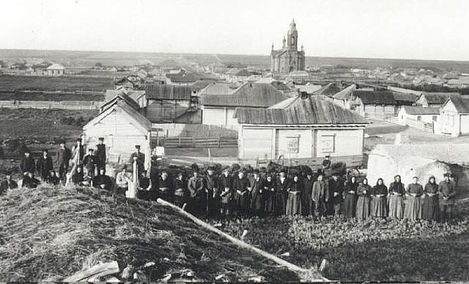
This convention, titled “The Storm,” centers on the effects of the 1917 Russian Revolution on the Germans from Russia. It will also celebrate the traditions, history, genealogy, music, and food of Germans from Russia.
Attendees will have access to a research area for genealogy, AHSGR bookstore, silent auction room, and more. The convention begins with registration Monday, July 30, and will conclude on Thursday, August 2 with a banquet and polka dance.
All convention activities will be held at the Memorial Union on the Fort Hays State University Campus, except for Kindertag, a youth day for children to learn more about their German from Russia heritage. Kintertag will be held from 8:30 a.m. – 3:25 p.m. on Wednesday, August 1 at the Ellis County Historical Society Museum, 100 W. 7th Street. The day will be filled with educational activities to show how the Germans from Russia lived, including sauerkraut and butter making, dancing, traditional games, German language, cooking, and life on the farm.
Registration is required and walk-ins are welcome. Registration for the entire convention is $125 for AHSGR members and $145 for non-members.
Ticket options are also available for individual meals, events, and tours, such as the Foundation/Society Recognition luncheon, Village Tour, Museum Tour, and Artisan Tour. Three German Cooking classes will be offered by Sam Brungardt and Charlie Dorzweiler for $10 per session.
Those interested can find details, register for the conference, and purchase individual tickets at www.ahsgr.org.
Talks for the event include:
Finding Your Ancestors
The German Russian Communities in the Age of Stalin’s Great Terror
Germans in Russia: History Milestone (Celebrating the 100th Anniversary of the Volga German Autonomy)
Masterpieces of German Religious Architecture on the Volga
Remembering a Ravaged Century: The German Colonies Caught in ‘The Storm’ of the Russian Revolution
Letters to Pauline (Schlegel) Lehi: Volga German Family Correspondence from Russia to Oklahoma, 1913-1937
DNA 1: The Basics of Life / DNA 2: Analyzing Your DNA Results
Ethnic Clothing for Mennonites and Other Germans from Russia
Mennonites in Russia after the Revolution
The Immigrant Woman
Dutch Hop: Music of the Volga Germans
History of the HFDR (Historical Research Association of Germans from Russia)
Lives of Ethnic Germans in Soviet Exile during and after WWII
FHSU Ethnic Studies Center: A Roomful of History – The Volga Germans of Ellis and Rush Counties in Kansas
Speakers include:
Olga Litzenberger (Russia)
Michael Wanner (Germany)
Eric Schmaltz (University of Oklahoma, Norman, OK)
Maggie Hein (Chicago, IL)
Ulrich Merten (Florida)
Peggy Goertzen (Wichita, KS)
Norma Pipkin (Hays, KS)
Terry Batt (Denver,CO / Russell, KS)
Alex & Nancy Herzog (Boulder, CO)
Sisters Alice Ann Pfeifer, Mary Ann Schippers, and Mary Elise Leiker (Wisconsin/Hays, KS)
Brent Mai (Connecticut)
Patty Nicholas (Fort Hays State University, Hays, KS)
The American Historical Society of Germans from Russia is located in Lincoln, Nebraska, and houses one of the largest repositories for German Russian studies in the U.S. It includes, books, records, maps, photos and many more items.
The Sunflower Chapter of AHSGR, Hays, is a local Chapter of AHSGR striving to promote the heritage of the German Russian on a local level.
For more information on attending the AHSGR Hays Convention can be found at by contacting the national AHSGR office at 402-474-3363 or [email protected] or Kevin Rupp at 785-656-0329 or krupp@ruraltel,net.
Ron Wilson is director of the Huck Boyd National Institute for Rural Development at Kansas State University.By RON WILSON Huck Boyd National Institute for Rural Development
The football players run onto the field for summer practice at Jefferson West High School. But something is different: This field is covered by artificial turf which was last used by the New Orleans Saints of the National Football League. How did NFL turf come to be on a high school football field? It’s due to a hometown Kansas company which specializes in turf installation across the country.
Jake Farrant is founder and president of this remarkable company named Kansas Turf. Jake grew up at Meriden. As a kid, he mowed lawns and helped with his uncle’s golf course and sod farm business in Topeka. He also loved football, starting at quarterback at Jefferson West High School and then at Ottawa University.
After graduation, he returned to Meriden and continued to help his uncle. He also became an assistant football coach at his alma mater, Jeff West. When the family was approached about building a multi-sport complex, which didn’t fit the work of his uncle’s company, Jake saw the opportunity to go into business for himself. In 2008, Kansas Turf was born.
Meanwhile, Jake had met and married his wife Kysa, a K-State graduate. “I sat down with her and drew out a sketch of what my dream business facility would look like,” Jake said. “As I look at our facilities now, it looks eerily like that today.”
Today, Kansas Turf has become a leading sports construction company, with capabilities to design and build sports complexes, do site work, implement golf course and cemetery renovations, and install natural grass and synthetic turf.
The company began doing high school baseball parks and projects for the Veterans Administration, but Jake’s ultimate dream was to do more with sports. When Jake’s former head coach at Ottawa, Patrick Ross, joined the company, the dream started to become reality.
“He was part of that elite coaching fraternity and it opened doors for us,” Jake said. Within 30 days of Coach Ross joining the company, Kansas Turf had its first college football job. It went so well that business grew from there.
Today, Kansas Turf – which started with three employees – employs some 100 people. The company has done projects in more than 30 states, from New York to San Francisco. “Right now we have projects going in Anchorage, Alaska, San Antonio, and Biloxi, Mississippi,” Jake said. That’s an impressive record for a company based in the rural community of Meriden, Kansas, population 813 people. Now, that’s rural.
They’ve even replaced turf for NFL teams such as the New York Jets, New York Giants, and New Orleans Saints. Jake’s company installed the New Orleans Saints turf on the field back home at his old high school, Jefferson West.
In 2018, Kansas Turf was the contractor for turf replacement at K-State’s Bill Snyder Family Stadium where a brand new, state-of-the-art product was installed. “Kansas Turf is proud to partner with AstroTurf on this project,” Jake said. “K-State is the first FBS school in the nation to install this innovative turf, called RootZone Trionic 3D.”
He foresees that more high schools will be installing artificial turf, as parents and administrators learn that such turf is seven times safer and creates less chance of concussions or ligament damage. “It’s all about the kids,” Jake said.
“We’re a family business, most of us from Meriden,” Jake said. Brother Bryce is the company’s chief information officer. Their dad even works on the installation crews sometimes. Under the leadership of Jake’s wife Kysa, the family opened a large day care and preschool facility which serves lots of families. “We believe in faith, family, and the future,” Jake said.
It’s time to leave this rural Kansas football field now covered by turf from the NFL. We thank Jake Farrant and the people of Kansas Turf who are making a difference with entrepreneurship in sports construction. I’m glad this company is based on our state’s home turf.
And there’s more. Turf is not the only benefit which this company has brought to the community. We’ll learn about that next week.
Ron Wilson is director of the Huck Boyd National Institute for Rural Development at Kansas State University.
The Soil is Alive! (Part II) Sometimes we think that bacteria, fungi, nematodes, and other soil microbes are pests to be illuminated, like the fungus infecting your tomatoes for example. But these microorganisms are not all bad, and they all have their own role in the soil food web. In fact, beneficial bacteria and fungi help to decompose many nutrients that would otherwise be unavailable for plants to use.
Some bacteria and fungi even have specialized interactions with certain plant roots, where they exchange nutrients to help one another grow. For example, mycorrhizae (pronounced My-cor-rye-zay) refers to a group of fungi which form a symbiotic relationship with many plants. These fungi grow either inside of a plant’s roots or attach to the surface of a root. The fungi benefits from the plant’s food and nutrients and in turn grow out into the surrounding soil to absorb nutrients and water. So, mycorrhizae actually enhance a plant’s ability to take up nutrients and water.
Soil is mostly made up of non- plant parasites, although some fungi, bacteria, and nematodes infect plant roots. These plant parasitic organisms can cause damage to plants, but the soil ecosystem is highly diverse and complex where plant parasites are not the only parasites living in the soil. Nematodes are an example of this. They are a non-segmented worm typically 1/500 of an inch (50 µm) in diameter and 1/20 of an inch (1 mm) in length. Though a few nematode species are responsible for plant diseases, the majority of them are fungal and bacterial feeders.
Microorganisms decompose organic matter in the soil and nutrients are also released as ions. This decomposed organic matter is where much of the nutrients plants need come from. We need microorganisms in our soil and without them plant life would not be able to exist.
Rip Winkel is the Horticulture agent in the Cottonwood District (Barton and Ellis Counties) for K-State Research and Extension. You can contact him by e-mail at [email protected] or calling either 785-682-9430, or 620-793-1910.
The current drought monitor has almost all of Kansas in some level of drought with much of the state in severe or extreme drought. It is hard to know how this will change in the coming months but preparation and planning can help us adapt and minimize the impact if dry conditions continue.
Keith Harmoney, range scientist at Hays, has studied a 36-year data set to look at the impacts of precipitation on season long forage production of shortgrass rangeland (https://www.ksre.k-state.edu/historicpublications/pubs/SRP1086.pdf). The strongest relationship between precipitation and year-end forage yield was the rainfall from October the prior year through September.
However, the October prior year through April precipitation had little to no relationship to the end of year forage yield. Notably in that data set, precipitation from May to June had nearly as good of a relationship with forage yield as the October prior year to September time period.
Therefore, as that May to June period of precipitation plays out, it can be used to help adjust this year’s grazing plans.
A good drought management plan will include critical dates for de-stocking based on rainfall received and what is observed in range production and utilization. A written plan with dates and numbers developed ahead of time can greatly reduce the stress many experience during drought.
History tells us that Western Kansas experiences a drought 1 out of every 5 years. Establishing a practice of moderate stocking rates helps maintain greater plant vigor and soil cover regardless of the amount of precipitation. It is also optimizes returns per acre. Without adequate soil cover, precipitation that does come is largely runoff and not captured in the soil.
Our schools have fire drills to prepare for possible problems. Preparing a drought management plan is like a fire drill so we are prepared if it should happen. If you don’t already have a drought management plan, now is the time to get started. Producers can find many helpful resources for managing drought risk on the ranch at https://drought.unl.edu/ranchplan/Overview.aspx including example drought management plans.
Alicia Boor is an Agriculture and Natural Resources agent in the Cottonwood District (which includes Barton and Ellis counties) for K-State Research and Extension. You can contact her by e-mail at [email protected] or calling 620-793-1910
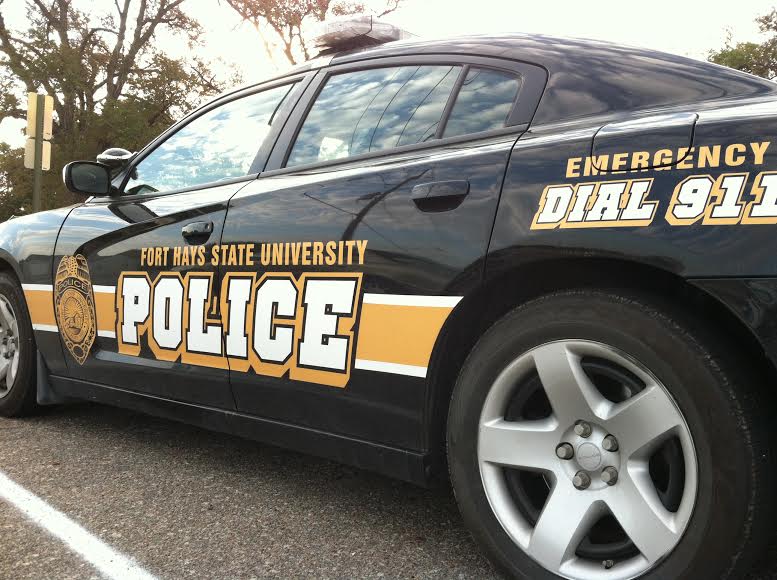
Fort Hays State University is currently accepting applications for the position of University Police Officer. Review of applications will begin after the priority deadline of 06/11/2018. For a full description and a list of requirements go to https://fhsu.wd1.myworkdayjobs.com/CAREERS.
Applicants must be at least 21 years of age, no felony convictions, no convictions for domestic violence, and must maintain a valid Kansas driver’s license.
Several Fort Hays State University Master of Business Administration students scored in top percentiles on three nationwide exams, placing them among top graduates in the nation.
The Educational Testing Service Proficiency Profile exam assesses four core skill areas: reading, writing, mathematics and critical thinking. The exam helps to meet requirements for accreditation, evaluate and inform teaching and learning and benchmark performance.
The students who took the fall 2017 and spring 2018 Proficiency Profile exams are listed by percentiles.
99th percentile: Kyle Grimes, Lawrence.
98th percentile: Nicholas Davis, Lawrence; Michael Denton, Augusta; Jason Foster, Mission; and Marcia Swann, Ulysses. 97th percentile: Braden Dreiling, Hays. 96th percentile: Erica Dinges, Victoria; Jacqueline Vinson, Eureka.
93rd percentile: Rebecca Ott, Mulvane; Elias Sallman, Lawrence; and Adam Wilson, Greensboro, N.C.
91st percentile: Jeri Braun, Lenexa; Michael Cropley, Norfolk, Va.; Alicia Wilson, Hutchinson; Tandra Wilson, Garden City.
90th percentile: Jamie Ellis, Garden City.
88th percentile: Chapman Dean, Centennial, Colo; Shewit Doherty, Denver, Colo.; and Hillary Jeanjaquet, Colorado Springs, Colo.
85th percentile: Jennifer Nicholson, Charlotte, N.C. 84th percentile: Sophie Amatya Dhoubhadel, Hays; Gordon Butler, Edmond, Okla.; and Rebecca Stiles, South Hutchinson.
The students who took the Major Field test are listed by percentiles.
97th percentile: Michael Denton and Jason Foster.
96th percentile: Jacqueline Vinson.
95th percentile: Rebecca Ott. 91st percentile: Jeri Braun; Erica Dinges;Renee Legleiter, Liebenthal; and Elias Sallman.
87th percentile: Chapman Dean and Adam Wilson. 85th percentile: Sophie Amatya Dhoubhadel; Alan Romans, Ashland; and Tandra Wilson.
83rd percentile: Michael Cropley and Marcia Swann.
The Major Field Test is administered by FHSU and was developed to assess the skills of graduating MBA students. It evaluates their abilities to analyze and solve problems, understand relationships and interpret material.
The field test also provides an assessment of faculty teaching effectiveness and identifies areas of improvement in the MBA curriculum. More than 230 colleges and universities in the United States administer the exam.
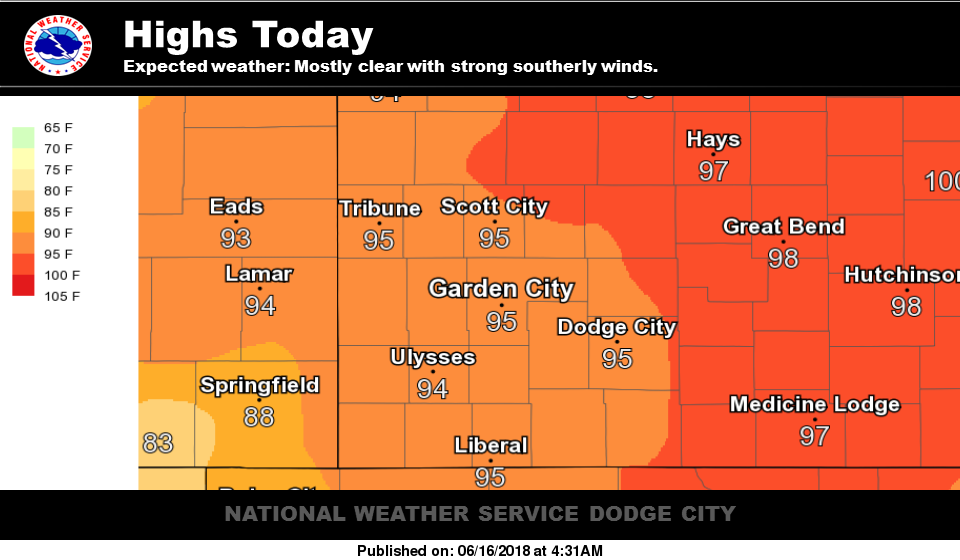
Today
Sunny, with a high near 97. Windy, with a south wind 15 to 20 mph increasing to 21 to 26 mph in the afternoon. Winds could gust as high as 36 mph.
Tonight
Partly cloudy, with a low around 76. Breezy, with a south wind 16 to 24 mph.
Sunday
A 20 percent chance of showers and thunderstorms after 1pm. Partly sunny, with a high near 95. Breezy, with a south wind 17 to 22 mph.
Sunday Night
A 30 percent chance of showers and thunderstorms. Mostly cloudy, with a low around 71. Breezy, with a south wind 10 to 20 mph.
Monday
Mostly sunny, with a high near 89. South southwest wind 8 to 11 mph becoming west northwest in the afternoon.
Monday Night
A 40 percent chance of showers and thunderstorms. Mostly cloudy, with a low around 63.
Tuesday
A 30 percent chance of showers and thunderstorms, mainly before 1pm. Partly sunny, with a high near 83.
Tuesday Night
Showers and thunderstorms likely, mainly after 1am. Mostly cloudy, with a low around 64. Chance of precipitation is 60%. New rainfall amounts between a quarter and half of an inch possible.
Wednesday
A 50 percent chance of showers and thunderstorms. Mostly cloudy, with a high near 80.
The Hays Larks Baseball Association would like to invite everyone to Fathers’ Day / Little League Night on Sunday, June 17, at 7 pm.
The Hays Larks will be playing the Oklahoma City Indians and admission is free courtesy of Downing-Nelson Oil and Hattan and Taylor Family Eye Care.
It will be a night of fun and exciting activities. All little league players in uniform will go on to the field during the Nation Anthem and receive a free freeze pop. The first 100 dads will receive a special package of M & M candy. The concession stand will have a Father’s Day special of a beverage, hamburger, and chips for only $4.00. Throughout the night there will also be raffle prizes awarded and drawings for Larks apparel. After the game the Larks players will be available for autographs and all kids will be permitted to run the bases.
Hays city commissioners voted unanimously Thursday night to approve a charter ordinance that will increase the transient guest tax (TGT) rate 2 percent to fund improvements to the north Vine Street traffic corridor, estimated at more than $7.6 million.
The TGT is currently at 5 percent and is added to each customer bill for stays in Hays motels. The monies fund the Convention and Visitors Bureau budget and are used for the promotion of Hays.
“City staff suggested a significant part of the project could be funded with transient guest tax dollars, due to the fact the improvements would make it better for visitors, pedestrians, people that are staying in the area, and not just for people that live here,” said Hays City Manager Toby Dougherty.
The Hays 5 percent TGT is lower than most of its peer cities in Kansas. Johnson County’s rate is 9 percent.
The charter ordinance can be challenged within a 61-day period by a petition of more than 10 percent of voters who voted in the last city election. If a valid petition is presented, the ordinance will be put to a vote of Hays residents.
Final publication of the ordinance will be June 25. The protest period will then begin, ending August 25. If there is no protest petition, the Kansas Department of Revenue will be notified August 27, with the new rate implemented October 1.
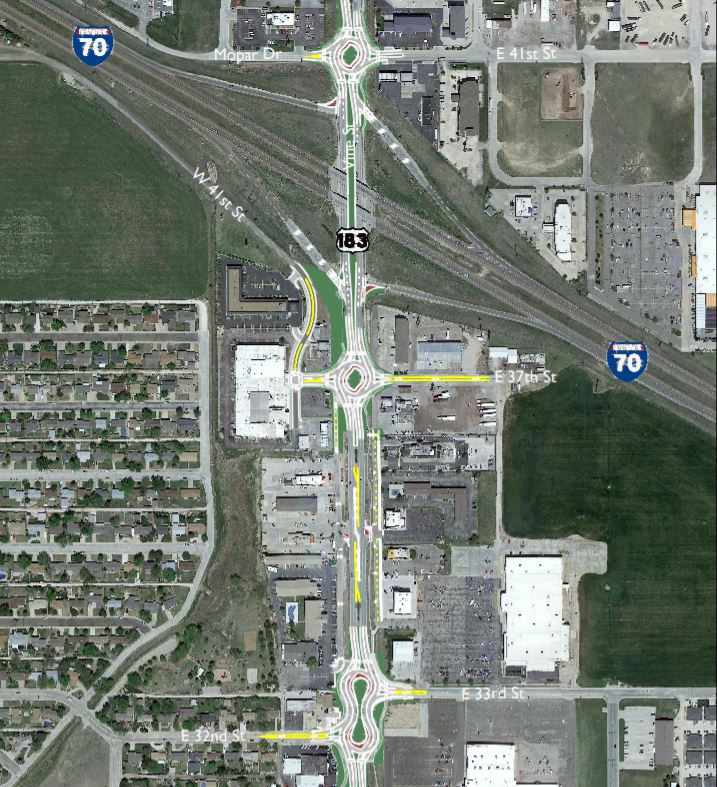
The city hopes to receive some federal funding for the roundabout project through a TIGER grant from the U.S. Department of Transportation. Vine Street is also a federal highway, U.S. Highway 183.
“If the grant is large enough, I’m sure our finance director (Kim Rupp) could look at the possibility of the city self-financing the project and get the interest off the grant, which would be beneficial for us as well,” Dougherty said.
Admitting he is “not a fan of roundabouts,” Vice Mayor Henry Schwaller still supported the TGT increase.
“We do need to resolve the intersection and 32nd and 33rd. It is the most dangerous intersection in the city and we’ve neglected it for a long time,” said Schwaller.
“We know one option that was really simple but we cannot pursue today, was about $1.8 million. So regardless of how we pursue this – we don’t even know what the engineering is going to look like — we will need at least $2 million to fix just that one intersection. It’s important that we do it and that’s why I support this tax.”
Commissioner Sandy Jacobs agreed with Schwaller, noting the earlier option came out of the city’s 20-year comprehensive plan. “I’m sorry we didn’t do that then but we didn’t, and now we’re moving forward.”
“I really appreciate staff’s recommendation on this. I think it’s an outstanding way to finance something that doesn’t call for us to raise taxes in other ways,” she added.
The 2 percent TGT increase is projected to raise $6.2 million over 20 years.
Outgoing commissioner Chris Dinkel called it a “creative approach.”
“We’ve known that the north Vine corridor has needed help for a long time…The idea of putting roundabouts throughout this corridor to help with access to businesses with this creative way of funding it doesn’t require us to raise taxes on the city. It doesn’t put other projects in jeopardy.”
(Click to enlarge)
Mayor James Meier noted the city’s sales tax revenues, which make up most of the General Fund, have been stagnant the past five years, while Transient Guest Tax receipts have increased.
“It’s been growing steadily,” Dougherty confirmed, “and in some places significantly outpacing the sales tax which has been very flat the past three years.”
The TGT was flat last year, according to Dougherty, the first full year the former Ambassador Hotel was closed. During that time, the Butterfield Inn, now Best Western Plus, was also closed for a significant time to repair water damage.
“TownePlace Suites is now open,” Dougherty noted. “Another hotel is getting ready to be constructed and another is in the planning stage, so we think the TGT is going to keep going up.”
The city is considering a plan approved by the Kansas Department of Transportation to install Vine Street traffic roundabouts at 32nd/33rd, 37th and 41st Streets. Engineering and design is underway.
 Today
Today














 Today
Today