We have a brand new updated website! Click here to check it out!

Kids learn alpacas spit, Jolly Ranchers made from corn during Ag Day

Students raise their hands to answer a question asked by Chase Wagner, ag salesman for Carrico Implement, during Ag Day at Pa’s Pumpkin Patch on Thursday. Wagner discussed the parts of a tractor and farm safety.

By CRISTINA JANNEY
Hays Post

Students fed alpacas, climbed into the cab of a tractor and ate popcorn all in the name of learning about agriculture during the 23rd annual Ellis County Farm Bureau Kids Ag Day at Pa’s Pumpkin Patch.

“Our goal for the day is to have kids have an on-farm experience,”  said Audrey Werth, board member for the Ellis County Farm Bureau. “A lot of kids don’t get to be around animals or to be around crops and learn about that on a day-to-day basis. We enjoy having kids out her so they can learn about what farmers do, learn what’s in their food, and learn where other ag products come from.”

On Thursday, Hays USD 489 fifth-graders visited the pumpkin patch. Fourth-graders will visit Oct. 4.

The stations the students explored included beef, pumpkins, soil, soybeans, wheat, sunflowers, water conservation, water cycle, farm equipment, alpacas, corn and leaves.

Alpacas

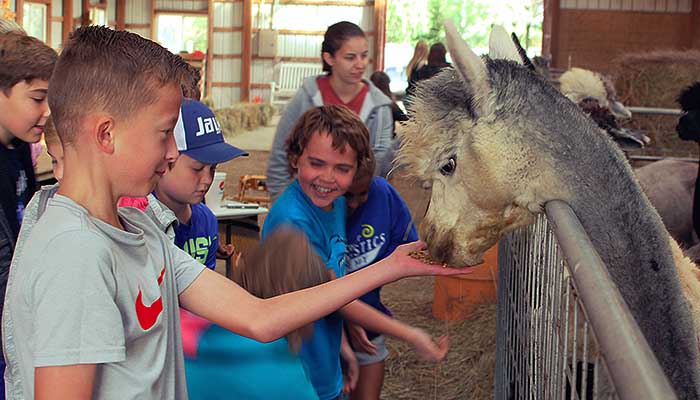
Students feed an alpaca hay.

Maggie Moeder, alpaca farm hand, talked to the students about care of the alpacas that live at the pumpkin patch as well as how their fleece is used.

Alpacas are known to spit. Generally they spit at other alpacas to let them know they are encroaching on their food. They make a high screeching sound as an alarm, Moeder said. In their native Peru, alpacas face many predators, but they don’t have many defenses.

An alpaca eats hay at Pa’s Pumpkin Patch during Ag Day.

Unlike other herd animals, alpacas don’t have hooves. They have soft pads on the bottoms of their feet similar to a dog’s paws.

Alpacas live to be about 20 years old. Alpacas are typically not slaughtered for their meat domestically, but it is served in high-end restaurants in South America.

Alpacas are shorn once a year. They are renowned for their fleece, which can be very warm. It is also hypoallergenic, whereas some people have allergies to wool. Moeder showed the students several examples of products made with alpaca fleece, including rugs, socks, scarves and earmuffs.

Farm safety

Chase Wagner, ag salesman with Carrico Implement, talked to the children about the importance of farm safety and explained several parts of a tractor.

Students in the cab of a John Deer tractor.

He said you need to make eye contact with a implement operator so you know that the operator has seen you. If you are directly in front of the tractor, you can’t be seen.

“If you are around this machine, and he has not made eye-contact with you, he does not know you are there. … These are big machines, and there is a lot gong on in that cab,” Wagner said.

He also warned the children to avoid the area between the tires and body of the tractor, which can be pinch point if the tractor is in operation.

Corn

Stacy Campbell of the Cottonwood Extension District, discusses corn with a group of fifth graders at the Farm Bureau Ag Day Thursday at Pa’s Pumpkin Patch.

The students were surprised to learn about products that contain corn, including biodegradable packing peanuts, dog treats and Jolly Ranchers candy. The students dunked the packing peanuts in water and watched them dissolve.

“It feels weird,” one student said as he dunked the packing peanut in water.

The pellets the students fed to the alpacas earlier in the day also contain corn. Corn is an inexpensive source of sugar for animals, so it is often used in animal feed.

Stacy Campbell of the Cottonwood Extension District talked about growing corn, and each student received a clear pouch to wear around their necks that contained a kernel of corn and water beads  Campbell said the moisture from the beads in combination with the students’ body heat should cause the corn to germinate.

“Farmers are needed, and their products are needed,” Campbell said. “They try to grow the corn as cheaply as they can, so they can make money.

“If they try to grow it as cheaply as they can, they don’t get carried away and put a bunch of pesticides out there. They put a very minimal amount of pesticides, just what the crops need. They only put the right amount of fertilizer on.”

The students also received bags of popcorn.

Holly Dickman, City of Hays water conversation specialist, talks about the water cycle with students during Ag Day on Thursday. The students had to pass a spoon holding ice while also answering question about the water cycle.
Molly McMurtrie, pumpkin patch volunteer, talks to students about pumpkins at the Farm Bureau Ag Day.
Students learn about the products made using alpaca fleece from Maggie Moeder during Ag Day.

Girl Scouts take over Big Creek Crossing during mall overnight

By CRISTINA JANNEY

Hays Post

About 150 Girl Scouts took over Big Creek Crossing Saturday night at the Girls Just Want to Have Fun event at Big Creek Crossing.

The girls participated in STEM activities with the FHSU Makers Van, the Kansas Cosmosphere and the Sternberg Museum. They also created crafts, painted their faces, learned about fashion, danced, sung karaoke, hunted clues in a scavenger hunt and bounced in a bounce house. The kids also munched snacks and played games.

The event is sponsored every other year by Girl Scout Service Unit 74, which includes Ellis County.

Girl Scouts Derilynn (left), 8, and Danielle (right) Wells, 6, paint their faces at Girl Just Want to Have Fun Saturday night at Big Creek Crossing.
Girl Scouts feel furs and examine fossils from the Sternberg Museum Saturday during Girls Just Want to Have Fun at Big Creek Crossing.
Girl Scouts Cailynn Luck, 7, and Karli Bradley, 7, participate in a robotics STEM activity lead by the FHSU Makers Van at Girls Just Want to Have Fun event Saturday at Big Creek Crossing.
Girl Scouts Cheyenne Reed, 8, and Danielle Derilynn Wells, 8, participate in a STEM robotics activity during Girls Just Want to Have Fun Saturday at Big Creek Crossing.
Girl Scout Sophia Gaschler, 8, works on a craft during Girls Just Want to Have Fun.
Cheyenne Reed, 8, plays with a balloon at Girls Just Want tot Have Fun.
Historic Girl Scout uniforms

Dedication of FHSU’s new art and design building set for Homecoming weekend

By DIANE GASPER-O’BRIEN
FHSU University Relations and Marketing

It seemed like just a dream for so long that it’s still hard for Karrie Simpson Voth to believe her eyes when she looks out the window of her office.

From the first floor of the new Center for Art and Design at Fort Hays State University, Simpson Voth can get lost in her thoughts, watching students walk across the quad or a landscaping crew seed grass around the building.

The 43,000-square-foot CAD was finished in August, just in time for the start of classes this fall, and Simpson Voth calls it a game changer.

The center is a must-see for those attending FHSU’s 2019 Homecoming. A ribbon cutting and reception are set for 9 a.m. Friday, Oct. 11, at the CAD as part of Homecoming activities.

“I’ve watched people come in and just stop and gaze, so the building sells itself,” said Simpson Voth, professor and chair of the Department of Art and Design. “We are standing on a great reputation that was built over decades by former faculty as well as current faculty. Now we have the incredible facility to go with it.”

A portion of the dedication will center on burying a time capsule with artwork, tools and other items from current students and faculty that will give those attending Fort Hays State in 2044 a glimpse of the art and design program of 25 years before.

The time capsule is a collaborative effort. The 25-by-13-by-7-inch box is made of stainless steel donated by the FHSU maintenance department and built by Fort Hays State sculpture students under the direction of Toby Flores, associate professor of sculpture. Simpson Voth created the design for the top of the box, which will be cast in bronze.

Simpson Voth, a two-time FHSU graduate who has taught at her alma mater for 21 years, cites two major advantages to the new building: light and connectivity, which complement each other in every sense.

“We want to have shared experiences, pulling things together,” Simpson Voth said. “This gives us such a sense of community.”

The inside classroom walls also are glass, giving student artists the chance to draw inspiration for the activity outside their classroom. It also gives passersby the chance to witness the creativity within.

So it’s easy to see why Simpson Voth is excited to show off the new building. She thinks alumni will be thrilled, from the creativity to the limestone covering that keeps with the tradition of the campus – and everything in between.

Alumni who will get an early glimpse of the new building are two FHSU graduates from the Kansas City area. Buck Arnhold and Brittany Bange are scheduled to speak in the new CAD on Thursday afternoon.

Arnhold, who holds three degrees from FHSU, is one of FHSU’s Alumni Achievement Award winners this year. He is a well-known artist in Kansas City who formerly created banners for the player foundations of the Kansas City Chiefs. Bange is a product and marketing manager at Hallmark.

Simpson Voth thinks students will thoroughly enjoy hearing from those alumni, as well as Sandy Gellis, a New York artist. Gellis is the donor of a mask collection which belonged to her husband, Garry Rich, also a New York artist and the collector of the masks. The masks, from Central and South America, adorn the south wall of the first-floor lounge area.

Arnhold will be able to shed a different light on how studying art at FHSU 40-some years ago differs from today. His first degree was a bachelor of arts in 1974. He later earned a master of arts and a master of fine arts from Fort Hays State.

Other features that make the building so engaging are state-of-the-art technology throughout, a second-story balcony that overlooks an atrium filled with chairs and small tables. An enclosed walkway leads visitors to the new Moss-Thorns Gallery of Art in a renovated spacious brick building that housed the university’s power plant until the late 1960s.

The former power plant was completely remodeled. The bricks on the outside were cleaned, and matching bricks cover a new storage addition built to the west of the gallery for the department’s vast art collection.

The art and design professors are proud of the ownership they have in the new building. They got the opportunity to work with the architects to explain their needs for their students and their classrooms.

“We professors are the experts in our areas, so the architects took our vision and brought it to life,” Simpson Voth said. “We made decisions together and for our program areas, so we all had a guiding hand in the process, which makes the building that much more special.”

Teacher of the Month: English teacher challenges students to look beyond words

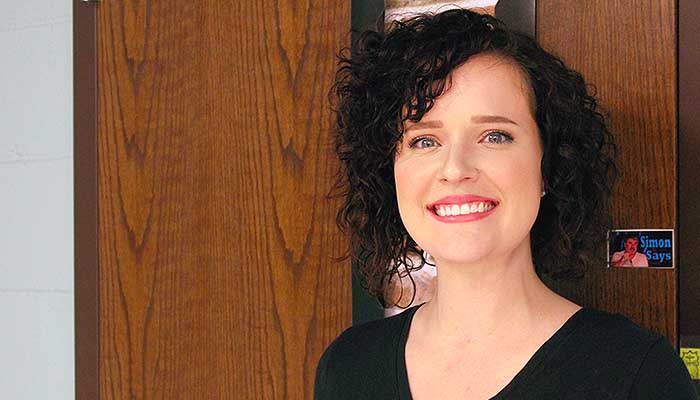
Jaici Simon, reading and language arts teacher at Hays Middle School, was honored as Hays Post’s September Teacher of the Month.

By CRISTINA JANNEY
Hays Post

Jaici Simon, reading and language arts teacher at Hays Middle School, might only be in her second year as a teacher, but she has a passion for her students and her profession.

Simon was nominated for the Hays Post September Teacher of the Month by student Taylor Freed, who said, “I would like to nominate Mrs. Simon because she teaches in a way that makes the subject easy to understand. I also feel she is patient and easy to talk to if I have questions.”

Simon is a Hays native. She attended Kennedy Middle School, Hays High School, and earned her teaching and English degrees from Fort Hays State University.

Simon’s mother encouraged her to enter the teaching profession.

“She reminded me when I was in college, I did really love to read and I love to learn and that is the way I explored the world and learned about the world,” Simon said.

She said she was also encouraged by the examples of some amazing teachers in USD 489.

One of those teachers was reading teacher Misti Norris, who still works at HMS.

“She has always been a positive and uplifting person,” Simon said. “She has a huge passion for English and for reading, especially. She tries to help find kids their kind of book and encourage them to read.”

At HHS, Diane Mason influenced Simon.

“She challenged me to think beyond the words on the page,” Simon said. “She always challenges her kids to analyze beyond just what is present and look beyond characters’ decisions. She is incredibly positive as well.”

Kathy Wagoner was Simon’s mentor as a student teacher, and she said Wagoner prepared her for her career as a teacher.

“She taught me to write properly and for English comp exams and what I should expect when I went to college. She was a very positive figure in my life — she still is to this day,” Simon said. “She is a role model to me, and I hope I can be as half as good an English teacher as she is.”

Just like millions of other kids, Simon loved J.K. Rowling’s Harry Potter series when she was a middle school student. She envisioned herself as Hermione Granger on adventures with Harry and Ron Weasley at the infamous Hogwarts School of Witchcraft and Wizardry.

“She grows a lot throughout the series,” Simon said of the Granger character. “She is also not afraid to be who she is, and I think that is very admirable.”

She said she was also inspired by the “Diary of Anne Frank,” which she read in the seventh grade.

“I have always been fascinated about learning more about history,” Simon said, “and how literature and history are very interwoven with one another.”

Often, history is told through history books, but the “Diary of Anne Frank” is told through the eyes of a teenage girl.

“It makes that experience more real,” she said, “especially when reading it when you are her age. You imagine walking beside this person who went through so much and experienced a lot of trials and tribulations. … It made me think a lot about how blessed I was to have the childhood that I did have.”

Simon said her No. 1 goal as a teacher is for her students to feel her classroom is a safe place.

“I want them to feel no matter where they are in life, no matter who they are, they can come here and feel safe and cared for,” she said.

She also wants her students to find a love of reading and writing, even if it is not their favorite subject.

“I want them to learn more about the world,” Simon said. “I want them to be able to ask tough questions and not be nervous or scared because it is important for us to grow as humans to ask those tough questions—for us to be able to learn in an environment that is safe and comforting—and to reach beyond our comfort zones to learn more about who we are.”

Other adults might be intimated by the pre-teen crowd — not Simon. Her favorite aspect of teaching is the kids.

“It is a time of learning who you are and what you like and who you are going to be for the rest of your life,” she said. “I love the kids. I think they are at a great age. They are trying to figure things out. I like that about this age.”

Simon also coaches cheerleading at HMS. She has been a dancer since she was 6 at Jackie Creamer’s Vision Dance Company and was a member of the dance team at HHS.

“I think kids need an outlet outside of school,” she said, “because kids come to school and they work so hard and they try and they are successful, but it takes a lot of brain power and it takes a lot of dedication. I think in a coaching capacity, coaches are able to connect with kids on a different level— being able to exercise, being able to do a physical activity where they are out of their seats. …”

“I think it creates a special bond between the kids and the coach.”

As a young teacher, Simon said she hopes to continue to grow.

“I never want to become a teacher who becomes stagnant or who doesn’t have a goal in mind each school year,” she said. “I know there will always be some area in which I need to grow.”

Simon said she was shocked she was nominated for Teacher of the Month, because there are so many great teachers in Hays.

“And to have a student nominate me was incredibly special and makes me feel like I am right where I am supposed to be,” she said. “I am with the right age. I am in the right school district. I’m where I need to be.”

Submit your nomination for Hays Post’s Teacher of the Month honor!

Hays Post and Eagle Radio are seeking nominations for Teacher of the Month for 2019-20.

Through April, Hays Post will solicit nominations from through the area from parents, students and colleagues. Nominate your favorite educator by sending the following information to [email protected]. Nominations will be kept through the entire school year, so you only need to nominate your favorite teacher once in a school year. If you nominated a teacher in a past year and he or she did not win the Teacher of the Month honor, you can nominate them again this school year.

• Your name and telephone number (will not be published).
• Teacher’s name
• Teacher’s school
• Tell us why you are nominating this teacher

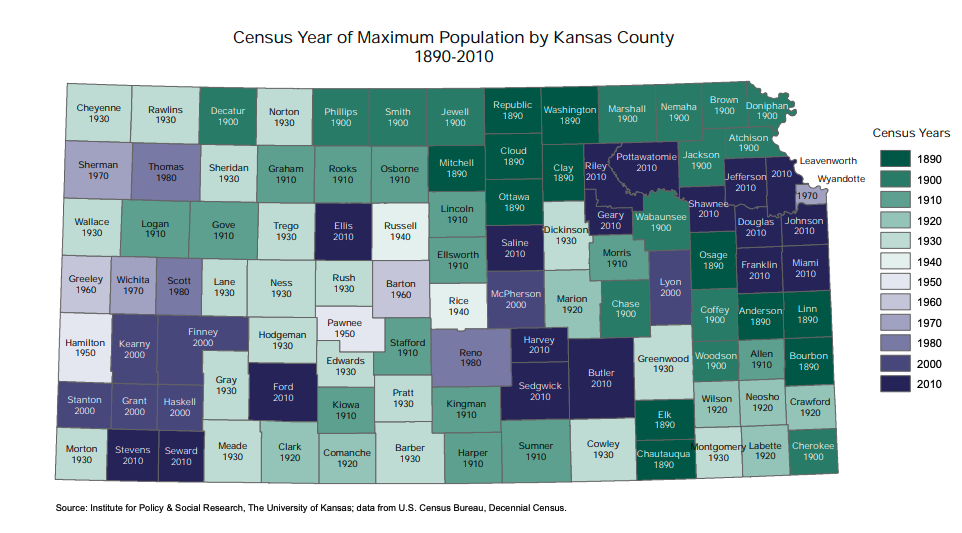
68 Kansas counties’ populations peaked in 1890; Ellis Co. peaked in 2010

KU News Service

LAWRENCE — Sixty-eight of 105 counties in Kansas peaked in population before the Dust Bowl. The most recent Kansas Statistical Abstract includes this and other interesting facts about Kansas.

The Institute for Policy & Social Research at the University of Kansas recently published the 53rd Edition of the Kansas Statistical Abstract, which contains social and economic data broken down by state, county and city.

“It is important for business and community leaders as well as policymakers to understand the changing demographic, social and economic characteristics of Kansas,” said Genna Hurd, IPSR associate researcher and KSA editor. “The KSA covers data on Kansas from climate to crime, parks to population, and energy to employment. We are honored that IPSR and KU have been able to provide this service to the people of the state for more than 50 years.”

This year’s KSA presents several new data visualizations.

“Our maps and graphs bring the data to life to illustrate patterns across the state,” said Xanthippe Wedel, IPSR senior research data engineer and State Data Center lead.

These visualizations reflect ongoing areas of interest for Kansans, such as a county-by-county look at the average small business loan amount at origination and a map of natural attractions and scenic byways in Kansas. And, with a presidential election coming up in 2020, one new map shows voter participation rates in the United States, by state, for the November 2016 election.

A new graph shows poverty rates by state and compares rates from 2011 to rates from 2017. The Kansas poverty rate increased to 14.7 percent in 2017, putting Kansas in the top 10 among states for the highest poverty rate.

More sobering data includes a map of infant mortality rates in Kansas by county and life expectancy at birth in Kansas by county. According to the data behind the life expectancy map, young children in Johnson County have a life expectancy that is nearly 8 years longer than their peers in Comanche County.

Each year, the KSA is compiled from state and federal data sources ranging from the Kansas Board of Regents to the Census Bureau. It is available at no cost from the IPSR website at https://ipsr.ku.edu/ksdata/ksah/.

“Working on the KSA has been an incredible and unique experience. I am lucky to be involved in research and data collection at IPSR, and I think the KSA showcases how useful this research can be on a local, state and national level,” said Abigail Byrd, IPSR student research assistant and KU 2019 Student Employee of the Year.

Illustration: Map showing Census year of maximum population for each county in Kansas. In Linn, Bourbon, Anderson, Osage, Elk, Chautauqua, Washington, Clay, Republic, Cloud, Ottawa and Mitchell counties, the maximum population census was in 1890. In Leavenworth, Johnson, Miami, Jefferson, Douglas, Franklin, Shawnee, Pottawatomie, Riley, Geary, Butler, Saline, Harvey, Sedgwick, Ellis, Ford, Stevens and Seward counties, the maximum population census was in 2010. Data sources available in Population in Kansas, by County, 1860 – 1970 (https://ipsr.ku.edu/ksdata/ksah/population/2pop16.pdf) and Population and Population Change in Kansas, by County, 1980 – 2010 (https://ipsr.ku.edu/ksdata/ksah/population/2pop12.pdf).

History commentary written by Fort Hays State professor

Dr. Raymond Wilson

FHSU University Relations

Dr. Raymond Wilson, professor emeritus of history and former chair of the History Department, wrote an invited commentary for “Spirit of the Indian Warrior,” edited by Michael Oren Fitzgerald and Joseph A. Fitzgerald.

This collection contains observations and speeches by American tribal leaders providing insights into their values, spirituality and understanding of the changes that were imposed on them from encroaching Europeans.

Warriors fought for their territory and defended against raids from other tribes and, later, American military. These Great Plains Indian warrior societies maintained cultural order and were the peacekeepers and disciplinarians of native society.

“The book is beautifully illustrated and contains profound comments by Indian warriors explaining the reasons they went to war,” Wilson said.

“Using today’s appropriate statement often spoken to our U.S. military, ‘thank you for your service,’ can indeed be applied to Indian combatants engaged in warfare to protect their loved ones and ways of life,” he said

The book is available now from World Wisdom Publishers.

Copyright Eagle Radio | FCC Public Files | EEO Public File