We have a brand new updated website! Click here to check it out!

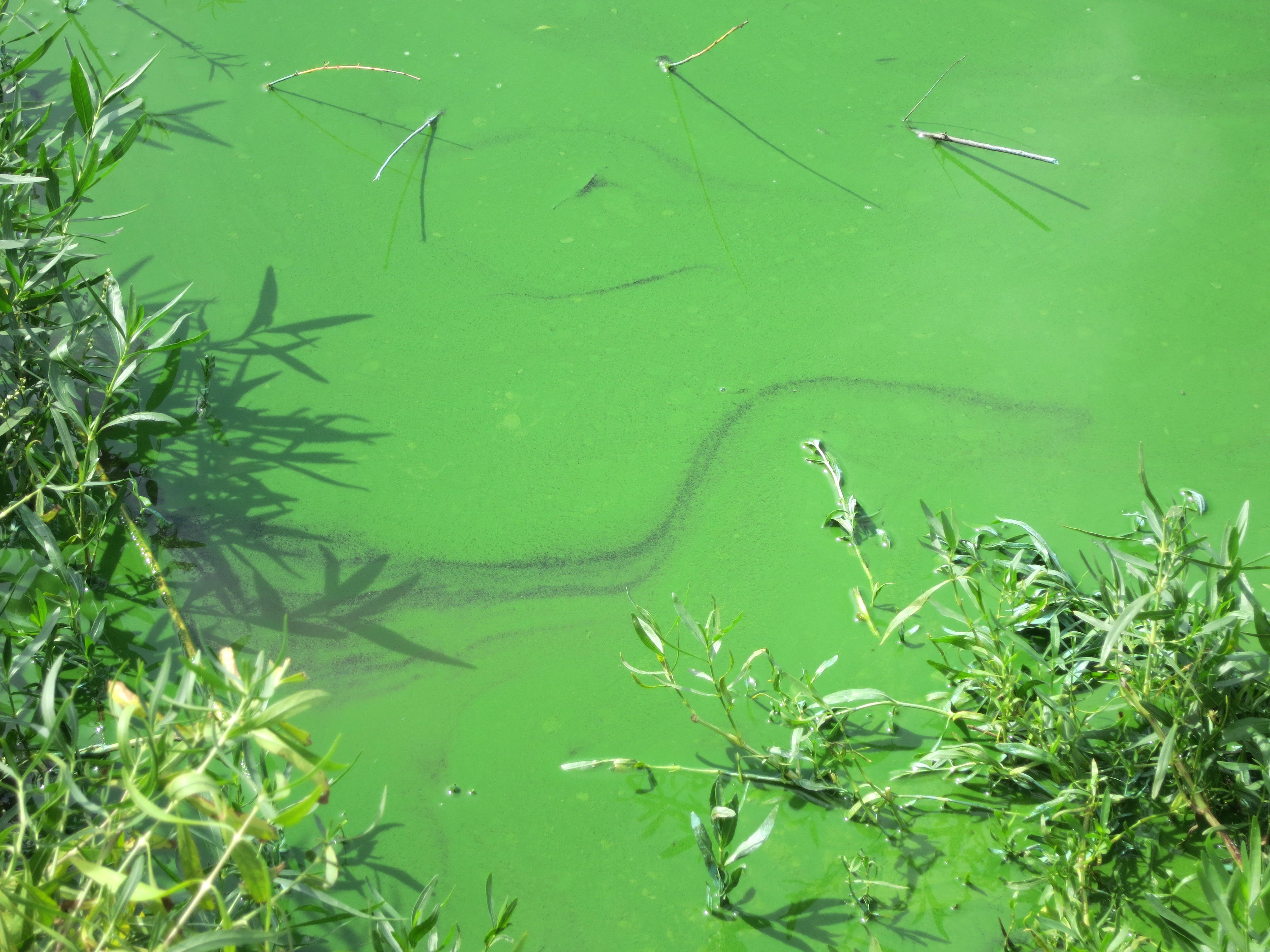
Hodgeman Co. lake downgraded to algae watch status

Algae bloom

KDHE

TOPEKA – The Kansas Department of Health and Environment (KDHE), in conjunction with the Kansas Department of Wildlife, Parks and Tourism (KDWPT), has issued public health advisories for Kansas lakes.

Warnings:

Elk Horn Lake, Jackson County (upgraded from watch 9/19)

Gathering Pond near Milford (Hatchery Supply Pond), Geary County (unchanged)

Hiawatha City Lake, Brown County (unchanged)

Jerry Ivey Pond, Saline County (unchanged)

Lake Jeanette, Leavenworth County (unchanged)

Lakewood Park Lake, Saline County (unchanged)

Marion County Lake, Marion County (unchanged)

Meadowbrook Park Lake, Johnson County (upgraded from watch 9/19)

Melvern Outlet Pond, Osage County (unchanged)

Melvern Swim Pond, Osage County (unchanged)

Westlake in Gage Park, Shawnee County (unchanged)

Yates Center Kids’ Fishing Pond, Woodson County (unchanged)

When a warning is issued, KDHE recommends the following precautions be taken:

  • Lake water is not safe to drink for pets or livestock.
  • Lake water, regardless of blue-green algae status, should never be consumed by humans.
  • Water contact should be avoided.
  • Fish may be eaten if they are rinsed with clean water and only the fillet portion is consumed, while all other parts are discarded.
  • Do not allow pets to eat dried algae.
  • If lake water contacts skin, wash with clean water as soon as possible.
  • Avoid areas of visible algae accumulation. 

Watches:

Atchison County Park Lake, Atchison County (new 9/19)

Big Eleven Lake, Wyandotte County (unchanged)

Camp Hawk Lake, Harvey County (unchanged)

Carousel Lake (Gage Park), Shawnee County (unchanged)

Hodgeman County State Fishing Lake, Hodgeman County (downgraded from warning 9/19)

Lake Afton, Sedgwick County (downgraded from warning 9/19)

Lake Shawnee, Shawnee County (unchanged)

Lebo Kids’ Pond, Coffey County (downgraded from warning 9/19)

Neosho State Fishing Lake, Neosho (unchanged)

Rock Garden Pond (Gage Park), Shawnee County (unchanged)

South Lake, Johnson County (unchanged)

A watch means that blue-green algae have been detected and a harmful algal bloom is present or likely to develop.  People are encouraged to avoid areas of algae accumulation and keep pets and livestock away from the water.

During the watch status, KDHE recommends the following precautions be taken:

  • Signage will be posted at all public access locations
  • Water may be unsafe for humans/animals
  • Avoid areas of algae accumulation and do not let people/pets eat dried algae or drink contaminated water.
  • Swimming, wading, skiing, and jet skiing are discouraged near visible blooms
  • Boating and fishing are safe. However, inhalation of the spray may affect some individuals. Avoid direct contact with water, and wash with clean water after any contact.
  • Clean fish well with potable water and eat fillet portion only.

KDHE samples publicly-accessible bodies of water for blue-green algae when the agency receives reports of potential algae blooms in Kansas lakes. Based on sampling results, KDHE reports on potentially harmful conditions.

Kansans should be aware that blooms are unpredictable. They can develop rapidly and may float around the lake, requiring visitors to exercise their best judgment. If there is scum, a paint-like surface or the water is bright green, avoid contact and keep pets away. These are indications that a harmful bloom may be present. Pet owners should be aware that animals that swim in or drink water affected by a harmful algal bloom or eat dried algae along the shore may become seriously ill or die.

For information on blue-green algae and reporting potential harmful algal blooms, please visit www.kdheks.gov/algae-illness/index.htm.
 

Unemployment rate dips in Ellis, Rooks counties

TOPEKA — Preliminary estimates reported by the Kansas Department of Labor and the Bureau of Labor Statistics show a seasonally adjusted unemployment rate of 3.2 percent in August. This was down from 3.3 percent in July and down from 3.3 percent in August 2018.

“The unemployment rate fell to 3.2 percent in August for the first time in more than 20 years, and Kansas employers in the private sector added 4,200 jobs. This growth was widespread with four industries contributing at least 1,000 jobs each,” said Secretary Delía García.

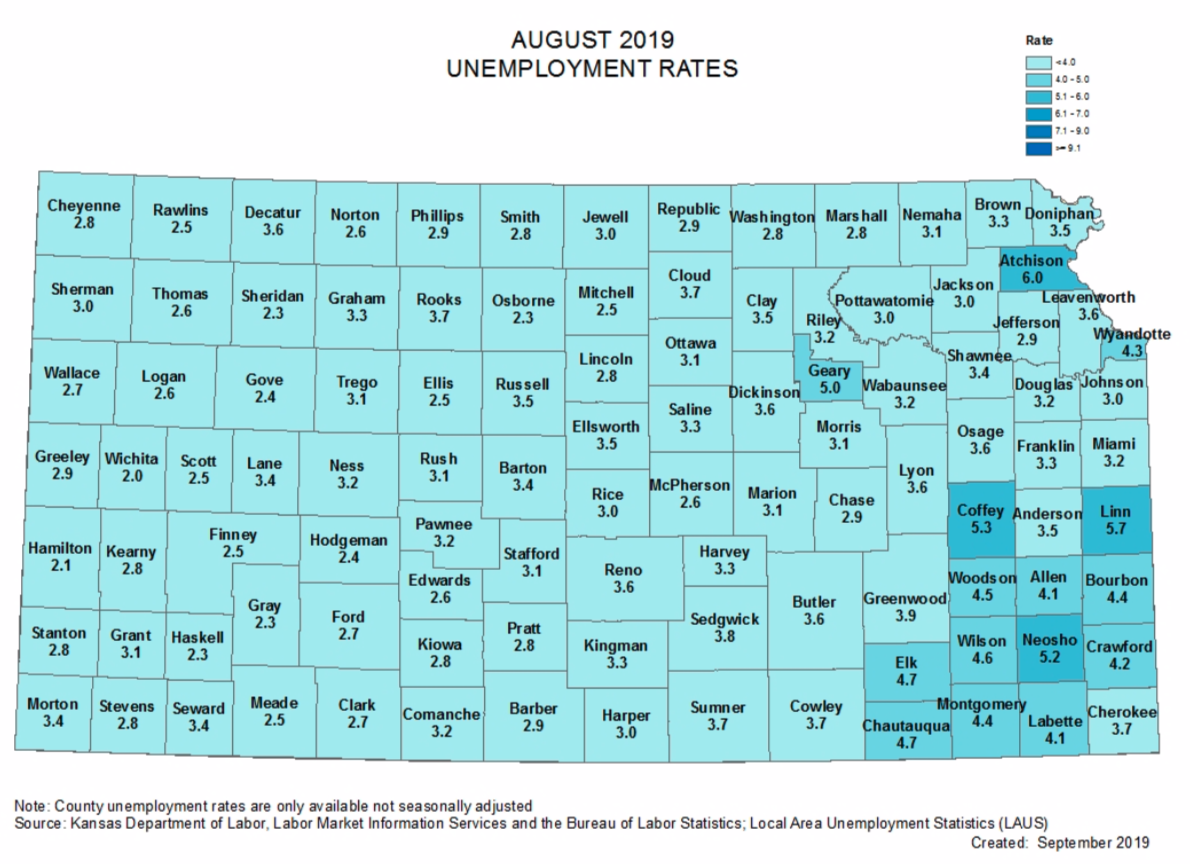
In northwest Kansas, jobless rates remain extremely low. Ellis County unemployment fell from 2.8 percent in July to 2.5 percent in August. Rooks County, which saw its economy take a hit in 2019 with stride at Dessin Fournir and Plainville Livestock Commission, saw its jobless rate fall from a regional high of 4.3 percent in July to 3.7 percent in August.

Trego, Graham, Ness, Rush and Russell counties also posted August jobless rates in excess of 3 percent.

Wichita County had the lowest unemployment rate in the state at 2 percent.

Seasonally adjusted job estimates indicate total Kansas nonfarm jobs increased by 7,900 from July. Private sector jobs, a subset of total nonfarm jobs, increased by 4,200 from the previous month.

“Kansas has seen significant growth in the number of private sector jobs compared to last August,” said Labor Economist, Emilie Doerksen. “This has been broad economic growth, with all 10 of the major private sector industries either remaining stable or adding jobs over the year.”

Since August 2018, Kansas gained 15,500 seasonally adjusted total nonfarm jobs and 17,800 private sector jobs.

The September 2019 Labor Report will be released Oct. 18.

Hansen Foundation now part of Kansas Complete Count Committee

Kansas Complete Count committee

KDOC

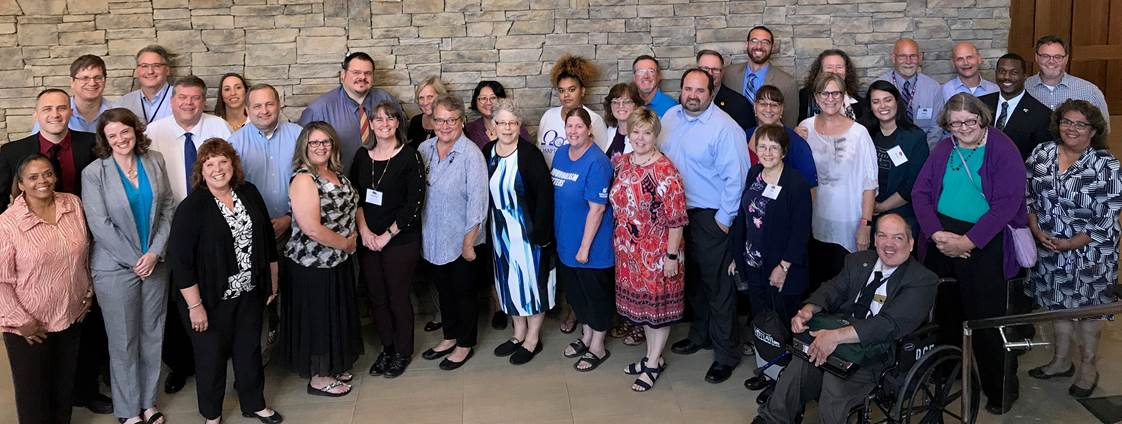
WICHITA – The Kansas Complete Count Committee, created through executive order by Governor Laura Kelly in April to assist the U.S. Census Bureau in promoting participation in the 2020 Census, met for the first time recently in Wichita.

“Every voice is important, and every Kansan must be counted,” Governor Kelly said. “In addition to the amount of federal funding that is on the line, we need an accurate picture of our communities so that we can properly plan for the future. The members of the Complete Count Committee are qualified professionals eager to make sure we have an accurate count.”

Brian McClendon, a Lawrence Democrat, and Joyce Warshaw, a Dodge City Republican, serve as co-chairs of the committee. McClendon is a professor at the University of Kansas and the former vice president of Google and Uber. Warshaw serves on the board of directors for the Kansas League of Municipalities and is the vice mayor of Dodge City.

“We’ve been meeting with stakeholders and recruiting members of our committee for months, so it was wonderful to finally have them all together to formally begin our efforts on Census participation,” Warshaw said. “These efforts are crucial to ensuring we have an accurate count in 2020.”

According to Warshaw, for every person not counted in the 2020 Census, Kansas stands to lose about $2,000 in federal funds per year for 10 years. That funding goes to dozens of programs such as Head Start, KanCare and the Community Development Block Grant (CDBG) program.

The Census will determine how the federal government distributes over $6 billion in federal funds to Kansas every year.

“Our state receives federal funding for everything from law enforcement to infrastructure to healthcare,” Warshaw said. “Since this affects so many different aspects of life in Kansas, we wanted to make sure our Complete Count Committee included a diverse group of people from across the state representing different communities with different interests.”

McClendon said they had been working with the Governor’s Office and the Kansas Department of Commerce to find and recruit members of the committee. The committee now includes representatives from nonprofit organizations such as Kansas Catholic Charities, Kansas Appleseed, Dane G. Hansen Foundation in Logan, El Centro and Kansas Farm Bureau. It also includes elected officials from across the state.

“It was great to see such a broad range of Kansans focused on helping Kansans get counted in the Census,” McClendon said. “It was a very productive session with many stepping up to take on more.”

During the Sept. 10 initial meeting, McClendon urged committee members to reach out to help form local Complete Count Committees in their communities to promote Census participation.

Emily Kelley, Complete Count Committee member and partnership coordinator for Kansas with the U.S. Census Bureau, also invited members to attend the formal openings of Census Bureau field offices in Overland Park and Wichita on Oct. 1. Governor Kelly will be attending the opening of the Overland Park office, while Lieutenant Governor Lynn Rogers will be at the Wichita opening.

Wonder Women League seeks to expand its programs in Ellis County

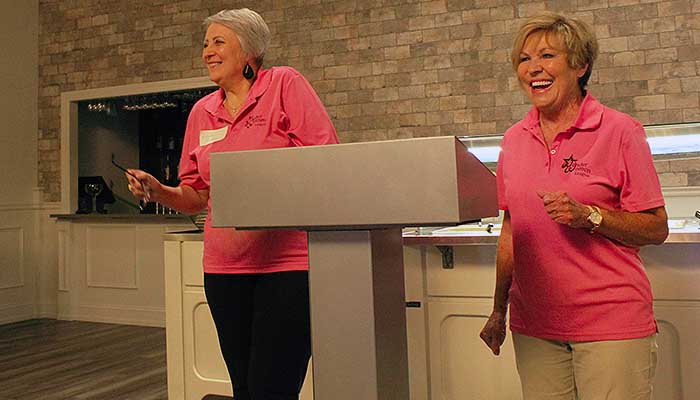
Wonder Women League Co-Chairs Rhonda Meyerhoff and Nancy Jeter speak at a League event Tuesday.

By CRISTINA JANNEY
Hays Post

The Wonder Women League is looking forward to several projects that will help children.

The nonprofit, which is affiliated with United Way of Ellis County, had a member drive luncheon Tuesday.

The Wonder Women League hopes to partner with HaysMed to buy stainless steel wagons and/or remote controlled cars for children who are patients at the hospital, Rhonda Meyerhoff, League co-chair, told the group.

“Mom or dad can take the child for a ride, and it is another way of transport,” she said.

The remote-controlled cars, can be a way a child can ride to surgery.

“I didn’t really think about it, but the impact on a child who is really, really scared …,” Meyerhoff said. “They want to cling to mom or to dad because they don’t know what is going to happen. They are scared. What we are told is if they can get the child into one of these motorized vehicles and into surgery, they have accomplished a lot with this child because the child is not going to fight them now.”

The Wonder Women League is a nonprofit that raises money for and implements projects that help children, families and the community.

HaysMed has approved the project, and it will be up for a vote in front of the Wonder Women in October. The group meets every other month on the second Thursday of the month for about an hour.

The group is trying to organize a cyber security program that could be presented to children in schools, the group also hopes to discuss this project at its next meeting.

The group also hopes to partner with the Fort Hays State University veterans organization to assist in its annual sports equipment drive. That could happen as soon as this fall.

“We know there may be children whose parents can’t afford the athletic equipment that they need to even do Hays Rec or some other team,” Meyerhoff said. “I don’t know about you, but it seemed every year I was having to buy new sizes of shoes for my kids for what they were going through because they had grown that much and the old pair just kind of got dumped.”

New equipment can be donated, but gently used equipment like basketballs, footballs, soccer balls or baseballs could also be donated.

The group has also discussed a long-term goal of creating a woman’s scholarship fund.

The League continues to participate in Matthew’s Gift in cooperation with HaysMed. The project provides bags with necessities, such as toiletries, bottled water, a lap blanket and snacks, to families who have loved ones who have to be transferred out of Hays on an emergency basis. The project was named for 3-year-old Matthew Wellbrock, who died as a result of an accident on his family’s farm.

Nancy Jeter, League c0-chair, said Matthew’s father and mother received a similar bag when Matthew was in the hospital. Matthew’s father told Jeter the bag was invaluable to the couple, because neither one of them wanted to leave Matthew’s side when he was in the hospital. They lived out of that bag until Matthew passed away.

Tammy Williams, HaysMed emergency department nurse, said the families who have received the bags have been very grateful. About three dozen bags have been distributed since the program began in the spring.

Meyerhoff said, “In my heart, when we give them that bag, I think we give them some love from Ellis County to go with them.”

Other projects Wonder Women have supported since the group launched two years ago included a self-defense class and Sunrise Park’s Born Learning Trail, which is a walking trail that includes interactive learning activities for children.

Prior to the event Tuesday, the group had about 35 members.

The group has changed its membership structure. The minimum contribution to become a member is $50. You can pay using check, cash or credit card. You can register online using a credit card.

You can volunteer for events or be on committees, but the League also offers a donor only option.

Registration is good for one year, and the money raised goes to support Wonder Women League projects. The group also accepts contributions from corporate sponsors. Although the League is under the United Way’s nonprofit umbrella, the funds raised through this organization are kept separate for League projects.

The exception is the annual Power of the Purse event, which jointly supports the League and United Way.

🎥 New organizational Hays logo will replace 20+ logos currently used

Hays graphic designer Scott Gross shows what the city’s new organizational logo will look like on a promotional photo of the bridge in Frontier Park.

By BECKY KISER
Hays Post

A single simple organizational logo will “displace the very large amount” of logos currently used by the city of Hays.

“I don’t think any of these logos were adopted by ordinance by the commission in the past,” Toby Dougherty, city manager, told city commissioners Thursday night.

“But because of the staff’s goal to combine them into one logo, we would like you to come to some sort of consensus.”

Dougherty, along with Melissa Dixon, Convention and Visitors executive director, and other city staff members worked with Hays artist Scott Gross who was contracted to design a new logo.

Three similar designs were shown to commissioners who agreed with the staff recommendation of the abstract lowercase “h” option.

Vice-mayor Sean Musil was a little hesitant. “I don’t hate it. I’m just not in love with it,” he said. “I love this logo,” Musil said holding up his bottle of water sporting a current city logo. “To me, this looks fresh.”

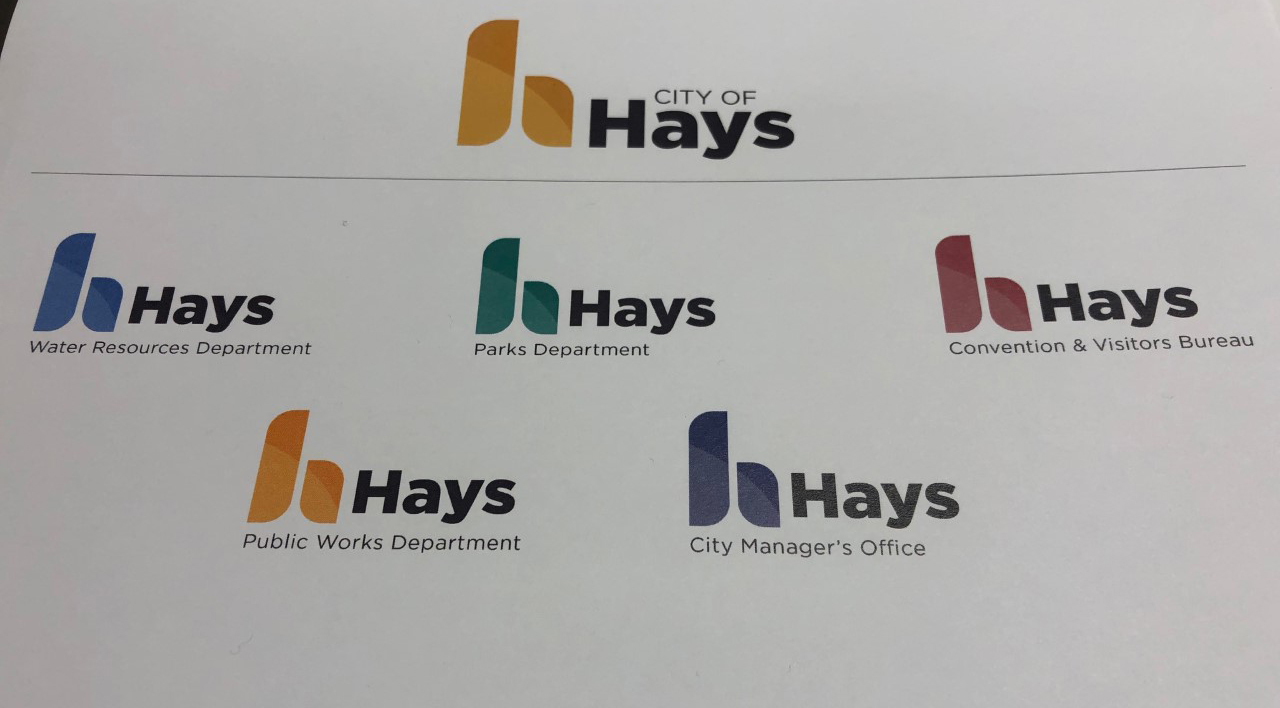
The goal of the logo project was to create a standardized city logo that will work in all type of media, signage, letterhead and even employee clothing. The logo color can be tailored to different departments such as green for parks and blue for water resources.

“The logos that are out there aren’t very organized or cohesive,” said Gross. “It was time to give it an update, give it a nice refresh.”

Gross, who has also designed logos for several local businesses including Regeena’s Flowers and Gella’s Diner in downtown Hays, showed mockups of the logo on city vehicles, clothing, the blue trash carts and a photo of the iconic Frontier Park bridge.

“The logo looks like it’s two colors but it’s really just one color,” Gross explained. “You’re only spending money on one color when you go to printing on different things. It’s portable. You can’t really embroider two tones like that so you’re just doing one color, nice and simple.”

The city’s “3 Amigos” logo featuring General George A. Custer, James B. “Wild Bill” Hickok and William “Buffalo Bill” Cody often utilized multiple colors, a more expensive process than a single color.

The new logo will use common Pantone colors and the sans-serif Gotham font.

Gross also showed examples of the logo reversed, in 1-color, gray-scale, and 2-color with a color background.

Some of the logo changes will start immediately.

“All the online electronic stuff, that will happen right away. The stuff we give to the press, the letterhead. All that stuff is going to change quickly,” Dougherty said.

Employee shirts will change as they need to be replaced.

The 50-plus wayfinding signs in Hays may not change. “We may look at it and say keep it. It’s a whole separate entity aside from the organizational logo for the city of Hays.”

Hays Regional Airport has its own logo. The new logo will be adapted, perhaps by adding an airplane, to keep the same organizational theme.

Commissioner Ron Mellick asked if the city was going to “throw away thousands of dollars of letterhead.”

“We buy letterhead in really low amounts,” Dougherty answered, “because commissioners’ names change and we have to redo that letterhead. We buy on an as-needed basis. It’s not like we’re going to toss a lot of stuff into the recycling.” Letterhead will not be changed until after the 2020 commission is seated in January, so there will be no additional cost.

The police and fire departments will also use the updated letterhead. Uniform patches will not be affected and for now, the logo will not be placed on police vehicles. Other city vehicles will get new vinyl decals right away.

The logo committee anticipates the cost to implement the new logo is less than $10,000.

Four TMP-M seniors earn Kansas Honors Program accolades

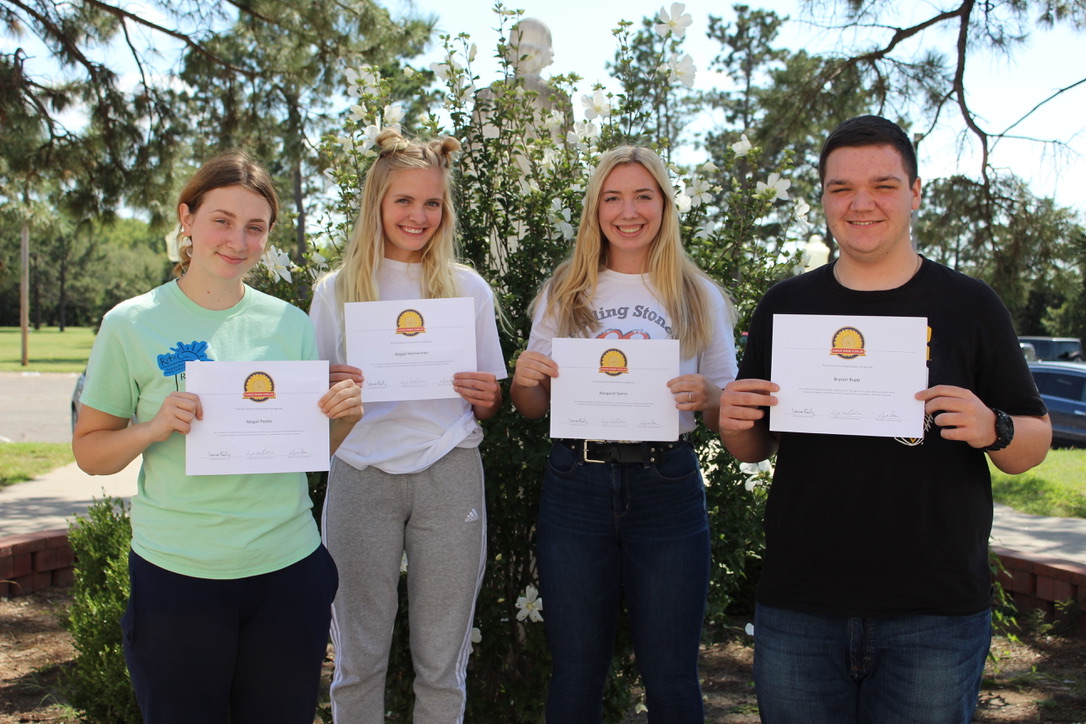
From left: Peeler, Heimerman, Speno and Rupp

The Kansas Honors Program, a longstanding tradition of the University of Kansas, Alumni Association and KU Endowment, honors high school seniors throughout Kansas for academic excellence and achievement.

This year, there were four Thomas More Prep-Marian seniors who received the honor. Abigail Heimerman, Abigail Peeler, Bryson Rupp and Margaret Speno were chosen due to their GPA being in the top 10 percent of their senior class.

— TMP-M

INSIGHT KANSAS: Addressing racial disparities key to fixing Kan. prison crisis

Patrick R. Miller is an Assistant Professor of Political Science at the University of Kansas.
To address prison overcrowding, Kansas must understand the racial disparities that exist in our system of mass incarceration, how they fuel our ballooning prison population, and potential remedies.

Our state prison population does not reflect the Kansas population on race. According to 2018 data from the Kansas Department of Corrections, 28% of our adult prisoners are African American, 12% Hispanic, 3% Native American, and 1% Asian. The 2010 Census shows that Kansas is 6% African American, 12% Hispanic, 1% Native American, and 3% Asian.

So, African Americans are represented in our prison population at nearly five times their share of the Kansas population, and Native Americans three times. Racial disparities also exist among juveniles in detention in Kansas, where 32% are black and 23% Hispanic.

Our prison population skews in other important ways, too. Among adult prisoners, 36% have less than a high school education. And 33% are diagnosed with a serious to severe mental illness, underscoring how prisons compensate for the decline of state psychiatric hospitals.

On race, the Bureau of Justice Statistics reports that the national imprisonment rate among black men has dropped by about 20% since 2000. Experts tie this to declining crime rates, shifts in drug enforcement toward opioids and meth, and criminal justice reform focused on urban communities. Consequently, as prison populations have declined in most states, the disparity in imprisonment between blacks and whites has shrunk, though not disappeared.

In Kansas, though our prison population has grown, African Americans have declined from 36% of the adult prison population in 2001, according to the Kansas Department of Corrections. That represents progress, though that decline has stagnated in recent years.

Nationally, Americans seem more aware of how racial disparities in prison are driven by differences in poverty and educational opportunities, drug laws and their enforcement, policing inequities, legal representation inequities, and sentencing disparities, among other factors.

But good data on Kansas are scarce. Challenge one in addressing the racial disparity in Kansas prisons is better studying and understanding how national factors that create this difference work specifically in Kansas.

Challenge two is policy. The upside to Kansas lagging other states on criminal justice reform is that we can learn from their experiences, though their approaches will not always fit well in Kansas.

Take Georgia. As the Atlanta Journal-Constitution reports, former Republican Governor Nathan Deal spearheaded bipartisan criminal justice reform measures, including “accountability courts” that provide prison alternatives for non-violent or mentally ill offenders and redefining what constitutes a “felony.” Though imperfect, Georgia has shrunk its prison population, cut the imprisonment rate of African Americans even more dramatically, and saved tens of millions of dollars.

Other states have tackled minimum mandatory sentencing, three strikes laws, indigent defense, and other factors that have exacerbated racial disparities in their respective prisons.

Challenge three is spine. Many reform advocates deemphasize race, perhaps thinking it makes the issue divisive. But avoiding hard truths serves no good. This leaves reform opponents as frequently the ones emphasizing race, often implicitly in their language or which violent offenders they cherry pick to mischaracterize reform proposals.

One column cannot adequately address this topic—especially policy complexities, moral justice, and the human impact. But to tackle this problem intelligently, we should not treat the issue as color blind when our prison crisis is inseparable from race.

Patrick R. Miller is an Associate Professor of Political Science at the University of Kansas.

New York-based jazz drummer musician to perform at FHSU

FHSU University Relations

Pete Zimmer, a New York based jazz drummer, will perform at Fort Hays State University’s Beach/Schmidt Performing Arts Center at 8 p.m. Monday, Sept. 23.

Touring through the midwest, Zimmer will stop in Hays to perform as well as work with music students.

This is not Zimmer’s first time in Hays. He has stopped to play on campus before and was a guest artist for the music camp four years ago.

Zimmer will perform with Dr. Ben Markley, an FHSU alum who teaches at the University of Wyoming, on piano, Bob Bowman, a freelance musician, on bass, Brad Dawson, assistant professor of music and theatre, and Luke Johnson an instructor of music and theatre.

“This will be a chance to hear great jazz from some great players,” said Dawson.

The show will feature two compositions written by Markley that are on his latest CD Slow Play.

The show is free and open to the public. For more information you can email Dawson at [email protected].

This weekend’s Hays-area garage sales

Hays-area garage sales

Scroll to the bottom for a map of garage sale locations. Hays Post offers FREE garage sale listings weekly. Having a garage sale next weekend? Click HERE to submit your information.

130 N Ash, Russell
Saturday 8-Noon

Lots of neat stuff, some antiques, Women’s Clothes, Men’s Big and Tall, household, garden, BBQ stuff, crafts and craft supplies and Misc. everything priced to sell. 130 North Ash Street Russell 8-Noon Saturday 9-21-19

———————

2206 Downing Ave., Hays
Friday, September 20th 5:30 until dark & Saturday, sept. 21st 8:00 am until 1:00 pm

Household items

———————

508 W 15th, Hays
Thursday, September 19th 4p.m. to dark, Friday, September 20th 4p.m. to dark, Saturday September 21st 9a.m. to Noon

Daycare closing! Toys, books, puzzles, baby items, pack n play, exersaucer, booster seats, house hold items, electronic keyboard with stand, sewing machine, too much to list

———————–

2516 Henry Drive, Hays
Friday 9/20 from 8 am to 8 pm and Saturday 9/21 from 8 am to noon

Automatic Baby Bottle Maker, antiques, collectables, porcelain dolls, queen bed frames, small grill I Robot Floor cleaner, toys, games puzzles, clothes, furniture, microwave, mens electric tools, lots of miscellaneous.

————————–

217 W. 35th St, Hays
Saturday, September 21st 8:00am to 12:00pm

Large, Multi-family garage sale
Girl’s clothing Newborn – 12 months, car seats, baby accessories, maternity clothes
shoes
Lots of home decor
wooden rocking chair
media console tables
desk hutch
coffee table
lots of miscellaneous!

—————————-

Hays High announces 2019 Homecoming candidates, events

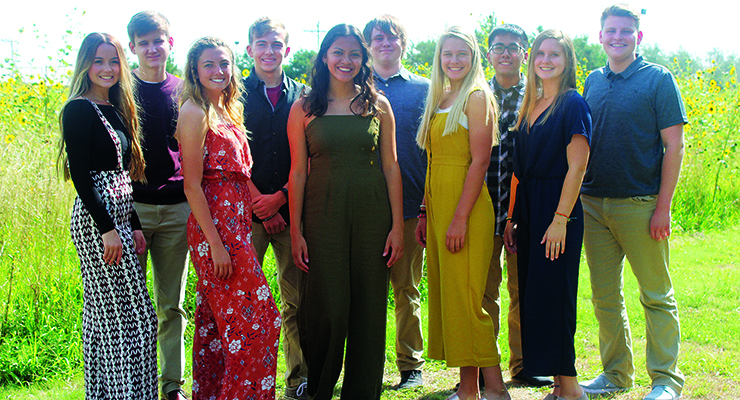
Front row, left to right: Avery Jones, daughter Paul and Steph Jones, and Elodie Jones; Maddie Lohmeyer, daughter of Joe and Misty Lohmeyer; Yesenia Maldonado, daughter of Lacho and Patty Maldonado; Madelyn Waddell, daughter of Josh and Tina Waddell; Cassidy Prough, daughter of Brandon and Shaina Prough. Back row, left to right: Ben Boland, son of Roger and Camber Boland; Nathan Erbert, son of Greg and Lisa Erbert; Tommy Brooks, son of Matt and Krista Brooks; Derrick Aragon, son of Inez Gutierrez; Carson Ackerman, son of Jeff and Kelly Ackerman.

Hays High School has announced 2019 Homecoming candidates and unveiled this year’s schedule of events.

Homecoming Week activities begin this weekend with a color run and float building. The crowing of the king and queen will take place at halftime of the varsity football  game against Garden City, which is scheduled to kick off at 7 p.m.

The entire schedule of events is below:

Science Cafe celebrates 100th lecture with call for citizen scientists

By CRISTINA JANNEY
Hays Post

Fort Hays State University celebrated its 100th Science Cafe on Monday night by encouraging audience members to become citizen scientists.

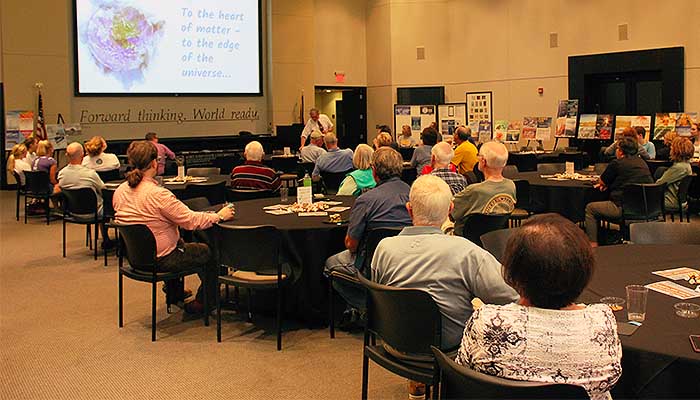
Dr. Paul Adams, director of the FHSU Science and Mathematics Education Institute, presented the lecture at the Robbins Center Monday looking back on the last 99 lectures, looking forward to future lectures and offering suggestions on how every day people can become involved in science.

“What I am asking you to do and to take the challenge with me is to get more engaged in the scientific enterprise — be part of the science ecosystem in our area,” he said. “That means to become a citizen scientist.”

Adams said science educators when working with children will ask them to draw a picture of a scientist.

They often draw a picture of a white person, wearing glasses, in a lab with test tubes or an older man with a beard looking at the stars. Adams said as a science educator, he is trying to change that perception.

Dr. Paul Adams gives the 100th Science Cafe lecture Monday at the Robbins Center.

“It is not them,” he said. “The idea is that science is done by other people for others. It is not doing science for ourselves. This is a challenge for you. How can you be part of this? How can you be a scientist?”

Citizen science involves non-scientists, includes scientific processes and research standards, and has a goal of advancing scientific knowledge.

Citizen science is not new. The Chinese have records for 3,500 years of locust outbreaks. The royal courts in Japan have 1,200 years of records when the cherry blossoms bloomed. The French have 640 years of records of grape harvest data. The United States has a long record of citizens who keep track of weather data and harvests.

These records weren’t kept by scientists or the government. They were kept my citizens, Adams said.

In recent years, citizen science has improved with the aid of technology.

There are more than 1,000 choices available through clearinghouses online you can choose from to be a citizen scientist. Adams highlighted a selection of these during his talk on Monday. Most of these projects can be accessed online or through apps.

An early online citizen scientist project was Galaxy Zoo.

“This is taking images from deep space. Nobody has seen them. You can be the first person to tell if it is a bar or spiral,” he said. “Computers can’t read these. Computers can’t interpret it.”

What are now called green pea galaxies where discovered using crowd sourcing such as this.

“They found these galaxies no one had classified before, and we learned our models weren’t right because of the science citizen scientists did,” Adams said.

Globe at Night asks citizens to make a monthly reports on what stars and constellations are visible from their locations. This global initiative is gathering data on light pollution. You don’t have to have a telescope. You make your observations with the naked eye. The app has a constellation ID tool. Training takes only a few minutes. Adams said this is a great app to use with students.

Adams said he tells his students,”Don’t worry about getting it right, because we don’t know what right is.”

Some of these programs use large number of observers to report data, and then they pinpoint what statistically most of the observers report. If the observers can’t agree, then scientists may need to look more closely at what is being observed to determine if there is an anomaly present. This is how the green pea galaxies were discovered.

Journey North asks citizens to help track migration patterns for birds, monarch butterflies and other creatures.

NASA’s All Sky Fireball Network asks you to observe fireballs or meteors in the night sky.

Budburst ask users to track when flowers start to bloom, which is also an indicator of climate change.

Global Explorer asks users to look at satellite imagery to determine if archeological sites have been looted.

Stall Catchers is a game that is used as tool in Alzheimer’s research.

eBirds looks at bird populations; iNaturalist asks you to take pictures of different species of animals in your area.

Dust Storms asks you to take picture of dust storms and report their location. This data is also being used to monitor climate change, which scientist believe is going to spark more dust storms.

NASA alone has a substantial list of citizen science projects, which can be accessed at science.nasa.gov/citizenscientists  or at www.nasa.gov/solve.

If you are interested in social sciences, there are projects that ask people to transcribe works from contemporaries of William Shakespeare or notes from U.S. Supreme Court justices. Look for more projects on Zooniverse.

Computers can’t interpret some data, such as handwriting. That is why scientists use crowd sourcing.

“Satellites work, but they aren’t perfect. They need people to validate, interpret and understand,” Adams said. “On Globe Observer, you can do clouds. You can do trees. You can do mosquitoes. You can do dust storms. The reason you do this, and this a direct quote from a scientist, ‘Satellites don’t see mosquitoes.’ Even though the technology is good. Even though they can read license plates in Russia, we are told, they can’t see mosquitoes.”

Knowing more information on mosquitoes helps to track the spread of diseases such as West Nile and Zika.

“A satellite can tell us where it is wet, but it can’t tell if the mosquitoes are going crazy,” Adams said.

He said he would like to see the residents of the Hays come together to do a citizen science project as a community, and he said he is entertaining ideas of what that project could be.

Science Cafe is supported through private donations. The lectures are free and open to the public.

The next Science Cafe will be at 7 p.m. Monday, Oct. 14, at The Venue at Thirsty’s in Hays. You can order food or beverages at your own cost from Thirsty’s.

Keri Maricle, biology instructor at the North Central Kansas Technical College, will present “Importance of Scientific Education in Western Kansas.”

Holly Dickman, water conservation specialist for the city of Hays, will be back this year to talk about water conservation. Another speaker will discuss virtual and augmented reality. Adams said someone had suggested bringing in a speaker to talk about cultured meat (lab grown not from animals), and he has also considered giving a lecture on fire walking, which he used to participate in.

Videos of some of the previous Science Cafes are available online. If you wish to learn more about the lecture series or suggest a topic for an upcoming lecture, contact Cari Rohleder at [email protected] or 785-628-4743.


Copyright Eagle Radio | FCC Public Files | EEO Public File