As you bring in your round bales for winter storage and feeding, store them to minimize weather losses.
Hay stored outside will be damaged by rain, snow, wind, and ice this fall and winter.The average round bale loses about one fourth of its original nutrients during storage, but these losses can be reduced to less than 10 percent or so.Now, you may be better than average but let’s still look at ways to reduce spoilage by storing that valuable hay more carefully this year.
For instance, do you sometimes line up bales for easy access so the twine sides touch each other?Or do you stack your bales?If so, extra spoilage will occur where these bales touch because rain, snow, and ice will gather in spots where bales touch instead of running off.Round bales butted end-to-end, cigar-like, usually have less spoilage.
Does snow drift around your bales?Bales placed in east-west rows often have drifts on the south side.Hay close to fencelines or trees can get extra snow.As snow melts it soaks into bales or makes the ground muddy.Plus, the north side never gets any sun so it’s slow to dry.This year, line your bales up north-and-south and away from trees for fewer drifts and faster drying as sunlight and prevailing winds hit both sides of the row.
Most important is the bottom of your bales.Always put bales on higher, well-drained ground so water drains away from them.Keep them out of terrace bottoms or other low spots.If necessary, use crushed rock, railroad ties, or even pallets to elevate bales to keep the bottoms dry.This also will reduce problems getting to your hay or getting it moved due to snow drifts or mud.
Just a little pre-planning can save lots of hay and frustrations.
Alicia Boor is an Agriculture and Natural Resources agent in the Cottonwood District (which includes Barton and Ellis counties) for K-State Research and Extension. You can contact her by e-mail at [email protected] or calling 620-793-1910
Projects for Phases I and II totaling $4.4 million were approved in 2004 by a TDD ordinance and a 3/4-cent sales tax was enacted April 1, 2005, both for a maximum 22 years. The city then issued $1.77 million in TDD sales tax bonds to finance Phase I.
The TDD tax outperformed projections allowing the Phase I bonds to be called early and completed in January 2018. It was determined the 3/4-cent TDD sales tax could continue until March 2027 to fund a portion of Phase II improvements.
ELLIS — At the regular Ellis City Council meeting Monday, the council unanimously approved an engineering contract with Driggs Design Group, completing another step in the process of applying for a Community Development Block Grant that would cover half of the cost of $824,000 project that would replace four waterlines through the city.
“It’s generally the same as the application we submitted two years ago with the exception that we added another waterline to it to try to capture some more money,” said Buck Driggs of Driggs Design Group.
The contract with the firm is also the same as during the previous submission, covering design and construction. The contract is contingent upon the city receiving the CDBG grant.
Approving the contract is a part of the application process and signifies the city is ready to move forward if the grant is received, Driggs told the council.
“By doing this in a public hearing, that gets two of the boxes checked,” he said.
Driggs expects the grant application to be submitted next week.
In other action:
The council approved a proposal to perform a survey for the swimming pool improvement project.
The council authorized the mayor to sign a letter of support for ACCESS Public Transportation. The letter will be used with grant applications.
The council approved a contract with the Ponderosa Tree Farm and Nursery.
The council approved a continuation of a tax abatement for the Ellis Days Inn. The abatement has been requested as the current owners are looking for a buyer and will only take effect if also approved by the Ellis County Commission and the Ellis Board of Education.
The council accepted resignation letters from Police Chief Taft Yates and Public Works Director Alan Scheuerman. Scheuerman will continue in his position until Nov. 1. Yates will continue in his role until Nov. 29.
Adding up to just over $310,000 in support from donors, 274 scholarships were awarded to business students for the 2019-2020 academic year at Fort Hays State University.
The scholarships were awarded at last week’s annual W.R. and Yvonne Robbins College of Business and Entrepreneurship scholarship awards ceremony.
“The support of these donors assures that Fort Hays State University continues to be a leader in business and entrepreneurship education by attracting and retaining the next generation of innovators and problem solvers,” said Dr. Melissa Hunsicker Walburn, Interim dean of the college and one of several speakers at the event.
“Through this shared commitment and partnership with friends and supporters external to the university, we achieve excellence in business education.”
“We extend our gratitude to the former students, organizations, businesses, and other friends of the Robbins College of Business and Entrepreneurship who have made possible these scholarships,” she said.
“My first association with the business college scholarship ceremony was in 1984 as a student who received an award.” said Linda Kepka, senior administrative assistant for FHSU’s Department of Economics, Finance, and Accounting.
“The Robbins College of Business and Entrepreneurship is awarding five times as many scholarships now as we did 30 years ago.”
Also praising the scholarship program was W.R. Robbins, for whom the business college is named.
“Each year the Robbins College of Business and Entrepreneurship list of donors for student scholarships continues to increase along with the dollar amount given,” he said.
“I feel this indicates that the quality of education our students are receiving is superior and they and their family have the desire to pay it forward to the next generation. I am so honored to be a part of this scholarship program.”
Learn how you can support students within FHSU’s Robbins College of Business and Entrepreneurship by visiting https://foundation.fhsu.edu or by contacting the FHSU Foundation at 785-628-5620 or [email protected].
TOPEKA – Recently the Kansas Water Authority (KWA) met in Goodland under the new direction of Constance (Connie) Crittenden Owen who was appointed Chair this past summer by Governor Kelly to lead the KWA.
“My experience as a licensed attorney practicing Kansas water law for more than 25 years has exposed me to real-life water issues that affect individuals and families, as well as businesses and municipalities,” said Owen. “As Chair I welcome the opportunity to apply the knowledge and expertise of the board members, professionals in our state agencies and stakeholders throughout Kansas to protect our water resources for current and future generations.”
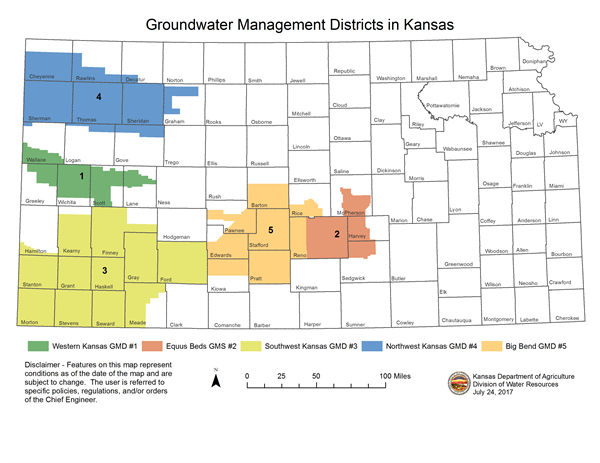
In addition to Owen, several new members were present including: Jeremiah Hobbs representing the State Association of Kansas Watersheds, Chris Ladwig representing the Kansas Chamber of Commerce and industrial water users, Sen. Carolyn McGinn representing Environment and Conservation, and David Stroberg, Hutchinson, representing Groundwater Management Districts (GMD) 2 & 5.
(GMD 5 includes Edwards County, site of the R-9 Ranch owned by the cities of Hays and Russell which is a planned long-term water source for the two communities.)
Two major actions were taken by the KWA which included approval of Regional Advisory Committee (RAC) membership for positions with 2019 term expirations as well as approval of State Water Plan Fund (SWPF) budget recommendations for State Fiscal Year (SFY) 2021.
The KWA re-appointed 54 currently seated members to serve another four-year term on their respective RACs and appointed 25 new members to serve on nine of the RACs.
As in recent years, the KWA decided to develop a SWPF budget recommendation package which focuses on full restoration of the State General Fund (SGF)/Economic Development Initiatives Fund (EDIF) demand transfer totaling $8 million. Enhancements and appropriations which took place for SFY 2020 were recommended as base-level funding program funding for SFY 2021, with additional enhancement recommendations for 12 projects/programs/initiatives totaling $3,170,100 and ultimately creating a budget recommendation package which includes full restoration of the SGF/EDIF demand transfer.
Other actions of note by the KWA include approval and authorization of the Kansas Water Office (KWO) Director to proceed with negotiations with the Lower Smoky Hill Water Supply Access District for the purchase of additional irrigation storage space in Kanopolis Lake; approval for the KWO to enter into a multi-state Planning Assistance to States (PAS) agreement with the U.S. Army Corps of Engineers for a flood risk management study for the Lower Missouri River Basin in Kansas, Missouri, Iowa and Nebraska; and approval for the KWO Director to enter into an agreement with the Federal Emergency Management Agency (FEMA) to receive and utilize High Hazard Potential Dams Rehabilitation Grant Funds.
Presentations were also provided by the Kansas Geological Survey on the Arbuckle in Kansas and Groundwater Management District 4 on water conservation efforts in northwest Kansas.
The KWA is responsible for advising the Governor, Legislature and Director of the Kansas Water Office (KWO) on water policy issues. They also ensure that water policies and programs address the needs of all Kansans as well as serve as advisors of the Kansas Water Vision and Kansas Water Plan. The KWA was established in 1981 and consists of 13 voting members who are appointed by the Governor or Legislative leadership. State agency directors serve as ex-officio members.
The KWA meetings are throughout the year and the next meeting is scheduled for December 19 in Salina. For additional information and other upcoming meetings, please visit www.kwo.ks.gov.
Ellis County residents will be asked to vote on a pair of sales tax questions next April after the county commission approved a resolution Monday calling for a mail ballot election.
Voters will get to vote on two quarter-cent sales tax questions. If both measures were approved by the voters, it would increase the sales tax in Ellis County by a half-cent.
After month of discussion, the commission settled on a quarter-cent directed specifically for health care services and a quarter-cent general sales tax.
If both sales taxes pass, the measures would generate about $2.2 million annually.
The health care services sales tax would generate approximately $1.5 million a year. Ellis County would also keep about $645,000 in general sales tax with the cities of Hays, Victoria, Ellis and Schoenchen dividing about $900,000 dollars.
It is projected the city of Hays would get $761,360 per year in tax revenue.
The taxes would sunset after 10 years.
County Administrator Phillip Smith-Hanes said Tuesday on the KAYS Morning Show that Ellis County is one of just a handful of counties in Kansas that do not have a countywide sales tax.
The mail ballot election will be April 7 and, if approved, the county could start collecting revenue by the end of the year.
County Commissioner Dustin Roths said Monday he likes that the vote will come before officials begin working on the 2021 budget.
“If we had to do another budget next year without knowing whether or not funds are available, there are some departments that would see massive cuts if not completely dissolving,” Roths said.
The added revenue could help the county fix many of its budget issues. At Monday’s meeting, Public Works Director Bill Ring and IT Director Mike Leiker asked the commission to approved significant equipment purchases and said that the fund that goes to pay for equipment upgrades has enough money in it to pay for 2020 purchases — but after that, those funds are drying up.
Smith-Hanes said Tuesday funding such purchases could be a challenge in the future.
“Having an additional source of revenue would go along way helping that,” Smith-Hanes.
He added that in the past the commission made the decision to not transfer as much into the capital equipment fund in an effort to avoid laying people off.
In 2013, voters approved a half-cent sales tax to fund several building projects in Ellis County. The funds paid for the construction of the county Emergency Services building and improvements to the county jail, the Law Enforcement Center and the County Administrator Building at 718 Main in Hays.
The sales tax was allowed to sunset in fall 2018 when the projects were paid off.
Similar to last vote, county employees will hold information sessions throughout the county to allow voters to ask questions and air concerns.
“Us three must continue to understand that this could not pass, both of them could not pass, one could pass and the other not,” Roths said. “I think the discussions we have with the citizens of this county about what might happen if we are forced to make some hard decisions next year are important for them to know and understand before the election.”
Smith-Hanes said Monday the election is expected to cost $20,500. He also recommended sending out an informational mailer to voters for a cost of $3,525.
The commission will use money set aside in a contingency fund in the 2020 budget.
In other business, the commission approved the trade-in of three graders from Public Works to go to the purchase of two new graders from Foley Equipment for $421,000. The funds to pay for the graders were placed in the capital equipment fund.
The commission also approved the purchase of two storage arrays and two servers for $69,697 from Dell. $65,000 of those funds came from the Register of Deeds office.
Commissioners also decided not to go forward with a study on user fees and contracted services. Smith-Hanes estimated it would cost between $28,500 and $52,000, and all three commissioners agreed it was not worth the high price.
The commission will not meet again until Tuesday, Oct. 1, for a work session.
The next commission meeting will be Monday, Oct. 7.
The United Way of Ellis County announced the opening of the 2020 CARE Council application process.
Any 501(c)(3) that provides services in Ellis County is eligible to apply.The services must meet one of the three criteria of education, health and financial stability.
The CARE Council is made up of 12 community volunteers who review the applications to determine funding for the United Way of Ellis County, City of Hays Social Service Funds and Alcohol Tax Funds and Ellis County Alcohol Tax Funds.
There will be an open community meeting for those interested in applying for funding from 4 to 5 p.m. Wednesday, Sept. 25 in the first floor conference room in the Hadley Center to learn about the online application process.
Applications will be accepted until 5 p.m. on Nov. 15, 2019.
For more information, contact Erica Berges, interim executive director, at 785-628-8281.
Looking to get your career started?
No prior experience is required. Eagle is committed to training our technicians to provide them with the skills and tools necessary to be successful. Our focus is growing your skill set so that you can quickly become a valued technician; one that our customers trust to deliver high-quality Eagle services.
Eagle Broadband is seeking a Full-Time Combination Technician based in the Abilene, KS area. Each day, you will have the opportunity to work with the latest technology in Digital Television, Internet, Wi-Fi, Telephone and customer premise equipment by providing technical solutions to our customers.
A Combination Field/Maintenance Technician at Eagle Broadband will enjoy the freedom and flexibility of working independently. Every day brings new challenges and opportunities for continued growth. You will have the opportunity to meet new people and satisfaction of providing our customers with the latest technology in Digital Television, Internet, Wi-Fi and Telephone services. Normal business hours are 8am to 5pm Monday through Friday. Our on-call rotation and desire to meet the demand of producing quality installation can change the flow of a normal day allowing the opportunity for overtime, including weekends. Requirements:
Drives Company vehicle between office, headend, and work sites
Ability to use a 28 ft. extension ladder and climbing equipment
Ability to be in Attics and Crawl spaces as necessary
Works within or outside of a customer’s premises
Ability to lift 70lbs
Ability to work overtime on regularly scheduled days or on scheduled days off due to customer or operational demands
Ability to work in adverse weather conditions
Travels to all systems within assigned region
Primary Responsibilities:
Install and troubleshoots residential and commercial Analog/Digital/HD television services.
Install and troubleshoots Digital residential and commercial telephone
Install and troubleshoots HI-Speed internet and WIFI internet
Locating underground facilities
Prepare for daily work assignment by requisitioning supplies from warehouse and stocking vehicle
Interact with customers in a professional, courteous manner including when responding to escalations and repeated customer concerns
Educate customers in the use of installed products
Salary:
Compensation is commensurate with experience and includes a competitive benefits package.
Other information:
Applications will be accepted until the position is filled. The selected candidate will be required to pass a criminal history background and motor vehicle check, drug test, and successfully complete a Physical Capacity Profile screening. Eagle Broadband is an EEO employer.
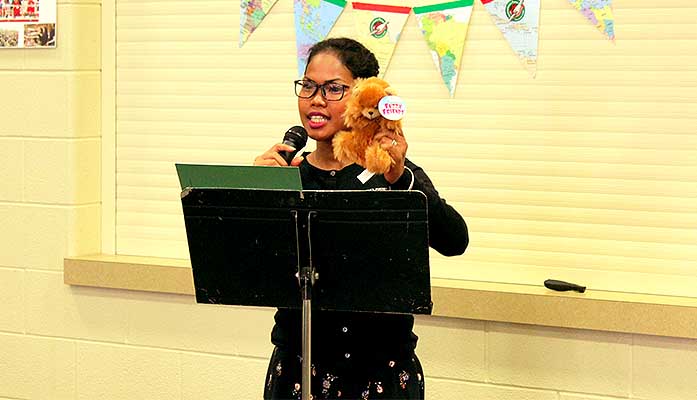
During a lecture Saturday in Hays, Boun Thorne, formerly of Cambodia, holds a stuffed animal similar to the one she received in her Operation Christmas Child box.
By CRISTINA JANNEY Hays Post
A group gathers Saturday at Messiah Lutheran Church to learn about Operation Christmas Child. This year’s shoebox collection week is Nov. 18-25.
Boun Thorne, who had an abusive childhood in Cambodia, said an Operation Christmas Child gift changed her life and help her accept God’s love.
Thorne, who now lives in the U.S., spoke to a group Saturday at Messiah Lutheran Church in Hays about her experiences growing up and her Operation Christmas Child gift.
Operation Christmas Child is a project of Samaritan’s Purse, an international relief agency headquartered in Boone, N.C., and led by the Rev. Franklin Graham. Every Christmas, thousands of individuals prepare shoeboxes filled with small toys, school supplies and hygiene items, which are then delivered to needy children around the world.
This year’s shoebox collection week is Nov. 18 to 25.
Thorne’s family was very poor when she was growing up. She grew up on a boat in a floating village. Her father was a fisherman, but he was also an alcoholic. Thorne’s father would fish to earn money, but he would spend his money on alcohol, leaving his family with nothing.
“Because of that we never had money to buy food from the market,” she said. “Growing up, we would eat anything we could find around us. Fish and rice was our basic food three times a day, and we would eat the leftovers for breakfast. There would be special occasions when my dad would catch a snake or a monkey and that was when we got to eat something different than fish.”
There was no electricity, no school or hospital.
Throne’s father was abusive when he was drunk. He regularly beat Thorne’s mother. After a particularly brutal beating, her mother passed out and Thorne thought she was dead. Thorne and her siblings would swim to a neighbor’s boat to hide from him, but they weren’t always successful in getting away.
When Thorne was about 6 years old, she became very ill. Her mother asked her father to take Thorne to the hospital.
“My dad told my mom, ‘Just let her die. If she doesn’t survive, we will just make more babies,'” Thorne said. “When I heard that, I felt like my dad didn’t love me at all. I thought maybe I am not his daughter.”
Thorne survived her illness. She decided then she wanted to some day be a nurse or doctor so she could help children who were sick.
She went to her father and asked if she could go to school. He said no, she didn’t need to go to school. She was told she would eventually marry and stay home with her children.
When she was 8, she left her family and her village to live with her aunt so she could go to school. She had to help her aunt make and sell Cambodian cookies to pay her way.
Thorne woke up at 3 a.m to help her aunt cook. After school, she would be sent in to village to sell cookies. If she did not sell all the cookies for the day, her aunt told her she was lazy and sent her to bed without diner.
“No matter what happened. No matter what my dad did to us, my mom would make sure I had food in my tummy before we went to bed,” she said.
After two years, Thorne said she could no longer bear her aunt’s abuse, gave up on her education and moved home with her parents.
During a Cambodian holiday, her father became so drunk he couldn’t fish for the family. Thorne’s mother sent her to fish with her uncle, so the family would have something to eat. Her uncle abused her on that trip.
Her mother wanted to report the crime to the police, but she couldn’t do it that day because of the holiday. By the time her mother could report the crime, her father had alerted her uncle, and her uncle fled the area to avoid the authorities.
Because her village elder thought Thorne might be in danger from her uncle, a couple months after the abuse incident, Thorne moved to a Rapha House, an international mission aimed at ending sexual exploitation and sex trafficking of children.
She would have to leave her mother and siblings again, but she would get to go to school.
“My house mother showed me where I was going to get my food,” she said. “There was a table with a lot of food on it. We never had desert or anything like that, but on the table there is a lot of desert. I was just standing there crying because I really wished my siblings and my mom would get to eat all of this food with me.
“Then she showed me I had a bunk bed. I had my own bed with my own mattress. I never slept on a mattress before. At home we slept on a mat on the floor. I just wished my mom and my siblings could experience this all with me.”
One of her counselors told her about Jesus Christ. She told her that God wanted her to forgive her uncle and her dad, but Thorne said she was not ready to forgive.
“It didn’t make sense to me,” she said. “My dad didn’t love me. Why do I have to love him? My uncle didn’t love me. Why do I have to love him? It hurts me.”
Thorne regularly went to church, but she said she went to be with her friends, because she could sing and dance and they served snacks.
When she was 13, her teacher told her they had special gifts for the children. It was boxes from Operation Christmas Child. This was the first gift she had ever received. Christmas and birthdays are not celebrated in Cambodia. They were told these were gifts from the people who love God and they wanted to bless the children with these gifts.
The children were told they were supposed to wait until all the children received their boxes before they opened their gifts, but Thorne couldn’t wait.
Inside her box was a new pair of flip flops. This was special because the students at the school only received one new pair of shoes each year. At home, she and her family always went barefoot. The box also contained a stuffed animal.
“I never knew something like this existed. I never knew they could make an animal like this, so soft,”she said. “It’s new and smells good. I used to eat all kinds of animals, growing up, but I never knew there was an animal that I didn’t have to eat that I could snuggle with and smelled better than the real animal.”
She said the shoebox helped her fall in love with God more deeply and have a relationship with God.
“I realized that God was so big that he could make impossible things happen,” she said. “He can make someone who doesn’t even know who I am to love me and send me this gift. I realized what my teacher told me that God loves me and he wanted me to love my uncle and to forgive him.”
She added, “Even if my earthly father didn’t love me, there is a father in heaven who loves me, and he is way better than my earthly father.”
Her young brothers came to visit her while she was living in Rapha House, and they fell in love with her stuffed animal. She decided they needed it more than she did, so she gave her toy to them. Her mother later told her that her siblings often fought over the toy.
One day, the stuffed animal fell off their boat into the water. The children saw this and came crying to their mother that their stuffed animal was dead. Because they knew other animals floated when they were dead, the stuffed animal must also be dead. The toy was dried and fluffed, and her siblings exclaimed that their toy had been brought back to life.
Thorne, 25, eventually married an American, who she met when she was working as an interpreter in Cambodia. She is working toward her U.S. citizenship. Today, she lives in Oklahoma and is attending college to become a nurse. In the future, she hopes to periodically return to her home country to offer medical assistance.
ComeauThe law firm of Jeter Turner Sook Baxter, LLP announced this week that Ashley Comeau has joined the firm in an “Of Counsel” capacity. Her practice will encompass a broad range of civil matters, including estate planning and elder law, to guide the firm’s business and individual clients.
Comeau graduated with honors from Washburn University School of Law in 2011, earning a Juris Doctor with a certificate in law and government, and from Fort Hays State University in 2008. She was a member of the Washburn Law Moot Court Council as well as the Trial Advocacy Team. Her prior experience includes work as corporate in-house counsel and, from 2012 to 2015, she was a civil litigation attorney at Wagstaff & Cartmell, LLP of Kansas City. She is admitted to practice law in the state and federal courts of Kansas, and is a member of the Kansas Bar Association, Kansas Women Attorneys Association, Ellis County Bar Association and Rooks County Bar Association, where she serves on the Rooks County Law Library Board.
“We are very excited that Ashley has joined the firm,” said Christopher Sook, the firm’s managing partner. “She brings experience and a background that will help us better serve our clients throughout the region.”
Jeter Law Firm has served Kansans for more than 80 years in the areas of Business Law, Banking Law, Commercial Law, Real Estate Law, Oil & Gas Law, Civil Litigation, Trusts, Wills, Estates, Probate, and School and Government Law. The firm includes six attorneys and has offices in downtown Hays and Stockton. More about the firm can be found at www.jeterlawoffice.com.
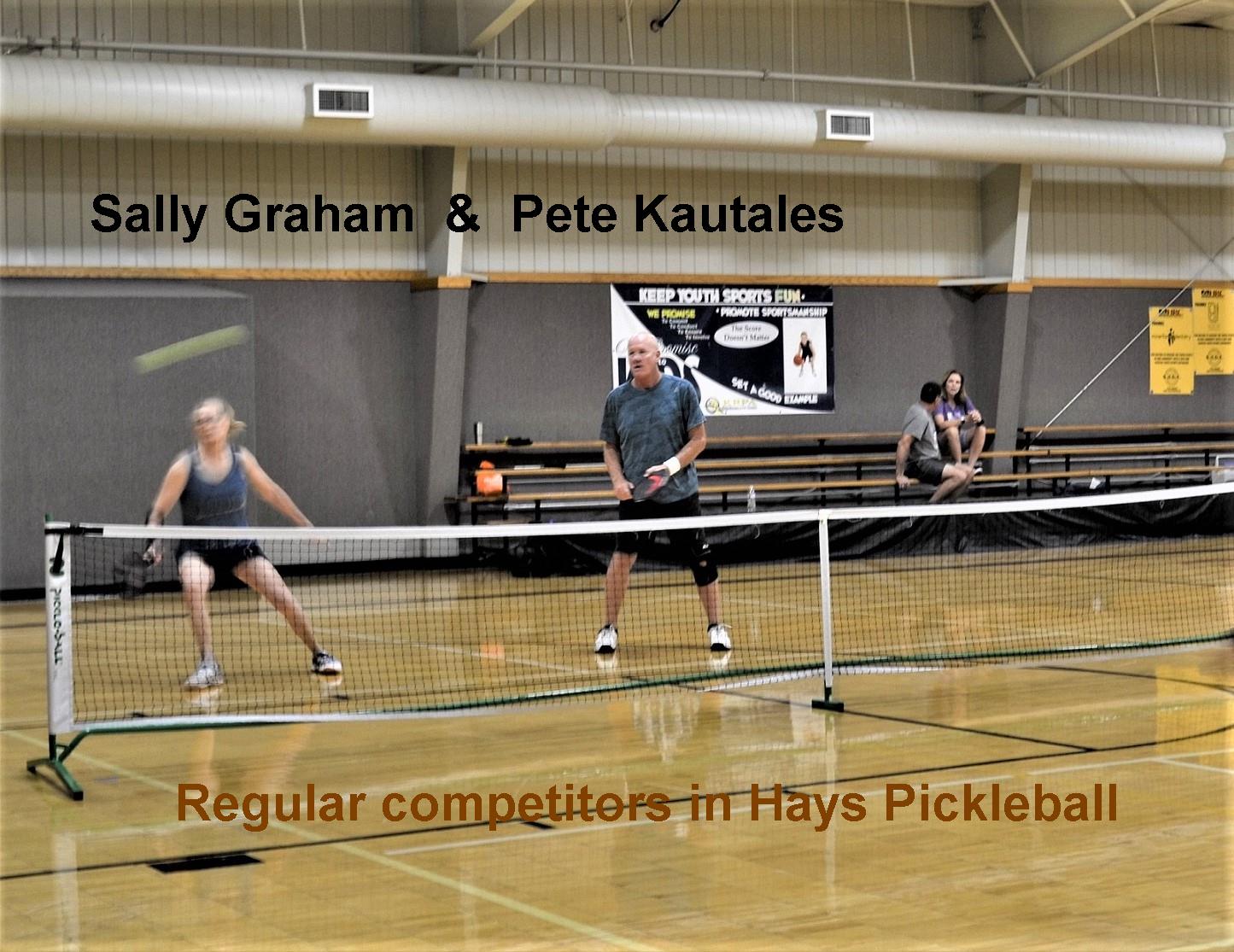
How awesome would it be to have had prominent sports announcers Howard Cosell, Pat Summerall or even Gerard Wellbrock covering the play by play of the second Hays Recreation Commission pickleball tournament?
Pickleball the fastest growing sport in America for players over the age of 60 and its popularity is rising in Hays, Kansas. The Hays City Commission recently gave its blessing for the addition of two nets at the tennis courts on South Main street under the direction of Jeff Boyle, director of the Parks Department.
That project will be undertaken this month. The addition to our quality of life in Hays is complemented by the Hays Recreation Commission having completed a refinish of the three gym floors at the complex on Canterbury Road with the addition of six pickleball sections. The process and wait time for proper drying of the floor took about a week where the local addicts of this sport overcame their withdrawal when 21 players showed up for the reopening of the gym.
What a nice showing of newly made friends from Great Bend who signed up to play. Nearly all victories to 15-point totals came down to break points in the quarter, semi-finals and finals of the matches among the 13 two-person teams that were entered to play. One-nail biting match pitted local rising star Devon Fuller, 28, a six-year Army veteran returning to further his education at FHSU, against Sheldon Hamilton, 72, from Great Bend. Despite a four-decade spread in age, the elder Hamilton moved forward to the semi-finals.
The finals took on an interesting twist of fate finding Justin McClung facing off against his son Bryce McClung in what took several playoffs to give the father, in this match-up, the victory. Justin’s teammate, Shawn Clark, was playing opposite side to Soumya Bhoumik, an associate professor at FHSU.
Keeping this short, fans or interested persons will want to view these 35 minutes of segments of some great action videos that had family and spectators glued to their seats into the finals of a great day.
By KIM BALDWIN McPherson County farmer and rancher
The other day Facebook reminded me that a year ago we kicked off our fall harvest season. I had posted a picture of the kids climbing into the combine with my husband, and then a picture of the four of us piled in the combine with smiles on our faces. It’s always an exciting day when we fire up the combines and move into the fields.
It means we have a crop to harvest. It also means adding many extra miles on my vehicle.
My mother-in-law and I will begin taking evening meals out to the field. I’ll begin reading books to my kids in the car while waiting for a combine to make its return to our side of the field. You might catch us some evenings driving slowly down a dirt road with our windows down blowing goodnight kisses to my husband because the kids won’t see him again until breakfast. It means driving out to a field and excitedly showing everyone when someone has lost a tooth, or celebrating being selected as the Star of the Day at school, or showing off the newest piece of art that was completed in class, or displaying a birthday card that arrived in the mail.
Yes, we spend a lot of time in the car this time of year. I’m always impressed the kids handle it so well. For them, it’s just a normal part of being a farm kid in the fall. After all, it is how they’ve spent every harvest since before they were even born.
Some days we’ll run home after school and change our clothes before heading out to the field, but more days than not, we go straight to where the crew is. It gives the kids extra time to ride alongside their dad or grandpa, to honk the combine’s horn, to “help” unload the grain by pushing buttons and pulling levers, or to just supervise the entire operation.
We try to keep a routine during harvest for the kids. Many evenings I’ll try to get them in the car and headed home before it’s dark. We’ll still have homework, bath time and stories before I put them to bed. But sometimes exceptions have to be made.
There are some evenings when the kids need extra daddy time, so I’ll ignore the setting sun or the time on the clock. Some days we’ll have to make a trip back out to a field after dark in our jammies because a little one needs to see their daddy one more time before bed and Facetime just isn’t cutting it.
Fall harvest will lead into wheat sowing followed by more fall harvest. The goal is to be completely done by Thanksgiving. Last year we went a few days past that.
Regardless of when the harvest is completed this year, you can bet my kiddos and I will have some quality time driving to and from fields this fall. We will be completing reading assignments while waiting for the crew to come to the edge of the field for a meal, enjoying the cool and crisp weather that will soon be here, and I’ll be snapping a picture every once in a while to document our trips out to the fields.
Yes, it’s the eve of fall harvest and we’re ready to begin this season.
“Insight” is a weekly column published by Kansas Farm Bureau, the state’s largest farm organization whose mission is to strengthen agriculture and the lives of Kansans through advocacy, education and service.



 By JAMES BELL






 Looking to get your career started?