We have a brand new updated website! Click here to check it out!

Mental Health First Aid: Substance use disorder an illness for millions of Americans

Canstockphoto.com
A Hays Post series focusing on mental health issues.

By CRISTINA JANNEY
Hays Post

An occasional glass of wine with dinner is not a symptom of mental illness, but for more than 21 million Americans — 8 percent of the U.S. population older than 12 — substance use disorder is a debilitating disease.

Alcohol use disorder is the most common of the substance use disorders, with 17 million American affected, students in a recent Mental Health First Aid class offered by High Plains Mental Health learned.

Substance use disorders are characterized by a dependence on the substance.

“For instance, you no longer just want to have a glass of wine with dinner, you need a glass of wine with dinner,” Kaley Conner, trainer, said. “It can become something that people depend on like a coping mechanism or a way to relax for people with extreme social anxiety. It may become an unhealthy coping mechanism for how to socialize, how to make friends, to cope in society in some of those stressful situations.”

It can also mean substance use, which is use of alcohol or drugs, leads to problems at work, home, school, in their physical or mental health, or to legal problems.

Substance use disorders start at a median age of 20. They are common among people who suffer from other mental illnesses. People who have mood or anxiety disorders are twice as likely to have substance use disorders, and men are twice as likely as women to have substance use disorders.

Warning signs of alcohol use disorder can include an increased tolerance, difficulty controlling use, symptoms of withdrawal, preoccupation with alcohol, impairment of major functions in life — ability to live, love and learn — inability to stop drinking even though they have expressed a desire to decrease or stop drinking.

Mental Health First Aid uses a four-question screen to determine if someone is at risk for alcohol use disorder

Rapid Alcohol Problems Screen

  • During the past year, have you had a feeling of guilt or remorse after drinking?
  • During the past year, has a friend or family member told you about things you said or did while you were drinking that you could not remember?
  • During the past year, have you failed to do what was normally expected from you because of drinking?
  • Do you sometimes take a drink in the morning when you first get up?

Yes to any of these questions indicates that a person’s drinking is harmful to their health and well-being. The person should receive a full evaluation from a qualified professional, according to the Mental Health First Aid curriculum.

Risk factors

  • Availability
  • Social factors
  • Genetic predisposition
  • Sensitivity
  • Learning
  • Other mental health problems

“I think it is important we change our frame of understanding around substance use disorders. For a long time, it has been thought of as a moral failure and maybe we have not had as much patience with people who have substance use disorders,” Conner said, “but realistically it is a physical addiction. It’s an illness.”

How to help

The course offers the acronym ALGEE to help first aiders remember the steps in aiding in a mental health crisis.

  • Access risk of suicide or harm.
  • Listen non-judgmentally
  • Give reassurance and information
  • Encourage appropriate professional help
  • Encourage self-help and other support strategies

Alcohol and drugs can lower inhibition. About 26 percent of people who complete suicide have a substance use disorder.

In addition to suicide and self-injury, a person with substance use disorder can have medical emergencies, including alcohol poisoning, overdose or severe withdrawal that will need medical attention.

Continual vomiting; vomiting while unconscious; person falls into unconscious state; signs of head injury; irregular, shallow breathing; irregular, weak pulse; and cold clammy pale or bluish skin are all signs of alcohol poisoning. Call 911. If a person is unconscious, roll them on their side until medical help arrives to avoid the person choking on vomit.

Confusion, visual hallucinations, agitation, fever, seizures and blackout are signs of severe alcohol withdrawal. Seek medical attention.

Some people when they drink may become aggressive. Don’t put yourself or others in harm’s way.

Remain as calm as possible and try to de-escalate the situation by talking calmly, not arguing, not threatening, refrain from using negative words, don’t restrict the person’s movement, consider taking a break to allow the person to calm down, according to the MHFA curriculum.

The only thing that can really help a person sober up is time. Black coffee, water and other cures are a myth, Amy Byrd, MHFA trainer, said.

Talk when you are both sober and when you are in a calm frame of mind, Amy Bird, MHFA trainer, said.

“It is very different dealing with a friend or family member who you love and you really care about, not that you don’t care about your co-workers or someone you don’t know as well. This can be a really emotional topic,” Bird said. “There may be kids involved or someone else you love. There can be a lot of anger and a lot of emotion. The time to talk about your concerns is not when you are really upset or angry because then you are going to be talking out of emotion.”

A person who has a substance problem might not have good insight into their problem. They might not recall everything that happened when they were intoxicated. Pointing all of those things out, though, might not be helpful.

“My perception of what is going on and their perception of what is going on may be two very different things,” Bird said.

She suggested refraining from assigning labels, such as alcoholic or drug addict.

As when dealing with other mental illnesses, try to focus on “I” statements and avoid “you” statements that may seem to assign blame —”I am concerned about your drinking?” instead of “You are drinking too much.”

“I am not saying you are a bad person. I am concerned about what you are doing, but I am not saying you are bad,” Bird said.

When you try to give reassurance, the G in ALGEE, consider the following:

  • Changing a substance use habit is not easy.
  • Willpower is not always enough.
  • Advice alone might not help a person change their behavior.
  • If abstinence from drinking is not the person’s goal, reducing the quantity consumed is a worthwhile objective.
  • A person may attempt to change or stop their behavior more than once before they are successful

Don’t join the person in drinking or substance use. Don’t try to control the person through nagging or threatening. Don’t make excuses for the person to cover up their substance use or behavior. Don’t take on the person’s responsibilities. Try not to feel guilty. You are not responsible for someone else’s substance use.

“Sometimes addressing underlying depression or anxiety [may help],” Bird said. “Asking people, ‘What does drinking do for you?’ Not just assuming you are drinking because you want to be drinking.”

Major life changes may be required in recovery.

“In AA, they talk about when you get sober you have to change your playmates, your playthings and your playgrounds,” Bird said.

Treatment does not necessarily mean inpatient rehab. You may start with your primary care physician, a drug and alcohol specialist, mental health professional, certified peer specialist or a support group, such as Narcotics Anonymous or Alcoholics Anonymous, which have support groups worldwide. There is an app for Apple and Android devices to find AA meetings.

High Plains Mental Health has a 24-hour crisis line that can be reached at 1-800-432-0333. Valley Hope is an addiction treatment facility, which has a site in Norton. They can be reached at 1-800-544-5101.

However, there remains a treatment gap. In 2014, an estimated 22.5 million Americans 12 and older needed treatment for a problem with drugs and alcohol, but just 4.1 million people received help. Money, stigma, lack of insurance, waiting lists and proximity to treatment can all be barriers to receiving treatment, Bird said.

Although you can’t make someone seek treatment, you can be there during treatment. Statistics indicate sufferers of substance use disorder are more likely to be successful in treatment if they have supportive friends and family. Groups for those who have loved ones struggling with substance use include Al-Anon and Alateen.

Other resources

Illustration courtesy Canstockphoto.com

100th Science Cafe will promote citizen scientists

By CRISTINA JANNEY
Hays Post

FHSU’s Science Cafe series will celebrate its 100th science lecture at 7 p.m. Monday at the Robbins Center.

Presenter Dr. Paul Adams, dean of the college of education, will discuss some highlights from past 11 years of Science Cafes, opportunities for average people to be citizen scientists and what to expect in the coming year from the lecture series.

One of Adams’ favorite lectures was on the movie “The Martian,” starring Matt Damon. Adams presented that lecture and discussed what aspects of the movie might be possible in reality if humans tried to live on Mars.

Adams

“That was interesting because of a lot of it was really on the edge of what we are going to be able to do,” he said.

The lecture “Mussels and Men” discussed how freshwater mussels use different appendages to fish for their food. A lecture on beekeeping prompted Adams to go out with Scout groups and put up bee houses.

In terms of citizen scientists, Adams said one of the topics in which he is interested is archeology from space.

“When we think of archeology, we think of everybody going in the field, going into Egypt and digging into the ground and whatever that may be,” he said. “Satellite imagery gives a lot back, but it is really tough to look at. To have citizens, anybody who want to go online, take a look at potential places to go and send archeologists to go find out about our past.”

Adams also uses an app called Globe at Night. This app looks at how much we have lost of our dark skies to light pollution and how does that play into urban planning. You go out at night, see what stars you can see and report it. The information is added into an international database. The app also has a legend of the constellations.

Another app, Globe Observer, enlists citizen scientists in monitoring dust storms. If you see a dust storm, you take a picture and turn that in.

“As we are warming and the climate changes, one of the predictions is that we will see an increase in activity and that has real impacts on farming and agriculture and business,” Adams said.

Yet another app asks citizen scientists to report mosquito populations. There is a federal clearinghouse with more than 500 citizen scientist projects. Some of these projects can be great for kids, Scouts, 4-Hers or school groups, Adams said.

“If you have an interest in the world in almost any area, even looking at ancient scrolls that are in Greek to figure out what those Greek letters are … It can be anything that is out there,” he said. “Scientists have discovered crowd-sourcing is a better way to go or computers don’t have the resolution to make out the images.”

Future topics that are being considered for Science Cafe topics, include cultured meat (IE meat created in a lab not from an animal), science education in northwest Kansas and other STEM developments that affect the Kansas economy.

Usually the Science Cafes are downtown or in restaurant in informal settings. For this special celebration, FHSU wanted to be able to serve cake and have space to display posters from past Science Cafes, so the event is scheduled in the Robbins Center. The event is free, and no registration is required.

Gabel helps continue the proud tradition of Victoria tennis

Coach Kaylene Gabel (right) and Assistant Coach Megan Karst (left) are pictured with the Victoria girls tennis team.

By JACOB BRUBAKER
Hays Post

VICTORIA — We met upstairs in her art room, in the afternoon. That’s because her girls tennis team was cheering on the volleyball squad, which had a triangular that afternoon. This meant a 6 a.m. practice for her team, but she wanted the volleyball team to have some support, as she knows her squad sometimes doesn’t get as much as it deserves. Victoria has a proud tradition of football, but there is another proud tradition in action this fall — Coach Kaylene Gabel and the Victoria Lady Knights tennis team.

Gabel has been helping coach the Victoria tennis squad for the last four years and is in her second year as head coach.

“I’m happy to be here, teaching in the district as well,” said Gabel, an art teacher.

The team has accumulated many honors in her tenure, including qualifying six members for state in Gabel’s first season with the squad. However, it would be a mistake to think that was her first exposure to Victoria tennis.

Gabel is a native of the 1,214-person community and was a member of the tennis squad, graduating in 1995. At that time, many more area schools had tennis and Victoria was part of the Mid-Continent league. The coach played her high school tennis for a local legend.

“I played under the legendary Carla Pruitt, who was a huge asset for Victoria tennis and the state of Kansas and was inducted into the Kansas Coaching Hall of Fame,” she said.

Fast-forward to today, and there are considerably fewer schools with girls tennis. Schools in divisions 3A, 2A and 1A all compete as a conglomerate at state and regional meets. Victoria is easily one of the smallest schools that compete in women’s tennis. However, that hasn’t fazed Gabel, as she continues to put together quality squads.

This year’s team features 11 athletes, including four seniors. Comparing that to the 14-girl volleyball team, Gabel feels 11 is a solid number.

“If there is recruiting to be done, the kids are the recruiters. They have a good experience, and they share it with their friends,” she said.

It isn’t just about numbers though. This is a competitive squad that has compiled a record of 71-30 in its matches this season. The team also won the Hays High meet, defeating the 5A host.

Gabel also expressed confidence in the intelligence of her players.

“I always say tennis kids are the smartest athletes. They only get coaching every other match.”

Members of this year’s team are:

Kiara Sweat-Senior
Daphne Gross-Senior
Scarlet Nowlin- Senior
Dallas Nowlin-Senior
Brooklynn Kuhn-Junior
Avery Cochran-Junior
Kenzie Sweat-Sophomore
Makaila Fritzler-Sophomore
Macy Hammerschmidt-Freshman
MaKenna Welbrock-Freshman
Autumn VonLintel-Freshman

Gabel knows she couldn’t do it alone and is assisted by recent Victoria graduate and former tennis player Megan Karst. Gabel is more of a singles expert, which makes Karst all the more helpful.

“I was excited to have an assistant coach who is a little more of the double’s forte. We make for a good mix,” Gabel said.

Together, they have helped to cultivate a family atmosphere that has brought their 11 players closer together. Karst stressed cohesion on her doubles teams, comparing it to a marriage saying.

”If they have a bad marriage, they will perform poorly,” she said.

Gabel  added, “Tennis is pretty unique,. It is unlike any other sport. You become almost like a little family. It is neat to see seniors take freshmen under their wing. Our girls don’t seem to know an age limit. They just bond. It is cool because they may not hang out with each other outside of tennis, but year-in, year-out, we have a really cohesive unit.”

The Lady Knights season is nowhere near over as they will be in action in Victoria on Monday against Hays High and Osborne.

Carl A. Hatch: North-central Kansas’ powerful forgotten native son

Author of ‘Hatch Act’ grew up in Kirwin, Kensington

Editor’s Note: In recognition of the sesquicentennial celebration — the big 150th Birthday Party — which will be held in Kirwin on Sat., Oct. 5, the Phillips County Review has been running original historical articles on the community.

By KIRBY ROSS
Phillips County Review

It’s difficult to read a newspaper these days or look at the news on television or online without there being a story coming out of Washington about some sort of allegation relating to a violation of the Hatch Act.

“Army Major Violates Hatch Act.”
“FBI Agent Lawsuit Highlights Gray Area in Hatch Act.”
“Conway Subpoenaed For Possible Violation of Hatch Act.”
“Six Officials Found In Violation of the Hatch Act.”
“Government Seeks Hatch Act Probe.”

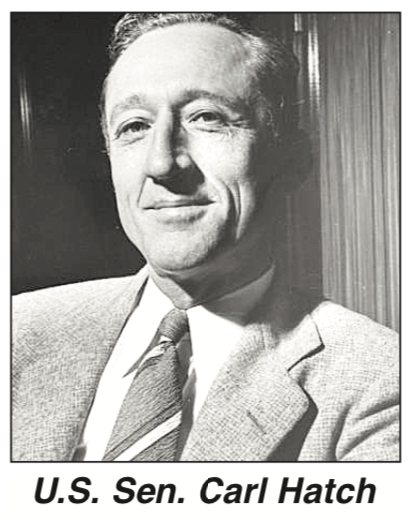
The Hatch Act, which is legislation banning federal employees from engaging in some forms of political activity, is named after its author, Carl Atwood Hatch, U.S. senator for New Mexico from 1933 through 1949.

With his service spanning the darkest days of American history — the Great Depression, World War II and the beginning of the Cold War — Hatch became a powerful member of the Senate as well as close friend of President Harry S Truman.

The story regarding Hatch’s life in New Mexico and his time in public service is extremely well documented. What is not documented, and what is more than a little bit breathtaking, is the fact he was born in Kirwin and spent his boyhood years growing up there, and that fact has been largely missed by Phillips County and Kirwin histories.

If it were not for Hatch’s own congressional biography, which mentions in very brief passing that he was born in Kirwin, his formative years living in Phillips County might forever be unknown and unnoticed.

It is difficult to travel down any modern-day Kansas roadway without coming upon some sign saying “Birthplace of —–,” or “Childhood Home of —–.”

This includes everyone from athletes and BB gun sharpshooters to astronauts and governors — and even other U.S. senators.

But nary a marker of any sort for Sen. Carl Atwood Hatch, native son of Kirwin and Phillips County. In conjunction with its upcoming Oct. 5 Sesquicentennial, Kirwin community leaders are now hard at work correcting this oversight–we’ll keep our readers updated on their progress.

In support of that effort and as part of the Phillips County Review’s Kirwin Sesquicentennial historical series, for the first time ever the untold story of Sen. Carl Hatch’s local boyhood years is now being brought to the light of day, in considerable detail.

It can also be noted the specific home site of the Hatch family had been lost to history–that is until Sept. 6 when the research of the Phillips County Review uncovered it, which perhaps might result in a plaque being placed there too.

Since Hatch himself left no autobiographical trail of his early Kirwin years, the Review has culled through many hundreds of pages of Kirwin-related historical documents, as well as Kensington documents, and has been able to flesh out a pretty thorough picture of his boyhood and family life in the area.

Family Patriarch, Harry Hatch

This particular story begins with the Hatch family patriarch, Harley Atwood Hatch.

Commonly known as H.A. Hatch, or more familiarly as Harry Hatch, he hailed from Butler County, Ohio, and first came to the American frontier town of Kirwin in 1879 at the age of 22-years-old, two weeks prior to the railroad’s arrival (see the in-depth two-part story of the coming of robber baron Jay Gould’s railroad to Kirwin in the Aug. 21 and Aug. 28, 2019 issues of the Phillips County Review).

Now living in boom-town Kirwin, Harry Hatch entered the profession he would follow his entire life–dry goods and hardware sales.

His first documented appearance in the local press reported how days after his arrival he asked the Kirwin Chief editor to send a copy of that newspaper to friends back east, where “Kirwin will certainly be regarded as she should be–a rattling, lively city.”

Initially becoming employed at Weaver’s Dry Goods and then at Ingersoll’s Mercantile, and working at one or the other for most of the next two decades, by the end of the 1890s Harry would undergo a period of personal upheaval during which he was separated from home and hearth for months on end, suffering multiple job changes over the course of just a few years.

But that was years off. In 1883 his life was more sedate as a single man. Harry and his first boss, A. Weaver, began a horse and mule partnership together, part of which included running 100 head on a 1,280 acre ranch along Bow Creek. The following year this two sections of land was reported to be “well stocked with cattle.”

In May 1884 the Kirwin Independent observed, “Harry Hatch is building a neat residence on the corner of West Main and Third Street. We are glad to notice this indication of thrift on the part of one of Kirwin’s most estimable young gentlemen.”

The Phillips County Review, accessing documents at the Phillips County Clerk and Recorders office in Phillipsburg, and with the assistance of County Recorder Bob Keesee, has found the deed which identifies the Hatch home as being on the southwest corner of that intersection.

Based on the deed description and utilizing historical photographs, last Friday we identified the specific site of the one story frame home as facing east onto Third Street, just north of the alley about a half block south of West Main.

Marriage and Children

Harry Hatch’s construction of this house appears to have had a specific purpose in mind–five months later, on Oct. 30, 1884, he married Esther Ryan, originally of Sullivan, Ill., at the Central House in Phillipsburg. The daughter of William Ryan, Esther’s family had taken up residence north of Agra.

Observed the Kirwin Independent, “Mr. Hatch has been long and favorably known to the people of this town and vicinity, and everybody wishes him and his wife a pleasant journey through life’s pathway.”

Over the next decade four children were born in Kirwin to the couple–Bertha on November 16, 1885; Frank on December 28, 1887; Carl, the future United States Senator, on Wednesday evening, November 27, 1889; and Edith Hazel on May 28, 1894.

Serious health problems began hitting the family–first Harry, Esther and Bertha, then later on young Carl and little Edith.

In March 1885 the Kirwin Republican reported, “Harry Hatch is laid up for repairs. The doctors say lung fever is the cause of his indisposition.”

A week afterwards the Kirwin Independent provided an update–“Harry Hatch, who has been confined to his room for some days past, is again seen on the streets.”

Two years later in February 1887, the entire Hatch household–consisting of Harry, Esther and Bertha at the time–was hit by illness.

“Harry Hatch and family have been having a very serious time with sickness for the past few days. Malaria or chills and fever seems to have taken possession of their house,” said the Kirwin Independent.

All survived and a few years later, after the births of Frank and Carl, the family moved over to Washington Street in Kirwin.

In 1894, with baby Edith about to be born, the three oldest Hatch children–Bertha, Frank and Carl–were obtaining their educations and show up in one report with schoolmates having somewhat familiar modern-day local Kirwin names such as Wyrill, Perkins, Van Allen, Vogel, Baughman, Willis, Freeman, Gray, Hull, Ewing and Stuckman.

Tragedy Begins Hitting Hatch Family

The persistent illnesses which would plague the family throughout the 1880s and 90s hit with a vengeance in late winter 1895, when nine-month-old Edith Hazel Hatch became sick.

When she had been born less than a year earlier and the Kirwin Globe reported on her birth the story spoke of her proud father, saying, “Harry is wearing a 4×6 smile.” But now, mere months later–

“After a severe illness of about four weeks with lung fever, the patient little sufferer passes to the great beyond,” the Kirwin Independent wrote of her March 21 death.

The distraught family of the little one, in publishing a thank you to the public for the aid and comfort provided during the illness and its aftermath, ran the following poem in the newspaper in remembrance of Edith–

There is no death! The stars go down
To rise upon some fairer shore;
And bright in heaven’s jeweled crown
They shine forever more.
And ever near us though unseen
The dear immortal spirits tread;
For all the boundless universe is life–there are no dead.

The following year in 1896 Harry was an unsuccessful candidate for Kirwin City Council.

Running again two years later on the Businessmen’s Ticket, this time he won. With his physical ailments soon returning, in July 1898 Harry and two other men from Kirwin went out to Colorado “for their health.”

Early the next year the family’s hard times worsened when Harry began struggling for work. Kirwin was on the decline, and finding a new permanent position would prove to be a difficult task that would take Harry all of a half decade to accomplish.

Following his opportunities, Harry moved alone to Kensington where he took a job at Ketchum & Woods Dry Goods, periodically coming back to Kirwin on visits to his family.

Harry soon returned to live in Kirwin after he was unable to find a house to rent for his family in Kensington, and his wife began complaining about her own illnesses. Although she would live another 30 years, she appears to have had a persistent debilitating depression in the aftermath of the death of her infant child.

Back home in Kirwin Harry went to work again for Ingersoll’s, which was Phillips County’s largest mercantile store.

Soon striking out on his own, just months later Harry returned to Kensington where he bought out Ketchum & Woods. Being successful in finding a place there for his whole clan to live, the rest of the Hatch family made the move on July 17, 1900.

Renaming his new establishment Hatch & Co., Harry dealt in groceries, dry goods, sewing machines, notions, hats, caps, boots, shoes, crockery, glassware and queensware.

Four decades later in 1939 the national press would report on this exact moment in the life of Harry’s son, Carl, who, as a powerful United States Senator had just achieved the greatest legislative achievement of his career. In commenting on Carl and what it was in his background that helped him get to where he was at, the Associated Press wrote–

“Carl Hatch was born in Kirwin, Phillips County, Kas., and his first job was counting eggs and weighing butter in his father’s country store. From Kirwin the family moved to Kensington, Kas., and here Carl went on counting eggs, with the slight variation that he counted in German–‘ein, schwein, drei’–for the new territory’s German farm folk.”

Throughout 1901 the newspapers in Smith Center, Kirwin and Kensington published multiple stories on how poorly Esther Hatch’s health was, with the Kensington Mirror noting “she has been a sufferer for a number of years.”

Carl’s own health was mirroring that of his two parents. On Jan. 17, 1901, it was reported “the youngest son of H.A. Hatch has been on the sick list this week.”

Carl was next noted to be recovering from “a slight attack of appendicitis” on Jan. 23, 1902. The next summer, on Aug. 11, 1903, Carl was ill once again, causing a problem for his local sports team. Noted the Smith County Journal, “The Kensington kid base ball nine was to have played our boys last Tuesday but on account of one of their players being at work in the country and their catcher, Carl Hatch, being sick, they wrote over and canceled the date.”

Carl and Esther’s illnesses were all taking place in the midst of yet another family crisis. Harry Hatch’s foray into owning his own business was ill-fated, lasting just 16 months. In September 1901 he had taken his daughter, Bertha, to St. Joseph, Missouri, to attend boarding school. Two months later the Phillipsburg Herald was reporting T.L. Cook, the cashier of the Kensington Bank, had assumed Harry’s interest in Hatch & Co.

Also noting the change in ownership, “Mr. Hatch has not decided what he will do,” said the Kensington Mirror.

Harry ended up briefly moving to Agra that December 1901, going to work at Underwood’s Store with his family remaining behind in Kensington.

Agra didn’t work out either. Still trying to find a place for himself and his loved ones, less than three months later, on March 13, 1902, Harry was reported to have “returned from Oregon,” and was now on his way to a big new job in Oklahoma.

With the help of an old colleague from Kirwin, Harry Hatch was about to find that place for himself and his family he had been looking for–a place that in turn would set in motion the events that would provide his youngest son a seat in the chambers of one of the most powerful institutions in American politics–the United States Senate.

Oklahoma Territory

Herman C. Wey had been a highly-prominent Kirwin merchant for almost a quarter of a century in the late 1800s. Moving there in 1878, he built the Iron Clad Hardware and Farm Implement store on the northeast side of the square a few months before the arrival of the railroad, and was present just in time to ride the boom that immediately followed. In the process he went on to become one of Kirwin’s wealthiest citizens.

After the boom, however, Kirwin began undergoing a prolonged economic contraction, losing close to half its population between 1880 and 1900.

As Kirwin was in the midst of its decline Oklahoma Territory was beginning its land rush era, with a flood of settlers flooding in and towns springing up across the region overnight.

Noted the Kirwin Kansan newspaper in speaking of Wey in 1913, “In 1902 opportunities in a business way held forth a more inviting field in the new Oklahoma country.”

Following those opportunities, Wey sold his hardware store in Kirwin as he went about establishing a chain of them in the new territory.

Wey himself retired to Wichita, building a $75,000 mansion (worth $2,000,000 in 2019 dollars), and set up his sons to run stores along the line of the Oklahoma portion of the Frisco Railroad between Kansas City and Dallas.

To assist them in this ambitious undertaking, Wey tracked down another Kirwin pioneer, Harry Hatch, who had took his desperate job search and hunt for greener pastures to the Pacific Northwest while his family remained back in Kensington.

Receiving the offer from Wey and then heading directly to Mountain Park, Oklahoma Territory, Harry Hatch helped the Wey family set up a store there, after which the Weys quickly set him up with one of his own to run.

“Being a first-class hardware and implement man, Harry Hatch was selected by Mr. H.C. Wey to manage the Eldorado business, and, when the time for opening stock came, sold merchandise from a tent on west Main street, the building to be occupied by the company not having been completed,” reported the Kirwin Argus not long afterwards.

This phase of the continuing Hatch family separation lasted for a year and a half. Finally, toward the end of 1903, Harry sent for the others to come join him.

Leaving Kensington, their residence for three years, Harry’s family–wife Esther, daughter Bertha, son Frank, and son Carl, made a final visit to Kirwin in November 1903 before heading on “to Oklahoma to make their permanent home.”

Almost four decades later the El Paso Herald-Post wrote, “The family moved to the brand new town of Eldorado, Okla., then booming as the Frisco Railroad pushed a new line into Texas. Now it was a hardware store the family had, and young Carl Hatch was up a winter’s morning to ready the place for the trade of farmers driving across country, behind six-horse teams, to the railroad town.”

Carl Hatch–Publisher, Attorney, State Judge, U.S. Senator, Federal Judge

The Herald-Post story continued, “High school was over for young Hatch in 1907, and soon he was setting type and feeding the press on the town’s newspaper, the Eldorado Courier. When some time later, the publisher wished to sell, Carl and a friend bought.”

This development did not go unnoticed back home in Kansas, with the Kensington Mirror noting, “We received a copy of the Eldorado, Oklahoma Courier, this week, and in looking over the same we notice that a former Kensington young man, Carl Hatch, is one of the owners of the same. The paper is a good one, well filled with advertising and local reading and shows that Carl is enjoying prosperity.”

Selling the newspaper after two years, Carl used the profits to attend law school at Cumberland University in Lebanon, Tenn.

Returning to Eldorado upon completing his legal studies and then being admitted to the Oklahoma bar in 1913, Carl married Ruth Winefred Cavniss.

During this period he made another visit back to Kansas in 1916–“Carl Hatch, a formerly young man of this city, but now of Eldorado, Oklahoma, where he is engaged in the law business, spent a few hours in this city last Saturday calling on Kensington friends. Carl moved from this city thirteen years ago and reports he notices many substantial improvements in the city during that time,” said the Kensington Mirror.

With the up and coming barrister moving further west to Clovis, N.M. weeks after this Kensington visit, fate now put him on the fast track to his greater destiny as he became a partner of Harry L. Patton.

Within months of hiring Hatch, Patton became New Mexico Attorney General, with 28-year-old Carl following as his assistant.

Kirwin also continued to lay claim to her native-born son, with the Kirwin Kansan reporting in 1918, “Mr. and Mrs. Harry Hatch and their son, Frank, still live in Eldorado. Bertha is living in Oregon, and Carl is a lawyer in Santa Fe, New Mexico. The old timers of Kirwin will remember this family.”

Appointed district court judge in 1923, notice of that achievement also made its way back home.

Said the Kirwin Kansan, “Carl A. Hatch is the new District Judge of the Ninth Judicial District of New Mexico. He was appointed Monday by Gov. Hinkle to fill out the unexpired term of Judge Sam Bratton. Judge Hatch was in Santa Fe when the appointment was made and returned to Clovis Wednesday morning and enters immediately into the duties of his new position. The Judge Hatch mentioned above was a boy raised here in Kirwin who later lived in Kensington. Old Kirwin settlers will remember the Hatch family well.”

Carl served as judge until 1930 when he resigned his position. Returning to private practice, he successfully managed the campaign of Arthur Seligman in being elected governor of New Mexico and Andrew Hockenhull, for lieutenant governor.

With Seligman dying in office in September 1933, one of the first official acts Hockenhull made was to appoint Carl Hatch to the United States Senate to fill a vacancy in that position.

Once appointed to the U.S. Senate, Hatch afterwards was reelected three times–once in a special election in 1934, and two more times in regular elections in 1936 and 1942. His final win was by a landslide.

The tenure of the new senator was proudly noted in the Kansas press, with the Emporia Gazette reporting in 1934 it had “discovered that Kansas actually has three senators in congress, although one of them is representing New Mexico. He is Carl Hatch, who was born at Kirwin, Kan., where he lived until 13 years of age.”

The Hatch Act

Taking on a major role as a Washington D.C. reformer, Senator Hatch began efforts to enact laws relating to the political activities of government employees. His first such piece of legislation would have prohibited federal workers from serving as delegates to national political conventions.

That effort hit a deadend.

His next try at reform was an attempt to restrict politics in Franklin D. Roosevelt’s Works Project Administration program, following allegations employees were heavily involved in 1938 Congressional campaigns in the swing states of Kentucky, Pennsylvania, Maryland and Tennessee.

The Roosevelt Administration pushed back hard against Hatch, resulting in the failure of his second major effort at reform.

Shortly after this defeat, however, investigative reporting uncovered significant political scandals surrounding WPA employee politicking, with Congressional hearings following.

In the midst of a national uproar the time was now ripe for Carl Hatch’s signature piece of legislation. Moving his bill forward in early 1939, it would–

•Prohibit bribing or intimidating voters

•Restrict political campaign activities by federal employees

•Prohibit using public funds earmarked for public works projects from being used for electoral purposes

•Forbid officials paid with federal funds from using promises of jobs, promotion, financial assistance, contracts, or any other benefit to coerce campaign contributions or political support

•Prohibit federal employees from membership in any political organization advocating the overthrow of the U.S. government

This time the bill–now christened the Hatch Act after Kirwin’s most famous son–successfully made its way through the U.S. Senate and U.S. House of Representatives.

From there it was sent to the desk of President Franklin D. Roosevelt, who would decide whether it would live or die. While he hadn’t taken a public position, Roosevelt was strongly opposed to it.

With all eyes on him, the political realities of what the Hatch Act stood for finally prompted Roosevelt to sign it on the very last day he could.

In doing so he made a statement suggesting he had always been fully supportive of Hatch’s efforts, and that the legislation would provide the protections the American public and federal employees needed.

In the jubilant aftermath of the passage of the Hatch Act, the national spotlight turned directly on successful reformer Carl Hatch and the personal character he tapped into which resulted in the passage of the groundbreaking law.

In writing about Hatch, the El Paso Herald-Post harkened back to the Hatch family’s earliest days in Kirwin, noting, “The father of Carl Atwood Hatch, senior senator from New Mexico, rode westward from Ohio to Kansas when homesteaders were opening that country in the Seventies. When Kansas lost its newness for him he rolled on to Oklahoma. All his life he had a pioneer’s heart. The same pioneering spirit lives on in the son who became a Senator and helped him to drive the Hatch Act, a far-reaching political reform, through Congress.”

Final Years

Carl Hatch would remain in the Senate another 10 years, serving on committees with Sen. Harry S Truman of Missouri and becoming a close personal friend to him–a relationship which continued after Truman was elected vice president in 1944 and then became president upon the death of Roosevelt in 1945.

In his remaining years in the Senate, Hatch played major roles in formulating nuclear energy policy after the invention of the atomic bomb, and in enacting labor legislation and public land use regulations.

In 1949 President Truman appointed Hatch to a federal judgeship in New Mexico.
During the term of Dwight Eisenhower in 1954, Hatch rose to become Chief Judge in the federal District of New Mexico before taking on senior judge status on April 5, 1963.

Five months later, on Sept. 15, 1963, Hatch quietly passed away in Albuquerque at the age of 73. Virtually every newspaper obituary of him in the nation, and there were hundreds of them, included the following defining words–

“Born Nov. 27, 1889, he was the son of a Kirwin, Kan., grocer, Harley A. Hatch.”

From there the stories of his life went on to speak of his major accomplishments and the great men he interacted with.

And while he has risen to a respected and almost revered place in the annals of New Mexico and American history, the formative years he spent growing up in Kirwin are just one more chapter in the Forgotten History of Phillips County.

INSIGHT KANSAS: Empty building, empty government

Burdett Loomis, Professor, Political Science, College of Liberal Arts and Science, University of Kansas

It just stands there, all 13 floors, abandoned and alone. Once the hub of Kansas’s administrative activity, the Robert B. Docking Office Building is empty and orphaned, its previously vibrant departments now slimmed-down and parceled out to rented space and other cities.

In the late 1940s, the State Building Commission foresaw the need for a major office building that would house at least eleven agencies and boards. Docking (given its name by the Carlin Administration in 1987) was built between 1954 and 1957, at roughly the same time as the Kansas Turnpike, which has aged far more gracefully. In its day, Docking stood as a progressive architectural statement of a forward-looking Kansas, much like the Turnpike. When constructed, at a cost of $9 million, the massive office building was an investment in an expectant future, even before Kansas government began to expand dramatically in the 1960s and beyond.

Throughout the 20th Century, Docking served its purpose well, requiring occasional updating to its heating and cooling systems and eventually coming to sit atop a large energy/mechanical system that continues to serve eight buildings in the Capitol Complex, including the statehouse.

Photo courtesy Topeka Capital-Journal

Still, buildings do have life expectancies and require substantial modifications, especially in updating communications capacities and energy usage. By the early 2000s, Docking was aging, increasingly inefficient, and a home to unwanted pests. As often happens, making tough, expensive choices about refurbishing an older building led to deferred maintenance, time and again.

In short, by 2010, the state of the Docking building had ceased to exist as a “condition” and had become a “problem.” Enter Governor Sam Brownback. If Docking was a problem, he had a solution, one that fit tidily with his small-government philosophy.

He would empty out Docking, scattering a host of agencies to various other, privately owned buildings (in and out of Topeka) and eventually imploding the structure that stood for large and centralized government.

The first part of his plan has been implemented, often with expensive, long-term, hard-to-break leases, which likely benefit some of his supporters. But the real rub comes with the second part, the proposed demolition by implosion of Docking.

If the top 12 floors of Docking now stand largely vacant, beneath the building lie the heating and air-conditioning guts of the Capitol Complex. If this valuable system is to be retained, any Docking demolition must proceed in a highly expensive, brick-by-brick removal.

Just as Brownback really didn’t care about governing as he dispersed state agencies from Docking and simultaneously nudged thousands of civil servants out of their jobs, neither did he truly think through the consequences of emptying the building. Rather, Docking became the symbol for his attacks on government, even as his privatized “solutions” – from tax cuts to welfare reform (sic) to farmed-out Medicaid – failed, one after another.

So now, Governor Laura Kelly and the Legislature have difficult, expensive choices on their hands. Renovate Docking and work to break some of the sweetheart deals that the Brownback Administration made? Do a partial renovation? Level Docking, while retaining the HUAV system that serves core state buildings? Or build a new power facility and implode the current structure. All are expensive and require serious thought.

In its day, Docking was a progressive example of Modernist architecture. Now, despite some wonderful bones and historic significance, it stands as a graphic example of the costs of hollowing out government.

Burdett Loomis is an emeritus professor of political science at the University of Kansas.

This weekend’s Hays-area garage sales

Hays-area garage sales


Scroll to the bottom for a map of garage sale locations. Hays Post offers FREE garage sale listings weekly. Having a garage sale next weekend? Click HERE to submit your information.

211 West 38th, Hays
Saturday, 7:30am to 1:00pm

Multi family:Fisher-Price doll house, girls bike, coach purses, luggage shoes (81/2), jewelry, antiques and collectibles, holiday decorations, household items Power rider exerciser games and toys.

——————-

3112 & 3114 El Dorado Ln., Hays
Fri., Sept. 13, 8 am-6 pm & Sat., Sept. 14, 8 am-3 pm

Assorted fishing gear; water skis; queen bed frame and headboard; PlayStation 2 and games; children’s, junior and adult clothing; lots of children’s and young teen books; bedding; double/queen bed frame; seasonal decorations; snare drum; alto saxophone; lots of misc.

———————

1313 W 42nd St, Hays
Friday Sept. 13th, 2:00pm to 7:00 pm and Saturday, Sept. 14th, 8:00 am to 11am

Decor items, Holiday decorations, Craft items, Little Tykes, Kitchen items, Shoes, Lots of name brand clothing for all ages, and Many more items.

———————-

Teachers, Hays USD 489 locked in dispute over wages, insurance

By CRISTINA JANNEY
Hays Post

Disputes over wages and insurance led the USD 489 school board to declare impasse in negotiations with teachers Wednesday.

This is the second year in a row the school district and teachers have been unable to come to an agreement.

The district wants to decrease the percentage it pays toward dependent health insurance, which is currently about 83 percent. The district proposed continuing to pay 100 percent for single plans.

Walker

Board president and member of the district negotiating team Mike Walker said a recent study commissioned by the school district indicated peer districts are paying 55 percent to 65 percent of teacher dependent insurance premiums.

The district proposed capping the amount the district pays for dependent plans at $1,000. Having a set amount the district pays for dependent insurance rather than a percentage would help the district in setting its annual budget, Walker said.

The district proposed the change in the insurance take affect next year. Teachers would next enroll for benefits as of July 1 at the beginning of the district’s fiscal year. Walker said the district suggested postponing the insurance change to give families an opportunity to evaluate insurance options.

Schneweis

Kim Schneweis, Hays NEA board president and member of the teacher’s negotiating team, said the teachers oppose locking themselves into an agreement on insurance a year in advance. Schneweis said the teachers are not completely opposed to changes in insurance, but they are proposing a committee be formed to further study employee insurance needs.

There is supposed to be a district committee already in place to do just that. However, Schneweis said two of the three teachers who were on the committee have moved out of Hays and the committee is not functioning adequately.

She said some teachers have complained about the district’s switch from the state Blue Cross Blue Shield plan to Aetna. Although several plans with varying deductibles were offered, some teachers ended up with higher deductibles under Aetna, Schneweis said.

“We have had several teachers that have told me personally they have neglected health needs because of the cost of our deductible,” she said.

Other teachers have complained about service under Aetna. Schneweis noted the state recently cited Aetna after doctors and hospitals complained about problems receiving reimbursements through Aetna’s Medicaid plan.

Premiums did not increase for the district this year, she said. The district saved money when it switched to Aetna, but the teachers are not reaping the benefits of that, she said.

Wages

The district also proposed allowing for horizontal and vertical moves on the pay schedule for teachers as well as a flat $1,300 per year pay increase for both teachers and classified staff.

The approximate cost for raises for both certified and classified staff would be $750,000 of the $1.3 million additional funds the district will receive this year from the state.

“Our position on the salary is that they are receiving $1.3 million. It is our ardent statement that they pass this to teachers for salaries in Kansas,” Schneweis said.

Teachers first proposed to increase each cell on the pay schedule by $2,580 per year. That would have brought starting salary for teachers to $40,000 per year. Schneweis noted 80 school districts in the state have $40,000 or more starting pay for teachers.

This is needed to attract and retain quality teachers, she said.

During negotiations, teachers came back with an offer of a $2,000 per year increase for teachers, but as of Wednesday, teachers and the district were still far apart on that number.

Walker said the district wants to give raises to teachers, but it has other issues it needs to address with the additional funds from the state. He said increasing starting teacher pay to $40,000 is a good goal, but the district is going to need more than one year to do that.

The district is also trying to establish a new pay schedule for clerical and secretarial staff, which are below their peers.

The district still doesn’t have the amount recommended for a district of its size in contingency. Walker said that fund could be used to pay salaries in the case of issues with state funding. It is also needed in the case of disasters or major unforeseen facility needs. Last year, the district had to complete significant plumbing repairs at Roosevelt Elementary School. Hays Middle School is undergoing repairs this fall for storm damage the day before school was set to start.

“We need those savings so we can react to big problems, and we may need that to pay salaries down the road,” Walker said.

The textbook fund was also drained during the recession and years after that when budgets were tight for the district.

Schneweis said the outlook for state funding is positive, and she was optimistic teachers will be able to reach an equitable deal in mediation.

“It’s frustrating to us because people worked so hard to get money to schools,” she said. “Hays was one of the founding members of  Schools for Fair Funding if you remember years ago when it very first started. It is very disappointing now that we have finally seen the results of these lawsuits, and the legislators have seen the wisdom of funding schools properly that our local school board wants to spend the money elsewhere or add to their contingency reserve, which they have bee adding to quite a bit.

“We really want to see that money put into teacher salaries because that is what that money was intended for. It is not meant to line our pockets,” she said. “It is really meant to shore up the profession of teaching — to attract and retain good teachers — because in the end that is what is best for our students.”

The school board asked school officials to file the impasse paperwork after meeting with teachers Wednesday night. A date has not yet been set to meet with federal mediators.

New season of live theater comes to the Fort Hays State stage on Oct. 3

FHSU University Relations

A season of comedy is planned for the 2019-20 season of theater at Fort Hays State University, beginning Oct. 3 with “The Drowsy Chaperone,” a parody of 1920s-style musicals starring Man in Chair.

The season progresses through Ken Ludwig’s “Comedy of Tenors,” and Jane Austen’s “Pride and Prejudice,” as adapted by Kate Hamill for a cynical and modern but funny sensibility by Kate Hamill.

The season-ending opera, scheduled for April, has not yet been selected.

“It has been our privilege to delight and entertain people through the magic of live theatre,” said Tomme Williams, director of FHSU Theatre.

“We come to the theatre to unite as artists and audiences in performances that create unique and inspiring experiences, taking us out of our everyday lives and into the realm of imagination,” she said. “This season is about exactly that: coming together – whether in celebration, hope, faith, love, perseverance, or risk, the stories of this season are of people reaching out and trying to overcome divides between each other.”

All productions are in the Felten-Start Theatre in Malloy Hall on the FHSU campus.

The Drowsy Chaperone
Oct. 3, 4, 5, Thursday, Friday, Saturday, 7:30 p.m. curtain
Sunday, Oct. 6, matinee at 2:30 p.m.
Winner of five Tony Awards, “The Drowsy Chaperone” is a loving valentine to musical comedy, hosted by the narrator and theatre aficionado Man in Chair, who invites the audience to listen to his favorite LP record of a fictitious 1928 musical, which comes magically to life around him.

The musical is full of the song and dance and the plot twists that were features of 1920s musicals.

A Comedy of Tenors
Nov. 14, 15, 16, Thursday, Friday, Saturday, 7:30 p.m. curtain
Sunday, Nov. 17, matinee at 2:30 p.m.
Comic genius Ken Ludwig wrote this sequel to his 1989 Tony Award winning comedy “Lend Me a Tenor.” The setting is 1930s Paris with one hotel suite, four tenors, two wives, three girlfriends, and a stadium full of screaming fans. The stage is set for the concert of the century – as long as producer Henry Saunders can keep Italian superstar Tito and his hot-blooded wife, Maria, from causing runaway chaos.

This ride is full of mistaken identities, bedroom hijinks and farcical delight.

Pride and Prejudice, adapted by Kate Hamill
March 5, 6, 7, Thursday, Friday, Saturday, 7:30 p.m. curtain
Sunday, March 8, matinee, at 2:30 p.m.
This bold, surprising and boisterous retelling of Jane Austen’s “Pride and Prejudice” puts a modern outlook in Georgian dress. This “Pride and Prejudice” for a new era explores the absurdities and thrills of finding your perfect (or imperfect) match in life. One of literature’s greatest tales of latent love has never been so theatrical and full of life.

Opera
April 17, Friday, 7:30 p.m. curtain
Sunday, April 19, matinee at 2:30 p.m.
Dr. Joseph Perniciaro, director of opera at Fort Hays State, has presented works spanning from Mozart to Bernstein.

Season ticket prices are $25 for students, up to age 18 or an FHSU student with ID; $30 for senior citizens, age 60 and up; and $50 for the public.

Individual tickets $10 for students or senior citizens and $15 for the public. For a complete listing, click HERE. For more information, call 785-628-4533.

“Our goal is to bring the best theatre experience we can, so we ask everyone to please grab a friend and join us,” said Williams. “A spectacular season awaits and everyone is invited.”

Rate hike of 10% hits Hays solid waste customers in Oct.; increases continue through 2024

By BECKY KISER
Hays Post

The monthly bill for solid waste collection in Hays is going up 10% starting next month, and will continue increasing over five years.

City commissioners unanimously approved a series of hikes through 2024 during their Thursday night meeting, although not quite as steeply as staff had first recommended.

City of Hays customers have been paying $15.20 a month since 2006 for trash and recyclables pick up.

That generates about $1.3 million in annual revenue, Public Works Director Jesse Rohr told the commission. However, estimated expenses for the Solid Waste Department next year are $1.5 million.

Inflation has crept in over 13 years and the solid waste fund has been slightly going into the negative the past two years. There also has been no money put into the fund’s reserves for equipment replacement during that time.

“What we’re trying to achieve is to keep the unreserved fund balance as close to zero as possible,” said Toby Dougherty, city manager, “without building up too much cash or going too far into the hole.”

Staff had recommended a hike to $17.30 starting next month.

Mayor Henry Schwaller and Commissioner Sandy Jacobs were concerned the jump was a little steep.

“I’d rather see it a little flatter,” Jacobs said.

Schwaller noted the city has also had to raise its sewer and water rates. “People, especially those working at minimum wage jobs or just above that, are having trouble paying their bills,” he said.

The commission, absent Vice-Mayor Shaun Musil who was away, agreed to a 10% hike in the October bill to $16.72, an increase of $1.12 per month or 10%.

In Jan. 2021 the bill will go up 9% to $18.22. The hikes slow down for the next three years with a 5% increase in 2022 to $19.14 a month. The increase will be 2% the next two years. The monthly bill will be $19.52 in 2023 and $19.91 in 2024.

In total, the increase will be $4.71 a month, gradually going up over 5 years.

Hays has had the least expensive solid waste collection fee among comparable Kansas cities, according to data collected by Rohr.

Expenses within the Solid Waste Division have slowly increased the past 13 years due to fuel increases, higher hauling and sorting fees for recyclables, salaries, and higher tipping fees at the Ellis County landfill.

Commissioners thanked the Ellis County Commission which agreed to reduce the tipping fee charged to the city from $75 to $72 a ton. The decrease was effective Sept. 1 and will continue through 2020 when a $1 increase will be implemented. Hays is the largest customer of the Ellis County waste transfer station.

A potential agreement with a private trash hauler was considered this summer. Dougherty noted the owner recently increased his contract price, making it unfeasible for the city.

Most of the solid waste rate paid by Hays customers goes to refuse collection and the annual alley cleanup. A portion goes to the award-winning curbside recycling program that began in 1995. A small part of the rate is used for operation of the free compost site started several years ago.

Revenue from the recycling program has declined due to changes in the worldwide recycling market. It was $63,000 in 2011, compared to $5,000 in 2018.

Reducing or eliminating the recycling program would result in a smaller rate hike, but Rohr is not recommending any alterations in the program.

Brian Dawson, HPD Asst. Chief, introduces new employees Sarah Wheeler, Joe Lantz and Derick Nordell to city commissioners Thursday.

In other business, the commission welcomed three new employees of the Hays Police Department who were introduced by Assistant Chief Brian Dawson.

Sarah Wheeler is a new HPD municipal court records clerk. Joe Lantz, Wichita, and Derick Nordell are new police officers. Nordell previously served in the Hays Police Department, moved to Concordia, and is now back in Hays.

An update on plans for transitional housing at First Call For Help for homeless Hays residents was presented by Linda Mills, executive director, and Dennis Wilson, FCFH board member.

Mayor Schwaller called for a 50 minute executive session at the end of the meeting to discuss matters of attorney/client privilege and discuss potential property acquisition.

Musil joined the executive session via phone along with Doug Williams, Grow Hays executive director and bond counsel, as well as the city project director, city attorney, city finance director and city manager.

No action was taken following the executive session.

Mental Health First Aid: Those suffering from psychosis deserve compassion, understanding

Canstockphoto.com
A Hays Post series focusing on mental health issues.

By CRISTINA JANNEY
Hays Post

Imagine someone was constantly whispering negative comments in your ear. “Don’t trust them.” “Is he looking at you?” “Why are you talking him?”

A group of Mental Health First Aid students experienced what this might felt like recently. One person whispered in their ear while they tried to carry on a conversation with a second person. All the students reported it was difficult to concentrate on the conversation, and it was difficult to respond to the person they were speaking with.

Hearing voices can be a symptom of psychosis — one of the topics discussed in Mental Health First Aid, which is offered by High Plains Mental Health.

Just the word “psychotic” is scary to most people. They don’t understand it. They think it means the person is going to be violent, and it is has become synonymous with “crazy.”

However, those who suffer from psychosis are people who deserve compassion, MHFA trainers said. Despite stereotypes, people who suffer psychosis with proper treatment can be good friends, neighbors and employees.

“As a teenager I did watch the original ‘Halloween’ movies, and I did remember Michael Myers,” said Kaley Conor, MHFA trainer. “He is running around and he is killing everybody. Who is chasing after him? It’s a psychiatrist. Because he is ‘crazy.’ He is ‘psycho.’ It paints this picture that people who are experiencing psychosis are violent. They are serial killers. They are people you need to be really terrified of, and we know that is not true …

“I think stigma is especially prevalent with psychosis and with disorders in which psychosis would occur.”

According to the Mental Health First Aid curriculum, psychosis is a general term, which is used to describe a mental health issue in which the person has lost some contact with reality. It can disrupt thinking, emotions and behavior and as a result impact relationships and work and make self-care difficult.

RELATED: Mental Health First Aid trains public to help those suffering from depression

Conner noted just because a person is experiencing psychosis doesn’t mean they are completely gone or completely out of touch with reality.

“We don’t ever want to speak about someone with psychosis as if they are not in the room, as if they don’t have ears on their head, or as if they don’t understand you,” she said.

Disorders in which psychosis is present are less common than other mental illnesses. They can include schizophrenia, bipolar disorder, psychotic depression, schizoaffective disorder, drug-induced psychosis and delirium. For example, bipolar disorder affects 2.8 percent of Americans, while schizophrenia affects just 0.3 percent to 0.7 percent of Americans.

Most people who develop schizophrenia do so between the ages of 16 and 30. The illness can develop quickly over weeks or take months or years. People who are in the early stages of psychosis can go undiagnosed and untreated for a year or more.

“That is a long time to wait,” Conner said. “If you are seeing things that are not there or hearing voices that aren’t really speaking to you, a year seems a really long time to wait to ask for help.”

People suffering from psychosis might be afraid to tell someone about their delusions for fear of hospitalization or that they may be laughed at, she said.

Trainer Amy Bird, said, “Even though I believe they are so real, I know if I call [someone] and tell her I think aliens are coming into my house, she is going to be ‘Wow!’so I am not very likely to reach out. I also might be really scared to reach out to somebody.”

A person can suffer psychotic episode as a symptom of their mental illness, but that does not mean that they will be constantly psychotic, Conner said.

The symptoms of psychosis could differ depending on the type of disorder from which the person is suffering. Schizophrenia is not split personality. It is an illness in which thoughts and perceptions become disordered, according to the MHFA curriculum.

Major symptoms of schizophrenia include:

  • Delusions: False beliefs of persecution, guilt, having a special mission or being under outside control. Although a person’s belief’s may seem very bizarre to us, they are very real to person experiencing the psychosis, according MHFA.
  • Hallucinations: Most commonly hearing voices, but can include seeing, feeling tasting or smelling things. Conner gave the example of a person feeling bugs crawling on him or her.
  • Thinking difficulties: Problems concentrating, with memory, ability to plan and communicate.
  • Loss of motivation
  • Blunted emotions: The person may be oblivious to the things happening around them and may not react appropriately
  • Social withdrawal

Conner tried to further explain blunted emotions, “Their face might be completely slack. They are terrified. They’re shaking. They’re trembling. They are very scared of things only they can see, but it is like there is nobody home. There is absolutely no emotion displayed on their face.”

Because senses can be heightened during a psychotic episode, a person might be constantly wearing headphones or sunglasses, Conner said. Someone who is hearing voices may have difficulty responding to questions and directions, she said.

People who suffer from bipolar disorder can suffer from severe depression, periods of mania and then have extended periods of normal mood in between, according MHFA.

A person who is experiencing mania, which is the upper swing of the bipolar mood, can have symptoms including:

  • Increased energy and overactivity
  • Elevated mood
  • A need for less sleep: A person may go for days without sleeping
  • Irritability
  • Rapid thinking or speech: The person may keep changing topics and may be hard to follow
  • Lack of inhibitions: The person may disregard risk, spending excessively, being very sexually active, excess drinking or drug use
  • Grandiose delusions: Inflated self-esteem, such as a belief that the person is superhuman, especially talented or intelligent, or an important religious figure.
  • Lack of insight: Person may not realize they are ill

“If someone is in a manic state, they might decide, ‘I am going to paint my house.’ They might start painting their house and then they are remodeling their kitchen,” Conner said. “All at the same time. Then they get bored with remodeling their kitchen, and they are organizing their bedroom. They have all these different projects going a the same time, and then they crash and nothing was actually accomplished.

“It was just a lot of hyperactive energy moving from thing to thing to thing.”

They might have grandiose ideas such as they might believe they are a secret agent on a top secret mission.

“You might have really inflated beliefs or ideas about yourself,” she said.

“These signs and symptoms might not seem very alarming on their own,” Conner said, “but when you start stacking them up, you can see how it might be more of a problem.”

Early intervention and treatment of disorders that include psychosis can be important in long-term functioning and recovery. Delayed treatment may result in increased risk of suicide and depression, can delay maturation, hurt relationships, disrupt employment, increase the instance of alcohol and drug abuse, and increase the chance the person may have problems with law enforcement.

Although people who suffer from psychosis might encounter law enforcement because of disruptive behavior, it is a myth that people mental illness are more prone to violence. Less than 4 percent violent crimes in the U.S. are attributed to people who have mental illness.

The course offers the acronym ALGEE to help first aiders remember the steps in aiding in a mental health crisis.

  • Access risk of suicide or harm.
  • Listen non-judgmentally
  • Give reassurance and information
  • Encourage appropriate professional help
  • Encourage self-help and other support strategies

Risk of suicide is high among people who suffer from disorders that include psychosis. About one-third of people who have schizophrenia will attempt suicide, and one in 10 will complete suicide. People who have bipolar have a lifetime risk of suicide that is 15 times higher than the general population. It is estimated that 25 percent of all people who kill themselves have bipolar disorder.

If you believe someone is an immediate threat to you or others or is acting out violently, call 911.

Other helping strategies include:

  • When you approach someone, do so non-judgmentally.
  • Chose a private time and place free from distractions. Stay calm and portray confidence. Be aware of body language.
  • State the specific behaviors that concerns you without blame.
  • Be sensitive to the way the person is behaving.
  • Let the person set the pace and style of the interaction. Speak quietly and in short sentences. Repeat things when necessary.
  • Don’t touch the person without permission.
  • Allow them the person to talk about their experiences and beliefs, but don’t force it.
  • Comply with reasonable requests
  • Offer help at the moment or when they are ready.
  • Offer practical help during crisis and after? Send get well cards, offer to make dinner, offer to help them do grocery shopping or laundry. Think about what you would do for someone who has been the hospital for a physical illness.

Don’t take delusional comments personally, raise your voice, use sarcasm, dismiss delusions or hallucinations, laugh at symptoms or inflame the person’s paranoia or threaten. Don’t restrict movement, which may agitate the person.

Instead of telling someone to stop a behavior, try asking them to do another behavior. Instead of telling a person to stop pacing, you might ask them to sit down, Bird said. If you do the same, this may also help.

“Don’t whisper,” Bird said. “People who are paranoid are scared. I may go over and say something to Kaley that has nothing to do with that person whatsoever, but if they’re scared and on alert, they are going to think they are conspiring and they are going to do something.”

A person who is experiencing psychosis may not have insight they are unwell. Unless a person meets the criteria for involuntary committal, they can’t be forced into treatment, the MHFA curriculum said. “If the they are not at risk of harming themselves or others, be patient, as people experiencing psychosis may need time to develop insight regarding their illness.”

High Plains has a 24-hour crisis line that can be reached at 1-800-432-0333. The local National Alliance on Mental Illness (NAMI) group meets on the first Monday of the month at 6 p.m. at the Hadley Center. The group also offers support for family members of those who suffer from mental illness. For more information contact Ann Leiker, coordinator, at 785-259-6859 or email her at [email protected].

Other resources:

WaterSmart Saturday features three events in Hays

City of Hays

On Saturday, the city of Hays and the KSU Big Creek Middle Smoky Hill River Watersheds will host three separate WaterSmart events:

    • Mulch-Loading Event at the City Parks Department from 8 to 11 a.m.
    • Rain Barrel Event at the KSU Ag Research Center from 9 to 11 a.m.
    • WaterSmart Landscape Tour from noon to 2 p.m.

Pre-registration is required for the rain barrel event and WaterSmart Landscape Tour.

Details, as well as registration information, can be found at watersmarthays.com or by following the city of Hays Department of Water Resources on Facebook and Twitter.

Meeting the needs of rural communities now extends to elementary education

Dr. Valerie Zelenka and Dr. Chris Jochum

FHSU University Relations

Extreme teacher shortages are hurting schools all across America. This alarming trend is especially acute in rural areas. Many professionals living in rural areas who already have a bachelor’s degree want to become teachers, but they can’t afford to leave home, work and family to complete the coursework required for the second bachelor’s degree that is the traditional pathway to becoming a teacher.

Fort Hays State University, a global leader in serving the non-traditional student, has a solution. The Master of Science in Education with a concentration in elementary education was approved this summer by the Kansas State Board of Education, and classes began this fall.

Anyone with a bachelor’s degree who wants to become an elementary school teacher can now do so without having to obtain a second bachelor’s degree.

“I have been contacted by a number of students who have graduated and want to come back, but they say ‘I have a family. I can’t quit my job,’ ” said Dr. Valerie Zelenka, associate professor of teacher education at Fort Hays State.

Zelenka, the program coordinator, also chaired the committee that developed and guided the program through the approval process.

“It is a cohort program because the students need to take the same courses in the same order. “Each semester builds on the previous semester’s work,” she said.

The program works this way: The students take 27 credit hours, including a semester of student teaching, over the course of two years. Program completers earn a license to teach in an elementary school. By completing an additional nine credit hours, they can go on to earn a Master of Science in Education.

The academic course work is online, and the first semester includes what is called a “clinical practicum,” in which the student is observed working with classes. This, said Zelenka, can be accomplished “with a couple of extended lunch breaks a week” over the course of the semester.

Fort Hays State University’s enrollment goal with this first cohort was 20 students.

“We have 33,” said Zelenka, “and we have another eight on the waiting list for spring.”
Speaking only a week into the semester, Zelenka said that potential students continue to contact the College of Education about the program, even though the outreach has so far been only by word of mouth. “We may double our numbers in the spring,” she said.

Like the Transition to Teaching (T2T) program for secondary school educators, the MSE-elementary education program provides a career change and/or enhancement option that allows the working professional to stay close to work and family while completing the coursework.

This is another example of Fort Hays State “reaching people where they are,” said Dr. Chris Jochum, professor of teacher education and chair of the department.

“This is a very significant development not only for FHSU but, more importantly, for the students, schools and communities that will be served,” he said.

Jochum provided statistics that illustrate the shortage of teachers. Between 2009 and 2014, 240,000 fewer students chose teacher education for their majors, a decrease of 35 percent. For the 2017-2018 school year, the K-12 teacher shortage was more than 100,000. In Kanas, in fall 2018, school started with 612 teacher positions unfilled.

The new program makes it possible for people who want to fill those positions to gain the credentials necessary to fill them effectively, and it will work across the country. Students from other states who complete the core 27 hours gain Kansas licensure, which is converted through reciprocal agreements into licensure in other states.

Jochum said the MSE is “actually more flexible than the T2T program, which requires students to (1) have a bachelor’s degree in the subject they wish to teach in high school, and (2) have secured a teaching job in a district willing to sponsor the student.”

In the MSE program, the student does not have to already be working in a school, but those who are, for instance as a para-professional, can, with the approval of their administrations, complete their observations and student teaching in that school,.

This degree also creates a new opportunity for current teachers who are not licensed for elementary education but who want to add elementary education to their existing license.

“If a high school history teacher wants to earn his or her elementary education license, then this program is a great option,” said Jochum. These people, too, will still have to complete the classroom observations and then go through a student teaching experience in a K-6 classroom.

Zelenka said she and her committee developed the proposal after talking to school district administrators, teachers and students. Members of the committee included Dr. Beth Walizer, professor of teacher education; Dr. Janet Stramel, associate professor of teacher education; and Dr. Kathleen Sanders, professor of advanced education programs.

“We have designed an exceptional program, and we’re really excited about it,” said Zelenka.

Copyright Eagle Radio | FCC Public Files | EEO Public File