Hays residents will likely see their fees go up for refuse and recycling collection by the city, starting with a 14% hike next month.
The city commission will vote Thursday on the recommendation made by city staff in July for a series of hikes in solid waste fees.
They would begin with 14% in October 2019. Then, smaller increases are recommended starting in January 2021 with 5.5%, a 3% increase beginning January 2022, and a 2% increase in 2023 and in 2024.
The monthly collection fees of $15.20 have been in place since 2006 and the city needs to catch up with inflation, says Toby Dougherty, city manager.
“The last couple years we’ve been eating into our end of year balance a little bit to where now we’re going negative,” Dougherty explained, “and we’re not putting money into reserves.
“We’re going to reach a point where a piece of equipment fails and we don’t have the money to pay for it.”
Expenses within the Solid Waste Division have slowly increased in the past 12 years due to fuel increases, higher hauling and sorting fees for recyclables, salaries, and higher tipping fees at the Ellis County landfill.
According to information supplied by Jesse Rohr, Hays public works director, recent discussion with the Ellis County Commission resulted in a $3 decrease in tipping fees charged to the city starting Sept. 1. That has lowered the rate from $75 to $72 a ton based on the volume the city hauls to the transfer station. The price will remain in effect through 2020, at which time a $1 increase will take place. Hays is the largest customer of the Ellis County landfill.
Also on the Sept. 12 agenda is an update about the services provided by First Call for Help by Linda Mills, executive director.
The meeting begins at 6:30 p.m. in Hays City Hall, 1507 Main.
Kaley Conor, Mental Health First Aid trainer, teaches a recent class at High Plains Mental Health Center. Behind her is how the students depicted a person who might be experiencing anxiety.A Hays Post series focusing on mental health issues.
By CRISTINA JANNEY Hays Post
Your hands are sweaty. Your heart is pounding. You feel like you can’t breathe. All your senses seem like they are on overload. Everything is too bright, too loud and even your clothes feel like sandpaper on your skin.
You may think you are having a heart attack, but these are also symptoms of an anxiety attack. One in five Americans will suffer an anxiety attack in their lives. Some might only have one instance and never experience an attack again. However, about 3 percent of Americans suffer from reoccurring anxiety attacks, which is also known as panic disorder. The broader category of anxiety disorders affects 18 percent of U.S. adults and may coexist with other mental illnesses.
Mental Health First Aid, which is course regularly offered by High Plains Mental Health, offers people steps to aid a person in a mental health crisis, including an anxiety attack or an anxiety disorder.
“We all get anxious about some things,” Amy Bird, MHFA trainer, said. “Anxiety serves a purpose. It makes us do things. If I’m not anxious about getting my documentation done, then I would just sit back and whatever happens. But if I know my supervisor is watching that list, I better do that. Sometimes it can become overwhelming and inhibits us …”
Bird gave the example of hearing a loud bang. We might jump, our heart might start to pound. A person may step in say, “Sorry, I was moving a file cabinet and I dropped it,” but it can take up to an hour for us to return to normal after an extreme state of anxiety.
Panic attacks occur when our bodies release fight or flight chemicals. These physical responses are needed if we are running for our lives or fighting off a bear, but are no so helpful if you are sitting talking with a friend over lunch.
In addition to the scenario listed above, other symptoms of an anxiety attack can include:
Trembling and shaking
Abdominal distress or nausea
Dizziness, lightheadedness or feeling faint
Feelings of unreality or of being detached
Fear of losing control or “going crazy”
Fear of dying
Numbness or tingling
Chills or hot flashes
Anxiety and anxiety disorders can be very physical.
“How many kids are going to come to you on the first day of school and say, ‘I’m anxious’?” Bird said. “They are going to say ‘I have a stomach ache or a headache,’ and they probably do.”
The median age for the onset of panic disorder is 24, but the median onset for specific phobias is 7 and the median age for all anxiety disorders is 11.
How you can help
An anxiety attack can mimic symptoms of a heart attack or other serious medical emergency. If a person presents with symptoms, and you are uncertain they are having an anxiety attack, it is best to call 911. Some people may wear a medic alert bracelet indicating panic disorder, so look for that.
Anxiety attacks do not necessary have a precipitating event, but can come “out of the blue.”
The course offers the acronym ALGEE to help first aiders remember the steps in aiding in a mental health crisis.
Assess risk of suicide or harm.
Listen non-judgmentally
Give reassurance and information
Encourage appropriate professional help
Encourage self-help and other support strategies
Mental Health First Aid students try to draw a picture of what they think a person who is experiencing anxiety might look like.
If you believe the person is having an anxiety attack, try to be calm and reassuring. Ask the person if they know what is happening and if you can help. Speak slowly and clearly and in short sentences. Because of the person’s state, they may be slow in answering or not be able to answer at all.
“Even if they know that is what it is, with all that adrenaline going through your body that is making all those physical things happen, it makes you scared because that is what tells you flight, fight or freeze,” Bird said.
Try to be patient with the person and acknowledge their fear. An anxiety attack is not life threatening, but it may seem like it to the person having one. Try, ‘I can see how scared you are.’ Reassure the person that he or she is safe and the symptoms will pass.
“When you are panicked you can’t make a decision,” Bird said. “There are lots and lots of thoughts going through your head. ‘I’m dying. I can’t breathe. All these people are watching me. What is going to happen? I don’t know what to do.’ Sometimes the best way to help is say, ‘I’m going to tell you what to do.’ ”
Ask the person what you can do to help. Byrd noted some people feel more threatened when people try to surround them or touch them during an anxiety attack. Others may feel comforted if you hold their hand.
Although anxiety attacks usually peak within 10 minutes, it could take up to an hour for someone who has had an anxiety attack to come back to feeling normal. Reminding a person the attack should peak in 10 minutes might not be helpful. The person might not have a good concept of time or could become obsessive over the duration of the attack.
Avoid expressing your own negative response to the anxiety attack. Saying things like “Calm down” or “Get over it” are not helpful. Also don’t have the person breathe into a paper bag. This is a myth.
Bird suggested first aiders have the person having the attack look at you. Breathe in for three counts and exhale for three counts.
Risk factors
Anxiety disorders also includes phobias, social anxiety disorder, post traumatic stress disorder (PTSD), general anxiety disorder, obsessive-compulsive disorder (OCD) and agoraphobia. Anyone can suffer from an anxiety disorder, but there are some risk factors, which include:
Having a more sensitive nature and a tendency to see the world as threatening
Having a history of anxiety as a child
Being female
Alcohol abuse
Having a traumatic experience
Difficult childhood (physical, emotional, sexual abuse or neglect)
Family background of poverty
Family history of anxiety problems
Family history of separation or divorce
Some medical conditions
Side effects of some prescription medication
Use of alcohol or drugs
Withdrawal from alcohol or drugs
Some anxiety attacks or flashbacks in the case of PTSD have triggers. Just because something might be benign to you, it may cause great distress to a person who has PTSD or a phobia. People who have PTSD can be triggered by a sound or a smell. Veterans may be triggered by loud sounds or fireworks.
The most common phobias are spiders, bugs, mice, snakes and heights. The most common causes of PTSD include war, accidents, assaults or witnessing a significant event, which can include a mass shooting, terrorist attacks or severe weather events, such as a hurricanes, tsunamis or tornadoes.
Resources
If a person has persistent issues with anxiety or anxiety attacks that are affecting their daily lives or functioning in their job, you can suggest the person seek professional help. If a person who has experienced a traumatic event still can’t stop thinking about the event, is upset and fearful, feeling jumpy, and has suffering relationships four or more weeks after the event, professional help is advised.
Talk therapy and/or medication may be used.
High Plains also has a 24-hour crisis line that can be reached at 1-800-432-0333.
The local National Alliance on Mental Health (NAMI) support group meets on the first Monday of the month at 6 p.m. at the Hadley Center. For more information, contact Ann Leiker, coordinator at 785-259-6859 or email her at [email protected].
Ron Wilson is director of the Huck Boyd National Institute for Rural Development at Kansas State University.
By RON WILSON Huck Boyd National Institute for Rural Development
“Kansas: The Mushroom State.” No, mushrooms have not surpassed wheat or sunflowers as a leading product in Kansas. In fact, today we’ll meet the only certified and inspected mushroom grower in the state. He and his family are growing and marketing mushrooms and honey as healthy, tasty foods. Thanks to Doug and Linda Beech for this story idea.
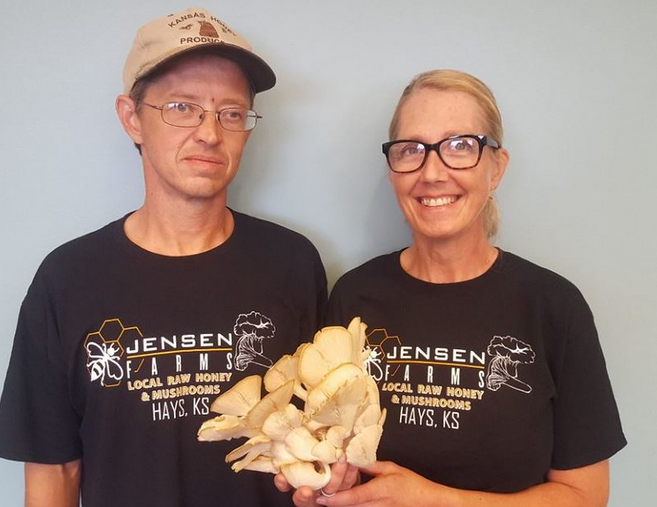
Mike and Amy Jensen are the owners of Jensen Farms and Professor’s Classic Sandwich Shop & More in Hays. Mike grew up on a farm northwest of Hays near the site of Yocemento. Amy grew up at Hays, came to K-State on a golf scholarship, and finished her degree at Fort Hays State. They met and married.
When he was a kid, Mike enjoyed hunting for morel mushrooms. Then he started growing mushrooms himself. His family also had a large garden but it needed pollination so they wanted bees. Mike and Amy met a farmer at Osborne who had a bunch of equipment for raising bees, and he gave it to them. They started raising bees along with the mushrooms, and it changed their perspective about healthy food.
In 2003, they bought the Professor’s restaurant in Hays and leased it for others to operate. Professor’s had been a long-time fixture in downtown Hays. As their honey production increased, the Jensens needed a storefront to serve as a retail outlet.
By 2017, Professor’s restaurant had closed so the Jensens reopened it as Professor’s Classic Sandwich Shop & More. They also got a permit to raise mushrooms in the basement below.
To produce mushrooms, they hand-pack long plastic sleeves with pasteurized straw and cottonseed hulls. Then they add mushroom spawn, seal the sleeves, and hang them straight down. “In three weeks, we’ll have mushrooms,” Mike said. A 10-pound sleeve will produce ten pounds of mushrooms, four times in a season.
Mike and Amy Jensen
Contrary to what some may think, these mushrooms are not grown in compost or manure. Mushrooms are so unusual that, when the Kansas Department of Agriculture food inspector came for an inspection, Mike had to walk him through the process.
The Jensens specialize in oyster mushrooms, but they also produce shiitake and lion’s mane mushrooms. For these, the growing process is slightly different. Shiitakes are grown on blocks which the Jensens create from wood pellets, water and flour. The blocks are sterilized before spawn is added and they are sealed for a subsequent harvest.
“Our mushrooms are medicinal as well as gourmet,” Mike said. Some believe these mushrooms have anti-cancer properties and can help with Alzheimer’s and Parkinson’s disease.
“Mushrooms can clean up the environment,” Amy said. They can absorb oil, for example.
The Jensens utilize their mushrooms and honey in their restaurant dishes as well as marketing the product directly. A diner can get a meal or buy raw honey and dried mushrooms or both.
The restaurant menu includes a mushroom taco burger and mushroom stir fry, for example. Each sandwich comes with a homemade honey cookie. Made-from-scratch honey lemonade is one of the drink offerings. There are no fried foods or sodas. “We use as much farm-to-table food as we can get,” Amy said. “We want people to know where their food comes from.”
The Jensens maintain 50 to 75 beehives each year. They live on the family farm northwest of Hays, near what was the community of Yocemento. Yocemento is now just a rural crossroads with only about five residents. Now, that’s rural.
The Jensens’ two kids were active in 4-H, and the family still manages the 4-H food stand during fair week. The family is environmentally sensitive, having recently decided to phase out Styrofoam packaging. “We want to be part of the solution,” Amy said.
Kansas: The Mushroom State. No, wheat or sunflowers are unlikely to be displaced by mushrooms in the state motto, but the Jensens are using mushrooms and honey to promote healthy eating. We commend Mike and Amy Jensen of Jensen Farms for making a difference with innovation in their products. I hope the positive results will mushroom.
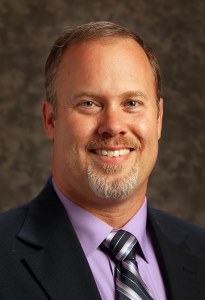
Rep. Adam Smith, R-WeskanCOLBY — Colby Community College will host a Constitution Day presentation by Kansas Rep. Adam Smith at 11 a.m. on Monday, Sept. 16, in the H.F. Davis Memorial Library on campus. The event is open to the public.
Smith, R-Weskan, is a member of the Kansas House of Representatives and serves District 120. He was elected to office on Nov. 8, 2016.
“We’re honored to have Rep. Smith on campus,” said Library Director Tara Schroer. “It gives students a chance to visit with a legislator in a small setting, which is rare in this part of the state.”
Constitution Day is recognized each year on or about Sept. 17, the day in 1787 that delegates to the Constitutional Convention signed the document in Philadelphia. Federal depository libraries across the nation celebrate the day with special events.
Refreshments will be served. For more information, contact Schroer at (785) 460-5487.
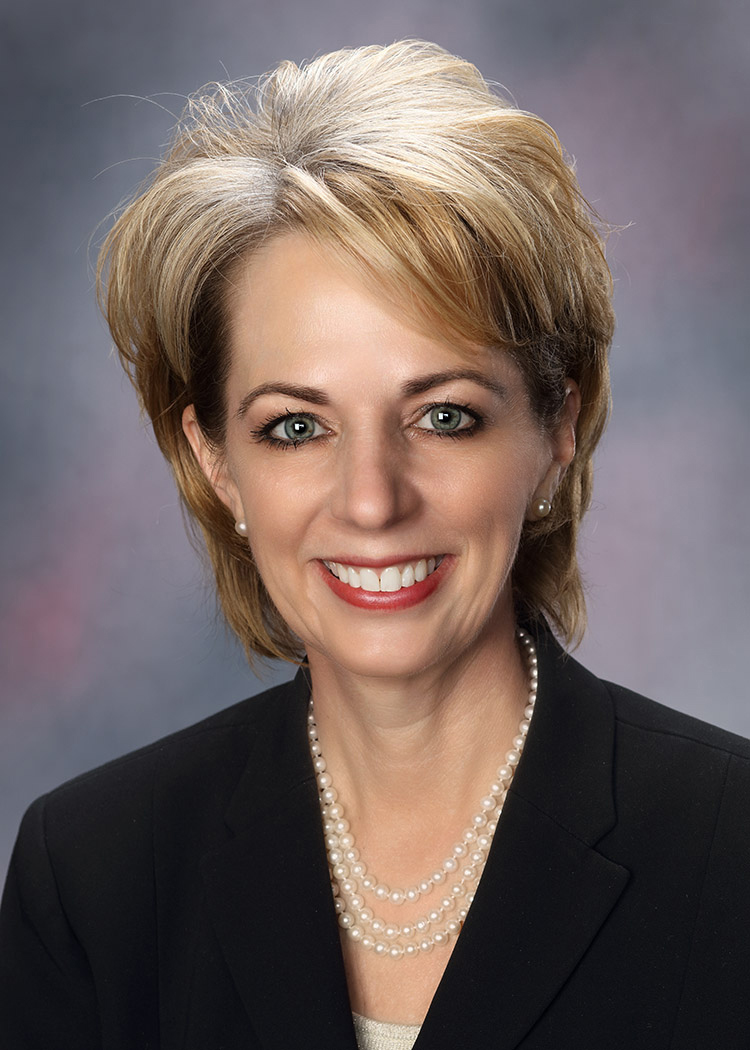
Each year since 1998, as traditional freshmen journey off to college, a list of generational facts known as the College Mind-Set List has been published. The list always makes me smile, and it makes me realize that my experience of our world is in many ways vastly different from the experiences of our college freshmen.
The list was created at Beloit College, Beloit, Wis., as a funny but thoughtful way to see the world through the eyes of these 18-year-olds. Last year, the list moved to Marist College in Poughkeepsie, N.Y., and it is as entertaining and enlightening as ever.
The full list of 60 is at www.marist.edu/mindset-list, but here, just for fun, are my top 10 items from the freshman class of 2019:
No. 44 Most of them will rent, not buy, their textbooks.
No. 31 By their sophomore year, their generation will constitute one-quarter of the US population.
No. 19 They may well not have a younger sibling, as the birth rate in the U.S. has been dropping since they were in grammar school.
No. 3 The primary use of a phone has always been to take pictures.
No. 17 Snapchat has become their social media app of choice, thus relieving them of the dilemma of whether or not to friend Mom.
No. 46 There have always been “smartwatches.”
No. 20 PayPal has always been an online option for purchasers.
No. 27 YouTube has become the video version of Wikipedia.
No. 37 Face recognition technology has always been used at public events.
No. 43 They have grown up with Big Data and ubiquitous algorithms that know what they want before they do.
As intended by the list creators, these items serve as great conversation starters. When I meet our newest Tigers, I must remember to ask them for tips on taking pictures with my phone!
I love the fact our new freshmen come to campus with more technological experience than those of previous generations. Our hands-on, technologically enriched campus is designed to challenge them and to help them become successful on campus and get them ready for the workforce of tomorrow.
Similarly, I think a lot about how this generation accesses YouTube for everything – including class materials. The impact of YouTube on how our students learn is intriguing to me, as is the growth of artificial intelligence in helping students learn on a very personal level. A couple of years ago, I read about an artificial intelligence tutor that could ask and answer questions on course material to help the students deepen their knowledge base. That sounds like a lot more fun than the way I studied!
What is especially exciting to me is that, as we welcome our new students to campus and to Hays, I recognize how different their world view is from mine and how much fun we will have learning from one another. They are beginning their incredible college learning journey, even as I continue on my own lifelong learning path.
Attempts to throttle journalists and frighten social media platforms have come to light recently, and while worthy of note — and criticism — none is likely to do serious harm to the First Amendment’s protections for our rights to free speech and a free press.
In one instance, multiple news outlets report an effort by supporters of President Trump to raise funds to target and track journalists and cable TV pundits seen as opponents to the White House, aiming to use old social media posts to show bias or prejudice.
In terms of the First Amendment, there’s no legal bar to such tactics. Freedom to write and speak does not carry any immunity to being criticized for it. As a piratical matter, holding journalists responsible for past social media posts or published works would seem limited by the likely small number of reporters and editors who have such embarrassing items in their history — despite what media critics would wish to be the case.
Another effort: A second, unsuccessful attempt by the White House to suspend the access pass of a journalist for what it deemed unprofessional conduct by engaging in a loud exchange with a former adviser during a Rose Garden event.
As in an earlier move to suspend the “hard pass” allowing access to the White House grounds held by CNN’s Jim Acosta, the proposed suspension of Playboy magazine correspondent Brian Karem’s credential through Sept. 14 was deemed by a federal court to be based on requirements too vague to be enforced, while clearly doing “irreparable harm” to his First Amendment rights.
The White House press office should stop trying to punish reporters it deems hostile or critical to send some sort of message to the Oval Office press corps. A more effective approach would be to provide accurate, factual regular briefings, position papers or even tweets to the public through the press on matters of substance, rather than deferring to brief, chaotic shouted press scrums as Trump enters or leaves the White House with Marine One’s engines intentionally roaring in the background.
And finally, there is the ongoing campaign by the administration and press critics that alleged bias against the president by social media outlets such as Twitter, Facebook and Google mean they are violating free speech protections. But such claims run aground on the simple fact that as private companies, those organizations are not subject to First Amendment restraints that prevent government from limiting or punishing any of us — individuals or global powerhouses — for what we say or write.
Some would even revive the long-discredited idea of a government-enforced “fairness doctrine” that could be applied across all forms of news media. Sen. Josh Hawley (R-Mo.) introduced a bill in August that would strip companies of key legal protections unless the Federal Trade Commission ruled them politically “neutral.”
If such legislation ever got through Congress — not likely — First Amendment lawyers would line up to challenge it as unconstitutional and counter to the very idea that we the people have the right to hold and express our own views, particularly when critical of government or public officials.
Again, the appropriate fix here is more speech — not as politically satisfying but more effective in the long run — presenting facts and opinions that allow the news consumer to decide on his/her own.
Current conflicts and criticism around controversial speech and press credibility issues — from Washington to college campuses to protest marches to the political slant of various cable TV outlets — can mask an important truth: The public has a solid commitment to protecting both free expression for us all and a free press’ role on our behalf as a “watchdog on government.”
The 2019 State of the First Amendment survey, by the Freedom Forum Institute, found 65 percent of us oppose restraints on what we post online, even when repugnant, and 72 percent of us support that role of a free press to hold government accountable on our behalf.
Any attempts to limit First Amendment rights deserve scrutiny, but clearly run against the core values held by sizeable majorities in an era when such majorities rarely exist.
Gene Policinski is president and chief operating officer of the Freedom Forum Institute. He can be reached at[email protected], or follow him on Twitter at@genefac.
Hays USD 489 has reached impasse in negotiation with teachers for the second year in a row.
The teachers and the school district are citing differences over insurance and pay.
The district is wanting to decrease the percentage it pays toward dependent health insurance, which is currently about 83 percent. The district proposed continuing to pay 100 percent for single plans.
The district also proposed allowing for horizontal and vertical moves on the pay schedule as well as a flat $1,300 per year pay increase for both teachers and classified staff.
The approximate cost for raises for both certified and classified staff would be $750,000 of the $1.3 million additional funds the district will receive this year from the state.
The school board asked school officials to file the impasse paperwork after meeting with teachers Wednesday night. A date has not yet been set to meet with federal mediators.
Canstockphoto.comA Hays Post series focusing on mental health issues.
By CRISTINA JANNEY Hays Post
If someone fell and gashed their leg, a stranger would likely jump to their aid. They would apply pressure to stop the bleeding and call 911.
Training in first aid and CPR is common for many Americans — even required by some professions and volunteer organizations.
How many of us would know what to do if someone was suicidal? How many of us even know the signs and symptoms of depression? How many of us would simply walk away too afraid to get involved?
High Plains Mental Health offers a day-long course in Mental Health First Aid. The program originated in Australia and now is offered across the U.S., including 10 years through High Plains for the adult program and six years for the youth program. Since the program started, HPMH has certified 2,387 northwest Kansas residents (from 20 counties) in Mental Health First Aid.
The course covers the most common mental illness, including depression, anxiety disorders, psychotic disorders and substance use disorders as well as ways every-day people can help people suffering from mental illness.
High Plains last year received a $20,550 grant from the Kansas Health Foundation to expand its Mental Health First Aid program and has had record participation this year. It has placed an emphasis this year on training first responders, said Kaley Conner, HPMH marketing coordinator and MHFA trainer. High Plains also received a $25,000 grant from the Schmidt Foundation this year to further public education and outreach efforts geared toward the agribusiness community. A small portion of that funding will also go toward MHFA.
Between 2014 and 2017, the suicide rate in the 20 northwest counties served by High Plains increased by 64 percent. In addition, a Centers for Disease Control study released in July 2016 reported farmers as a group had the highest suicide rate of any occupation in the U.S.
Mental illness affects about one and five Americans. It is more prevalent than cardiovascular disease, diabetes and chronic respiratory disease. Many people delay seeking help because of lack of education about mental illness or the stigma surrounding it. Support services may be hard to access, especially in rural communities, and the person suffering the illness might not have good insight into to their illness, according to the MHFA curriculum.
Conner talked about why the MHFA classes are important.
“First and foremost, this class helps raise awareness in our communities, as well as acceptance and empathy,” Conner said. “It is important for our communities to talk about mental health and to understand mental illness is a real illness that has the potential to be very impactful.
“It is also important to give community members practical, easy to remember tools for how they can approach and offer assistance to someone who might be struggling. When someone has a possible mental health problem, it is often going to be family members, friends, colleagues and others in the community who might first notice. For this reason, it is important for community members to be educated about possible warning signs and symptoms, and to know how to respond effectively.”
The first section in the MHFA curriculum discusses depression and goes on to discuss suicide prevention.
Although women present more often for treatment for depression, statistically men are more likely to complete suicide because they tend to use more lethal means, including guns and hanging. Men are four times more likely to complete suicide than women. Although this is a trend, it is not true in all cases.
Depression, which is believed to be caused by the changes in the natural brain chemicals called neurotransmitters, can have many causes, according to the HMFA curriculum.
Some of the risk factors include:
Stressful or traumatic events
A difficult childhood
Ongoing stress and anxiety
Long-term poverty
Bullying
Victim of a crime
Long-term physical illness
Death of a partner
Substance abuse
Depression can also be the result of another medical condition, childbirth (AKA postpartum depression), side effect of medication, the stress of having another mental illness, withdrawal from drugs or alcohol premenstrual changes, lack of exposure to light in the winter (AKA seasonal affective disorder), caring for a person with a long-term disability.
You may be more prone to have depression if you have a family member who has had depression or you have had a previous episode of depression.
Additional risk factors for suicide, include a previous suicide attempt, a friend or loved one who has completed suicide, and an organized plan.
If you believe a person is suffering from mental illness, the trainers urged first aiders to talk to person using “I” statements, as opposed to “you” statements that may seem judgmental. For example, “I am concerned about you.”
There is a difference between empathy and sympathy. Avoid saying, “I understand exactly how you feel.” You don’t. Instead you might say, “I can imagine how you might be feeling.” Empathy, trying to put yourself in another’s shoes, is different than sympathy, feeling sorry for someone.
Other helpful examples included:
How long have you been feeling this way?
Have you spoken to anyone about this before?
Is something bothering you?
You haven’t been joining us lately at coffee.
If the feelings that you are describing have been present for a long time, I think it’s important that you see your family physician.
Your goal as a mental health first aider is not to treat the person who is suffering from the mental health crisis, just as a physical first aider you are not going to set a person’s broken leg. You can offer to get the person to the professional help they need.
“You may not know how to handle the situation,” Conner said, “but you can move them on to someone who does.”
The course offers the acronym ALGEE to help first aiders remember the steps in aiding in a mental health crisis.
Access risk of suicide or harm.
Listen non-judgmentally
Give reassurance and information
Encourage appropriate professional help
Encourage self-help and other support strategies
When accessing risk of suicide, there are signs to look for:
Saying goodbye
Giving away items
Withdrawal
Saying they are thinking of killing themselves
Talking about suicide, death or dying on social media
Seeking means to kills themselves (buying a gun, seeking pills)
Expressing hopelessness
Engaging in reckless behavior
Increased alcohol or drug use
Dramatic mood change
Anxiety or agitation, unable to sleep or sleeping all of the time
Saying they feel trapped
According to the MHFA trainers, asking a person if her or she is considering suicide will not cause the person to kill him or herself or “put the idea in their head.” Talking about their thoughts and feelings may give them a release.
Amy Bird, MHFA trainer, said talking about death or suicide should not be thought of as an attention-seeking behavior. It should be thought of as attention-needing. The person may feel hopeless and worthless, and they need your help.
If you believe a loved one or you may be at risk of suicide, it is wise to put as much distance between thought and action as possible, the trainers said. For instance, move guns out of the house, separate guns from ammo, remove pills from the house.
If you have an immediate concern about a person’s safety, speak to them calmly and sincerely. Appearing confident can be reassuring. Ask:
Are you having thoughts of suicide?
Are you thinking of harming yourself?
Have you decided how you are going to kill yourself?
Have you decided when you are going to kill yourself?
Have you collected the things you need to carry out your plan?
If you have a serious concern about a person’s safety, do not put yourself in danger. If the person has a weapon or is acting aggressively, call 911.
High Plains has a 24-hour crisis line that can be reached at 1-800-432-0333. The National Suicide Prevention Lifeline is 1-800-273-TALK (8255). The national suicide crisis text line can be reached at 741741.
The annual Hays Area Out of the Darkness Walk, which seeks to bring light to the issue of suicide is Saturday at Municipal Park. Registration will start at 1 p.m. in Municipal Park and the walk will start at 2 p.m. If you are interested in walking, volunteering or donating, go to www.asfp.org/Hays.
When dealing with a mental health crisis, include the person in making a safety plan. Do not leave a person who is actively suicidal alone. However, you must recognize you can’t be with a person at every moment. You can help them with the second E in ALGEE by asking them what has been helpful in the past.
Do not use guilt to try to dissuade the person from hurting his or herself. Don’t make comments such as “You will go to hell” or “You are going to ruin other people’s lives.” Also don’t agree to keep the person’s suicide plan a secret.
Help can be found through doctors, psychiatrists, social workers, counselors, peer specialists and other mental health workers. Some people suffering depression may be prescribed medication. They may also engage in talk therapy, support groups or other professional support. Sadly, only about half of the people with depression in a given year receive treatment.
Other self-help strategies can include:
Exercise
Relaxation and meditation
Peer support groups, such as National Alliance on Mental Illness (NAMI). The local NAMI group meets on the first Monday of the month at 6 p.m. at the Hadley Center. For more information contact Ann Leiker, coordinator at 785-259-6859 or email her at [email protected].
Supporting the healthy development of the young child’s brain is both a tremendous opportunity and an awesome responsibility.
Dr. Bradford Wiles, K-State Research and Extension Specialist, specializes in brain development in early childhood. Wiles will speak from 7 to 9 p.m. Thursday at the Extension Office, 601 Main, Hays. The two-hour training is a certified KDHE training and is free of charge. He will also present from 8:30 to 11 a.m. Friday at 2501 E. 13th, Building 1.
The program will include what adults can do to support brain development and how play builds connections in the brain. Child care professionals, day care providers and parents are invited to attend.
Call Cottonwood Extension at 785-628-9430 for more information.
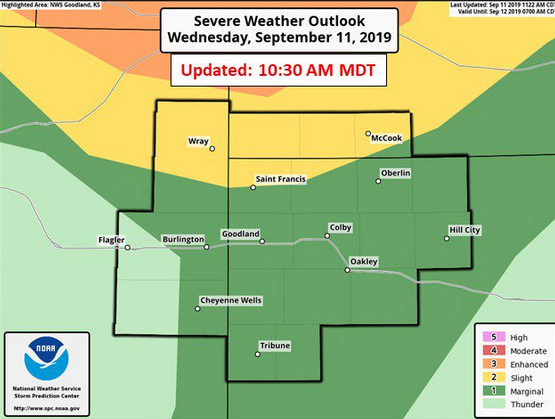
The National Weather Service in Goodland is warning of the potential of severe thunderstorms in northwest Kansas Wednesday afternoon and evening.
Late Wednesday morning, forecasters were predicting a possibility of strong storms, and possibly tornadoes in extreme northwest Kansas, including St. Francis. The primary risks are 2-inch hail and winds up to 80 mph, along with a low to medium risk for one or two tornadoes.
The strongest storms are expected north of U.S. 36 as a cold front pushes into the region from the west.
PRATT – The Kansas Wildlife, Parks and Tourism Commission will conduct its next public meeting on Sept. 19 at the Kansas Wetlands Education Center, 592 NE K-156 Highway, in Great Bend. All are welcome to attend the meeting, which begins at 1:30 p.m., recesses at 5 p.m., and reconvenes at 6:30 p.m. for a public hearing. Time will be set aside for public comment on non-agenda items at the beginning of both the afternoon and evening sessions.
During the afternoon session, attendees will hear a report on agency and state fiscal status, and general discussion on public lands regulations, antelope and elk regulations, and what to expect in the 2019 Upland Bird Hunting Forecast.
A series of workshop topics – items that may be voted on at a future commission meeting – will follow, including: threatened and endangered species regulations, electronic licensing, fishing regulations, state park regulations, 2020-2021 turkey regulations, and big game regulations.
Commissioners will then recess by 5 p.m. and reconvene at 6:30 p.m. to continue general discussions regarding renovations at Cheyenne Bottoms Wildlife Area, and potential duck zone changes, before voting on the use of electric-assisted bicycles at Kansas state parks.
If necessary, the Commission will reconvene at 9 a.m. at the same location, September 20, 2019, to complete any unfinished business. Should this occur, time will again be set aside for public comment on non-agenda items.
Information about the Commission, including the September 19, 2019 meeting agenda and briefing book, can be downloaded at ksoutdoors.com/KDWPT-Info/Commission.
If notified in advance, the Commission will have an interpreter available for the hearing impaired. To request an interpreter, call the Kansas Commission for the Deaf and Hard of Hearing at 1-800-432-0698. Any individual with a disability may request other accommodations by contacting the Commission secretary at (620) 672-5911.
The next KWPT Commission meeting is scheduled for Thursday, Nov. 14, at the William Carpenter 4-H Building in Scott City.

 By BECKY KISER