We have a brand new updated website! Click here to check it out!

BOOR: Help is available for high stressors in ag industry

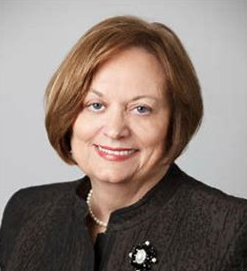
Alicia Boor

When looking at hazardous occupations in the world, agriculture is consistently in the top ten. There are many factors that go into this: the large equipment, working long days and longer evenings, and the repetitive heavy labor that just wears down the body over time.

Additionally, there is an alarming statistic that is on the rise thus making agriculture even more dangerous.

According to the Center for Disease Control, professions that are ag related sadly have the highest rate of suicides in the US. In July of 2016, 84.5 out of 100,000 in Ag took their lives compared to a national average of 13.4 per 100,000. The disparity is disturbing and unfortunately the number is on the rise with the uncertainty in agriculture at this time.

Agricultural occupations are unique in the job market and many of the factors that make it unique also make them much more stressful.

The higher stressors include: engaging in dangerous activities much of the time, the lack of control on conditions such as input pricing, commodity pricing, and weather. These all play into whether a producer can pay his bills. Sustained higher levels of stress can cause depression, fatigue, anxiety, and other triggers that cause a greater propensity of attempting suicide. The negative stigma of mental health issues can also make it difficult for producers to feel that they can reach out for help.

There is help available specifically to the agriculture community, assistance from individuals who understand a producer’s lifestyle and are ready to help.

The Kansas Agriculture Mediations Services at (800) 321-3276 can help producers with several programs in place. They will gather information from you and can connect you with financial advisors, legal advice, lawyers, and can also connect people with mental health facilities close to your location. One phone call can get you in touch with many people that can help your unique situation.

Also, the National Suicide hotline is (800) 273-8255 and provides 24/7 free and confidential support.

Some people do not want to talk on the phone. You can also text 741741, or chat online at imalive.org.

Most of all, watch out for your family and friends. If you feel that something is wrong, ask.

It is also good to implement strategies that can help daily. Some practices you can implement are: Taking a walk, get a massage, try guided restful breathing practices, listen to relaxing music, or just take 10 minutes to write down your blessings. Positive thoughts and practices can go a long way to improving an outlook on life. And most of all, if you need help, seek it. Your friends and family need you.

Alicia Boor is an Agriculture and Natural Resources agent in the Cottonwood District (which includes Barton and Ellis counties) for K-State Research and Extension. You can contact her by e-mail at [email protected] or calling 620-793-1910

Now That’s Rural: Verl Coup, Talmage Historical Museum

Ron Wilson is director of the Huck Boyd National Institute for Rural Development at Kansas State University.

By RON WILSON
Huck Boyd National Institute for Rural Development

When a bank and a school both close, what is to be done with the two buildings? Today we’ll learn about a rural community which seized the opportunity to convert a former school into a library and a former bank building into a museum. These actions help preserve and promote the history of the community’s citizens.

Verl Coup is director of the Talmage Historical Museum. He grew up near Talmage and lived here his whole life, other than during his service in the Army. Verl was a long-time rural letter carrier. He started collecting artifacts of the Talmage community.

“When the older people would move to the nursing home, they knew I was interested in history so they would pass some of their things along to me,” Verl said. “Otherwise, when they pass, their money and artifacts go to the big city.”

One day in 2010, he got an important call. “A lady who used to live here said the bank was closing and they would give us the building and most of the furniture,” Verl said. Sure enough, the Talmage branch bank closed and the building was donated to the Talmage Historical Society to become a museum.

“My wife (Kathy) was happy to get all these things out of our house,” Verl said with a smile. Kathy now volunteers at the museum. A local farmer left an endowment to support the new use for the building. In December 2010, the new museum opened its doors.

“The museum highlights the stories of the people from here,” Verl said. The old bank building was organized into various displays. The teller area has places for various area families to display their family trees and photos. The bank offices have been organized into different types of rooms.

For example, there is the school room with various artifacts from school buildings and classes through the years. I had to laugh when I saw the hairstyles, eyeglasses, and short basketball shorts of yesteryear.

There is the picture room with lots of images from around the county, and a place for photos of farmers and their equipment. The vault has safety deposit boxes which are used for storage of pictures and memorabilia. There’s a veterans area, a memorial wall where people can honor someone with donations that help sustain the building, and much more.

Artifacts continue to be donated. One morning Verl found a box left anonymously on the front step. Among the contents was a homestead certificate signed by President Chester A. Arthur.

The grade school in Talmage had closed in 2000 and then served as a church for a time. It has now become the Talmage Library and Events Center. Shawni Sheets, a board member of the Talmage Historical Society, is director.

The Talmage Library and Events Center is located up the street from the museum. In addition to the library’s own collection, the Manhattan Public Library loans a rotation of books to the library every two months. As one might guess, the former school building has a kitchen and dining area. The big gym is available for recreation, and an additional game room has pool, foos ball, ping pong, and exercise equipment. The facility is for rent by donation. Shawni Sheets said that many volunteers have donated books and other resources.

In spring 2019, the Dickinson County Community Foundation conducted a Match Day where donations to various worthy projects in the area were matched and doubled. “By noon that day, we had matched our $10,000 goal,” Verl said. “The community support is there.”

It is impressive to see such remarkable, repurposed facilities in a rural community like Talmage, population 99 people. Now, that’s rural.

For more information, go to www.talmagekansas.com.

When a bank and a school close, what is to be done with the buildings? In Talmage, they are being re-used in creative ways. We commend Verl and Kathy Coup, Shawni Sheets, and all those involved with Talmage for making a difference by repurposing and maintaining these buildings in ways that benefit the community. They could school other communities – you can bank on it.

🎥 Grant pays for more training of local Crisis Intervention Team

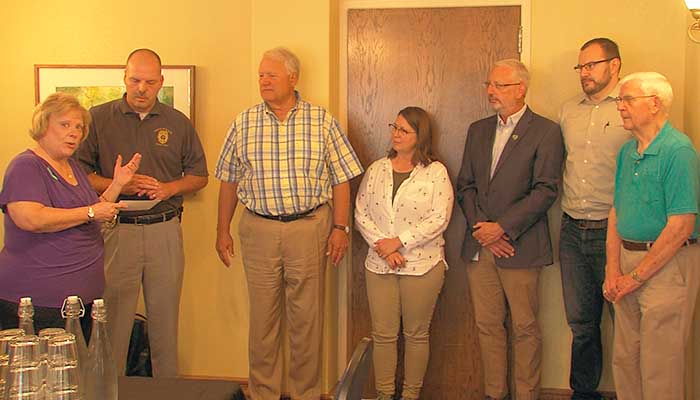
Ann Leiker, NAMI-Hays, presents a $10,000 check to Hays Police Chief Don Scheibler for national CIT training in Spokane, Wash. Onlooking are Joe Jeter, trustee of the Schmidt Foundation which funded the grant; Sherrie Vaughn, NAMI-Kansas exec. dir., Dave Anderson of High Plains Mental Health Center and an Ellis County CIT Council member; Josh Tanguay, psychologist and Ellis County CIT Council member; and Tom Pitner, founder of NAMI-Hays.

By BECKY KISER
Hays Post

Six members of the new Ellis County CIT (Crisis Intervention Team) Council were in Seattle, Wash., this week for national CIT training, thanks to a $10,000 grant from the Bob and Pat Schmidt Foundation of Hays.

NAMI-Hays (National Alliance on Mental Illness) applied for the grant on behalf of the council.

“One of the areas Bob and Pat Schmidt were always interested in was health in our community,” said Joe Jeter, Schmidt Foundation trustee. “When Tom Pitner (the founder of NAMI-Hays) approached the foundation about a potential grant for NAMI, it seemed like a no-brainer. It fit right into what we’re doing. We know Bob and Pat would be very pleased about this.”

Crisis Intervention Team programs are supported nationally by NAMI in more than 2,700 communities.

The lack of mental health crisis services across the U.S. has resulted in law enforcement officers serving as first responders to most crises. A Crisis Intervention Team (CIT) program is an innovative, community-based approach to improve the outcomes of these encounters, according to NAMI.

“High Plains Mental Health Center has always had a really strong and great working relationship with local law enforcement,” said Dave Anderson, a member of the Ellis County CIT and director of clinical resources at HPMHC.

“We rely on them heavily for the work that we do because many of the people who are in mental health crisis, law enforcement is often the first people that come into contact with them,” Anderson pointed out. “CIT strengthens that relationship. We spend a lot of time talking about issues in the community and the ways we can work together to help deal with those issues.”

“CIT in a community this size is fairly unusual. It’s usually in larger, more urban areas. We’ve had some challenges, but I think we’ve hit the ground running.”

Hays Police Chief and CIT member Don Scheibler spoke to the HPMHC board about CIT last month and explained the challenges law enforcement faces in dealing with people who have mental health crises.

CIT, which is ever evolving, began with the Memphis, Tenn. police department in 1988 following the fatal shooting of a mentally ill person.

“In 2016, we had the same situation happen here in our community,” Scheibler said, “and that really made us start looking at a way we could do this better, is there a way we could provide better service to our mental health consumers, and that’s how CIT grew out for us.”

“I’m especially pleased with the support of High Plains Mental Health Center and NAMI, and Ellis County law enforcement.”

Scheibler agreed that “law enforcement has become the de facto health provider for a lot of people.”

“We are often the very first people they see in a crisis. Better training, better preparing of our people in those types of situations is huge.”

Hays resident Joey Weber, 36, who had autism, was shot and killed by a Hays police officer during a brief struggle Aug. 18, 2016, following an attempted traffic stop for an expired license tag. The Kansas Bureau of Investigation determined the officer acted in self-defense.

The bill “Joey’s Law,”  aimed at protecting Kansas drivers with cognitive disabilities, was signed into law by then-Governor Sam Brownback  on April 7, 2017.

NAMI was actively involved in the Memphis development of CIT and continues to be involved in CIT, according to Dr. Sherrie Vaughn, executive director of NAMI-Kansas.

“We were active partners and collaborators for the implementation of CIT and growing it across the nation,” Vaughn said. She thanked Jeter and the Schmidt Foundation for supporting NAMI-Hays in their efforts to support the Hays police department and the CIT team.

“What a great opportunity that this grant award is going to give to you and your board in growing CIT here in Hays. I’m excited about what that’s going to do for your department, for your department morale and also for the citizens that receive your services,” she added.

Scheibler and Anderson attended an international CIT training program in Kansas City last year, where presenters urged CIT groups to have training for all their members.

ELLIS COUNTY CIT COUNCIL

Sgt. Brandon Hauptman, President–Hays Police Dept.
Sgt. Tim Deines, Vice-President–Ellis Co. Sheriff’s Office
Chief Don Scheibler–Hays Police Dept.
Chief Ed Howell–FHSU Police Dept.
Chief Taft Yates–Ellis Police Dept.
Undersheriff Scott Braun–Ellis Co. Sheriff’s Office
Brenda Basgall–Ellis Co. Attorney’s Office
David Anderson–High Plains Mental Health Center
Gina Smith–FHSU Kelly Center
Bob Piatt–NAMI Hays
Josh Tanguay–NAMI Hays
Pat McGinnis–Community member

The Hays Police Department recently completed the One Mind Campaign started by the International Association of Chiefs of Police. HPD was the second agency in Kansas participate in the intiative to improve response to community members with mental illness.

Power outages, 80 mph winds and hail from latest storm

Thursday’s summer storm rolled out of Nebraska and brought large hail to northwest Kansas along with damaging winds and flooding rains.

Power lines down photo courtesy Prairie Land Electric

Power poles are down and many tree limbs and some trees are down as a result of the storm, according to the Norton County Sheriff’s Department.

The Graham County Sheriff’s department in Hill City reported straight line winds of near 80-miles per hour and over two inches of rain in some areas of the county.

Prairie Land had wide spread power outages in Norton, Decatur, Sheridan, Graham, and Rooks Counties.

Their crews were out overnight assessing damage and despite the difficult conditions are working to restore power.

There were tank battery fires on 390th and O Road and North of 24 and 170th, in Graham County, according to the sheriff’s Department.

The wind also did damage to trees and power lines in Barton County, according to the sheriff’s department.

There are no injuries reported.

SHPTV Polka Party set for next month at Hays VFW

BUNKER HILL – Smoky Hills Public Television is excited to announce that we will be having a Polka Party fundraising event on Saturday, Sept. 21, at the VFW Hall in Hays.

The event will be held from 1 to 5 p.m. and will feature the Wes Windholz Polka Band. There will be snacks, a cash bar, and raffle prizes.

“We can’t wait to bring you this fun event,” said Tricia Flax, Smoky Hills Public Television events coordinator. “The Wes Windholz Band is a local favorite and they do an amazing job. Don’t miss out on this great event where you can kick up your heels and have a good time!”

The ticket cost is $20 per person. For tickets, you can call 800.337.4788 or visit our website at www.shptv.org. Tickets are limited.

INSIGHT KANSAS: School redesign — outcomes for the future

Dr. Sharon Hartin Iorio is Professor & Dean Emerita at Wichita State University College of Education.

Kansas Can, launched by the Kansas State Board of Education is a visionary project to create more effective PreK-12 learning. Begun in 2017 with seven schools, today Kansas Can has grown to include 66 of the 286 districts in Kansas.

Aimed at statewide, overall school redesign, the KSDE board laid out a concept for the project then engaged teachers to drive the course of action. All districts are expected to join the redesign process by 2026.
How much do we know about this ambitious undertaking to make the changes required for student success in today’s world?

Redesign emerged from conversations held in 2014 by then newly named KSDE Commissioner Randy Watson. Watson traveled the state conducting focus groups that totaled more than 2,000 people to learn their thoughts on the future of Kansas public education.

Kansans interviewed said that students needed to be better prepared upon graduation. Many said students should be learning “soft skills” including team work and responsibility.

Based on the feedback, the KSDE board established five redesign outcomes for measuring progress. Teachers in participating schools will measure steps taken for students to engage social-emotional development, kindergarten readiness and creating a plan of study focused on career interest. The outcomes also require collecting data on changing high school graduation rates and data on student participation in or completion of post-secondary learning.

At this point, the five KSDE board outcomes have been presented to school districts that volunteered to participate. No extra funding is allocated from KSDE or state education budgets. The work is school-site specific enacted by teachers in the 160 schools within the 66 currently participating districts.

For example, in Stockton, to promote social/emotional growth, the school provides for students and adult employees to meet regularly in a multi-age, small community to cultivate commitment to democratic values and participation in improving society on behalf of all people. In Wellington personalized learning through basic academic content is offered by a free online/computer-based program within a limited number of carefully selected classrooms.

Neither online learning nor school communities are required as part of current school redesign—redesign rests with how teachers in each school interpret the KSDE outcomes.

School redesign is well known by educators but not widely known by the public, except in districts where there has been criticism of the new activities, often centered around classrooms where online learning covers basic content instruction.

While many Kansans support the current, free KSDE online learning opportunities that serve individual students away from teacher-led instruction, the public opinion jury is still out on whether shifting substantial group time to online for academic study is more beneficial than regular school.

Voters in Wellington will help make that call. This fall’s local school board election will see three open board positions contested by candidates, whose platforms, in part, address online classroom learning.

Change is often needed, but change also can be stressful and occasionally not productive. The important point to remember is that online classrooms are just one way to implement one part of the much larger redesign project—not the defining element of the KSDE redesign’s critical and far-reaching mission for each Kansas student to succeed.

Kansans can make redesign, though challenging, a change for the better. After all, redesign is not nearly as challenging as sending a man to the moon.

Dr. Sharon Hartin Iorio is Professor & Dean Emerita at Wichita State University College of Education.

SPONSORED: United Way seeks executive director

The Board of Directors of the United Way of Ellis County (Hays, KS), a local affiliate of the national charitable organization, is seeking an experienced and motivated

Executive Director. The Executive Director of the United Way of Ellis County is a visionary with the qualities of effective leadership and ability to lead change initiatives; has a proven track record of successful donor cultivation; is an effective relationship builder with a diverse, wide spectrum of constituencies, including corporate and community leaders and partner agencies.

Reporting to and working cooperatively with the Board of Directors, the Executive Director is directly responsible for leading and developing staff, and day-to-day operations including resource development, community investment, and maintaining/strengthening the relationship with partner agencies. This individual must be a powerful communicator in telling the United Way’s story of “lives changed” and “people mobilized” within our community.    

Qualifications:

  • Bachelor’s Degree or equivalent experience required
  • Must be able to pass a background check
  • Must be able to obtain a bond
  • Demonstrate integrity and  high energy
  • Business insight
  • Experience managing and leading an organization or business unit of comparable size.

Salary:  Beginning compensation between $35,000 and $45,000 based on experience with opportunity for bonus pay based upon performance. 

Qualified candidates should send an application, résumé and cover letter including your vision of how to be a successful Executive Director, three references, three year salary history and requirements via e-mail to: [email protected].  Applications are available online at www.liveunited.us.  All submissions will be confidential, and references will not be contacted without the candidate’s approval. Priority deadline is September 6, 2019.  Review of applications will begin after the deadline and continue until the position is filled.

Please visit www.liveunited.us for more information about the United Way of Ellis County.

United Way of Ellis County is an Equal Opportunity Employer.

CAMPBELL: Make an informed decision when selecting the best wheat variety

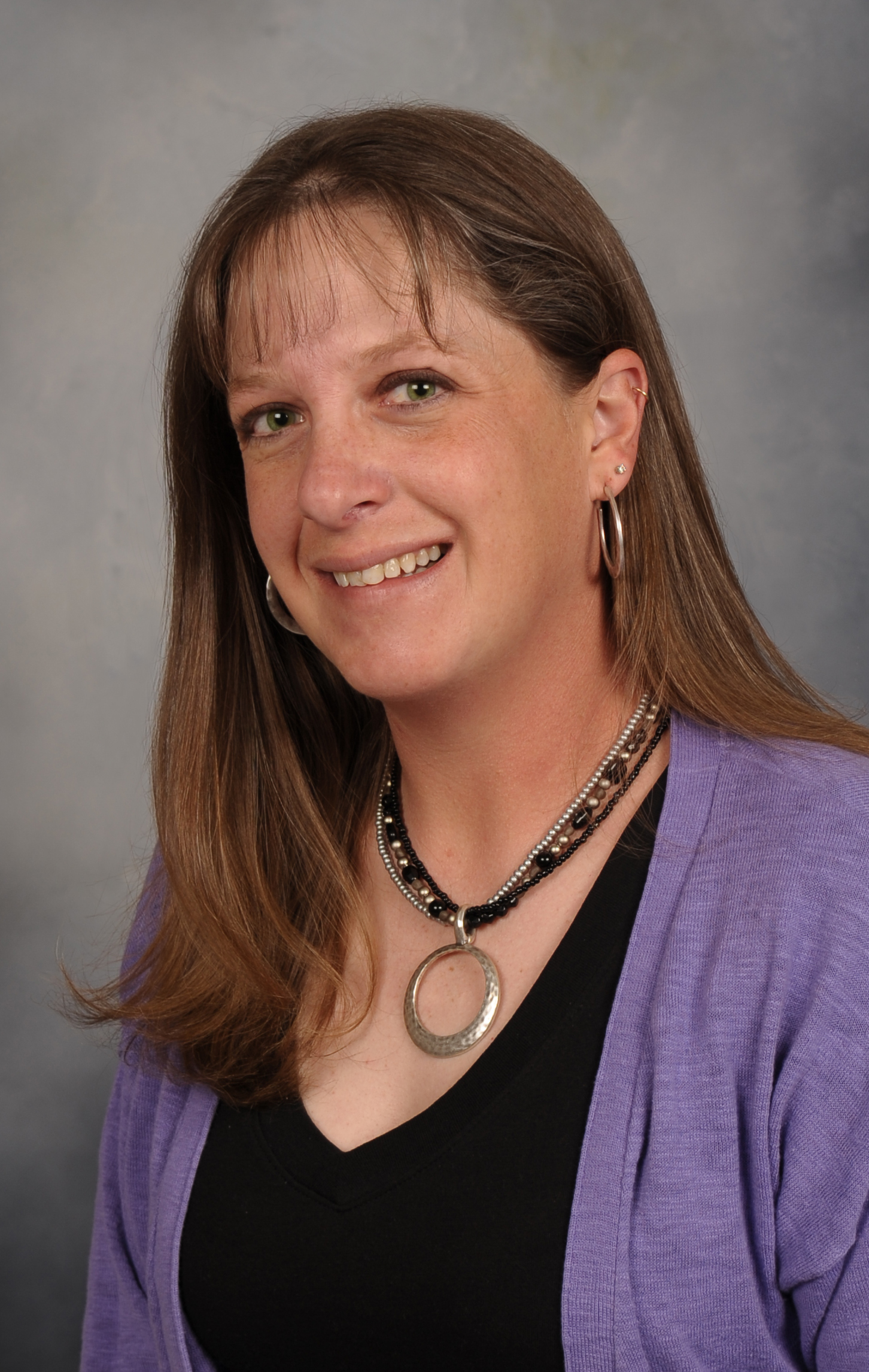
Stacy Campbell is Agriculture & Natural Resources Extension Agent for the Cottonwood Extension District.

In recent years, wheat producers are faced with an increasing number of varieties from which to choose. One of the reasons behind having so many available varieties is that many public and private institutions are breeding wheat varieties in the Great Plains: Colorado State University, Kansas State University, Oklahoma State University, Texas A&M University, University of Nebraska, AgriPro/Syngenta, Limagrain, and WestBred/Monsanto. Additionally, several companies license varieties from existing breeding programs, such as AGSECO, Dyna-Gro, AgriMaxx among others.

Producers can use different tools and publications to study each variety’s strengths and weaknesses, selecting varieties that best match their needs.

Making a better decision: Steps to select a wheat variety

The following information provides a step-by-step guideline, as well as relevant resources, to help producers make a better decision when selecting one or a few varieties to plant in their operation.

  1. Select several varieties that are adapted to your region of the state.

Regardless whether you intend to plant one variety or several on your farm, it is important to start out with a list of several good candidate varieties. The final product of interest is grain yield and therefore, it is crucial to select varieties that have shown consistent performance and excellent yield record in the region. Varieties that worked well for you and your neighbors in the past should be considered, but also make sure and check yield results from nearby K-State (and other universities’) variety performance tests and demonstration plots. It is important to take into consideration the conditions experienced during the year in question. For instance, results from central Kansas during 2019 season were extremely variable due to excessive rainfall at several locations. Thus, when looking at these results it is very important that results from more than a single year, and possibly more than a single nearby location, are taken into consideration.

A few good resources to consult are:

  1. K-State variety performance test: Start searching by year, narrow down your search by region and finally by site. Choose the site(s) nearest to you and look for varieties that are consistently toward the top. Repeat the procedure for different years to check the consistency of the variety performance. Go to our web site www.cottonwood.ksu.edu to access the K-State wheat variety performance test results.
  2. Colorado Wheat Variety Database: This database encompasses replicated trial results from Colorado, Kansas, Oklahoma, and several other public state trials, so producers throughout the Plains can benefit. It is an excellent, easy-to-use resource that allows you to dig into data from single location, multiple locations, multiple years, and also allows for head-to-head variety comparisons. We suggest that users start by looking at “Single Location Trial Data”, selecting the location nearest to you, and repeating this step for several years of data for that location. Check for varieties that tend to be consistently toward the top. Afterwards, look at “Multiple Location Trial Data,” which will allow you to look at yields spanning a wider geographical region instead of a single location for one, two, three, or four years combined. Depending on region and number of years selected, you might be looking at more than 15 replicated trials combined. Thus, if a given variety remains a top yielding variety across all these replicated trials, it is a pretty good argument that you should at least look at that variety’s characteristics and consider it in your farming operation. Finally, after selecting a few potential candidates based on their performance, we suggest that users click on “Head-to-head comparisons”, so they can test whether those candidates performed statistically different over a wide range of environments. That web address is www.ramwheatdb.com/

Additional Resources

A few great resources to help you walk through each variety’s characteristics as far as maturity, disease ratings, drought, straw strength, winterhardiness, and other agronomic characteristics are:

  1. K-State Wheat Variety Disease and Insect Ratings 2019: This comprehensive guide to wheat varieties will allow you to compare different varieties in their agronomic and disease resistance characteristics in detail. Many varieties are individually described, others are shown in a table format which allows for easy and fast comparison. It is available on our web site www.cottonwood.ksu.edu
  2. Wheat Varieties for Kansas and the Great Plains by Layton Ehmke: This private-sector book is also an excellent, comprehensive source of information regarding different varieties and their characteristics. It provides detailed ranking of varieties by traits of interest, making it easy to use. It also has a good summary of several variety performance tests in the Great Plains. While not available online, producers can purchase it at https://thewheatfarmer.com/

Information provided by  Romulo Lollato, Extension Wheat and Forages Specialist and Erick DeWolf, Extension Plant Pathologist.

Two arrested in Hays on suspicion of passing counterfeit hundreds

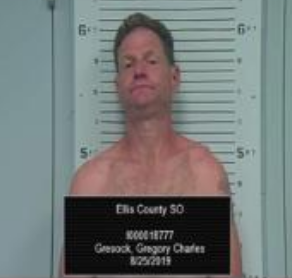
Gresock / Ellis Co. photo

By JAMES BELL
Hays Post

On Sunday, the Hays Police Department arrested two people at a local hotel after investigating reports of fake currency being used at several Hays businesses.

“We had a number of business report that they had received $100 bills that were fake,” said Hays Police Lt. Tim Greenwood.

During the investigation, the same two suspects were observed at the locations and tracked to a local hotel. They were later identified as Gregory Gresock, 48, Ellis, and Amanda O’Brien, 34, Hays.

“They knew that they were counterfeit and passing them as legitimate bills,” Greenwood said.

After contact was made, Gresock and Obrien were taken into custody and a search warrant was obtained for a hotel room.

During the search of the room, more bills were located, Greenwood said, adding methamphetamine and drug paraphernalia were found on Gresock and O’Brien.

“Based on information received during their interview, we were able to apply for, receive and execute a search warrant out in the county at a residence and recovered more bills, drugs and paraphernalia,” Greenwood said.

He believed at least one of the suspects was working in Hays but did not know why they had procured a hotel room.

While the use of fake bills led to arrests, several of the business suffered losses after being paid with fraudulent bills.

“There were some losses because they had already provided services or goods and then they realized after the fact that the bill was fake,” Greenwood said.

The bills were described as having Asian writing on them, but Greenwood said he was unsure where the bills had come from and no manufacturing devices had been found during the investigation.

“There was no indication that they were making them themselves,” he said.

While fake currency can sometimes be hard to detect, Greenwood said, if a bill is presented with markings, or if the bills feel suspicious, he advised asking for another form of payment.

“When in doubt, don’t take it,” he said.

Greenwood said he was happy with the investigation by the department.

“Our guys did well here,” he said. “They recovered over 40 counterfeit bills, and two people will face the charges.”

O’Brien was arrested on suspicion of two counts of suspicion of possession or intent to distribute counterfeit currency, two counts of theft by deception, drug possession and possession of drug paraphernalia.

Gresock was arrested on suspicion of six counts of suspicion of possession or intent to distribute counterfeit currency, four counts of theft by deception, theft, drug possession and possession of drug paraphernalia.

Both Gresock and O’Brien are presumed innocent until proven guilty in a court of law, Greenwood said.


Boil order issued for Smith County community

TOPEKA – The Kansas Department of Health and Environment has issued a boil water advisory for the Smith County Rural Water District No.1 for all services west of M Road including the city of Athol, located in Smith County.

Customers should observe the following precautions until further notice:

  • If your tap water appears dirty, flush the water lines by letting the water run until it clears.
  • Boil water for one minute prior to drinking or food preparation or use bottled water.
  • Dispose of ice cubes and do not use ice from a household automatic icemaker.
  • Disinfect dishes and other food contact surfaces by immersion for at least one minute in clean tap water that contains one teaspoon of unscented household bleach per gallon of water.
  • Water used for bathing does not generally need to be boiled. Supervision of children is necessary while bathing so that water is not ingested. Persons with cuts or severe rashes may wish to consult their physicians.

The advisory took effect on August 29 and will remain in effect until the conditions that placed the system at risk of bacterial contamination are resolved. KDHE officials issued the advisory because of a loss of pressure. Failure to maintain adequate pressure may result in a loss of chlorine residuals and bacterial contamination.

Regardless of whether the public water supplier or KDHE announced a boil water advisory, only KDHE can issue the rescind order following testing at a certified laboratory.

For consumer questions, please contact the water system or KDHE at 785-296-5514. For consumer information please visit KDHE’s PWS Consumer Information webpage: https://www.kdheks.gov/pws/emergencyresponse/water_disruption.htm

Restaurants and other food establishments that have questions about the impact of the boil water advisory on their business can contact the Kansas Department of Agriculture’s food safety & lodging program at  [email protected] or call 785-564-6767.

— KDHE   

41st annual Logan Labor Day Celebration Sunday

LOGAN – The 41st Annual Logan Labor Day Celebration at the Logan Golf Course located 1.25 miles east of Logan, Kansas on Highway 9, will be held on Sunday, September 1, 2019.

The Dane G. Hansen Museum with funds from the Dane G. Hansen Foundation sponsors this annual family-friendly event. There is no admission fee.The day kicks off at 11:00 a.m. with a sand volleyball tournament and the Dane G. Bales, Jr. Memorial Car Show. The car show has been a highlight of the Labor Day Celebration since 1998. This year’s featured car is Greg Andrews’ 1991 Callaway Corvette. Make sure to get there before 4:00 p.m. to check out everything from classic coupes and beefed-up muscle cars to antique pick-up trucks and flashy hot rods.

Get some exercise, don a disguise, see the sights, or win a prize at this year’s festivities. Let the kids run loose and find entertainment that will burn off some energy, including a Bungee Trampoline and a 6-in-1 inflatable course. “Disguise” yourself or the kiddos by visiting the free face painting booth.

Ready to see the sights from higher up? Check out the popular 25-foot rock climbing wall that will be open from 11:00 a.m. to 5:30 p.m. in the middle of the celebration. Feeling competitive enough to try for a prize? The Siruta Pedal Pullers State Sanctioned Kid’s Tractor Pull begins at 2:00 p.m. and winners are eligible to compete in the State Pull at the Kansas State Fair in Hutchinson.

In-between activities, you’ll find plenty of delicious options for both lunch and dinner, (plus snacking in-between), at the Logan Chamber of Commerce Food Booth, The Corn Kettle, and Buck’s Snow Shack.

A shuttle will carry visitors to and from the Dane G. Hansen Museum from 2:00 p.m. to 5:00 p.m. to view the photography exhibit, “A Life In The Wild” by Nebraska native Thomas D. Mangelsen. Three of Mangelsen’s most iconic photos are included in the exhibit: “Polar Dance” (1989) of polar bears appearing to dance in near-whiteout conditions; “Mountain Outlaw” (2014) of a grizzly bear charging head on through the snow; and “Catch of the Day” (1988) which captures the exact moment that a spawning salmon, trying to leap over a waterfall, soars right into the waiting jaws of a massive brown bear. Amazing and inspiring, this is a must-see exhibition. The shuttle will load in the golf course parking lot and on Main Street in front of the museum.

The 41st Annual Logan Labor Day Celebration’s musical entertainment will start at 5:30 p.m. under the tent by the Logan Chamber of Commerce Food Booth with Patsy Cline impersonator Melinda Ferree and at 7:30 p.m. “The Innocence” will take the stage and wow the crowd with their superior talent and a song list packed full of diverse hits from Journey to George Strait and Bruno Mars to AC/DC.

Last, but certainly not least, the grand finale by Rainbow Fireworks of Inman, Kansas, will light up the sky with a brilliant display of fireworks that can be seen for miles.

For more information, call the Dane G. Hansen Museum at 785-689-4846 or visit us on the web at www.hansenmuseum.org. Museum Hours are M-F 9-12 & 1-4; Sat. 9-12 & 1-5; Sun. & Holidays 1-5. The museum is closed Thanksgiving, Christmas, and New Years. We are handicapped accessible and admission is always free thanks to the generous support of the Dane G. Hansen Foundation.

For more information contact Shari Buss at 785-689-4846.

– SUBMITTED –

Copyright Eagle Radio | FCC Public Files | EEO Public File