

 HAYSMED
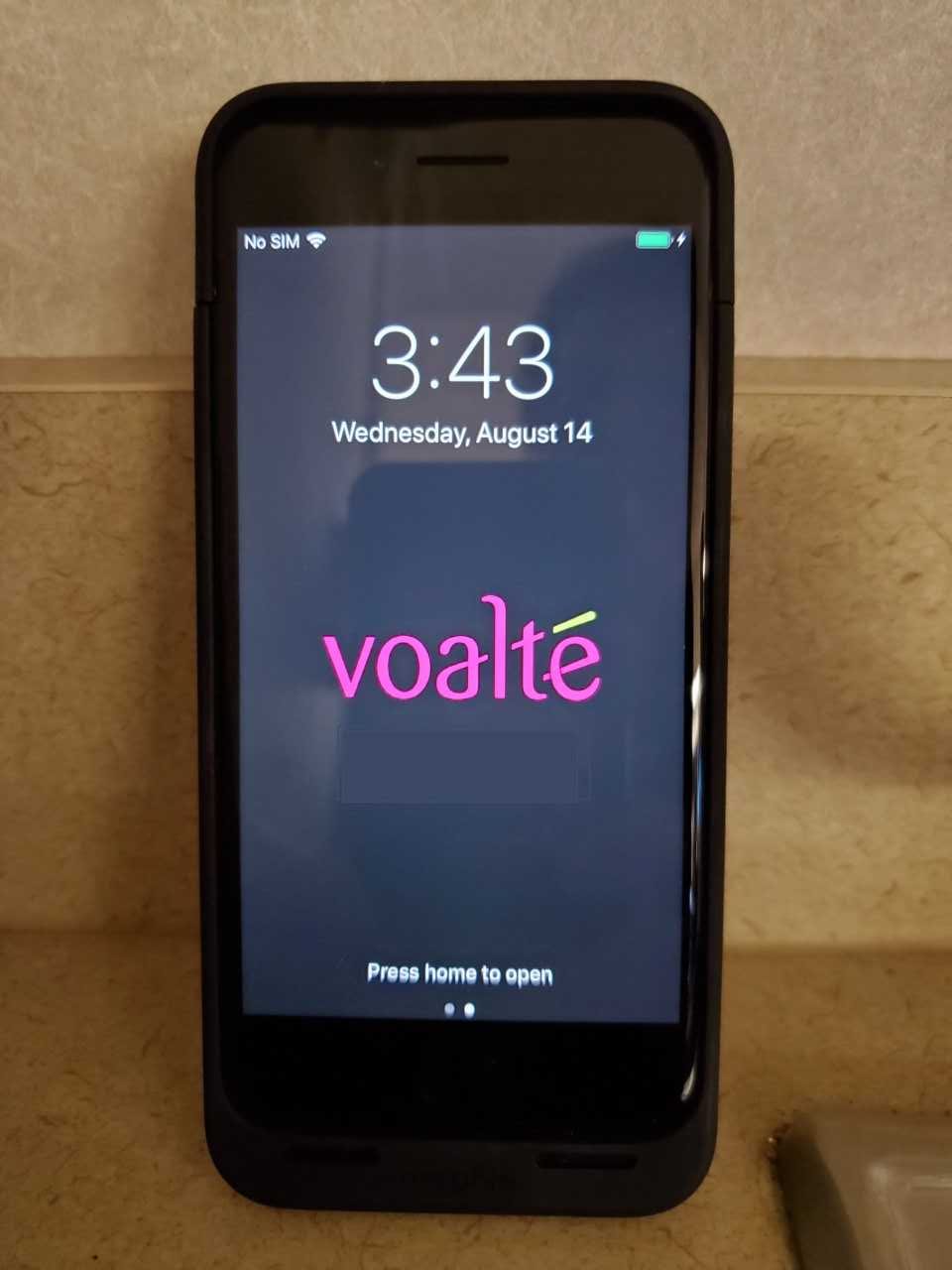
HaysMed recently launched a new initiative to coordinate patient care. The Voalte Platform™ helps enhance patient care and communication through the use of smartphones. The system integrates Apple® iPhones with multiple alarm sources and HIPAA compliant messaging to ensure physicians, nurses and support staff always have the most up-to-date patient information.
The Voalte Platform implementation will include Voalte One™ on shared smartphones for nurses at the point of care, Voalte Me™ for physicians and others using personal smartphones outside the hospital, and the Voalte Messenger™ web client for unit coordinators and secure calling and messaging, bringing together all forms of communication on one powerful, smartphone-based platform.
“As hospital dedicated to providing high-quality healthcare to our community, we look for solutions to improving patient care,” said Bryce Young, Chief Operating Officer. “We want our employees to have the most up to date technology as the foundation for communication across the hospital to ensure that care teams can access and exchange information securely, and collaborate efficiently on patient care.”
With this system physicians and nurses will be able to collaborate quickly and efficiently on an easy-to-use smartphone, and provide the best possible patient care.
“The ability to streamline care team communication and improve access to vital patient information is invaluable” said Young.

By BECKY KISER
Hays Post
Another stormy night in Hays, the third time in five days.
Three waves of thunderstorms cut through Saturday night into early Sunday morning – at 9:20 p.m., 11 p.m. and 3:45 a.m. – according to official records at the K-State Agricultural Research Center south of town.
Weather keeper Joe Becker says the storms included high damaging winds, driving rain, ground lightning and thunder, with some small hail in the final wave.
The peak wind gust recorded at the research center was 65 mph at 10:10 p.m. At the Hays Regional Airport, a peak wind gust of 69 mph was recorded out of the southwest at 1:56 a.m. Sunday, with sustained wind of 53 mph.
The official rainfall amount was 2.72 inches. At the airport, 2.15 inches was recorded.
So far in August Hays has received 5.61 inches of rain, far exceeding the average total rainfall of 2.97 inches for August.
Total moisture recorded far the year to date is 20.25 inches. The average is 17.57 inches by the end of August.
The National Weather Service in Dodge City has issued a Flood Warning for Ellis County until 5:15 a.m. Monday, with radar-indicated rainfall amounts ranging from 3 to 7 inches across the area.
Visit the beautiful gardens maintained by the extension office at 601 Main Street, in downtown Hays, KS.

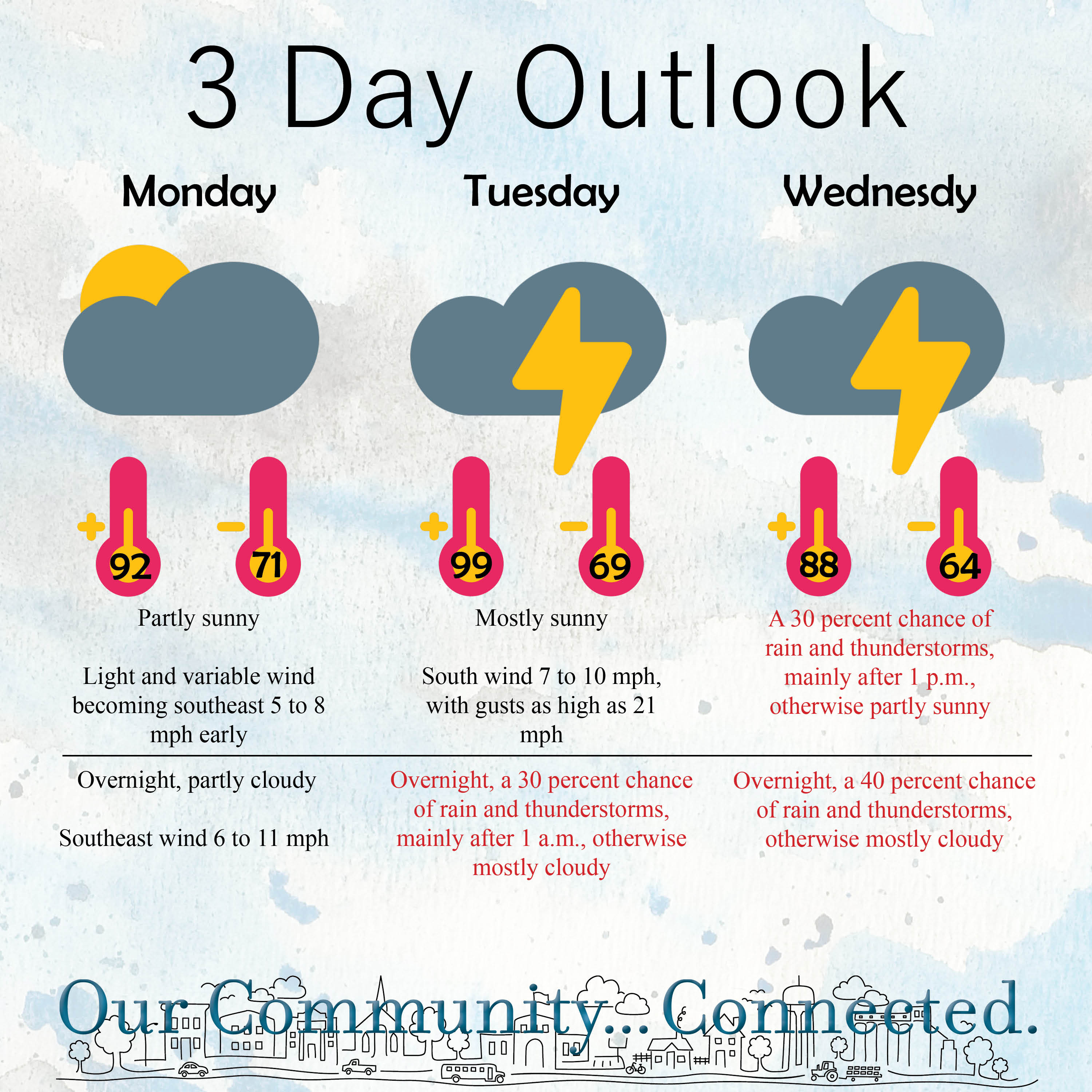
Midwest Energy is asking its Hays customers to conserve electricity on the afternoons of Monday and Tuesday between the hours of noon and 7 p.m.
The request is being issued following the downing of several key power lines in northwest Hays during a storm the evening of Aug. 13.
With several key lines out of service, Hays is being supplied using powerlines from the South and East.
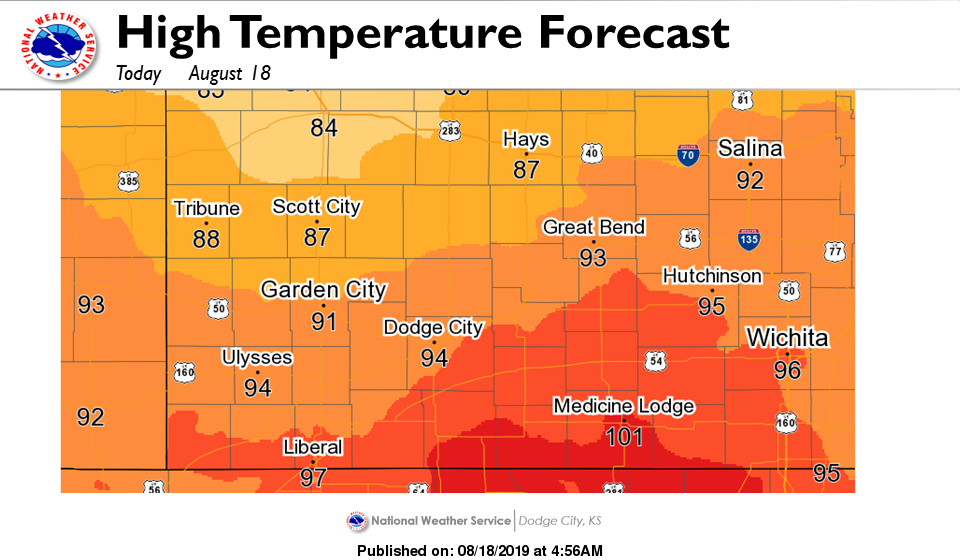
Bill Dowling, Midwest Energy’s Vice President for Engineering and Energy Supply, said that under normal conditions, these other lines can easily meet the city’s power needs. But on Monday and Tuesday, with forecasted temperatures near 100 degrees, the company is asking customers to conserve power between peak hours of noon to 7 p.m., to ensure these lines don’t become overloaded.
“We would ask that people set their thermostats a few degrees higher than they normally would during those noon to 7 p.m. periods,” Dowling said. “If you can delay chores like using the clothes dryer, and maybe cook dinner on the stovetop instead of in the oven, those simple things will go a long way in helping us avoid overloading these lines.”
Most of the poles downed during the storm were replaced within 24 hours, but the 25 transmission poles downed along 230th Avenue are 65 to 75 feet tall, nearly double the size of the 40-foot tall poles seen throughout town. Spring and summer storms have damaged an extraordinary number of tall structures within Midwest Energy’s service area, depleting the company’s normal supplies of tall poles.
Midwest Energy will continue to monitor weather forecasts and alert customers if any additional conservation measures are needed until the line is back up.
— MWE
CRISTINA JANNEY
Hays Posst
About 90 dogs were already in the pool by 11:30 a.m. Saturday for the Hays Aquatic Park’s annual dog swim. The poll expected even more pouch paddlers before the event ended. Last year the pool welcomed 150 dogs for the last day of pool operation. The pool will be drained for the season after the dog swim.


The Ellis County Commission has elected to waive tree dumping fees at the Ellis County Landfill from now through Sat., August 24, 2019.
All persons transporting tree limbs during this time frame (including licensed tree trimmers) may bypass the scale.
We ask that all drivers use caution while on the landfill property due to high volume traffic.
Direct any questions to the Ellis County Landfill at 785-628-9460.
— Ellis County
 WPAA
WPAA
Hard to believe that the golden anniversary is here. Western Plains Arts Association board members representing large and small northwest Kansas communities hope you will join in an all-year celebration of the organization’s 50th Season.
As usual WPAA offers a large number of quality programs — a whopping 20 for the 2019-2020 season. An adult season ticket is still a great value of just $50. Student tickets, high school senior or younger, are just $15 a season. Family memberships are $110; families receive two adult tickets plus one student ticket for each child in the family who is high school senior age or under. Adult tickets for many of the individual programs are $20, while student tickets are as much as $10.
Special to the season is the “Fiftieth Anniversary Celebration Show,” Feb. 16. At this free show we will take a stroll down memory lane of several of the highlights since the debut season of 1969-1970. We will also feature WPAA board member and affiliate local talent, and host a reception, all at the cultural arts center in Colby.
With so many season programs, WPAA is sure to have several you and your family will not want to miss. Still trying to graduate since the 1950s, The Four Freshmen will open the season Sept 8 at the Oakley High School Auditorium.
Hear one of the best traditional and Dixieland jazz groups in the Rocky Mountain region as Denver’s Queen City Jazz Band comes to Goodland High School Auditorium Sept. 15. The band also features jazz-blues singer Wende Harston.
Enjoy some of the greatest Big Band music of all time as The Glenn Miller Orchestra rounds out the first month Sept. 29 at Colby’s Cultural Arts Center.
Here is a look at the rest of the tentative schedule for 2019-2020.
* Jana Jae, fiddler, with her western swing band, Oct. 13, Colby.
* Wichita Chidren’s Theatre, Three Billy Goats Gruff, Oct. 14-16, area schools: Hoxie, Atwood, Winona, Sharon Springs and Colby.
* Backtrack, New York City vocal ensemble, Oct. 20, Colby.
* Duane Laflin of Branson’s Grand Magic Show, Nov. 3, Hoxie.
* Adam Gardino, guitarist and fiddle, Nov. 10, Bird City.
* Derik Nelson and Family present Seasons, Nov. 17, Colby.
* Take Three Christmas show, Dec 1, Colby.
* Shades of Buble, tribute to Michael Buble, Jan. 19, Oakley.
* Acoustic Eidolon, Celtic, folk & classic duo, Jan. 26, Sharon Springs.
* Mollie O’Brien, folk singer, Feb. 9, St. Francis.
* 50th Anniversary Celebration Show, Feb. 16, Colby.
* Jay & Leslie Cady, juggling & other nonsense, March 1, Quinter.
* Forever Young musical theater production, March 8, Oakley.
* Marimba Sol de Chiapas, marimba ensemble, Hoxie.
* Nashville Legacy, March 27, Oakley.
* Ball in the House, a cappella, April 19, Oakley.
* Lezlee & Paul, formerly called En Power & Light, April 26, Atwood.
Please contact any local board member for season tickets. Contact information is at the organization’s website: wpaa.us. Season tickets may also be purchased upon arrival to any of the early season program, or on-line with PayPal. Single program tickets are always available at the door. All Sunday show times begin at 3 p.m. Central, irregardless of the local time zone of the host community. Further information about each program will generally appear a full one-to-weeks in advance. Most area newspapers and radio stations partner with WPAA to provide media releases in advance of each program. Western Plains programing is only possible through a number of generous grants, business sponsors and private supporters of arts programming.
 Today
Today
MANHATTAN – With every new farm bill comes new decisions for farmers to make that can have lasting implications for their businesses. The most recent legislation is no exception. To help agricultural producers determine the best course of action, Kansas State University’s Department of Agricultural Economics will host 10 Farm Bill meetings around the state, starting in late August.
The meetings will cover commodity programs, including the economics of the Agriculture Risk Coverage/Price Loss Coverage (ARC/PLC) programs, Supplemental Coverage Option and a new decision tool available for producers.
K-State Research and Extension agricultural economists, extension agents, USDA Farm Service Agency and Natural Resources Conservation Service representatives will provide a big picture perspective, as well as a more local view for each area.
Dates and locations include:
More information and registration is available online or by contacting Rich Llewelyn at 785-532-1594 or [email protected] .
Alicia Boor is an Agriculture and Natural Resources agent in the Cottonwood District (which includes Barton and Ellis counties) for K-State Research and Extension. You can contact her by e-mail at [email protected] or calling 620-793-1910

In the past few years, social media companies have faced intense criticism for not taking a more active role in stopping the spread of hate speech and misinformation on their platforms. Meanwhile, the White House thinks those same companies are going too far in their efforts to regulate content and is currently drafting an executive order called, “Protecting Americans from Online Censorship,” which would give the Federal Communications Commission oversight over these decisions.
The order seems to be an outgrowth of the social media summit that President Trump held last month, where his 2020 campaign manager Brad Parscale said, “At a time when social media platforms are banning conservative voices and supporters of the president, it’s important for President Trump to emphasize that he appreciates their support and wants to protect their First Amendment rights.”
The executive order hasn’t been released yet. If and when it is I’m sure there will be plenty of ink spilled over whether it’s constitutional and whether Twitter and Facebook are truly biased against conservatives. But let’s put that aside for a moment. At a time when people across the political spectrum are upset with tech companies, albeit for different reasons, I’d like to posit that the real problem with social media isn’t that it allows hate to spread or that it discriminates against users based on their points of view. It’s that we only become aware that those things are happening when they involve famous or powerful people.
The First Amendment prevents the government from censoring our speech, but it doesn’t apply to private companies. Social media companies actually have their own First Amendment rights and are free to create their own policies that ban whatever kinds of content they want. Most platforms do have rules or community guidelines that ban content that threatens or harasses other users. And in the wake of recent controversies, many platforms have gone further than that. Facebook currently bans hate speech, which it defines as a direct attack on someone because of characteristics like race, ethnicity, national origin, religion, gender, sexual orientation or disease. YouTube bans content that promotes violence or incites hatred against individuals or groups because of these characteristics. Twitter threads the needle a bit, not banning hate speech but banning “hateful conduct,” meaning hateful messages that actually target specific people.
All of these content policies censor speech that would be protected by the First Amendment, but again, these platforms don’t have to comply with the First Amendment. Facebook is a private company and it has no more obligation to host you than a restaurant has to serve a customer who hurls insults at the waiters or refuses to wear shoes. What’s more troubling is how inconsistently enforced these policies are. A restaurant with a strict dress code isn’t necessarily controversial; a restaurant that bans some patrons for not adhering to the dress code, allows others to walk in naked and has an ever-shifting definition of what qualifies as a bowtie is infuriating.
To be fair, the sheer volume of content posted on social media platforms makes it difficult for them to consistently moderate content. They use a combination of algorithms and human moderators to identify posts that violate their policies — and it doesn’t always work that well.
Determining whether a post is hateful depends on context, but algorithms aren’t sophisticated enough yet to look at that — they have to use specific rules to weed out content. In 2017, an investigation by ProPublica into Facebook’s hate speech standards revealed that a post advocating for killing all radicalized Muslims didn’t count as hate speech because it targeted a subgroup of a protected category — radicalized Muslims, not all Muslims. The algorithm was programmed to designate speech attacking a category as a whole as hate speech, not speech targeting a subset.
Meanwhile, many users were banned for uploading screenshots of racist or sexist messages they had received in order to raise awareness of hate speech. This isn’t dissimilar to Twitter’s decision last week to freeze the campaign account of Senate Majority Leader Mitch McConnell for tweeting out a video showing several protesters shouting violent threats against McConnell outside his home. Twitter’s rules ban users from posting content containing threats of violence, even if it’s the target of the threats doing the posting. (Twitter quickly reversed its decision after rampant criticism from Republicans.)
Social media platforms can and do fine tune their content rules when controversies arise. For instance, Facebook’s policy does allow for hate speech that’s shared with the intention of educating others. Twitter made an exception for McConnell’s tweet because of its “intent to highlight the threats for public discussion.” But case in point, these changes usually occur when celebrities or public figures create negative publicity for the companies. Another way that business interests factor into how content rules are enforced? According to a group of former and current YouTube content moderators, high-profile content creators who draw the most advertising revenue “often get special treatment in the form of looser interpretations of YouTube’s guidelines prohibiting demeaning speech, bullying and other forms of graphic content.”
Which means that while certain people have a disproportionate amount of power to change, challenge and skirt content rules, the average person has none.
Lata Nott is executive director of the First Amendment Center of the Freedom Forum Institute. Contact her via email at [email protected], or follow her on Twitter at @LataNott.
 SALINA – The executive board of the Silver Haired Legislature held their annual mid-summer issues meeting on Wednesday, July 31 in Salina.
The Executive Board is composed of the SHL chairperson from each of the eleven PSA (Planning and Service Area) districts across the state of Kansas, plus the officers of the overall membership of the organization. These include the Speaker, Speaker Pro Tem, and the Floor Leader. Jay Rowh, Mitchell County SHL representative who is the out-going president of the Executive Board, chaired the meeting.
The meeting began with the bi-annual election of the officers of the Executive Board. Newly elected officers were Bill Otto, PSA 7 (Coffey County – Leroy), who will take over the reins from Rowh as the new President, and Ross Boelling, PSA 8 (Dickinson County – rural Junction City), who replaces Thomas Gordon, PSA 1 (Wyandotte County – Kansas City), as the new Vice-President of the Executive Board. These two officers will serve in their new capacity for a two-year term. Rowh will continue on the Executive Board as the Immediate Past President, and Gordon will also serve as the current chair of PSA 1 (Wyandotte County). Donna Lehane, PSA 2 (Sedgwick County – Wichita) was then appointed by new President Bill Otto to serve as the Secretary of the SHL.
In the spring and early summer, the SHL members within each of the eleven PSA districts meet to decide what issues are important to Senior Citizens in their district. These issues are then brought to the state issues meeting, where they are discussed, debated, and whittled down to a select few. The resulting finalists will subsequently be presented to the entire SHL membership for their consideration at the annual conference in Topeka on October 1-3.
A total of 26 local issues were initially brought to the Executive Board. From this list, a total of seven issues were selected to be presented to the full membership in October. These issues will be forwarded in the form of resolutions, as they are carryover bills from the 2019 Kansas Legislative Session. A SHL resolution indicates support from the organization for that legislation should it meet with approval when voted upon by the entire SHL body in the fall.
Six of these measures were SHL carryovers from last year: 1) Support for Medicaid Expansion; 2) Continued support for the KDOT Rural Public Transportation program; 3) Support for the State of Kansas to fully fund KPERS as the law stipulates, and to pass a Cost of Living Allowance (COLA) for KPERS beneficiaries; 4) Protect Grandparents Rights in Child Custody and Visitation cases, plus providing financial assistance in Guardianship matters; 5) Support for the Removal of Sales Tax on Food; and 6) Support for Legalizing the Sale of Medicinal Cannabis in Kansas.
The one new resolution deals with Support and/or Expansion of the Senior Care Act in Kansas, the act that allows qualifying Seniors to stay in their own home with just a minimum of financial support. This financial aid averages approximately $240 per month, and helps in such tasks as cleaning, washing clothes, meal purchase and/or preparation, and medication assembly for the week. If the Senior does not get this help, they often must move to a nursing home, where typical costs average around $4000 per month. The Senior Care Act is definitely a money-saver for the state of Kansas.
The next step in this process is for the entire SHL membership to discuss and debate these resolutions in committee work at the annual session of the full Silver Haired Legislature this coming October in Topeka. Those measures successfully passed out of committee will then face deliberation by the full SHL body, and if subsequently approved, will then be forwarded on to the Kansas Legislature in their 2020 Legislative Session for consideration with SHL support.
The Silver Haired Legislators represent the over 600,000 Kansas Seniors over the age of 60, most of whom vote in local, state and national elections. The SHL is just one of the ways their collective voice can be heard.
For this, and other information on the Silver Haired Legislature, you are invited to view our website Kansas-shl.org.
– SUBMITTED –