The Hays Area Planning and Development Commission will meet at 6:30 p.m. Monday in Hays City Hall, 1507 Main.
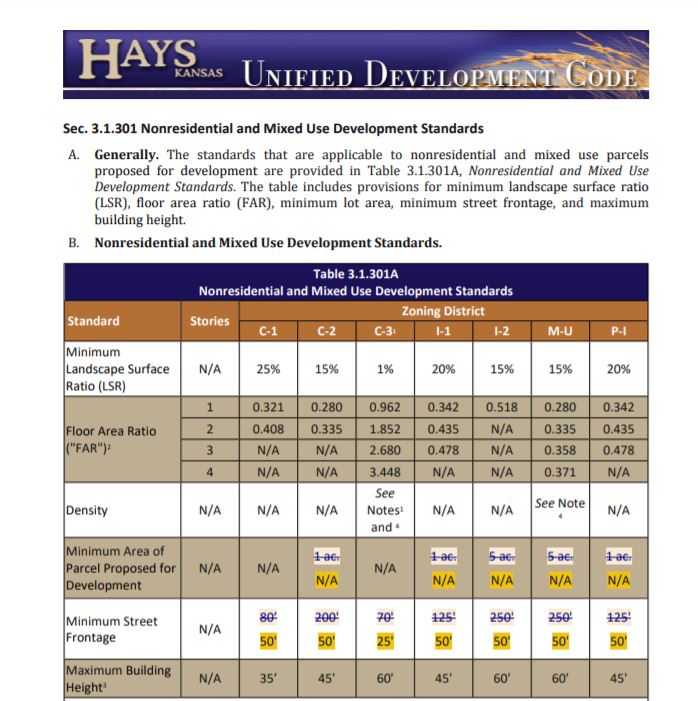
Agenda items for Aug. 19 include discussion of proposed changes to the Unified Development Code regarding a reduction in development density requirements and changes in parking requirements.
City staff is considering some changes to the UDC that would remove specific requirements for development density.
Minimum landscaping area, floor area, lot area, street frontage, and maximum building height are all regulated within the UDC and can directly impact density.
According to a commission memo, staff has found that the UDC has various requirements that can be too restrictive and create the need for unnecessary larger property lots. Making changes to the regulations would provide developers more options for more dense developments.
Staff recommends setting a public hearing for Mon., Sept. 16, 2019 to consider changes to UDC Table 3.1.301A, Development Standards, and Sec. 2.2.306 (C) (9), Hotel/Motel Compatibility Standards.
Staff has also considered a change that would add flexibility to parking requirements for small business owners.
Allowing a limited amount of on-street parking to be counted towards the total parking required could help reduce costs for some developments.
A second public hearing is being recommended for Sept. 16 to consider adding proposed language to the UDC allowing limited on-street parking to be counted towards total parking requirements.
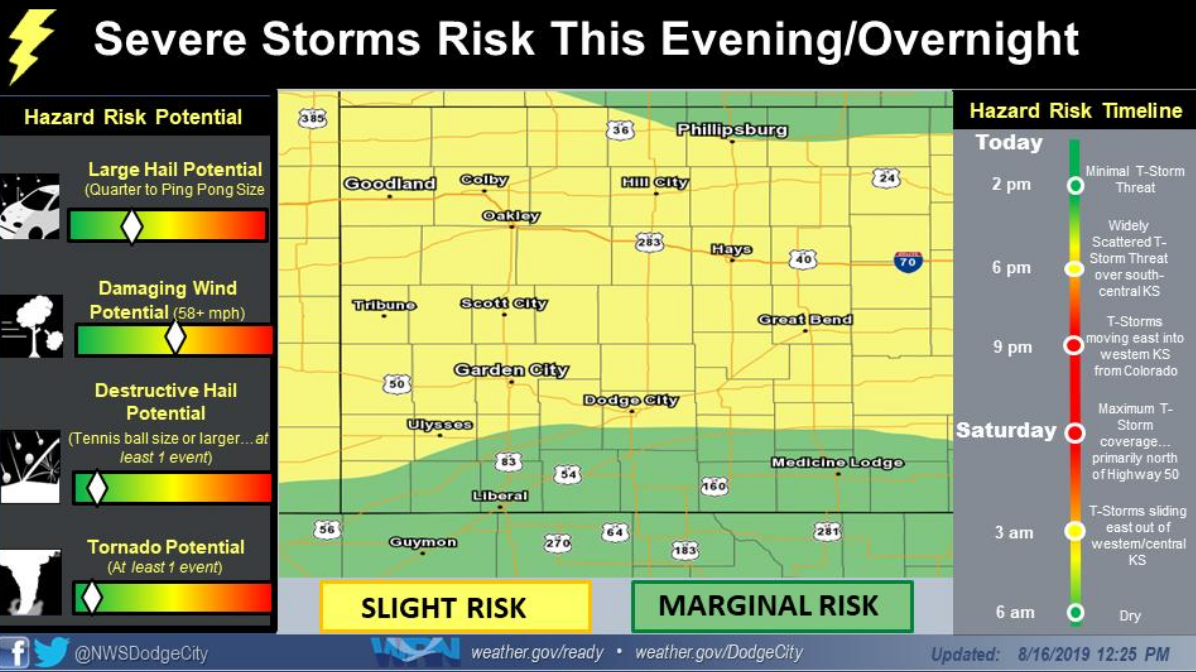
The National Weather Service in Dodge City has issued a hazardous weather outlook for the remainder of Friday and overnight Saturday.
Forecasters are predicting isolated strong to severe thunderstorms possible after 4 p.m. south and east of Dodge City. The storms could bring quarter-size hail, wind gusts of up to 60 mph and heavy rainfall.
After 7 p.m., the chance for additional storms return, this time north of a line from Garden City to Rush Center. Wind up to 60 mph, heavy rain and large hail also could accompany these storms.
The chance of rain Friday night and overnight in Hays is about 70 percent. Skies are expected to begin to clear after 7 a.m. Saturday.
LIBERAL — Liberal/Seward County Development Corporation has announced the hiring of Eli Svaty as the Executive Director of Economic Development. Eli brings an energy and enthusiasm to the position that supports the overall goals of the organization and the area.
Svaty grew up on a farm south of Ellsworth, Kansas. He graduated from Sterling College in 2006 with a degree in language and literature. He moved to Liberal in August of that year when he began his career as a teacher with USD 480 and Liberal High School. For the past 13 years, he has worked for the district teaching English and coaching basketball, golf, and scholars bowl. During that time, he also earned a Master’s Degree from Fort Hays State University.
While in Liberal, Eli met his wife Marilyn, a graduate of Liberal High School. They have four children — Caleb, Cairo, Zoe and Atticus — who range in age from 11 to 1. Marilyn spends most of her time with the children and also works part time for the Liberal Area Coalition for Families.
While the transition from classroom to economic development might not be a typical one, Svaty sees a number of parallels between the positions. First, much of what education demands is salesmanship. Students are often reluctant to write papers or read novels, and it is up to the teacher to convince them that this investment of time and energy is worthwhile. The same will be needed to bring new businesses and industries here. Second, as a coach, Mr. Svaty was exposed to the perspectives of the rest of the state and their views of our region. Seward County has great opportunities and great resources, and living here has helped him understand that and given him the desire to correct the misconceptions around the state.
This position also requires significant communication with Topeka and the work being done there. Svaty has existing connections with the Department of Commerce, and his brother served as Secretary of Agriculture for Governor Parkinson and continues to work for Gencur-Svaty Public Affairs in Topeka. Eli is also a certified grant writer and has written grant proposals for nonprofit organizations in the area.
THOMAS COUNTY — One person was injured in an accident just before 10:30 a.m. Friday in Thomas County.
The Kansas Highway Patrol reported a 2010 Chevy Camaro driven by Raymond Paul Crump, 61, West Palm Beach, Fla., was westbound on Interstate 70 just west of County Road K.
The Camaro left the roadway, struck the guardrail on the north side of the interstate, continued into the northbound ditch striking a KDOT fence and came to rest in a pasture.
EMS transported Crump to the hospital in Colby. He was properly restrained at the time of the accident, according to the KHP.
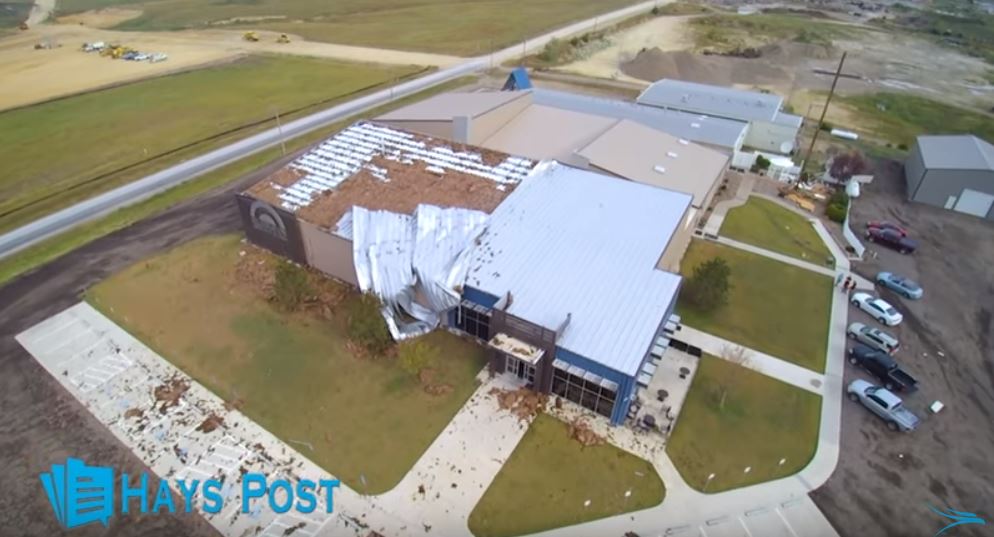
Aug. 13 storm damage at Hays Celebration Community Church
By BECKY KISER Hays Post
Longtime Hays resident Sandy Jacobs, who is a city commissioner, calls Tuesday night’s severe weather the “worst storm” she’s ever witnessed in her many years living in Hays.
“I’ve got videos and go back and look at it and it still scares me,” she said during Thursday night’s commission work session.
Jacobs offered a public “thank you” to first responders and city employees for their quick and thorough response to the flooding and other damage.
She also recognized the residents of Hays.
“I’d really like to thank neighbors helping neighbors. There was so much of that going on. I saw it in my neighborhood. I saw it in every neighborhood,” Jacobs pointed out. “They were bringing in equipment to help each other.
“That’s what makes this community great and makes me really proud to be a citizen.”
Toby Dougherty, city manager, clarified what the process will be.
“We stated in our press release to put the limbs curbside, and we won’t go on private property. … what we mean by not going onto property is if a tree is leaning on somebody’s house or it’s crushing a fence or a shed, we’re not going onto the property.
“Don’t block the sidewalk. Have it as close as possible to the sidewalk as possible on the edge of your property,” Dougherty directed.
“The county has agreed to accept them (tree limbs) for free so we want to thank the Ellis County Commission for extending that to us,” Schwaller added.
At the end of the meeting, Schwaller called for a 30-minute executive session which included the city manager, City Attorney John Bird and Assistant City Attorney Todd Powell to discuss matters of attorney/client privilege.
No action was taken following the executive session.
Hays Police Chief with Dave Anderson, HPMHC director of clinical services
Hays Police Department
The Hays Police Department announced this week it has completed the pledge taken to improve response to those suffering from mental illness in our community. The pledge is part of an initiative called the One Mind Campaign started by the International Association of Chiefs of Police.
The Hays Police Department is the second agency in Kansas to successfully complete the One Mind Campaign.
To join the One Mind Campaign, law enforcement agencies must pledge to implement four promising practices in a 12-36 month period to ensure successful future interactions between police officers and persons with mental illness.
In the law enforcement community, mental illness has become a common focus, with some departments estimating that as many as 20% of their calls for service are mental health-related. Chief Don Scheibler made the decision to join the International Association of Chiefs of Police’s One Mind Campaign because law enforcement has become the default responders to our nation’s current mental health crisis, and we wanted to prepare our officers to better serve those in our community who suffer from mental illness or who are in crisis.
In completing the One Mind Pledge, the Hays Police Department (1) developed and implemented model policies to address officers’ interactions with those affected by mental illness; (2) ensured that all of our officers and civilian staff received mental health first aid awareness training; (3) had at least twenty percent of the department complete the more intensive Crisis Intervention Team (CIT) training; and (4) established a sustainable partnership with High Plains Mental Health (HPMH).
High Plains Mental Health has been a long-term partner with the Hays Police Department, and they were instrumental in helping us to successfully complete the One Mind Campaign.
Other initiatives that the Hays Police Department has pursued in response to the needs of the community include developing a verbal de-escalation training program, assigning two Crisis Negotiators to the Special Situation Response Team, starting a Peer Support Team, providing officers with suicide awareness training, and assisting with the formation of the Ellis County Crisis Intervention Team Council made up of Ellis County law enforcement, mental health care providers and community-based stakeholders.
The greatest benefit in adopting all the strategies of the One Mind Campaign pledge has been providing our officers with the tools necessary to best serve the mental health consumers in our community, especially those in crisis, and making those interactions safer for both the officers and the consumers.
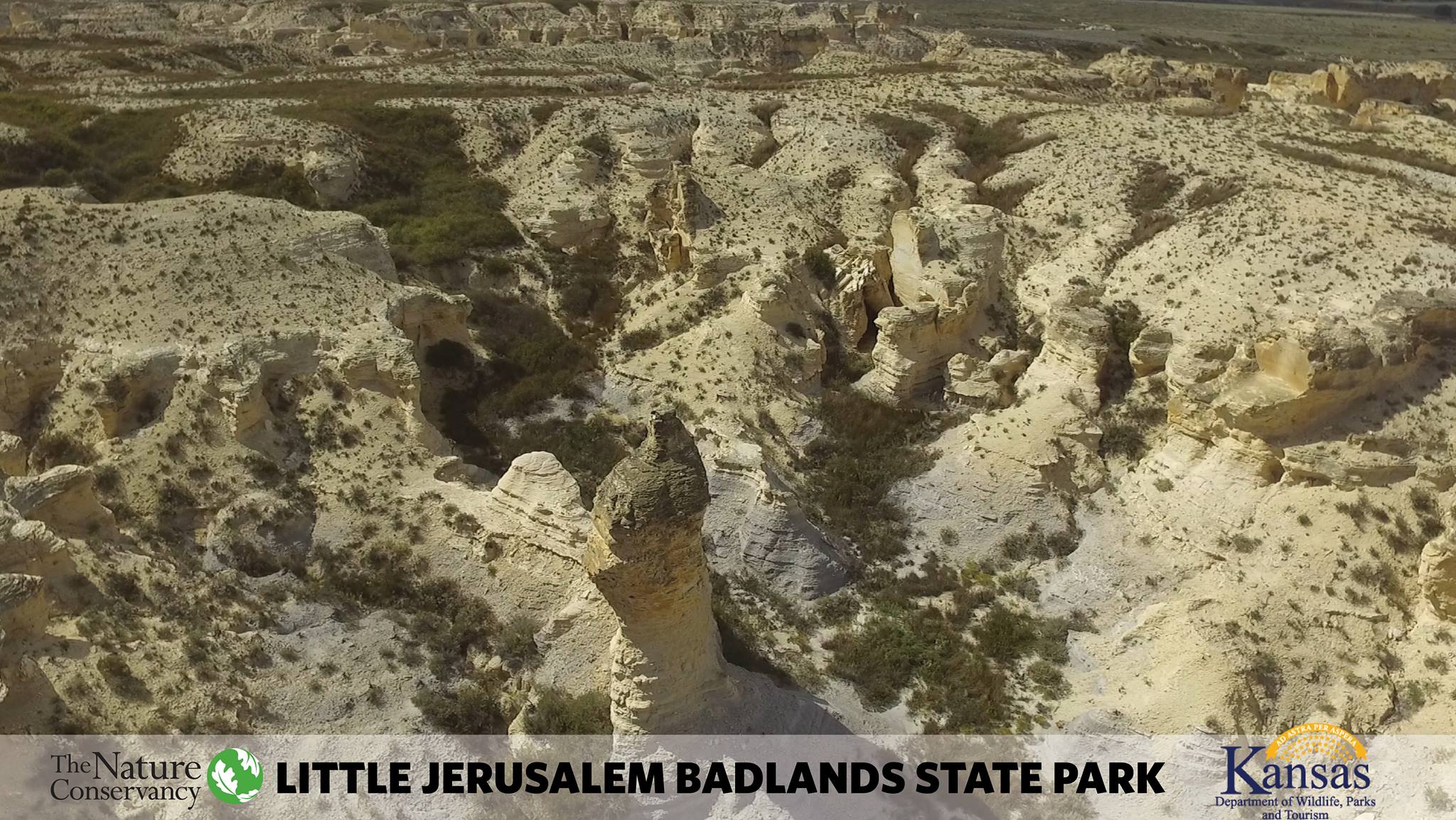
The $50 backcountry pass to the Little Jerusalem Badlands State Park in Logan County has been unanimously rescinded by the Kansas Department of Wildlife Parks and Tourism commission, according to a social media post by The Nature Conservancy in Kansas.
A standard $5 vehicle pass (or the annual pass) required at all Kansas state parks will be the only fee.
TOPEKA – Kansas Department for Children and Families Secretary Laura Howard today terminated the agreement with Hysell & Wagner, LLC, which administers the Kansas Reading Roadmap (KRR) program. In addition, Howard also announced the agency will directly fund schools that made plans to offer the KRR program during the 2019-20 school year at the same level Hysell & Wagner was contractually obligated under the terminated grant.
“The Department for Children and Families is committed to ensuring that recipients of federal and state funds are spending those funds efficiently,” Howard said. “After reviewing the results of a DCF audit and despite heightened oversight during the first six months of 2019, it’s clear that Hysell & Wagner is falling short of this basic standard.”
The audit, initiated during the Brownback administration but never finalized or released, uncovered problems with internal controls required to achieve compliance with grant terms and conditions and applicable state regulations. All totaled, DCF auditors determined nearly $2.3 million were incorrectly claimed and paid to Hysell & Wagner during the time period from February 2014 to December 2015.
Since January, DCF Economic and Employment Services leadership uncovered additional concerns with Hysell & Wagner’s FY 2019 Kansas Reading Roadmap grant, including:
– TANF funds, categorized as indirect costs, used for excessive payments to company executives surpassing federal salary limits
– $216,000 was paid to owners as direct expenses and more than $607,000 has been charged to the grant in “guaranteed payments” as indirect expenses which would also go to the owners
– TANF funds, categorized as indirect costs, were used for 38 trips between Kansas and the CEO’s and CFO’s residences in Washington, DC, and San Diego, CA
– Administrative expenses charged to the Kansas Reading Roadmap grant exceeded federal and grant-specific limits of 15% of grant costs.
DCF has, in good faith, worked with Hysell & Wagner to educate and correct the identified issues. Despite these efforts, Hysell & Wagner continues to struggle with the heightened monitoring requirements and has rejected revisions in their FY 2020 contract addressing indirect costs.
“I’ve always been concerned about the use of no-bid contracts and lack of accountability under the previous administration,” Governor Laura Kelly said. “It’s clear that the State of Kansas cannot continue to support Hysell & Wagner’s administration of the Kansas Reading Roadmap program.
I am pleased that the Department for Children and Families is providing direct funding to schools for the coming year to ensure they receive the funds they’re counting on.”
Hysell & Wagner has until September 15 to complete their work with the program including providing notice of termination to sub-recipients of the award. DCF issued the draft audit to Hysell & Wagner August 15. The company has up to 30 days to respond. Once the agency receives their response the audit report will be finalized and made public.
See below for a complete list of schools which will receive funding directly from DCF for the 2019-20 school year.
TOPEKA – The Kansas Department of Health and Environment (KDHE), in conjunction with the Kansas Department of Wildlife, Parks and Tourism (KDWPT), has issued public health advisories for Kansas lakes.
Warnings:
Big Eleven Lake, Wyandotte County (unchanged)
Camp Hawk Lake, Harvey County (unchanged)
Gathering Pond near Milford (Hatchery Supply Pond), Geary County (unchanged)
Jerry Ivey Pond, Saline County (unchanged)
Lake Afton, Sedgwick County (unchanged)
Lakewood Park Lake, Saline County (unchanged)
Lebo Kids’ Pond, Coffee County (unchanged))
Marais des Cygnes Wildlife Area (unchanged)
Marion County Lake, Marion County (unchanged)
Melvern Outlet Pond, Osage County (unchanged))
Melvern Swim Pond, Osage County (unchanged))
Neosho State Fishing Lake, Neosho (unchanged)
South Lake, Johnson County (unchanged)
Westlake in Gage Park, Shawnee County (unchanged)
When a warning is issued, KDHE recommends the following precautions be taken:
Lake water is not safe to drink for pets or livestock.
Lake water, regardless of blue-green algae status, should never be consumed by humans.
Water contact should be avoided.
Fish may be eaten if they are rinsed with clean water and only the fillet portion is consumed, while all other parts are discarded.
Do not allow pets to eat dried algae.
If lake water contacts skin, wash with clean water as soon as possible.
Avoid areas of visible algae accumulation.
Watches:
Carousel Lake (Gage Park), Shawnee County (unchanged)
Hiawatha City Lake, Brown County (unchanged)
Hodgeman County State Fishing Lake, Hodgeman County (unchanged)
Lake Shawnee, Shawnee County (unchanged)
Lovewell Reservoir, Jewell County (unchanged)
Rock Garden Pond (Gage Park), Shawnee County (unchanged)
Meadowbrook Park Lake, Johnson County (new)
The following watches have been lifted effective August 15:
Keith Sebelius Reservoir, Norton County
Marion Reservoir, Marion County
A watch means that blue-green algae have been detected and a harmful algal bloom is present or likely to develop. People are encouraged to avoid areas of algae accumulation and keep pets and livestock away from the water.
During the watch status, KDHE recommends the following precautions be taken:
Signage will be posted at all public access locations
Water may be unsafe for humans/animals
Avoid areas of algae accumulation and do not let people/pets eat dried algae or drink contaminated water.
Swimming, wading, skiing, and jet skiing are discouraged near visible blooms
Boating and fishing are safe. However, inhalation of the spray may affect some individuals. Avoid direct contact with water, and wash with clean water after any contact.
Clean fish well with potable water and eat fillet portion only.
KDHE samples publicly-accessible bodies of water for blue-green algae when the agency receives reports of potential algae blooms in Kansas lakes. Based on sampling results, KDHE reports on potentially harmful conditions.
Kansans should be aware that blooms are unpredictable. They can develop rapidly and may float around the lake, requiring visitors to exercise their best judgment. If there is scum, a paint-like surface or the water is bright green, avoid contact and keep pets away. These are indications that a harmful bloom may be present. Pet owners should be aware that animals that swim in or drink water affected by a harmful algal bloom or eat dried algae along the shore may become seriously ill or die.
The Dane G. Hansen Foundation announces a new quarterly magazine to debut this month.
Northwest Kansas Today will be published by the Foundation and distributed to all residents of its 26-county service area. The magazine will feature area businesses, arts, lifestyle, communities and people.
The mission of the Foundation is to provide opportunities for the people of Northwest Kansas to enjoy the highest possible quality of life. In addition to the grants and strategic initiatives the Foundation provides, the Hansen Trustees believe that the publication, highlighting the many positive attributes of the region, will contribute to the sense of pride for our communities. It also can be used by residents and businesses to recruit new people to Northwest Kansas. Readers are encouraged to share their copy with friends and family who do not live in the area. A digital version will also be available on the Foundation’s website at www.danehansenfoundation.org.
Northwest Kansas Today, which is designed to share stories for and about this area’s people and communities, will be distributed at no cost to all verified post office addresses in the Foundation’s service area. In order to efficiently provide the magazine to all residents, the Foundation is not able to remove an address from the mailing list. Anyone receiving the magazine who does not wish to read it is encouraged to share it with someone who might. Because the mailing goes through several post offices, the magazine will not hit every mailbox on the same date, but residents should look for it to arrive in late August or early September.
Story ideas or other feedback can be sent to the Foundation at: [email protected].
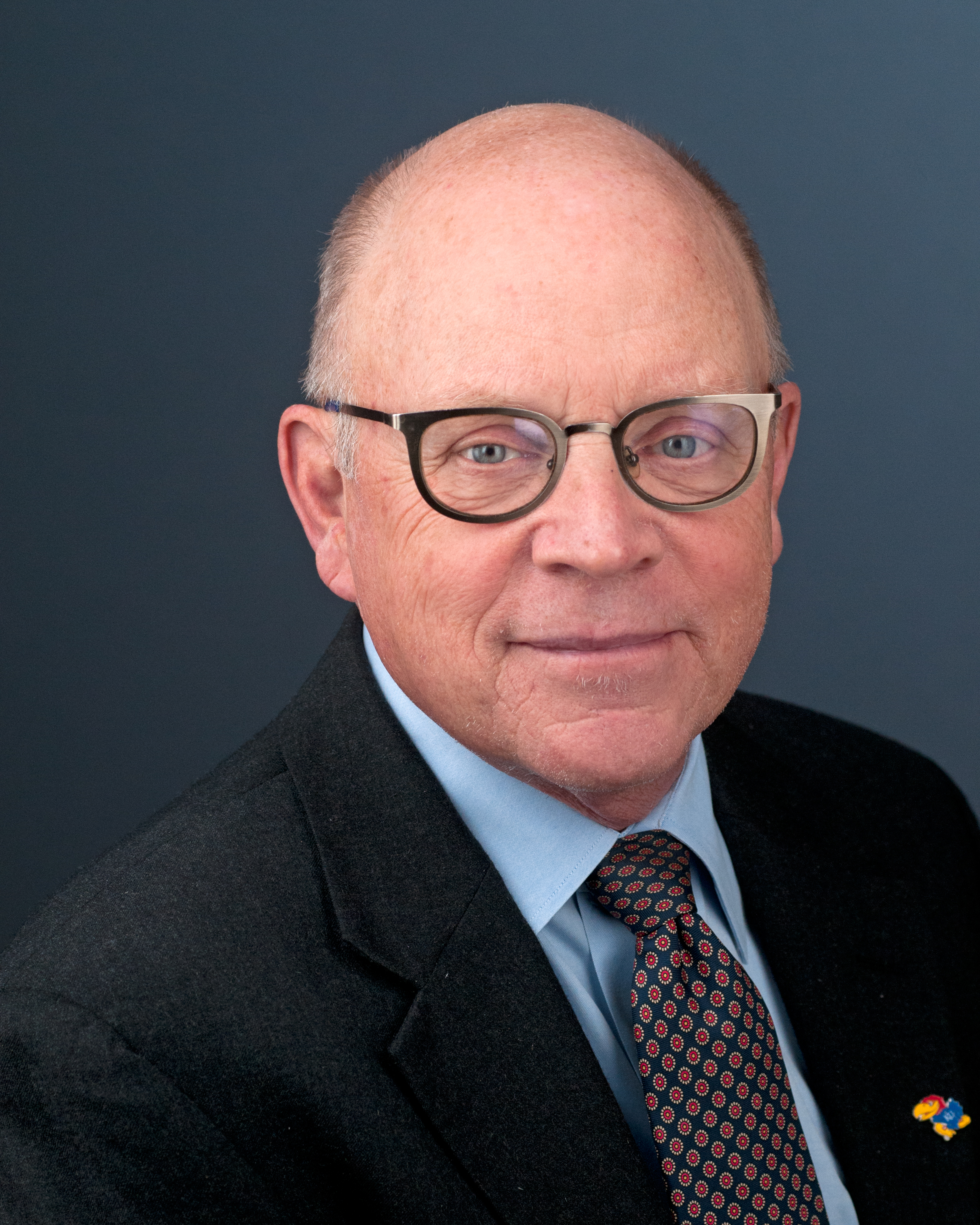
Burdett Loomis, Professor, Political Science, College of Liberal Arts and Science, University of Kansas
Former Speaker of the U.S. House Tip O’Neill famously said, “All politics is local.” He was referring specifically to congressional races, where responding to local issues from a national perspective – farm subsidy payments, Social Security checks, small business loans, etc. – was crucial to winning re-election. O’Neill’s aphorism still applies, but only to an extent, as House districts trend more blue or red over time.
Indeed, today most politics is national, not local; we can decry partisanship and polarization, but they are facts of contemporary political life. Sometimes, however, the price of partisanship is simply too high. This is one of those times.
Republicans in the U.S. House and Senate, as well as those in the Kansas Legislature, must come to terms with their unblinking support for President Donald Trump, whose excesses place him outside the mainstream of American politics. To be sure, he retains a 42 or 43 percent job approval rating and a hard core of supporters, but many of them question his fitness, capabilities, and policy preferences. For example, across several polls, more than 40 percent of Republicans think that immigrants strengthen the country.
If Republican legislators simply address their own partisan constituents’ preferences, it’s reasonable that they continue to back President Trump. But that type of representation – the all-politics-is-local kind implies that legislators are simply delegates who do what their voters wish reflects only one way to view representation. An equally significant perspective views legislators as “trustees,” who, once elected, use their own best judgment as they approach political issues.
In reality, lawmakers are both delegates and trustees, but this latter role needs to be taken seriously, especially with Trump. In short, Kansas’s national legislators, along with their state counterparts, must address contentions that Donald Trump is unfit for the position he holds and subsequently voice their concerns, even if on balance they support him.
At the national level, only Sen. Jerry Moran has expressed – sporadically – any serious concerns over Trump’s pronouncements and policies. Immigrant children separated from their parents? Nothing. Allowing Putin to interfere with our elections? Nada. Posting a grossly insensitive photo with a grin and a “thumbs up,” while Melania holds the orphaned child of two parents who died protecting him? Zip.
The list goes on, even when Kansas farmers are the target of unthinking tariff policies. Rep. Roger Marshall from the Big First congressional district reported an April conversation with the president as to the farm economy. He expressed his concerns, and the president responded. “Thanks to the farmers who are being patriots for getting us through this.” Subsequently, the impact on Kansas famers has only worsened but with little acknowledgment and no actions from Marshall or fellow representatives Estes and Watkins.
Even Pat Roberts, the chair of the Senate Agriculture Committee, while complaining about the impact of tariffs, has done virtually nothing within the Republican-controlled Senate.
With Trump’s net approval rating currently standing at +5 percent in Kansas, legislators-as-delegates could argue that they are reflecting their constituents’ wishes. Still, representation is far more than that. Legislators must use their intelligence, experience, and proximity to power in assessing the overall fitness of a president to govern. And they have been silent, as the president cozies up to dictators and mass murderers, continually labels immigration an “invasion” and cannot provide even the appearance of empathy to a nation distraught over mass shootings.
Legislators, speak out.
Burdett Loomis is an emeritus professor of political science at the University of Kansas.