LAWRENCE, Kan. (AP) — A 21-year-old University of Kansas student who won $10,000 in a half-court shot game has plans for the money: she’ll give it to her grandmother who rescued her from foster care when she was 10.
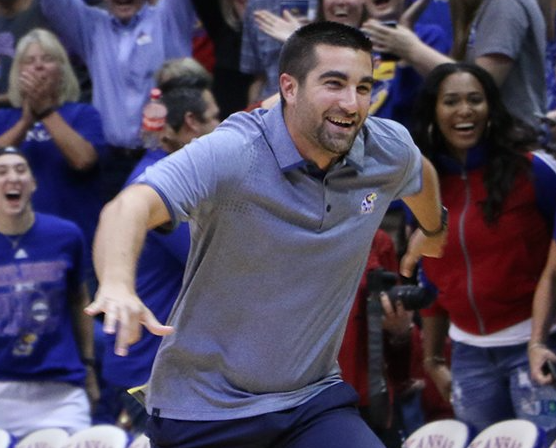
Jordan Stiers, a sophomore from Independence, Missouri, won the money Saturday when Brennan Bechard, director of Kansas basketball operations, made the half-court shot during Late Night in the Phog in Lawrence.
The Wichita Eagle reports that Stiers is the first one in her family to graduate high school and also to attend college. She says her grandmother took her in and also volunteered to raise four of Stiers’ siblings in her Independence home.
Stiers said the money will help her grandmother pay bills.
HUTCHINSON – Two Kansas women arrested on September 18, for drug distribution were in Reno County court Friday for the formal reading of charges.
Roberta Arell, 47, and Sunny Chew, 31, both of Wichita, are charged with possession of methamphetamine and drug paraphernalia with intent to distribute, personal use drug paraphernalia, two counts of aggravated endangerment of a child while allegedly selling drugs and illegal transportation of alcohol.
Arell was also charged with criminal possession of a firearm because of a previous conviction for possession of marijuana. She allegedly had a handgun when she was arrested.
The two were allegedly in possession of between 3.5 and 100 grams of methamphetamine and had two children in the car, a 2-year-old and a 6-year-old.
Both women are free on bond and their cases will now move to a waiver-status docket.
Arell has previous drug convictions in 2011 and 2013 in Reno County
Applying for recognition from the National Cancer Institute is no small task, so the University of Kansas Cancer Center created a wall chart to track progress on the 16 chapters. Cancer Center Director Dr. Roy Jensen relied on staffers Lisa Harlan-Williams (left) and Teresa Christenson to help edit, write, and coordinate the application. They placed a gold star on the chart upon completion of each chapter. CREDIT JOHN MCGRATH / FLATLAND
By MIKE SHERRY
Four years ago, former Kansas Gov. Kathleen Sebelius returned home as U.S. Secretary of Health and Human Services with a prize the University of Kansas Cancer Center had been seeking for years: certification as a nationally recognized center through the National Cancer Institute (NCI).
But amid the hoopla, KU Cancer Center Director Dr. Roy Jensen declared the NCI designation was “merely a water break and a rest stop” on the way toward earning higher-echelon status from the institute as a “comprehensive” cancer center.
Now it’s time for the nail-biting to begin again, as the cancer center last week electronically submitted its roughly 1,600-page application for that higher-level designation. NCI is expected to decide whether to grant it by summer 2017.
If the cancer center does earn comprehensive status, it would become just the 48th institution in the country to achieve the designation, joining the likes of the University of Texas MD Anderson Cancer Center and Yale Cancer Center.
To a large extent, the regional impact of NCI designation comes through the improvements in patient care, research and prevention that have accompanied the hefty investment needed for the KU Cancer Center to even submit a credible application.
Dr. Roy Jensen, director of the University of Kansas Cancer Center, started this countdown clock four years ago and keyed it to Sept. 26, 2016, the due date for its application to the National Cancer Institute. The cancer center submitted its application this morning, with room to spare on the midnight deadline. CREDIT JOHN MCGRATH / FLATLAND
The money has come from both public and private sources.
For instance, the cancer center secured nearly $30 million from the Kansas Bioscience Authority to upgrade research facilities in the Wahl/Hixon complex on the KU Medical Center campus in Kansas City, Kansas.
State-of-the-art facilities like these are used by the cancer center to recruit and retain top-notch physician scientists like Dr. Raymond Perez, who came from Dartmouth Medical School to head the cancer clinical trials program.
The goal is to reduce the prevalence and mortality of cancer in Kansas and western Missouri, which see about 22,000 newly diagnosed cases and about a third that many deaths from cancer annually.
“We need an organization that gets up in the morning, and it’s the first thing they think about and it’s the last thing they think about when they go to bed,” Jensen said in a recent interview. “And I can guarantee you that is the KU Cancer Center.”
Cancer center officials are hoping that three different initiatives — including one involving a repurposed jock-itch medicine — will help convince NCI that the center is worthy of the higher-level designation. They say their efforts are wider, deeper and larger than they were in the first application.
Obesity
Americans have been told for years that they are too fat and that obesity can lead to all sorts of health problems, including diabetes and an increased risk of stroke.
Cancer, too.
In fact, Jensen says, obesity is projected to overtake tobacco as the leading cause of cancer in the U.S. within the next decade or so.
While the smoking rate among American adults has dipped to below 17 percent, obesity is on the rise. More than a third, 36.5 percent, of U.S. adults are obese, according to the U.S. Centers for Disease Control and Prevention.
Janis Wearing (right) weighs in at Salina Family Healthcare Center as part of a weight-management study led by the University of Kansas Medical Center. Working with Wearing is Shari Sutton, a nurse at the health center. CREDIT BRYAN THOMPSON / HEARTLAND HEALTH MONITOR
The rate is even worse outside metropolitan areas, which is bad news for heavily rural states like Kansas and Missouri.
Obesity is associated with a higher risk for several types of cancers, according to NCI, including cancers of the esophagus, pancreas and breast.
Fat tissue produces excess estrogen, high levels of which have been associated with the risk of breast, endometrial and some other cancers. Obese individuals also often have chronic low-level inflammation, which has been associated with increased cancer risk.
Public health messages about the dangers of obesity have yet to penetrate as much as warnings about the link between smoking and cancer, says Christie Befort, co-leader of cancer control and population health at the KU Cancer Center and principal investigator on a KU Med Center weight-management study.
Weight is also a sensitive issue for doctors.
“Few patients even get told they are obese,” Befort says. “People don’t like that word or that they need to lose weight. It doesn’t even come up in conversation as much as it should, and that is complicated in small towns, where you know your patient personally.”
That’s where Befort’s weight-management study comes in. It’s called RE-POWER, which is short for Rural Engagement in Primary Care for Optimizing Weight Reduction. The five-year, $10 million study includes three dozen rural primary care clinics in Kansas, Nebraska, Iowa and Wisconsin.
Outside of its potential clinical benefits, KU Cancer Center officials hope NCI reviewers are impressed that competitive funding for the study came through the congressionally authorized Patient-Centered Outcomes Research Institute (PCORI).
The study is testing which of three treatment models works best in helping overweight patients slim down: office visits with an individual provider; group counseling via conference call with a KU Med weight-management specialist; or group sessions coordinated by a staffer at a clinic and via conference call.
Salina Family Healthcare Center, one of the Kansas clinics, is a RE-POWER site. It started its two years of work in March, according to Dr. Bob Kraft, a staff physician.
Group members receive counseling on proper nutrition and are given an exercise goal of 45 minutes of walking at least five times a week. A loss of even 5 percent of the patient’s baseline weight can improve their health, Kraft says.
His hope is that RE-POWER will encourage discussions about weight in the exam room.
“Part of the difficulty physicians have in talking about being overweight is the lack of services to help patients,” Kraft says. “It is hard to talk about things we can’t do something about, so hopefully programs like this will help us develop services that we can then refer patients to.”
Survivorship clinic
Childhood cancer is not the killer it once was; the five-year survival rate for pediatric cancer now stands at more than 80 percent. NCI says there are 15.5 million cancer survivors in the United States, hundreds of thousands of whom were first diagnosed when they were younger than 21.
But the life-saving treatments can cause medical issues years, or even decades, later.
Radiation for a brain tumor, for instance, might affect the growth and fertility functions of the pituitary gland. Some chemotherapy patients face an increased risk of heart problems.
It can be challenging for these late-term-effect patients to find primary care physicians who are knowledgeable about treating cancer survivors.
For younger patients, the struggle comes as they get too old to see their pediatrician. For older patients, they might be geographically removed from the medical providers they saw in their hometown.
Enter the Survivorship Transition Clinic, which opened two years ago in the medical office building on the University of Kansas Medical Center campus. It’s a companion program to the pediatric Survive & Thrive program at Children’s Mercy Hospital in Kansas City.
Its relevance to the quest for comprehensive designation comes through its origins as a project of the Midwest Cancer Alliance, the “outreach division” of the KU Cancer Center. With 21 members throughout the region, it extends the cancer center’s capacity to treat patients throughout its primary service area of Kansas and western Missouri.
The clinic has tripled — to more than 100 — the number of patients it serves since it opened its doors, says Dr. Becky Lowry, medical director of the clinic.
“We have had a number of patients who show up in their 40s and 50s and who were treated in their childhood, and had a number of health conditions that had either not been diagnosed or had been dismissed, that turned out to be related to their treatment,” Lowry says.
That was not the case with Morgan Goodman, a 23-year-old new mom residing in Gladstone, Missouri.
Born and raised in Topeka, Goodman was treated at Children’s Mercy after she was diagnosed with non-Hodgkin’s lymphoma as a high school freshman.
Seeing familiar faces from Children’s Mercy in the transition clinic made for a warm handoff into adult care, she says. Lowry is her primary care physician.
Goodman has a lot going on. She’s caring for 4-month-old Harper and studying for her nursing boards. So she doesn’t dwell on the health problems she might face as a result of her chemotherapy.
“I can’t worry about that,” she says. “There are so many other things to worry about in life. If it’s going to happen, it’s going to happen. That’s kind of what my treatment taught me.”
Bladder Cancer
The clinical name is tinea cruris, and it’s a fungal infection that crops up in warm, moist areas of the body, making uncomfortable places you don’t want to be scratching in polite company.
Outside the medical field, it’s known as jock itch. And the ring-shaped rash figures prominently in the NCI application because of KU Cancer Center’s role in leading the development of a new drug, which it has patented and hopes to begin testing in clinical trials early next year.
Work on the drug came through the Institute for Advancing Medical Innovation (IAMI), which is the product development arm of the cancer center.
IAMI has a long-standing relationship with the Leukemia & Lymphoma Society, which is how the institute got involved with Canadian research showing that ciclopirox, the active ingredient in a common jock-itch cream, effectively combated a certain type of leukemia.
The leap to bladder cancer occurred in 2010-11, prompted by the early results of a clinical trial. Researchers found that upping the dosage of the orally administered drug to potentially effective levels irritated the digestive systems of patients with acute myloid leukemia.
But IAMI Director Scott Weir was loath to quit on a compound that had killed leukemia cells in the lab merely because it couldn’t be given orally.
So the real coup for IAMI and the cancer center came as they drew on an established practice that chemically cloaks the key parts of the drug molecule when it is injected into the body. Then, naturally occurring enzymes in the blood cleave off the protective coat, leaving the active ingredient.
This delivery mechanism avoids the irritation of the digestive system caused when the drug is taken orally. It also offers the hope of a new therapy that will avoid the excruciating sloughing off of the urinary tract lining that can happen with the established treatment for non-muscle-invasive bladder cancer, which has remained largely unchanged for 50 years.
Bladder cancer is one the most common cancers among men and women. A 2009 study published in the World Journal of Urology pegged it as the most expensive cancer to treat (costing more than $200,000 per patient in some countries) because it has the highest recurrence rate among all cancers, thus requiring ongoing monitoring.
IAMI scientists also made a breakthrough by separating out a salt from ciclopirox to make it more soluble.
Weir’s epiphany about the drug’s potential for bladder cancer came during his afternoon commute one day in 2012.
“Our bodies consider drugs foreign things, so our bodies have ways of either preventing them from getting into the bloodstream or, once they are in our bodies, getting rid of them,” Weir says. “And our bodies are really, really good at getting rid of ciclopirox. So I am driving and going, ‘The entire dose that gets into the body is out in the urine in 12 hours.’ So it hit me: What about bladder cancer?”
Weir says this is exactly the kind of breakthrough that NCI is looking for in evaluating centers seeking comprehensive designation. In their approval of the cancer center’s first application, the reviewers called it an area offering real potential.
Ultimately, however, Weir says the real satisfaction will come if and when the drug proves to be a safe, effective treatment for bladder cancer.
Surveying the totality of the cancer center’s initiatives, Jensen, the cancer center director, says his operation is now positioned to make a strong case to NCI for the upper-level designation. Other efforts include smoking cessation, working to close the health gap between rich and poor, and vaccinating teenagers against the human papillomavirus (HPV).
“What we are going to be able to demonstrate in the (application) is that we have moved forward across a pretty broad front of cancer control and prevention,” he says. So it’s tobacco, it’s HPV, it’s obesity, it’s health disparities. I think we have a really good story to tell.”
Mike Sherry is a reporter for KCPT television in Kansas City, Mo., a partner in the Heartland Health Monitor team.
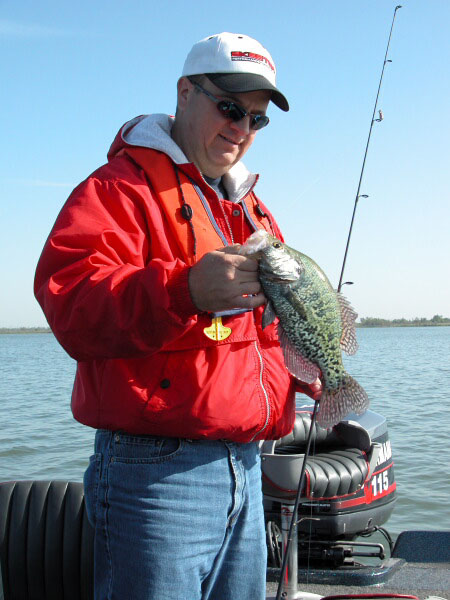
TOPEKA–In addition to voting for their chosen candidates and other important matters in the November 8, 2016 general election, voters will decide whether to amend the Kansas Constitution’s Bill of Rights to add a constitutional right to hunt, fish and trap wildlife.
The proposed amendment would specify the people have a right to hunt, fish and trap by traditional methods, subject to reasonable laws and regulations that promote wildlife conservation and management and that preserve the future of hunting, fishing and trapping. The amendment would also specify that hunting and fishing are the preferred means for managing and controlling wildlife, and that the amendment shall not be construed to modify any provision of law relating to trespass, eminent domain or other private property rights.
The amendment would be created if approved by a majority of Kansas voters. A “Yes” vote will be a vote in favor of adding the amendment to the constitution, and a “No” vote will be a vote against adding the amendment. If the amendment passes, current laws and regulations governing hunting, fishing and trapping of wildlife would still apply, as the proposed right is subject to reasonable laws and regulations. If the amendment fails, there would be no changes to current laws and regulations.
The proposed amendment was introduced into the 2015 Legislative Session as House Concurrent Resolution (HCR) 5008 by Representative Couture-Lovelady and Representative Lusker, but no action was taken. It was carried over to the 2016 session where it passed both chambers by large margins. The Kansas Department of Wildlife, Parks and Tourism (KDWPT) testified in support of the resolution.
According to the website Ballotpedia.org, 19 states currently have similar constitutional provisions for the right to hunt and fish. Two others have constitutional provisions guaranteeing the right to fish, and two have statutes providing for the right to hunt and fish. Vermont established its right to hunt and fish in 1777, but most of the other states have created their rights since 2000.
Hunters and anglers provide all of the support for the state’s wildlife and fisheries management programs. These programs are entirely funded by license/permit fees and a federal match from the excise tax paid by hunters and anglers on equipment they buy (these revenues can only be used to fund wildlife and fisheries programs; they cannot be used for state park maintenance). The state’s share of the federal excise tax can only be returned to Kansas if someone buys a license or permit. KDWPT does not receive any state general funds for any of its programs.
For more information about the Kansas Department of Wildlife, Parks and Tourism, visit KSOutdoors.com or TravelKS.com.
LAWRENCE, Kan. (AP) — A new report shows that the number of rapes reported at the University of Kansas went down from 2014 to 2015.
The university’s latest Clery report shows there were 13 reported rapes at the university in 2015, down from 19 reported in 2014.
The new report, which was released Friday, also shows that of the 13 rapes reported at the university in 2015, five occurred in campus housing and five occurred elsewhere on campus. One occurred at a “non-campus” location, and two occurred on public property.
The Lawrence Journal-World reports that fondling reports also went down, from 14 in 2014 to four in 2015.
The federal Clery Act requires postsecondary institutions to track and annually report crime reported on their campuses.
Perry Lee Isley, 58, is among offenders who spent time at the State Hospital in Larned-photo Kan. Dpt. of Corrections
JOHN HANNA, Associated Press
TOPEKA, Kan. (AP) — Kansas is overhauling a program that confines sex offenders indefinitely for post-prison mental health treatment.
The changes to be rolled out this month follow a federal lawsuit, a critical legislative audit and legal challenges to similar programs in other states.
Officials at the Larned State Hospital program said treatment will become more structured, personalized and focused on changing behavior that could cause patients to commit new crimes. They also said patients will be allowed a greater number of short, supervised community visits.
Advocates for the 264 men committed by state courts to the program said they’re encouraged by the promised changes but remain concerned about staffing issues at the western Kansas hospital.
Twenty-five patients filed a federal lawsuit in October 2014 and a critical legislative audit followed last year.
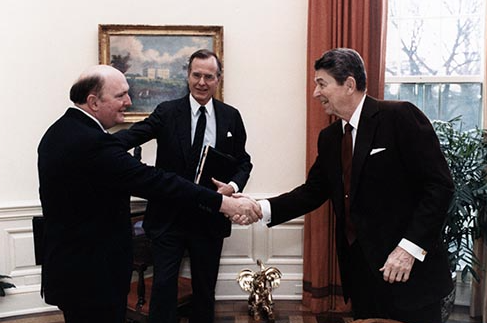
MANHATTAN – This month, Kansas State University Libraries honors alumnus and Abilene native Marlin Fitzwater with an exhibit, “Marlin Fitzwater: From Wheat Fields to White House.”
Fitzwater, who received an honorary doctorate from Kansas State University in 2015, has donated his personal papers to the Richard L.D. & Marjorie J. Morse Department of Special Collections at K-State Libraries.
Fitzwater, left, with Bush and Reagan- courtesy photo
The items in the exhibit represent a small sample of the donation. Visitors will be able to examine correspondence, publications, photos, memorabilia and official government documents, all of which will be available to future generations of researchers.
The exhibit opens at 5:30 p.m. Tuesday, Oct. 4. The evening will include a 6:30 p.m. conversation with Fitzwater.
He will reflect on his time as the only press secretary in U.S. history appointed by two presidents, both Ronald Reagan and George H.W. Bush.
Fitzwater was born in Salina, grew up in Abilene, and graduated from Kansas State University in 1965. In the following decades, he rose through the ranks of civil service in Washington, D.C., where he served as a spokesman and speechwriter at the Environmental Protection Agency, the Department of Transportation and the Department of the Treasury.
In 1983, Fitzwater joined the White House staff, where he remained for 10 years, including six as press secretary.
His role afforded him a front-row seat at some of the most important moments in modern history. Fitzwater’s reports to the press largely determined how the American public experienced the United States’ relationship to the Soviet Union and the last decade of the Cold War. His tenure as spokesman also included coverage of the Panama invasion and the Gulf War.
“Mr. Fitzwaterhas trusted K-State Libraries with a collection that reflects his journey from Abilene to Washington,” said Dean Lori Goetsch. “We are honored to present this exhibit so that his fellow Kansans and K-Staters can get an inside view of the White House as experienced by one of our own.”
The exhibit will remain on display through March 17, 2017.
TOPEKA, Kan. (AP) -The Kansas Supreme Court has upheld the conviction of a man convicted of killing a Topeka lawyer.
The Topeka Capital-Journal reports the Kansas Supreme Court on Friday upheld the convictions of Jimmy Jermal Netherland, who was found guilty of killing Natalie Gibson during an attempted holdup behind her home in 2011.
Netherland appealed convictions for first-degree felony murder, attempted aggravated robbery and other charges. Netherland contended in part that there was insufficient evidence to support his convictions.
The Supreme Court found Netherland’s claim of insufficiency of the evidence completely meritless.
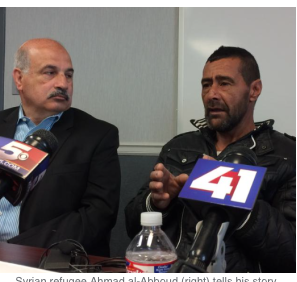
Syrian refugee Ahmad al-Abboud (right) tells his story through interpreter Fariz Turkmani at a press conference Monday morning in Kansas City. ALEX SMITH / KCUR 89-THREE
AUSTIN, Texas (AP) — Texas has formally stopped helping the U.S. government provide aid and services to refugees, citing alleged safety concerns.
Republican Gov. Greg Abbott said last week that Texas would withdraw from the federally funded refugee resettlement program unless the state’s demands for stricter refugee vetting were met.
Abbott said Friday that federal authorities failed to meet those demands, and he announced Texas’ official withdrawal. The move follows withdrawals by Kansas and New Jersey.
In May, Governor Brownback notified the Obama Administration that the State of Kansas was withdrawing from the federal government’s refugee relocation program due to concerns for the safety of Kansans.
Beginning in November 2015, the Governor attempted to work with the federal government to address security concerns related to resettlement of some refugees in Kansas.
“We made a reasonable request of the Obama Administration to provide us with information we need to help protect the safety and security of Kansans,” said Governor Brownback. “Because the federal government has failed to provide adequate assurances regarding refugees it is settling in Kansas, we have no option but to end our cooperation with and participation in the federal refugee resettlement program.”
In Texas, a judge had already rejected Texas’ efforts to halt the arrival of new refugees from Syria after last year’s deadly attacks in Paris.
Friday’s move means Texas will stop facilitating refugee services and benefits covered by federal funding.
The White House recently announced the U.S. will strive to take in 110,000 refugees from around the world next year.
HARVEY COUNTY – A semi driver avoided injured after a train accident just before 10 a.m. on Saturday in Harvey County.
The Kansas Highway Patrol reported a 1980 Kenworth semi hauling an empty grain trailer and driven by Edward J. Brubacher, Jr., 73, Walton, was westbound on east Grant Avenue crossing the railroad tracks at U.S. 50.
The driver stopped on the railroad tracks due to traffic. As the train approached, the semi attempted to move westbound.
A BNSF train hit the left rear corner of the truck’s trailer.
Brubacher, the train’s engineer and conductor, both from Missouri were not injured.
Brubacher was properly restrained at the time of the accident.
JACKSON COUNTY – Law enforcement authorities in Jackson County are investigating a dog attack on a social worker.
Just after 1:30 pm on Friday, a female social worker drove herself to the Potawatomi Tribal Fire Station for help after she was attacked by a Presa Canario dog in rural Delia in southwestern Jackson County, according to a media release.
The Fire Department transported the victim who was said to be in “code red” condition to a Topeka hospital.
The attack took place earlier at 10810 J. Road in Jackson County, according to the sheriff’s department.
The victim arrived at the address for a visit when the dog attacked her.
She was in reported in serious, but stable condition.
The Jackson County Sheriff’s Office impounded the dog at the scene. The owner was not home at the time of the attack. The investigation is being forwarded to the Jackson County Attorney’s Office for review.
In November of 2014, a Jackson County Deputy shot a different Presa Canario in self-defense after the neighbor south of 10810 J. Road was attacked and her chickens were killed.
The dog survived its injuries and was impounded, but was later released by the court. The dog was prohibited from remaining in Jackson County by the court. The owner of the dogs, Kevin McGillivary was booked into the Jackson County Jail in April of 2016 on a warrant for permitting a dangerous animal to be at large.
SHAWNEE COUNTY –Law enforcement authorities in Shawnee County are investigating gunshots fired from a vehicle.
Just after 7:30 p.m. on Friday officers with Topeka police responded to the 300 Block of SW Western after a report of gunshots, according to a media release.
Officers found shell casings in the street, interviewed multiple witnesses and were able to get a description of a vehicle used in the shooting.
A short time later, a patrol unit saw the vehicle, detained the suspects and seized the firearms.
No additional details were available early Saturday.




 KDWPT
KDWPT