SALINE COUNTY – Law enforcement authorities in Saline County are investigating a suspect on child porn allegations.
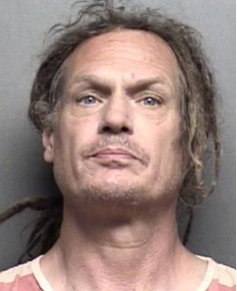
Following an investigation by Wichita-based Internet Crimes Against Children and the Department of Homeland Security, Michael Rodenbeek, 53, Salina, was arrested, according to Salina Police Captain Mike Sweeney.
A search warrant was executed at Rodenbeek’s east Salina home just before 10 a.m. Tuesday.
Officers seized at least one computer from the home during the search, according to Sweeney.
Rodenbeek is being held the Saline County Jail on two requested charges of sexual exploitation of a child, according to Sweeney.
TOPEKA, Kan. (AP) — The Latest on the Kansas Supreme Court’s hearing on a school funding lawsuit (all times local):
11:55 p.m.
Kansas Supreme Court justices have briefly considered whether the state could pay for a suitable education for every child by shifting funds out of programs for gifted students.
The court heard arguments Wednesday in a lawsuit filed in 2010 by four school districts. They argue that the state’s nearly $4.1 billion a year in aid to its 286 school districts is not enough to provide a suitable education for every child.
Justice Dan Biles suggested during the arguments that the court might have to target its order to helping underachieving students.
State Solicitor General Stephen McAllister said school districts might be able to help underachieving students by taking money out of Advanced Placement courses. But he said he wouldn’t want that to happen and educators rejected the idea.
___
11:15 a.m.
A Kansas Supreme Court justice is suggesting that an order from the court on education funding might have to be targeted to help underachieving students in the state’s public schools.
Justice Dan Biles raised the issue Wednesday during arguments before the court in a lawsuit filed by four school districts in 2010. The districts argue that the state’s nearly $4.1 billion a year in aid to its 286 school districts is not adequate.
Biles questioned districts’ attorney Alan Rupe about his argument that the state needs to boost its annual spending by $800 million. Rupe said a third to half of the state’s public school students are struggling.
But Biles said the state constitution appears to require the state to target struggling students because others already receive an adequate education.
10:25 a.m.
An attorney for four Kansas school districts has told the state Supreme Court that too many students are being left behind in their educations because the state isn’t spending enough money on its public schools.
Attorney Alan Rupe argued Wednesday before the justices that legislators have failed to meet their duty under the state constitution to provide a suitable education to every child. The state’s annual aid to its 286 districts is nearly $4.1 billion, but Rupe suggested that falls about $800 million a year short of being adequate.
Rupe said that students’ test scores on standardized English and math scores show that between a third and half of them are struggling.
The state argues that its education system compares well with those in other states and that funding is adequate.
___
9:35 a.m.
Kansas Supreme Court justices are expressing skepticism with the state’s arguments that its current education funding is adequate as they consider a lawsuit filed by four local school districts.
Chief Justice Lawton Nuss and four other justices on the seven-member court on Wednesday peppered state Solicitor General Stephen McAllister with questions after he suggested that the high court should defer to the Legislature.
The state argued that its annual aid of nearly $4.1 billion a year to its 286 districts is sufficient for legislators to meet their constitutional duty to provide a suitable education for every child.
Several justices pointed to data from state standardized tests suggesting many children aren’t on track to be ready for college and they challenged McAllister when he suggested spending isn’t necessarily crucial to student performance.
___
9:15 a.m.
The Kansas solicitor general has opened his arguments on an education funding case before the Kansas Supreme Court by telling the justices that the Legislature is entitled to substantial deference in its decisions about how much to spend on public schools.
Solicitor General Stephen McAllister appeared Wednesday before the court in a lawsuit filed in 2010 by four school districts. The state is trying to persuade the court that the state’s annual aid of nearly $4.1 billion a year to its 286 districts is sufficient.
The Dodge City, Hutchinson, Wichita and Kansas City, Kansas districts argue that legislators are hundreds of millions of dollars short each year in fulfilling their constitutional duty to give every child a suitable education.
A lower-court panel sided with the districts. The state appealed.
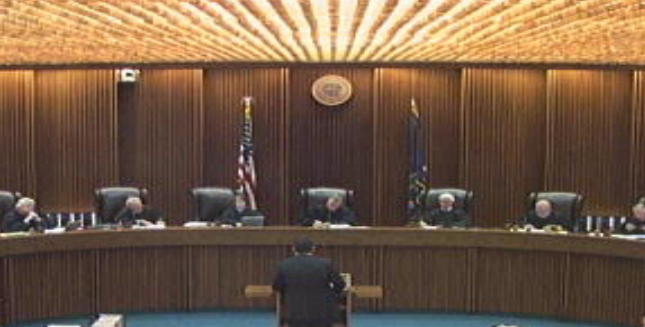
Packed court room on Wednesday to hear the school funding arguments
————–
TOPEKA, Kan. (AP) — Attorneys for cash-strapped Kansas are trying to persuade the state Supreme Court not to order hundreds of millions of dollars in additional aid each year for schools.
But lawyers for four poorer local school districts, who will present arguments before the court Wednesday, say they are confident the judges will side with them.
The Dodge City, Hutchinson, Wichita and Kansas City, Kansas, districts sued in 2010. They contend legislators aren’t providing enough aid to give every child a suitable education, as required by the constitution.
The six-year legal dispute has brought the court into repeated conflict with GOP conservatives who control the rest of state government.
The justices are considering whether the state’s nearly $4.1 billion in annual aid to school districts is sufficient or up to $1.4 billion short.
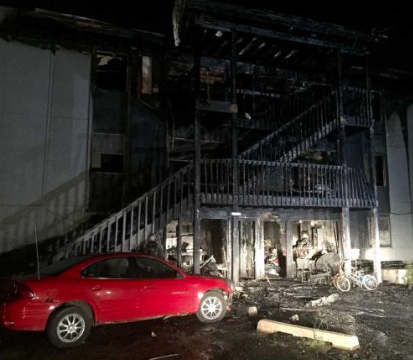
Early morning fire in Topeka. Photo by Phil Anderson courtesy Topeka Capitol Journal
TOPEKA, Kan. (AP) — Authorities say two people are hospitalized after a Topeka apartment fire.
The Topeka Capital-Journal reports that heavy smoke was coming from the east side of the 12-unit building when crews responded around 12:30 a.m. Wednesday.
Firefighters conducted a search and removed two adults from the building. Fire officials said they were taken to a Topeka hospital and later transferred to The University of Kansas University Hospital in Kansas City, Kansas. Their injuries aren’t believed to be life-threatening.
The fire was classified as accidental and blamed on improperly discarded smoking materials. Damages to the three-story building and its contents are estimated at $150,000.
SHAWNEE COUNTY- Law enforcement authorities in Shawnee County are investigating carjacking and searching for the suspect.
Just after 2a.m. on Wednesday, police officers were dispatched to the 1700 Block of Topeka Boulevard for a reported carjacking, according to a media release.
The victim reported a young Hispanic man entered the victim’s 4-door sedan while he was fueling it at the Kwik Shop. The suspect then pointed a silver hand gun at the victim and drove away.
Approximately 15 minutes later, officers spotted the vehicle near SE 2nd and SE Rice Street. They attempted to stop the car and the driver refused to comply.
They chased the stolen vehicle on SE 2nd to SE Golden where the suspect wrecked the vehicle down an embankment of Shunga Creek and escaped.
Two people dead after Tuesday plane crash in the Kansas City suburb of Lee’s Summitt-photo courtesy KCTV5
LEE’S SUMMIT, Mo. (AP) _ Authorities say two people have died after single-engine plane crashed at a suburban Kansas City airport.
Lee’s Summit police Sgt. Chris Depue says the crash happened at 6:10 p.m. Tuesday at Lee’s Summit Municipal Airport. Responding crews found the Piper 28 on the west side of the airport tarmac. Depue says the victims were the only people in the plane. No other injuries were reported.
Authorities say the flight originated from Iowa and the FAA is investigating the
First responders on the scene of Tuesday’s plane crash photo courtesy KCTV 5
KANSAS CITY –Five Kansas City area women and one man have been indicted by a federal grand jury for their roles in a marriage fraud conspiracy, according to Tammy Dickinson, United States Attorney for the Western District of Missouri.
Delmar Dixon, 48, Traci R. Porter, 44, her daughter, Tierra Ofield, 23, Stephanie Harris, 21, Shakeisha Harrison, 36, and Kakeland Barnes, 36, all of Kansas City, were charged in a 14-count indictment returned under seal by a federal grand jury on Aug. 31, 2016. That indictment was unsealed and made public Tuesday upon the arrests and initial court appearances of all six defendants.
The federal indictment alleges that Dixon, Porter, Ofield, Harris, Harrison and Barnes participated in a conspiracy beginning in 2007 in which they were paid to marry African nationals so that their spouses could obtain lawful permanent resident status in the United States.
According to the indictment, Dixon arranged marriages between African nationals (from Kenya and Tanzania) and U.S. citizens. Dixon allegedly introduced the African nationals to U.S. citizens who were willing to enter into fraudulent marriages with them, including but not limited to Dixon’s co-defendants.
Dixon allegedly charged the African nationals $1,000 upfront for such introductions. The African nationals were allegedly required to pay the U.S. citizen spouses, including Porter, Harrison, Ofield, Harris, and Barnes, $500 at the time of the wedding, $500 after the completion of the wedding and $250 each month after the wedding until the immigration process was complete.
After the African nationals and U.S. citizen spouses were married, according to the indictment, they filed immigration documents in order to obtain lawful permanent resident status for the African nationals. Conspirators allegedly represented their marriages as valid and legitimate through false statements on immigration forms, including by claiming the couples resided together, and making false and misleading statements about their marriages to federal officials. Dixon coached the African nationals and his co-conspirators on how to make their marriages appear legitimate, the indictment says, advising the couples to get to know each other and make it appear as if they were residing together.
According to the indictment, on Nov. 24, 2015, Harris married a confidential informant working with Homeland Security Investigations (HIS) in Kansas City. (Because the marriage was staged by HSI, it is not legally valid.) From the fall of 2015 until the present, Harris accepted monthly payments from the confidential informant and pressured him for other financial benefits.
On Jan. 23, 2016, Dixon allegedly accepted a payment from an undercover agent working with HSI in Kansas City. The payment was for the introduction of the agent to a potential spouse he could marry for the sole purpose of obtaining immigration benefits for the undercover agent. Dixon introduced the undercover agent to Barnes, who allegedly indicated to the agent that she was willing to enter into the marriage for the sole purpose of obtaining immigration benefits for the undercover agent and that she understood it was just a business transaction. On Feb. 19, 2016, Barnes and Dixon allegedly accepted payments from the undercover agent for their ongoing cooperation in the marriage arrangements. Barnes allegedly accepted another payment from the undercover agent on July 19, 2016.
In another instance cited in the indictment, Porter married a Kenyan national twice. The two had to end their first marriage because a federal investigation revealed the Kenyan national was still legally married in Kenya. Porter and the Kenyan national remarried after his divorce from his prior wife was granted.
In addition to the conspiracy, Dixon, Porter, Harrison and Harris are each charged with one count of marriage fraud.
Dixon, Porter and Harrison are each charged with one count of making a false statement relating to naturalization, one count of unlawfully procuring citizenship or naturalization and one count of false swearing in an immigration matter.
WICHITA, Kan. (AP) — Kansas agriculture groups have formed a group to push for the lifting of a trade embargo with Cuba.
The Wichita Eagle reports that Engage Cuba’s Kansas State Council includes representatives of the Kansas Wheat Commission, Kansas Soybean Association, Kansas Farm Bureau, Kansas Livestock Association and the Kansas Corn Growers Association.
The state council is part of Engage Cuba, a coalition of private U.S. companies and organizations working to build support for congressional action to end the ban in order to sell more grain and other commodities in Cuba.
Jay Armstrong, past chairman of the Kansas Wheat Commission, said in statement that a level playing field with Canada and Europe is critical for U.S. wheat farmers to fully realize their export potential to Cuba.
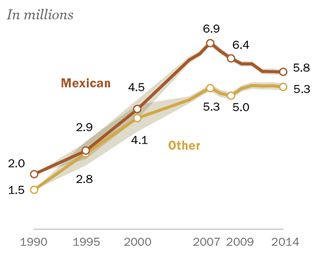
The number of immigrants in the U.S. illegally has changed little since the Great Recession began, dropping to 11.1 million in 2014 from 11.2 million in 2012 and 11.3 million in 2009, according to a study released Tuesday by Pew Research Center.
The population peaked at 12.2 million in 2007. Pew, which reached conclusions by subtracting the estimated number of legal immigrants from census data on the foreign-born, found that a declining number of Mexicans has had a profound impact in parts of the country.
WHERE ARE THEY FROM?
The number of Mexicans in the U.S. illegally has dropped sharply since the Great Recession began to 5.8 million in 2014, unchanged from 2012 but down from 6.3 million in 2009 and a peak of 6.9 million in 2007. Last year, Pew said more Mexicans were returning to Mexico than arriving.
The drop in Mexicans is nearly offset by an increase in Asians, Africans and Central Americans. The number of Central Americans in the U.S. illegally hit 1.7 million in 2014, up 110,000 from 2009. The number of Asians in the country illegally jumped by about 130,000 during the five-year period to 1.4 million, with notable increases of people from India, China, the Philippines and South Korea.
Mexicans still account for 52 percent of people in the U.S. illegally in 2014 down from 56 percent in 2009 but still the largest nationality by far.
WHICH STATES ARE SEEING THE BIGGEST CHANGE?
The number of people in the U.S. illegally dropped in seven states from 2009 to 2014 due to fewer Mexicans— Alabama, California, Georgia, Illinois, Kansas, Nevada and South Carolina. California had the biggest numerical drop, down 190,000 to 2.3 million.
The number of immigrants in the country illegally grew in six states during the same period — Louisiana, Massachusetts, New Jersey, Pennsylvania, Virginia and Washington. Louisiana saw an increase from Mexico. Increases in the five other states were due to higher numbers from countries other than Mexico. New Jersey and Pennsylvania had the biggest numerical increases, up by 50,000 each.
Mexico was still the leading birth country for people in the country illegally in at least 38 states. El Salvador is the leading birth country for those living illegally in the District of Columbia, Maryland and Virginia. The Philippines is the leading source in Alaska and Hawaii. Brazil is the top sender for Massachusetts, India in New Hampshire, and Guatemala in Rhode Island.
Most people in the country illegally lived in six states — California, Texas, Florida, New York, New Jersey and Illinois — in that order. Nevada had the highest share of its population made up of people in the country illegally (7.2 percent), followed by Texas (6.1 percent), California (6 percent) and New Jersey (5.4 percent).
HOW LONG HAVE THEY BEEN HERE?
People in the country illegally are more likely to have been here a long time. That’s particularly true in western states with deeply established Mexican populations.
The median length of time in the country for those in the U.S. illegally was 13.6 years in 2014, up from 7.1 years in 1995.
The median length of time in the U.S. for residents there illegally was 15.6 years in California.
Only five states had a median length of stay shorter than 10 years — Hawaii, Louisiana, Massachusetts, Missouri and Ohio.
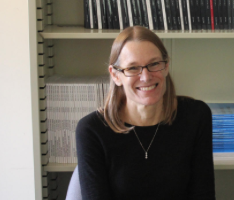
Jean Hall, director of the University of Kansas Institute for Health and Disability Policy Studies, will lead a team of partners from nonprofit organizations and government agencies to improve physical activity, nutrition and oral health for Kansans with disabilities. The team received a $1.5 million grant from the Centers for Disease Control and Prevention for its work. CREDIT ANDY MARSO / HEARTLAND HEALTH MONITOR
By ANDY MARSO
University of Kansas researchers plan to use a $1.5 million federal grant to help Kansans with disabilities catch up to their non-disabled peers in several health categories.
Jean Hall, director of KU’s Institute for Health and Disability Policy Studies, will lead a team of partners from nonprofit organizations and government agencies to improve physical activity, nutrition and oral health for Kansans with disabilities.
Kansas is one of 19 states to get the grants from the Centers for Disease Control and Prevention.
Hall said the CDC required grant recipients to focus some attention on increasing physical activity, and her team members chose nutrition and oral health as the other areas they wanted to address.
“Based on survey data from the state, those are really big issues,” Hall said.
‘A good start’
Research compiled by Hall’s team shows that Kansans with disabilities are five times more likely to report that they had a heart attack than non-disabled peers, and 75 percent are overweight.
Additionally, almost 36 percent of Kansans with disabilities surveyed reported having no dental care in the past year, compared with 23 percent of non-disabled Kansans.
Hall said her group will work with partners like Oral Health Kansas as well as disability caregivers and health care providers to make dental care, healthy foods, and workout facilities and equipment more accessible to Kansans with intellectual and developmental disabilities or physical disabilities that limit mobility.
Todd Brennan, a case manager with Jenian in Johnson County, said focusing on those three areas would be “a good start” for his clients with intellectual and developmental disabilities.
Dental care in particular is elusive for that population, because many Kansans with intellectual and developmental disabilities need to be sedated for treatment. That’s expensive work, and most Kansans with intellectual and developmental disabilities are on Medicaid, which pays about 40 cents on the dollar compared to private dental insurance.
Brennan said Johnson County is down to one dentist who will do it, after the state cut Medicaid reimbursements another 4 percent.
“This is an issue for all types of health care professionals,” Brennan said in an email. “The best doctors, dentists and psychiatrists often will not take a Medicaid patient. We see it all the time.”
Brennan said the grant “sounds encouraging” but predicted Hall’s group would bump up against systemic problems that would make it difficult to provide disabled people the same health care as their non-disabled peers.
For example, Brennan said doctors recently canceled surgery for a client with a broken foot because of her “disruptive behaviors.” He had been trying for months, unsuccessfully, to get that client psychiatric care to address those behaviors.
Dentist shortage a factor
Hall said a general shortage of dentists in the state makes it challenging for Kansans with disabilities to access oral health care, and that will factor into her team’s work.
“There’s not a lot we can do,” Hall said. “We can only work with the providers that are there.”
r several years, Oral Health Kansas has pushed for the Legislature to allow licensing for mid-level “dental therapists” who would be allowed to perform more dental work than hygienists but less than dentists.
The Kansas Dental Association, an advocacy group for the state’s dentists, has opposed the legislation.
Hall said the change might improve oral care for Kansans with disabilities.
“To the extent we could advocate for the mid-level providers, if that were a good solution, we’d certainly do that,” Hall said.
Hall also said low Medicaid reimbursements for dental care are “penny wise and pound foolish” if they reduce access to care because studies have shown that unmet dental needs lead to costly medical problems.
People with disabilities who don’t get proper dental care also are much more likely to suffer oral pain, she said, which limits the foods they can eat.
“That ties back to the nutrition,” Hall said.
Hall said her team will encourage more physicians to ask Kansans with disabilities about their activity level and let them know it’s OK to recommend more activity, just as they would for non-disabled patients.
She said all Kansans have a stake in the success of the five-year grant program.
“If you improve health outcomes for people with disabilities in the state, everyone’s health care costs go down,” Hall said. “It’s pretty simple. And besides, wouldn’t you want your neighbor to be as healthy as you are?”
Andy Marso is a reporter for KHI News Service in Topeka, a partner in the Heartland Health Monitor team. You can reach him on Twitter @andymarso
LAS VEGAS (AP) — A coalition of 21 states is suing the U.S. Department of Labor over a new rule that would make more higher-earning workers eligible for overtime pay.
Nevada Attorney General Adam Laxalt filed the lawsuit in Texas on Tuesday, urging the court to block implementation before the regulation takes effect on Dec. 1.
The measure would repeal the so-called “white collar exemption” and more than double the salary threshold under which employers must pay overtime to their workers.
Laxalt said the rule would burden private and public sectors and represents inappropriate federal overreach.
Officials from the labor department didn’t immediately respond to requests for comment.
Other plaintiffs include Alabama, Arizona, Arkansas, Georgia, Indiana, Iowa, Kansas, Kentucky, Louisiana, Maine, Michigan, Mississippi, Nebraska, New Mexico, Ohio, Oklahoma, South Carolina, Texas, Utah and Wisconsin.
TOPEKA, Kan. (AP) — U.S. Rep. Keith Ellison has introduced federal legislation that would require schools with to provide fuller disclosure of their campus gun laws.
The Lawrence Journal-World reports that the proposed law would require federally-funded universities to publish their gun policies on their websites and in other promotional materials.
Presently, Kansas law allows concealed carry by anyone who is legally eligible to own a gun.
Ellison introduced the legislation after Minnesota resident Marti Priest contacted Ellison with concerns regarding the University of Kansas’ lack of disclosure its campus gun rules. Priest was worried for her son Erik Nelson after a professor disclosed that the school would comply with the states conceal carry law.
University of Kansas officials say they have yet decided what their specific policy will be.
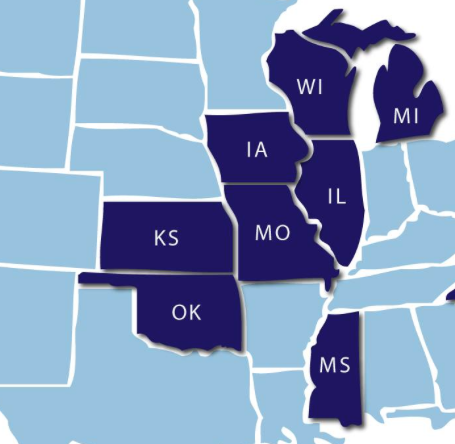
CCSS Alternate Assessment – Dynamic Learning Maps works with students in these states- DLM image
MONTPELIER, Vt. (AP) — Representatives from a consortium of states are reconsidering a decision that would greatly increase the costs for some smaller population states, including Kansas and Vermont, of testing students who have significant cognitive disabilities.
The move comes after Vermont Education Secretary Rebecca Holcombe wrote a letter Sept. 8 to the governing board of the Dynamic Learning Maps assessment.
Vermont’s congressional delegation also this week complained that the pricing structure will shift the cost of rising prices onto small states like Vermont, which would see a more than 1000 percent price increase from $39 to an estimated $459 per test.
The director of the Achievement & Assessment Institute at the University of Kansas said Tuesday that there’s a very good chance that the governing board will change the cost allocation method.