HUTCHINSON – Fire officials believe an electrical issue is responsible for a Sunday morning fire at a residence in Hutchinson.
Just before 3 a.m., Hutchinson Fire Department responded to the 3000 Block of North Halstead for a structure fire, according to a social media report.
Initial arriving units reported heavy fire involvement in the front of the structure. A vehicle was on fire inside a garage, according to Reno County dispatch.
Crews made an interior attack, completed a search of the structure and found it to be unoccupied.
The fire was controlled in 15 minutes. Crews remained on scene performing overhaul and extinguishing hot spots.
No damage amount is available. No injuries were reported.
OLATHE, Kan. (AP) — Health officials say a Johnson County resident who traveled to an area where mosquitoes are spreading Zika virus is the county’s first case of the virus.
The county health department didn’t provide details about the returned traveler or the travel destination. The Kansas City Star reports that the county health department says the risk of contracting Zika in the area is extremely low.
State health officials said in March that an adult from southwest Kansas was the state’s first confirmed case of the Zika virus. That person also had traveled to a country with “local Zika virus transmission.”
The Zika virus is spread mainly by a tropical mosquito and causes a mild illness in most people. But infection during pregnancy can cause fetal deaths and birth defects.
Rebecca Lyn Phillips, of Topeka, has schizophrenia and writes a blog about the challenges of living with the disorder. She says the prospect of step therapy is ‘terrifying’ to many people with severe and persistent mental illnesses. CREDIT JIM MCLEAN / HEARTLAND HEALTH MONITOR
By JIM MCLEAN
Although every state has now adopted some form of “step therapy” to control prescription drug costs, patient advocacy groups in Kansas remain deeply distrustful of the policy scheduled to take effect July 1.
Also known as “fail first,” the policy requires providers participating in KanCare, the state’s privatized Medicaid program, to start patients on less expensive drugs before moving them to more expensive alternatives if medically necessary.
“Taking prescribing out of the hands of doctors and putting it in the hands of administrators and people who are trying to make a profit is not good for patient care,” says Dr. Donna Sweet, a professor of internal medicine and a clinician at the University of Kansas School of Medicine-Wichita, where she focuses on treating patients with HIV and AIDS.
Advocates for Kansans with mental health disorders are particularly concerned even though legislators who pushed for the change say they needn’t be.
A ‘terrifying’ prospect
Rebecca Lyn Phillips, of Topeka, is one such advocate. She has schizophrenia and writes a blog about the challenges of living with the disorder. She says the prospect of step therapy is “terrifying” to many people with severe and persistent mental illnesses.
She wonders what will happen if a drug that a mental health provider is required to start a patient on fails.
“What does that mean?” Phillips asks. “Does that mean that a person with a mental illness does something that endangers someone else or themselves?”
Phillips’ concerns stem from experience. Several years ago, she stopped taking the initial medications she had been prescribed because she thought they robbed her of her personality. Phillips became paranoid and fled her home in a panic.
“I drove to Lyndon one night in the middle of the winter and slept behind a dumpster just thinking that people were going to harm me,” she says.
Eric Harkness says he has needed to change medications for depression several times over the years. A drug will work for a while but will suddenly become less effective, he says, recalling how frightened it was the first time it happened. CREDIT JIM MCLEAN / HEARTLAND HEALTH MONITOR
Eric Harkness, a Topeka pharmacist, has battled severe depression for most of his adult life. He’s unable to work because of his illness, but he’s an active member of the Kansas affiliate of the National Alliance for Mental Illness, a nonprofit advocacy group.Harkness says he has needed to change medications several times over the years. A drug will work for a while — sometimes several years — but will suddenly become less effective, he says, recalling how frightened he was the first time it happened.
“I didn’t know what was going on at first, and my doctor didn’t either and my condition continued to deteriorate,” Harkness said. “I wound up losing my job, and my fiancé at the time wound up leaving because I was by no means any fun to be around.”
After an extended stay at the now-defunct Topeka State Hospital and a change in medications, Harkness improved. But he says the experience and others like it in the succeeding years demonstrate how important it is for him to be on the right medication. And that’s why he’s also concerned about the new step therapy policy.
“When you get someone outside the (treatment) room saying, ‘Hey, wait a minute. Let’s use this other medication instead of what you and your doctor picked out,’ my doctor and I both start to get kind of nervous,” he says.
A method of controlling costs
Dr. Susan Mosier, secretary of the Kansas Department of Health and Environment, says the concerns of patients and providers are overblown. The fact that most commercial health insurance providers and Medicaid programs in every state but Kansas already are using step therapy demonstrates that it’s an effective way to control prescription drug costs without compromising patient care, she says.
“Step therapy is an approach to prescriptions that is intended to control the risks that are posed by prescription drugs as well as their cost,” Mosier says.
Amy Campbell, director of the Kansas Mental Health Coalition, says the group is concerned about any policy that uses price to determine what medications providers are able to prescribe.
“Cost is not a good determining factor for what is the best prescription medication for people with mental illness,” she says. “These policies have been known to interrupt treatment.”
Sen. Jim Denning, an Overland Park Republican and vice chair of the Senate Health and Human Services Committee, helped win passage of the bill authorizing the step therapy policy.
“With pharmacy consuming more and more of the Medicaid dollar, I think it’s just time that we start taking a look at it,” Denning says, noting that prescription drug costs for KanCare, the state’s privatized Medicaid program, are “growing at 10 times the rate of inflation.”
Step therapy will save KanCare an estimated $10.6 million annually, according to KDHE. Gov. Sam Brownback is banking on the savings to help balance the fiscal year 2017 budget.
Rep. Dan Hawkins, a Wichita Republican and chair of the House Health and Human Services Committee, also supports step therapy. But at the end of the session when a final version of the bill was being negotiated, he insisted on including more patient protections. Among other things, they allow a doctor to bypass an inexpensive drug for a more expensive one if he or she believes the less costly medication would be ineffective or harmful.
Kari Rinker, senior advocacy manager of the Mid America Chapter of the National Multiple Sclerosis Society, says that and other protections, including one that requires provider appeals to be handled within 72 hours, helped alleviate some of the concerns of patient advocates. Still, she says, advocates want to work with KDHE to add more protections in the rules and regulations that will spell out how the policy will work.
“Our job is not done,” Rinker says. “The devil is in the details, and we need to continue to advocate for some more specific protections in the process.”
For instance, Rinker says, advocates want to see an enforcement mechanism added to the bill to ensure that the managed care companies that oversee the day-to-day operations of KanCare adhere to the 72-hour allowance for appeals.
No mental health exception
Mental health advocates wanted more than that, asking lawmakers to maintain a provision in state law that prohibited step therapy for behavioral health drugs. That didn’t happen, as the bill that passed repealed that provision.
Hawkins says lawmakers concluded it would have been unfair to carve out one class of drugs.
“That just wasn’t something we could do. Because once you carve out one, you have to start carving out everybody, and that just wasn’t going to work,” he says, stressing that other provisions in the bill should ease the concerns of mental health advocates.
Campbell of the mental health coalition says while those protections are important, they aren’t enough to alleviate advocates’ fears.
“No ifs, ands or buts, the legislation does allow step therapy policies to be implemented for mental health medications, and that is our concern,” she says.
Jim McLean is executive editor of KHI News Service in Topeka, a partner in the Heartland Health Monitor team.
WASHINGTON, DC – U.S. Senator Pat Roberts (R-Kan.), Chairman of the Senate Committee on Agriculture, Nutrition and Forestry, on Friday applauded the Senate Appropriations Committee for advancing the Fiscal Year 2017 Interior, Environment and Related Agencies Appropriations Bill which contains language he sought to halt the misuse of Environmental Protection Agency (EPA) federal grant funding that supported an advocacy and public relations campaign with the sole purpose of denigrating agriculture.
“I commend Senator Murkowski for sticking up for our farmers and ranchers who were attacked by an EPA funded public advocacy campaign in Washington state,” Senator Roberts said. “We worked together to ensure report language in the appropriations bill included measures to hold EPA accountable and ensure better oversight of this grant program in the future.”
At issue was an advocacy campaign, funded in part by a $20.5 million EPA grant, by the Northwest Indian Fisheries Commission in Washington state. The campaign included billboards and a website attacking agriculture and urging state lawmakers to increase regulation over the agricultural industry. The use of federal funds in this instance is not only inappropriate but may be in violation of federal government lobbying restrictions.
The bill directs EPA to update its federal grant guidelines to ensure accountability: “within 90 days of enactment, the agency is directed to update its grant policies, training, and guidelines to ensure federal funds are not used in this manner, including an update of the mechanism by which the agency tracks the use of its grants, and to provide the committee with a copy of its updated grant policies, training, and guidelines.”
The bill also contains other provisions important to farmers, ranchers, and rural America supported by Chairman Roberts to block costly and burdensome regulations such as EPA’s Waters of the United States (WOTUS) final rule and attempts by the Fish and Wildlife Service (FWS) to reassess the listing status of the lesser prairie chicken under the Endangered Species Act.
Roberts and Senator Jim Inhofe (R-Okla.) on April 5 sent a letter to Arthur A. Elkins, Jr., EPA inspector general, requesting an audit and investigation of the grants EPA awarded to the Northwest Indian Fisheries Commission. The inspector general has confirmed that it will answer the questions raised in the Roberts and Inhofe letter as part of an audit.
WICHITA, Kan. (AP) — Federal immigration authorities recently arrested dozens of people in Kansas and Missouri as part of a monthlong operation.
U.S. Immigration and Customs Enforcement says in a release that the agency arrested 31 people in Kansas and 34 in Missouri during the investigation, which began in May and ended Monday. The agency says 39 people were also arrested on both sides of the state line in the Kansas City area.
The agency says of the arrests made in Missouri, 28 people had been convicted of crimes including domestic battery and larceny. ICE says 25 people arrested in Kansas had been previously convicted of crimes including battery and sexual assault.
Others were accused of recently entering the U.S. illegally.
TOPEKA, Kan. (AP) — If Kansas legislators increase aid to poor school districts to satisfy a recent state Supreme Court order, much of the money would go to dropping local property taxes instead of classroom spending.
That bothers many Republicans.
The Legislature convenes Thursday for a special session to address the court’s order last month declaring that the state’s education funding system remains unfair to poor school districts. The justices warned that schools might not be able to reopen after June 30 if further changes aren’t made.
Gov. Sam Brownback has embraced a proposal to increase education funding by $38 million for the 2016-17 school year to help poor districts. But as much as 75 percent of the new dollars would to property
RENO COUNTY— A Kansas man sentenced to over 18 years in prison in a kidnapping case won a minor battle on Friday in the Court of Appeals.
Todd Lloyd, 32, Hutchinson, was ordered to prison for violating his probation after he was charged in a kidnapping case.
He appealed contending the court erred in relying upon a probable cause finding made at his preliminary hearing.
He was ordered to serve the two-year, eight-month sentence.
The appeals court in their opinion issued Friday stated that the stand of proof required to bind a defendant over for trial is a lesser burden of proof then the preponderance of evidence standard needed to establish a probation violation.
They said that Judge Trish Rose erred and ordered the case back to District Court for a new probation violation with instructions for the court to apply the correct burden of proof.
However, Lloyd had stipulated to violating his probation when Judge Rose made her decision.
Lloyd had entered a plea in this case from 2012 to aggravated battery and misdemeanor theft.
Despite having a substantial criminal history, he was granted two years probation on the underlying sentence of two years and eight months.
The state says he violated his probation by being arrested on April 23, 2014 when he came close to being shot by two Hutchinson Police officers during an altercation where he held his girlfriend at knifepoint.
District Attorney Keith Schroeder said that had Judge Joe McCarvile handled the probation violation at the end of the preliminary hearing he could have found there was a preponderance of evidence for the probation violation.
Schroeder says he argued at the time of the appeal, that Lloyd had been convicted in the kidnapping case.
So when the case comes back, the judge will now be able to rule using what the Court of Appeals instructed her to do.
OTTAWA, Kan. (AP) — The Kansas Bureau of Investigation is looking into the death of a 35-year-old inmate at an eastern Kansas jail.
Authorities said Benjamin F. Mastel, of Ottawa, Kansas, was found unresponsive in his cell at the Franklin County jail late Friday night. He was rushed to a hospital where he was pronounced dead.
The sheriff’s office says Mastel had been in the jail since April 19.
The Kansas City Star reports court records show Mastel was being held on charges of aggravated battery and theft.
State law requires the KBI to investigate such deaths.
TOPEKA – Abuse of vulnerable adults may take on numerous forms, including physical, emotional or sexual abuse, self-neglect or neglect by a caregiver and financial exploitation. Three State agencies presented a united front today, against such abuse of Kansas’ vulnerable adults.
Gathered at the Jayhawk Area Agency on Aging office in Topeka, speakers from the Kansas Department for Children and Families (DCF), and the Kansas Department for Aging and Disability Services (KDADS) preceded a presentation by Alma Heckler, Assistant Attorney General, to call attention to the issue, as well as to the State’s efforts to combat it.
Heckler provided an overview of changes in Kansas statute that toughen penalties for adult abuse.
“These changes give Kansas new tools to prosecute criminally those who would abuse some of our most vulnerable citizens,” Heckler said. “The penalties are more severe for committing what is a growing area of crime.”
Adult abuse affects individuals 18 and older who are unable to protect themselves. This includes older adults and persons with disabilities.
Governor Sam Brownback declared June Adult Abuse Awareness Month, and DCF asked its staff and the general public to wear purple Friday, June 17 in support of adult abuse prevention.
During the current fiscal year, the DCF’s Adult Protective Services (APS) hotline has received more than 13,000 calls regarding abuse and neglect of this population. The agency helps protect older adults from being taken advantage of, as well as to ensure they are taking care of themselves.
“I have worked with vulnerable adults my entire career as a social worker, in nursing homes, group homes for the mentally ill and with DCF,” said April Shine, APS Supervisor. “It is my passion to help others in need, who cannot protect themselves. There is no greater joy than to see clients reach their potential and live the life they choose.”
Deneen Dryden, Director of Prevention and Protection Services, says the agency is receiving an increasing number of reports of abuse and/or neglect among this population, primarily due to the growing elderly population in the state.
Kansans can report abuse by calling the DCF Kansas Protection Report Center at 800-922-5330.
“We have a strong and effective partnership with KDADS,” said Dryden. “DCF investigates abuse and neglect of individuals in the community. KDADS, meanwhile, oversees investigations involving long-term care facilities. Together we are combatting the problem and equipping families with the resources and knowledge they need to protect their loved ones.”
Kelli Ludlum, KDADS Assistant Secretary, said the agency is improving its credentialing and background check policies at long-term care facilities. Through a federal grant, KDADS has recently added the ability to check out-of-state records for more extensive background checks.
“This allows us to do better at stopping abuse before it starts,” Ludlum said. “Those in long-term care are dependent on others for many to all aspects of their care. We want to make sure those in that position are qualified for that responsibility.”
KDADS offers a hotline for long-term care consumers to file complaints specific to adult care homes – 1-800-842-0078.
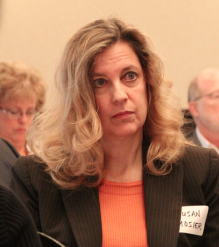
Photo by KHI News Service Susan Mosier, secretary of the Kansas Department of Health and Environment
TOPEKA, Kan. (AP) — State officials say a contractor underrepresented the scope of the state’s backlog of applications for Medicaid eligibility.
The Topeka Capital-Journal reports the contractor for the Kansas Department of Health and Environment miscounted by about 12,000 people.
KDHE Secretary Susan Mosier told federal officials in early June that Accenture relied upon a flawed method of reporting the Medicaid processing. The correction pushed the waiting list from 3,500 people on May 8 to 15,400 on May 22.
Mosier says temporary workers hired by the state to delve into the processing backlog would be kept after they were scheduled to be released at the end of June.
Processing problems began emerging in 2015 when the administration of Gov. Sam Brownback introduced a new computer system for determining Medicaid eligibility.
A new federal rule in the works is spurring discussion about what it means to integrate Kansans with disabilities with their communities and how service providers can do it.
The rule being developed by the Centers for Medicare and Medicaid Services seeks to ensure that providers of home and community-based services are providing enough opportunities for their clients with disabilities to interact with the community at large. State officials, who will be responsible for administering the rule starting in March 2019, have spent the week soliciting public input from service providers and disability advocates in Hays, Topeka, Overland Park and Wichita.
Susan Fout, director of the Home and Community Based Services division of the Kansas Department for Aging and Disability Services, moderated a meeting Wednesday in Topeka.
She stressed that the rule was intended to improve quality of life for people with disabilities, a goal that providers, their clients and the state share. “I think we all have to work together,” Fout said. “We’re all in this together.”
Providers, though, expressed concerns about how the rule will be implemented. Staff of sheltered workshops were particularly concerned after Fout said their type of services, as well as those provided by assisted living facilities connected to nursing facilities, would face renewed scrutiny under the rule to ensure they are providing an “individual experience” and “community integration” for their clients.
“The ones of concern are those that have the appearance of isolation or an institution,” Fout said.
She said KDADS will be posting a “tool” on its website next week with tips for providers on how to identify and avoid practices that isolate clients. Cottonwood Inc. is a nonprofit in Lawrence that provides residential services to Kansans with disabilities, including a sheltered workshop.
Janet Fouche-Schack, the organization’s director of support services, said she hoped few changes would be necessary to comply with the new rule once it’s finalized.
“I want to make sure they understand that, in my opinion, we are community-based,” Fouche-Schack said. “We make every effort to provide opportunities for people to be in the community.”
Photo by Andy Marso/KHI News Service Ian Kuenzi, right, a Topeka disability advocate who has cerebral palsy, questioned whether facilities for people with disabilities could truly be community-based. He and others attended a meeting Wednesday in Topeka where state officials gathered input on an upcoming federal rule regarding home and community-based services.
Fouche-Schack said about half of Cottonwood’s clients have some employment in the community, though it may not be full-time. Sheltered workshops have become controversial, with some providers arguing they provide a path to more competitive employment and some disability advocates saying they represent a low-paying dead end. Other state and federal efforts to steer people with disabilities into more mainstream employment are under way.
Jill Baker, Cottonwood’s administrator of services, said the facility uses its work center “as a staging area” where clients with disabilities can gather before heading to places in the community. But she said rather than feeling isolated, some clients like the company and camaraderie of being with other people with disabilities at the facility.
The new rule should allow for that sort of individualized approach, she said. “We’re hoping they don’t get too prescriptive,” Baker said.
But Ian Kuenzi, a Topeka disability advocate who has cerebral palsy, said facilities that gather Kansans with disabilities are, by definition, isolating them from the community at large, and the new rule should crack down on that.
“First of all, we need to define what a facility is,” Kuenzi said. “Secondly, how could a facility ever be community-based?” Kuenzi questioned whether KDADS should give providers notice before inspections to evaluate their compliance with the coming rule.
Fout said the advance notice would only be given in the lead-up to the finalized rule, as the agency works with providers to try to ease the transition. Rather than see providers close or send clients elsewhere, the agency would like to help them better integrate clients, she said.
“Our goal is that our providers will want to make any needed modifications to those settings,” Fout said. She also said the week’s meetings had given her a better sense of the possible costs involved for providers to make their services more individualized.
Sean Gatewood is a former Democratic state representative who now works as an advocate for people in KanCare, the state’s privatized Medicaid program.
He asked Fout if the state would reapply for $15 million in federal vocational rehabilitation money that it turned down last year.
Fout said she wasn’t aware of that possible funding source and she would ask Michael Donnelly, director of rehabilitation services for the Kansas Department for Children and Families, about it.
Andy Marso is a reporter for KHI News Service in Topeka, a partner in the Heartland Health Monitor team. You can reach him on Twitter @andymarso
LEAVENWORTH, Kan. (AP) — A northeast Kansas woman has been sentenced to more than nine years in prison for causing a deadly crash while using drugs.
Thirty-seven-year-old Jaime Carter, of rural Linwood, was sentenced Thursday in Leavenworth County District Court for the May 2014 crash that killed 49-year-old Mary Steuber and led to the amputation of one of her husband’s legs.
The Leavenworth Times reports that Steuber was riding with her husband on a motorcycle when Carter’s car crashed into them. Carter tested positive for methamphetamine and prescription drugs after the crash.
Carter pleaded guilty last year to involuntary manslaughter while driving under the influence of drugs, aggravated battery and driving with a suspended license.
Carter’s attorney, Elaine Halley, said her client has “severe mental illnesses” and “admits she made a terrible decision.”

 HUTCHINSON – Fire officials believe an electrical issue is responsible for a Sunday morning fire at a residence in Hutchinson.
 OLATHE, Kan. (AP) — Health officials say a Johnson County resident who traveled to an area where mosquitoes are spreading Zika virus is the county’s first case of the virus.





 WICHITA, Kan. (AP) — Federal immigration authorities recently arrested dozens of people in Kansas and Missouri as part of a monthlong operation.
 JOHN HANNA, AP Political Writer



 DCF
DCF