HUTCHINSON– A Kansas teen entered a plea to a single count of conspiracy to commit capital murder before his case could go to a bench trial, scheduled for Monday.
Ayrton Marroquin, 14, Hutchinson entered the plea in Juvenile Court on Thursday.
Marroquin and 15-year-old Carson Cabral are accused of making threats against officials at Hutchinson High School.
The two were arrested on March 7, after several students came forward to express concerns about a threat to students.
Officers were called into investigate, and the two students were then taken into custody.
Several search warrants were issued which turned up plans for making pipe bombs as well as sketches and plans of where certain teachers and staff would be so they could be targeted.
Police also recovered items that could be used to build explosive devices, which were confiscated by law enforcement.
A psychiatric evaluation was ordered for Marroquin and a tentative sentencing date of June 27th was set.
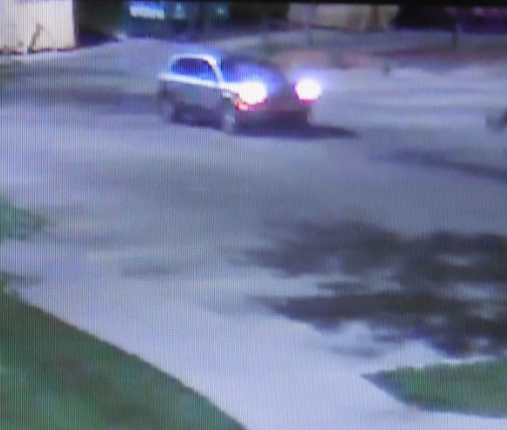
The SUV from this morning’s armed robberies has a bright yellow vanity plate on the front of the vehicle-photo Lawrence police
DOUGLAS COUNTY – Law enforcement authorities in Douglas County are investigating three aggravated robberies.
On Monday between 4:55am and 5:30am, three aggravated robberies occurred in Southwest Lawrence, according to a media release.
During each incident, a shotgun was used to facilitate the robberies.
In the area just southeast of Hyvee, 3504 Clinton Parkway, three males who were armed and took the victim’s property approached a man.
One of the suspects was described as dark skinned, 6 feet tall, thin build, wearing a dark hoodie and a baseball style hat, possibly with a red bill.
The second robbery occurred in the area of Holcomb Sports Complex, according to police.
Three men who were armed and took items from the victim approached a man.
The last robbery occurred in the 1500 block of West 27th Street, while a man was out walking his dog.
He was approached by three males, who demanded his property. A shotgun was displayed and the victim’s dog was shot and killed by one of the suspects.
The incidents appear to involve the same suspects. The suspects are described as three males, at least one of whom is described as dark skinned. They are believed to be associated with a small SUV.
Anyone with information on these incidents is encouraged to contact Douglas County Crime Stoppers at 785-843-8477 or the Lawrence Police Department. The investigation is ongoing. Further information will be provided when it becomes available.
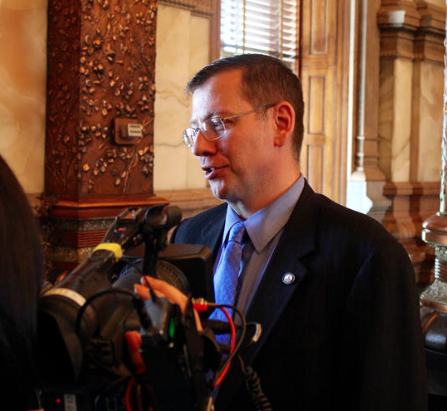
Kansas Senate Majority Leader Terry Bruce said that three Kansas oil and natural gas companies recently filed for bankruptcy, a sign of that sector’s severe downturn. ANDY MARSO / HEARTLAND HEALTH MONITOR
By ANDY MARSO
Kansas tax collections for May fell short of projections by about $74 million, and legislators said Wednesday they fear that will mean more cuts to Medicaid.
The May shortfall comes despite the state’s revenue estimating group revising projections downward for the third consecutive time about six weeks ago.
It wipes out the meager savings Gov. Sam Brownback created when he made cuts two weeks ago after the Legislature sent him a budget that didn’t balance.
Brownback now must find millions more to get the state through the current fiscal year that ends June 30 — and his options are limited.
“It’s higher education and Medicaid, realistically,” said Rep. Steven Johnson, a Republican from Assaria. “We’ve got very few places to go.”
The governor’s spokeswoman, Eileen Hawley, said his office does not expect any further allotments, or unilateral spending cuts, this year. She has not yet responded to a request for more information on how the budget will be balanced.
The $50 million package of fee sweeps, topped by $16 million from the Children’s Initiatives Fund, is being floated as a possible solution.
The May revenue numbers cast a pall over last week’s ceremonial “sine die” one-day legislative meeting, the last official gathering of the 2016 session.
A Kansas Supreme Court decision ordering the Legislature to appropriate more money to equalize school funding among districts also loomed large over the proceedings.
It would take about $40 million to comply with the order. Legislators opted not to address that Wednesday, increasing the possibility of a special session before July 1, when the court said it might close schools.
Sen. Jim Denning, vice chairman of the Senate budget committee, alluded to the revenue shortfall Wednesday during a caucus of Senate Republicans. He said a special session would serve little purpose if the Legislature is unable to comply with the court order because it has to “scrape any money up” to pay for other items, including Medicaid.
“I just don’t see anything good about trying to come back and appropriate money where we need to leave it in the checking account to pay for our core services,” Denning said. “That may not be constitutional, but it’s real life.”
Few budget-balancing options left
Public schools are by far the largest expense in the state’s general fund budget of almost $6 billion. But K-12 education is exempt from more spending cuts under the budget the Legislature passed.
Brownback and the Legislature already have agreed to delay the state’s remaining payment into the state employee pension plan for the current fiscal year. The state highway fund is largely tapped out. Other special funds also have been depleted.
Johnson is one of a group of Republicans who have tried the last two sessions to help balance the budget by rolling back a business income tax exemption Brownback signed in 2012.
Johnson said the May numbers are more evidence that the state needs to increase its income tax revenue stream, but he also acknowledged it’s too late for that to solve the current crisis.
Income tax changes would not go into effect until Jan. 1, 2017.
Medicaid and higher education already have taken cuts, but Rep. Barbara Bollier, a Republican from Mission Hills, said they may be in for more. But she also said the Children’s Initiatives Fund, which provides grants to a host of early childhood programs, also might be in the crosshairs.
“These would be tragically possible consequences,” said Bollier, who also has pushed to roll back the 2012 tax cuts.
A retired physician, Bollier said some medical providers in the state have given up billing Medicaid because the reimbursements don’t cover the time and resources it takes to procure them.
Some serve Medicaid patients for free and some drop out of the program. Bollier said more cuts would lead to fewer providers.
“It’s going to really strain the system, I believe,” Bollier said.
Revenue shortfalls common
Revenues have come in short of estimates more often than not in the last two years, but the May shortfall was large even by recent standards.
Revenue Secretary Nick Jordan said layoffs in the aviation, agriculture and oil industries were to blame.
“This is a trend reflected throughout the region,” Jordan said.
Senate Majority Leader Terry Bruce said during the Republican caucus that three Kansas oil and natural gas companies recently filed for bankruptcy, a sign of that sector’s severe downturn.
A news release from Jordan’s office said $58 million of the May shortfall was from individual income tax receipts. Corporate income tax receipts came in $15 million below estimates and sales tax revenue came in a bit above expectations.
Kansas Democrats like Rep. Tom Sawyer of Wichita said the income tax cuts are a bigger factor in Kansas’ continued budget shortfalls than energy prices.
“It’s continued bad news, and it’s amazing with as many times as we’ve had to downgrade the (revenue projection) numbers,” Sawyer said. “Again, it shows the failure of the Brownback tax plan. We’ve got to change it.”
Brownback’s office said it’s conducting “a full, independent review with outside experts” to determine why the revenue estimating process is struggling to accurately predict how much tax money the state will take in.
Rep. Vicki Schmidt, a Republican from Topeka and a pharmacist, said even if Medicaid is spared further spending cuts, there’s cause for concern.
“We’re already destroying Medicaid, before the revenue numbers came out today,” Schmidt said. “I mean it is dreadful. It is access to care, it’s breaking promises. It’s people’s lives.”
Andy Marso is a reporter for KHI News Service in Topeka, a partner in the Heartland Health Monitor team. You can reach him on Twitter @andymarso
TOPEKA, Kan. (AP) — The Kansas Legislature’s top Democrats are urging their colleagues to force Republican Gov. Sam Brownback to call a special session on education funding.
Senate Minority Leader Anthony Hensley of Topeka and House Minority Leader Tom Burroughs of Kansas City said Monday that lawmakers need to boost aid to poor school districts to keep all public schools from being shut down.
They were joined by Democratic Rep. Jim Ward of Wichita.
The state Supreme Court late last month rejected school funding changes made by lawmakers earlier this year and said schools won’t be able to reopen after June 30 unless legislators approve additional fixes before then.
The letter sent to Governor Sam Brownback-click to enlarge
Legislators adjourned their annual session last week.
Legislators can force Brownback to call a special session if two-thirds of them sign individual petitions demanding one.
KANSAS CITY, Mo. (AP) — Hostess Brands says it is voluntarily recalling various snack cakes and doughnuts over concerns they may have come in contact with peanut residue not included in the ingredient list.
The Kansas City, Missouri-based company’s recall announced Friday covers more than 700,000 cases of Ding Dongs, Zingers, Chocodiles and various doughnuts sold in grocery, dollar, drug and convenience stores in the U.S. and Mexico.
LAWRENCE, Kan. (AP) — The University of Kansas is working to prevent another internet fiber cable cut that crippled the campus earlier this spring, with some officials arguing for funding to build a backup system.
On March 29, construction crews accidentally cut a section of fiber, shutting down internet access across the Lawrence campus and wireless internet at the Overland Park campus. Phone service also was cut in some buildings. It also shut down state testing for K-12 student in dozens of states.
We’re sorry for the inconvenience and are working to fix the network outage caused by cable cut on @KUNews campus. Stay tuned for updates…
The Lawrence Journal-World reports a University Senate committee report estimates the cost to the university will reach seven figures but an exact amount has not been announced. School officials aren’t naming the company that cut the fiber but they insist the school will not be paying for repairs.
Gene Policinski is senior vice president of the First Amendment Center.
Donald Trump is mad at the press. Many in the press are mad at Donald Trump. And much of the public apparently is mad at both.
Whew. Welcome to the “marketplace of ideas,” 2016-style. Lots of heat. Occasionally, a little bit of light. And this year, all taking place at the hyper-space speed of social media.
It’s not like we haven’t seen this before — long before — in the heady air around the presidency, just slower. Revolutionary War writer and activist Thomas Paine and second term President George Washington traded insults of “hypocrisy and treachery” and “careless, ungrateful, virulent” in a Philadelphia newspaper in 1796, near the end of Washington’s second term.
And as Theodore Roosevelt’s time in office was ending, he directed government attorneys in 1909 to sue newspaper publisher Joseph Pulitzer for libel because of stories and editorials questioning the purchase of the company building the Panama Canal and Roosevelt’s claims about the decision.
Of course, both of those involved presidents after election. Trump, and other candidates for offices high and low, now may feel more empowered to lash out at reporters and news operations during campaigns because they no longer need the “press” to reach voters.
To be sure, television, political talk shows and newspaper articles still count, but can be countered as never before with instant viral tweets, and more. And the web’s direct reach doesn’t need — or permit — the press-as-gatekeeper of information.
The spark for the latest brushfire on the campaign trail was — as we know from a rush of online and televised chatter —Trump’s anger at being asked to provide evidence on the occasion of Memorial Day that he had indeed raised and distributed $6.5 million to various veterans’ groups, as he claimed earlier. Questions in, insults out, and so it began — again.
The nation’s Founders regularly faced political and personal criticism and harsh questions —much more vulgar and regular than what we see today. But they still placed strong protection for a free press among our core freedoms.
Our governing system of checks and balances relies on give-and-take, with an unfettered — and often unruly and imperfect press — to inform us so that we may make the hard decisions required for self-governance.
We ought to be concerned when “checks” — most recently, a large one written by Silicon Valley billionaire Peter Thiel — have the potential to distort a long-standing legal balance protecting those who report or opine about elected officials and other public figures — whether full time or in the occasional tweet or post.
Granted, the case at hand involving Theil, who apparently financed a libel action brought by former pro wrestler Hulk Hogan against the sensational web news provider Gawker, is tawdry and not one on which a free press would like to hang constitutional hopes.
A jury awarded the wrestler $140 million in damages over Gawker’s post of a sex tape involving Hogan. Jurors apparently found persuasive the argument that writing about the tape probably was a First Amendment protected act of publishing — but that showing the actual video was unwarranted and invaded Hogan’s privacy.
The specter of billionaire-funded lawsuits against internet startups or financially pressured traditional media would seem enough of a threat in itself. Throw in Trump’s campaign-fueled, vitriolic promise to work to weaken libel law protections for the media he disdains, and that combination is a lot scarier than a few outbursts and insults.
A landmark United States Supreme Court decision in 1964, New York Times Co. v. Sullivan, set out that public officials (later extended to public figures) had to prove a writer or publication had knowingly or recklessly disregarded the truth before being able to win a defamation lawsuit. In the unanimous decision, the Court said it ruled that way because of a “profound national commitment to the principle that debate on public issues should be uninhibited, robust, and wide-open.”
A long-held view among working journalists is that they are not the story — but increasingly it’s clear that in the 2016 presidential race, they are, after years in which polls show the public’s view of the news media as an unbiased, accurate source of news has declined dramatically. And that lack of public trust, not sparring matches with politicos over personal characteristics, is where a real threat to freedom of the press resides.
While the Gawker trial’s salacious sex tape details and Trump’s tantrums deserve to be reported, journalists ought to keep in mind that challenge from the Founders was to be both a smart surrogate for citizens and a thick-skinned watchdog on government.
Issues, not insults, should be the stuff of campaign reporting — regardless of what candidates say. Reporters should ask tough questions and ignore the personal attacks. Focus more on what the candidates will do if elected and less on what they’re saying as tactics of diversion or distraction.
Over time, “accurate” and “fair” will prove more lasting labels than some momentary verbal slap from a politician. It would be a shame to see the mighty protections of Times v. Sullivan — indeed of the First Amendment itself — rolled back because the nation simply saw no need to protect “click-bait” journalism.
Gene Policinski is chief operating officer of the Newseum Institute and senior vice president of the Institute’s First Amendment Center. [email protected]
WICHITA, Kan. (AP) — Thirteen suspects are facing a total of 50 federal charges after a federal investigation into an identity theft ring in the Wichita area.
Federal prosecutors say the suspects took mail from boxes and mail rooms across the Wichita region. Some of the suspects stole the mail, while others altered checks, created fake checks or applied for credit cards. Others created fake Kansas driver’s licenses and some bought goods with stolen identities, including weapons and drugs.
Spokesman Jim Cross said Friday this is one of the largest identity theft cases the U.S. attorney in Kansas has ever prosecuted.
The fraud brought in an estimated $3.5 million of stolen money and goods.
RENO COUNTY- A Kansas man was injured in a truck, bicycle accident just before 12:30 p.m. on Sunday in Reno County.
A 2012 Ford F-150 driven by Jacob Gehring, 21, Hutchinson was northbound on Old Kansas 61, according to the Reno County Sheriff’s Department.
Shortly after passing through the intersection of 69th Avenue, the passenger side mirror of his truck struck Brett Brillhart, 28, Hutchinson, who riding a bicycle.
The bike left the roadway and crash in the east side ditch.
Eagle Med transported Brillhart to Wesley Hospital in Wichita.
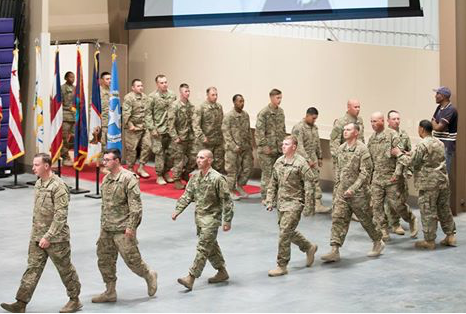
Photo courtesy of 1st Infantry Division Public Affairs
FORT RILEY -More than 300 Second Armored Brigade Combat Team members returned home Sunday from the Central Command Area of Responsibility in the Middle East.
The soldiers deployed last September.
While deployed, the “Dagger” brigade assumed responsibility of the theater security cooperation and partnership mission within CENTCOM.
Through bilateral exercises and training exchanges, Dagger Soldiers displayed commitment in increasing partner capacity while fostering professional and personal relationships in the region to reaffirm support for long-term sustainment of security and stability in the region.
All of the Second Armored Brigade Combat Team members are due back at Fort Riley by the end of July.
Crews search for the body last week photo courtesy KWCH
WICHITA, Kan. (AP) — Authorities have found a body downstream from where they’d been searching for a missing 11-year-old boy who fell into a Kansas creek.
The Wichita Eagle reports that Wichita police Deputy Chief Hassan Ramzah says the body was found Saturday by a kayaker. Ramzah couldn’t confirm the identity of the body, other than to say it was a male.
Officials say Devon Dean Cooley fell into Gypsum Creek on May 27. Crews have continued searching for the boy, and say the unidentified body was found about a mile downstream from the search area.
Cooley’s family issued a statement late Saturday saying they believe the body to be Devon’s but also acknowledging the absence of official confirmation.
Police say the body likely won’t be identified until a coroner’s investigation is completed.
SHAWNEE COUNTY – One person was injured in an accident just before 4p.m. on Sunday in Shawnee County.
The Kansas Highway Patrol reported a 2013 Volkswagen driven by William T Selesky, 42, Bolivar, CA., was eastbound on Interstate 70 one mile east of Valencia.
The vehicle hit the median then crashed into a deep ravine creek.
Selesky suffered a possible medical condition and was transported to Stormont Vail.
He was properly restrained at the time of the accident, according to the KHP.
Kansas Department of Aging and Disability Services
MELISSA HELLMANN, Associated Press
TOPEKA, Kan. (AP) — Funding designed to keep Kansas seniors out of nursing homes by offering in-home services such as cooking and cleaning is set to be cut as the state deals with a budget shortfall.
Some advocates for seniors worry that the 30 percent reduction to the Senior Care Act program will affect more than 4,500 elderly Kansans.
A spokeswoman for the state Department of Aging and Disability Services says family and community members will help seniors whose services are reduced or eliminated.
Opponents say the move will drive elderly people into nursing homes and onto Medicaid, which will cost the state more money in the long run.