SEDGWICK COUNTY- A Kansas teen was injured in an accident just after 9a.m. on Saturday in Sedgwick County.
The Kansas Highway Patrol reported a 1996 Chevy Suburban driven by Jaime Valles, 17, Wichita, one was northbound on Interstate 135 and took the exit to 13th Street.
The vehicle crossed 13th, entered the northbound onramp to Interstate 135, went into the grassy median, struck a tree and a fence.
Valles was transported to St. Francis. He was not wearing a seat belt, according to the KHP.
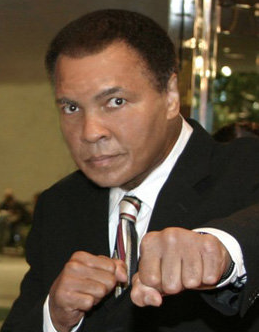
He was fast of fist and foot — lip, too — a heavyweight champion who promised to shock the world and did. He floated. He stung. Mostly he thrilled, even after the punches had taken their toll and his voice barely rose above a whisper.
He was The Greatest.
Muhammad Ali died Friday at age 74, according to a statement from the family. He was hospitalized in the Phoenix area with respiratory problems earlier this week, and his children had flown in from around the country.
“It’s a sad day for life, man. I loved Muhammad Ali, he was my friend. Ali will never die,” Don King, who promoted some of Ali’s biggest fights, told The Associated Press early Saturday. “Like Martin Luther King his spirit will live on, he stood for the world.”
A funeral will be held in his hometown of Louisville, Kentucky. The city plans a memorial service Saturday.
Louisville Mayor Greg Fischer ordered flags lowered to half-staff to honor Ali.
“The values of hard work, conviction and compassion that Muhammad Ali developed while growing up in Louisville helped him become a global icon,” Fischer said. “As a boxer, he became The Greatest, though his most lasting victories happened outside the ring.”
With a wit as sharp as the punches he used to “whup” opponents, Ali dominated sports for two decades before time and Parkinson’s disease, triggered by thousands of blows to the head, ravaged his magnificent body, muted his majestic voice and ended his storied career in 1981.
He won and defended the heavyweight championship in epic fights in exotic locations, spoke loudly on behalf of blacks, and famously refused to be drafted into the Army during the Vietnam War because of his Muslim beliefs.
Despite his debilitating illness, he traveled the world to rapturous receptions even after his once-bellowing voice was quieted and he was left to communicate with a wink or a weak smile.
“He was the greatest fighter of all time but his boxing career is secondary to his contribution to the world,” promoter Bob Arum told the AP early Saturday. “He’s the most transforming figure of my time certainly.”
Revered by millions worldwide and reviled by millions more, Ali cut quite a figure, 6-foot-3 and 210 pounds in his prime. “Float like a butterfly, sting like a bee,” his cornermen exhorted, and he did just that in a way no heavyweight had ever fought before.
He fought in three different decades, finished with a record of 56-5 with 37 knockouts — 26 of those bouts promoted by Arum — and was the first man to win heavyweight titles three times.
He whipped the fearsome Sonny Liston twice, toppled the mighty George Foreman with the rope-a-dope in Zaire, and nearly fought to the death with Joe Frazier in the Philippines. Through it all, he was trailed by a colorful entourage who merely added to his growing legend.
“Rumble, young man, rumble,” cornerman Bundini Brown would yell to him.
And rumble Ali did. He fought anyone who meant anything and made millions of dollars with his lightning-quick jab. His fights were so memorable that they had names — “Rumble in the Jungle” and “Thrilla in Manila.”
But it was as much his antics — and his mouth — outside the ring that transformed the man born Cassius Clay into a household name as Muhammad Ali.
“I am the greatest,” Ali thundered again and again.
Few would disagree.
Ali spurned white America when he joined the Black Muslims and changed his name. He defied the draft at the height of the Vietnam war — “I ain’t got no quarrel with them Viet Cong” — and lost 3 1/2 years from the prime of his career. He entertained world leaders, once telling Philippines President Ferdinand Marcos: “I saw your wife. You’re not as dumb as you look.”
He later embarked on a second career as a missionary for Islam.
“Boxing was my field mission, the first part of my life,” he said in 1990, adding with typical braggadocio, “I will be the greatest evangelist ever.”
Ali couldn’t fulfill that goal because Parkinson’s robbed him of his speech. It took such a toll on his body that the sight of him in his later years — trembling, his face frozen, the man who invented the Ali Shuffle now barely able to walk — shocked and saddened those who remembered him in his prime.
“People naturally are going to be sad to see the effects of his disease,” Hana, one of his daughters, said, when he turned 65. “But if they could really see him in the calm of his everyday life, they would not be sorry for him. He’s at complete peace, and he’s here learning a greater lesson.”
The quiet of Ali’s later life was in contrast to the roar of a career that had breathtaking highs along with terrible lows. He exploded on the public scene with a series of nationally televised fights that gave the public an exciting new champion, and he entertained millions as he sparred verbally with the likes of bombastic sportscaster Howard Cosell.
Ali once calculated he had taken 29,000 punches to the head and made $57 million in his pro career, but the effect of the punches lingered long after most of the money was gone. That didn’t stop him from traveling tirelessly to promote Islam, meet with world leaders and champion legislation dubbed the Muhammad Ali Boxing Reform Act. While slowed in recent years, he still managed to make numerous appearances, including a trip to the 2012 London Olympics.
Despised by some for his outspoken beliefs and refusal to serve in the U.S. Army in the 1960s, an aging Ali became a poignant figure whose mere presence at a sporting event would draw long standing ovations.
With his hands trembling so uncontrollably that the world held its breath, he lit the Olympic torch for the 1996 Atlanta Games in a performance as riveting as some of his fights.
A few years after that, he sat mute in a committee room in Washington, his mere presence enough to convince lawmakers to pass the boxing reform bill that bore his name.
Members of his inner circle weren’t surprised. They had long known Ali as a humanitarian who once wouldn’t think twice about getting in his car and driving hours to visit a terminally ill child. They saw him as a man who seemed to like everyone he met — even his archrival Frazier.
“I consider myself one of the luckiest guys in the world just to call him my friend,” former business manager Gene Kilroy said. “If I was to die today and go to heaven it would be a step down. My heaven was being with Ali.”
One of his biggest opponents would later become a big fan, too. On the eve of the 35th anniversary of their “Rumble in the Jungle,” Foreman paid tribute to the man who so famously stopped him in the eighth round of their 1974 heavyweight title fight, the first ever held in Africa.
“I don’t call him the best boxer of all time, but he’s the greatest human being I ever met,” Foreman said. “To this day he’s the most exciting person I ever met in my life.”
Born Cassius Marcellus Clay on Jan. 17, 1942, in Louisville, Kentucky, Ali began boxing at age 12 after his new bicycle was stolen and he vowed to policeman Joe Martin that he would “whup” the person who took it.
He was only 89 pounds at the time, but Martin began training him at his boxing gym, the beginning of a six-year amateur career that ended with the light heavyweight Olympic gold medal in 1960.
Ali had already encountered racism. On boxing trips, he and his amateur teammates would have to stay in the car while Martin bought them hamburgers. When he returned to Louisville with his gold medal, the Chamber of Commerce presented him a citation but said it didn’t have time to co-sponsor a dinner.
In his autobiography, “The Greatest,” Ali wrote that he tossed the medal into the Ohio River after a fight with a white motorcycle gang, which started when he and a friend were refused service at a Louisville restaurant.
The story may be apocryphal, and Ali later told friends he simply misplaced the medal. Regardless, he had made his point.
After he beat Liston to win the heavyweight title in 1964, Ali shocked the boxing world by announcing he was a member of the Black Muslims — the Nation of Islam — and was rejecting his “slave name.”
As a Baptist youth he spent much of his time outside the ring reading the Bible. From now on, he would be known as Muhammad Ali and his book of choice would be the Koran.
Ali’s affiliation with the Nation of Islam outraged and disturbed many white Americans, but it was his refusal to be inducted into the Army that angered them most.
That happened on April 28, 1967, a month after he knocked out Zora Folley in the seventh round at Madison Square Garden in New York for his eighth title defense.
He was convicted of draft evasion, stripped of his title and banned from boxing.
Ali appealed the conviction on grounds he was a Muslim minister. He married 17-year-old Belinda Boyd, the second of his four wives, a month after his conviction, and had four children with her. He had two more with his third wife, Veronica Porsche, and he and his fourth wife, Lonnie Williams, adopted a son.
During his banishment, Ali spoke at colleges and briefly appeared in a Broadway musical called “Big Time Buck White.” Still facing a prison term, he was allowed to resume boxing three years later, and he came back to stop Jerry Quarry in three rounds on Oct. 26, 1970, in Atlanta despite efforts by Georgia Gov. Lester Maddox to block the bout.
He was still facing a possible prison sentence when he fought Frazier for the first time on March 8, 1971, in what was labeled “The Fight of the Century.”
A few months later the U.S. Supreme Court overturned the conviction on an 8-0 vote.
“I’ve done my celebrating already,” Ali said after being informed of the decision. “I said a prayer to Allah.”
Many in boxing believe Ali was never the same fighter after his lengthy layoff, even though he won the heavyweight championship two more times and fought for another decade.
Perhaps his most memorable fight was the “Rumble in the Jungle,” when he upset a brooding Foreman to become heavyweight champion once again at age 32.
Many worried that Ali could be seriously hurt by the powerful Foreman, who had knocked Frazier down six times in a second round TKO.
But while his peak fighting days may have been over, he was still in fine form verbally. He promoted the fight relentlessly, as only he could.
“You think the world was shocked when Nixon resigned,” he said. “Wait till I whup George Foreman’s behind.”
Ali won over a country before he won the fight, mingling with people as he trained and displaying the kind of playful charm the rest of the world had already seen. On the plane into the former Congo he asked what the citizens of Zaire disliked most. He was told it was Belgians because they had once colonized the country.
“George Foreman is a Belgian,” Ali cried out to the huge crowd that greeted him at the airport. By the time the fight finally went off in the early morning hours of Oct. 30, 1974, Zaire was his.
“Ali booma-ya (Ali kill him),” many of the 60,000 fans screamed as the fight began in Kinshasa.
Ali pulled out a huge upset to win the heavyweight title for a second time, allowing Foreman to punch himself out. He used what he would later call the “rope-a-dope” strategy — something even trainer Angelo Dundee knew nothing about.
Finally, he knocked out an exhausted Foreman in the eighth round, touching off wild celebrations among his African fans.
“I told you I was the greatest,” Ali said.
That might have been argued by followers of Joe Louis or Rocky Marciano or Sugar Ray Robinson, but there was no doubt that Ali was just what boxing needed in the early 1960s.
He spouted poetry and brash predictions. After the sullen and frightening Liston, he was a fresh and entertaining face in a sport that struggled for respectability.
At the weigh-in before his Feb. 25, 1964, fight with Liston, Ali carried on so much that some observers thought he was scared stiff and suggested the fight in Miami Beach be called off.
“The crowd did not dream when they lay down their money that they would see a total eclipse of the Sonny,” Ali said.
Ali went on to punch Liston’s face lumpy and became champion for the first time when Liston quit on his stool after the sixth round.
“Float like a butterfly, sting like a bee,” became Ali’s rallying cry.
His talent for talking earned him the nickname “The Louisville Lip,” but he had a new name of his own in mind: Muhammad Ali.
“I don’t have to be what you want me to be,” he told reporters the morning after beating Liston. “I’m free to be who I want.”
Frazier refused to call Ali by his new name, insisting he was still Cassius Clay. So did Ernie Terrell in their Feb. 6, 1967, fight, a mistake he would come to regret through 15 long rounds.
“What’s my name?” Ali demanded as he repeatedly punched Terrell in the face. “What’s my name?”
By the time Ali was able to return to the ring following his forced layoff, he was bigger than ever. Soon he was in the ring for his first of three epic fights against Frazier, with each fighter guaranteed $2.5 million.
Before the fight, Ali called Frazier an “Uncle Tom” and said he was “too ugly to be the champ.” His gamesmanship could have a cruel edge, especially when it was directed toward Frazier.
In the first fight, though, Frazier had the upper hand. He relentlessly wore Ali down, flooring him with a crushing left hook in the 15th round and winning a decision.
It was the first defeat for Ali, but the boxing world had not seen the last of him and Frazier in the ring. Ali won a second fight, and then came the “Thrilla in Manila” on Oct. 1, 1975, in the Philippines, a brutal bout that Ali said afterward was “the closest thing to dying” he had experienced.
Ali won that third fight but took a terrific beating from the relentless Frazier before trainer Eddie Futch kept Frazier from answering the bell for the 15th round.
“They told me Joe Frazier was through,” Ali told Frazier at one point during the fight.
“They lied,” Frazier said, before hitting Ali with a left hook.
The fight — which most in boxing agree was Ali’s last great performance — was part of a 16-month period on the mid-1970s when Ali took his show on the road, fighting Foreman in Zaire, Frazier in the Philippines, Joe Bugner in Kuala Lumpur, Malaysia, and Jean Pierre Coopman in Puerto Rico.
The world got a taste of Ali in splendid form with both his fists and his mouth.
In Malaysia, a member of the commission in charge of the gloves the fighters would wear told Ali they would be held in a prison for safekeeping before the fight.
“My gloves are going to jail,” shouted a wide-eyed Ali. “They ain’t done nothing — yet!”
Ali would go on to lose the title to Leon Spinks, then come back to win it a third time on Sept. 15, 1978, when he scored a decision over Spinks in a rematch before 70,000 people at the Superdome in New Orleans.
Ali retired, only to come back and try to win the title for a fourth time against Larry Holmes on Oct. 2, 1980, at Caesars Palace in Las Vegas. Ali grew a mustache, pronounced himself “Dark Gable” and got down to a svelte 217 1/2 pounds to beat Father Time. But Holmes, his former sparring partner, mercifully toyed with him until Dundee refused to let Ali answer the bell for the 11th round.
“He was like a little baby after the first round,” Holmes said. “I was throwing punches and missing just for the hell of it. I kept saying, ‘Ali, why are you taking this?’
“He said, ‘Shut up and fight, I’m going to knock you out.'”
When the fight was over, Holmes and his wife went upstairs to pay their respects to Ali. In a darkened room, Holmes told Ali that he loved him.
“Then why did you whip my ass like that?” Ali replied.
A few years later, Ali said he would not have fought Holmes if he didn’t think he could have won.
“If I had known Holmes was going to whip me and damage my brain, I would not have fought him,” Ali said. “But losing to Holmes and being sick are not important in God’s world.”
It was that world that Ali retreated to, fighting just once more, losing a 10-round decision to Trevor Berbick in the Bahamas.
With his fourth wife, Lonnie, at his side, Ali traveled the world for Islam and other causes. In 1990, he went to Iraq on his own initiative to meet with Saddam Hussein and returned to the United States with 15 Americans who had been held hostage.
One of the hostages recounted meeting Ali in Thomas Hauser’s 1990 biography “Muhammad Ali — His Life and Times.”
“I’ve always known that Muhammad Ali was a super sportsman; but during those hours that we were together, inside that enormous body I saw an angel,” hostage Harry Brill-Edwards said.
For his part, Ali didn’t complain about the price he had paid in the ring.
“What I suffered physically was worth what I’ve accomplished in life,” he said in 1984. “A man who is not courageous enough to take risks will never accomplish anything in life.”
Rep. Tom Moxley, a moderate Republican from Council Grove, is among Kansas legislators who are not seeking re-election. CREDIT JIM MCLEAN / KHI NEWS SERVICE
By JIM MCLEAN
The stage is set for what many believe could be a pivotal 2016 election season in Kansas.
With campaigns for all 165 seats in the Legislature, the opportunity for change is reflected in the roster of candidates certified by Kansas Secretary of State Kris Kobach after Wednesday’s filing deadline.
For the first time in decades, Democrats, who currently hold only eight seats in the Kansas Senate, have fielded candidates in all 40 Senate districts. Several moderate House Republicans who survived stiff challenges from conservatives in the 2014 primary are running unopposed this year.
“Democrats and moderate Republicans, at least in terms of candidate recruitments, are certainly on offense and not defense this year,” says Patrick Miller, a University of Kansas political scientist who has studied voting patterns across the state.
The electoral climate favors candidates not tied to Republican Gov. Sam Brownback and his budget and tax policies, Miller says.
“It’s no secret, we have multiple polls this year that show — despite what anyone says to refute it — that Brownback is pretty unpopular,” he says. “And the headlines coming out of Topeka are not positive. So, if you’re a Democrat or a moderate Republican, you might be able to take advantage of that.”
The state’s continuing budget mess, compounded by Wednesday’s news that May tax receipts were nearly $74 million short of revised estimates, has created opportunities for Democrats and moderate Republicans to regain ground lost to conservative Republicans who seized control of the Legislature in 2012 and solidified it in 2014, Miller says.
“Whether that happens will be determined on a race-by-race basis,” he says.
A total of 354 candidates are running for House and Senate seats, down overall from 399 in 2012. But, the 150 Democrats running for the Legislature exceeds the 140 fielded by the party in 2012, while the number of Republicans candidates has fallen from 259 to 204.
In the Senate contests, 47 Democrats and 53 Republicans are competing for 40 seats. On the House side, 151 Republicans and 103 Democrats are vying for 125 seats.
The retirements of several veteran GOP lawmakers are a contributing factor. Conservative Republican senators Les Donovan, Mitch Holmes, Ralph Ostmeyer, Michael O’Donnell and Garrett Love are not seeking re-election. Neither are the top two GOP leaders in the House: Speaker Ray Merrick and Speaker Pro Tem Peggy Mast. They head a list of more than a dozen House Republicans who are stepping down.
Most of the Republicans who are not running again were reliable supporters of Brownback. Many held leadership positions or chaired important committees. Mast, along with Senate Education Committee Chair Steve Abrams, is among a handful who withdrew only hours before the filing deadline.
Rep. Tom Moxley, a moderate Republican from Council Grove who is not seeking re-election for personal reasons, thinks many of his conservative colleagues aren’t returning because they know the state’s budget problems will be difficult to solve.
“I think they’re bailing,” Moxley says. “They’ve seen what they’ve done and they don’t want to fix it.”
Rep. Steven Anthimides isn’t bailing, even though he may be more conservative than the voters in his Wichita district. His is one of several swing districts that Miller identified based on recent gubernatorial and presidential elections.
Anthimides acknowledges that the state is facing big problems. But he says voters can trust him to help fix them.
“I don’t like to take blame but I will take responsibility,” Anthimides says. “You know, we’re all here for the same reason. I don’t think anyone is elected to ruin Kansas. We’re all here to make it better.”
Jim McLean is executive editor of KHI News Service in Topeka, a partner in a statewide collaboration covering elections in Kansas. Follow him on Twitter @jmckhi.
CHASE COUNTY –A Kansas man was injured in an accident just after 9:30p.m. on Friday in Chase County.
The Kansas Highway Patrol reported Chase County Sheriff Richard Dorneker in a Ford SUV was in pursuit of a 1982 Honda ATV driven by Charles J. Horst, 32, Emporia.
Both vehicles exited onto U.S. 50 from Kansas 177.
The ATV crashed into the ditch. Horst recovered the ATV crossed U50 and crashed again.
Horst was transported to Newman Regional Medical Center. Dorneker was not injured.
The Chase County Sheriff’s Office has not released what prompted the pursuit and possible charges.
MANHATTAN–From sunrise to sundown, from the heat of the summer to the cold of the winter, Kansas farmers and ranchers know there is great beauty in agriculture. Photographers are encouraged to capture that beauty and share it with others through the Kansas Department of Agriculture’s annual photo contest. KDA will began accepting photos Wed., June 1.
Photos must be submitted no later than 5:00 p.m. on Monday, August 1. Winners will be announced on Monday, October 3.
This year, KDA is adding new categories to promote different aspects of Kansas agriculture. Farmers and ranchers work year-round to produce food, fiber and energy. Spring, Summer, Winter and Fall categories will showcase agriculture during all times of the year. Water, a major component of Kansas agriculture, will also have its own category in the photo contest. Irrigation systems, ponds, rivers and other water sources create beauty in our Kansas infrastructure. In addition, there will be a separate Youth division, for young photographers age 19 and under.
KDA serves to advocate for the agriculture industry, the state’s largest industry. Photos capturing the moments of bliss, struggle and joy in Kansas agriculture will be used to promote the state’s largest economic driver. Prizes will be awarded to the top two winners in each of the six categories: Spring, Summer, Winter, Fall and Water as well as the Youth division.
Guidelines for the contest can be found at: agriculture.ks.gov/photocontest. After submission, the Kansas Department of Agriculture is granted permission to use any photograph for publications, social media, websites, displays, etc. without payment or other consideration from the photographer.
Follow KDA on Facebook, Twitter, Pinterest and Instagram for more details on the contest, including deadlines, divisions and prizes. For more information, contact KDA Director of Communications Heather Lansdowne at [email protected] or (785) 564-6706.
LEAWOOD, Kan. (AP) — A federal workplace safety investigation is planned in the case of a man who fell to his death from scaffolding during an apartment renovation site in suburban Kansas City.
The U.S. Department of Labor’s Occupational Safety and Health Administration says it will scrutinize the death Friday in Leawood, Kansas, of a Van Trust Real Estate LLC employee.
The man’s name, age and hometown have not been released.
As OSHA’s area director in Wichita, Kansas, Judy Freeman says the agency extends its sympathies to the victim’s family and friends. She says OSHA will thoroughly investigate whether any safety standards were violated.
TOPEKA, Kan. (AP) — Gov. Sam Brownback has appointed the retired chief financial officer of an advertising and public relations agency to lead a review of the state’s revenue-projecting process.
Brownback announced Friday that Sam Williams of Wichita will help budget director Shawn Sullivan evaluating the forecasting process. The governor’s office also said Williams will help analyze tax policy.
The governor’s budget staff, Department of Revenue officials, legislative researchers and university economists issue revenue forecasts for state government twice a year. Tax collections have fallen short of their projections 10 of the past 12 months.
Williams is a former CFO for Sullivan Higdon & Sink who ran unsuccessfully for Wichita mayor in 2015. He also served as chairman of a task force set up in 2014 to look for efficiencies in public schools.
LAWRENCE, Kan. (AP) — A woman has admitted that she killed a Lawrence woman who had given her a place to live.
Angelica Kulp pleaded guilty Thursday to second-degree murder and aggravated burglary in a plea agreement that dropped a first-degree murder charge.
The Lawrence Journal-World reports Kulp killed 56-year-old Christine Kaplan in July 2014. Police found dozens of stab wounds on Kaplan’s body when it was found in her home.
Prosecutor Eve Kemple says Kaplan was known for helping those in need and had given Kulp a place to stay. But Kaplan eventually asked Kulp to leave and said she was afraid of her.
Several days after Kaplan’s body was found, Kulp was arrested in Topeka after an unrelated burglary of an acquaintance’s house.
TOPEKA, Kan. (AP) — A spokeswoman for Gov. Sam Brownback says his staff is looking at shuffling funds within state government to cover a projected short-term budget deficit.
But Brownback spokeswoman Eileen Hawley said Friday that budget-balancing measures won’t be finalized until officials have a better picture of revenues this month.
Tax collections fell $74.5 million short of expectations in May. That leaves Kansas with a projected deficit of about $45 million when the fiscal year ends June 30.
Hawley said the governor does not anticipate trimming spending to address the problem. But making cuts so late in a fiscal year is difficult anyway.
She said the governor’s budget staff is looking at diverting fees collected in dozens of special funds into the state’s main bank account, where the shortfall would occur.
ELLSWORTH COUNTY – On Friday, Joe Shepack, Ellsworth County Attorney provided an update on the conviction and sentencing of two Great Bend juveniles involved in the incident on a school swim team bus trip.
In a media release, Shepack stated: On May 31, 2016, Connor Furrey, age 17, of Great Bend was convicted of a Class “B” misdemeanor battery in Ellsworth County District Court Case 2016-JV-04. Sentencing has been set for 2:00 P.M. on July 5, 2016. Mr. Furrey will remain free on bond until sentencing.
On June 1, 2016, Mr. Furrey’s co-defendant, Alan Matthew Bobbitt, was sentenced pursuant to his conviction for a Class “B” misdemeanor battery. Sentencing was conducted by the Honorable District Magistrate Judge Verle Willey.
The sentence was sentence to probation through May of 2017.
The sentencing judge noted that this was Mr. Bobbitt’s first conviction for a misdemeanor and that Mr. Bobbitt had previously issued an apology, through social media, to the victim, and that neither the victim nor a spokesperson for the victim appeared at sentencing, notwithstanding having been given notice of the sentencing date and time back in April of 2016. The sentencing judge also took note of a pending civil lawsuit directed at Mr. Bobbitt’s parents, which necessarily precluded Mr. Bobbitt from speaking on his own behalf at his sentencing.
On May 11, in Ellsworth County District Court Case (2016-CV-17) a lawsuit seeking monetary damages was filed on behalf of the defendant against twenty-one (21) named defendants including the Superintendent of USD 428; the Principal of Great Bend High School; two (2) Great Bend swim team coaches, a bus driver, and members of the USD #428 School Board. Also included as defendants are the parents of certain Great Bend High School students, including the parents of Mr. Bobbitt and Mr. Furrey.
The Ellsworth County Attorney makes no comment about the merits, or lack thereof, of said lawsuit, other than to remind the public that the standards of proof for civil lawsuits and criminal proceedings are vastly different.
To compare, a plaintiff in a civil lawsuit can prevail by presenting evidence that is 51% believable. This is called proving a case by a preponderance of the evidence. In criminal cases, the standard for conviction is “proof beyond a reasonable doubt”. Although there are no Kansas cases quantifying “proof beyond a reasonable doubt”, logic would suggest that we are talking about a 98% or 99% or 100% proof of guilt. Thus, persons who may not be convicted, nor even charged in criminal cases, may still face civil liability. Indeed, comparing civil cases to criminal cases is like comparing apples to oranges.
HUTCHINSON -A Kansas woman entered a guilty plea to intentional second-degree murder on Friday in the strangulation death of 38-year-old Mary Ann Arnett in June of last year.
Jamie Hatfield, 27, Hutchinson, enter the plea to the single count while all other charges were dismissed by the District Attorney.
Arnett’s body was found in a dry creek bed near Nickerson.
An autopsy showed she had been strangled by a cell phone cord and extension cord.
Prosecutors say Hatfield and Jonathan Perser-Wilson were involved in Arnett’s death.
PerserWilson was shot and killed by police during a confrontation the day after Arnett’s body was found.
Arnett and Hatfield had previously dated but when Arnett’s body was found, Hatfield was in a relationship with Wilson.
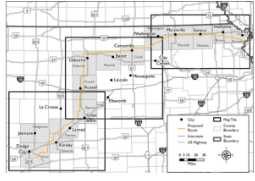
The overview map on this page depicts the route of the Grain Belt Express Clean Line in Kansas- Image Clean Line Energy Partners.
ST. LOUIS (AP) — A group representing Missouri municipal utilities has signed up for space on a transmission line that would carry wind power from western Kansas across Missouri and further east.
The Missouri Joint Municipal Electric Utility Commission said Thursday it signed an agreement for up to 200 megawatts of transmission space on the Grain Belt Express. The St. Louis Post-Dispatch reports the commission represents municipal utilities that pool their resources to buy power.
The Missouri Public Service Commission blocked the transmission line last summer after strong opposition from landowners along the line’s proposed route.
Texas-based Clean Line Energy, which is proposing the transmission line, says the agreement proves that there are customers for the line in Missouri.
Grain Belt Express has already won approval from Kansas, Indiana and Illinois regulators.
BOURBON COUNTY – A Kansas woman was injured in an accident just before 7:30a.m. on Friday in Bourbon County.
The Kansas Highway Patrol reported a 2013 Chevy Equinox driven by Christel Jean Goodell, 40, Pittsburg, was south bound in the rain on U.S. 69 four miles south of Kansas 7.
The vehicle hydroplaned and slid off the road into the east ditch
Goodell was transported to Mercy Hospital.
She was properly restrained at the time of the accident, according to the KHP.





 KDA
KDA
 LEAWOOD, Kan. (AP) — A federal workplace safety investigation is planned in the case of a man who fell to his death from scaffolding during an apartment renovation site in suburban Kansas City.
 TOPEKA, Kan. (AP) — Gov. Sam Brownback has appointed the retired chief financial officer of an advertising and public relations agency to lead a review of the state’s revenue-projecting process.








 BOURBON COUNTY – A Kansas woman was injured in an accident just before 7:30a.m. on Friday in Bourbon County.