TOPEKA, Kan. (AP) — Top Republicans in the Kansas Legislature hope to finish work on a plan for balancing a state budget that would require GOP Gov. Sam Brownback to do most of the work.
The House was taking the measure up first Sunday. If its members approved the bill, the Senate would decide whether to send it to Brownback.
Rejection in either chamber would require the legislative negotiators who drafted the plan to write a new one.
The plan would only partially close shortfalls totaling more than $290 million in the current budget and the one for the next fiscal year beginning July 1.
The plan assumes Brownback follows through with announced plans to cut higher education spending and delay major highway projects so road funds can be diverted to general government programs.
LINCOLN, Neb. (AP) — Nebraska Attorney General Doug Peterson and his counterpart in Oklahoma are joining a lawsuit aimed at halting legal marijuana in Colorado.
The Lincoln Journal Star reports that the two states asked to be added as plaintiffs this month in a case being considered by an appeals court in Denver.
The appeal combines two separate cases: one on behalf of a Colorado couple who own land near a recreational marijuana growing facility and another brought one by a group of sheriffs from Colorado, Kansas and Nebraska.
Oklahoma and Nebraska argue they have “unique sovereign interests” in stopping marijuana from crossing their state borders, and that they shouldn’t be left out as the court weighs the issue.
The U.S. Supreme Court denied considering a similar lawsuit by states in March.
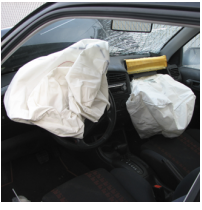
NEW YORK (AP) — Nearly 4 million Nissan cars are being recalled due to major safety problems where passenger air bags or seat belts could fail in a crash.
Nissan North America, Inc. says the first problem is with a sensor that detects if the front passenger seat is occupied. The issue, with 3.2 million cars, can have the computer incorrectly think that an adult is a child or classify the seat as empty, turning off the air bag.
A number of models are affected including the Maxima, Altima, LEAF, Sentra, Pathfinder and some Infiniti models.
A second problem affects 620,000 Sentras and their front seat child restraint system, which might cause air bags to inflate when they shouldn’t.
Nissan says it will notify owners and fix the issues free of charge.
Two killed in 2014 Ottawa Co. crash- photo courtesy KWCH
MINNEAPOLIS, Kan. (AP) — A north-central Kansas man faces more than 16 years in prison for a vehicle crash that killed a teenager and her father.
Jason Jeardoe of Bennington was convicted earlier of involuntary manslaughter while driving under the influence of alcohol in the 2014 deaths of Jason Pisocki and his daughter, Emma Jo Pisocki.
The Topeka Capital-Journal reports Jeardoe was sentenced Friday to 16 years and three months in jail.
The Kansas Highway Patrol says the collision occurred April 11, 2014, about three miles west of Bennington. A parked vehicle was partially in the westbound lane, and Jeardoe, who was driving west, moved his pickup truck into the eastbound lane to avoid it, colliding head-on with the Pisockis’ vehicle.
LAWRENCE, Kan. (AP) — A Kansas man has been sentenced to life in prison for a 2014 home invasion that left another man dead.
The Kansas City Star reports 31-year-old Dustin Walker of Lawrence must serve 20 years before he is eligible for parole after being sentenced Friday.
The life sentence was ordered to run consecutively with a sentence of 10 years and 10 months for aggravated burglary.
Walker was found guilty last month of first-degree murder for the March 2014 killing of Patrick Roberts.
Roberts was fatally shot inside a Lawrence apartment after two men broke in and demanded, “Where is it?”
Roberts’ brother wrestled the gun from one of the intruders, who fled. A co-defendant previously was sentenced to life in prison with no chance of parole for 20 years.
WASHINGTON (AP) — The Food and Drug Administration is reconsidering whether doctors who prescribe painkillers like OxyContin should be required to take safety training courses, according to federal documents.
A panel of FDA advisers meets next week to review risk-management plans put in place nearly four years ago to reduce misuse and abuse of long-acting painkillers, powerful opioids frequently abused for their euphoric effects.
Under the current risk programs, drugmakers fund voluntary training for physicians in safely prescribing their medications. However, many experts — including a previous panel of FDA advisers — said the measures didn’t go far enough and that physician training should be mandatory.
The FDA will ask outside safety experts on Tuesday what changes should be made to improve the risk plans, according to briefing documents posted Friday.
WICHITA, Kan. (AP) — A woman has been found guilty in the death of another woman who was hit by an SUV in Wichita following an argument at a party.
The Wichita Eagle reports that 31-year-old Tiplance Walker was convicted of second-degree intentional murder and two counts of child endangerment Friday. Prosecutors say Walker rammed her SUV into a backyard chain-link fence at 31-year-old Lydia Treto’s home on May 17, 2015, striking Treto.
Authorities say Walker’s 10-year-old and 4-month-old sons were in the vehicle at the time of the collision.
TOPEKA, Kan. (AP) — The Kansas Court of Appeals has ruled that a man could be convicted of driving under the influence using evidence obtained under a defunct law.
The appeals panel ruled Friday that the statute in question had been struck down by the Kansas Supreme Court after Brent Kraemer’s 2013 arrest in Salina for suspicion of DUI.
The Topeka Capital-Journal reports the officer read Kraemer an implied consent advisory, informing him of a criminal charge if he refused to take a blood-alcohol test. Kraemer agreed to take the test, which he failed.
Since then that advisory has been replaced.
Kraemer wanted the appeals court to find his consent was obtained by an unconstitutional advisory. But the appeals panel says the ruling stands because the law was in effect at the time.
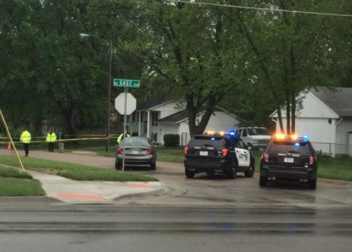
SHAWNEE COUNTY – Law enforcement authorities in Shawnee County are investigating a shooting near a child care center.
Just after 5 p.m. on Friday, police responded to 33rd and Gage Street in Topeka after report that a man was wounded, according to a media release.
The victim was transported to a local hospital with non-life threatening injuries.
Several rounds from the weapon were fired, according to police. One bullet also hit a building used as a child care center. There were no injuries in that facility.
Police are looking for a black male suspect driving a 2-door Chrysler convertible.
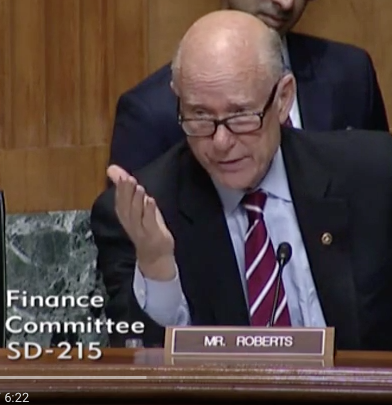
WASHINGTON, DC – U.S. Senator Pat Roberts (R-Kan.) on Thursday said that the administration’s latest proposed drug rule for Medicare Part B could disrupt care and quality of life for Medicare patients, or “ration” care as Roberts predicted during the initial debate on the Affordable Care Act.
Speaking at a Senate Finance Committee hearing on mental health, Roberts said, “When this committee was debating the Affordable Care Act, I was concerned about several provisions that I believed would decrease individual choice and open the door to government rationing of health care. I’m sorry to say that with this latest proposal from CMMI, my fears are coming home to roost.”
For video of the Senator’s remarks at the here go here.
Last month, the Center for Medicare and Medicaid Innovation (CMMI) proposed changes to how the government pays for prescription drugs under Medicare Part B. The proposal would reduce reimbursements on new medications and could limit access to others that the administration does not deem “high value.” This could result in patients being switched to products that are less effective or have more side effects. Over 300 organizations are asking that this rule be withdrawn. In addition, all Republican members of the Senate Finance Committee sent a letter to CMS this week requesting the agency withdraw this proposal.
In 2014, Roberts spoke on the Senate floor warning of the dangers of the government’s expanded authorities over healthcare as a result of Obamacare. He said, “Let me start with something called the Center for Medicare and Medicaid Innovation. Yep, another fancy big government name. And the center has an enormous budget to match – aimed at finding innovative ways to reform payment and the delivery of health care.
“Sounds good, but, what this really means is that the ‘Innovation Center’ can now use taxpayer dollars to invest in ways to reduce patient access to care. Let me say that again: the government can now use taxpayer dollars to invest in ways to reduce patient access to care. It gives the government new powers to cut payments to Medicare beneficiaries with the goal to reduce program expenditures. However, the reality is they will reduce patients’ ability to access the care they want and need. All hidden under the cloak of ‘innovation.’”
In 2014, Senator Roberts introduced legislation in response to this called the Four Rationers Repeal Act, which would repeal CMMI, and three other rationing bodies.
“I’ve been talking about the four rationers for a long time and what it means to patients,” Roberts said. “What really scares me, as I watch all the other warnings and broken promises come true, is what is going to happen to Kansans back home when the warnings about the four rationers come true. Access to quality care will be a thing of the past for Americans.”
GREENWOOD COUNTY- Two people died in an accident just after 4p.m. on Friday in Greenwood County,
The Kansas Highway Patrol reported a 2014 Honda Accord driven by Jerry Don Sconce, 68, Bethany, OK., was eastbound on U.S. 400 three miles east of Fall River.
The Honda drifted left of center and hit a westbound 2006 GMC Sierra driven by Ronald Jason Edwards, 40, Elk City, head-on.
Sconce and Edwards were pronounced dead at the scene. They were not wearing seat belts, according to the KHP.
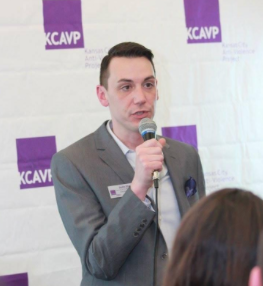
Justin Shaw is executive director of the Kansas City Anti-Violence Project, which recently opened a new facility to provide domestic violence services for LGBT individuals. CREDIT KCAVP
Congress voted in 2013 to require domestic abuse service providers who receive federal funds to offer help to people in same-sex relationships. But many advocates say LGBT people still have far fewer resources available to them than what’s traditionally been available for woman escaping violence from men.
To help fill that gap, the Kansas City Anti-Violence Project opened a center earlier this year in Westport to provide support for LGBT people living in the Great Plains region.
But the group’s executive director, Justin Shaw, tells KCUR’s Alex Smith that there’s still a lot of unwillingness – both inside and outside the community – to face up to the problem.
Are there a lot of misconceptions about violence within these communities?
People have for a long time looked at gay and lesbian and trans folks and bisexual folks in same-gender relationships as devious already. And so, well, of course two guys are going to get in a fight. Men are naturally violent. So of course two gay men are going to get in a fight. And it’s just a fight. It’s not violence. You know, domestic violence only happens to a woman from a man, from her husband. ’Cause that’s the story we’ve heard for so long and people only talking about domestic violence victims as being ‘her’ and things like that.
When it comes to sexual violence, again, we are looked at as a deviant – sexually deviant – community, so any sexual assault that could happen sometimes is looked at as – you wanted that, or violence is just naturally part of that. And I think that internalized homophobia within that affects a lot of people from reaching out and seeking services.
I wonder if there is resistance within the community from people who say they want to protect the image of people like them?
That is a huge thing. People often said, ‘Well people already look at us bad enough. Do want to report that as well? We just got marriage equality. Why do you want to go talk about the problems in your relationship to everybody?’ And I think there’s a lot of politics within the LGBTQ community about that, as far as there’s definitely groups of people that want to normalize the LGBTQ community or assimilate us into ‘we’re just the same as everybody else’ – which, in reality, nobody is the same as anybody else. And so to approach life from that kind of standpoint is really dangerous, because you’re not addressing specific needs of specific community members.
Are there particular issues or factors that more often lead to abuse in same-sex relationships?
I think it’s a lack of education about that it can happen to us, and I think that’s education to the community. I think that we try to get that information out there, but (if you) do an outreach at a bar on a Saturday night, people don’t want to talk about violence and abuse there. They’re there to escape the week of whatever has just faced them, whether that be discrimination or having to stay in the closet at their job. So just realization from the community that this violence happens first. And that there are people and services available for them.
Why reach out beyond Kansas City to provide services?
I think that Kansas City and St. Louis both have really vibrant LGBT communities, which is really exciting, and I think being in the middle of the map, so to speak, and then having these really kind of rural areas, (with) not a lot of big cities in the states around us – I think that we are a haven for people to go to come to. And so it’s important to be located and kind of based within there, but we do know that a lot of people don’t want to leave their homes if they consider themselves a country person or they are a farmer and they love farming. Why should they have to leave their home and escape to the city where they don’t know anybody? And it’s not always certain that they’ll find a community here. There’s people here, but as far as finding that feeling of community, that’s not always a guarantee.
What kind of help are you able to offer someone from, say, western Kansas?
Sure. We can start on the phone. This is something we do quite often, actually. We get calls from rural areas and kind of start on the phone. Try to assess safety needs. Part of the education and outreach we do across the states is not just to get more inclusive but it’s also to help our referral base, so we know of organizations that are actually competent, that aren’t just saying that they’re culturally competent, and so we can try to connect people with resources that are close to them. If there aren’t any, then our therapists can do phone therapy. If somebody really wants to come to Kansas City, we have funding to get transportation here. But like I said, that’s not everyone’s situation. So (we’re) trying to provide support to those folks however we can – and oftentimes that looks like regular checkups on the phone and that kind of support and being there.
Alex Smith is a reporter for the Heartland Health Monitor team. You can reach him on Twitter @AlexSmithKCUR
WICHITA, Kan. (AP) — A 23-year-old Kansas woman has pleaded guilty to second-degree reckless murder and other charges in the death of a 66-year-old woman in a September home invasion.
The Wichita Eagle reports the state plans to ask a judge to sentence Brittany McDay to 21 years and 5 months for her role in killing Jacquelyn Harvey in Harvey’s home.
Prosecutors say McDay and 22-year-old Jacob Strouse went to the neighborhood to collect a debt but kicked in the door to the wrong house and shot Harvey before realizing their mistake.
Prosecutors dropped other counts against McDay in exchange for Friday’s guilty plea to the murder charge, aggravated burglary and attempted criminal use of a financial card.
Strouse is scheduled for trial in August on first-degree murder and other felony charges.