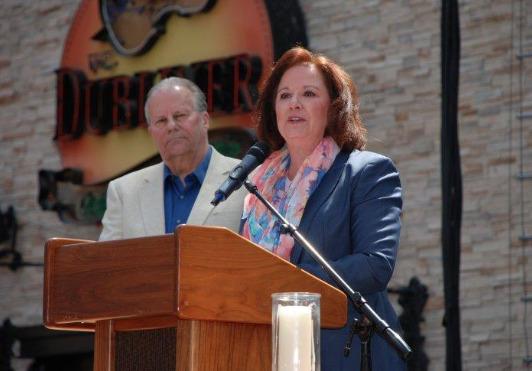
Shannon Catsoradis, president and CEO of Kansas Action for Children, says policy restrictions have reduced access to cash assistance for low-income Kansans. Credit File photo / Heartland Health Monitor
Kansas has fewer low-income families receiving cash assistance than at any time in the last decade, but less than 10 percent are recorded as leaving the program because they found jobs.
Gov. Sam Brownback has touted his administration’s success in reducing dependency by moving families from welfare to work. However, a Kansas children’s advocacy group that released an overview earlier this week on families removed from cash assistance said the data only supports the first half of that position and that families are being pushed deeper into poverty.
Shannon Cotsoradis, president and CEO of Kansas Action for Children, said policy restrictions have reduced access to cash assistance for low-income Kansas families.
She singled out the Hope, Opportunity and Prosperity for Everyone (HOPE) Act, which lowered the lifetime limit for cash assistance from 48 months to 36 months, as accelerating the rate of families leaving the Temporary Assistance for Needy Families program. Brownback signed the HOPE Act into law in April 2015. About 200 families hit the new limit and were removed from the program in January.
“For struggling Kansans, state-administered safety net programs are an essential lifeline to help families with children meet basic needs,” she said in a news release. “Less than a year since its implementation, the HOPE Act has already harmed Kansas’ most vulnerable kids.”
Theresa Freed, spokeswoman for the Kansas Department for Children and Families, said more people are working because of the requirements. About 450 Kansans receiving TANF reported new employment in November, the most recent month with data available, she said.
“It is unfortunate when organizations choose to encourage welfare dependence,” she said in an email. “The Kansas HOPE Act is designed to empower families with the tools they need to break the cycle of poverty, giving their children hope for a successful future.”
Fewer Kansans receiving TANF
The number of Kansas families receiving TANF has been falling since 2005, with the exception of a partial rebound in 2010 and 2011. In 2005, an average of 17,118 Kansas families with 30,321 children received TANF benefits each month. So far in 2016, the monthly average is far lower at 5,506 families and 9,630 children.
CLICK to Enlarge
It isn’t clear how many of those families left TANF because they obtained employment. In 2006, the U.S. Department of Health and Human Services reported about 41 percent of TANF cases that were closed in Kansas listed the reason as “employment.” In 2014, the most recent year with data available, only about 9 percent of closed TANF cases cited employment.
Families also can be removed from TANF if they hit federal or state time limits, fail to fulfill work requirements, break a program rule, voluntarily leave the program or are deemed uncooperative, for reasons such as missing eligibility appointments.
Freed said the records likely understate the number of Kansans who became employed, because some people who get jobs stop returning calls or request that their case be closed without providing a reason. About 20 percent of TANF closures in 2014 also are listed as for an unknown reason, she said. In 2005 it was about 9 percent.
“It is likely more have obtained employment but simply do not report that,” she said.
It isn’t clear if imprecise reporting entirely explains the decrease in closures due to employment, however. As unemployment increased from 2006 to 2010, the percentage of cases closed due to employment dropped off. The employment closures didn’t rebound as unemployment began to drop again in 2011, however, and it isn’t clear why the two measures no longer tracked closely through 2014.
Restrictions increase
Since 2011, the state has lowered the lifetime TANF limit from 60 months to 48 months, and then again to 36 months; shortened the time mothers of infants could go before resuming work or searching for a job; and increased the length of time recipients could be excluded from the program for not meeting work or child support requirements, according to a report this month from KAC.
Some other restrictions, including requiring job readiness screening and eliminating some hardship exemptions for families that hit the time limit, also took place under prior administrations. The state also made some changes that let more people remain eligible, including allowing disabled veterans to count their payments from the Veterans Administration as earned income.
More changes may be coming. Senate Bill 372, proposed in February, would lower the lifetime TANF limit again, to 24 months. DCF estimated about 420 families would be affected.
The bill, which passed the Senate 31-8, is among the measures being negotiated by a conference committee seeking to reconcile differences between House and Senate versions of several bills. The conference committee is expected to resume its negotiations when lawmakers return on April 27 for the final weeks of the 2016 session.
In recent years, many Kansans who no longer receive TANF remained below the poverty line, which is $11,770 a year for a single adult. Those who reported they were employed when they left TANF in 2014 had an average monthly income of $1,107, or $13,284 annually.
About 52 percent had no income other than TANF, and the 48 percent who did have some other source of income only received an average of $575 per month, or $6,900 per year, from work or other sources.
Still, for many that may have been a higher income than under TANF. The program only covers families in deep poverty, with a maximum of $6,228 in other income allowed for a family of three. Families that live in lower-cost counties or don’t have other income have lower limits.
Cotsoradis said studies have shown that children who have access to extra income and security through TANF and other safety net programs, such as food assistance and Medicaid, grow up to have higher earnings and are less likely to be involved in violent crimes or become teen mothers.
“Policymakers may be well intended in their desire to promote self-sufficiency among poor Kansas families, but data shows the most economically fragile Kansas children need access to the safety net,” she said. “Keeping the HOPE Act’s unnecessary restrictions in place does nothing but increase the likelihood that today’s poor children will become tomorrow’s poor adults.”
Megan Hart is a reporter for KHI News Service in Topeka, a partner in the Heartland Health Monitor team. You can reach her on Twitter @meganhartMC
WASHINGTON – Conventional strawberries top the Dirty Dozen™ list of EWG’s 2016 Shopper’s Guide to Pesticides in Produce, displacing apples, which headed the list the last five years running, according to a media release.
Nearly all strawberry samples – 98 percent – tested by federal officials had detectable pesticide residues. Forty percent had residues of 10 or more pesticides and some had residues of 17 different pesticides. Some of the chemicals detected on strawberries are relatively benign, but others are linked to cancer, reproductive and developmental damage, hormone disruption and neurological problems.
Strawberries were once a seasonal, limited crop, but heavy use of pesticides has increased yield and stretched the growing season. In California, where most U.S. strawberries are grown, each acre is treated with an astonishing 300 pounds of pesticides. More than 60 pounds are conventional chemicals that may leave post-harvest residues but most are fumigants – volatile poison gases that can drift into nearby schools and neighborhoods.
“It is startling to see how heavily strawberries are contaminated with residues of hazardous pesticides, but even more shocking is that these residues don’t violate the weak U.S. laws and regulations on pesticides in food,” said Sonya Lunder, EWG Senior Analyst. “The EPA’s levels of residues allowed on produce are too lax to protect Americans’ health. They should be updated to reflect new research that shows even very small doses of toxic chemicals can be harmful, particularly for young children.”
“Parents looking for help in lowering their children’s exposure to pesticides while still eating plenty of healthy fruits and vegetables can turn to the Environmental Working Group’s guide as an easy-to-use resource when shopping at the store,” said Dr. Philip Landrigan.
Dr. Landrigan is the Dean of Global Health and Director of the Children’s Environmental Health Center at Mt. Sinai School of Medicine, and was the principal author of the pivotal 1993 National Academy of Sciences study, “Pesticides in the Diets of Infants and Children,” that led Congress to pass the 1996 Food Quality Protection Act that set safety standards for pesticides on foods.
Recent studies of insecticides used on some fruits and vegetables, including strawberries, found that children exposed to high levels were at greater risk of impaired intelligence and ADHD. Research also indicates that the levels of pesticides in the bodies of elementary school children peaked during the summer, when they ate the most fresh produce. But after just five days on an organic diet, they were essentially pesticide-free.
The Dirty Dozen lists the fruits and vegetables that have been contaminated by multiple pesticides and which have higher concentrations of pesticides. More than 98 percent of strawberries, peaches, nectarines and apples tested positive for at least one pesticide residue. The average potato had more pesticides by weight than any other produce.
Avocados, on the other hand, remained atop EWG’s Clean Fifteen™ list with less than one percent of samples showing any detectable pesticides. No single fruit sample from the Clean Fifteen tested positive for more than four types of pesticides, and very few for more than one.
“Fruits and vegetables are important for your health,” Lunder said. “But for those on the Dirty Dozen, we recommend buying the organic versions if you want to avoid pesticides on your food. You can feel confident that conventionally grown fruits and veggies on the Clean Fifteen list have very little pesticide contamination.”
The Shopper’s Guide to Pesticides in Produce, updated every year since 2004, ranks pesticide contamination on 48 popular fruits and vegetables. EWG’s analysis is based on results of more than 35,200 samples tested by the U.S. Department of Agriculture and Food and Drug Administration. This year’s update found a total of 146 different pesticides on fruit and vegetable samples tested in 2014 – residues that remain on produce even after items are washed and in some cases peeled.
WASHINGTON – U.S. Senator Jerry Moran (R-Kan.) – member of the Senate Veterans’ Affairs Committee, Senate Appropriations Defense Committee, and Co-Chair of both the Senate Defense Communities Caucus and Senate Aerospace Caucus – took action during this week’s mark-up of the Fiscal Year 2017 Military Construction, Veterans Affairs and Related Agencies Appropriations Bill. The bill, which passed unanimously, will fund the Department of Veterans Affairs (VA) for FY17, and prioritizes funds for various projects and programs carried out by the VA. The full committee supported Sen. Moran’s call for the VA to commit to studying toxic exposure and related health conditions affecting veterans and potentially their children and grandchildren.
“I’m pleased the committee approved critical bill and report language taking important steps to push the VA to resolve systemic problems and toward doing what is in the best interest of veterans, including addressing the impact of toxic exposure on our military members and their families,” Sen. Moran said. “Additionally, the full committee agreed to a two-year extension for Project ARCH to make certain veterans within the program have continuity in their health care.”
The committee unanimously approved Sen. Moran’s amendment to prohibit use of funds for the VA’s Appraised Value Offer (AVO) Program, which assists in relocations of Senior Executive Service (SES) employees and has been abused by several VA employees for personal gain. This language mirrors a prohibition included in the FY16 appropriations bill.
Numerous Sen. Moran priorities in the FY2017 Military Construction, Veterans Affairs and Related Agencies Appropriations Bill and accompanying report include:
• National Academy of Medicine Study on Toxic Exposure
Requires the VA to enter into a contract with the National Academy of Medicine to conduct a study and assessment on the current research available regarding the health conditions related to exposure to toxic substances, and to provide recommendations for further research opportunities relating to toxic exposures and potential health conditions that result from those exposures.
• Access Received Closer to Home
A two-year extension for Project ARCH until the VA can consolidate their community care programs into one program.
• Veteran Farming
Urges the VA to coordinate with USDA and the Department of Defense to promote and provide educational or vocational training in agriculture related fields, behavioral health services on site through licensed providers and a pathway to employment in agriculture related fields.
• Choice Program
Directs the VA to survey community healthcare providers in rural areas to assess the struggles the face in using the program.
• Copayments for Opioid Antagonists and Education on the Use of Opioid Antagonists: Eliminates copayments for opioid healthcare resources and increase education on opioid use and rescue kit use.
• Rural Veterans Health
Directs the VA to explain how the agency will improve recruitment and retention of healthcare practitioners in rural areas, especially in those who specialize in mental health access.
• Encouraging Public-Private Partnerships
Encourages the VA to utilize public-private partnerships to fill gaps and solve problems, which are valuable to communities, save taxpayer money and create efficiencies that are otherwise caught in bureaucratic red tape.
• Burn Pits
Encourages the VA to continue further research and medical trials into the treatment of health conditions resulting from burn pit exposure.
• Curing Hepatitis C Within the Veteran Population
Directs the VA to continue providing treatment for Hepatitis C aggressively with the objective of treating and curing as many veterans as possible, as soon as possible. The VA requested billions for Hepatitis C medication for veterans and then rationed the medication to veterans in need.
Roger Kemp, the father of Ali Kemp (for whom the annual award is named) joined U.S. Attorney Tammy Dickinson to present the award.-courtesy photo
KANSAS CITY, Mo. – Tammy Dickinson, United States Attorney for the Western District of Missouri, presented the Crystal Kipper & Ali Kemp Memorial Award Thursday to the SCAN (Safety Care And Nurturing) Clinic at Children’s Mercy Hospital., according to a media release.
Dickinson also presented the Lifetime Achievement Award to former Assistant U.S. Attorney Katharine Fincham.
The award ceremony was part of an annual event hosted by the U.S. Attorney’s Office, the Jackson County Prosecutor’s Office and VictimNet, a coalition of victim service providers and others committed to meeting the needs of crime victims in Jackson County, in conjunction with the observance of National Crime Victims’ Rights Week. This year’s theme – “Serving Victims. Building Trust. Restoring Hope.” – emphasizes the importance of providing needed services at the earliest stage of victimization.
Crystal Kipper & Ali Kemp Memorial Award
“Thousands of children, the most vulnerable victims of crime, have been served by the SCAN Clinic at Children’s Mercy Hospital,” Dickinson said. “The SCAN Clinic is a critical resource to protect children from further trauma, provide the resources they need for recovery and prosecute their abusers.”
The SCAN Clinic is designed to provide an unbiased resource to investigate child abuse based on medical evidence. The specialized medical exams can help identify overlooked abuse as well as disprove suspected abuse. The SCAN clinic serves children and adolescents along with the families involved in the allegations of abuse and neglect. The SCAN Clinic has open access and accepts referrals from all sources including physician offices, individuals and families.
The Division of Child Abuse and Neglect at Children’s Mercy Hospital cares for nearly 3,000 children each year by identifying, preventing and treating all forms of child abuse. The division consists of:
The SCAN Clinic;
The Child and Family Therapy Department;
A multi-disciplinary team for kids under 6 years old dealing with any trauma, which is comprised of the Division of Developmental and Behavioral Sciences and the Department of Social Work.
WICHITA, Kan. (AP) — A Tennessee father has sued a Kansas military school alleging its failure to adequately supervise cadets led to the sexual assault of his 12-year-old son by another student.
The lawsuit, filed Friday in U.S. District Court in Kansas against St. John’s Military School, is the latest in a string of litigation that has dogged the Episcopalian boarding school in Salina.
The lawsuit stems from an accusation that in spring 2014 a grade-school boy sexually assaulted a fellow student in a dorm room.
The school says it did not learn of the accusation until a month ago, when child welfare officials, who are investigating, contacted them.
The plaintiff’s attorney says the boy did not tell anyone about the alleged assault until months later.
TOPEKA, Kan. (AP) — Kansas Gov. Sam Brownback has a new proposal designed to end his state’s ongoing battle with Missouri to lure businesses across the border in the Kansas City area.
But the proposal Brownback outlined Friday would require Missouri to weaken a 2014 law that it enacted in hopes of ending the border war. And Missouri lawmakers are scheduled to end their annual session in mid-May.
Brownback’s plan was outlined in a directive to his commerce secretary.
It would stop using a Kansas tax incentive program to lure existing jobs from the Missouri side of the metro area unless a company plans to invest at least $10 million in a new building. The program still could be used to lure new jobs.
But it wouldn’t take effect until Missouri changes its law.
MCPHERSON – A Kansas woman was sentenced Friday to nearly 27 years in prison for murder, according to Kansas Attorney General Derek Schmidt.
Kamra Kay Farrell, 27, was sentenced in McPherson County District Court by Chief Judge Joe Dickinson to 323 months to be served in the Kansas Department of Corrections.
Farrell pleaded guilty in February to one count of voluntary manslaughter, one count of kidnapping and one count of aggravated robbery. The convictions stemmed from crimes that occurred in November 2014 in connection with the death of James Avery Croft. Additional unrelated charges against Farrell were prosecuted by the McPherson County Attorney and contributed to the sentence.
A co-defendant, Clinton Bascue, was sentenced in July 2015 to life in prison in connection with these crimes. A third defendant, Samuel Darrah, has been charged with first-degree premeditated murder and is currently awaiting trial in McPherson County. Charges are merely accusations. Individuals are presumed innocent unless and until proven guilty.
TOPEKA, Kan. (AP) — A Kansas Supreme Court justice’s fundraising arm is pursuing donations by arguing an “unprecedented politicized effort” is underway to deny justices retention over school finance rulings.
The Topeka Capital-Journal reports Justice Carol A. Beier 2016 Inc. says the state’s high court has been fair and impartial in directing the governor and Legislature to fund schools as required under Kansas’ constitution.
Beier told the newspaper she didn’t write the fundraising letter, and that she has recused herself from hearing the school finance case.
The high court early next month is to review the Legislature’s response to its February ruling that school funding is inequitable between districts.
Five justices are up for retention in the November election.
MCPHERSON COUNTY – Law enforcement authorities in McPherson County continue to investigate a fatal, deputy involved shooting.
Just before 3 p.m. on Thursday, McPherson County Sheriff Deputies attempted to serve an arrest warrant on Hwy. 56 approximately .2 mile west of 19th Avenue in McPherson County.
While trying to complete the arrest, the subject physically resisted and a physical altercation ensued between the subject and the two deputies, according to a media release from the Kansas Bureau of Investigation.
During the altercation, one of the deputies deployed his Taser in multiple modes and numerous times with no success.
The suspect continued to resist arrest and struck one of the deputies in the face numerous times.
The second deputy issued commands for the subject to stop but and did not comply. The subject approached the second deputy, physically attacked him, and resumed his striking of the first deputy. The second deputy deployed his service weapon striking the subject.
Officers immediately rendered medical aid to the subject until EMS personnel arrived on scene.
The subject was transported to McPherson Memorial Hospital where he was pronounced deceased.
This incident was captured on video and will be reviewed during the continuing investigation.
HARVEY COUNTY – A Kansas man was injured in an accident just before 10:30 a.m. on Friday in Harvey County.
The Kansas Highway Patrol reported a 1994 Mercury Cougar driven by Shawn E. Collins, 43, Wichita, was northbound on Oliver two miles southwest of Walton and traveling at a high rate of speed.
The driver lost control on a curve. The vehicle entered the east ditch, struck an embankment and rolled multiple times.
Collins was transported St. Francis Medical Center.
He was properly restrained at the time of the accident, according to the KHP.
The state of Kansas has delayed its obligation to pay roughly $90 million into the Kansas Public Employees Retirement System, or KPERS, which covers educators and most employees in state and local government. The quarterly payment to the pension system was due Friday.
Photo by Susie Fagan/KHI News Service The state of Kansas has delayed its obligation to pay roughly $90 million into the Kansas Public Employees Retirement System, or KPERS, which covers educators and most employees in state and local government.
And while there is still a question about how the money will be used, some financial experts say the state is setting a risky precedent by not keeping its promise to state retirees. Current estimates show Kansas will end the fiscal year $32 million short of a balanced budget. But by law, the budget has to be balanced.
Delaying the state’s required contribution into the pension plan is just one of the ways the Legislature is trying to eliminate the deficit. Lawmakers approved the delay with a provision that the state makes up the deferred payments, plus 8 percent annual interest. That’s to make up for what the funds could have earned if they had been invested.
“I suspect what they’re trying to do is move the required contribution into the next fiscal year so they can balance the budget this year, and then they’ll deal with next fiscal year’s challenges at that time,” said Keith Brainard, the Texas-based research director for the National Association of State Retirement Administrators.
Brainard is more familiar with pension plans than most people are with their own bank accounts, but he’s a bit skeptical of the current situation in Kansas.
“So the question you’re really asking is a fiscal question for the state and that is, ‘What is it that you, the state, are expecting to change between now and the time you would pay back this money?’” he said. “And you know, frankly, in a period when interest rates are as low as they are, it’s kind of an expensive loan the state is taking.”
Decisions down the line
Kansas officials do not consider the deferred payment a loan. According to State Budget Director Shawn Sullivan, it’s not about whether it’s referred to as a loan or something else.
“Either way, the payment will get paid back,” Sullivan said. “Either because we decide not to use it as a budget-balancing tool and it’s paid back this year or … we decide to use it for this year as a tool and then it’ll be paid back by September 30 of the next fiscal year.”
Photo by Stephen Koranda/KPR Budget Director Shawn Sullivan says other budget changes will have to be made down the line to find funds to repay a delayed obligation to KPERS.
As far as paying back the money, Sullivan said other budget changes will have to be made down the line. But until a decision is made whether to use the payments as a budget-balancing tool, $90 million in required contributions is being held in ambiguous political limbo.
If, for instance, the state decides to delay a fraction of that $90 million — maybe just $50 million in payments — it will have to find that $50 million somewhere else, Sullivan said, plus 8 percent annual interest.
Many critics of Kansas government blame Gov. Sam Brownback’s fiscal policies for the current financial situation. But in the case of KPERS, that’s not totally true.
The Kansas pension plan only has about 67 percent of the funds it currently owes to future retirees. That’s partially because of a cap instituted by the Legislature in the early 1990s that limits the amount that state and employee contributions can increase from year to year. Ken Kriz, director of the Kansas Public Finance Center, said that has resulted in contributions that are consistently lower than what they would need to be to keep funding levels where they need to be.
Many researchers say 80 percent is a healthy funding level. “And the state has just fallen further and further behind in terms of what it owes,” he said. KPERS has billions of dollars to cover retirement benefits for decades to come.
For members who have been paying into KPERS, that money cannot legally be touched; that 67 percent just means that if everyone in the system retired today, the state would only have two-thirds of the money it has promised to employees. Kriz says that in the short run, the contribution cap might have been a decent idea.
“But,” he says, “to keep it in place this long, really, it has no intellectual or public finance justification.” And when you consider that along with the delayed contributions from the state, complications from the economy and the 2012 tax cuts, the result is more than $9.5 billion that the state is obligated to pay retired Kansans but it currently does not have.
Perennial issue
Rep. Don Hineman, a Dighton Republican, serves the 118th District in the northwest part of the state. He said the controversy over KPERS funding is a perennial part of the legislative process.
“It seems like every year in some way we are impacting KPERS either to the positive or the negative side,” he said.
Hineman said he sees the future of KPERS and those paying into it as positive. There is a plan in place to have KPERS in relatively good shape by 2020, he said, but the plan depends on the government making payments.
“We are on the right track,” he said. “We are moving in the right direction.”
That being said, he admits that with revenues as low as they are, he’s unsure of how the state expects to make this delayed payment, plus interest.
“I haven’t heard any specific rationale for how we might be able to make those payments. Some folks might be thinking that things will turn around and revenues will increase once we get into the new fiscal year,” Hineman said.
“If there is a plan, I don’t know what it is. “My expectation is that our difficult financial circumstances are going to be with us for some time to come, and that makes me very skeptical. And actually, I believe that means we will have to do more cutting in other areas of the budget in order to give a higher priority to making those KPERS payments.”
At some point the state will have to pay what it has promised. And Brainard said that’s what Kansans should be concerned about.
“Part of the problem is that the state has neglected the problem for so long, and of course the best thing the state could do is to stop digging a hole,” he said. “I mean, what do they say? ‘The first thing to do when you’re in a hole is to stop digging.’ And the state needs to do that.”
SALINA – After a two-month investigation, five people were arrested Thursday after search warrants were executed by the Salina Swat Unit and the Interstate 135/Interstate 70 Drug Task Force.
The first warrant was executed just before 5p.m. at 213 S. 2nd, apt #2 in Salina, according to Drug Task Force commander Lt. Bill Cox
A large quantity of methamphetamine, personal use marijuana, and several guns were seized.
Jason Sheets, 35, was arrested on requested charges of distribution of a controlled substance within 1000 feet of a school, felony gun charges, and child endangerment.
Ashley Weis
Ashley J. Weis, 30, was arrested on charge of child endangerment.
Just before 5p.m., the second search warrant was executed at 950 S. 3rd.
Personal use marijuana and guns were seized. 22-year-old Crystal D. Ellyson, 22, was arrested for outstanding warrants.
Seth A. George 24, and Kyle A. Palmer, 28, were arrested on drug and gun charges.
Additional arrests in the case are possible, according to Cox.

 MITCHELL COUNTY – A Kansas teen died in an accident just before 12:15 a.m. on Saturday in Mitchell County.