MICHELLE R. SMITH, Associated Press
SUSAN HAIGH, Associated Press
HARTFORD, Conn. (AP) — It’s called “passing the trash”: A school suspects a teacher of sexual misconduct and forces the teacher out to protect the students. But that person can still get a new job in a new school, sometimes with a glowing recommendation.
Only Pennsylvania, Missouri and Oregon ban the practice.
A man charged with child sex crimes was hired as a Wichita teacher last fall after a background check failed to uncover that he resigned from Garden City Community College amid a child pornography investigation.
Sixty-two-year-old Steven Thompson, of Wichita, was charged In January with three counts of sexual exploitation of a child in Finney County, where he previously was a tenured computer science instructor.
Garden City Police Capt. Randy Ralston says school officials reported in September 2013 that child pornography was found on Thompson’s work computer.
A federal mandate passed in December now requires states to address its potential risks. Connecticut is considering such legislation.
Advocates say it’s an important tool to keep abusers from moving from school to school and hurting more children.
A teachers union says it overreaches and presumes guilt before innocence.
And the Connecticut Association of Boards of Education says it worries the legislation might make it difficult for schools to make timely job offers.
Heated university-wide town hall forum on race at KU
LAWRENCE, Kan. (AP) — A four-month investigation into a University of Kansas professor who used a racial slur in class has concluded it was used in an educational context and not intended as racist.
The Lawrence Journal-World reports assistant communication studies professor Andrea Quenette was notified late Friday by the university’s Office of Institutional Opportunity and Access that she did not violate school policies.
Quenette used the slur a day after a heated university-wide town hall forum on race. The teacher noted that unlike other campuses where there had been highly racist acts, she hadn’t see the slur spray painted on walls at KU.
A group of eight graduate students filed a discrimination complaint because of her use of the word and Quenette was put on paid leave while the university investigated.
(AP) -Nissan is expanding a recall of 2014 Rogue vehicles to fix a fuel pump problem that can prevent the engine from starting or cause the engine to while the vehicle is being driven.
The expanded recall affects 46,671 vehicles manufactured between July 25, 2013 and June 7, 2014, according to information the manufacturer reported to federal safety officials.
Nissan says the affected fuel pumps have nickel plating that can flake and create loose particles that interfere with the pump’s operation. While the problem is more likely to prevent the engine from starting, Nissan says it could cause a crash if the engine stops while driving.
The company is notifying affected owners to bring their vehicles to a Nissan dealer, who will replace the fuel pump at no cost.
HUTCHINSON – Law enforcement authorities in Reno County are investigating a case of assault against a utility company employee.
Just after 11:30 on Thursday, Reno County Sheriff Deputies were called to the area of 5000 West Nickerson Blvd. northwest of Hutchinson for the report of an aggravated assault.
When deputies arrived, they found a wrecked Ford Ranger pick-up with Westar Energy signage on the sides.
As they investigated, they discovered that a sub-contracted employee of Westar Energy was in the area replacing electrical meters on the houses in the area. This is a project that has been going on for quite some time.
As the employee changed out the meter at one house, the resident, 62-year-old Kerry Getz became outraged that the meter had been changed. A verbal assault of the employee also occurred, according to deputies.
As the employee tried to explain the reasons for doing this, Getz became more outraged.
The man who was distinctly marked as a Westar employee fled the residence in his truck for safety.
As the employee was calling his supervisor, Getz allegedly followed him in his own vehicle and blocked Westar vehicle from leaving.
Another confrontation occurred and Getz allegedly damaged the Westar vehicle and attempted to take property from the truck.
In one of the verbal exchanges, he made the comment to the Westar employee that had a weapon and may have to use it.
At some point, Getz attempted to use his vehicle in an effort to run over the Westar employee, however the employee was able to escape with no injuries.
Eventually, the Westar employee attempted to flee again in his truck and the resident chased him down in his vehicle and forced him off of the road by ramming into him, according to deputies.
After hearing the account of what had happened and speaking with Getz, he was arrested on charges of aggravated battery, aggravated assault, and criminal damage to property.
He was released on a $15,250 bond and should make a first court appearance next week.
JUNCTION CITY– A Kansas man was sentenced Friday to more than 15 years in prison for child sex crimes, according Kansas Attorney General Derek Schmidt said.
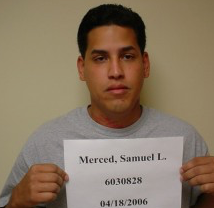
MERCED, SAMUEL L – photo Kan. Dpt. of Corrections
Samuel L. Merced, 35, was sentenced in Geary County District Court by Judge Maritza Segarra to 185 months to be served in the Kansas Department of Corrections.
Merced was convicted by a jury in October 2015 of two counts of aggravated indecent solicitation of a child and one count of lewd and lascivious behavior. The convictions stemmed from crimes that occurred in May and June 2014.
The case was investigated by the Junction City Police Department. Assistant Attorney General Lyndzie Carter of Schmidt’s office prosecuted the case.
TOPEKA–Kansas Department for Children and Families (DCF) Secretary Phyllis Gilmore is pleased to announce a new measure that will help cash, food and child care assistance clients when they discover their Kansas Benefits Card is lost or stolen. Currently, when a client’s card is missing, the card must be permanently deactivated and he/she has to wait for a replacement card to arrive in the mail. Beginning April 4, the client can simply suspend the card (temporarily deactivate it), while the individual searches for the card. If the card is found, the client can call the EBT Customer Service Center and unsuspend the card.
“We’re excited about this new feature available to our clients,” Secretary Gilmore said. “This option is expected to result in fewer card replacements, better card security and improved benefit access.”
During the current Administration, DCF has taken several steps to reduce fraudulent use of benefits cards. In 2013, the Kansas Benefits Card was redesigned with added language about prohibited uses. It also began to be issued through the mail, instead of provided at our DCF service centers.
In 2011, the card replacement rate was more than 3 percent (6,632 replacements). To date, we’ve experienced a nearly 40 percent reduction in the card replacement rate.
Employment-focused statutes enacted in the Kansas Hope, Opportunity and Prosperity for Everyone (HOPE) Act, that was signed into law on April 16, 2015, are being enhanced this legislative session. This year’s additions to the HOPE Act include a provision to monitor excessive benefits card replacements and a provision to refer clients to the agency’s fraud investigation unit after the fifth request for a replacement card in a 12-month period. The latest version of the HOPE Act has not yet passed.
DCF’s Anti-fraud Unit has investigated 1,421 cases this fiscal year, as of Feb. 29, 2016. The value of judgments obtained is $1.3 million, with programs savings of $421,599.
WICHITA, Kan. (AP) — A woman has accepted a plea deal in a man’s shooting death on the Wichita State University campus.
Eboni Fingal of Wichita pleaded guilty to involuntary manslaughter and robbery in the August 2015 death of 23-year-old Rayan Ibrahim Baba in the parking lot of a university student dormitory.
The Wichita Eagle reports Fingal was scheduled for trial Monday for first-degree murder and aggravated robbery but entered her pleas March 11. She will be sentenced April 29.
Prosecutors say Fingal and Isaiah Copridge killed Baba after he contacted Fingal for sexual services she had advertised online.
Baba was an undergraduate student from Saudi Arabia.
Copridge is serving more than 21 years in prison after pleaded guilty to second-degree murder and aggravated robbery.
DENVER (AP) — Rampant teen sexting has left politicians and law enforcement authorities around the country struggling to find some kind of legal middle ground.
To many public officials, prosecuting students for child porn seems like overkill. But many aren’t ready to let students off the hook altogether.
Dozens of states have adopted or are considering new, more lenient laws that would apply in cases of teenagers sharing nude selfies among themselves.
The Kansas Senate has passed a bill to lessen the penalties for sexting by middle and high school students in hopes that prosecutors will be willing to combat the practice.
The Kansas House has approved their own version of the legislation.
Both measures focus on 12- to 18-year-olds accused of transmitting images of a nude child. Under existing state law, prosecutors are restricted to filing a felony charge that carries a prison sentence up to 11 years and four months and lifetime registration as a sex offender.
Both chambers’ bills make a first offense by someone 18 or younger a misdemeanor, punishable by up to a year in jail.
The debate underway in Colorado revealed deep divisions about how to deal with the phenomenon.
JACKSON COUNTY, MO- A Kansas man was injured in an accident just after 3a.m. on Saturday in Jackson County Missouri..
The Missouri State Highway Patrol reported a 2013 Chevy Silverado driven by Sean P. Lamb, 24, Blue Springs, MO., was westbound on Interstate 70 just east of Blue Springs.
The SUV traveled off the right side of the road, struck a ditch and overturned.
Lamb and a passenger Casey S. Bates, 26, Manhattan, were transported to Centerpointe Medical Center in Independence.
They were properly restrained at the time of the accident, according to the MSHP.
July 2017 may seem like a long way away, but when you’re planning to allow guns on college campuses, it might as well be just around the corner. How Kansas colleges will comply with the law allowing guns on campus while maintaining security is complicated.
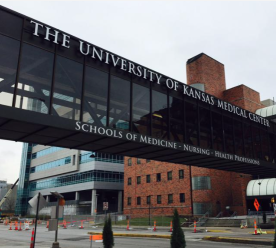
But it’s perhaps most complex at the University of Kansas Medical Center and KU Hospital in Kansas City, Kan.
Photo by Sam Zeff/Heartland Health Monitor The University of Kansas Medical Center in Kansas City, Kan., says it will hire more police officers when concealed weapons are allowed on campus in July 2017.
Since Kansas lawmakers passed a bill that would allow almost anyone to carry a concealed gun on college campuses, we’ve been hearing the arguments against it: Students are too immature to carry guns, theft is a problem and faculty would feel unsafe debating controversial topics in class. At the sprawling and growing KU Medical Center, they have all those worries and more.
“There are concerns in a high-stress, high-risk environment like health care,” says Executive Vice Chancellor Doug Girod.
The law allows institutions to ban guns, but only if they provide metal detectors and security guards. That’s not only prohibitively expensive but almost impossible to achieve at the medical center complex.
It’s easy to see why as you walk around the campus. From 39th Street you can see a dozen doors leading into the bookstore and a courtyard between buildings. Turn around and look north and there’s the medical library. Just down the street is the busy emergency room.
Almost 7,000 students and staff and hundreds of more patients and family member pass through those doors and dozens of others around the complex every day. Once through the doors, they enter a maze of hallways that connect classrooms, offices and clinics.
So Girod says he is worried.
“We have some vulnerable populations that are harder to protect. I mean, we’ve got patients stuck in a hospital, they aren’t going to get up and flee. We have children. We have pregnant mothers. The spectrum is very broad, so health care is certainly a unique environment.”
How unique? Some doctors say conflict is part of the job.
“But there’s a lot of confrontation that happens in health care,” says Allen Greiner, a family medicine doctor who has been on the faculty for 18 years and is a native Kansan. “Between groups of patients, inside of families, between providers and patients. Between providers and providers.”
He says guns are probably already being carried into the hospital, but he thinks this could make it even more common and gun accidents more likely. He’s not alone.
Erin Corriveau joined the faculty about a year ago and is also a family doctor. She has nothing but praise for KU Medical Center and Kansas City. But inviting more guns on campus, she says, may drive her and others from KU.
“I think a lot of faculty members will consider moving on if this is enacted,” says Corriveau. “I don’t think this is smart for Kansas. I don’t think this is the best thing for the health of our population.”
Most faculty and staff across the state agree with Corriveau. A recent survey from the Docking Institute at Fort Hays State University showed 70 percent of faculty and staff at Kansas Board of Regents institutions oppose the new conceal and carry law. Eighty-two percent said they would feel less safe with armed students on campus.
So there is pushback and even a bill that would reverse the portion of the law allowing guns on campus.
But all of it is mostly falling on deaf ears in Topeka. “Do you need security? Then you better get it,” says state Sen. Forrest Knox, a Republican from Altoona and one of the leading gun advocates in the Legislature.
He says his daughter is an emergency room nurse at Truman Medical Center in Kansas City, Mo., and her experiences there reinforce his thinking that everyone should be able to defend themselves.
“If you don’t provide security, then you shouldn’t deny the public’s right to provide for their own,” he says. “That’s the logic of the bill, OK, and nothing has changed in that whether it’s a hospital or not.”
Knox says he’s willing to listen if KU Medical Center officials want to restrict guns in the emergency room or patient rooms. For their part, officials say they probably will hire more police officers to patrol the 41-acre complex and may post security at the library, restricting guns in that building.
But short of turning out conservatives in the November election, nothing appears to be able to stop concealed weapons from coming to Kansas campuses.
Sam Zeff is a reporter for Heartland Health Monitor, a news collaboration focusing on health issues and their impact in Missouri and Kansas.
ABILENE – The first in a series of Kansas Town Hall programs focusing on election year issues, “We the People: Civic Education in Kansas,” will be held Tue., March 22, in the Visitors Center of the Eisenhower Presidential Library, Museum and Boyhood Home, Abilene.
The program begins at 7 p.m. with a keynote speech by Kansas Attorney General, Derek Schmidt, who will address the rights and responsibilities of citizenship.
“I sometimes reflect on how much we demand of those who wish to become American citizens by their own choice,” Schmidt said. “In many ways, it is more than we demand of those of us fortunate to have been born to citizenship. The nature of citizenship is not always fully understood or appreciated by those to whom it came without effort.”
Schmidt was elected the 44th attorney general of Kansas in 2010 and reelected in 2014. In 2015, he was elected national Vice President for the National Association of Attorneys General.
A panel discussion will follow the keynote address, including four panel members. The panelists will discuss civic education programs, classes and activities in which they are involved. A question and answer session will follow their presentations.
Panel participants include:
Bob Beatty, Professor, Political Science, Washburn University. Beatty is also a
political analyst and consultant with KSNT/KTKA TV.
Nathan McAlister, History teacher, Royal Valley Middle School, Mayetta, Kan. In 2010 McAlister was named Kansas and National History Teacher of the Year by the Gilder Lehrman Institute for American History.
Pam Sanfilippo, Education Specialist, Eisenhower Presidential Library. Sanfilippo facilitates learning for groups of all ages using the primary sources in the holdings of the Eisenhower archives.
Tom Vontz, Professor and Director, Center for Social Studies Education, Kansas State University. Vontz’s interests include civic education research.
This Kansas Town Hall program is held in partnership with the Kansas Humanities Council, Kansas State University Library, and the Kansas State University Institute for Civic Discourse and Democracy.
Friday plane accident in Wichita-Photo Wichita Fire Department
WICHITA, Kan. (AP) — A pair of teenagers was able to walk away from a rented airplane one of them was flying when it crashed onto a Kansas golf course.
Wichita police say the pilot was a 17-year-old boy and the passenger an 18-year-old woman who were on their way from Nashville, Tennessee, to Jabara Airport in Wichita on Friday when they crashed.
The Wichita Eagle reports the 1966 single-engine Mooney came down on the 14th hole at the Tallgrass Country Club, narrowly missing nearby homes. Nikki Womack says she and her daughter saw the plane fly very low over their neighbor’s home before crashing onto the golf course.
Womack says the boy got out and was bleeding from the head, followed by the woman, who had a serious eye injury.
———–
WICHITA- A small plane made an emergency landing at Tallgrass golf course in Wichita just after 3:20p.m. on Friday.
Two people were injured in the accident, according to Wichita Fire Department officials. The golf course is located in the 2400 Block of North Tallgrass.
Few additional details on what caused the accident are available. Check Hays Post for more information as it is released.
TOPEKA, Kan. (AP) — Low-risk juvenile offenders and those who violate probation could be referred to community-based programs instead of being placed in juvenile detention centers under a proposal being considered by Kansas lawmakers.
House representatives gave the measure first-round approval vote Friday. It passed 38-2 in the Senate last month. The House is expected to vote on final approved Monday. A Senate conference committee will then review changes to the measure.
The House Corrections and Juvenile Justice Committee added a provision to reserve up to 50 beds in group homes for offenders without a safe home. The measure approved by the Senate said all group homes would close by July 2018.
Some law enforcement agencies worried that offenders committing higher-level misdemeanors would be likely to re-offend if all homes closed.







 DCF
DCF







 ABILENE – The first in a series of Kansas Town Hall programs focusing on election year issues, “We the People: Civic Education in Kansas,” will be held Tue., March 22, in the Visitors Center of the Eisenhower Presidential Library, Museum and Boyhood Home, Abilene.