RILEY COUNTY – A bicycle rider was injured in an accident just before 4:30p.m. on Thursday in Riley County.
The Kansas Highway Patrol reported a 2013 Honda Civic driven by Rachel Ryan, 24, Overland Park, was south bound on U.S. 177 three miles south of Manhattan, in the right lane.
The vehicle struck a southbound bicycle ridden by Shem McConnell, 17, Cusseta, Georgia.
McConnell was transported to the University of Kansas Hospital. He was wearing a helmet, according the KHP.
A bill being pushed by Republicans would prevent local governments from restricting the sale or require more extensive labeling of high-calorie foods and drinks. JULIEN MENICHINI / CREATIVE COMMONS-FLICKR
The Kansas House on Thursday tentatively approved a bill to prohibit city, county and school district officials from adopting certain types of healthy food policies.
The bill — House Bill 2595 — would prevent local officials from restricting the sale of so-called junk food at restaurants, grocery stores and other retailers. It also would preclude policies that require businesses to provide consumers with more nutritional information about the food and drinks they sell.
The bill is scheduled for final action Friday.
The Kansas measure mirrors model legislation developed by the American Legislative Exchange Council, a controversial organization that works with corporate executives and state lawmakers to develop business-friendly policies.
The bill is being pushed by Republicans seeking to build a firewall in Kansas against policies being implemented in other areas of the country to restrict the sale or require more extensive labeling of high-calorie foods and drinks. The cite former New York Mayor Micheal Bloomberg’s failed attempt to regulate the size of sugary drinks as an example.
Supporters also want to head off any effort to use zoning and licensing laws to limit where fast food restaurants can locate. They say Kansas needs a statewide policy to create a predictable environment for businesses.
“What we’re looking for is consistency and uniformity,” said Rep. Gene Suellentrop, a Wichita Republican and ALEC member.
But opponents charge the bill is a solution in search of a problem. They say cities, counties and school districts aren’t contemplating the kind of policies the bill is intended to block. And they fear it will disrupt more modest local efforts to promote healthy eating and curb the state’s rising obesity rate, which at 31.3 percent ranks as the nation’s 13th highest.
“This bill would, I think, be harmful to hundreds of innovative and evidence-based programs and initiatives designed to improve the health of Kansans, especially children and teens,” said Rep. John Wilson, a Lawrence Democrat who works for a nonprofit organization focused on reducing childhood obesity.
Wilson said he fears the bill will have “a chilling effect” on efforts under way in Lawrence and Douglas County to create a healthy food environment. He said communities should be free to pursue such comprehensive approaches because the environments in which people live and work can “make it easy, hard or impossible” for them to make healthy choices.”
Ashley Jones-Wisner, a lobbyist for KC Healthy Kids, a nonprofit advocacy organization, said she is concerned the bill will hinder collaborative efforts to increase access to healthy foods in the Kansas City metropolitan area.
“The problem with this bill is that the language is incredibly broad,” Jones-Wisner said. “There could be a lot of unintended consequences.”
Jones-Wisner is particularly concerned about language in the bill that prohibits cities and counties from using permitting and licensing policies to address “food-based health disparities.”
“This bill could effectively tie the hands of local governments trying to retain local grocery stores in rural areas,” she said. “It could also potentially harm the work that we’re doing in urban areas to try and attract grocery stores and increase food access in low-income (urban) areas.”
During a committee hearing on the bill, Jason Watkins, a lobbyist for the Kansas Restaurant and Hospitality Association, said advocates needn’t be so concerned.
“Nothing in this bill says that a nonprofit can’t do education about lifestyle choices with their members,”
Watkins said. Still, Rep. Erin Davis, an Olathe Republican, was uncertain about whether the bill would allow school districts and local health departments to continue nutrition education programs.
So she offered an amendment to ensure that educators could continue to teach children that “an apple is a more healthy choice than a (Hostess) Ho Ho.”
Opponents applauded the amendment, which passed on a voice vote, but said they remained concerned that the bill could prohibit the ability of school districts to limit the availability of non-nutritious items in vending machines.
Jim McLean is executive editor of KHI News Service in Topeka, a partner in the Heartland Health Monitor team.
TOPEKA, Kan. (AP) — The Topeka Symphony Orchestra is performing stormy music to commemorate the upcoming 50th anniversary of a tornado that killed 16 people.
The Topeka Capital-Journal reports that the performance is scheduled Saturday night at the White Concert Hall on the campus of Washburn University.
The symphony’s music director and conductor, Kyle Wiley Pickett, says he’s read accounts of the tornado that struck on June 6, 1966. The tornado was classified as an F-5 on the Fujita scale. It stayed on the ground for more than a half hour, cutting a half mile-wide swath.
Works from Ludwig van Beethoven and English composer Benjamin Britten will be performed in remembrance. Pickett says the selections “reminds us of the greatness of nature — its beauty as well as terrible power.”
TOPEKA, Kan. (AP) — Kansas residents will decide this November whether to include the right to hunt, fish and trap wildlife in the state constitution.
Kansas would become one of about 20 states that make hunting, fishing and trapping a constitutional right if voters approve the proposed amendment in the Nov. 8 election. The Senate gave final approval to the House resolution in a 36-0 vote Thursday. It passed 117-7 in the House last month.
The measure would add a new section to the constitution’s Bill of Rights to preserve the outdoor activities as a preferred way to manage wildlife. Any future measures seeking to limit the activities would need to prove that a particular animal could become endangered.
KANSAS CITY, Kan. (AP) — Authorities say two Kansas City, Kansas, police officers have been suspended and are under investigation.
The Kansas City Star reports that police said the officers were suspended with pay on Saturday. As part of the “dignitary detail,” the officers were assigned to the mayor’s security detail.
HUTCHINSON -A Kansas man’s effort to withdraw his plea and also fire his appointed attorney failed and he was sentenced to prison.
Sonny Bray, 35, Hutchinson, entered guilty pleas to felony flee and elude, criminal possession of a shotgun, battery of a law enforcement officer, aggravated battery and felony theft.
Bray initially wanted to fire his attorney because that attorney apparently spoke with the defendant’s sister and Bray said he asked him not to do this.
Judge Joe McCarville denied the request.
He had filed a motion to withdraw his plea saying he didn’t understand what the agreement entailed.
But, Judge McCarville noted that he had signed an advice of rights form indicating he did understand and his request to withdraw was also denied.
McCarville sentenced Bray to five years for all three cases as agreed upon by both parties as a part of the plea agreement.
Bray was arrested on July 19, 2015, following a search by law enforcement.
Bray then fled from officers and, during that chase, allegedly threw the shotgun from the vehicle, struck a parked semi-trailer, a curb and a stop sign, causing the vehicle to become disabled. He then fled on foot, but was quickly captured.
In the aggravated battery with a deadly weapon case, he struck a man with a glass bottle in April of 2015.
In the third case, he was convicted of battering a law enforcement officer in September 2014.
DICKINSON COUNTY-The Dickinson County Sheriff’s Department Drug Enforcement Unit along with the Abilene Police Department and the Kansas Highway Patrol Special Response Team executed a search warrant on Tuesday at 2042 900 Avenue in rural Dickinson County.
According to Sheriff Gareth Hoffman the search warrant was the result of a four-month long investigation into the alleged distribution of methamhetamine in the Herington and Hope area. Arrested during the search warrant were three occupants of the residence.
–Shawn O. Penrod, on suspicion of Conspiracy to Distribute Methamphetamine, Distribution of Methamphetamine, Possession of Methamphetamine with the Intent to Distribute, Possession of Methamphetamine, Possession of Drug Paraphernalia ( felony ), Possession of Drug Paraphernalia ( misdemeanor ), Acquiring Drug Proceeds, Failure to Obtain a Kansas Drug Tax Stamp, and three counts of Criminal Use of a Weapon. Bond was set at $200,000.
–Olivia Penman, Conspiracy to Distribute Methamphetamine, Possession of Methamphetamine, and Possession of Drug Paraphernalia. Bond was set at $100,000.
Russell Pitts
–Russell Pitts, Conspiracy to Distribute Methamphetamine, Possession of Methamphetamine, and Possession of Drug Paraphernalia. Bond was set at $75,000.
Hoffman reported that law enforcement officers seized a total of 646.9 grams of methamphetamine that was in bulk and packaged for resale. The estimated street value of the methamphetamine seized was calculated at more than $65,000 dollars.
Hoffman indicated that the case is still ongoing, and as a result of the investigation more arrests can be expected in the next few weeks.
SALINE COUNTY – A Kansas man was injured in an accident just after 8 a.m. on Friday in Saline County.
The Kansas Highway Patrol reported a 2001 Dodge passenger car driven by Ryan N. Trickle, 20, Salina, was southbound on U.S. 81 two miles north of Interstate 70.
The driver lost control on the wet pavement, struck a guardrail and then a bridge.
Trickle was transported to Salina Regional Medical Center.
He was properly restrained at the time of the accident, according to the KHP.
WICHITA, Kan. (AP) — A plumbing and heating systems manufacturer plans to move its headquarters and 113 jobs from Wichita to Denver.
The company, Viega, has been in Wichita for 10 years. Viega’s general counsel, Jess Arbuckle, says all 113 employees have been offered jobs in Denver. The move is expected to be completed by the end of next year.
The Wichita Eagle reports the company is keeping its manufacturing plant in McPherson, where it has about 200 employees.
Arbuckle declined to say exactly why the company was moving. He said a nationwide feasibility study found Denver was the best fit for the company because the corporate staff will be more accessible to customers, vendors and regional staff.
KANSAS CITY – A former Johnson County restaurant owner was indicted Wednesday on charges of fraudulently obtaining $605,000 in loans, according to U.S. Attorney Barry Grissom.
Charles Waits, 54, Lenexa, Kan., was charged in a superseding indictment with one count of bank fraud and two counts of making false statements to a lender. The indictment alleges Waits, a partner in Kansas City Sports Grille, Inc., obtained two commercial loans through Community America Credit Union. He gave the lender a financial statement with false statements regarding his personal assets and net worth.
The indictment seeks a monetary judgment of $605,000, representing the proceeds of the crimes.
If convicted, he faces a maximum penalty of 30 years in federal prison and a fine up to $1 million on each count. The U.S. Secret Service investigated. Assistant U.S. Attorney Chris Oakley is prosecuting.
MANHATTAN — Masons from 220 lodges across Kansas have collectively given $2.5 million through the Kansas Masonic Foundation to support Kansas State University programs. The gift will support the Kansas PRIDE program, the Center for the Advancement of Entrepreneurship and the Office of Military and Veterans Affairs, according to a media release.
“This gift is on behalf of Kansas Masons to benefit programs that are good for Kansans and Kansas communities,” said Darren Kellerman, grand master of Kansas Masons.
“Last year, we awarded 78 scholarships to Kansas State University students. Now we are excited to expand our partnership with K-State through three truly unique initiatives,” said Michael Tavares, president of the Kansas Masonic Foundation. He added that the foundation is celebrating its 50th anniversary with the public launch of a $20 million fundraising campaign to help Kansas Masons continue improving communities.
“We are grateful for this significant partnership with Kansas Masons,” saidKirk Schulz, president of Kansas State University. “Their generous investment will support K-State’s outreach and service mission, which is part of our land-grant heritage and is key to becoming a Top 50 public research university by 2025.”
The Kansas PRIDE Program is a partnership between K-State Research and Extension, the Kansas Department of Commerce and Kansas PRIDE Inc. The program encourages and assists local volunteers working in cooperation with local government in making their community a better place to work and live through projects that preserve, create and improve.
“With more than 45 years of success, the Kansas PRIDE program continues to be vital in creating a better tomorrow for 500 Kansas communities over the life of the program, including about 70 communities each year,” said Daryl Buchholz, associate director of extension and applied research at Kansas State University. “The Kansas Masons’ generous investment of time and money will help us expand this program to even more communities, engaging more Kansans in community vitality projects that will improve their future.”
The Center for the Advancement of Entrepreneurship works to enhance the entrepreneurial environment at Kansas State University and throughout Kansas by providing education and support to entrepreneurs. The Kansas Masonic Foundation’s gift will support the Kansas Entrepreneurship Challenge, offering financial prizes and mentors from Masonic and business leaders to guide teams from Kansas high schools and universities.
“We are sincerely grateful for the generosity and support of the Kansas Masons,” said Chad Jackson, director of the Center for the Advancement of Entrepreneurship. “Their sponsorship of the Kansas Entrepreneurship Challenge will enable us to provide key resources and support for the next generation of Kansas entrepreneurs who will drive our state’s economy.”
The Office of Military and Veterans Affairs focuses on military-related institutional policies, education, research and outreach. The office works in conjunction with administrative, academic and student life offices across Kansas State University, and also with the ROTC program, the Kansas National Guard and Fort Riley military installation.
“This gift will help us expand the reach and depth of our work serving military and their families in the state of Kansas, as well as those who are transitioning from military back into civilian work and education in the state of Kansas,” said Arthur DeGroat, retired U.S. Army lieutenant colonel and executive director of military and veterans affairs at the university.
Philanthropic contributions to Kansas State University are coordinated by the Kansas State University Foundation. The foundation was established in 1944 as the official fundraising arm of the university. It is a separate, independent entity chartered by the state of Kansas as a 501(c)(3) nonprofit education corporation. The foundation is leading Innovation and Inspiration: The Campaign for Kansas State University to raise $1 billion for student success, faculty development, facility enhancement and programmatic success.
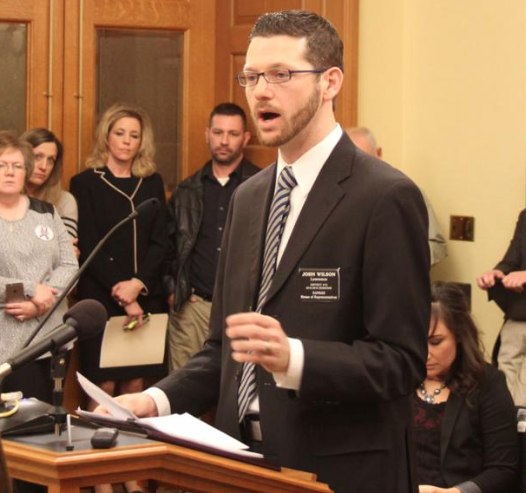
File Photo by Andy Marso/KHI News Service Rep. John Wilson, a Democrat from Lawrence testified before the committee
A bill that would legalize hemp oil for treating seizures advanced Thursday to the full Kansas Senate, but not before a committee made extensive changes.
The Senate Public Health and Welfare Committee amended Senate Bill 489 to forbid in-state hemp oil production, create different standards for adult and child patients, require doctors who want to prescribe hemp oil to pay for a different certification and specify that the state’s Health Care Stabilization Fund wouldn’t be liable if patients are injured while taking hemp oil.
The amended bill would require that hemp oil prescribed to people younger than 21 contain no more than 0.3 percent tetrahydrocannabinol, or THC, which is the chemical that produces a sense of euphoria or “high” in recreational marijuana users.
Sen. Jim Denning, an Overland Park Republican, introduced the amendment to lower the limit for minors while allowing THC content of up to 3 percent for adults.
A second amendment, from Sen. Jacob LaTurner, a Pittsburg Republican, would stipulate that the hemp oil must contain at least 15 percent cannabidiol, or CBD, a chemical in marijuana that doesn’t cause a high.
Advocates see health benefits
Medical marijuana advocates converged Wednesday on the Statehouse to plead their case, but the committee delayed working the bill due to limited time.
Sara Weber was among those who said allowing hemp oil could make a significant difference in her life.
Weber, 27, of Washington, said she has had multiple types of seizures since she has was 18, and taking variety of medications hasn’t substantially reduced them.
A doctor she visited in Colorado said she would benefit from taking a high-cannabidiol hemp oil as a maintenance medication and a hemp oil with a higher tetrahydrocannabinol content for times of heightened seizure activity, but she and her two children can’t easily pick up and move from their family’s support system.
Weber said she takes four medications but still has 20 to 50 seizures per month, and hopes hemp oil could change that. The seizures have kept her from driving, working in her parents’ restaurant or even taking care of daily activities without someone present to make sure she isn’t injured, she said.
“Maybe I would be able to take my daughters to the park,” she said. “Maybe I’d be able to cook dinner without someone in the kitchen. Maybe I’d be able to go back to work.”
No in-state production
During Thursday’s committee hearing, LaTurner also offered an amendment striking language that would allow facilities to produce hemp oil in Kansas. States such as Oklahoma also have taken the route of importing from states with looser restrictions, and forbidding production in Kansas would address law enforcement’s concerns about explosions in facilities creating the oil, he said.
“This is in line with what Kentucky, Iowa and others have done,” he said.
The Colorado explosions mostly have happened in homes where amateur cooks attempted to make hash oil. Hash oil differs from hemp oil in that it is created to maximize THC content for recreational users.
Rep. John Wilson, a Lawrence Democrat who testified before the committee, said the amendment banning in-state production could make the bill unworkable because hemp oil remains illegal under federal law.
“You are asking them to break federal law by bringing a controlled substance across a state border,” he said.
Federal authorities have opted not to aggressively enforce drug laws against medical marijuana users, but a future president could change that informal policy.
Denning also offered amendments that would:
allow patients a 30-day supply instead of a 60-day supply.
require providers to pay $2,000 for an annual certification if they want to prescribe hemp oil and have an office in a state-licensed medical facility.
hold the state’s Health Care Stabilization Fund harmless if patients are harmed after hemp oil, meaning any compensation would have to come from the doctor’s malpractice insurance.
Denning said a higher license fee is necessary to pay to set up the framework to regulate hemp oil.
But Sen. David Haley, a Kansas City Democrat, said he thought it was “discriminatory” to charge doctors who want to prescribe hemp oil more than the state charges those looking to reinstate their licenses after losing them.
“We’re just getting started. We have no pay-fors,” Denning said.
Megan Hart is a reporter for KHI News Service in Topeka, a partner in the Heartland Health Monitor team. You can reach her on Twitter @meganhartMC
ARKANSAS CITY, Kan. (AP) — An Arkansas City woman has been found guilty in connection to the death of her 16-month-old daughter.
KAKE-TV reports that Lindsey Abegg pleaded guilty to aggravated endangerment of a child in the August 2015 death of Astra Abegg. She also pleaded guilty to possession of methamphetamine and marijuana.
Police say that Astra Abegg was found dead at an Arkansas City apartment when emergency crews responded to a report of a medical emergency involving a child.
The cause of the child’s death has not been released.

 RILEY COUNTY – A bicycle rider was injured in an accident just before 4:30p.m. on Thursday in Riley County.