PRATT– According to the Western Association of Fish and Wildlife Agencies (WAWFA), aerial surveys for lesser prairie chickens will begin Thu., March 17. The surveys, which will continue through mid-May, will be conducted by helicopter throughout the five-state lesser prairie chicken range. The surveys are conducted annually by WAFWA to ascertain population trends and how the bird is responding to management strategies identified in the Lesser Prairie Chicken Range-wide Conservation Plan.
The range-wide plan is a collaborative effort of WAFWA and the state wildlife agencies of Texas, New Mexico, Oklahoma, Kansas and Colorado. It was developed to ensure conservation of the lesser prairie chicken with voluntary cooperation from landowners and industry. This plan allows agriculture producers and industry to continue operations while reducing impacts to the species and its grassland habitat.
“Working with the wildlife agencies of each of these five states, we’ve established a consistent methodology to conduct these aerial surveys,” explained Bill Van Pelt, WAFWA’s grassland coordinator. “This allows us to get the most accurate information possible so we can see how various management strategies for the bird are working on the ground.”
In previous years, some of the fly paths prompted calls, which is why WAFWA is getting the word out about the start of aerial survey work.
Last year’s aerial surveys brought good news: an abundance of spring rainfall in 2015, along with ongoing efforts associated with the range-wide plan and other conservation initiatives, helped increase the lesser prairie chicken population by approximately 25 percent from 2014 to 2015. Results from this year’s surveys will be available on July 1.
Despite last year’s encouraging news, the population is still low compared to historical numbers, and concern for the lesser prairie chicken and its habitat still exist. WAFWA is committed to continued successful implementation of the range-wide plan and the long-term recovery of this iconic grassland bird.
For more information about the lesser prairie chicken and the conservation work being done to support it, see the Lesser Prairie Chicken Range-wide Plan at www.wafwa.org.
GEARY COUNTY – One person was injured in an accident just after 3p.m. on Tuesday in Geary County.
The Kansas Highway Patrol reported a 2001 Suzuki passenger car driven by Carmen Renee Keeton, 28, Columbus, OH, was southbound on Crider Road one mile west of Junction City.
The driver lost control of the vehicle. It left the road, hit an embankment, flipped, and landed on its roof.
A passenger in the vehicle Angel L. Gonzalez, 26, Long Beach, NJ., was transported to Geary Community Hospital.
Keeton was not injured. Both were properly restrained at the time of the accident, according to the KHP.
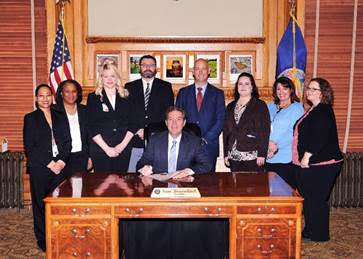
(L to R): DCF Deputy Secretary Jaime Rogers, DCF Deputy Director of Permanency/Training Sharri Black, DCF Social Worker Amber Rufener, DCF Deputy Director of Performance Improvement Tony Scott, Governor Sam Brownback, KDADS Secretary Tim Keck, KDADS Social Worker Laura Leistra, DCF Assessment and Prevention Administrator Suzanne Martinez, KDADS Social Worker Dawn Turner
DCF
TOPEKA–The critical service provided by social work professionals, including the protection of vulnerable children and adults from abuse and neglect, will be highlighted this month, thanks to special recognition from Governor Sam Brownback and the Kansas Department for Children and Families (DCF).
Governor Sam Brownback has designated March as Social Worker Month, a time to recognize the tireless commitment of those who take on this challenging occupation. It’s a time also to call attention to the need to retain and recruit social workers to serve the State of Kansas.
“As a licensed social worker, I know the many difficulties and rewards that come with this line of work,” DCF Secretary Phyllis Gilmore said. “We are working hard to attract more caring and compassionate social workers to join our Prevention and Protection Services team.”
DCF, along with its contracted providers, employs nearly 1,000 social workers statewide. There remains, however, a persistent need for more.
DCF typically has approximately 50 vacant social worker positions, which it struggles to fill. Some of the most challenging areas to fully staff include the agency’s Wichita and West regions. DCF uses a wide range of recruitment strategies to attract social workers, including partnerships with Kansas colleges. The agency also has a Recruitment and Retention Workgroup that is tasked with helping solve social worker staffing needs.
DCF Social Worker Amber Rufener, Topeka, recognizes that social work is often thankless and rarely easy.
“It’s a challenge, because people don’t always want to work with you,” said Rufener, a social work specialist in the Topeka Service Center. “They need help, but often they don’t want it. Social workers have to give them the resources to be successful. We serve as a bridge to the help in many cases.”
Rufener began work as a certified nursing assistant while in college. It was then that she took an interest in the social side of human services. To prepare for a career as a social worker, she earned a bachelor’s degree in Human Services, then a master’s degree in Social Work from Washburn University.
“I went into social work because I wanted to protect those who are vulnerable, who maybe don’t have a voice for themselves,” said Rufener, who participated in the signing of the Social Work Month proclamation.
Rufener emphasized that the ability to work with clients who suffer from mental health issues is essential. She recognizes that there is always a need for new people in the social work field, and said while it’s not for everyone, she believes many caring individuals would find it rewarding.
“You have to be in it because you have a heart for helping people,” she said. “You don’t always get rewards or praise. But it’s rewarding when you can see that you made a difference in someone’s life.”
To become a social worker, individuals must graduate from an accredited university with at least a bachelor’s degree in social welfare. They must also pass a licensure exam and maintain the license with 40 hours of continuing education, every two years.
DCF recently added four categories of professionals who now can fill the same role as social workers within the agency’s Prevention and Protection Services division. Individuals with education backgrounds that now may, with certain qualifications, serve as DCF social workers are Bachelor’s in Social Work, Master’s in Psychology, Master’s in Professional Counseling and Masters in Marriage and Family Therapy.
HUTCHINSON– While police were looking for a Kansas man who ran from a traffic stop, they discovered a home and garage that contained drug and drug paraphernalia.
Police suspected a man who ran from the stop might be hiding in the garage.
Johnathon Carson, 32, Hutchinson, was standing outside the garage and denied knowing whether anyone was inside.
Items consistent with drugs were found leading to a search of the garage and the home, according to police.
Carson admitted that he had a shotgun inside the garage. Police found the gun, which had a modified barrel.
They also found digital scales and baggies with meth residue.
Potential charges include possession of methamphetamine, being a felon in possession of a firearm, criminal use of a weapon, possession of marijuana and drug paraphernalia.
In court, Carson asked for a bond reduction, however the state objected because of his convictions involving drugs including unlawfully manufacturing, possession of drugs and drug paraphernalia.
Bryson Pallen, 24, was also arrested at the home and faces potential charges of possession of methamphetamine and possession of drug paraphernalia. His bond set at $7,500.
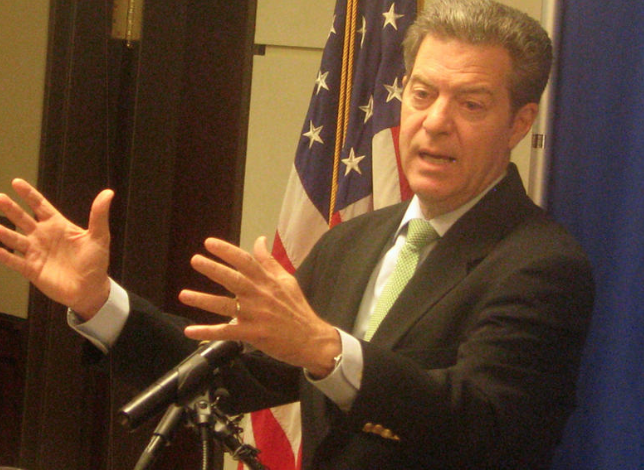
Gov. Sam Brownback vetoed a provision that would have reinstated mental health screenings after federal officials threatened to reduce the state’s Medicaid funding. DAVE RANNEY / HEARTLAND HEALTH MONITOR
By Megan Hart
Federal officials found fault with the way Kansas had screened people for admission to psychiatric hospitals, but left the door open for the state to divert patients if it reforms its screening procedure.
Gov. Sam Brownback vetoed a section in Senate Bill 161 that would have reinstated a requirement that Medicaid recipients be screened before admitting them for inpatient psychiatric treatment. Brownback said he supports the screenings, but the Centers for Medicare and Medicaid Services have threatened to reduce state funding for health programs by up to $1.8 million because of the requirement.
The issue is parity. Under federal law, insurers, including Medicaid programs, can’t put restrictions on mental health and substance abuse benefits that don’t exist for comparable medical or surgical benefits. A CMS official, who declined to be identified, said it appears to be a violation to require a person to be screened before he or she can be admitted for inpatient psychiatric care, but not to require a similar screening for a person being admitted for a physical condition.
CMS didn’t rule out requiring mental health screenings, but the state would need to have other, unspecified “criteria” that would ease concerns about parity, the official said. Both CMS and Brownback’s office said they are discussing ways that the state could conduct some form of screening without violating parity.
“Other states use a prescreening process to make recommendations regarding admission, but more often whether to divert to community services,” the CMS official said. “Our understanding is that Kansas proposed to use this process to make a decision regarding admission to an inpatient facility, and payment for that admission. There was no such requirement on the medical/surgical side for any inpatient admissions.”
Angela de Rocha, a spokeswoman for the Kansas Department for Aging and Disability Services, said CMS considers the screening for Medicaid recipients a form of prior authorization. KDADS changed its screening policy in October 2015 so that screenings wouldn’t be required before a person covered by Medicaid could be admitted for inpatient mental health treatment in a private or community hospital, she said.
“Kansas received anecdotal feedback that the screens, in some instances, were creating unnecessary delays in access to treatment for hospitals with psychiatric units,” she said.
Kyle Kessler, executive director of the Association of Community Mental Health Centers of Kansas, said he was disappointed in Brownback’s decision to veto restoring the screenings, and hopes Kansas will make the case that its screenings are an appropriate way to place people who need mental health treatment in the least restrictive setting possible.
“We would argue the screening process has been diversionary,” he said. “It seems like this is something that can be fixed.”
The current procedure is for medical staff at the hospital to determine if the person needs to be hospitalized, de Rocha said. The three managed care organizations that administer KanCare still could determine that a hospital stay wasn’t necessary and decide whether to pay fully for the care, she said.
Kessler said he has heard some concerns that private inpatient beds have been filling up, because the people present at the screenings aren’t also aware of what community resources are available. In some cases, that leads to people being admitted to state hospitals, because local inpatient facilities don’t have space, he said.
Kansas’ community mental health centers still screen people before they are admitted to the state psychiatric hospitals at Osawatomie and Larned. Those hospitals only accept people who are determined to be a danger to themselves or others. That appears not to create a parity issue because no equivalent concept exists when it comes to physical conditions: People who don’t manage their diabetes may be putting their health in danger, but the state can’t force them to stay in a hospital until their blood sugar is under control.
Megan Hart is a reporter for KHI News Service in Topeka, a partner in the Heartland Health Monitor team. You can reach her on Twitter @meganhartMC
HARVEY COUNTY – Law enforcement authorities in Harvey County have arrested a suspect in connection with a serious of burglaries and a high-speed chase that sent two officers to the hospital.
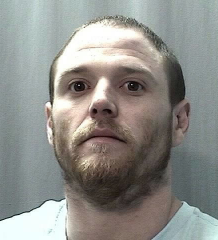
Jacob Cox, 30,was formally charged with four counts of burglary and four counts of theft, according to the Harvey County Sheriff’s office Additional charges are expected.
Just after 10p.m. on March 8, two law enforcement officers were injured in the accident during a pursuit.
The Kansas Highway Patrol reported a Harvey County Sheriff 2015 Chevy Tahoe driven by Deputy James Slickers, 43, Halstead, followed by a Kansas Highway Patrol 2015 Dodge Charger driven by Trooper Joseph Owen, 33, Newton, were southbound on Hertzler Road four miles west of Sedgwick attempting to stop a fleeing vehicle.
Sheriff Deputies had responded to multiple vehicle burglaries in the 2300 block of N. Oliver Road. While speaking with the victims of the burglaries a call came out of another burglary occurring at the Newton City-County Airport.
Deputies approaching the area observed a vehicle traveling at a high rate of speed away from the airport. Deputies pursued the vehicle, a Ford Escape stolen from Butler County.
Weapons found in the car- photo Harvey Co. Sheriff
During the course of the chase, the driver threw numerous objects from the vehicle including a shotgun, rifle, and paperwork belonging to the earlier reported vehicle burglaries. The driver avoided three sets of spike sticks placed at various locations in Harvey County. Speeds reached 100 mph.
When the suspect’s vehicle slowed to turn onto Southwest 84th, the Charger rear-ended the Tahoe.
The collision caused the Deputy’s vehicle to spin into a ditch and hit a telephone pole. The Trooper’s vehicle was disabled on the roadway.
Slickers and Owen were transported to Newton Medical Center with minor injuries.
The chase continued into Sedgwick County where Deputies lost sight of the suspect vehicle in the area of Tyler and 77th.
A citizen called to report a vehicle in a field at 73rd and Ridge road. The vehicle was the Ford Escape that had been in the chase. The driver of the vehicle was not located. Inside the Ford Escape were numerous weapons and stolen property, including a $14,000 airplane prop from the earlier burglaries.
TOPEKA, Kan. (AP) — Two Republican lawmakers are suggesting that the Kansas Legislature turn the job of determining how state aid to public schools is distributed over to the State Board of Education.
Reps. Gene Suellentrop of Wichita and Marvin Kleeb of Overland Park raised the idea during a House Appropriations Committee hearing on a school funding plan from the panel’s chairman.
The 10-member board would then face the burden of making sure the money is distributed fairly.
The plan is designed to bring the state into compliance with a Kansas Supreme Court order last month saying have been unfairly shorted on their state aid.
The plan would boost overall state spending on schools by nearly $39 million for the 2016-17 school year while shifting dollars among districts. Seventy-nine would still lose funds.
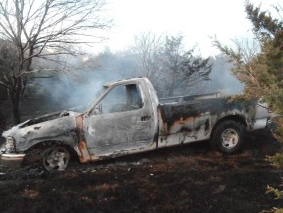
This Ford F-150 was totally destroyed by the fire.– Photos Saline Co. Sheriff
SALINE COUNTY- A grass fire in the 200 Block of Mound Road in Saline County just after 6 p.m. on Monday burned approximately 15 acres of land and other property, according to Saline County Sheriff’s Captain Roger Soldan
Scott Miller was working in an open field at the location in Southern Saline County when the trailer he was using possibly started the fire.
The fire also destroyed a 1997 Ford F-150 pickup and caused minor damage to a 1977 Chevrolet C-10 pickup.
Soldan said firefighters from McPherson County Rural Fire District #2 were called to the fire, which took about 3 hours to extinguish.
15 acres of land were damaged by the fire.
No damage estimate was available Tuesday morning. There were no injuries reported.
TOPEKA – Legislators are considering a measure that would encourage education for state residents about human trafficking and slavery.
House Resolution 6038 seeks to create awareness that traffickers are abducting children in Kansas, aims to educate residents about the problem, and, ultimately, seeks to end such criminal activities.
Jennifer Rapp, deputy director of the Anti-Human Trafficking Unit in the Kansas Attorney General’s office, told members of the House Committee on Federal and State Affairs last week that she receives regular phone calls from Kansans who have seen young adults selling products, such as magazines and cleaning products, across the state. Many times they are forced into this activity through “complex psychological manipulation,” and they live in substandard conditions with drugs and alcohol used by traffickers to keep them compliant, she said.
“It’s really sort of like a cult,” Rapp said. “They are usually older teens, young adults who perhaps don’t have the same opportunities as others to attend college, and this sounds like a lucrative or a good opportunity to them.”
Studies show that traffickers frequently prey on the poor, vulnerable, and those living in unsafe environments.
Rep. Tony Barton, R-Leavenworth, said that young people are lured through the Internet, via interactive video games, blogs and chatrooms that target children because they’re “vulnerable, gullible, and there is a market for young victims.”
“This is evil at its core,” Barton said. “These evil souls, cowards (traffickers) take away (the victims’) innocence and destroy their lives without conscience just for a dollar.”
Speaking in support of HR 6038, Barton told lawmakers he hopes the measure can bring freedom to the victims of human trafficking.
“To not consider this resolution is to say that their lives, the lives of these children, men and women do not matter,” Barton said.
Eight years ago, Barton’s daughter, who was about 5 years old at the time, wandered outside their church Sunday morning when a white van pulled up in front of her. When a member of the church hurried over, the van screeched out of the parking lot. Barton feared the worst for his daughter.
“What would’ve happened if this church member had not pulled in at the time he did. Would Rebecca be here today?” Barton said.
Rapp shared a similar personal story about her daughter. Three years ago, her daughter was walking on Massachusetts Street in Lawrence. It was around 7 on a Tuesday night in September, and Rapp’s 16-year-old daughter wanted to shop at the Urban Outfitters store. Not long after Rapp dropped off her daughter, the young woman called, urgently asking her mother to come back to the store. Panicked, Rapp drove back to see her daughter talking to a man neither she nor her daughter knew. Rapp’s daughter said the man had been watching her while she was in the store.
She tried to stay inside as long as she could, but when she stepped outside, he approached her and started asking questions about where she was from and where she went to high school. Rapp’s daughter did not give him the information. The man asked the young woman to look at his Facebook page on her phone and to add him as a friend, which she didn’t. Rapp said this was a wake-up call: This was exactly how traffickers prey on a young person’s vulnerabilities, she told the committee.
“If this can happen to my daughter, it can happen to anyone of yours,” Rapp said. “This is happening in our communities.”
The U.S. Department of Justice calls Kansas an “originating” state for human trafficking, which means that traffickers abduct children, men and women to be treated as slaves, to be forced into prostitution, or to work with little or no pay. Human trafficking is the fastest growing criminal industry in the world, and the International Labor Organization estimates that 20.9 million people are victims of human trafficking globally.
Last summer the Kansas attorney general’s office partnered with Clear Channel Outdoors and Lamar Advertising to launch a statewide anti-trafficking effort. The campaign featured billboards that read: “Human trafficking is happening in Kansas. If you see something, report it.” The billboard gives a number for the National Human Trafficking Resource Center. The campaign was aimed at reaching trafficking victims to let them know that resources exist to help them and to encourage community members to recognize trafficking.
Rapp said the media have not done a good job differentiating between human trafficking and human smuggling. Human trafficking is a crime against a person; human smuggling is a crime in which a person crosses a border illegally
Trafficking affects all kinds of businesses across Kansas, especially in the southwestern part of our state in the agricultural industry, Rapp said.
“A lot of what we hear in the media is about foreign-born victims being brought into our country and trafficked,” Rapp said. “But the truth of the matter is more than 80 percent of human trafficking involves domestic victims, and the majority of these are children.”
Rapp advised Kansans to get as much information as possible if they encounter someone they suspect is a trafficking victim. Asking where they are from and who they work for is a good start. Obtaining that kind of information will help law enforcement, she said. However, she cautioned that when asking questions, individuals should not be intrusive or put themselves in danger, she said. Since human trafficking generates an estimated $150 billion globally, it is a dangerous criminal enterprise and getting involved can be risky, she warned.
No opponents to the bill testified during the hearing.
If approved, the bill would recommend, but not require, education. It now goes to the full House for consideration.
Police use pepper spray during weekend rally Image Courtesy YouTube
KANSAS CITY, Mo. (AP) — Kansas City police say four people who were arrested at a weekend rally for Republican presidential candidate Donald Trump have been issued disorderly conduct citations.
The Kansas City Star reports that the ticketed protesters were 22-year-old Kendrick Washington, of Chicago; 20-year-old Alexander Fisher, of Overland Park, Kansas; 28-year-old Shane Stange, of Kansas City; and 37-year-old Megan Gallant, of Kansas City.
Protests erupted Saturday night during the Trump rally in downtown Kansas City. Capt. Tye Grant says police are pleased no one was injured. He says officers used pepper spray twice, both times when protesters tried to step into the street.
Gallant’s lawyer, Rick Johnson, says his client was misidentified by police and wasn’t participating in the protest. It wasn’t immediately clear if the other three had attorneys.
SHAWNEE COUNTY – Law enforcement authorities in Shawnee County continue to investigating a fatality accident involving 6 vehicles.
Just before 10:30 p.m. on Saturday, police responded to report of a collision involving a Capital City Cab and a Nissan Altima at 5322 Southwest 22nd Place in Topeka, according to a media release from police.
The Nissan driven by Darrell Blackwell, 24, Topeka and a passenger Alicia Quigley, 23, Topeka, drove away before officers arrived.
As they drove away, the Nissan hit two parked vehicles, according to police. The driver of the cab was transported to a local hospital.
Just before 10:40 p.m. officer received another report that the Nissan had been involved in another collision on Southwest 6th between Fairlawn and Gage.
The driver of the other vehicle followed the Nissan and relayed information on the direction of travel to police.
The Nissan hit a fourth vehicle at 6th Street and MacVicar and a 5th vehicle, a Chevy Trailblazer, at 29th and Topeka Boulevard.
Blackwell was transported to a hospital with life-threatening injuries. Quigley was pronounced dead at the scene.
The woman driver of the Trailblazer was also transported for treatment.
Additional details on Blackwell’s condition have not been released.
HUTCHINSON — In September of 2015, a Kansas man charged with alleged distribution of drugs was bound over for trial, but that trial will be delayed even longer.
Brian Green, 29, Hutchinson, faces trial for possession of methamphetamine with intent to sell, possession of drug paraphernalia with intent to distribute, possession of marijuana, personal use drug paraphernalia, interference with law enforcement and aggravated false impersonation. But, the state added a charge of identity theft after testimony in the case was complete.
The defense has filed a motion to suppress and that will delay the trial, which was scheduled to begin Tuesday.
The state alleges at the time of his arrest by Hutchinson Police, Green was in possession of between 3.5 and 100 grams of methamphetamine as well as the paraphernalia, which the state alleges was used to distribute drugs.
He also allegedly had a small amount of marijuana and gave police the name of Shawn Green, which they later learned was not his name.
Green has previous convictions involving the manufacturing of methamphetamine and associated charges in Reno, Rice and
Harvey counties.
SALINA – Law enforcement authorities in Saline County are investigating a bomb threat.
The threat was called into the City of Salina’s Water Department just before 3p.m. on Monday, according to Salina Police Captain Mike Sweeney
Officers searched the city-county building at on West Ash for explosives and none were found.
Following the search, announcements were made to courtrooms, as well as those in attendance at the weekly city commission meeting, to alert people in the building that a threat had been made.