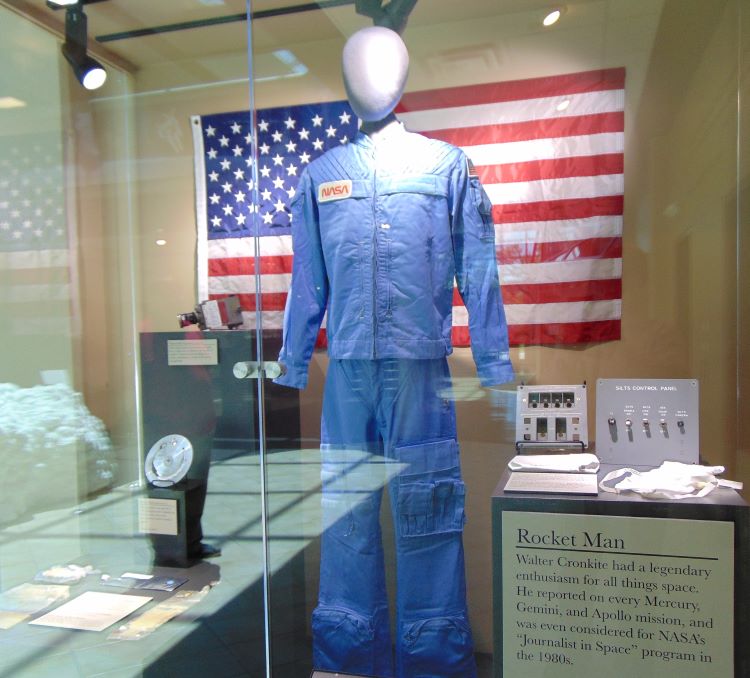
One of the Apollo 11 displays at the Walter Cronkite Memorial / Photo by Brent Martin
By BRENT MARTIN St. Joseph Post
ST. JOSEPH, Mo. — A special exhibit at the Walter Cronkite Memorial on the Missouri Western State University campus commemorates the 50th anniversary of the moon landing.
University curator Amanda Morrow says it’s appropriate for the Cronkite Memorial to focus on the Apollo 11 mission which first landed a man on the moon.
“He was a big proponent of space travel and he spent a lot of time learning about the principles of space travel so he could communicate those principles to the public,” Morrow tells St. Joseph Post.
The special Apollo 11 exhibit features recreations of the flag planted on the moon as well as Neil Armstrong’s footprint on the lunar surface. The Cronkite Memorial also has displays of artifacts which actually flew in space, loaned it by Cosmosphere Space Museum in Hutchinson, Kansas.
Artist in residence, Eric Fuson, says the exhibit has already evoked special memories for those who have viewed it.
“The whole mission of making it to the moon and competing with the Russians was so cohesive to the nation,” Fuson says. “We all came together to make this happen and it was such a point of pride within the country. Even the kids wanted to be part of it; it was like, I want to be an astronaut. So, it was just very, very cool.”
Morrow says she has observed various generations of families interact at the exhibit with grandparents explaining what it was like to see Neil Armstrong take his first step on the moon.
“A lot of these things are human experiences and so regardless of your age, you can find a way to connect to them, which is great for school groups, but also great for families, too.”
The Apollo 11 exhibit is on display now at the Cronkite Memorial, located on the Missouri Western State University campus in St. Joseph. It will run through August.
Hereford cattle at the Finney County Feedyard. Corinne Boyer / Kansas News Service
By CORINNE BOYER Kansas News Service
GARDEN CITY — Nearly all American cattle spend their final months in massive feedlots, munching on feed designed to fatten them for slaughter.
But not all that goes into the beasts transforms to beef.
Their four-chamber-stomach digestive systems continually seep all forms of gasses, including the powerful greenhouse gas methane they burp up silently and constantly.
Cattle herds also produce ammonia. By the ton. It’s in their manure and especially in their urine. Because that pungent ammonia is a compound of nitrogen and hydrogen, it can form nitrous oxide and pump more greenhouse gas into the atmosphere.
But more immediately, ammonia poses a threat to our air and water.
The Finney County Feedyard feeds cattle three times a day. Credit Corinne Boyer / Kansas News Service
What if you could add something to animal feed that changes the chemistry within cattle, that converts more of what they eat into weight and less in ammonia-heavy poop and pee? Turns out there’s a new drug for that. And one that, maybe, could help cattle put on weight.
It’s not yet on the market. Its manufacturer, Elanco, isn’t saying when Experior will be for sale or how much it will charge.
Ammonia can foul air quality so much that it contributes to potentially deadly respiratory diseases. Ammonia-heavy water runoff from cattle operations contributes to the nitrogen overload in lakes and rivers that trigger algae blooms. Those, in turn, ultimately suck oxygen from waterways and create dead zones, including a massive swath in the Gulf of Mexico.
Elanco won approval in November from the U.S. Food and Drug Administration for lubabegron as a way to cut ammonia in cattle waste. Research showed that, in particular conditions, adding Experior cut ammonia gas from cattle by 14% to 18%.
That’s a fraction of a reduction. But in Kansas alone, about 2.4 million cattle can be found in feedlots on a given spring day.
“When you multiply it out by a lot of animals … that can be pretty significant in terms of reducing ammonia emissions,” said Sara Place, the senior director for sustainable beef production research at the National Cattlemen’s Beef Association. “We’ll never be able to totally eliminate those emissions, so it is more about those incremental reductions.”
At the Finney County Feedyard near Garden City, some 34,000 cattle fill pens lined with concrete feed bunks that stretch for hundreds of feet. Angus, Charolais and Hereford cattle retreat from those feed troughs as feedlot manager Jeff George drives by.
Three times a day, trucks drive back and forth delivering food, typically a mixture of corn, corn silage or other forage and vitamins.
Feedlots dot western Kansas because so much grain is grown nearby and because meatpacking plants across this corner of the state exist to slaughter and cut up cattle into hamburger and steak.
George says he would use Experior if the new drug could help him make more money, but he’d need to see trial data to make a decision.
Cattle urine and manure excrete nitrogen, which leads to ammonia gas formation. Credit Corinne Boyer / Kansas News Service
“It’s not that farmers and ranchers aren’t concerned about the environment or it’s not that they don’t want to do anything to improve the environment,” George said. “(But) the profit margins in the livestock business, in general, are really thin. So anything that we do has to have a financial benefit.”
That sentiment doesn’t surprise Kevin Kedra, a research analyst at G.research. For a cattle operator running a business, Kedra says there’s little reason to justify an additional expense that’s all about improving air and water quality.
“If the incentive is, ‘OK, I want to be a good steward for the environment,’ you know, it’s a bit of a tougher sell given that the data, it’s not like this thing of wipes (ammonia) out 100%,” Kedra said. “It’s a reduction, but not a complete reduction of the release of the gas.”
Once cattle get moved to a feedlot, their waste, primarily their urine, contributes to ammonia gas formation.
“They’re consuming nitrogen and then the ammonia can be produced” on the ground in a feedlot pen, said Justin Waggoner, a beef systems specialist at Kansas State University.
Yet Experior retains more nitrogen within the body of a steer or heifer. That not only decreases the potential formation of ammonia gas, it could potentially help increase the weight of the animal. Yet in approving the drug, the FDA found no evidence that adding the drug to feed makes the animals put on more pounds.
“The evidence (found no) performance advantage in beef cattle, such as weight gain or feed efficiency, as a result of receiving Experior, although no negative effects were noted,” the agency said when it approved the drug.
Elanco might have more success if it can show that Experior fattens cattle more efficiently. If it could, ranchers and feedlot operators might see a way to improve their profits, not just the environment.
“So I am pretty certain that’s going to be a part of this post-approval project or projects that the company does as well in terms of actually looking at animal performance more in-depth,” said Place of the National Cattlemen’s Beef Association. “Because … if you can justify feeding the compound because you’re going to be more efficient, then it makes a heck of a lot of sense.”
That’s a benefit George sees. He says it could catch on within the feedlot industry.
“If it did not provide a monetary benefit for the business, our profit margins are thin enough that I would be greatly surprised if anybody would feed it just to reduce cattle emissions,” George said.
The Finney County Feedyard feeds approximately 34,000 cattle every day. Credit Corinne Boyer / Kansas News Service
The only way Kedra sees the drug being used is if the U.S. Environmental Protection Agency begins requiring cattle producers to cut ammonia emissions.
“A lot of talk about what is the impact of large-scale factory farming … (is about) should EPA get involved?” Kedra says. “This product could actually have material benefits.”
Corinne Boyer covers western Kansas for High Plains Public Radio and the Kansas News Service. You can follow her on Twitter @corinne_boyer or ror email cboyer (at) hppr (dot) org.
The Kansas News Service is a collaboration of KCUR, Kansas Public Radio, KMUW and High Plains Public Radio focused on the health and well-being of Kansans, their communities and civic life.
WICHITA (AP) — Wichita State University’s aviation research program has landed a $33 million contract for the Army’s high-speed missile program.
The Wichita Eagle reports that the three-year contract calls for the National Institute for Aviation Research to make the missiles lighter and cheaper while improving performance.
Wichita State interim president Andy Tompkins said in a news release Tuesday that the contract will give students, both undergraduates and graduates, “an advantage no other university in the country can match.”
The university previously was awarded a three-year, $23.5 million Air Force contract develop technology for automated, in-service inspection of military aircraft.
WASHINGTON – U.S. Senators Jerry Moran (R-Kan.) and Kyrsten Sinema (D-Ariz.) – both members of Senate Veterans’ Affairs Committee – introduced the Paul Benne Specially Adaptive Housing Improvement Act of 2019 to expand Specially Adapted Housing (SAH) eligibility for seriously injured or ill veterans. This legislation is named after Spring Hill, Kan. native, Army Colonel (Ret.) Paul Benne, MD, MPH.
U.S. Representatives Gus Bilirakis (FL-12), David Roe (TN-01) and Mike Levin (CA-49) introduced companion legislation, the Ryan Kules Specially Adaptive Housing Improvement Act of 2019, in the U.S. House of Representatives.
In 2013, Col. Benne developed a medical condition that led to his retirement from the U.S. Army after 23 years of service. Col. Benne was rated 100 percent disabled at the time of his retirement. In 2016, Col. Benne was fitted by the Department of Veterans Affairs (VA) for a wheelchair and applied for an SAH grant, as neither the Benne’s home nor vehicle could accommodate his new wheelchair. After more than a year of navigating the VA, Col. Benne and his wife, Christine, contacted Sen. Moran’s office for assistance. Within three months of Sen. Moran’s office working with Col. Benne to engage the VA, Col. Benne was given a favorable decision on his adaptive housing claim and provided SAH grants.
This legislation – developed to prevent future difficulties similar to those Col. Benne faced while trying to access an SAH grant – would give seriously ill veterans priority consideration for SAH grants, with the definition of “seriously ill” to be determined by the secretary of the VA; would double the maximum number of awarded grants from 3 to 6 per veteran; and would increase the number of authorized applications per Fiscal Year from 30 to 120.
“This legislation will serve veterans who may need similar assistance to that received by Colonel Benne by expanding SAH eligibility qualifications for seriously ill or injured veterans,” said Sen. Moran. “This modernized and expanded grant program will allow veterans to utilize vital SAH grants in a way that best fit their needs – providing greater support and improving the quality of life for many of our nation’s veterans. Thank you to Colonel Benne and his wife, Christine, for their decades of selfless service to our nation and for their advocacy, resiliency and willingness to share their story, which will undoubtedly help many veterans in the future.”
“Many veterans carry wounds from their service that make everyday life more challenging,” said Sen. Sinema. “That is why our bill is so important; it breaks down barriers and helps veterans access the specially adaptive housing benefits they’ve earned.”
“Sen. Moran is good about putting veterans first,” said Army Colonel (Ret.) Benne, MD, MPH. “This SAH grant has given me the ability to stay at home and my family the ability to better care for me. As my disease continues to change, the ability to change my surroundings will be met with this legislation.”
“We are pleased with the introduction of S. 2022,” said Paralyzed Veterans of America Executive Director Carl Blake. “This legislation is very important to PVA members because it will provide critical improvements to the Specially Adaptive Housing benefits that help them live healthy, productive lives in homes that meet there needs in their communities. We look forward to its swift passage.”
“S. 2022 will improve the quality of life for many wounded warriors and their families by helping ensure their homes fit their abilities,” said Wounded Warrior Project CEO Lt. Gen. (Ret.) Mike Linnington. “We are grateful to Sen. Jerry Moran for sponsoring this bill and to Sen. Kyrsten Sinema for co-sponsoring, and we thank them both for their leadership and great fidelity to our nation’s wounded warriors.”
“Wounded warriors face unique challenges in recovering from their injuries,” said Wounded Warrior Project Combat Stress Recovery Program Director Former U.S. Army Capt. Ryan Kules. “The Specially Adapted Housing benefit has helped me tremendously, and renewing this benefit every 10 years will help ensure wounded veterans’ homes can be adapted as our needs change throughout our lives.”
Col. Benne, a Spring Hill, Kan. native and University of Kansas School of Pharmacy graduate, served on both Fort Riley and Fort Leavenworth during his 23 years of service in the United States Army, most recently as chief of the Department of Public Health at Irwin Army Medical Hospital on Fort Riley. He and his wife, Christine, reside in Manhattan, Kan.
HUTCHINSON — The main suspect involved in the June 20 shooting that led to a six-hour standoff is out of the hospital and has been formally charged by the state.
Brendan Jones is charged with aggravated battery, criminal possession of a firearm and felony interference with law enforcement.
Also charged in the case is 18-year-old Tyson Samuels. He is also charged with aggravated battery for the wounding of Jacob Foley.
Samuels and Jones are accused of being at a home in the 300 block of West Eighth and planning to fight with the victim. During the course of that fight, a handgun was pulled from a fanny pack, and Jones allegedly fired several shots. Foley was struck by a bullet in his left thigh.
Later in the morning, police got word that Jones was at a home in the 300 block of West 16th, where the standoff occurred. Samuels eventually surrendered, but Jones got to the door and allegedly began shooting at officers. Ten officers returned fire, striking Jones.
Jones was taken to a Wichita hospital for treatment of his wounds. He is now back in Reno County on a bond of $750,000. More charges could be coming after the KBI completes its review of the shooting.
DENVER (AP) — Wildlife officials have confirmed at least one gray wolf from Wyoming was spotted in northern Colorado.
Colorado Parks and Wildlife said Wednesday the animal reported near Walden in Jackson County was a male from the Snake River wolf pack.
It was wearing a radio collar and was last recorded Feb. 12 around South Pass in west-central Wyoming.
Parks and Wildlife spokeswoman Rebecca Ferrell says biologists were unable to confirm whether a second animal reported in Grand County was also a gray wolf.
Gray wolves were native to Colorado but were hunted to near extinction by the 1940s. The most recent previous confirmed wolf sightings in the state were also near Walden, in 2015.
About 6,000 of the animals live in the Northern Rockies, Pacific Northwest and Western Great Lakes.
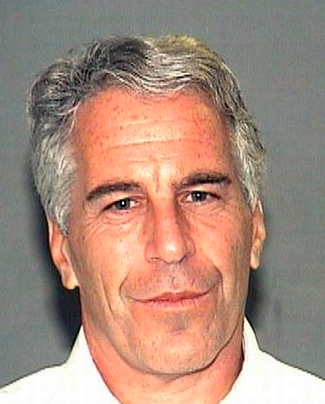
Epstein / Palm Beach County (Fla.) Sheriff’s Department
By DÁNICA COTO Associated Press
CHARLOTTE AMALIE, U.S. Virgin Islands — Ask about Jeffrey Epstein on St. Thomas and rooms go quiet. Some people leave. Those who share stories speak in barely audible tones.
The 66-year-old billionaire bought Little St. James Island off this U.S. Caribbean territory more than two decades ago and began to transform it — clearing the native vegetation, ringing the property with towering palm trees and planting two massive U.S. flags on either end. When guides took scuba divers to spots near the island, security guards would walk to the water’s edge.
It was off-putting to residents of St. Thomas — a lush tropical island east of Puerto Rico with winding roads through mountains dotted with dainty Danish colonial-era homes. Then, when Epstein pleaded guilty in a 2008 to soliciting and procuring a minor for prostitution, his need for privacy began to appear more sinister.
“Everybody called it ‘Pedophile Island,’ ” said Kevin Goodrich, who is from St. Thomas and operates boat charters. “It’s our dark corner.”
Many people who worked for Epstein told The Associated Press this week that they had signed long non-disclosure agreements, and refused to talk. One former employee who declined to be identified said Epstein once had five boats, including a large ferry in which he transported up to 200 workers from St. Thomas to his island every day for construction work.
The man said he saw a handful of young women when he was on Epstein’s property but he believed they were older than 18.
“When he was there, it was keep to yourself and do your thing,” the man recalled, adding that Epstein paid well and would give away older machinery and surplus including lumber to his employees.
Epstein built a stone mansion with cream-colored walls and a bright turquoise roof surrounded by several other structures including the maids’ quarters and a massive, square-shaped white building on one end of the island. Workers told each other it was a music room fitted with a grand piano and acoustic walls. Its gold dome flew off during the deadly 2017 hurricane season. Locals recalled seeing Epstein’s black helicopter flying back and forth from the tiny international airport in St. Thomas to his helipad on Little St. James Island, a roughly 75-acre retreat a little over a mile southeast of St. Thomas.
Government documents and ledgers show that Little St. James Island was once known as Mingo Cay. In April 1998, a company called L.S.J. LLC bought it for $7.95 million. Additional documents showed that Epstein is the sole member of L.S.J., with his signature reminiscent of an infinity loop.
Epstein later bought neighboring Great St. James Island, which once was popular with locals and tourists for its main attraction, Christmas Cove, a place where you could hang out and order pizza and have it delivered via boat.
“He wasn’t well received,” recalled Spencer Consolvo, a St. Thomas native who runs a tourist shop near a large marina. “People think he’s too rich to be policed properly.”
According to public records obtained by the AP, the island was once worth $3 million and owned by a woman who died in a chalet in Switzerland. The island had been divided into parcels and given to three people and was later sold to Epstein.
Federal authorities consider the smaller of the two islands to be Epstein’s primary residence in the United States, a place where at least one alleged victim said in a court affidavit that she participated in an orgy, as well as had sex with Epstein and other people. She said she saw former U.S. President Bill Clinton on the island, but that she never saw him having sex with anyone. A Clinton spokesman issued a statement saying he never visited there.
A day after he pleaded not guilty in a New York courtroom to charges of sexually abusing dozens of underage girls, there was scant movement on the Caribbean island. Hurricane shutters covered the windows, locals hadn’t seen any lights at night and a lone worker drove a bright blue golf cart around the property.
At a nearby office that locals say Epstein owns in a seaside strip mall, a man in a T-shirt and sunglasses on his head opened the door a crack, shook his head vehemently when asked about Epstein and locked the door. The firm, Southern Trust Company Inc., hired Cecile de Jongh, wife of former Gov. John de Jongh, as its office manager, according to records with the U.S. Virgin Islands Economic Development Authority.
Meanwhile, Epstein’s arrest also prompted the U.S. Virgin Islands representative in Congress, Stacey Plaskett, to announce she would give the money Epstein had donated to her campaigns to charitable groups.
Now that Epstein has been arrested a second time, locals say tourists are increasingly asking about his islands when they visit St. Thomas. A woman who did not want to be identified for fear of losing her job running a charter company said she was elated when Epstein got arrested but is now vexed at tourists’ curiosity, saying she reluctantly shares whispered details of his case to prying adults if children are around.
Some of that fascination aggravates Vernon Morgan, a taxi driver and St. Thomas native.
“It brought some kind of notoriety to the Virgin Islands,” he said. “We would much rather that the Virgin Islands be seen in a different light.”
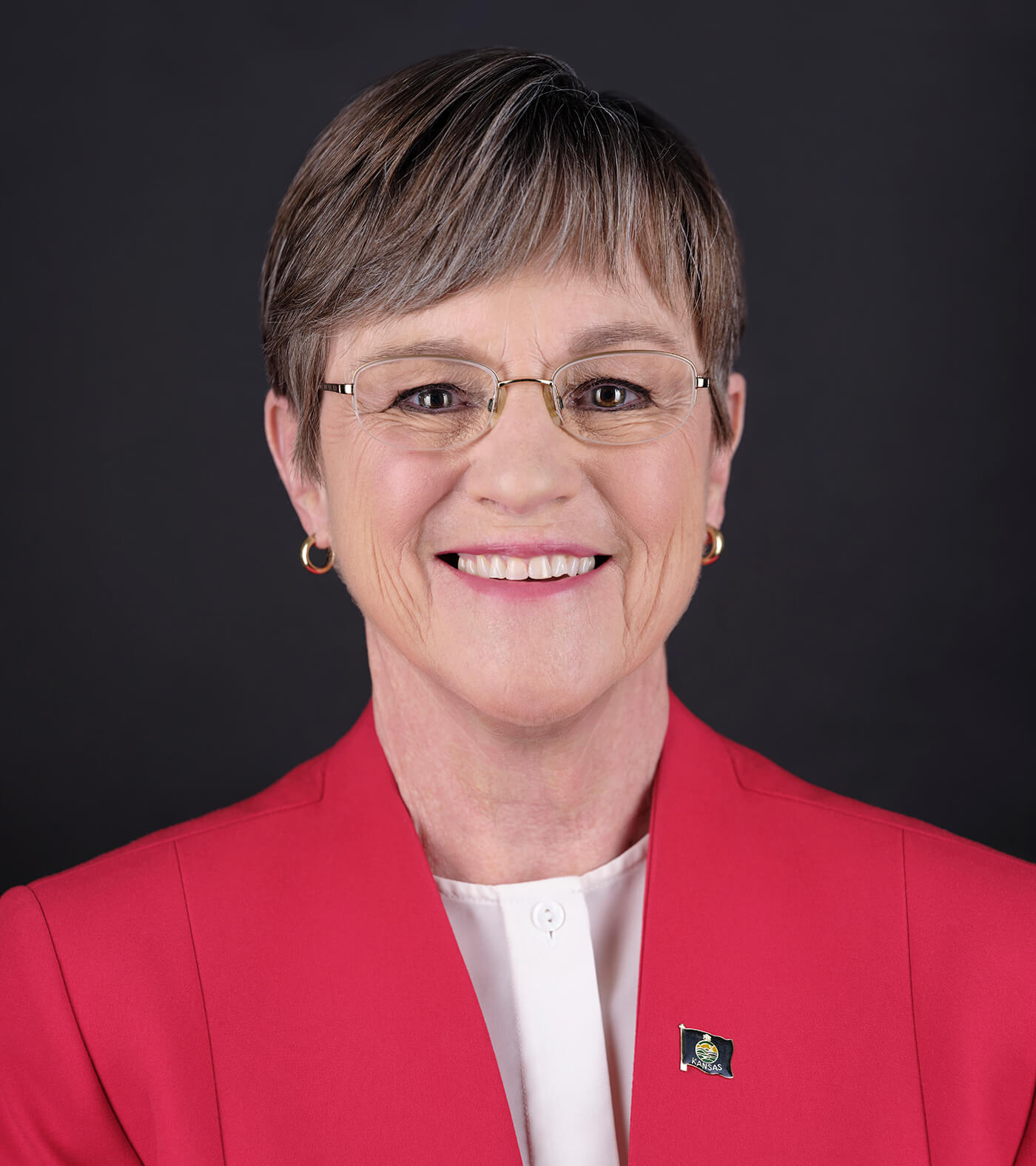
Laura Kelly (D), Kansas GovernorWICHITA (AP) — Kansas’s top prosecutor is threatening to go to court if Democratic Gov. Laura Kelly doesn’t drop a policy that allows some adults without children to receive welfare even if they don’t meet work requirements.
The Wichita Eagle reports that Republican Attorney General Derek Schmidt has given Kelly a deadline of Friday to act.
Kelly has stood by the policy and her office plans a news conference Thursday to address the issue. She has long been critical of the state’s restrictions on welfare, which lawmakers placed into law under former Republican Gov. Sam Brownback.
The policy at issue represents an attempt to minimize welfare restrictions through agency action after unsuccessful attempts by Democrats to make changes through the legislative process.
GREAT BEND — It comes down to two simple “yes” or “no” questions for the Great Bend school district. The outcome from a mail-in ballot will determine if USD 428 is able to move forward with renovations, enhancements, and additions to their facilities.
The first bond question worth $41,750,000 plans to make renovations to all seven of the school buildings, including a new sixth-grade classroom wing at Great Bend Middle School to make the shift of sixth graders to the middle school.
USD 428 Superintendent Khris Thexton says the district will be providing tours to anyone that wants to view the existing buildings and hear about the plans.
“We’re talking about virtual tours as well,” Thexton said. “If you want to see it in person or virtually, you have that option.”
The first bond would also demolish the 100-year-old portion of Washington and build new in its place. Plans are to build a new transportation, maintenance, and grounds building at the District Education Center site.
The second bond question of $3,120,000 wants to build a new gymnasium and locker rooms at the middle school to accommodate the addition of sixth grade.
“We want to get out the information as much as possible,” said Thexton. “We want to eliminate some of the misinformation that might be out there.”
All registered voters in the school boundary will be mailed a ballot on August 20 with September 5 as the deadline to return the ballot. The voter registration deadline is August 6.